3rd From Sol

~ Learn from before. Live now. Look ahead.

3rd From Sol

Tag Archives: apsidal precession

Are We Missing an Ice Age? (Part III of III)

21 Monday Nov 2011

Posted by Paul Kiser in History, Science

≈ 16 Comments

Tags

apsidal precession, axial precession, Earth Science, Earth's orbit, eccentricity, Global warming, Ice Age, insolation, Milankovitch Cycles, Milution Milankovic, obliquity, Warm Age

PART III – Should We Be In An Ice Age Now? 

IMAGE 1.0 - The Northern Hemisphere at the end of the last Ice Age (10,000 years ago)

RECAP: In Part I of this series, we looked at how scientists have determined that Earth has experienced regular cycles of cold climates followed by brief periods of warm climates during the last 400,000 years. We learned that the current cycle has been different because the warm period has persisted when past warm climates have rapidly dropped back into a cold climate. We also discussed how the Sun acts as a ‘battery charger’ for Earth’s climate.

Part II of the series explained that Earth’s orbital relationship with the Sun also follows a cyclic pattern and that almost 100 years ago, a Serbian named Milutin Milanković  proposed possible mechanisms related to Earth’s tilt and orbit that could be the root cause of the regular cycle of Ice Ages.

PART III – Should We Be In An Ice Age Now?

No one can say for certain whether or not that we should be in an Ice Age today. Past Warm Ages have typically collapsed back into a cooler period within a few thousand years followed by a complete return to an Ice Age within about 10,000 years. If Earth past climate history is correct then our planet should be in a cooling period, if not into a full-scale Ice Age. Instead, Earth is warming. The Milankovitch Cycles don’t all concur on this issue, but there is some intriguing evidence that suggests we have missed a cooling period based on Earth’s orbit and tilt. 

Consider the factors discussed in Part II of this series.

Orbit Eccentricity or Circular to Ellipse
Our orbit eccentricity is about one-third the way from our lowest level, meaning Earth’s orbit is becoming more circular. It’s cycle is about the same as Earth’s climate cycle, so it could be a significant factor. Interestingly, the eccentric peak of .02 during the current cycle was half to one-third of the peak past three cycles (.04 to .06.)¹ Could that be a factor in the prolonged warm period? Possibly, but why? Earth just passed the peak a few thousand years ago so, does a low peak eccentricity result in a prolonged Warm Age?

Paul Kiser

Obliquity or Earth’s Tilt On Its Axis
Earth is about halfway between our high and low peak tilt angles.  Our planet’s tilt, or obliquity is on an approximate 41,000 year cycle, so we were just passing through our highest peak obliquity at the start of this Warm Period. If high tilt angle is a trigger for a Warm Age, then we should be cooling down, unless obliquity must be coupled with another factor to trigger a cooling period.

Axial Precession or Earth’s Wobble
Earth’s axis wobbles and it takes 26, 000 years to complete one cycle. It is hard to see a connection with the slow regression of the seasons and Earth’s climate, but perhaps the cycle of axial precession couples with another factor to trigger a cooling period, or sustain a Warm Age.

IMAGE 1.1 - Apsidal Precession - The Creep of the Seasons in Earth's Orbit

Apsidal Precession or The Hulu Hoop Effect
Apsidal precession is factor has some interesting possibilities on how it might impact Earth’s climate. Currently the Summer in the northern hemisphere occurs when Earth is farthest from the Sun (aphelion.) Our closest approach to the Sun (perihelion) occurs during Summer in the southern hemisphere.

IMAGE 1.2 Land Masses in the Northern Hemisphere
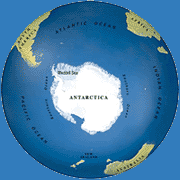
IMAGE 1.3 - Land Masses in the Southern Hemisphere

Earth’s northern hemisphere is about 40% land and 60% water. The southern hemisphere is about 20% land and 80% water. Land that is not covered with ice absorbs more energy than water because water reflects more of Sun’s energy back into space. In Part II we learned that the hemisphere that is in summer during perihelion receives 23% more solar radiation. Because of the greater land mass, the northern hemisphere will retain more of the summer Sun’s energy in 10,000 years (when perihelion occurs in July) than the southern hemisphere does currently.

From a standpoint of apsidal precession, Earth should be in the coldest period since we are closest to the Sun when the smallest percentage of our land mass will absorb the energy or insolation. 

Orbital Inclination
The tilt of Earth’s orbital plane off of the invariable plane is on a 100,000 year cycle, which coincides with Earth’s climate cycle. Since  higher angles of our orbital plane result in a higher obliquity and magnify the effect of land mass absorption differential between the two hemispheres, it could be a factor in triggering the Ice/Warm Age cycles; however, it is unclear how this factor could contribute to the prolonged warm period.

Are We Missing an Ice Age?
Earth’s climate cycle does not follow a perfect 100,000 year pattern. Most people would be happy if we never went into another Ice Age; however, if we have missed the trigger of the next Ice Age, what does that mean for our climate? Will Earth’s delicate climate balance be ruined leading into a runaway warm period or will the next Ice Age come in a rapid onset like in a disaster movie?

The Sun charges Earth’s climate ‘battery’ and variations in how much solar radiation our planet absorbs dramatically affects the environment for all life. It will be important for scientists to discover what is happening to our climate and why. Life on Earth exists in a narrow band that is not to cold and not to hot and we have no practical methods to reinforce or siphon off the Sun’s energy in a crisis.

While scientists to continue to examine this issue there are other issues that should be considered beyond climate. At least for the past 400,000 years, the Warm Ages have been relatively brief periods. It is during those brief periods of warmth that life has flourished, then the Earth has been cleansed with the next Ice Age. What will happen as insects, reptiles, and bacteria continue to  evolve and expand without an Ice Age to push back their spread across the globe? Is it possible that too much life will threaten human existence?

These are all questions that have to be answered as long as the Earth continues to avoid the next Ice Age.

PART I – Should We Be In An Ice Age Now?

PART II – Understanding the Milankovitch Cycles, Clues to Earth’s Climate Changes

NOTES AND REFERENCES

¹Wikipedia – The Free Encyclopedia. (2011). Milankovitch Cycles. Retrieved November 13, 2011, from http://en.wikipedia.org/wiki/Milankovitch_cycles.

IMAGE CREDITS

IMAGE  1.0 – Image thanks to http://www.space4case.com/mmw/pages/space4case/solar-system/earth/artic.php

IMAGE 1.1 – Image thanks to Wikimedia Commons at http://en.wikipedia.org/wiki/File:Precession_and_seasons.jpg

IMAGE 1.2 – Image thanks to http://www.learner.org/jnorth/tm/humm/WhyComeGlobalGame.html

IMAGE 1.3 – Image thanks to http://www.learner.org/jnorth/tm/humm/WhyComeGlobalGame.html

USA PDT [Twitter: ] [Facebook] [LinkedIn] [Skype: 775.624.5679]

Are We Missing an Ice Age? (PART II of III)

16 Wednesday Nov 2011

Posted by Paul Kiser in History, Science

≈ Leave a comment

Tags

aphelion, apsidal precession, axial precession, Earth's orbit, Earth's Wobble, eccentricity, Global warming, Ice Ages, invariable plane, Milankovitch Cycles, Milution Milankovic, obliquity, orbit, orbital inclination, orbital plane, perihelion, solar system, Tilt, Warm Ages

PART II – Understanding the Milankovitch Cycles, Clues to Earth’s Climate Changes 

RECAP: In Part I of this series, we looked at how scientists have determined that Earth has experienced regular cycles of cold climates followed by brief periods of warm climates during the last 400,000 years. We learned that the current cycle has been different because the warm period has persisted when past warm climates have rapidly dropped back into a cold climate. We also discussed how the Sun acts as a ‘battery charger’ for Earth’s climate.

Milutin Milanković  proposed possible mechanisms related to Earth’s tilt and orbit that could be the root cause of the regular cycle of Ice Ages. His theory, outlined in several papers from 1912 to 1920, is now referred to as the Milankovitch Cycles¹. This theory outlines four factors that change the amount of solar radiation received by the Sun, which could explain why Earth experiences dramatic changes in its climate over a 100,000 year cycle. In addition, there is a fifth factor that has been added to the Milankovitch Cycle theory, which also follows a 100,000 year cycle and may also be contributing triggering our Ice/Warm Age cycles.

FACTOR ONE
Eccentricity or Earth’s Orbit – From a Circle to Oval and Back

IMAGE 1.0 -Earth's Orbit: High Eccentricity vs. Low Eccentricity

Earth’s orbit changes from a nearly perfect circle, to an oval (technically, an ellipse) over a period of thousands of years. The cause of this elongation or eccentricity of our orbit is due to the gravity influences of Jupiter and Saturn, which are much farther away from the Earth than the Sun, but exert enough pull to periodically stretch our orbit out of its circular shape.

In an orbit that is a perfect circle the amount of energy the Earth receives is relatively constant throughout the year, assuming the Sun is generating a constant amount of energy (which it doesn’t.) However, when Earth’s orbit is an ellipse (or more eccentric) the Earth receives more energy when it is closer to the Sun than when it is farther away.

Paul Kiser

Earth’s orbit eccentricity varies from .005 (low) to .058 (high) and the cycle of low to high eccentricity is roughly 100,000 years. Our orbit had major peak eccentricities of .04 to .06 at approximately 120, 220, 320 thousand years ago. These peaks fall about 10,000 to 20,000 years before the start of the last three Warm Ages.

Currently the eccentricity of our orbit is .017 and it is falling from a minor peak of about .02. That means that Earth’s orbit is about one-third the way from our lowest eccentricity and becoming more circular. The eccentricity of Earth’s current orbit creates about a three million mile difference between its closest and farthest approach to the Sun. Earth at perihelion (closest to the Sun) is 91.4 million miles away from the Sun. At aphelion the Earth is 94.5 million miles away.

FACTOR TWO
Obliquity or the Severity of Earth’s Tilt

Currently the Earth is tilted at 23.44 degrees from the Sun’s orbital plane, but that is not constant. The Earth’s tilt or obliquity is decreasing from the high obliquity (tilt angle) of 24.4° towards the low of 22.1º. It will take Earth about 10,000 years to reach the low point in a 41,000 year cycle.

For comparison, Mars’ current obliquity is 25.19° and varies from 10° to 40° over hundreds of thousands of years. Venus’ obliquity is 177.4°, which means that the planet is so tilted that its ‘north’ is facing south. That may seem strange to have an obliquity greater than 90°; however, since Venus’ rotation is retrograde (Venus turns in the opposite direction of Earth) scientists consider its ‘up’ side to have been literally turned upside down.

IMAGE 1.1 - Tilt or Obliquity of the '8' Planets and Pluto

Higher obliquity is believed to result in the Earth absorbing more solar radiation (insolation) because the higher latitudes receive more sunshine in the summer. Earth’s current Warm Age began at about the same time as our peak obliquity, so there is evidence that this theory is valid.

FACTOR THREE
Axial Precession or Earth’s Wobble

Image 1.2 - Earth's Wobble is called Axial Precession

Currently the north pole, or axis, points towards the star called Polaris. That is temporary because the Earth wobbles. This wobble is called the Axial Precession. Over time our north axis will no longer be aimed at Polaris, but instead will leave us without a ‘North Star’ until Earth’s north axis points to Vega, Deneb, or another bright star or galaxy.

It takes about 26,000 years for the wobble to complete one full cycle and during that cycle the Earth’s wobble will cause a slow change in the seasons. This is because the axis wobble alters the direction of our tilt during every orbit of the Sun. When the Earth returns to the same relative position in its orbit, the axis will point to a slightly different place than it did the prior year. The axis will have reached that point earlier, so our seasons slowly move backward.

FACTOR FOUR
Apsidal Precession or The Hula Hoop Effect

IMAGE 1.3 - This graphic shows Apsidal Precession (Click to Activate)

One of the more interesting factors is Apsidal Precession. If you think of Earth’s orbit as a hula hoop and your waist as the Sun (no, it’s not that big,) as the hula hoop goes around, the ‘orbit’ shifts. Any particular point on the hula hoop will move from being closest to your waist and then it will shift to be the farthest away from you waist. Our seasons do the same thing as Earth’s orbit slowly shifts or precesses.

Currently, summer in the northern hemisphere occurs when the Earth is the farthest away (aphelion) and in winter we are closest to the Sun (perihelion.) In the southern hemisphere it is exactly opposite. During the summer in the southern hemisphere (Earth at perihelion) it receives 23% more solar radiation than the northern hemisphere does during its summer, which occurs at the aphelion. It takes about 21,000 years for the Apsidal Precession to cause the seasons to make a full cycle, so in about 10,000 years, the northern hemisphere will experience summer at perihelion. 

FACTOR FIVE
Orbital Inclination or Our Orbits Tilt From the Orbital Plane

IMAGE 1.4 - Earth's Orbital Plane from the Solar Systems Invariable Plane

By averaging the orbits of the eight planets scientists have created one plane that is considered the invariable plane. Jupiter is almost on this invariable plane; however, Earth and the other six planet’s orbital planes are tilted or inclined from the invariable plane.

Not only is Earth’s orbital inclination 1.57° off the invariable plane, the amount of tilt changes on a cycle that repeats every 100,000 years. Earth’s variance during that cycle can be as much as 3° off the invariable plane, which is additive to Earth’s obliquity or tilt on its axis. That means that increased orbital inclination magnifies the effect of Earth’s obliquity.

This factor was not part of Milankovic’s original theory; however, scientists have added it to the Milankovitch Cycle because it impacts the amount of insolation the Earth receives and because it follows the 100,000 year cycle.

In Part II, we have discussed five cyclical factors that change the amount of insolation the Earth receives and where Earth is in all five cycles. In Part III we look at how Earth’s climate seems to be on a hair-trigger and why we should or should not be in an Ice Age now.

PART I – Are We Missing An Ice Age?

PART III – Should We Be In An Ice Age Now?

USA PDT [Twitter: ] [Facebook] [LinkedIn] [Skype: 775.624.5679]


NOTES AND REFERENCES

¹Wikipedia – The Free Encyclopedia. (2011). Milankovitch Cycles. Retrieved November 13, 2011, from http://en.wikipedia.org/wiki/Milankovitch_cycles.

IMAGE CREDITS

IMAGE 1.0 – Image thanks to http://apollo.lsc.vsc.edu/classes/met130/notes/chapter16/mil_cycles.html

IMAGE 1.1 – Image Copyright 1999 by Calvin J. Hamilton. Found at http://www.solarviews.com/cap/misc/obliquity.htm 

IMAGE 1.2 – Image thanks to http://tomsastroblog.com/archives/8047

IMAGE 1.3 – Graphic thanks to Wikimedia Commons at http://en.wikipedia.org/wiki/File:Precessing_Kepler_orbit_280frames_e0.6_smaller.gif

Support Wikipedia

Other Pages of This Blog

  • About Paul Kiser
  • Common Core: Are You a Good Switch or a Bad Switch?
  • Familius Interruptus: Lessons of a DNA Shocker
  • Moffat County, Colorado: The Story of Two Families
  • Rules on Comments
  • Six Things The United States Must Do
  • Why We Are Here: A 65-Year Historical Perspective of the United States

Paul’s Recent Blogs

  • Dysfunctional Social Identity & Its Impact on Society
  • Road Less Traveled: How Craig, CO Was Orphaned
  • GOP Political Syndicate Seizes CO School District
  • DNA Shock +5 Years: What I Know & Lessons Learned
  • Solstices and Sunshine In North America
  • Blindsided: End of U.S. Solar Observation Capabilities?
  • Inspiration4: A Waste of Space Exploration

Paul Kiser’s Tweets

Tweets by PaulKiser

What’s Up

February 2026
S M T W T F S
1234567
891011121314
15161718192021
22232425262728
« Jun    

Follow Blog via Email

Enter your email address to follow this blog and receive notifications of new posts by email.

Join 688 other subscribers

Create a website or blog at WordPress.com


Loading Comments...