3rd From Sol

~ Learn from before. Live now. Look ahead.

3rd From Sol

Tag Archives: orbit

Is Jupiter the Cause of the Solar Sunspot Cycle?

26 Tuesday Feb 2019

Posted by Paul Kiser in 1968, Astronomy, Eclipse, NASA, Science, solar, Space

≈ 1 Comment

Tags

astronomy, electromagnetic radiation, gravity, Jupiter, Jupiter Solar Cycle Precession, orbit, Solar Cycle, solar maximum, Solar Minimum

A Strange Coincidence

About every eleven years the Sun completes a sunspot cycle. Every 11.9 years Jupiter completes its orbit of the Sun. Coincidence? Maybe, but there is compelling evidence to suggest that Jupiter and the sunspot cycle are linked.

Image 1.0  Sunspots at the beginning of the 2017 Total Solar Eclipse

The Solar Sunspot Cycle

The solar maximum (the period when the Sun has the maximum sunspot count) of last six cycles occurred in 2012, 2001, 1990, 1979, 1968, and 1957. In each case, the solar maximum extended over many months, but by selecting a common date within the period, (e.g.; June 1st,) the eleven year period becomes apparent (SEE Graphic 1.0)

Graphic 1.0 The Eleven-Year Solar Cycle using a Common Date (June 1st)

It is important to note that the eleven-year cycle applies to the maximum sunspot activity. Solar minimums tend to vary significantly from cycle to cycle; however, solar maximum activity is usually reliable within plus or minus six months.

Jupiter’s Solar Cycle Precession

The question is, where is Jupiter in relation to the Sun during the solar maximums? The answer is simple. For the last six solar maximum cycles, Jupiter has been approximately twenty-five degrees (25°) further back in its orbit than the previous solar maximum. 

Graphic 2.0 The position of Jupiter in its Orbit for the Recent Solar Maximum Cycles and the upcoming cycle (Planets reflect orbital positions for 25 FEB 2019)

The idea of a connection between Jupiter’s orbit and the solar cycle has been traditionally scoffed at by astrophysicists; however, as more is understood about the dynamics of the Sun’s influence beyond the visible solar atmosphere, scientists are less eager to ignore the possibility. A 2016 German study suggests Jupiter, Venus, and Earth may all play a role in sunspot activity.

If there is a connection between the position of Jupiter and the solar maximum, it raises the question of why? Is it a gravitational link, or is it an electromagnetic link? Why does the solar maximum occur when Jupiter is approximately 25° further behind its position of the last solar maximum? Answers to these questions will certainly lead to more questions.

The answers may come soon. In the meantime, Jupiter is raising some interesting questions. 

Falling Sky: China’s Tiangong 1 Space Station Last Hours

28 Wednesday Mar 2018

Posted by Paul Kiser in About Reno, All Rights Reserved, Astronomy, China, Exploration, NASA, Reno, Science, Space, Technology

≈ Leave a comment

Tags

atmosphere, China, Chinese Space Agency, deorbit, ISS, orbit, Skylab, Space Station, Tiangong 1

Within the next 72 hours China’s first space station, the Tiangong 1, is going to end its life. It is already scraping the extreme upper atmosphere of Earth and the air resistance is slowing down the 7.7 metric tons (8.5 ton) spacecraft with every passing second. It is coming down somewhere, but scientists don’t know exactly when or where.

Tiangong altitude

The rapid altitude decline (in km) of Tiangong 1

Current Stats of Tiangong 1

The current speed of the Tiangong 1 (27 March 2018 at 12 noon PDT) is at 28,000 km/hr (17,400 mph) and it is at an altitude of just under 200 km (125 mi) at the lowest point in its orbit. Its orbit has lowered by over 60 km in the last two months. As Tiangong 1 approaches 160 km the air resistance will be too much for it to maintain orbit.

Statistically, Tiangong 1 will most likely fall into an ocean; however, there is a possibility that it could fall on southern Europe, southern Asia, Africa, Austrailia, South America, Central America, or the United States.

Lost Contact

Normally, objects like this are brought down in a controlled fall using thrusters to slow the craft down at a specific time and location. In the case of Tiangong 1, the Chinese engineers had planned to bring it down in a controlled reentry until they mysteriously lost contact with it two years ago.

China said they had shut down telemetry with Tiangong 1 in March of 2016. They didn’t admit they had lost control of it until amateur astronomers had confirmed the space station was tumbling in space a few months later. Without the ability to communicate with the space station, there is no way to command the thrusters for a controlled reentry.

Best Guess?

The experts are currently estimating that Tiangong 1 will come down on Easter Sunday (1 April.) Since Earth’s atmosphere expands and contracts with solar activity, the air resistance is not consistent. There is a critical point when the air resistance will win its battle with the space station and the orbit will decay exponentially. At that point, the spacecraft will begin a rapid breakup as it descends through the thicker atmosphere.

For what it’s worth, my guess is 7:42 am PDT on Saturday, 31 March.

Why Are There 360 Degrees in a Circle?

19 Monday Mar 2018

Posted by Paul Kiser in All Rights Reserved, Astronomy, Eclipse, History, Photography, Science, solar, Space

≈ Leave a comment

Tags

360°, astronomy, Base 60 Babylonians, circles, degrees, Greeks, math, mathematicians, metric, orbit, year

Everyone knows there are 360 degrees in a circle. Why? A circle could have a 1,000° which would make a half circle equal 500° and a quarter circle 250°. Who chose the number 360? Was there a vote? Who do we blame? Inquiring minds want to know!

Two circles getting in each other's way

2017 Total Solar Eclipse from Canyon City, OR

As it turns out there are at least two reasons we use 360° as the number to define a complete circle. One reason has to do with astronomy and the other with mathematics.

360 Degrees? Blame the Babylonians

The Greeks are partly responsible for defining the numerical value for a circle, but really it was the Babylonians. It may even be farther back than the Babylonians, but someone erased their hard drive and now we will never know.

Apparently, the Babylonians loved the number ’60.’ They created a number system using Base 60 (we use Base 10.) The number 60 is amazing because it can be divided into so many factors. 60 can be divided evenly by 1, 2, 3, 4, 5, 6, 10, 12, 15, 20, 30, and 60. Since the Babylonians loved 60, the fact that a circle can be divided into six equilateral triangles made 360 the best option for defining the numerical value of a circle.

We don’t actually know if it was the Babylonians, but we do know that several prominent Greek mathematicians used 360° as the numerical value for a circle. It is written…in Greek of course.

Star Gazers In a 360 Days

But long before the Babylonians, it was obvious to anyone who looked up at the sky at night that the stars followed a circular pattern through the year. If one noted the position of a star or constellation on a particular night and time, next year that star would be in the same place on the same day and time.

The elapsed number of nights for a full circle? About 360. Anyone who tracked the stars would have noted that the circular pattern of the stars resumed after about 360 days.

The reason we have 360° is most likely because of the speed at which the Earth rotates, (once every 24 hours,) and there are approximately 360 rotations (days) in a year.

Metric Circles?

Believe it or not, there were attempts to make circles metric. It didn’t take. There are some uses for it, but the 360° value is more accepted ‘around’ (that’s a joke) the world.

Is There a Planet Nine or Not?

03 Saturday Mar 2018

Posted by Paul Kiser in Astronomy, Exploration, NASA, Science, solar, Space, Technology, US Space Program

≈ 1 Comment

Tags

ecliptic, ninth planet, orbit, Planet Nine, solar plane, solar system, Sun, trans-Neptunian objects

Is there a Planet Nine in our solar system? After Pluto got kicked out of the planet club most of us woke up to the reality that there were only eight planets. There was no reason to believe that some mysterious Planet Nine out there that met the requirements of the club. We would have seen by now, correct?

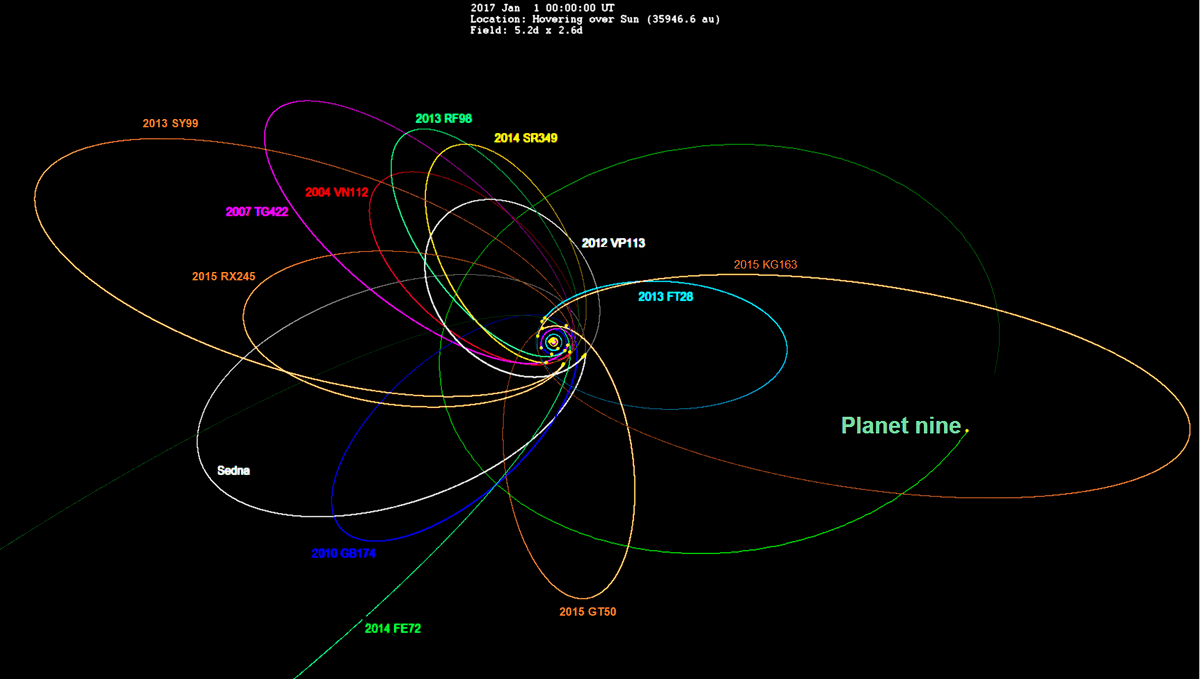
Planet Nine and other orbits looking from above the solar ecliptic

Nothing New In Planet Discovery

All the planets except Uranus and Neptune were discovered by Babylonian astronomers, although the six innermost planets were most likely noted by humans before writing was invented. Uranus was discovered in 1781, and Neptune was found in 1846. Despite all the advances in telescopes and space exploration no other ‘planet’ has been discovered in our solar system. So, why would anyone think another planet might exist?

Odd Ducks Out There

If the Sun and the planets were formed from a disk of debris, then most objects would be aligned in that disk or solar ecliptic plane, or the plane that the major planets are on as they orbit the Sun. Collisions between asteroids can send them off in unusual orbits that don’t align with the solar ecliptic.

However, there are a group of objects beyond Neptune that have unusual orbits. These objects are called trans-Neptunian objects. These are on a different plane and defy easy explanation. In addition, the Sun itself is a bit odd in its rotation. The Sun seems to rotate slightly off the ecliptic plane that all the planets follow.

Doing the Math

Two astronomers, Chad Trujillo and Scott S. Sheppard, tackled the odd orbits of the trans-Neptunian objects and discovered that some of the orbits of the objects could be explained if there were a large planet farther out in the solar system. That didn’t sit well with other astronomers so they decided to prove them wrong.

Planet Nine’s likely orbit and the orbits of trans-Neptunian objects

Konstantin Batygin and Michael E. Brown from CalTech decided to re-do the calculations of Trujillo and Shepard. They eliminated some of the objects studied because they might be influenced by Neptune’s gravity. That left six objects to study. To their surprise, they discovered that a planet ten times the size of Earth in an off-plane orbit much farther out than Neptune explained the orbits of the six objects to a 99% degree of certainty.

Is There a Ninth Planet?

Despite the mathematical support, there is no Planet Nine…yet. An analogy would be that if someone picked a date ten years in the future, say 3 March 2028, and was asked if that day would fall on a weekday. Without a calendar to look at it would be hard to say ‘yes’ or ‘no.’ It is very likely, but it is not certain until there is proof.

We currently have no proof of another planet, and spotting Planet Nine will be difficult at best. It would be a relatively small target with almost no sunlight reflecting off of it. It couldn’t be seen with today’s telescopes in either the visible or infrared spectrums. Even if we could determine where it is in its orbit, it would take a probe as many as twenty years to get into the Planet Nine neighborhood.

So the answer remains ‘no.’ There is no Planet Nine…but stay tuned.

SpaceX Falcon Heavy Defies the Odds

07 Wednesday Feb 2018

Posted by Paul Kiser in Falcon Heavy, History, NASA, Pride, Public Image, Public Relations, Science, Space, SpaceX, Technology, United States, US Space Program

≈ Leave a comment

Tags

asteroid belt, booster, Elon Musk, Falcon Heavy, landing, launch, Mars, orbit, relanding, SpaceX, Tesla, Tesla Roadster, test

I’m not a fan of SpaceX, nor of Elon Musk, but one can only observe yesterday’s Falcon Heavy launch with awe. It was brilliant. One thing that Elon Musk and I agreed on was that the chance it was not going to end in a massive fireball was slim. It is hard to convey how unlikely a successful launch was considering all the factors involved. The people working at SpaceX did at least one trillion things right to achieve the results of yesterday’s launch.

Taken from live feed of Tesla Roadster in orbit

Starman takes a test drive

SpaceX and Musk Had a Great Day

A sample of what went right:

  • Other than weather, the launch had no delays. That is unusual with a prototype rocket test.
  • An engine ignited and worked as intended. Multiply that by 27.
  • A side booster that was essentially a rocket in itself, did exactly what it suppose to do without any new issues common in a prototype test. Multiply that by 2.
  • The core booster functioned as intended and delivered the second stage and the payload, a Tesla car, into position for a boost into orbit.
  • A side booster completed a complex task of a powered relanding withing a few meters of the target zone. Multiply that by two.
  • A side booster was reused from a previous mission. Multiply that by 2.
  • The second stage booster fired its engines, times three, sending the payload into a heliocentric orbit that will extend beyond Mars, and near the Asteroid Belt.
  • A team of thousands of people performed their functions in synch allowing the payload to achieve orbit.

Hold My Beer and Watch This

The only small item that did not go as planned was the failed landing of the core booster on the Drone ship. The engineers have determined that only one of the needed three engines for landing had reignited. Until they can analyze the issue, I’m going with the explanation that the core booster was so excited about the success of the launch that it thought it would go for the biggest splash. It was successful.

Regardless, it was a minor misstep in a successful mission-impossible-type achievement.

Bye Bye Starman

Late on Tuesday the second stage of the Falcon Heavy successfully ignited for a third and final time sending ‘Starman’ (the alternate human in the spacesuit) and the Telsa Roadster into a heliocentric orbit that will take it to Mars and beyond. His orbit may last for over a million years, but the car won’t. All the exposed, non-metalic parts of the car will be no match for the radiation, heat, and cold of space. The paint job will suffer as well.

Starman’s out-for-a-drive orbit

Still, the pièce de résistance was the video of Starman in orbit above Earth. I’ll leave you with these images I captured from the live feed. Below that you can watch the video of the launch. Well done, SpaceX.

Starman 1 (2)
Starman 4 (2)
Starman 5 (2)
Starman 7 (2)

[COUNT TO 500:  496th Article in PAULx]

NASA’s Orion Capsule: A ‘Look Busy’ Project?

19 Friday Jan 2018

Posted by Paul Kiser in 1968, Ethics, Government, History, Honor, Management Practices, NASA, Politics, Pride, Public Image, Public Relations, Science, Space, Technology, US History

≈ Leave a comment

Tags

Airbus, Amber Gell, Amy Shira Teitel, Apollo, cosmic radiation, Curious Droid, Earth, engineer, Gemini, Kelly Smith, Lara Kearney, LEM, Lockheed Martin, lunar module, manned space program, manned spacecraft, Mars, Mercury, Moon, NASA, orbit, Orion, Paul Shillito, Space Shuttle, spacecraft, STS-135, Van Allen Belts, Vintage Space

NASA has a publicity campaign for the next generation of spacecraft. It is the Orion capsule, and it is touted as the spaceship that will take us back to the Moon and beyond. The problem is that all the talk doesn’t match reality.

8 July 2011, STS-135 – The final launch of a USA spacecraft

On 8 July 2011, I stood several miles away from Kennedy Space Center and watched the end of the United States manned spacecraft program. I stood in the warm sunshine of Florida as the last Space Shuttle (STS-135) soared into the sky. Since then NASA has put our astronauts in space by paying Russia to take them to and from the International Space Station (ISS.) 

A few months before that last Space Shuttle flight NASA announced the development of a new spacecraft called Orion. The announcement came so abruptly that it seemed that NASA was unaware it wouldn’t have a spacecraft to send humans into space until just before the end of the Space Shuttle program.

Orion – A Spacecraft of Contradictions

The Orion program, for all its hype, seems to have major flaws that NASA doesn’t seem to notice, or perhaps, hopes the public won’t notice. NASA’s description of the purpose of Orion:

For the first time in a generation, NASA is building a human spacecraft for deep-space missions that will usher in a new era of space exploration…and this new spacecraft will take us farther than we’ve gone before, including to the vicinity of the Moon and Mars…the Orion spacecraft is designed to meet the evolving needs of our nation’s deep space exploration program for decades to come. Orion deep space exploration missions…will help put NASA and America in a position to unlock the mysteries of space and to ensure this nation’s world preeminence in exploring the cosmos.

Orion a USA Spacecraft????

Lockheed Martin Corporation is designing and building the capsule of Orion. Like the Apollo capsule, Orion can only be separated from the Service Module for a short period of time.

The Service Module is the business section of Orion. It supplies all the power, fuel, oxygen, and is the primary propulsion of the spacecraft. Anyone familiar with Apollo 13 knows what happens to the capsule when the Service Module is non-functioning. The Service Module is being built by Airbus, a French corporation, for the European Space Agency.

Orion Capsule: A Human Storage Shed in Space

In Space, Size Matters

The Apollo capsule had a volume of 5.9 m³ (210 ft³.) Apollo astronauts were able to use the 6.7 m³ (235 ft³) space in the Lunar Module (LEM) during the three day trip between Earth and Moon. The total volume of the Apollo capsule and LEM was 12.6 m³ (445 ft³) for three astronauts. On the return, the Apollo astronauts were restricted to the capsule. Each astronaut had about 2 m³ in the capsule or 4 m³ in the capsule/LEM configuration.

Orion has 8.95 m3 (316 cu ft) of habitable space for four astronauts. This is slightly more cubic meters per astronaut than the Apollo capsule and much less than Apollo’s capsule/LEM configuration. The idea that Orion is capable of taking four astronauts on an eight-month journey to Mars is absurd. Orion is only for use in short-term, near-Earth missions.

NASA has briefly acknowledged the space issue in a video. Amber Gell of Lockheed Martin briefly touches on the need for an add-on crew habitat. She implies that it is an issue that NASA has yet to address. If it takes NASA twelve years to design and build a slightly bigger version of the 1960’s Apollo spacecraft, how long will it take them to build a crew quarters that four people can live in for up to three years?

NASA’s Misleading Video about Orion

NASA has been pumping out videos of engineers explaining how Orion is the next great achievement of the space agency. The videos cover a variety of subjects and some are pre-test and post-test news releases of Orion’s systems and structure. One video features Kelly Smith, a NASA Engineer, who explains how Orion is being designed to deal with the radiation from the Van Allen Belts around Earth.

The 2014 NASA video, titled, “Orion: Trial By Fire,” describes the challenges of the first test flight, including a dramatic description of the dangers of flying through the radiation of the Van Allen Belts above Earth. He explains that Orion will be designed to protect the astronauts as they fly through these dangerous regions.

The problem is that NASA already solved that problem with Apollo. They either fly around the Van Allen Belts, or through the thinner sections, as described by a video by Amy Shira Teitel of Vintage Space, and a video by Paul Shillito of Curious Droid.

There is a radiation issue in space, namely cosmic radiation, and it is a problem on long trips beyond Earth orbit; however, as Lara Kearney of NASA’s Orion Crew and Service Module’s Office explains in another NASA video, that they don’t have the answer to the cosmic radiation problem. This video contradicts the enthusiastic Smith video and raises the question:  Does NASA know what they are doing?

Orion:  The NASA Glacial-Paced Project

In May 1961, President John F. Kennedy asked Congress to fund a space program to take to the Moon and safely back. From the time of his speech in 1961 to the end of 1972, NASA launched the five of the six manned Mercury missions, designed, tested, built, and launched 10 Gemini manned missions, designed, tested, built, and launched 11 Apollo manned missions, landed men on the Moon, and overcame a disaster that delayed the manned launches for 21 months. Eleven years, three complete rocket programs, 27 manned missions, six successful Moon landings, no prior experience.

Orion, a slightly larger version of the Apollo capsule, only useful for short-term habitation in near-Earth orbit, is taking twelve years. Something is amiss.

NASA’s ‘Look Busy’ Project?

NASA definitely needs more funding, but something else is wrong. NASA’s Orion project doesn’t make any sense unless they are attempting to create the appearance that they are moving forward with a manned space program. The Orion project is, at best, an Earth to orbit elevator. It can’t meet any of the stated manned spaceflight goals of NASA. The question is, why isn’t NASA aware of these issues, and if they are aware, what is the agenda that is causing them to promote a project that is meaningless to the stated goals of deep space flight?

A New Year’s Earthquake?

21 Thursday Dec 2017

Posted by Paul Kiser in About Reno, Education, Science, solar, Space

≈ Leave a comment

Tags

astronomy, crustal plates, Earth Science, earthquakes, geology, Holiday earthquake 2018, orbit, perigee, perihelion, plate tectonics, USGS


Earth Science is one of my life’s passions. It was my first choice of study in college, but I gave up it when I discovered that calculus was required for any science degree.

However, I am a creature that is more fascinated by the world around me, than the details of societal norms. I don’t have a degree in science, but I do a lot of research on what real scientists have learned. That is why I’m interested in the orbits of the Sun and the Moon and the potential of an increase in earthquake activity starting near Christmas and continuing through the first week in January.

The gravitational pull of the Sun and Moon do not cause earthquakes. Earthquakes are caused by the movement of crustal plates at and near the surface of our planet. Anyone who claims that the Sun and Moon cause earthquakes is dancing on fringe science.

However, as the plates grind against each other they create stress and at times lock up. It is when a region of locked plates break free that an earthquake occurs. The bigger the movement after the release, the bigger the earthquake.

The gravitational pull of the Sun and Moon affects the Earth. This pull may have trigger effect on some earthquakes under certain conditions. It would be a situation where a region is near the release point, and the tug of the Sun and/or Moon gives the needed boost to start the movement of the stressed area.

Currently, the Earth is approaching its annual perihelion (closest approach) to the Sun. Perihelion will officially occur at 9:34 pm PST on 2 January 2018. At the same time the Moon is approaching its closest approach to Earth (perigee) for all of 2018 at 1:48 pm on 1 January.

The Sun and the Moon will be on opposite sides of the Earth around New Year’s Day, so the gravitational pull will be most intense at that time, potentially stretching areas of the Earth’s crust that are ready to break free. Will this cause and increase in earthquakes? I can’t answer that. No one can. But it will be interesting to track.

As always, preparation for an earthquake in those areas prone to have earthquakes, and in coastal areas is always wise, regardless of the orbits of the Sun and the Moon.

Happy Winter Solstice!

Living in the Imminent

27 Tuesday Oct 2015

Posted by Paul Kiser in Government, Honor, Passionate People, Pride, Random, Science, Space, Technology, Travel

≈ Leave a comment

Tags

astronauts, cosmonauts, death, ESA, International Space Station, ISS, Japan, NASA, orbit, Russia, scientists, Space, USA

international-space-station-completeSix people near death 

Don’t they know?

They show no fear

They have to know.

They live surrounded by a monster that kills without effort

Yes, in this millisecond they live in peace

In the next they could die in horror

We have no reason to fear walking outside

But these six

They should have reason

Death awaits outside with the tools of the universe

Radiation, heat, cold, or even nothing can kill

These six live where no one should

Yet, these six rob Death

These six live flawlessly where perfection matters

These six know Death and know his tools

Yes, these six know and know the risk

Just before sunrise or just after sunset

We watch them go by

We walk outside and watch them go by

For them, sunrise comes, sunset goes many times a day

But rarely do they go outside to watch

They know what is waiting outside

They know the risk

And three by three they will come and go

Three to rob death, three to come home

Three to look up to, and three to celebrate

Six people near death

But alive and well

Are We Missing an Ice Age? (PART II of III)

16 Wednesday Nov 2011

Posted by Paul Kiser in History, Science

≈ Leave a comment

Tags

aphelion, apsidal precession, axial precession, Earth's orbit, Earth's Wobble, eccentricity, Global warming, Ice Ages, invariable plane, Milankovitch Cycles, Milution Milankovic, obliquity, orbit, orbital inclination, orbital plane, perihelion, solar system, Tilt, Warm Ages

PART II – Understanding the Milankovitch Cycles, Clues to Earth’s Climate Changes 

RECAP: In Part I of this series, we looked at how scientists have determined that Earth has experienced regular cycles of cold climates followed by brief periods of warm climates during the last 400,000 years. We learned that the current cycle has been different because the warm period has persisted when past warm climates have rapidly dropped back into a cold climate. We also discussed how the Sun acts as a ‘battery charger’ for Earth’s climate.

Milutin Milanković  proposed possible mechanisms related to Earth’s tilt and orbit that could be the root cause of the regular cycle of Ice Ages. His theory, outlined in several papers from 1912 to 1920, is now referred to as the Milankovitch Cycles¹. This theory outlines four factors that change the amount of solar radiation received by the Sun, which could explain why Earth experiences dramatic changes in its climate over a 100,000 year cycle. In addition, there is a fifth factor that has been added to the Milankovitch Cycle theory, which also follows a 100,000 year cycle and may also be contributing triggering our Ice/Warm Age cycles.

FACTOR ONE
Eccentricity or Earth’s Orbit – From a Circle to Oval and Back

IMAGE 1.0 -Earth's Orbit: High Eccentricity vs. Low Eccentricity

Earth’s orbit changes from a nearly perfect circle, to an oval (technically, an ellipse) over a period of thousands of years. The cause of this elongation or eccentricity of our orbit is due to the gravity influences of Jupiter and Saturn, which are much farther away from the Earth than the Sun, but exert enough pull to periodically stretch our orbit out of its circular shape.

In an orbit that is a perfect circle the amount of energy the Earth receives is relatively constant throughout the year, assuming the Sun is generating a constant amount of energy (which it doesn’t.) However, when Earth’s orbit is an ellipse (or more eccentric) the Earth receives more energy when it is closer to the Sun than when it is farther away.

Paul Kiser

Earth’s orbit eccentricity varies from .005 (low) to .058 (high) and the cycle of low to high eccentricity is roughly 100,000 years. Our orbit had major peak eccentricities of .04 to .06 at approximately 120, 220, 320 thousand years ago. These peaks fall about 10,000 to 20,000 years before the start of the last three Warm Ages.

Currently the eccentricity of our orbit is .017 and it is falling from a minor peak of about .02. That means that Earth’s orbit is about one-third the way from our lowest eccentricity and becoming more circular. The eccentricity of Earth’s current orbit creates about a three million mile difference between its closest and farthest approach to the Sun. Earth at perihelion (closest to the Sun) is 91.4 million miles away from the Sun. At aphelion the Earth is 94.5 million miles away.

FACTOR TWO
Obliquity or the Severity of Earth’s Tilt

Currently the Earth is tilted at 23.44 degrees from the Sun’s orbital plane, but that is not constant. The Earth’s tilt or obliquity is decreasing from the high obliquity (tilt angle) of 24.4° towards the low of 22.1º. It will take Earth about 10,000 years to reach the low point in a 41,000 year cycle.

For comparison, Mars’ current obliquity is 25.19° and varies from 10° to 40° over hundreds of thousands of years. Venus’ obliquity is 177.4°, which means that the planet is so tilted that its ‘north’ is facing south. That may seem strange to have an obliquity greater than 90°; however, since Venus’ rotation is retrograde (Venus turns in the opposite direction of Earth) scientists consider its ‘up’ side to have been literally turned upside down.

IMAGE 1.1 - Tilt or Obliquity of the '8' Planets and Pluto

Higher obliquity is believed to result in the Earth absorbing more solar radiation (insolation) because the higher latitudes receive more sunshine in the summer. Earth’s current Warm Age began at about the same time as our peak obliquity, so there is evidence that this theory is valid.

FACTOR THREE
Axial Precession or Earth’s Wobble

Image 1.2 - Earth's Wobble is called Axial Precession

Currently the north pole, or axis, points towards the star called Polaris. That is temporary because the Earth wobbles. This wobble is called the Axial Precession. Over time our north axis will no longer be aimed at Polaris, but instead will leave us without a ‘North Star’ until Earth’s north axis points to Vega, Deneb, or another bright star or galaxy.

It takes about 26,000 years for the wobble to complete one full cycle and during that cycle the Earth’s wobble will cause a slow change in the seasons. This is because the axis wobble alters the direction of our tilt during every orbit of the Sun. When the Earth returns to the same relative position in its orbit, the axis will point to a slightly different place than it did the prior year. The axis will have reached that point earlier, so our seasons slowly move backward.

FACTOR FOUR
Apsidal Precession or The Hula Hoop Effect

IMAGE 1.3 - This graphic shows Apsidal Precession (Click to Activate)

One of the more interesting factors is Apsidal Precession. If you think of Earth’s orbit as a hula hoop and your waist as the Sun (no, it’s not that big,) as the hula hoop goes around, the ‘orbit’ shifts. Any particular point on the hula hoop will move from being closest to your waist and then it will shift to be the farthest away from you waist. Our seasons do the same thing as Earth’s orbit slowly shifts or precesses.

Currently, summer in the northern hemisphere occurs when the Earth is the farthest away (aphelion) and in winter we are closest to the Sun (perihelion.) In the southern hemisphere it is exactly opposite. During the summer in the southern hemisphere (Earth at perihelion) it receives 23% more solar radiation than the northern hemisphere does during its summer, which occurs at the aphelion. It takes about 21,000 years for the Apsidal Precession to cause the seasons to make a full cycle, so in about 10,000 years, the northern hemisphere will experience summer at perihelion. 

FACTOR FIVE
Orbital Inclination or Our Orbits Tilt From the Orbital Plane

IMAGE 1.4 - Earth's Orbital Plane from the Solar Systems Invariable Plane

By averaging the orbits of the eight planets scientists have created one plane that is considered the invariable plane. Jupiter is almost on this invariable plane; however, Earth and the other six planet’s orbital planes are tilted or inclined from the invariable plane.

Not only is Earth’s orbital inclination 1.57° off the invariable plane, the amount of tilt changes on a cycle that repeats every 100,000 years. Earth’s variance during that cycle can be as much as 3° off the invariable plane, which is additive to Earth’s obliquity or tilt on its axis. That means that increased orbital inclination magnifies the effect of Earth’s obliquity.

This factor was not part of Milankovic’s original theory; however, scientists have added it to the Milankovitch Cycle because it impacts the amount of insolation the Earth receives and because it follows the 100,000 year cycle.

In Part II, we have discussed five cyclical factors that change the amount of insolation the Earth receives and where Earth is in all five cycles. In Part III we look at how Earth’s climate seems to be on a hair-trigger and why we should or should not be in an Ice Age now.

PART I – Are We Missing An Ice Age?

PART III – Should We Be In An Ice Age Now?

USA PDT [Twitter: ] [Facebook] [LinkedIn] [Skype: 775.624.5679]


NOTES AND REFERENCES

¹Wikipedia – The Free Encyclopedia. (2011). Milankovitch Cycles. Retrieved November 13, 2011, from http://en.wikipedia.org/wiki/Milankovitch_cycles.

IMAGE CREDITS

IMAGE 1.0 – Image thanks to http://apollo.lsc.vsc.edu/classes/met130/notes/chapter16/mil_cycles.html

IMAGE 1.1 – Image Copyright 1999 by Calvin J. Hamilton. Found at http://www.solarviews.com/cap/misc/obliquity.htm 

IMAGE 1.2 – Image thanks to http://tomsastroblog.com/archives/8047

IMAGE 1.3 – Graphic thanks to Wikimedia Commons at http://en.wikipedia.org/wiki/File:Precessing_Kepler_orbit_280frames_e0.6_smaller.gif

Support Wikipedia

Other Pages of This Blog

  • About Paul Kiser
  • Common Core: Are You a Good Switch or a Bad Switch?
  • Familius Interruptus: Lessons of a DNA Shocker
  • Moffat County, Colorado: The Story of Two Families
  • Rules on Comments
  • Six Things The United States Must Do
  • Why We Are Here: A 65-Year Historical Perspective of the United States

Paul’s Recent Blogs

  • Dysfunctional Social Identity & Its Impact on Society
  • Road Less Traveled: How Craig, CO Was Orphaned
  • GOP Political Syndicate Seizes CO School District
  • DNA Shock +5 Years: What I Know & Lessons Learned
  • Solstices and Sunshine In North America
  • Blindsided: End of U.S. Solar Observation Capabilities?
  • Inspiration4: A Waste of Space Exploration

Paul Kiser’s Tweets

Tweets by PaulKiser

What’s Up

March 2026
S M T W T F S
1234567
891011121314
15161718192021
22232425262728
293031  
« Jun    

Follow Blog via Email

Enter your email address to follow this blog and receive notifications of new posts by email.

Join 688 other subscribers

Create a website or blog at WordPress.com


Loading Comments...