3rd From Sol

~ Learn from before. Live now. Look ahead.

3rd From Sol

Tag Archives: solar system

Is There a Planet Nine or Not?

03 Saturday Mar 2018

Posted by Paul Kiser in Astronomy, Exploration, NASA, Science, solar, Space, Technology, US Space Program

≈ 1 Comment

Tags

ecliptic, ninth planet, orbit, Planet Nine, solar plane, solar system, Sun, trans-Neptunian objects

Is there a Planet Nine in our solar system? After Pluto got kicked out of the planet club most of us woke up to the reality that there were only eight planets. There was no reason to believe that some mysterious Planet Nine out there that met the requirements of the club. We would have seen by now, correct?

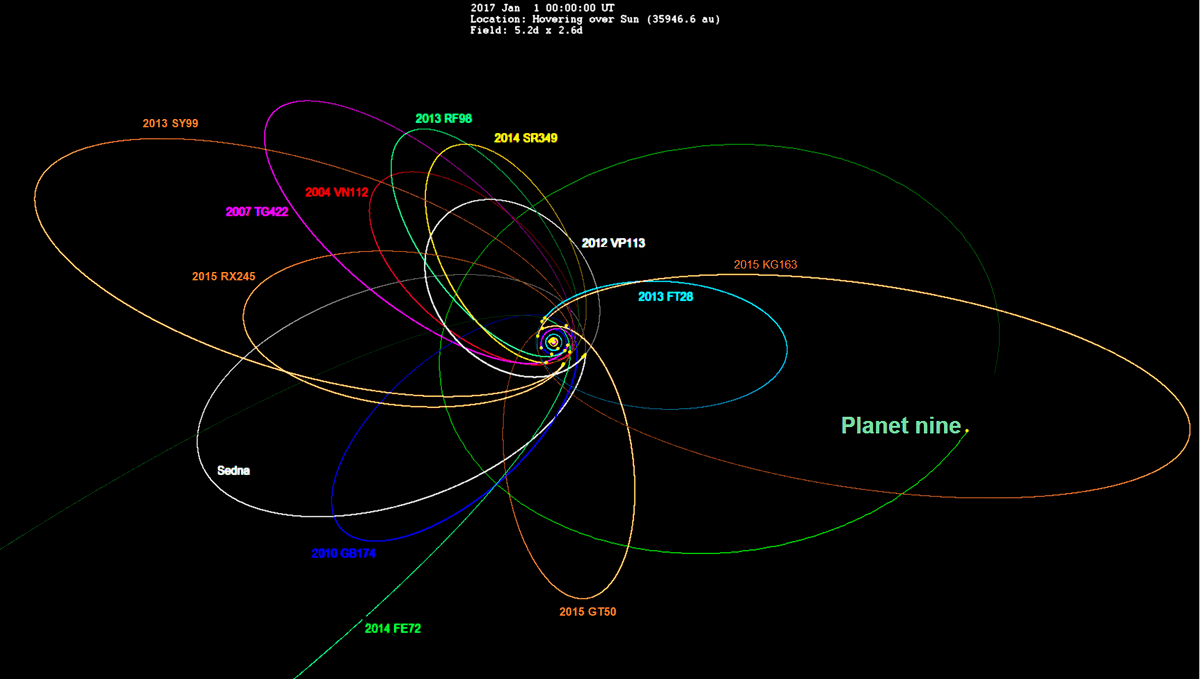
Planet Nine and other orbits looking from above the solar ecliptic

Nothing New In Planet Discovery

All the planets except Uranus and Neptune were discovered by Babylonian astronomers, although the six innermost planets were most likely noted by humans before writing was invented. Uranus was discovered in 1781, and Neptune was found in 1846. Despite all the advances in telescopes and space exploration no other ‘planet’ has been discovered in our solar system. So, why would anyone think another planet might exist?

Odd Ducks Out There

If the Sun and the planets were formed from a disk of debris, then most objects would be aligned in that disk or solar ecliptic plane, or the plane that the major planets are on as they orbit the Sun. Collisions between asteroids can send them off in unusual orbits that don’t align with the solar ecliptic.

However, there are a group of objects beyond Neptune that have unusual orbits. These objects are called trans-Neptunian objects. These are on a different plane and defy easy explanation. In addition, the Sun itself is a bit odd in its rotation. The Sun seems to rotate slightly off the ecliptic plane that all the planets follow.

Doing the Math

Two astronomers, Chad Trujillo and Scott S. Sheppard, tackled the odd orbits of the trans-Neptunian objects and discovered that some of the orbits of the objects could be explained if there were a large planet farther out in the solar system. That didn’t sit well with other astronomers so they decided to prove them wrong.

Planet Nine’s likely orbit and the orbits of trans-Neptunian objects

Konstantin Batygin and Michael E. Brown from CalTech decided to re-do the calculations of Trujillo and Shepard. They eliminated some of the objects studied because they might be influenced by Neptune’s gravity. That left six objects to study. To their surprise, they discovered that a planet ten times the size of Earth in an off-plane orbit much farther out than Neptune explained the orbits of the six objects to a 99% degree of certainty.

Is There a Ninth Planet?

Despite the mathematical support, there is no Planet Nine…yet. An analogy would be that if someone picked a date ten years in the future, say 3 March 2028, and was asked if that day would fall on a weekday. Without a calendar to look at it would be hard to say ‘yes’ or ‘no.’ It is very likely, but it is not certain until there is proof.

We currently have no proof of another planet, and spotting Planet Nine will be difficult at best. It would be a relatively small target with almost no sunlight reflecting off of it. It couldn’t be seen with today’s telescopes in either the visible or infrared spectrums. Even if we could determine where it is in its orbit, it would take a probe as many as twenty years to get into the Planet Nine neighborhood.

So the answer remains ‘no.’ There is no Planet Nine…but stay tuned.

Can Venus Be Made Habitable?

25 Monday Dec 2017

Posted by Paul Kiser in Green, Science, solar, Space, Technology, Travel

≈ Leave a comment

Tags

atmosphere, carbon dioxide, CO₂, CO², Earth, extreme makeover, Global warming, greenhouse effect, hydrogen, nitrogen, O², oxygen, solar system, terraforming, Venus, Weather

Venus: Too hot, too much atmosphere

Venus may be the future of Earth and may also hold the answers to global warming.

Earth’s atmosphere is 78 percent nitrogen, 21% oxygen, (O₂,) and 1% other gases including carbon dioxide (CO₂) and water vapor. Even though CO₂ is considered a trace gas in our atmosphere it is a major player in the absorption of energy from the Sun. Nitrogen and oxygen are ‘invisible’ to the Sun’s radiation, so the energy from the Sun passes through the two gases without being absorbed.

The atmosphere of Venus 96% CO₂ and 3.5% nitrogen, with 0.5% other gases, including water vapor. Venus’ atmosphere is also extremely dense. The pressure at the surface of Venus is the same as the pressure at 1,000 meters (3,000 ft.) under the surface of Earth’s ocean.

Venus is also hot. The CO₂ absorbing the Sun’s energy retains the heat in a runaway greenhouse effect that keeps the temperature at 462 °C (864 °F,) both day and night.

The interesting, and terrifying fact is that the carbon found on Earth is roughly equal to the carbon found on Venus. The difference is that Earth stores its carbon in the ocean, and in calcite deposits that consists of dead marine life that settled in the bottom of an ocean and became a sedimentary rock formation.

There is also a nitrogen problem. Even though nitrogen makes up 3.5% of Venus’ atmosphere, it is four times the amount of nitrogen in Earth’s atmosphere.

Venus could be Earth Like if:

  • Almost all of the atmospheric carbon and three-quarters of the nitrogen could be transformed into solid carbon and solid nitrogen.
  • Some of the oxygen from the CO₂ could be liberated for the atmosphere.
  • The rest of the oxygen could be liberated to combine with hydrogen in the upper atmosphere to create water.
  • The Sun’s energy could be reduced (blocked) to allow Venus to cool.
  • Venus’ rotation could be sped up and a slight tilt in the axis to match Earth’s rotation and axis.

Numbers 4 and 5 are beyond our current technology, however, solving the 1 through 3 issues are a matter of finding or creating an organism that could float in venus’ upper atmosphere and convert CO₂ to O₂. This could help scientists find a way to remove the excess carbon from Earth’s atmosphere and prevent global warming from becoming a runaway greenhouse effect on our planet.

It should be noted that Earth’s temperature is a delicate balance between incoming and outgoing energy. We don’t know at what point a runaway greenhouse effect kicks in and destroys the energy balance that maintains a near constant temperature on Earth; however, there is a point of no return where evaporating water vapor and CO₂ will absorb more energy from the Sun than what is radiated back into space. If we reach that point, Earth will become another Venus and the human race will cease to exist.

Epilogue of Planet Epsilon (science fiction)

24 Tuesday Dec 2013

Posted by Paul Kiser in Fiction, Science, Science Fiction, Space

≈ Leave a comment

Tags

Alien, alien ship, asteroid belt, Delta, Disaster, Earth, Epsilon, Gamma, Japan, Jupiter, Mar, Mars, Mercury, Nippon, planet, Saturn, scifi, sol, solar system, Sun, Venus

24 December 2038 – Chōfu, Tokyo, Nippon Unified Aerospace Agency (NUAA)

Orbits of 6 worlds nearest Sol

Orbits of 6 worlds nearest Sol and debris from the Epsilon explosion (Data recovered from alien ship) 

At today’s 9:00 AM press conference we announced the discovery of an alien craft found in orbit around our Sun. The orbital path of the craft was almost thirty degrees off the orbital plane of the solar system and was between Venus and Mercury at perihelion and extended out to near Jupiter’s orbit at aphelion. The long-deceased occupants of the ship were apparently from within our solar system on a planet they called Epsilon.

As mentioned this morning, we are releasing the text of the most significant alien messages or logs that we recovered on a hand device inside the craft. From what we can determine from the ship’s records so far is that Epsilon, located between Mars and Jupiter, exploded about 66 million years ago. The Epsilonian language is apparently the root language of English as the symbols and sounds are almost identical to English.

The aliens were human in body type. Several of the occupants of the ship were found in a compartment that preserved their bodies. We believed these aliens died after their craft was damaged and the crew put them in an area of the ship without heat or air to keep them from decomposing. DNA testing has proven that we are related these aliens, although probably not directly to the occupants of the ship.

According to what we have learned from their records so far, this ship was one of seven that attempted to reach Earth (named Gamma in Epsilonian) from Mars (named Delta in Epsilonian) after Epsilon exploded. Remnants of the planet still exist in what we have come to know as the Asteroid Belt; however, most of the planet was scattered throughout our solar system and some larger fragments impacted on the other planets including Earth. The descendants of the aliens that landed on Earth must have survived for millions of years in small pockets until humans began to become dominant in the past 100,000 years.  This ship was apparently the only one that did not make it to Earth.

Image of Epsilon before it exploded. Recovered from the alien database.

Image of Epsilon before it exploded. Recovered from the alien database.

Below is the original text from the most significant messages we have recovered so far. 

Message 10884.11.75.06.41.12.52 From Epsilon Crew Member
Wee faild. Wee tride, wee tride agane, wee tride more, and wee still faild.

Tu ue hoo reed this, I noe ue kant understand ar sarow. Pleese, here me. Fore ar brothers and sisters mae bee, likelee ar, yore fathers and mothers. If ue kan reed this then it is sertan ue ra, fore yore words kame from ar words.

Wee wer from Epsilon, tha 5th world from Sol, but wee livd in ae kalonee on Delta, tha 4th world. Now bothe worlds ar lost and all hope lies on Gamma, tha 3rd world.

Let mee restart. Epsilon was tha sorse of life in tha Sol sistim. Ar world was bigger than Gamma and Baeta (tha 2nd world,) and much bigger than Dellta. All 4 worlds had firm ground and ae laer of gas, but Baeta, like Alpha (the 1st world) had noe likguid. Gamma, Dellta, and Epsilon had likguid, but Epsilon producd life and evold 1st.

Epsilon was home but wee wantd tu xplore, soe wee lernd tu sore beetwene worlds. Dellta and Gamma had life, but not wise life. Ar peepel desided to kalonee on Dellta 1st.

Wee had livd on Dellta fore almoest 50 orbits and preeparing tu kalonee on Gamma  when disaster struk Epsilon. Ae flash that lit up ar erly morning skie on Dellta then faded. Epsilon was gon. Wee beeleve it was natural. Epsilon had plenteeful unstabil ellamints in tha krust. If those ellamints xtended into tha likguid rok beeloe, thae it koud hav gatherd tu ae kritikal mass and xploded with such forse tu destroy ar home world.

Ae grupe of sieintists had warnd that Epsilon mite….. (text was not recoverable)

Message 10884.11.75.06.41.15.04
Delltas orbit put it in tha Epsilon deebree flung toward Sol. Wee had onelee weeks tu evevakuate Dellta. With Dellta in sertan dume, ar hope was tu sore tu Gamma, but wee had noe kalonee ther. Wee had 7 ships availabel. 6 had peepel and 3 months of supplies eech. 1 ship kaireed ar teknolojee. That ship held ar soring masheens, ar komemunikashun eekwipmint, shelters, and everee thing needed tu restart ar sivilliesaeshun. 6 ships made it tu Gamma. 1 ship, ar ship, did not.

Wee due not noe if thae kan sirvive without….(text was not recoverable)

Volcanoes in the lower left caused by fragments from the break up of Epsilon

Volcanoes in the lower left caused by fragments from the break up of Epsilon

Ar ship was tha last tu leve Dellta. Deebree from r home world hit ar ship. It disstroyd ar injin kontrol. Ar injins flamed until wee had noe fuel. Ar orbit touk us abav tha planit orbits, around Sol, then in an eeliptikal orbit out past Epsilon and back tu Sol. Of ar 16 crew, 7 hav survived 2 orbits, but ther is noe hope. Wee noe longer can reepair our eekwipmint and ar air sistim will fail sune.

Message 10884.11.75.06.04.44.03
Wee hav watchd as ar broekin world has reekd havoke. Tha rimnants of Epsilon tore thru tha Sol sistim and miny larg fragmints inkluding 2 of Epsilons moons ar still in unstaebel orbits that will evinchuelee hit another world or Sol. 4 massiv fragmints hit Dellta kreeating majore fire mountans spewing out likwid rok. It is terning tha world inside out. Tha impakts of tha fragmints pushd Delltas gas in tu spase and chaengd its axis by 25 dagrees. Oever 1000 peepel wer left on Dellta and thae ar all ded.

Far side of the Moon peppered by fragments of Planet Epsilon

Far side of Earth’s Moon peppered by fragments of Planet Epsilon

Gamma survived thanks tu its Mone. A storem of deebree hit tha bak side of the Mone, but 1 larj fragment did hit tha Gamma. It filld tha air with fire and ash and tilt the axis almoset as much as Dellta. Kondishuns fore our peepel mae not bee sirviveabel.

 Zeta was forjunate. It was on tha opposeit of Sol when Epsilon xploded and it has not bin hit by maejor fragmints yet, however, ……(text was not recoverable)

Saturn's rings from the oceans of Epsilon

Saturn’s rings from the oceans of Epsilon

 ….differint fore Eta. Ae larj fragmint and sum fine deebree, posieblee likwid from 1 of Epsilons oeshuns was sent towards Eta. The fragmint tilted Etas axis and tha fine deebree went in tu orbit around Eta. It seems tu bee forming ae ring strukchure around Eta.

Sum of Epsilon was eejektd far out frum Sol kreeating ae cloud of deebree in tha outer sistim. Deebree nere Zeta was absorbed, but sum setteld in orbit ahed and beehind Zeta. What littel is left of Epsilon is spreding out whair ar world usd tu orbit. Fragmints will kontinue tu raen don on tha worlds fore senjurees…..(text was not recoverable) 

Message 10884.11.75.08.18.32.29
…..(text was not recoverable) Wee had kontakt with tha moset of tha ather ships until their power faild. Thae must restart ar race without all tha teknalogee wee karee on r ship. It mae bee hundreds of orbits, mae bee longer beefore thae kan sore aegaen. This message will not bee red until long after wee ar gon.

Are We Missing an Ice Age? (PART II of III)

16 Wednesday Nov 2011

Posted by Paul Kiser in History, Science

≈ Leave a comment

Tags

aphelion, apsidal precession, axial precession, Earth's orbit, Earth's Wobble, eccentricity, Global warming, Ice Ages, invariable plane, Milankovitch Cycles, Milution Milankovic, obliquity, orbit, orbital inclination, orbital plane, perihelion, solar system, Tilt, Warm Ages

PART II – Understanding the Milankovitch Cycles, Clues to Earth’s Climate Changes 

RECAP: In Part I of this series, we looked at how scientists have determined that Earth has experienced regular cycles of cold climates followed by brief periods of warm climates during the last 400,000 years. We learned that the current cycle has been different because the warm period has persisted when past warm climates have rapidly dropped back into a cold climate. We also discussed how the Sun acts as a ‘battery charger’ for Earth’s climate.

Milutin Milanković  proposed possible mechanisms related to Earth’s tilt and orbit that could be the root cause of the regular cycle of Ice Ages. His theory, outlined in several papers from 1912 to 1920, is now referred to as the Milankovitch Cycles¹. This theory outlines four factors that change the amount of solar radiation received by the Sun, which could explain why Earth experiences dramatic changes in its climate over a 100,000 year cycle. In addition, there is a fifth factor that has been added to the Milankovitch Cycle theory, which also follows a 100,000 year cycle and may also be contributing triggering our Ice/Warm Age cycles.

FACTOR ONE
Eccentricity or Earth’s Orbit – From a Circle to Oval and Back

IMAGE 1.0 -Earth's Orbit: High Eccentricity vs. Low Eccentricity

Earth’s orbit changes from a nearly perfect circle, to an oval (technically, an ellipse) over a period of thousands of years. The cause of this elongation or eccentricity of our orbit is due to the gravity influences of Jupiter and Saturn, which are much farther away from the Earth than the Sun, but exert enough pull to periodically stretch our orbit out of its circular shape.

In an orbit that is a perfect circle the amount of energy the Earth receives is relatively constant throughout the year, assuming the Sun is generating a constant amount of energy (which it doesn’t.) However, when Earth’s orbit is an ellipse (or more eccentric) the Earth receives more energy when it is closer to the Sun than when it is farther away.

Paul Kiser

Earth’s orbit eccentricity varies from .005 (low) to .058 (high) and the cycle of low to high eccentricity is roughly 100,000 years. Our orbit had major peak eccentricities of .04 to .06 at approximately 120, 220, 320 thousand years ago. These peaks fall about 10,000 to 20,000 years before the start of the last three Warm Ages.

Currently the eccentricity of our orbit is .017 and it is falling from a minor peak of about .02. That means that Earth’s orbit is about one-third the way from our lowest eccentricity and becoming more circular. The eccentricity of Earth’s current orbit creates about a three million mile difference between its closest and farthest approach to the Sun. Earth at perihelion (closest to the Sun) is 91.4 million miles away from the Sun. At aphelion the Earth is 94.5 million miles away.

FACTOR TWO
Obliquity or the Severity of Earth’s Tilt

Currently the Earth is tilted at 23.44 degrees from the Sun’s orbital plane, but that is not constant. The Earth’s tilt or obliquity is decreasing from the high obliquity (tilt angle) of 24.4° towards the low of 22.1º. It will take Earth about 10,000 years to reach the low point in a 41,000 year cycle.

For comparison, Mars’ current obliquity is 25.19° and varies from 10° to 40° over hundreds of thousands of years. Venus’ obliquity is 177.4°, which means that the planet is so tilted that its ‘north’ is facing south. That may seem strange to have an obliquity greater than 90°; however, since Venus’ rotation is retrograde (Venus turns in the opposite direction of Earth) scientists consider its ‘up’ side to have been literally turned upside down.

IMAGE 1.1 - Tilt or Obliquity of the '8' Planets and Pluto

Higher obliquity is believed to result in the Earth absorbing more solar radiation (insolation) because the higher latitudes receive more sunshine in the summer. Earth’s current Warm Age began at about the same time as our peak obliquity, so there is evidence that this theory is valid.

FACTOR THREE
Axial Precession or Earth’s Wobble

Image 1.2 - Earth's Wobble is called Axial Precession

Currently the north pole, or axis, points towards the star called Polaris. That is temporary because the Earth wobbles. This wobble is called the Axial Precession. Over time our north axis will no longer be aimed at Polaris, but instead will leave us without a ‘North Star’ until Earth’s north axis points to Vega, Deneb, or another bright star or galaxy.

It takes about 26,000 years for the wobble to complete one full cycle and during that cycle the Earth’s wobble will cause a slow change in the seasons. This is because the axis wobble alters the direction of our tilt during every orbit of the Sun. When the Earth returns to the same relative position in its orbit, the axis will point to a slightly different place than it did the prior year. The axis will have reached that point earlier, so our seasons slowly move backward.

FACTOR FOUR
Apsidal Precession or The Hula Hoop Effect

IMAGE 1.3 - This graphic shows Apsidal Precession (Click to Activate)

One of the more interesting factors is Apsidal Precession. If you think of Earth’s orbit as a hula hoop and your waist as the Sun (no, it’s not that big,) as the hula hoop goes around, the ‘orbit’ shifts. Any particular point on the hula hoop will move from being closest to your waist and then it will shift to be the farthest away from you waist. Our seasons do the same thing as Earth’s orbit slowly shifts or precesses.

Currently, summer in the northern hemisphere occurs when the Earth is the farthest away (aphelion) and in winter we are closest to the Sun (perihelion.) In the southern hemisphere it is exactly opposite. During the summer in the southern hemisphere (Earth at perihelion) it receives 23% more solar radiation than the northern hemisphere does during its summer, which occurs at the aphelion. It takes about 21,000 years for the Apsidal Precession to cause the seasons to make a full cycle, so in about 10,000 years, the northern hemisphere will experience summer at perihelion. 

FACTOR FIVE
Orbital Inclination or Our Orbits Tilt From the Orbital Plane

IMAGE 1.4 - Earth's Orbital Plane from the Solar Systems Invariable Plane

By averaging the orbits of the eight planets scientists have created one plane that is considered the invariable plane. Jupiter is almost on this invariable plane; however, Earth and the other six planet’s orbital planes are tilted or inclined from the invariable plane.

Not only is Earth’s orbital inclination 1.57° off the invariable plane, the amount of tilt changes on a cycle that repeats every 100,000 years. Earth’s variance during that cycle can be as much as 3° off the invariable plane, which is additive to Earth’s obliquity or tilt on its axis. That means that increased orbital inclination magnifies the effect of Earth’s obliquity.

This factor was not part of Milankovic’s original theory; however, scientists have added it to the Milankovitch Cycle because it impacts the amount of insolation the Earth receives and because it follows the 100,000 year cycle.

In Part II, we have discussed five cyclical factors that change the amount of insolation the Earth receives and where Earth is in all five cycles. In Part III we look at how Earth’s climate seems to be on a hair-trigger and why we should or should not be in an Ice Age now.

PART I – Are We Missing An Ice Age?

PART III – Should We Be In An Ice Age Now?

USA PDT [Twitter: ] [Facebook] [LinkedIn] [Skype: 775.624.5679]


NOTES AND REFERENCES

¹Wikipedia – The Free Encyclopedia. (2011). Milankovitch Cycles. Retrieved November 13, 2011, from http://en.wikipedia.org/wiki/Milankovitch_cycles.

IMAGE CREDITS

IMAGE 1.0 – Image thanks to http://apollo.lsc.vsc.edu/classes/met130/notes/chapter16/mil_cycles.html

IMAGE 1.1 – Image Copyright 1999 by Calvin J. Hamilton. Found at http://www.solarviews.com/cap/misc/obliquity.htm 

IMAGE 1.2 – Image thanks to http://tomsastroblog.com/archives/8047

IMAGE 1.3 – Graphic thanks to Wikimedia Commons at http://en.wikipedia.org/wiki/File:Precessing_Kepler_orbit_280frames_e0.6_smaller.gif

Support Wikipedia

Other Pages of This Blog

  • About Paul Kiser
  • Common Core: Are You a Good Switch or a Bad Switch?
  • Familius Interruptus: Lessons of a DNA Shocker
  • Moffat County, Colorado: The Story of Two Families
  • Rules on Comments
  • Six Things The United States Must Do
  • Why We Are Here: A 65-Year Historical Perspective of the United States

Paul’s Recent Blogs

  • Dysfunctional Social Identity & Its Impact on Society
  • Road Less Traveled: How Craig, CO Was Orphaned
  • GOP Political Syndicate Seizes CO School District
  • DNA Shock +5 Years: What I Know & Lessons Learned
  • Solstices and Sunshine In North America
  • Blindsided: End of U.S. Solar Observation Capabilities?
  • Inspiration4: A Waste of Space Exploration

Paul Kiser’s Tweets

Tweets by PaulKiser

What’s Up

February 2026
S M T W T F S
1234567
891011121314
15161718192021
22232425262728
« Jun    

Follow Blog via Email

Enter your email address to follow this blog and receive notifications of new posts by email.

Join 688 other subscribers

Create a website or blog at WordPress.com


Loading Comments...