3rd From Sol

~ Learn from before. Live now. Look ahead.

3rd From Sol

Monthly Archives: November 2011

New Religion For Business: Believing in the ‘L’ Word

23 Wednesday Nov 2011

Posted by Paul Kiser in Business, Customer Relations, Customer Service, Information Technology, Internet, Management Practices, Public Relations, Social Interactive Media (SIM), Social Media Relations, Technology

≈ Leave a comment

Tags

DataSift, Facebook, filtering, listening, Nick Halstead, Rob Bailey, Twitter

Paul Kiser

For a hundred years the Church of the Big Sell has preached to enterprise decision-makers that they will give a voice to their company…for a price. Media chieftains told the world of business that the customer is a commodity that can be manipulated and controlled with the right ad campaign, the right slogan, the right spokesperson, or the right look. Then came Social Media.

Social Media has put a lot of business traditionalists in a tailspin. It turns out that the customer is not a commodity and they hate it when they are treated like one (e.g.; Netflix, United Airlines, Bank of America, etc.) Customers  are people and they have feelings, wants, likes, and dislikes.

Facebook and Twitter gave the people fire and they liked it. Now the customer has a voice and they use it. They talk. They converse. They express. They judge. Not only do they have a voice, they now have the power to turn off advertising…and they do.

The Church of the Big Sell is burning and the voice they were supposed to give to business is wasted on ads in newspapers and magazines that nobody reads, radio and television commercials that nobody listens to or watches, and yellow pages books that go from the front doorstep to the recycling bin…unused. Social Media took away the microphone of enterprise because people are tired of being preached to by the Church of the Big Sell.

Business is realizing that customer interaction has changed. Enterprise in a Social Media world is not about talking, but about listening. Listening is the alpha and omega of the Social Media world. Almost everything a business needs to know is there, if they listen. A new church is being built on the ashes of the old and the religion is based on the ‘L’ word.

Listening is not as easy as it sounds (pun intended.) Social Media is noisy. Too many voices, too many issues. A restaurant owner does not need to know that Emily had a great date last night…unless Emily’s date was at his restaurant. Then he might want to know that Emily’s date was great despite her eating experience, where the food was cold, the parking a pain, and the service rude. The restaurant owner might also want to know that nine of Emily’s friends responded to her Tweet by agreeing that his restaurant sucks and they will never eat there again.

Rob Bailey - Head of US Operations and new CEO of DataSift

Tools of Listening in the New Church of Social Meda
Paring down the noise of Social Media is a major challenge for a business and the new religion has new tools. “The amount of Social Media that people are producing is doubling every year…,” explained Rob Bailey, who is the head of United States Operations for DataSift, a Social Media filtering platform for business that was launched last week. Bailey said that there are three steps in refining raw Social Media into relevant information for any enterprise.

The first step is to refine the data down to what is being posted about an organization, subject, or topic. That refinement may require multiple filters to distill out undesired spam, retweets, and other noise. The second step is to analyze the results based on factors such as age, gender, geographic location, and sentiment. The final step is to have a visual tool that reports the results simply and accurately for interpretation by the decision-maker in the company.


Nick Halstead - Past CEO and now Chief Technology Officer

DataSift had 8,000 users in the alpha test of its Social Media monitoring platform and found that the interest in this technology spanned a wide variety of industries. CEO Nick Halstead said that they had, “… government agencies to pharmaceuticals, a lot in finance, a lot in retail…and quite a few start-ups…” interested in DataSift’s technology to monitor issues of concern to their business and organizational operations. Another industry that wants to be able the monitor the Social Media are News Outlets that are trying to compete with Twitter and Facebook in providing events in real-time. Bailey said, “Twitter is an incredible vehicle…” for finding out what is going on in the world.

Public Relations and Social Media firms are also using tools to filter out the Social Media noise for companies who would rather hire an outside service for their Social Media presence rather than doing it in-house. In addition to listening to the Social Media these agencies help a business identify and correct their public image by handling public image issues and concerns for the organization.

View of data stream screen

The tools of the new platform allow the user to search multiple Social Media formats and have access to the full Twitter worldwide database in real-time. Beyond listening to what is being said about a company’s public image, they can now test market products or services and use Social Media to determine the reaction. The platform also has an interesting application in politics by allowing campaigns to determine sentiments on key issues by geographic region before a candidate campaigns in that area.

Improved customer response is probably the most obvious benefit to listening to Social Media, as a business can now pick up any post written about their company, product, or service and appropriately respond in minutes with a thank you for positive comments and a resolution or apology for negative experiences.

There is no turning back. Social Media demands that enterprise be great listeners and now they have no excuse.

USA PDT [Twitter: ] [Facebook] [LinkedIn] [Skype: 775.624.5679]

Are We Missing an Ice Age? (Part III of III)

21 Monday Nov 2011

Posted by Paul Kiser in History, Science

≈ 16 Comments

Tags

apsidal precession, axial precession, Earth Science, Earth's orbit, eccentricity, Global warming, Ice Age, insolation, Milankovitch Cycles, Milution Milankovic, obliquity, Warm Age

PART III – Should We Be In An Ice Age Now? 

IMAGE 1.0 - The Northern Hemisphere at the end of the last Ice Age (10,000 years ago)

RECAP: In Part I of this series, we looked at how scientists have determined that Earth has experienced regular cycles of cold climates followed by brief periods of warm climates during the last 400,000 years. We learned that the current cycle has been different because the warm period has persisted when past warm climates have rapidly dropped back into a cold climate. We also discussed how the Sun acts as a ‘battery charger’ for Earth’s climate.

Part II of the series explained that Earth’s orbital relationship with the Sun also follows a cyclic pattern and that almost 100 years ago, a Serbian named Milutin Milanković  proposed possible mechanisms related to Earth’s tilt and orbit that could be the root cause of the regular cycle of Ice Ages.

PART III – Should We Be In An Ice Age Now?

No one can say for certain whether or not that we should be in an Ice Age today. Past Warm Ages have typically collapsed back into a cooler period within a few thousand years followed by a complete return to an Ice Age within about 10,000 years. If Earth past climate history is correct then our planet should be in a cooling period, if not into a full-scale Ice Age. Instead, Earth is warming. The Milankovitch Cycles don’t all concur on this issue, but there is some intriguing evidence that suggests we have missed a cooling period based on Earth’s orbit and tilt. 

Consider the factors discussed in Part II of this series.

Orbit Eccentricity or Circular to Ellipse
Our orbit eccentricity is about one-third the way from our lowest level, meaning Earth’s orbit is becoming more circular. It’s cycle is about the same as Earth’s climate cycle, so it could be a significant factor. Interestingly, the eccentric peak of .02 during the current cycle was half to one-third of the peak past three cycles (.04 to .06.)¹ Could that be a factor in the prolonged warm period? Possibly, but why? Earth just passed the peak a few thousand years ago so, does a low peak eccentricity result in a prolonged Warm Age?

Paul Kiser

Obliquity or Earth’s Tilt On Its Axis
Earth is about halfway between our high and low peak tilt angles.  Our planet’s tilt, or obliquity is on an approximate 41,000 year cycle, so we were just passing through our highest peak obliquity at the start of this Warm Period. If high tilt angle is a trigger for a Warm Age, then we should be cooling down, unless obliquity must be coupled with another factor to trigger a cooling period.

Axial Precession or Earth’s Wobble
Earth’s axis wobbles and it takes 26, 000 years to complete one cycle. It is hard to see a connection with the slow regression of the seasons and Earth’s climate, but perhaps the cycle of axial precession couples with another factor to trigger a cooling period, or sustain a Warm Age.

IMAGE 1.1 - Apsidal Precession - The Creep of the Seasons in Earth's Orbit

Apsidal Precession or The Hulu Hoop Effect
Apsidal precession is factor has some interesting possibilities on how it might impact Earth’s climate. Currently the Summer in the northern hemisphere occurs when Earth is farthest from the Sun (aphelion.) Our closest approach to the Sun (perihelion) occurs during Summer in the southern hemisphere.

IMAGE 1.2 Land Masses in the Northern Hemisphere

IMAGE 1.3 - Land Masses in the Southern Hemisphere

Earth’s northern hemisphere is about 40% land and 60% water. The southern hemisphere is about 20% land and 80% water. Land that is not covered with ice absorbs more energy than water because water reflects more of Sun’s energy back into space. In Part II we learned that the hemisphere that is in summer during perihelion receives 23% more solar radiation. Because of the greater land mass, the northern hemisphere will retain more of the summer Sun’s energy in 10,000 years (when perihelion occurs in July) than the southern hemisphere does currently.

From a standpoint of apsidal precession, Earth should be in the coldest period since we are closest to the Sun when the smallest percentage of our land mass will absorb the energy or insolation. 

Orbital Inclination
The tilt of Earth’s orbital plane off of the invariable plane is on a 100,000 year cycle, which coincides with Earth’s climate cycle. Since  higher angles of our orbital plane result in a higher obliquity and magnify the effect of land mass absorption differential between the two hemispheres, it could be a factor in triggering the Ice/Warm Age cycles; however, it is unclear how this factor could contribute to the prolonged warm period.

Are We Missing an Ice Age?
Earth’s climate cycle does not follow a perfect 100,000 year pattern. Most people would be happy if we never went into another Ice Age; however, if we have missed the trigger of the next Ice Age, what does that mean for our climate? Will Earth’s delicate climate balance be ruined leading into a runaway warm period or will the next Ice Age come in a rapid onset like in a disaster movie?

The Sun charges Earth’s climate ‘battery’ and variations in how much solar radiation our planet absorbs dramatically affects the environment for all life. It will be important for scientists to discover what is happening to our climate and why. Life on Earth exists in a narrow band that is not to cold and not to hot and we have no practical methods to reinforce or siphon off the Sun’s energy in a crisis.

While scientists to continue to examine this issue there are other issues that should be considered beyond climate. At least for the past 400,000 years, the Warm Ages have been relatively brief periods. It is during those brief periods of warmth that life has flourished, then the Earth has been cleansed with the next Ice Age. What will happen as insects, reptiles, and bacteria continue to  evolve and expand without an Ice Age to push back their spread across the globe? Is it possible that too much life will threaten human existence?

These are all questions that have to be answered as long as the Earth continues to avoid the next Ice Age.

PART I – Should We Be In An Ice Age Now?

PART II – Understanding the Milankovitch Cycles, Clues to Earth’s Climate Changes

NOTES AND REFERENCES

¹Wikipedia – The Free Encyclopedia. (2011). Milankovitch Cycles. Retrieved November 13, 2011, from http://en.wikipedia.org/wiki/Milankovitch_cycles.

IMAGE CREDITS

IMAGE  1.0 – Image thanks to http://www.space4case.com/mmw/pages/space4case/solar-system/earth/artic.php

IMAGE 1.1 – Image thanks to Wikimedia Commons at http://en.wikipedia.org/wiki/File:Precession_and_seasons.jpg

IMAGE 1.2 – Image thanks to http://www.learner.org/jnorth/tm/humm/WhyComeGlobalGame.html

IMAGE 1.3 – Image thanks to http://www.learner.org/jnorth/tm/humm/WhyComeGlobalGame.html

USA PDT [Twitter: ] [Facebook] [LinkedIn] [Skype: 775.624.5679]

Are We Missing an Ice Age? (PART II of III)

16 Wednesday Nov 2011

Posted by Paul Kiser in History, Science

≈ Leave a comment

Tags

aphelion, apsidal precession, axial precession, Earth's orbit, Earth's Wobble, eccentricity, Global warming, Ice Ages, invariable plane, Milankovitch Cycles, Milution Milankovic, obliquity, orbit, orbital inclination, orbital plane, perihelion, solar system, Tilt, Warm Ages

PART II – Understanding the Milankovitch Cycles, Clues to Earth’s Climate Changes 

RECAP: In Part I of this series, we looked at how scientists have determined that Earth has experienced regular cycles of cold climates followed by brief periods of warm climates during the last 400,000 years. We learned that the current cycle has been different because the warm period has persisted when past warm climates have rapidly dropped back into a cold climate. We also discussed how the Sun acts as a ‘battery charger’ for Earth’s climate.

Milutin Milanković  proposed possible mechanisms related to Earth’s tilt and orbit that could be the root cause of the regular cycle of Ice Ages. His theory, outlined in several papers from 1912 to 1920, is now referred to as the Milankovitch Cycles¹. This theory outlines four factors that change the amount of solar radiation received by the Sun, which could explain why Earth experiences dramatic changes in its climate over a 100,000 year cycle. In addition, there is a fifth factor that has been added to the Milankovitch Cycle theory, which also follows a 100,000 year cycle and may also be contributing triggering our Ice/Warm Age cycles.

FACTOR ONE
Eccentricity or Earth’s Orbit – From a Circle to Oval and Back

IMAGE 1.0 -Earth's Orbit: High Eccentricity vs. Low Eccentricity

Earth’s orbit changes from a nearly perfect circle, to an oval (technically, an ellipse) over a period of thousands of years. The cause of this elongation or eccentricity of our orbit is due to the gravity influences of Jupiter and Saturn, which are much farther away from the Earth than the Sun, but exert enough pull to periodically stretch our orbit out of its circular shape.

In an orbit that is a perfect circle the amount of energy the Earth receives is relatively constant throughout the year, assuming the Sun is generating a constant amount of energy (which it doesn’t.) However, when Earth’s orbit is an ellipse (or more eccentric) the Earth receives more energy when it is closer to the Sun than when it is farther away.

Paul Kiser

Earth’s orbit eccentricity varies from .005 (low) to .058 (high) and the cycle of low to high eccentricity is roughly 100,000 years. Our orbit had major peak eccentricities of .04 to .06 at approximately 120, 220, 320 thousand years ago. These peaks fall about 10,000 to 20,000 years before the start of the last three Warm Ages.

Currently the eccentricity of our orbit is .017 and it is falling from a minor peak of about .02. That means that Earth’s orbit is about one-third the way from our lowest eccentricity and becoming more circular. The eccentricity of Earth’s current orbit creates about a three million mile difference between its closest and farthest approach to the Sun. Earth at perihelion (closest to the Sun) is 91.4 million miles away from the Sun. At aphelion the Earth is 94.5 million miles away.

FACTOR TWO
Obliquity or the Severity of Earth’s Tilt

Currently the Earth is tilted at 23.44 degrees from the Sun’s orbital plane, but that is not constant. The Earth’s tilt or obliquity is decreasing from the high obliquity (tilt angle) of 24.4° towards the low of 22.1º. It will take Earth about 10,000 years to reach the low point in a 41,000 year cycle.

For comparison, Mars’ current obliquity is 25.19° and varies from 10° to 40° over hundreds of thousands of years. Venus’ obliquity is 177.4°, which means that the planet is so tilted that its ‘north’ is facing south. That may seem strange to have an obliquity greater than 90°; however, since Venus’ rotation is retrograde (Venus turns in the opposite direction of Earth) scientists consider its ‘up’ side to have been literally turned upside down.

IMAGE 1.1 - Tilt or Obliquity of the '8' Planets and Pluto

Higher obliquity is believed to result in the Earth absorbing more solar radiation (insolation) because the higher latitudes receive more sunshine in the summer. Earth’s current Warm Age began at about the same time as our peak obliquity, so there is evidence that this theory is valid.

FACTOR THREE
Axial Precession or Earth’s Wobble

Image 1.2 - Earth's Wobble is called Axial Precession

Currently the north pole, or axis, points towards the star called Polaris. That is temporary because the Earth wobbles. This wobble is called the Axial Precession. Over time our north axis will no longer be aimed at Polaris, but instead will leave us without a ‘North Star’ until Earth’s north axis points to Vega, Deneb, or another bright star or galaxy.

It takes about 26,000 years for the wobble to complete one full cycle and during that cycle the Earth’s wobble will cause a slow change in the seasons. This is because the axis wobble alters the direction of our tilt during every orbit of the Sun. When the Earth returns to the same relative position in its orbit, the axis will point to a slightly different place than it did the prior year. The axis will have reached that point earlier, so our seasons slowly move backward.

FACTOR FOUR
Apsidal Precession or The Hula Hoop Effect

IMAGE 1.3 - This graphic shows Apsidal Precession (Click to Activate)

One of the more interesting factors is Apsidal Precession. If you think of Earth’s orbit as a hula hoop and your waist as the Sun (no, it’s not that big,) as the hula hoop goes around, the ‘orbit’ shifts. Any particular point on the hula hoop will move from being closest to your waist and then it will shift to be the farthest away from you waist. Our seasons do the same thing as Earth’s orbit slowly shifts or precesses.

Currently, summer in the northern hemisphere occurs when the Earth is the farthest away (aphelion) and in winter we are closest to the Sun (perihelion.) In the southern hemisphere it is exactly opposite. During the summer in the southern hemisphere (Earth at perihelion) it receives 23% more solar radiation than the northern hemisphere does during its summer, which occurs at the aphelion. It takes about 21,000 years for the Apsidal Precession to cause the seasons to make a full cycle, so in about 10,000 years, the northern hemisphere will experience summer at perihelion. 

FACTOR FIVE
Orbital Inclination or Our Orbits Tilt From the Orbital Plane

IMAGE 1.4 - Earth's Orbital Plane from the Solar Systems Invariable Plane

By averaging the orbits of the eight planets scientists have created one plane that is considered the invariable plane. Jupiter is almost on this invariable plane; however, Earth and the other six planet’s orbital planes are tilted or inclined from the invariable plane.

Not only is Earth’s orbital inclination 1.57° off the invariable plane, the amount of tilt changes on a cycle that repeats every 100,000 years. Earth’s variance during that cycle can be as much as 3° off the invariable plane, which is additive to Earth’s obliquity or tilt on its axis. That means that increased orbital inclination magnifies the effect of Earth’s obliquity.

This factor was not part of Milankovic’s original theory; however, scientists have added it to the Milankovitch Cycle because it impacts the amount of insolation the Earth receives and because it follows the 100,000 year cycle.

In Part II, we have discussed five cyclical factors that change the amount of insolation the Earth receives and where Earth is in all five cycles. In Part III we look at how Earth’s climate seems to be on a hair-trigger and why we should or should not be in an Ice Age now.

PART I – Are We Missing An Ice Age?

PART III – Should We Be In An Ice Age Now?

USA PDT [Twitter: ] [Facebook] [LinkedIn] [Skype: 775.624.5679]


NOTES AND REFERENCES

¹Wikipedia – The Free Encyclopedia. (2011). Milankovitch Cycles. Retrieved November 13, 2011, from http://en.wikipedia.org/wiki/Milankovitch_cycles.

IMAGE CREDITS

IMAGE 1.0 – Image thanks to http://apollo.lsc.vsc.edu/classes/met130/notes/chapter16/mil_cycles.html

IMAGE 1.1 – Image Copyright 1999 by Calvin J. Hamilton. Found at http://www.solarviews.com/cap/misc/obliquity.htm 

IMAGE 1.2 – Image thanks to http://tomsastroblog.com/archives/8047

IMAGE 1.3 – Graphic thanks to Wikimedia Commons at http://en.wikipedia.org/wiki/File:Precessing_Kepler_orbit_280frames_e0.6_smaller.gif

Support Wikipedia

Are We Missing an Ice Age? (Part I)

14 Monday Nov 2011

Posted by Paul Kiser in History, Science

≈ 4 Comments

Tags

Earth's orbit, Global warming, Ice Age, Ice Ages, ice core data, interglacials, Milankovitch Cycles, Milution Milankovic, solar radiation, Warm Ages

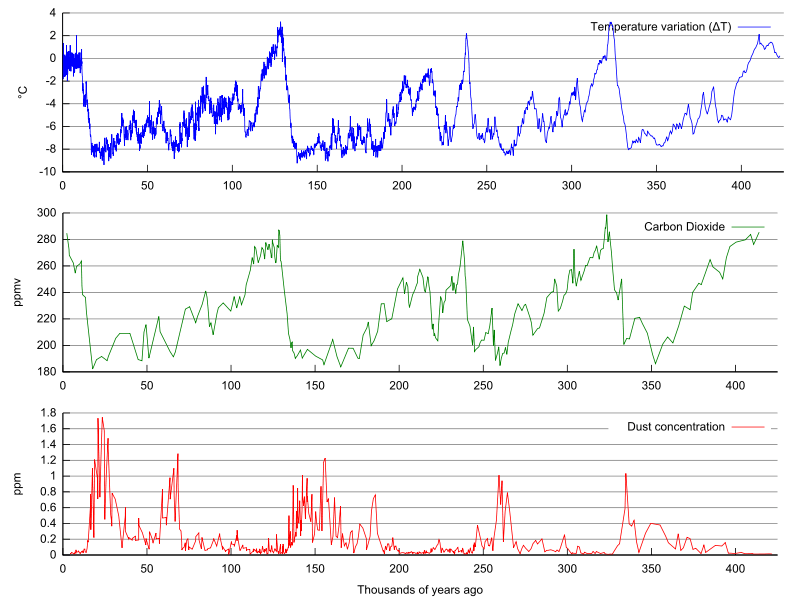
There is no doubt that Earth has a fairly consistent cycle of Ice Ages followed by interglacials, or Warm Ages. Using physical geologic evidence of the last Ice Age, and by analyzing and comparing ice cores, ocean sediment cores, and other samples that preserve air and climate data within them, scientists have an understanding of Earth’s overall climate back for over 400,000 years.

GRAPH 1.0 - Vostok Ice Core Data

There is a pattern to the data that suggests an approximate 100,000 year cycle that includes a 90,000 year cold period (Ice Age) followed by a brief 10,000 year warm period (Warm Age.) While this cycle can vary, the fact is that we have been in a Warm Age for over 10,000 years. Another unusual aspect of the current pattern is that typically the Warm Age rises to a sudden peak followed by a fairly rapid cooling period. The current Warm Age suddenly began and peaked about 11,000 years ago. The Earth has stayed relatively warm, and is in fact, continuing to get warmer.

The question is, are we missing an Ice Age?

GRAPH 1.0 is the data from the Vostok Station ice cores in the Antarctica. The top (blue line) graph indicates the trending air temperature, the middle graph (green line) indicates CO² levels trapped in the ice, and the bottom graph (red line) indicates the dust found in the ice samples. Note that present day is on the left side of all of the graphs and to the right is going farther back in time. Ice core data is not precise because of several factors; however, the data indicates the conditions within a 6,000 year margin of error.

The data indicates that there was a sudden warming starting at about 15, 140, 245, and 330 thousand years ago. The CO² has similar peaks but lags behind the temperature increases by 200 to 600 years. Dust seems to also correlate with the temperature variations, but whether low dust causes warmer temperatures, or warmer temperature cause a cleaning of atmosphere by increased rain, is unknown.

Paul Kiser

The consistency of the cycles indicates that there is some mechanism that drives the cold/warm periods which would be difficult to explain using Earth-bound causes. Volcanic periods, plate tectonics, ocean currents and other activities on Earth that might influence our climate don’t seem to have cycles that could be matched to the ice core data; however, there are exo-mechanisms (outside of Earth) that could help to explain the Ice/Warm Age cycles.

Earth as a Battery
Everyone knows that the Earth warms in the Spring and Summer and cools in the Fall and Winter. The reasons for this are due to Earth’s 23.5° tilt as we orbit around the Sun (SEE:  23.5 Degrees = Seasons on Earth.) Based on our firsthand experiences, it might be easy to believe that the Earth’s relationship to the Sun, outside of the annual march of the seasons, is relatively constant; however, it is not.

Earth’s orbit and tilt change over time and there is a significant difference in how much of the Sun’s energy (solar radiation) that Earth receives based on its relative position with the Sun. This is important because the energy our planet receives from the Sun is like a battery charger for our climate. When Earth absorbs more energy, the battery charges and we have a warmer, more active climate. When the Earth absorbs less energy, it cools and our climate reacts accordingly.

There are multiple factors that change Earth’s position in relationship to the Sun. Almost 100 years ago, Serbian geophysicist and civil engineer, Milutin Milanković noted these astronomical variations and suggested a theory of climate change based on these factors now known as the Milankovitch Cycles. In Part II of this series we will learn about the changes in Earth’s orbit and tilt that result in variation of the amount of solar radiation our planet receives. In Part III we will discuss Earth’s current status in the Milankovitch Cycle and why we may be overdue for an ice age.

PART II – Understanding the Milankovitch Cycles, Clues to Earth’s Climate Changes

PART III – Should We Be In An Ice Age Now?

USA PDT [Twitter: ] [Facebook] [LinkedIn] [Skype: 775.624.5679]
If You’re a Conservative in Alabama, You Just Might Be a Racist

09 Wednesday Nov 2011

Posted by Paul Kiser in Ethics, Government, Politics, Travel

≈ 2 Comments

Tags

African Americans, Alabama, Governor Robert Bentley, HB - 56, Hispanics, Illegal Immigrants, Immigration, immigration laws, racism

USA PDT [Twitter: ] [Facebook] [LinkedIn] [Skype: 775.624.5679]

Paul Kiser

Racism is not a ‘card’ to be played, nor is it something that a person absolves themselves from by saying, “I’m not a racist!” Racism is determined by the act(s) of a person and one single act can reveal subconscious or hidden attitudes of a person or group of people who betray their desire to put other races down and keep them there.

Alabama doesn’t have a great record when it comes to racism. The State has a history of implementing laws to obstruct, intimidate, and harass minorities in order to retain the power of government in the hands of white men. When that was ruled illegal by higher authorities, white men used terrorism tactics to suppress and/or drive African-Americans out of Alabama. This was done with the blessing of the State government that enacted laws, and when necessary, involved the Governor and State Police to force minorities to comply.

There you go playing the Racism card

The tactics were effective. African-Americans consisted of almost half (47.7%) of the population of Alabama in 1870. It declined until the 1970 census when the African-American population was down to almost one-quarter (26.2%.) 

But all that is in the past. The racial violence of the 1960’s is all over and everything is better in the South. White men no longer have a need to target minorities with laws that harass and intimidate. Governors in Alabama do not support laws that target a certain race, nor enforce laws intended to obstruct, harass, nor intimidate them. Racism is not the way of the New South.

So, this past June, why did Alabama pass the toughest immigration law (House Bill 56 – 2011) in the country that targets Hispanics and anyone associated with them? Hispanics only consisted of 3.9% of the Alabama’s population in the 2010 census, which was up from 1.7% in the 2000 census. Could the new law that harasses and intimidates anyone who even looks Hispanic be a response to their population doubling in ten years?

The law was sponsored by 25 Republicans in the Alabama House of Representatives. All 58 Republicans in the House voted for the bill along with 9 Democrats. One Democrat voting for the bill, Representative Pebblin Warren told me that her vote was misreported and that she voted ‘Nay.’ Of the other eight Democrats who voted ‘Aye,’ five has since changed parties and are now Republicans. Those five are Representatives Alan C. Boothe, Lynn Greer, Steve Hurst, Mike Millican, and Lesley Vance.  Below are pictures the 63 Republicans and the 3 Democrats who voted for HB – 56:

Alabama Representatives Voting For HB -56

In the Alabama Senate, all but one Republican voted for the bill along with five Democrats. Below are the pictures of the 20 Republicans and 5 Democrats who voted in favor of the immigration reform bill:

Alabama Senators Who Voted For HB - 56

If the ethnic background of the politicians behind this law seem to lack diversity, they do.  The lone African-American who voted for the law, Senator Rodger Smitherman, is confusing because the month before the vote he was quoted as saying:

“We’re going back to some day we don’t want to see, where people can be pulled out of a car because they look like somebody,” 

I contacted a member of his staff to determine if he intended to have his vote recorded in favor of HB – 56; however, he has not responded by the time this was published. Regardless, this bill that targeted one race was proposed and passed almost exclusively by white, conservative politicians.

The final player in this saga is Governor Robert Bentley.  

Alabama Governor Robert Bentley

It seems that ‘Happy Days’ of the Old South are back.

This article first published as
If You’re a Conservative in Alabama, You Just Might Be a Racist
on Technorati.com

Alabama Politicians Who Voted For the Immigration Law HB – 56

08 Tuesday Nov 2011

Posted by Paul Kiser in Politics

≈ Leave a comment

Tags

Alabama, HB - 56, Hispanics, Illegal Immigrants, Immigration, racism

These pictures are part of the article:

If You’re a Conservative in Alabama, You  Just Might Be Racist

Alabama House of Representatives Who Voted For HB – 56

63 Republicans and 3 Democrats (Five Democrats Changed Parties After They Voted For HB -56)

Alabama Senators Who Voted For HB – 56

20 Republicans and 5 Democrats

Wristwatches Tell Age As Well As Time

05 Saturday Nov 2011

Posted by Paul Kiser in Aging, Generational, Technology

≈ Leave a comment

Tags

cell phones, fashion, time pieces, watches, wristwatches

USA PDT [Twitter: ] [Facebook] [LinkedIn] [Skype: 775.624.5679]

Paul Kiser

Daylight Saving Time ends this weekend (‘fall back’ at 2:00 AM this Sunday) and the man who reaches for his wristwatch to set it for Standard Time is likely to be over 40…or 50…or 60.

With the invention of the cell phone, the need for the wristwatch has become a piece of a 107 year-old technology that young men often see as unnecessary and outdated. For the cell phone dependent male, time is as close as the phone display and it is always accurate and updates itself when the user changes time zones, or time changes to and from Daylight Saving Time.

A Sign of the "Time"

Mike, who is under 40 and doesn’t own a wristwatch, states:

…only time it’s “cool” is if you are dressing fancy and need to be a little more classy than checking your phone for the time…

James, who is over 40, says:

Most of my life I preferred pocket watches but since I started running/biking I needed a stopwatch function…

A man who wears a watch is noticed by the opposite sex.  Kayla, who is under 40, may have expressed the sentiment of many women when she said:

I like the look of wristwatches on men, but they are becoming a bit outdated….

Kayla goes on to say that she has seen men who are wearing a watch pull out their cell phone to check the time rather than look at their wrist, which supports the theory that wristwatches are more for fashion than function.

In a bar in Golden, Colorado, four young men sitting together were asked if they wore a wristwatch and all said “no.” When asked why, they indicated that their cell phone was their time piece of choice. At the same bar, two men who were over 40 and wearing wristwatches were discussing an expensive Rolex model that one of them hoped to buy. The value of wristwatches seems to clearly be correlated to the age of the man.

Perhaps those who became reliant on wristwatches before there were cellphones continue to be attached to the idea of a wristwatch even though technology has made them obsolete. Whatever the reason, a wristwatch seems to become a generational indicator as well as a time keeper.

This article first published as
Wristwatches Tell Age As Well As Time
on Technorati.com

9 Most Violent States In the U.S. of the Past Decade

04 Friday Nov 2011

Posted by Paul Kiser in About Reno, Crime, Government, Travel

≈ Leave a comment

Tags

Alaska, California, Colorado, Delaware, FBI, Florida, Hawai'i, Illinois, Louisiana, Maine, Maryland, Nevada, New Mexico, New York, Oregon, South Carolina, Statistics, Tennessee, Uniform Crime Reports, Violent Crime

USA PDT [Twitter: ] [Facebook] [LinkedIn] [Skype: 775.624.5679]

Paul Kiser

South Carolina, Tennessee, Florida, New Mexico, Maryland, Nevada, Louisiana, Delaware, and Alaska are America’s most violent States¹ during the last ten years according to FBI statistics². Violent crime is on the decline in most States; however, these nine have averaged over 600 violent crimes per every 100,000 in population in the last decade. There is an 85 point gap between the tenth highest State (Illinois) and ninth ranked Alaska, which is a significant separation considering that there is only a 116 point spread among the top nine (see TABLE 2.0.)

Graph 1.0 - The 10 Most Violent States of the Past 10 Years and other example States

The good news is that five of the of the top nine States have made major progress in decreasing violent crime during the last ten years. Florida dropped almost 255 points from its 2001 rate to its 2010 rate. Maryland and New Mexico dropped 235 and 192 points respectively. South Carolina and Louisiana both dropped over 100 points during the decade.

Four States still had rates in 2010 that were over 600 violent crimes per 100,000. Two of those States (Delaware and Tennessee) have made little progress over the decade and the other two (Nevada and Alaska) have lost ground from where they were in 2001.

Table 2.0 - 10 Year Violent Crime Averages (per 100,000 pop.)

Nevada began the decade with a violent crime rate below California’s, but the rate jumped in 2006, peaked in 2007, and has slowly declined. Despite the decline, the significant drop of other high ranked States has placed Nevada as the most violent State for the last two years.

Graph 1.0 shows the average violent crime rates over the last ten years for the eleven highest ranking States, plus five other States that are representative of borderline, middle, and low ranking States. Two of the eleven highest ranking (Illinois and California) were ranking relatively high in 2001, but dropped rapidly during the first three years of the decade and ended up with violent crime rates that were just over the United States average.

NOTES

¹ The District of Columbia was excluded from this report as it is not a State and is more representative of an urban area.

²The violent crime statistics are from the FBI’s Uniform Crime Reports, Table 4, years 2001-2010. The information can be found at http://www.fbi.gov/about-us/cjis/ucr/ucr.

This article first published as
Nine Most Violent States of the Past Decade
on Technorati.com

Muller: “global warming….why you should not be a skeptic”

02 Wednesday Nov 2011

Posted by Paul Kiser in Politics, Science

≈ 2 Comments

Tags

Dr. Richard Muller, erkeley Earth Surface Temperature, Global warming, Jon Stewart, Koch, Muller, Richard Muller, skeptics, The Daily Show with Jon Stewart

USA PDT [Twitter: ] [Facebook] [LinkedIn] [Skype: 775.624.5679]

Paul Kiser

On October 21, Dr. Richard Muller published an article in the Wall Street Journal (WSJ) presenting the results of a two-year exhaustive study of the world temperature records using multiple methods to verify the data. The verdict, global warming is real and the skeptics are wrong.

This was news because Dr. Muller, a physics professor at the University of California, Berkeley, has been one of the ‘legitimate scientists’ that skeptics have relied on to support their position that global warming is a myth. This startling announcement was largely ignored by the news media until Jon Stewart had a field day with the announcement on his October 26 episode of The Daily Show with Jon Stewart. Since airing, several other news media outlets have picked up the story, including MSNBC, and The Huffington Post.

Richard Muller says it's real

Part of the lack of awareness is partially due to Dr. Muller spending the first half (516 out of 1009 total words) of his Op Ed piece restating why he thinks people should be skeptical of global warming. Since most people don’t read past the first few paragraphs it was easy for the heart of his announcement to remain buried in the last half of the article where he finally states:

…But now let me explain why you should not be a skeptic, at least not any longer.

Conservatives, who are consistent skeptics of global warming, have accused scientists of almost every type of conspiracy and evil motivation in order to throw a blanket of doubt on legitimate, scientific research which have uncovered a significant change in Earth’s climate. On the Daily Show’s episode, Stewart shows clips of Texas Governor and presidential candidate, Rick Perry accusing, “a substantial number of scientists…” of “…manipulating the data…” in order to get funding for their projects. On the same show, a comical interview of Republican Strategist Noelle Nikpour has her stoically accusing scientists of making up data “…for their own finanshual (sic) gain…” and adds that “every American…would have a gut feeling…” that scientific data is wrong.

Muller’s analysis is part of the Berkeley Earth Surface Temperature study and is a review of the scientific data used to determine whether the average surface temperatures (historical and present day) are reliable. The study received $150,000 from the Charles G. Koch Charitable Foundation, associated with the Koch brothers, who made their money in the oil industry. The study also received $100,000 from both the William K. Bowes Foundation and a foundation established by Bill Gates. 

In the WSJ article Muller explains:

…When we began our study, we felt that skeptics had raised legitimate issues, and we didn’t know what we’d find. Our results turned out to be close to those published by prior groups. We think that means that those groups had truly been very careful in their work, despite their inability to convince some skeptics of that.

Will this quiet the skeptics? Probably not, but facts don’t usually get in the way of people in denial.

This article first published as
Muller: “global warming…why  you should not be a skeptic”
on Technorati.com

5 Reasons Why Ignoring Negative Social Media is a Career Ender for a VP of Customer Service

01 Tuesday Nov 2011

Posted by Paul Kiser in Business, Communication, Customer Relations, Customer Service, Public Relations, Social Interactive Media (SIM), Social Media Relations

≈ 4 Comments

Tags

Blogs, Facebook, Foursquare, Netflix, Twitter, United Airlines, Yelp

USA PDT [Twitter: ] [Facebook] [LinkedIn] [Skype: 775.624.5679]

Paul Kiser

Despite the overwhelming evidence of the impact of Social Media on the perceived public image of a business, many Customer Service (CS) and Public Relations (PR) executives still handle negative Social Media (blogs, Facebook, Twitter, Foursquare, Yelp, etc.) by ignoring the bad publicity. One can only marvel at the rationale of an executive team in the 21st century, which believes that avoidance behavior of PR problems in the Social Media environment is the best policy.

I would suggest that there are four reasons for this philosophy, which are as follows:

Bad Social Media PR is Bad for Business

  • An outmoded understanding and/or denial of Social Media and its long-term impact on the company’s public image.
  • A belief that negative statements in the Social Media have no cumulative effect and that they will disappear over time.
  • An arrogance by the executives of a corporation that they control their public image by what they say and do and by the money they spend on advertising, not by what individuals outside the company say about them.
  • A belief that by giving attention to someone with a complaint about their company will cause more problems and possibly force the company to admit to their stupidity.
There are five reasons why ignoring negative Social Media is a bad idea and why the CS and PR executives who follow this policy have an expiration date on their careers:
  1. A negative Social Media comment is forever. It doesn’t fade and it doesn’t go away.
  2. A negative blog can and will be found by any Google search of your company. Why would a CS or PR executive let people who search for their company be exposed to everything said by the people who hate you?
  3. Bad comments on Social Media are cumulative. When someone is mad at your company they will search to find other people who feel the same way, and then you have a movement of people who are united against your company.
  4. Waiting to address bad publicity only makes a company look like they are hiding something when they finally do publicly address the issue, which is a lose, lose, loser in damage control.
  5. Once a company wakes up and realizes that ignoring bad PR is a stupid idea, how long will the implementor of that policy have before the company seeks someone who is smarter about handling negative Social Media?

A negative Social Media comment about a company is an opportunity. Everyone knows that major corporations are monitoring the Social Media, so when someone makes a negative comment they know that someone in the company is reading it. A company that contacts the author of the complaint to show concern will, at the very least, prove that the company appreciates its customers. By, 1) addressing the reason for the complaint and, 2) making some tangible effort to offer a reward to the person for bringing the issue to the company’s attention, the complainer will likely become a positive voice for the company’s public image and may even delete the negative blog or comment.

Companies, and their executives, who fail to address negative Social Media comments are risking their future. Netflix and United Airlines are just two examples of corporations that have done too little too late to address public image issues in the Social Media and they are paying the price. How many companies have to become a joke to their customers, investors, and the public before they realize the mistake they are making by ignoring Social Media?

Other Pages of This Blog

  • About Paul Kiser
  • Common Core: Are You a Good Switch or a Bad Switch?
  • Familius Interruptus: Lessons of a DNA Shocker
  • Moffat County, Colorado: The Story of Two Families
  • Rules on Comments
  • Six Things The United States Must Do
  • Why We Are Here: A 65-Year Historical Perspective of the United States

Paul’s Recent Blogs

  • Dysfunctional Social Identity & Its Impact on Society
  • Road Less Traveled: How Craig, CO Was Orphaned
  • GOP Political Syndicate Seizes CO School District
  • DNA Shock +5 Years: What I Know & Lessons Learned
  • Solstices and Sunshine In North America
  • Blindsided: End of U.S. Solar Observation Capabilities?
  • Inspiration4: A Waste of Space Exploration

Paul Kiser’s Tweets

Tweets by PaulKiser

What’s Up

November 2011
S M T W T F S
 12345
6789101112
13141516171819
20212223242526
27282930  
« Oct   Dec »

Follow Blog via Email

Enter your email address to follow this blog and receive notifications of new posts by email.

Join 688 other subscribers

Create a website or blog at WordPress.com


Loading Comments...