3rd From Sol

~ Learn from before. Live now. Look ahead.

3rd From Sol

Tag Archives: STS-51L

Challenger STS-51L: What Happened – 12 Hours + 73 Seconds + 207 Seconds

28 Saturday Jan 2012

Posted by Paul Kiser in Government, History, Science, Space, US History

≈ 3 Comments

Tags

1986, Challenger, Disaster, ET, External Tank, January 28, NASA, Solid Rocket Boosters, Space Shuttle, SRB, STS-51L

Many experts have discussed what happened in the moments up to and after the breakup of the Challenger Space Shuttle on January 28, 1986. NASA thoroughly investigated the events the led to the loss of the vehicle and the seven astronauts on board. This information was released over the months (and years) following the disaster, but here is a synopsis of what has been learned and discussed.

The four basic parts of the Space Shuttle

What Didn’t Happen

Not An Explosion
The Challenger and the External Tank (ET) did not ‘explode’ in the sense of a violent, pressure wave of energy. The fireball that engulfed the Space Shuttle was triggered when the bottom of the External Tank broke away releasing all the hydrogen fuel. This fuel ignited and gave the ET a sudden acceleration or upward push, which then caused the rupture of the oxygen tank in the upper portion of the External Tank that tore off the top of the ET¹. The result of the escaping fuel from the top of the ET created an oxygen-rich environment around the vehicle. The fuel in the Orbiter for the thrusters also ignited which may have been released when the nose of the Challenger sheared off due to aerodynamic forces.

STS-51L at 59 seconds after launch – black smoke reappears

(¹There is also evidence that the nose of the starboard Solid Rocket Booster swung into the ET and contributed to the rupture at the top of the tank.)

The failure at both the bottom and top of the External Tank ultimately led to its breakup because it no longer had an aerodynamic structure to force the air around it. In the last images of the Space Shuttle before breakup, the entire vehicle is masked by a translucent white and gold curtain of smoke and burning fuel. The fireball that surrounded the Space Shuttle was a combination of all the liquid fuel being released and igniting.

STS-51L at 73 seconds – The both the bottom and top of the ET have ruptured

Similarly, the breakup of the Orbiter was not caused by explosive forces from the fireball. As the ET accelerated and broke apart Challenger began pivot, nose down, so that the upper portion of the Orbiter turned into the oncoming rush of air. Since it was not aerodynamically designed to fly into that position (the Shuttle was traveling at 1,450 mph) the nose portion, including the crew compartment sheared away from the rest of the vehicle. As the crew compartment separated from the rest of the Orbiter, air rushed in to the Payload Bay and other cavities literally blowing Challenger apart from the inside.

Joint Section of SRB and the seal is inspected after STS-51L disaster

Cold Weather and O-ring Failure Not the Entire Cause of Disaster
The joint on the starboard Solid Rocket Booster (SRB) failed and allowed extremely hot gases to be directed at the External Tank; however, the infamous O-rings (a primary and secondary for each joint) and the cold weather were probably NOT the only factors leading to the disaster.

STS-51L liftoff – Black smoke at lower right joint on SRB

Both Solid Rocket Boosters were subjected to subfreezing temperatures overnight (it was only 36°F at launch.) If temperature was the only factor, then other joint breaches should have occurred in the multiple joints of both SRBs. There was only one breach on one SRB and at one point in the 360° circumference around the joints. 

Photographic evidence shows that a breach of the joint occurred as Challenger lifted off, but it seemed to re-seal (probably with soot and debris) as the vehicle cleared the tower. However, Challenger hit the strongest wind shear conditions of any Shuttle in twenty-five missions soon after launch. Whatever was sealing the earlier breach in the O-ring probably broke free as the SRB joints flexed in the wind shear. That started the hot gases to burn an ever-increasing hole through the joint, which was aimed at the strut that attached the External Tank to the Solid Rocket Booster.

Joint design, wind shear, O-rings, weather, and possibly an unknown factor (undetected pre-launch damage or weakness at one point of the joint) all seem to create a set of extraordinary circumstances that doomed Challenger. 

What Happened

T Minus 12:00:00.000 Hours
In the twelve hours before the launch, Launch Pad 39B experienced colder temperatures than had occurred prior to any Shuttle launch. This likely caused the O-rings in the joint of the SRBs to contract slightly.

00:00:00.000 Launch
At launch, possibly due to the cold weather or other causes, the joint was not completely sealed and hot gases burned through one point on a joint on the starboard Solid Rocket Booster. As Challenger lifted off puffs of black smoke appeared near the joint area 3 times per second. 

+00:00:02.733 Joint Re-Seals
The black puffs of smoke are no longer visible. It is believed that debris from the O-rings temporarily re-sealed the joint.

+00:00:19.000 Wind Comment
Pilot Michael Smith says, “Looks like we’ve got a lot of wind here today.”

+00:00:36.990 Shuttle Responds to Wind Shear
Challenger automatically responds to heavy wind shear. This causes stress and flexing of the joints in the SRBs. The belief is that at some point the temporary seal formed soon after launch breaks free and hot gases begin to blow through the gap. The hole in the joint grows as the gases melt the structure around it.

At 59 seconds a flame is clearly escaping from the SRB above the rocket nozzle

+00:00:58.788 Heat Plume 
Cameras record an abnormal plume of flame and smoke coming from the starboard Solid Rocket Booster. The plume grows in size over the next several seconds. The plume is aimed at the strut on the External Tank which connects it to the Solid Rocket Booster.

+00:00:60.004 Pressure Drop in SRB
Computer data shows a pressure drop in the starboard Solid Rocket Booster. While Mission Control and the crew are not fully aware of this, there is no doubt that the leak in the joint is effecting the power output of the Solid Rocket Booster. Had the flame been pointed away from the Shuttle and the External Tank, the Solid Rocket Booster would have eventually caused an abort due to lack of thrust to make orbit.

+00:00:64.660 ET Burn Through
The plume between the Solid Rocket Booster and the External Tank suddenly changes shape. This indicates that the External Tank has burned through and hydrogen fuel is leaking and increasing the flame.

+00:00:66.764 Pressure Drop in ET
Pressure in the External Tank begins to drop indicating a massive leak; however, even if the astronauts had noted the drop in pressure there was no action they could have taken. In seven seconds the entire vehicle will be engulfed in flame and the External Tank and Orbiter will be breaking up.

+00:00:70.000 “Go at throttle up.”
Commander Scobee calmly responds to Mission Controls authorization to increase speed by saying, “Roger, go at throttle up.” While events around the Solid Rocket Booster and External Tank are beginning to impact the vehicles flight path, no one on the ground or in the air has any forewarning of what is about to happen.

+00:00:72.204 Wild Nozzle Movements
At this point the engines on the Solid Rocket Boosters are shifting positions to compensate for flight path variations caused by the cascading failures of the ET and SRB. These movements of the engines on the SRB and then by the Main Engines on the Orbiter become wilder over the next second. The computer is desperately attempting to keep the vehicle on the flight path.

+00:00:73.124 Beginning of the End
Challenger is traveling at almost twice the speed of sound. Seventy-three (73) seconds into the flight the lower strut on the External Tank, which has been the target of the blow torch of hot gases leaking from the SRB, gives way and the lower end of the starboard Solid Rocket Booster flies free. It begins to pivot around the upper support. At about the same time the bottom of the External Tank comes off allowing all the hydrogen to escape and ignite. This causes a rapid acceleration of the External Tank. The upward pressure on the interior of the ET then causes the a rupture at the top of the tank, which then releases the oxygen around the Shuttle. In rapid succession, the External Tank breaks up, the Solid Rocket Boosters completely separate from the vehicle, and the Shuttle is pushed into a pivot that causes the nose to shear off at the point just in front of the Shuttle bay.

STS-51L post breakup with crew cabin arching over ocean

The Next 207 Seconds
The crew compartment is violently thrown around, but the G-forces most likely are not severe enough to seriously injure the crew. Ultimately, the crew cabin continues to move up from approximately 46,000 feet to over 60,000 feet, until its forward momentum is lost and it begins to arc down to the ocean below. At one point the crew probably experience weightlessness as the cabin begins to fall. The crew compartment begins a rotation that will continue until about 100 seconds before impact when it seems to stabilize with the black tiles on the bottom of Challenger’s nose facing the shore.

There is little doubt that most, if not all, of the seven astronauts survived the breakup. Personal Egress Air Packs (PEAP) were activated by the crew and switches at the pilot’s station were changed from launch position. In both cases, the break up of the vehicle, nor the impact on the ocean could have caused these actions. It is believed that all astronauts were strapped into their seats at the time of impact, which would be expected regardless of their state of consciousness.

The oxygen supply for the crew was behind them and lost in the break up. It is likely that the crew knew they lost their oxygen supply, possibly due to a loss in cabin pressure and were seeking to reestablish oxygen flow via the PEAPs. Three of four air packs were activated, unfortunately, if cabin pressure was lost the air packs would not have offered pressurized flow and therefore the crew would have lost consciousness. How quickly that would have happened would have depended on the speed of the possible decompression of the crew compartment.

Regardless of their condition during free fall, the crew would have been killed instantly upon impact in the Atlantic Ocean at 207 seconds after the break up of Challenger. The upper left section of the compartment was likely the point of first impact. It would be over six weeks before the remains were found and recovered.

15 Days in January – Day 15

28 Saturday Jan 2012

Posted by Paul Kiser in Fiction, Government, History, Science, Space, Technology, US History

≈ Leave a comment

Tags

1986, Challenger, Disaster, ET, External Tank, January 28, Kennedy Space Center, KSC, NASA, Orbiter, Solid Rocket Boosters, Space Shuttle, SRB, STS-51L

(NOTE: The following is a fictionalized account of the 15 days in January 1986 leading up to the Challenger Space Shuttle disaster on the 28th of that month; however, the details of weather and NASA events are based on known historical data.)

Titusville, Florida
Tuesday, January 28, 1986
High Temp: 46° F Low Temp: 32° F

Challenger and crew clear the tower

Where do I start? Seven amazing, wonderful, smart people lost their lives today. None of us can come to terms with the reality of what happened.

The morning was cold. We opened the water valves on Launch Pad 39B overnight to keep the lines from freezing and ice was all over the pad. Still, that should have not been a problem, nor caused a disaster. We had a delay of two hours because of an equipment failure on the pad, but the fuel and crew were loaded normally and Challenger launched at 11:38 AM.

Ice on Launch Pad 39B after water release to protect pipes

There were no warnings, no alarms, no indication of a problem. At 73 seconds after liftoff a massive cloud surrounded the vehicle and we lost sight of it. Then the Solid Rocket Boosters (SRBs) emerged at the top of the cloud and continued on followed by pieces of debris. We knew that something had happened but it was over a minute before it became apparent that the Orbiter had not survived.

The impact on everyone was a wall of emotions. The feeling of loss because the seven astronauts were our family. The feeling of empathy for the astronaut’s families for their loss. The feeling of anxiety as to if there was something we did that caused this tragedy and the need to find answers as quickly as possible. The loss was made even harder as we all watched helplessly seeing the remains of STS-51L fall into the ocean. Many of us held out hope of the miracle until it became apparent there would not be one.

Much of what happened does not make sense. Any rocket-based vehicle is a flying explosion waiting to happen, but everything possible is done to keep the volatile chemicals from interacting until they reach the nozzle. The cloud was apparently the result of a sudden burn of fuel from the External Tank, which doesn’t necessarily mean it was a violent explosion. If there was an explosion, why did the Solid Rocket Boosters (SRBs) escape, seemingly untouched. Challenger has been cursed with Main Engine problems, so some wonder if one of them failed causing the External Tank (ET) to breach and the fuel to burn, but again, why didn’t the SRBs also explode? 

There has been discussion that the cold might have caused a problem with the seal around the joint of a SRB, but why would that destroy the External Tank (ET) and Orbiter, but have seemingly little or no impact on the SRBs? It is apparent that the ET is key to explaining what happened. A joint could fail and hot gas escape that is aimed directly at the ET, which could cause an explosion, but a joint is 360°around and less than 25% of a joint faces at or near the ET. Odds of a first time failure of a joint facing the ET after 25 missions are ridiculously low.

STS-51L Christa McAuliffe, Gregory Jarvis, Judy Resnik, Mission Commander Dick Scobee, Ronald McNair, Pilot Michael Smith, Ellison Onizuka in White Room on 8 JAN 1986

The biggest question on everyone’s mind is the one no one wants to discuss. What happened to the crew? The Orbiter and ET emerged from the cloud in fragments and some were large enough to be the area where the crew sat during launch. Most of us believe that they were killed instantly, but no one will rest peacefully until we know what happened to them. 

The scope and breadth of this tragedy is far beyond what I could have imagined. Somehow we all have to move forward, but we’re all trying to deal with what happened. Moving forward doesn’t seem possible, right now. The first step in moving forward will be to understand what happened.

TOMORROW: What Happened to STS-51L

15 Days in January – Day 14

27 Friday Jan 2012

Posted by Paul Kiser in Fiction, Government, History, Science, Space, Technology, US History

≈ Leave a comment

Tags

1986, Challenger, Disaster, freezing temperatures, launch delays, Launch Pad, NASA, Pad 39A, Pad 39B, Space Shuttle, STS-51L, Weather

(NOTE: The following is a fictionalized account of the 15 days in January 1986 leading up to the Challenger Space Shuttle disaster on the 28th of that month; however, the details of weather and NASA events are based on known historical data.)

Titusville, Florida
Monday, January 27, 1986
High Temp: 55° F Low Temp: 36° F

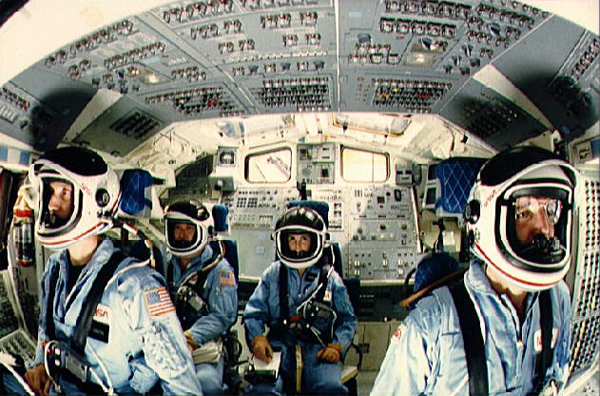
Flight deck wide-angle view of STS-51L crew all dressed up and ready to go

It is frustrating when minor issues become show stoppers. Today’s first launch from Pad 39B was thwarted by a simple tool that wouldn’t come off the hatch on Challenger as we locked the crew in the Orbiter. We finally sawed it off and then drilled out a bolt to replace it. By the time we had solved the issue the winds were unacceptable for a landing if we had to abort and bring the Challenger back. We are now scheduled for launch tomorrow morning, January 28.

The weather was cold this morning. We’ve never launched in conditions this cold, but it is a lot colder than 36 ° F only 20,000 feet above Kennedy Space Center (KSC) and the Challenger will be there about 30 seconds after launch. I guess we shouldn’t be complaining down here.

STS-51L mid-deck with rest of crew strapped in

Tomorrow’s forecast is for clear skies and temperatures to be cold overnight and not as warm tomorrow during the day. The big issue on the Launch Pad for us is whether or not the temperatures will drop below freezing tonight. We have a lot of water piped in and around the pad area and if the water in the pipes freeze and break the Challenger might not go up for several days. One option being discussed is to open valves tonight and let the water flow to keep it from freezing. Trying to heat the entire pad area is not a realistic option and any open heat source is dangerous considering the fuels we have in and around the Shuttle.

If everything goes smoothly tomorrow we will finally get Challenger on its way for its 10th mission. We are now almost a week behind on this launch because of the delays of Columbia and the weather, both here and at other abort landing sites. After the launch we have to clean up the chemical residue from the Solid Rocket Boosters (SRBs) and inspect the launch pad area for damage. Repairs and  maintenance will be scheduled and addressed, which is currently underway at Launch Pad 39A after Columbia’s January 12th launch. 

By this time next year we will be more like the gate at an airport with a continuous process of preparing for launch, repairing from launch, and preparing for next launch, with three active pad crews (two here at KSC and one at Vandenberg AFB.) President John F. Kennedy gave our country a dream to reach for the stars and it is exciting to watch the dream become a reality.

15 Days in January – Day 13

26 Thursday Jan 2012

Posted by Paul Kiser in Fiction, Government, History, Science, Space, Technology, US History

≈ Leave a comment

Tags

Challenger, Launch Rats, NASA, Space Station, STS-51L, Teacher in Space, USSR

(NOTE: The following is a fictionalized account of the 15 days in January 1986 leading up to the Challenger Space Shuttle disaster on the 28th of that month; however, the details of weather and NASA events are based on known historical data.)

Titusville, Florida
Sunday, January 26, 1986
High Temp: 66° F Low Temp: 48° F

Launch Rats working on the hydrogen fuel line

What’s next? One of the people on the launch pad team (we’re known as ‘Launch Rats’) likes to say, “What’s next?” He rarely stops moving. Once he’s completed one task he wants to move on. That is a great philosophy to have at NASA. We are constantly facing a new task or issue as we prepare for each launch and in order to address them all we have to keep moving.

That’s also what we have done in the American space program. It was a major achievement to get to the Moon and back, but that was only one task. We started out behind the U.S.S.R. in space technology, but we now are in the pilot’s seat in determining the future of space exploration. U.S.S.R is copying our Shuttle design so they can also have a reusable space vehicle, but they are at least a decade behind us.

Our family of Orbiters have the capacity to build a massive space station, much larger than the Soviet space station that is rumored to be launched sometime this year. Once we have a platform in space we can prepare for extended missions to the Moon or Mars without the current limitation of a single rocket’s lift capabilities. That is what’s next for America’s space program.

Tomorrow, pending good weather, we will send Challenger on its way, and before they are in orbit we have a Launch Rat that will be saying, “What’s next?”

15 Days in January – Day 12

25 Wednesday Jan 2012

Posted by Paul Kiser in Education, Fiction, Government, History, Public Relations, Science, Space, Technology, US History

≈ 1 Comment

Tags

1986, Challenger, Christa McAuliffe, Dick Scobee, Kennedy Space Center, KSC, NASA, Space Shuttle, STS-51L, Teacher in Space

(NOTE: The following is a fictionalized account of the 15 days in January 1986 leading up to the Challenger Space Shuttle disaster on the 28th of that month; however, the details of weather and NASA events are based on known historical data.)

Titusville, Florida
Saturday, January 25, 1986
High Temp: 73° F Low Temp: 57° F

Teacher in Zero G - Christa McAuliffe trains for STS-51L

The launch of STS-51L is now scheduled for Monday. We were scheduled for a liftoff Sunday morning, but tomorrow’s weather is predicted to be as bad or worse than today’s, which was foggy until about noon. Hopefully, we can get Challenger off the ground on the 27th and then focus on Columbia’s next launch in March.

The seven astronauts going up with Challenger on Monday include our first teacher. The Teacher in Space Project was announced by President Ronald Reagan in the Fall of 1984. Last Summer Vice President George Bush announced that Sharon Christa McAuliffe was selected as the first Teacher in Space from 11,000 applicants. Christa teaches in Concord, New Hampshire and submitted her application on the last day they were being accepted.

STS-51L crew trains for emergency evacuation from launch pad

Mrs. McAuliffe, as she is known in the classroom, has always dreamed of being part of the space program and is pleased to have the chance to take her classroom skills into space. Christa talked about the opportunity she has been given, saying:

Imagine me teaching from space, all over the world, touching so many people’s lives. That’s a teacher’s dream! I have a vision of the world as a global village, a world without boundaries. Imagine a history teacher making history!

In addition to Mrs. McAuliffe will be four members of the ‘Class of 1978.’ Commander Francis R.’Dick’ Scobee, Mission Specialists Ellison ‘El’ S. Onizuka, Judith ‘Judy’ A. Resnik, and Ronald ‘Ron’ E. McNair were all selected as astronaut candidates in January of 1978. The other two crew members are Pilot Michael J. Smith and Payload Specialist Gregory Jarvis.

Commander Dick Scobee noted the opportunity of the Teacher in Space Project when he said:

“My perception is the real significance of it, and especially a teacher, is that it will get people in this country, especially the young people, expecting to fly in space. That’s the best thing that can happen to our program. The short-term gain is a publicity gain. The long term gain is getting expectations of the young people in this country to the point where they expect to fly in space, they expect to go there, they expect this country to pursue a program that allows it to be in space permanently to work and live there, to explore the planets.”

The Teacher in Space Project is just one more part in keeping America a world leader by bringing space down to Earth. On Monday we will take the next step with the beginning of mission STS-51L…assuming the weather cooperates!

15 Days in January – Day 11

24 Tuesday Jan 2012

Posted by Paul Kiser in Communication, Education, Fiction, Government, History, Information Technology, Science, Space, Technology, US History

≈ Leave a comment

Tags

Challenger, Halley's Comet, Kennedy Space Center, KSC, NASA, Satellite, Space Shuttle, SPARTAN 203, STS-51L, TDRS, Teacher in Space

(NOTE: The following is a fictionalized account of the 15 days in January 1986 leading up to the Challenger Space Shuttle disaster on the 28th of that month; however, the details of weather and NASA events are based on known historical data.)

Titusville, Florida
Friday, January 24, 1986
High Temp: 66° F Low Temp: 55° F

TDRS satellite to be launched by Challenger STS-51L

This afternoon’s launch had to be scrubbed. The weather here was cool and damp, but the real problem was the weather at one of the abort landing sites. We have an alternate abort site but they cannot handle a nighttime landing (an abort on this side of the world would be a night landing there,) so the launch was rescheduled for tomorrow morning in case we have to activate the alternate abort site. That would allow Challenger to land in daylight at the alternate site if they have to abort.

The launch was then pushed back another day because of the morning versus afternoon liftoff. The problem is that we have a set amount of work to do and it was quickly determined that we would not be ready for launch by Saturday morning. Mission Control then moved the launch to Sunday morning. 

SPARTAN 203 satellite to have its eye on Halley's Comet

Once we finally do get Challenger in orbit, the STS-51L mission has several goals. One will be to launch the TDRS-2 satellite, which is a communications relay station for analog and digital signals. These satellites are the next generation in communication technology allowing information to be transmitted around the world in seconds. Another small satellite called SPARTAN 203 is being deployed to observe Halley’s Comet, which will reach its perihelion (closest approach to the Sun) on February 9, 1986.

In addition, this mission will send our first “Teacher in Space.” More about that tomorrow. 

15 Days in January – Day 10

23 Monday Jan 2012

Posted by Paul Kiser in Fiction, Government, History, Science, Space, Technology, US History

≈ Leave a comment

Tags

C1, C2, C3, Challenger, Criticality, KSC, NASA, space flight, STS-51L

(NOTE: The following is a fictionalized account of the 15 days in January 1986 leading up to the Challenger Space Shuttle disaster on the 28th of that month; however, the details of weather and NASA events are based on known historical data.)

Titusville, Florida
Thursday, January 23, 1986
High Temp: 75° F Low Temp: 53° F

Earth looking out through Challenger cargo bay

Tomorrow we should launch Challenger on its 10th mission. Temperatures were seasonal today; however, the weather is questionable as another cold front is moving through tomorrow. We won’t know if the launch is a go or not until a few hours or less before liftoff.

Beyond weather considerations, there are thousands of things that have to be perfect before a mission is given a “go for launch.” It’s a wonder we ever get a Space Shuttle off the ground. Every individual component of the Orbiter, the External Tank (ET), and the Solid Rocket Boosters (SRBs) is rated in one of five categories of impact on the mission, vehicle, and/or crew if the part fails. The ratings are as follows:

  • Criticality 1 (C1) – Loss of vehicle or crew if the component fails
  • Criticality 2 (C2) – Loss of mission
  • Criticality 3 (C3) – Component will not have fatal impact on crew, vehicle, or mission if it alone fails
  • Criticality 1R (C 1R) – Redundant component, but loss of vehicle or crew if both primary and redundant components fail
  • Criticality 2R (C 2R) – Redundant component, but loss of mission if both primary and redundant components fail

Any component that is not rated C3 and has a known issue not only stops the countdown, but the entire program, until resolved. When trying to put seven people and tons of cargo into Earth orbit, there are a lot of components that fall into the C1, C2, C 1R, or C 2R categories. Safety can be annoying, but it save lives.

Crew of Challenger STS-7 mission working in space

That said, it is impossible for any human, regardless of how careful, intelligent or well-educated, to be able to anticipate every possible problem. Exploration of uncharted territory comes with a price and that price is the loss of human life. Over 700 people died trying to reach the North Pole and even there we have air to breathe, water, and survivable temperatures if properly dressed. In space there is no air, no water, and a human dies if directly exposed to the vacuum of space.

Space travel is risky on the best of days. Astronauts are put in a ship that is designed to be as light-weight as possible with no significant armor or shielding around them. They are attached to two highly explosive solid rocket boosters that would flatten a small city if they exploded, connected to a massive tank filled with hydrogen and oxygen that has a nasty tendency to flash burn if it comes in contact to even a small flame or spark.

In addition, the speeds and the pressures that astronauts experience are unlike any other reality most humans can imagine. There is no doubt that human life will be lost in the pursuit of space exploration. We will do everything we can to safeguard our astronauts, but at some point we will discover what we did not anticipate. At some point an accident will occur on the ground or in flight. We will investigate, learn where we failed and moved forward again.

For centuries humans sailed near the coastline because no one knew what lie out across the sea. Staying close to shore taught us how to sail, while minimizing the risk. Even then ships sank and people died. The Space Shuttle program is our way of sailing near the coastline. We send people up into low Earth orbit and learn how to ‘sail’ in space. After a few decades we will be ready to go out into open space, just as ships were ready to cross open seas.

There are some who ask why should we reach out into space. That is probably what some people asked sailors who went off to explore the new world. But those brave men sailed off into uncharted waters and everything we now enjoy in the United States of America is due to those who took the risks to leave behind the safety of ‘the known’ in order to explore the unknown.

The answer to those people who want to know ‘why’ is simply this: we don’t know why…YET. After we get there we will know why it was so important we went. That is the way it has always been when exploring the unknown. That is the way it will always be.

15 Days in January – Day 8

21 Saturday Jan 2012

Posted by Paul Kiser in Fiction, Government, History, Science, Space, Technology, US History

≈ Leave a comment

Tags

Challenger, hot gases, joint leakage, NASA, O-rings, Solid Rocket Boosters, SRB, STS-51-L, STS-51B, STS-51L, STS-6, STS-7, STS-8

(NOTE: The following is a fictionalized account of the 15 days in January 1986 leading up to the Challenger Space Shuttle Disaster. The character’s account is fictional; however, the details of weather and Space Shuttle events are based on known historical facts.)

Titusville, Florida
Tuesday, January 21, 1986
High Temp: 64° F Low Temp: 45° F

Challenger rolls out to Launch Pad 39A

Today we are having another day of cool, but clear weather with the wind out of the north. Challenger (OV-099) is still being prepped for a Friday launch and I’m just grateful that the original launch date was pushed back because of Columbia’s flight delays. Hopefully, it will be warmer on Friday, which will make the launch more comfortable for everyone watching. 

Challenger STS-6, her maiden voyage

As I said yesterday, Challenger has given us many ‘challenges.’ The fact that OV-099 was not originally intended to fly may be part of the reason she has been sometimes reluctant to leave Earth. That said, despite her temperament, Challenger  has broken new ground for the program.

After her problematic maiden voyage the second flight was relatively trouble-free. Launched on June 18, 1983, Challenger STS-7 was the first mission with a planned landing at KSC, but that had to be waved off because of weather.

Challenger in lightning storm just prior to liftoff

Challenger’s third mission (STS-8) was supposed to be in July, but because a payload issue the launch was pushed back to August 30, 1983. After a spectacular lightning show just before launch, Challenger lifted off almost on time making history as the first nighttime launch of a Space Shuttle. This feat was complimented by the first nighttime landing when Challenger returned on September 5, 1983.

1984 was a great year for Challenger. OV-099’s fourth, fifth, and sixth missions gave us the first untethered ‘space walk,’ the first Orbiter landing at KSC, the successful recovery, repair, and redeployment of an orbiting satellite, the first time seven people were launched into space, and the first time two women were in space at the same time.

Bruce McCandless II became first human satellite on STS-41B

The seventh mission for Challenger, and her first of 1985, was unusual because it was the only mission where the Shuttle had been delivered to the launch pad and then had to be pulled back to the Vertical Assembly Building (VAB.) Concerns about the reliability of a satellite in the payload bay of Challenger forced NASA to cancel the mission.

After a two month delay Challenger’s new STS-51B mission was finally launched on April 29, 1985, with the European Space Lab – 3 in its payload bay. The mission was a success with the only issue with the flight occurring after the Solid Rocket Boosters (SRB) were recovered. The left SRB had evidence that it leaked hot gases through a joint area and two rubber o-rings that were designed to sealed the joint were damaged. One ring had 4mm of erosion and the other had 8mm of erosion.

This leakage presents two issues. The first is the potential loss of pressure if the leak is too major and the second is the danger of hot gases that might be directed toward the External Tank (ET), the Orbiter, or the other SRB, which might damage them. Fortunately, this was not an issue during this flight.

Despite the SRB hot gases leakage issue on her seventh mission, the biggest scare Challenger would give us was on her eighth mission. I’ll talk about that tomorrow. 

15 Days in January – Day 7

20 Friday Jan 2012

Posted by Paul Kiser in Fiction, Government, History, Science, Space, Technology, US History

≈ Leave a comment

Tags

Challenger, NASA, Orbiter, OV-099, Space Shuttle, STA-099, STS-51L

(NOTE: The following is a fictionalized account of the 15 days in January 1986 leading up to the Challenger Space Shuttle Disaster. The character’s account is fictional; however, the details of weather and Space Shuttle events are based on known historical facts.)

Titusville, Florida
Monday, January 20, 1986
High Temp: 66° F Low Temp: 48° F

Challenger atop the Boeing 747 on April 18, 1983

We are now four days from the launch of Challenger on the STS mission 51L. The decision was made to push back the date to Friday the 24th. I think that will be a great way to end our week. 

Challenger is our second space-qualified Orbiter. Columbia was the first. Challenger has been responsible for nine of 24 completed missions, and at times Challenger has been challenging.

Challenger rolls out to Launch Pad 39A for maiden voyage (8 DEC 1982)

While most civilians know Challenger by its name, we know it as OV-099 (technically:  Orbiter Vehicle-099;) however, that was not its original designation because initially it was not intended to fly.

Because of the lack of computer simulations, STA-099 (Structural Test Vehicle-099) was built to be a full-scale test model to determine if the design would meet stress expectations without failing. The contract to build it was awarded on July 26, 1972, but construction didn’t begin until November 21, 1975. After a year of testing was decided that it would be quicker and less expensive to refit STA-099 for space flight rather than rebuild the original air-flight test vehicle we know as Enterprise (OV-101.) The conversion of STA-099 to OV-099 began on January 28, 1979, which, in eight days, will be exactly seven years ago.

Repairing/replacing Challenger's main engines before its maiden flight

Challenger rolled out of the Palmdale assembly facility on June 30, 1982 and arrived at KSC on July 5th. Challenger was prepped for its first flight, which was scheduled for January 20, 1983, but while it sat on Launch Pad 39A testing revealed a hydrogen leak in one of the main engines. Subsequently, Challenger had to have her main engines removed for repairs while sitting on the launch pad. One of the engines had to be completely replaced.

Challenger problems did not end with the engines. A severe storm contaminated the payload while she sat on the pad. The payload had to be decontaminated. Challenger finally was successfully launched on her maiden flight on April 4, 1983, 51 months after the conversion began.

More on this ship’s history tomorrow.

Other Pages of This Blog

  • About Paul Kiser
  • Common Core: Are You a Good Switch or a Bad Switch?
  • Familius Interruptus: Lessons of a DNA Shocker
  • Moffat County, Colorado: The Story of Two Families
  • Rules on Comments
  • Six Things The United States Must Do
  • Why We Are Here: A 65-Year Historical Perspective of the United States

Paul’s Recent Blogs

  • Dysfunctional Social Identity & Its Impact on Society
  • Road Less Traveled: How Craig, CO Was Orphaned
  • GOP Political Syndicate Seizes CO School District
  • DNA Shock +5 Years: What I Know & Lessons Learned
  • Solstices and Sunshine In North America
  • Blindsided: End of U.S. Solar Observation Capabilities?
  • Inspiration4: A Waste of Space Exploration

Paul Kiser’s Tweets

Tweets by PaulKiser

What’s Up

March 2026
S M T W T F S
1234567
891011121314
15161718192021
22232425262728
293031  
« Jun    

Follow Blog via Email

Enter your email address to follow this blog and receive notifications of new posts by email.

Join 688 other subscribers

Create a website or blog at WordPress.com


Loading Comments...