3rd From Sol

~ Learn from before. Live now. Look ahead.

3rd From Sol

Tag Archives: launch delays

Zuma Mystery: It’s Classified and Invisible…Apparently

01 Thursday Feb 2018

Posted by Paul Kiser in Business, Communication, Crisis Management, Customer Relations, Ethics, Government, History, Honor, Management Practices, NASA, Pride, Public Image, Public Relations, Relationships, Science, Space, SpaceX, Technology, United States, US History, US Space Program

≈ Leave a comment

Tags

deployment, Elon Musk, failed mission, fairing, Fairings, Falcon 9, Indian Ocean, launch, launch delays, Northrop Grumman, orbital inclination, secret satellite, SpaceX, USA-280, Zuma

On 8 January 2018 the top-secret USA-280 satellite, as known as Zuma, went up, but a funny thing happened on the way to orbit. It was launched to the northeast at a vector of approximately 51° off the equator. A rough course estimate would have taken Zuma south of Great Britain, across Europe (possibly over France, Italy, and Greece,) over Saudia Arabia, and to the Indian Ocean west and/or south of India. According to one unnamed source, that is where the flight of USA-280 ended.

Zuma went down in the Indian Ocean?

Possible approximate flight path of Zuma

Elon We Have a Problem

The first hint that something was wrong is when Brian Mahlstedt, the launch narrator for SpaceX, paused for 90 seconds after announcing that the fairing (the cover around the satellite) would deploy “…any second..” and then changed the subject when he began talking again. This was also significant because he said that coverage of the launch phase of the would end AFTER the deployment of the fairings. Had the fairings deployed as scheduled it would not have crossed over into the coverage of the landing of the booster phase, which was what happened. 

The second hint was when SpaceX public relations (PR) didn’t spike the ball after the launch, praising its success.

By the next morning, sources were quietly saying that the satellite didn’t make orbit. Some seemed to suggest that the fault was with the SpaceX rocket. Some indicated the release platform of the satellite failed, keeping it connected to the upper stage as it fell back to Earth.

SpaceX came out with a qualified statement that didn’t deny the failure to achieve orbit but adamantly implied that the SpaceX rocket performed as intended. Northrop Grumman, the contractor for the super secret satellite and the release platform announced that it didn’t comment on confidential payloads. 

Disinformation Campaign

A few media sites suggested that maybe everything was fine and the satellite was safely in orbit. It was a tactic that a covert agency might employ to feed a few trusted sources with a disinformation campaign to calm the discussion of failure, and for the most part, it worked. Few follow-up reports have been made about USA-280.

The evidence, or lack of it, is telling a different story. Astronomy hobbyists, some highly skilled in finding and tracking human-made objects in orbit, have spent the past three weeks trying to find the ‘invisible’ satellite with no success. They have found a satellite lost over ten years ago, but no one has sighted the wayward Zuma satellite.

The Zuma Fairing Mystery?

The chronology of the fairing deployment is as follows: 

  • T+0:50 seconds (50 seconds after liftoff) – A SpaceX announcer begins a live and nearly continuous commentary regarding upcoming events with the Falcon 9 rocket, pausing only for those events to be confirmed by SpaceX control.
  • T+2:03 – SpaceX announcer pauses as four events related to second stage separation are about to begin.
  • T+3:06 – SpaceX announcer resumes commentary and confirms a successful second stage separation, and explains at T+3:15 that fairing separation “…should occur any second now” (ejection of protective nose shell around satellite.) He continues on to say that he will confirm the fairing separation after it occurs.
  • T+3:26 – SpaceX announcer begins a pause that lasts for one minute and thirty seconds.
  • T+4:57 – SpaceX announcer says, “Alright, so we’ll address the fairing deployment in a second once we have more information, but for now we’re going to shift our transition back to our secondary mission…”
  • T+5:17 – SpaceX announcer says, “…ah, quick sidebar here that we did get confirmation that the fairings did deploy.”

The launch of Zuma was delayed last November because of an issue with the fairing deployment. The question is whether the previous issue along with the 90-second pause in announcing the fairing deployment indicate there was an in-flight problem with the fairing.

Best Guess?

Everything is speculation. Based on what we know, this is my suggestion of the most likely scenario:

  • The fairing failed to deploy at the prescribed time, but it did deploy late. (That would fit SpaceX’s non-denial denial.)
  • The late deployment caused a decision to abort the flight so that it would come down in the Indian Ocean.
  • Had the abort been held off, the flight might have been able to continue, but point-of-no-return in the abort decision had been reached and the flight was terminated.

This would still allow SpaceX to claim its rocket performed ‘nominally’ and only fudge a little when not admitting the fairing issue. It would also suggest that there was disagreement during the ascent phase and that the incident is a sore spot for the parties involved…

…but you didn’t hear that from me.

[COUNT TO 500:  490th Article in PAULx]

The Day Business Killed The NASA Space Program

28 Sunday Jan 2018

Posted by Paul Kiser in Business, Government, History, NASA, Politicians, Politics, Public Image, Public Relations, Science, Space, Technology, US History, US Space Program

≈ 2 Comments

Tags

aerodynamic forces, astronauts, Challenger, Disaster, Ethics, International Space Station, Kennedy Space Center, launch delays, manned space program, manned spacecraft, Morton Thiokol, NASA, Solid Rocket Boosters, space exploration, space flight, Space Program, Space Shuttle, SRB, STS-51-L, Vintage Space

Thirty-two years ago today, the first in-flight deaths of NASA astronauts tragically occurred after a launch that wasn’t supposed to happen. Some have proposed that the accident was a result of NASA and their contractors being pressured for public relations reasons. The truth is that their deaths were caused by trying to make space a business venture.

Seven astronauts killed in the Challenger accident

STS-51-L crew: (front row) Michael J. Smith, Dick Scobee, Ronald McNair; (back row) Ellison Onizuka, Christa McAuliffe, Gregory Jarvis, Judith Resnik.

 Death By Impact

On 28 January 1986, seven astronauts in the Space Shuttle Challenger (STS-51-L) died as their crew compartment slammed into the Atlantic Ocean after falling 12 miles in two and a half minutes. They were not killed in the breakup of the Shuttle, nor did they become unconscious from the depressurization of the crew compartment, as suggested by NASA. Some, if not all astronauts, were aware that they were about to die and knew there was nothing they could do to avoid it.

Trail of Causes

The technical primary cause of the accident was weather-related. The Space Shuttle was not to be launched at temperatures below 4° C (39° F) and had never been launch at temperatures below 12° C (54° F.) A few hours before the launch the temperature had fallen to -8° C (18° F.)

The technical fault caused by the weather were rubber O-rings at each of the joints of the solid rocket boosters (SRB.) The O-rings needed to be warm enough to expand to seal the joint to avoid burning gases from blowing out between the sections of the solid rocket booster. The concern was that the power of the burning fuel would rupture the joint at launch and cause an uncontrolled blast of hot gases to escape causing an explosion on the launch pad.

Known Problem to NASA

After previous Space Shuttle launches some of the recovered solid rocket boosters had shown ‘blow-by’ of the O-rings. That meant that the O-rings had not completely sealed the SRB joint and could have potentially compromised the safety of the crew had the blow-by breached to the exterior of the joint.

Engineers at Morton Thiokol, the Utah contractor that designed and built the solid rocket booster, had felt that NASA was ignoring their concerns about the issues regarding the SRB joints. In an emergency teleconference meeting held the night before the launch, the engineers made it clear that the temperatures were unacceptable.

NASA decision-makers did not like the ‘no-launch’ answer and suggested that if they didn’t launch the next day, the company would be blamed for the delay. Morton Thiokol managers caved into NASA and overruled their own engineers. They gave a go for launch. Just prior to the reversal of the recommendation the general manager of Morton Thiokol said to the Vice President of Engineering, “…take off your engineering hat and put on your management hat…” It was the moment that sealed the fate of the seven Challenger astronauts.

Run NASA Like a Business

Previous space projects at NASA had been focused on spaceflight. The goal of NASA and its contractors were to safely put humans in space.

That changed after we reached the Moon. We had done the impossible and now space was less interesting and too expensive. The deflation of post-Moon public support forced NASA to find a justifiable reason to move forward. The decision was that NASA must end the exploration of space and build the ‘business’ of space. The Space Shuttle was intended to make the United States leaders in space commerce.

The Space Shuttle was built to be a reusable, frequent-launch spacecraft that would make traditional, single-use rockets too expensive and unreliable for commercial customers to use. The idea of running NASA like a business became the core value of the organization.

Delays, Delays, Delays

By January of 1986, NASA far behind its business goals. It was not launching the Shuttle frequently enough, nor was the reusability function creating the desired savings. STS-51-L was a critical point in making NASA run like a business. Delays in the launch of previous Shuttle (STS-61-C) had pushed back the STS-51-L flight twice. The launch had been pushed back four more times because of weather and equipment malfunctions.

On the Business Stage

Business is like theatre. It doesn’t matter what is going on backstage because the only thing that counts is what the audience can see. Backstage, NASA was in crisis, but if they could launch STS-51-L, they could maintain the perception that they had everything under control.

There were several public image opportunities if the launch occurred on the 28th that would be lost if it was delayed again. For Challenger and NASA, the teleconference on January 27th had only one possible business outcome. It must be launched. The engineers at Morton Thiokol didn’t know that they were up against a business mentality when they met on that night. Nor did the managers at Morton Thiokol or NASA know that they were about to kill seven astronauts. To them, it was just business-as-usual.

Events in Motion

Once the decision was made to launch events were set in motion.

  1. The cold temperatures caused the O-rings to become rigid. After the SRB’s were ignited a puff of hot gases blew through the O-rings at a point near the large external fuel tank.
  2. The joint temporarily sealed itself off from the debris of the exhaust of the burning fuel.
  3. As the Shuttle rose after launch it hit the worst wind shear ever experienced by a Shuttle and the debris sealing the O-ring broke free allowing the hot gases to burn through the joint.
  4. The flame from the joint acted as a blowtorch cutting into the external fuel tank and finally igniting the hydrogen fuel.
  5. The resulting hydrogen fuel explosion ripped the External Tank into pieces, pushing the Shuttle away.
  6. The Shuttle rolled out of its nose-forward position and was blown apart by aerodynamic forces.
  7. The crew compartment broke free of the Shuttle and continued to ascend until it lost momentum and began to fall down toward the ocean. It did not suddenly depressurize, but likely, depressurized slowly. The astronauts were jolted by the breakup, but not severely injured.
  8. At least three of the astronauts turned on personal oxygen after as the crew compartment fell. One did not, and the equipment for the other three astronauts was not found.
  9. The crew compartment fell and eventually hit the ocean, killing the seven astronauts on contact.
  10. NASA created a story that the astronauts were killed instantly, even after they knew that the events during the accident did not support the story. 

End of the NASA Manned Space Program

The Space Shuttle didn’t fly again for almost three years. It would resume flight for an additional 13 years, but it failed to meet the objectives of making space a business venture. The accident exposed the inherent issues of running a space program like a business and political pressure undermined the concept of a manned space program.

In 2011, NASA ended the United States manned space program with the last launch of the Space Shuttle. Since the last Shuttle launch, NASA has worked hard at pretending to have a manned space program by paying Russia to send U.S. astronauts to the International Space Station and producing videos of the development of the next generation of manned spacecraft. The reality is that NASA no longer can put a human in space, at won’t at any time in the near future.

Below is Vintage Space’s take on the cause of the Challenger disaster.

15 Days in January – Day 14

27 Friday Jan 2012

Posted by Paul Kiser in Fiction, Government, History, Science, Space, Technology, US History

≈ Leave a comment

Tags

1986, Challenger, Disaster, freezing temperatures, launch delays, Launch Pad, NASA, Pad 39A, Pad 39B, Space Shuttle, STS-51L, Weather

(NOTE: The following is a fictionalized account of the 15 days in January 1986 leading up to the Challenger Space Shuttle disaster on the 28th of that month; however, the details of weather and NASA events are based on known historical data.)

Titusville, Florida
Monday, January 27, 1986
High Temp: 55° F Low Temp: 36° F

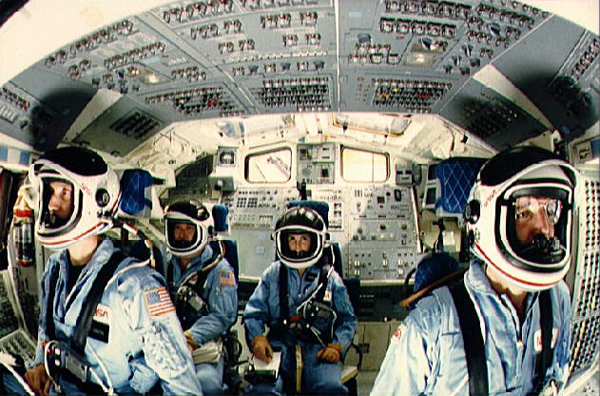
Flight deck wide-angle view of STS-51L crew all dressed up and ready to go

It is frustrating when minor issues become show stoppers. Today’s first launch from Pad 39B was thwarted by a simple tool that wouldn’t come off the hatch on Challenger as we locked the crew in the Orbiter. We finally sawed it off and then drilled out a bolt to replace it. By the time we had solved the issue the winds were unacceptable for a landing if we had to abort and bring the Challenger back. We are now scheduled for launch tomorrow morning, January 28.

The weather was cold this morning. We’ve never launched in conditions this cold, but it is a lot colder than 36 ° F only 20,000 feet above Kennedy Space Center (KSC) and the Challenger will be there about 30 seconds after launch. I guess we shouldn’t be complaining down here.

STS-51L mid-deck with rest of crew strapped in

Tomorrow’s forecast is for clear skies and temperatures to be cold overnight and not as warm tomorrow during the day. The big issue on the Launch Pad for us is whether or not the temperatures will drop below freezing tonight. We have a lot of water piped in and around the pad area and if the water in the pipes freeze and break the Challenger might not go up for several days. One option being discussed is to open valves tonight and let the water flow to keep it from freezing. Trying to heat the entire pad area is not a realistic option and any open heat source is dangerous considering the fuels we have in and around the Shuttle.

If everything goes smoothly tomorrow we will finally get Challenger on its way for its 10th mission. We are now almost a week behind on this launch because of the delays of Columbia and the weather, both here and at other abort landing sites. After the launch we have to clean up the chemical residue from the Solid Rocket Boosters (SRBs) and inspect the launch pad area for damage. Repairs and  maintenance will be scheduled and addressed, which is currently underway at Launch Pad 39A after Columbia’s January 12th launch. 

By this time next year we will be more like the gate at an airport with a continuous process of preparing for launch, repairing from launch, and preparing for next launch, with three active pad crews (two here at KSC and one at Vandenberg AFB.) President John F. Kennedy gave our country a dream to reach for the stars and it is exciting to watch the dream become a reality.

Other Pages of This Blog

  • About Paul Kiser
  • Common Core: Are You a Good Switch or a Bad Switch?
  • Familius Interruptus: Lessons of a DNA Shocker
  • Moffat County, Colorado: The Story of Two Families
  • Rules on Comments
  • Six Things The United States Must Do
  • Why We Are Here: A 65-Year Historical Perspective of the United States

Paul’s Recent Blogs

  • Dysfunctional Social Identity & Its Impact on Society
  • Road Less Traveled: How Craig, CO Was Orphaned
  • GOP Political Syndicate Seizes CO School District
  • DNA Shock +5 Years: What I Know & Lessons Learned
  • Solstices and Sunshine In North America
  • Blindsided: End of U.S. Solar Observation Capabilities?
  • Inspiration4: A Waste of Space Exploration

Paul Kiser’s Tweets

Tweets by PaulKiser

What’s Up

May 2026
S M T W T F S
 12
3456789
10111213141516
17181920212223
24252627282930
31  
« Jun    

Follow Blog via Email

Enter your email address to follow this blog and receive notifications of new posts by email.

Join 688 other subscribers

Create a website or blog at WordPress.com

Loading Comments...