3rd From Sol

~ Learn from before. Live now. Look ahead.

3rd From Sol

Tag Archives: Earth Science

A New Year’s Earthquake?

21 Thursday Dec 2017

Posted by Paul Kiser in About Reno, Education, Science, solar, Space

≈ Leave a comment

Tags

astronomy, crustal plates, Earth Science, earthquakes, geology, Holiday earthquake 2018, orbit, perigee, perihelion, plate tectonics, USGS


Earth Science is one of my life’s passions. It was my first choice of study in college, but I gave up it when I discovered that calculus was required for any science degree.

However, I am a creature that is more fascinated by the world around me, than the details of societal norms. I don’t have a degree in science, but I do a lot of research on what real scientists have learned. That is why I’m interested in the orbits of the Sun and the Moon and the potential of an increase in earthquake activity starting near Christmas and continuing through the first week in January.

The gravitational pull of the Sun and Moon do not cause earthquakes. Earthquakes are caused by the movement of crustal plates at and near the surface of our planet. Anyone who claims that the Sun and Moon cause earthquakes is dancing on fringe science.

However, as the plates grind against each other they create stress and at times lock up. It is when a region of locked plates break free that an earthquake occurs. The bigger the movement after the release, the bigger the earthquake.

The gravitational pull of the Sun and Moon affects the Earth. This pull may have trigger effect on some earthquakes under certain conditions. It would be a situation where a region is near the release point, and the tug of the Sun and/or Moon gives the needed boost to start the movement of the stressed area.

Currently, the Earth is approaching its annual perihelion (closest approach) to the Sun. Perihelion will officially occur at 9:34 pm PST on 2 January 2018. At the same time the Moon is approaching its closest approach to Earth (perigee) for all of 2018 at 1:48 pm on 1 January.

The Sun and the Moon will be on opposite sides of the Earth around New Year’s Day, so the gravitational pull will be most intense at that time, potentially stretching areas of the Earth’s crust that are ready to break free. Will this cause and increase in earthquakes? I can’t answer that. No one can. But it will be interesting to track.

As always, preparation for an earthquake in those areas prone to have earthquakes, and in coastal areas is always wise, regardless of the orbits of the Sun and the Moon.

Happy Winter Solstice!

Are We Missing an Ice Age? (Part III of III)

21 Monday Nov 2011

Posted by Paul Kiser in History, Science

≈ 16 Comments

Tags

apsidal precession, axial precession, Earth Science, Earth's orbit, eccentricity, Global warming, Ice Age, insolation, Milankovitch Cycles, Milution Milankovic, obliquity, Warm Age

PART III – Should We Be In An Ice Age Now? 

IMAGE 1.0 - The Northern Hemisphere at the end of the last Ice Age (10,000 years ago)

RECAP: In Part I of this series, we looked at how scientists have determined that Earth has experienced regular cycles of cold climates followed by brief periods of warm climates during the last 400,000 years. We learned that the current cycle has been different because the warm period has persisted when past warm climates have rapidly dropped back into a cold climate. We also discussed how the Sun acts as a ‘battery charger’ for Earth’s climate.

Part II of the series explained that Earth’s orbital relationship with the Sun also follows a cyclic pattern and that almost 100 years ago, a Serbian named Milutin Milanković  proposed possible mechanisms related to Earth’s tilt and orbit that could be the root cause of the regular cycle of Ice Ages.

PART III – Should We Be In An Ice Age Now?

No one can say for certain whether or not that we should be in an Ice Age today. Past Warm Ages have typically collapsed back into a cooler period within a few thousand years followed by a complete return to an Ice Age within about 10,000 years. If Earth past climate history is correct then our planet should be in a cooling period, if not into a full-scale Ice Age. Instead, Earth is warming. The Milankovitch Cycles don’t all concur on this issue, but there is some intriguing evidence that suggests we have missed a cooling period based on Earth’s orbit and tilt. 

Consider the factors discussed in Part II of this series.

Orbit Eccentricity or Circular to Ellipse
Our orbit eccentricity is about one-third the way from our lowest level, meaning Earth’s orbit is becoming more circular. It’s cycle is about the same as Earth’s climate cycle, so it could be a significant factor. Interestingly, the eccentric peak of .02 during the current cycle was half to one-third of the peak past three cycles (.04 to .06.)¹ Could that be a factor in the prolonged warm period? Possibly, but why? Earth just passed the peak a few thousand years ago so, does a low peak eccentricity result in a prolonged Warm Age?

Paul Kiser

Obliquity or Earth’s Tilt On Its Axis
Earth is about halfway between our high and low peak tilt angles.  Our planet’s tilt, or obliquity is on an approximate 41,000 year cycle, so we were just passing through our highest peak obliquity at the start of this Warm Period. If high tilt angle is a trigger for a Warm Age, then we should be cooling down, unless obliquity must be coupled with another factor to trigger a cooling period.

Axial Precession or Earth’s Wobble
Earth’s axis wobbles and it takes 26, 000 years to complete one cycle. It is hard to see a connection with the slow regression of the seasons and Earth’s climate, but perhaps the cycle of axial precession couples with another factor to trigger a cooling period, or sustain a Warm Age.

IMAGE 1.1 - Apsidal Precession - The Creep of the Seasons in Earth's Orbit

Apsidal Precession or The Hulu Hoop Effect
Apsidal precession is factor has some interesting possibilities on how it might impact Earth’s climate. Currently the Summer in the northern hemisphere occurs when Earth is farthest from the Sun (aphelion.) Our closest approach to the Sun (perihelion) occurs during Summer in the southern hemisphere.

IMAGE 1.2 Land Masses in the Northern Hemisphere

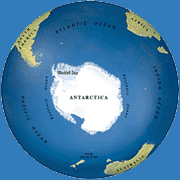
IMAGE 1.3 - Land Masses in the Southern Hemisphere

Earth’s northern hemisphere is about 40% land and 60% water. The southern hemisphere is about 20% land and 80% water. Land that is not covered with ice absorbs more energy than water because water reflects more of Sun’s energy back into space. In Part II we learned that the hemisphere that is in summer during perihelion receives 23% more solar radiation. Because of the greater land mass, the northern hemisphere will retain more of the summer Sun’s energy in 10,000 years (when perihelion occurs in July) than the southern hemisphere does currently.

From a standpoint of apsidal precession, Earth should be in the coldest period since we are closest to the Sun when the smallest percentage of our land mass will absorb the energy or insolation. 

Orbital Inclination
The tilt of Earth’s orbital plane off of the invariable plane is on a 100,000 year cycle, which coincides with Earth’s climate cycle. Since  higher angles of our orbital plane result in a higher obliquity and magnify the effect of land mass absorption differential between the two hemispheres, it could be a factor in triggering the Ice/Warm Age cycles; however, it is unclear how this factor could contribute to the prolonged warm period.

Are We Missing an Ice Age?
Earth’s climate cycle does not follow a perfect 100,000 year pattern. Most people would be happy if we never went into another Ice Age; however, if we have missed the trigger of the next Ice Age, what does that mean for our climate? Will Earth’s delicate climate balance be ruined leading into a runaway warm period or will the next Ice Age come in a rapid onset like in a disaster movie?

The Sun charges Earth’s climate ‘battery’ and variations in how much solar radiation our planet absorbs dramatically affects the environment for all life. It will be important for scientists to discover what is happening to our climate and why. Life on Earth exists in a narrow band that is not to cold and not to hot and we have no practical methods to reinforce or siphon off the Sun’s energy in a crisis.

While scientists to continue to examine this issue there are other issues that should be considered beyond climate. At least for the past 400,000 years, the Warm Ages have been relatively brief periods. It is during those brief periods of warmth that life has flourished, then the Earth has been cleansed with the next Ice Age. What will happen as insects, reptiles, and bacteria continue to  evolve and expand without an Ice Age to push back their spread across the globe? Is it possible that too much life will threaten human existence?

These are all questions that have to be answered as long as the Earth continues to avoid the next Ice Age.

PART I – Should We Be In An Ice Age Now?

PART II – Understanding the Milankovitch Cycles, Clues to Earth’s Climate Changes

NOTES AND REFERENCES

¹Wikipedia – The Free Encyclopedia. (2011). Milankovitch Cycles. Retrieved November 13, 2011, from http://en.wikipedia.org/wiki/Milankovitch_cycles.

IMAGE CREDITS

IMAGE  1.0 – Image thanks to http://www.space4case.com/mmw/pages/space4case/solar-system/earth/artic.php

IMAGE 1.1 – Image thanks to Wikimedia Commons at http://en.wikipedia.org/wiki/File:Precession_and_seasons.jpg

IMAGE 1.2 – Image thanks to http://www.learner.org/jnorth/tm/humm/WhyComeGlobalGame.html

IMAGE 1.3 – Image thanks to http://www.learner.org/jnorth/tm/humm/WhyComeGlobalGame.html

USA PDT [Twitter: ] [Facebook] [LinkedIn] [Skype: 775.624.5679]

The Tipping Point Explains How Twitter Works

20 Thursday May 2010

Posted by Paul Kiser in 2020 Enterprise Technologies, Book Review, Communication, Customer Relations, Customer Service, History, Information Technology, Internet, Lessons of Life, Public Relations, Random, Re-Imagine!, Rotary, Science, Social Interactive Media (SIM), Social Media Relations, The Tipping Point

≈ 1 Comment

Tags

40404, Bloggers, Blogging, Blogs, Earth Science, Jack Dorsey, Lightening, Malcolm Gladwell, New Business World, Public Image, Public Relations, Publicity, Rotarians, Rotary, Social Media, Social Networking, The Tipping Point, Thunderstorms, Tweets, Twitter, Wikepedia

by Paul Kiser

Paul Kiser - CEO of Enterprise Technologies, inc.

People will often to say to me, “I just don’t get Twitter.” What people have to understand is that Twitter functions like a thunderstorm in the world of ideas. In the summer, air (including water vapor) heats and rises. The water vapor in the air is wrung out of the rising air (water vapor condenses to water droplets) and clouds form. For reasons not exactly understood, a discharge of electricity leaps between the positive and negative regions. FLASH! BAM! A thunderstorm is born.

Like a summer thunderstorm, 40404* provides the environment for ideas to flash across the Internet. Jack Dorsey, the Chairman and one of the creators of Twitter eludes to this ‘electricity’ when explaining how they arrived at the name:

Ideas: Lightning on the grassy plains of Twitter

“…we wanted to capture that feeling: the physical sensation that you’re buzzing your friend’s pocket. It’s like buzzing all over the world. So we did a bunch of name-storming, and we came up with the word “twitch,” because the phone kind of vibrates when it moves. But “twitch” is not a good product name because it doesn’t bring up the right imagery. So we looked in the dictionary for words around it, and we came across the word “twitter,” and it was just perfect.

(*40404 is the SMS Code for Twitter – Read more here)

I was re-reading The Tipping Point by Malcolm Gladwell and he compares mass social events/phenomenons to epidemics.  He offers three factors that are common to all mass social behaviors.

  1. The Law of the Few
  2. The Stickiness Factor
  3. The Power of Context

Note that Gladwell’s book was first published in 2000, six years before Twitter was launched, but his three factors perfectly describe the workings of Twitter. The Law of the Few suggests that a few ‘extraordinary’ people tend to trigger mass social events. In the case of Twitter, we have users who the ability to attract masses of followers that fan out information to their followers, who continue the ‘retweets’ to their followers. A few people who have a large impact and influence throughout the world.

Not every tweet or URL of a blog, becomes a ‘Viral Tweet’ but those that do have a Stickiness Factor. They hit upon an idea or thought that causes an emotional reaction among other users, which leads to the final factor of The Power of Context. A Tweet that races across the Twitter world like lightning manages to ignite something that has been brewing in a person’s mind…more specifically brewing in the minds of many people, but somehow the Tweet or blog is the perfect polarity to cause a reaction in mass.

That is why Twitter is like a thunderstorm in the world of ideas. It provides the conditions and media for ideas and thoughts to leap out of one mind and into millions…in the flash of …well, enough with the analogy.

More blogs

  • Signs of the Times
  • The Quality of Relationships and Social Interactive Media
  • Rotary Magazine Dilemma Reveals the Impact of Social Media
  • How Social Interactive Media Could Transform Higher Education
  • How to Become a Zen Master of Social Media
  • Car Dealership Re-Imagines Customer Service
  • Death of All Salesmen!
  • Aristotle’s General Rules on Social Media
  • Social Media:  What is it and Why Should You Care?
  • Social Media 2020:  Keep it Personal
  • Social Media 2020:  Who Shouldn’t Be Teaching Social Media
  • Social Media 2020:  Public Relations 2001 vs Social Media Relations 2010
  • Social Media 2020: Who Moved My Public Relations?
  • Publishing Industry to End 2012
  • Who uses Facebook, Twitter, MySpace & LinkedIn?
  • Fear of Public Relations
  • Facebook, Twitter, LinkedIn…Oh My!
  • Does Anybody Really Understand PR?

Other Pages of This Blog

  • About Paul Kiser
  • Common Core: Are You a Good Switch or a Bad Switch?
  • Familius Interruptus: Lessons of a DNA Shocker
  • Moffat County, Colorado: The Story of Two Families
  • Rules on Comments
  • Six Things The United States Must Do
  • Why We Are Here: A 65-Year Historical Perspective of the United States

Paul’s Recent Blogs

  • Dysfunctional Social Identity & Its Impact on Society
  • Road Less Traveled: How Craig, CO Was Orphaned
  • GOP Political Syndicate Seizes CO School District
  • DNA Shock +5 Years: What I Know & Lessons Learned
  • Solstices and Sunshine In North America
  • Blindsided: End of U.S. Solar Observation Capabilities?
  • Inspiration4: A Waste of Space Exploration

Paul Kiser’s Tweets

Tweets by PaulKiser

What’s Up

February 2026
S M T W T F S
1234567
891011121314
15161718192021
22232425262728
« Jun    

Follow Blog via Email

Enter your email address to follow this blog and receive notifications of new posts by email.

Join 688 other subscribers

Create a website or blog at WordPress.com


Loading Comments...