3rd From Sol

~ Learn from before. Live now. Look ahead.

3rd From Sol

Tag Archives: Social Media

Social Media 2020: Public Relations 2001 vs Social Media Relations 2010

13 Tuesday Apr 2010

Posted by Paul Kiser in Human Resources, Information Technology, Management Practices, Passionate People, Public Relations, Re-Imagine!, Rotary, Social Interactive Media (SIM), Social Media Relations, Tom Peters

≈ 1 Comment

Tags

Book, Facebook, HR, LinkedIn, Management Practices, New Business World, Public Image, Publicity, Social Media, Social Networking, Tom Peters, Twitter

A lot has changed in the last nine years in regard to the world of Public Relations.  In Part One I compare the fable presented in the Late 1990’s book, Who Moved My Cheese by Spencer Johnson to the reaction towards today’s new world of Social Media.  In Part Two of this series I compare how we looked at Public Relations in 2001 versus how we look at it today.

Paul Kiser

(Read Part One of this series – Social Media 2020: Who Moved My Public Relations?)

Public Relations 2001:  The Power of Third-Party Media

In 2001, Public Relations was more distinct.  A person could easily identify the roles and responsibilities. Publicity was defined as earning the attention of third-party media of an organization through free media channels. Promotion described the use of paid third-party media advertising (newspaper, radio, TV, phone book, mail, etc.) to gain public attention.  It was easier to define Public Relations in 2001 because it consisted of three distinct roles:  1) The organization seeking publicity/promotion, 2) the third-party media, and 3) the target audience.

Of the three roles, the third-party media was considered a deity.  The goal of PR professionals (and non-professionals) was to gain favorable attention of those key people in the third-party media so that they would talk about you to their audience.  You could buy your way into the hearts and minds of the media, but the goal was to seduce the media and gain their favor.  Journalists, newspaper editors, television news directors, and other media professionals had the power to make or break the public image of company and/or influence customers purchasing habits.  The people in the media were the gatekeepers to the public.

In 2001, the Internet was not new, but it was still primarily a place of email and websites.  PR professionals were promoting websites as another tool in their arsenal to reach the public, but many organizations still had their doubts about the importance of how a website could increase their business.  A few could see beyond the existing uses of the Internet.  Some of those gifted few might have imagined a world where junk mail and the yellow pages would become obsolete, but the idea of masses of people in continuous connection to each other was hard to fathom by almost everyone, especially PR professionals.

The New Cheese: The Individual

Tom Peters - author of Re-Imagine! New Business Excellence in a Disruptive World

One person who saw something brewing in the early part of the new millennium was Tom Peters.  In his 2003 book, Re-Imagine! Business Excellence in a Disruptive Age, he devoted a chapter to Individual Branding.  He suggested a future where the skills and experience of the individual would be key to ‘New Business’.  A world where a person isn’t swallowed up as a commodity in the belly of a corporation, but rather as an independent professional that companies would compete to have on their team.

(Go to Tom Peters Re-Imagine! website)

In 2003, it seemed hard to imagine how an individual could become relevant in a business world that often captured employees and then made them sign non-disclosure, non-compete, we-own-you agreements.  The ability for someone to market themselves was severely restricted, if not, banned outright by the corporation that made no promises of job security, but demanded total loyalty.

Perhaps Peters could see that the blogging sites of 2001-03 were signaling a new age of individualism; perhaps there were trends in place that Peters could project in the future; or perhaps (and this is my theory) that Peters has the ability to travel in time; but with the development and massive growth of Social Interactive Media in the last five years, Peters accurately predicted a new world of branding of the individual that is now a reality.

The Individual Trumps False Corporate and Media Gods

The rapid growth of Facebook and Twitter are two of the significant factors that changed the world of Public Relations.  Facebook made Social Media acceptable to millions.  Social Media allowed an individual to connect with hundreds of other people without the approval or denial of a third-party media deity.  Ideas, opinions, and knowledge were now being shared and it all bypassed the traditional gatekeepers.  It is hard to say what was the critical mass flash point that pushed Social Media into the mainstream, but once Facebook exceeded 100 million users there was no doubt that the Age of the Individual had dawned.

Twitter’s contribution to the age of the individual was two-fold.  The 140 character limitation for Twitter messages created a need to link to blogs, articles, and websites to fully convey new information and ideas; therefore, the practice of embedding links into a Tweet became commonplace.  That spurred a new connectivity of an individual’s ideas and opinions to the rest of the world.  Prior to Twitter, a blog was primarily found via a Google search, but a Tweet brought more attention to the general public without relying on a deliberate search, AND, the Tweet put new information out to an audience that was already interested in the topic.

The second impact of Twitter was a continuous flow of connectivity.  As a Social Media tool it put people in touch with each other 24/7/365.  While other Social Media tools could make a similar claim, Twitter encouraged users to stay connected and placed a priority on real-time interaction.  This was a pace of communication that corporations, with layers of control and approval, were not equipped to handle.  The corporate practice of running every statement or concept by a Public Relations professional before it goes public was not possible in the world of real-time information.  Twitter was designed for communication of individuals, not corporations, which is exactly the way users wanted it.

A Different Flavor of Cheese

Nobody will deny that Public Relations is still not a viable function in today’s world, but the old concept of the worship of third-party media like newspapers has been lost.  Discussing the Internet and Social Media when a newspaper professional is in the room is like discussing a new girlfriend in front of someone who used to date her and got dumped.  Public Relations is no longer an effort to make the best possible impression with the public as it is about being genuine.  Users of Social Media can spot a fake PR effort and anything that smacks of a corporate sell job is rejected…permanently.

To survive in a world of ‘Social Media Relations,’ corporations no longer can hide behind the perfect façade of Public Relations.  A business will be judged by the sum of its individuals and that means less control and manipulation of its employees.  The successful company will unshackle its people to dazzle its customers with their expertise of the business, and their competitors will tremble in fear.  It’s a new world, but not for those who don’t adapt and adopt.

Tom Peters world of New Business is here and Public Relations can no longer hide behind the curtain in New Oz.

Other Blogs on Social Media and Public Relations

Publishing Industry to End 2012

Who uses Facebook, Twitter, MySpace & LinkedIn?

Fear of Public Relations

Facebook, Twitter, LinkedIn…Oh My!

Does Anybody Really Understand PR?

Who Uses Facebook, Twitter, MySpace, & LinkedIn?

01 Thursday Apr 2010

Posted by Paul Kiser in Information Technology, Management Practices, Public Relations, Rotary, Social Interactive Media (SIM)

≈ 5 Comments

Tags

Age Differences, Facebook, Gender Differences, LinkedIn, MySpace, Social Media, Twitter

Paul Kiser - CEO of Enterprise Technologies, inc.

by Paul Kiser [Twitter: ] [Facebook] [LinkedIn] [Skype:kiserrotary or 775.624.5679]

People are surprised to learn that the fastest growing group on Facebook is women over 55; however, that demographic is still a small group compared to the younger age groups.  Only 16% of Facebook users (women and men combined) are over 55, so while women over 55 may be the fasted growing group, it fails to tell the whole story.

Yesterday I used Google Ad Services to look at the current statistics for Facebook, Twitter, MySpace, and LinkedIn.  It is important to understand that the Social Media arena is a constantly changing, but there are trends that have developed and are shaping our understanding of who is using the media.  When considering this information please remember this does not tell us who is NOT using the Social Media tools.  Anecdotally we can surmise that the older a person is, the more likely that they are limited or non-users of Social Media, but I have no facts to support that conclusion.

Facebook Visitors 1Q 2010

In terms of users, Facebook still reigns supreme in the world of social media.  Worldwide there are 490 million users. Twitter and MySpace each currently have 80 million and LinkedIn has 41 million.  There is no doubt that many people belong to and/or use more than one Social Media platform; however, to my knowledge there are no statistics that can precisely measure duplicate users.

MySpace Visitors 1Q 2010

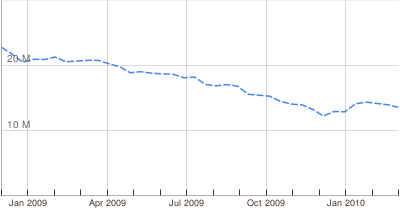
MySpace was a pioneer of the Social Media and it established the standard for most of the other web-based membership groups; however, it has undergone a series of scandals of misuse by some members and it has a reputation of being used primarily by young (underage users) which have driven people away.  MySpace is the only one of the four researched Social Media platforms that is losing users.  In the past year MySpace has dropped from slightly over 20 million visitors per day to about 13 million. Not the direction that they would like to go.

Another Discussion  about Facebook & Twitter

Women tend to use the Social Media more with LinkedIn having a tie of Male and Female users.  On Facebook and Twitter women account for 60% of the users, and on MySpace they account for 66% of the users.  The fact that women tend to use the Social Media more than men may tell us a lot about gender differences in behavior and attitudes towards the use of Social Media.

MySpace Age Groupings

Age differences among the four Social Media platforms have specific patterns that indicate some of the most interesting demographics.  In general terms, MySpace dominates the under 17 crowd with 34% of all users in that age group.  It would seem that a rite of adulthood is to end your MySpace account, which may be why 18-24 year olds have distanced themselves from the service.

Facebook Age Groupings

Twitter Age Groupings

Facebook, Twitter, and LinkedIn all have an older following than MySpace with Twitter users peaking in the 35 to 44-year-old range and 46% of the Facebook users in the 35 to 54-year-old range.  While the difference is not dramatic, Facebook users are slightly older than Twitter users, but both have over 70% of their users in the 25 to 64-year-old range.

LinkedIn Age Groupings

LinkedIn is unique in the distribution of the age groups with an almost perfect ‘Bell Curve’.  Considered to be the Social Media platform for business, it reflects a majority (56%) of 35 to 54 year olds as members, with another (33%) evenly spread on either side of the majority group.  The next age groups on either side of that are also evenly divided at 4% each.

Social Media Stats 1st Q 2010

Social Media is still in a transformational phase. With each passing month the users are redefining the significance of the new communication forms. With new applications and new uses for the multiple platforms being invented on a daily basis, the people who traditionally have been resources of Public Relations and Marketing are racing to understand what is relevant and what is not. In addition to business concerns like Public Relations and Marketing, experts in fields like Social Psychology, Human Communication, and even Information Technology are scrambling to grasp what all this means.

What we know about Social Media is that it is not going away, nor is it a fad. We also know that Social Media is becoming a force in informing and influencing people with speed that has never been experienced before.  It is macro-communication that occurs with micro-interactions. Much as the collective neurons in the human brain can influence our mood, the collective individuals in social networks are influencing the attitudes and awareness of a mass of people who often act or react based upon the knowledge gained through their Social Media group.

Those that engage in the tools of Social Media and learn the appropriate use of the tools will have a marketing advantage over those who shun it out of ignorance. Tools like Facebook, Twitter, and LinkedIn are even changing the way people manage and can be managed in an organization as they bypass all controls used by the Chain of Command leaving authority figures irrelevant unless they take part in the dialogue with those that have been empowered with a new voice.

More Articles

  • Tony Hayward: The very model of a modern Major General
  • Rotary@105: A young professionals networking club?
  • One Rotary Center: A home for 1.2 million members
  • War Declared on Social Media: Desperate Acts of Traditional Media
  • Pay It Middle: The Balance between Too Much and Too Little Compensation
  • Mega Executive Pay Leads to Poor Performance
  • Relationships and Thin-Slicing: Why the other person knows what you’re really thinking
  • Browser Wars: Internet Explorer losing, Google Chrome gaining ground
  • Rotary@105:  What BP Could Learn from the 1914 Rotary Code of Ethics
  • Twitter is the Thunderstorm of World Thought
  • Signs of the Times
  • Rotary Magazine Dilemma Reveals the Impact of Social Media
  • How Social Interactive Media Could Transform Higher Education
  • How to Become a Zen Master of Social Media
  • Car Dealership Re-Imagines Customer Service
  • Death of All Salesmen!
  • Aristotle’s General Rules on Social Media
  • Social Media:  What is it and Why Should You Care?
  • Social Media 2020:  Keep it Personal
  • Social Media 2020:  Who Shouldn’t Be Teaching Social Media
  • Social Media 2020:  Public Relations 2001 vs Social Media Relations 2010
  • Social Media 2020: Who Moved My Public Relations?
  • Publishing Industry to End 2012
  • Who uses Facebook, Twitter, MySpace & LinkedIn?
  • Fear of Public Relations
  • Facebook, Twitter, LinkedIn…Oh My!
  • Does Anybody Really Understand PR?

What Social Media tool do you use?

(polls)

Fear of Public Relations

21 Sunday Mar 2010

Posted by Paul Kiser in Crisis Management, Human Resources, Information Technology, Lessons of Life, Management Practices, Passionate People, Public Relations, Re-Imagine!, Rotary, Social Interactive Media (SIM), Tom Peters

≈ 4 Comments

Tags

New Business World, Re-Imagine!, Social Media, Tom Peters

The fog of Social Interactive Media is burning off

There are two approaches to Public Relations. The first is to live in fear of it and tremble at the prospect of screwing up. Take only measured steps that are carefully calculated and planned.

The other approach is to dive in. Risk mistakes and live and breathe being real and human.

The old school of Public Relations is the former. It is controlled by the Chain of Command. No one is authorized to speak unless cleared by multiple levels of authority and even then, to say or do anything that is nothing less than perfect is to fail. It is that Public Relations of which the world has become accustomed. Anyone who mars the perfect image risks banishment from the corporate world. Nightmare situations such as the current Toyota recalls reinforce the fear that Public Relations is a beast that must be closely guarded and heavily controlled.

This is why the new world of social media terrifies the old school. The unprecedented access to expressing our individuality on Facebook, Twitter, or even our own blog is the worst possible situation for those who believe that control of the message is the alpha and omega of Public Relations. Many companies are establishing strict policies for their employees on using Facebook, blogging, and all other avenues of professional or personal expression. Most of this comes from the management attitude that employees are a necessary evil and potentially a major embarrassment to the company.

What the old school of Public Relations doesn’t understand is that social interactive media (SIM) is creating a new model of business that is being driven by a desire of the consumer to do business with real people, not corporations. In today’s interactive world the branding of the individual is now becoming a driving force to he branding of the corporation. This is 180 degrees from the mission of most Public Relation professionals in major companies and it gives indigestion to old school managers that live in fear of employee self-expression.

Re-Imagine! Business Excellence in a Disruptive Age

In 2003, Tom Peters came out with a book called Re-Imagine!: Business Excellence in a Disruptive Age. If you understand that the book was published before Twitter and Facebook were available to the public, you have to wonder if Tom Peters can travel into the future and back again. Today everyone throws around the term ‘Branding’ but few know that today’s usage of the term originated from Peter’s 2003 book. On page 232 of Re-Imagine! Peters explains a new world of people who develop her or his individual brand separate from the corporate world. Now, in 2010, social interactive media has provided the vehicle for individuals to show off who they are and what they know and Peters has become the Moses of the new business world.

Like all business, the winner will always be the one who can embrace change before others. Companies that can adapt and use social interactive media to promote and showcase the quality and expertise of the individual within their ranks will have the advantage over the competition. In those companies the new role for the Public Relations professional is to help employees brand themselves instead of trying to muzzle them.

Still, the old school will loudly point out every slight misstep or mistake made by an employee that may reflect poorly on a company’s reputation. What they don’t understand is that errors make us human and that can deepen the bond between the company and the customer. An error is the opportunity to make things right and that is the key to all long-term relationships.

Facebook, Twitter, LinkedIn, OH MY!

12 Friday Mar 2010

Posted by Paul Kiser in Human Resources, Information Technology, Management Practices, Public Relations, Rotary, Social Interactive Media (SIM)

≈ 4 Comments

Tags

Facebook, LinkedIn, Social Media, Twitter

My boy, Alexander, is almost four years and five months old. In one month (Jan. 2010) Facebook had almost one unique visitor (134 million) for each second Alexander has been alive. That is a 95% growth over Jan. 2009.

A Social Interactive Media in Snow

Alexander - The same age as Twitter

Twitter is also four years old and it has over 23 million unique visitors the same month.   Their growth during this last year was ‘slightly’ bigger than Facebook.  Twitter grew by 294% in one year. By the time my son is eight, Twitter plans to have over 1 billion users.

It is staggering to see how many people are connected in the Social Media world, and even more staggering to see how much it is changing every month. A person who graduates from college this May from a four-year Business or Marketing program started college before Twitter existed.   Business colleges are trying to teach students about a world that is undergoing an extreme makeover every six months and they recognize the importance of social media in business.   Fortunately for students at U of NV, Dr. Simmons (www.bretlsimmons.com) is staying on the top of the tsunami of social media and how it impacts Branding.  Dr. Bret Simmons of the University of Nevada Business School calls Twitter “the center of the Social Media universe.”

But what about the rest of us. Why should we care about Social Interactive Media (SIM)?

SIM: End of Innocence
Imagine two people. Each want to start a bicycle shop in Davis, California. One rents space, puts up his business sign, advertises in the local paper and puts out flyers.

The other person does all that and also has a Facebook page, Tweets regularly on various items of note for bicycle enthusiasts, has a website with a shopping cart feature that allows people to order parts and purchase bicycles, and the owner has a blog about cycling in and around Davis. Who do you think will have more success? All other things being equal, the one who has better SIM smarts will have the advantage.

But it doesn’t just stop with business marketing. SIM is influencing opinion, shaping discussions, and in general changing everyone’s life whether they participate in the new media or not. Life is being changed because so many people are now involved in Facebook, Twitter, and other SIMs. A person can choose not to be involved and disconnect themselves from all forms of new technology. There will be a segment of our population that does exactly that; however, they will find themselves more and more out of touch with a world that isn’t waiting for them. No one knows what our society will look like in five years, but for those who unplug themselves from society, I think they will find the world is a lonely, foreign place.

Does Anybody Understand PR?

07 Sunday Mar 2010

Posted by Paul Kiser in Management Practices, Public Relations, Rotary

≈ 4 Comments

Tags

Facebook, Public Image, Publicity, Social Media, Twitter

by Paul Kiser

Question: What is PR.
Answer: The 16th and 18th letters in the Alphabet.

Paul Kiser - CEO of 2020 Enterprise Technologies, inc.

That’s probably the best answer most people can get today about the beast that has become Public Relations. Public Relations used to be so simple. It was about promoting your organization. You did it through newspapers, radio, and television. If you were good at it you could disguise it so it looked like news. It involved writing skills, and people skills, and often it involved that attractive young, female, PR representative in the tight business skirt. It was all so easy…if you knew what you are doing and had the right connections to the right people.

And then came the Internet, and bloggers, and MySpace, then Facebook and Twitter. Perky people fell in love with the new ‘social media’ and the cynical people loathed it. Young people became texting experts and old people smirked and scoffed at the young people…well, maybe old people have always done that…but they did it more.

Slick PR types smiled, and then didn’t smile as much, and then didn’t smile at all. A tight skirt didn’t translate on the Internet. A slap on the back didn’t register on the virtual shoulder. All the ‘critical people to know’ at the newspapers, radio stations, and television stations were not as important in a world that was tuning out of traditional media. Newspapers started measuring the drop in circulation not by how much it dropped from last month, but how much the percentage of drop increased from last month. Publishing became something anybody could do, not just magazines and newspapers…and the soft thud we heard was the editor’s cigar hitting the floor as they sat in their 1960’s office chair with mouth agape while kids with cell phones were ‘scooping’ reporters with laptops.

O Brave New World
New technology did not kill PR, just everything we knew about it.  The PR Stoics still say that PR really hasn’t changed, but who are they trying to kid.  The field of Public Relations is changing daily, sometimes hourly.  A 15-year old kid can make a bigger splash than a 30-year PR veteran, and the teen can do it in one Tweet.

Public Relations has been evolving for over a decade; however, in the past five years the media world experienced a 10.0 magnitude earthquake in best practices of PR that has shattered everyone’s understanding of the field.  Whether it is a corporate entity, a non-profit organization, or a political campaign; what worked in 2005 is only going to work for a smaller and older segment of a society.  The Public Relations experts are mixed in with everyone else trying to stay on top of the tsunami of change.

Reality Check in a Virtual World

  • Publicity is not Public Relations –Get the message out, yes, but then listen for the response
  • All Public Relations is local – “How does this impact me?” is the only question people want answered
  • Public image is about what OTHER people think about your organization – Forget what you know, it’s what they think that is important
  • Genuine trumps ‘Slick’ every time – Manipulation and selling is red flagged by the social media audience
  • Passion trumps formality for the social media audience – Passion scares the traditional audience
  • New PR: Shape the message to the audience – Old PR: Control the message!
  • Communication is organic and messy – PR is about doing 1000 LITTLE things right, not just one BIG thing right
  • The true value of advertising is declining – Super Bowl ad may be seen, but does it translate to commerce?
  • Advertising = Spam – The audience has found the OFF button and they are not afraid to use it!
  • Public Relations is a two-way process, not just broadcasting –Can people find out more?  Can they even find you?

more Connected, more Segmented, and more Complicated
The new world of social media allows us to be more connected, but it also make us more aware of things we may not like or agree with on flashpoint issues.  This can cause some people to ‘unfriend’ or ‘unfollow’ with those that they disagree, which divide people into segments of like-minded audiences.  Organizations need to be aware of their audience and how that audience perceives everything they do.  Even one worker can have a negative or positive impact the on public relations of an entire company.

Public Relations is a now a 24/7/365 field where an organization has to understand all age groups, all media resources, and look in the mirror constantly to see what the public sees from their point of view.  What works today may not work tomorrow.   What worked yesterday might be novel enough to work again.  Branding is important, but like a woman’s make up, too much and you look like a whore.  An organization’s public image is the sum of its individuals as much as it is advertising.  Everyday Public Relations gets more chaotic and less forgiving.

“Does anybody really understand Public Relations?” is the wrong question.  The question is who can afford not to?

Newer posts →

Other Pages of This Blog

  • About Paul Kiser
  • Common Core: Are You a Good Switch or a Bad Switch?
  • Familius Interruptus: Lessons of a DNA Shocker
  • Moffat County, Colorado: The Story of Two Families
  • Rules on Comments
  • Six Things The United States Must Do
  • Why We Are Here: A 65-Year Historical Perspective of the United States

Paul’s Recent Blogs

  • Covert Narcissism in Relationships
  • Divorce Without Mercy Part 9 – Epilogue
  • Divorce Without Mercy Part 8 – June/July 2026
  • Divorce Without Mercy Part 7 – May 2026
  • Divorce Without Mercy Part 6 – April 2026
  • Divorce Without Mercy Part 5 – March 2026
  • Divorce Without Mercy Part 4 – February 2026

Paul Kiser’s Tweets

Tweets by PaulKiser

What’s Up

September 2026
S M T W T F S
 12345
6789101112
13141516171819
20212223242526
27282930  
« Aug    

Follow Blog via Email

Enter your email address to follow this blog and receive notifications of new posts by email.

Join 685 other subscribers

Create a website or blog at WordPress.com

Loading Comments...