3rd From Sol

~ Learn from before. Live now. Look ahead.

3rd From Sol

Monthly Archives: January 2020

Moffat County Coal: Why Ignorance is Not Bliss

30 Thursday Jan 2020

Posted by Paul Kiser in Business, Conservatives, Donald Trump, Economy, Education, Employee Retention, Ethics, Government, Government Regulation, Green, History, Honor, jobs, labor, Layoff, Mining, Politicians, Politics, Public Image, Public Relations, racism, Reduction in Force, Small town, Technology, US History, Voting

≈ Leave a comment

Tags

coal industry, coal mining, coal-fired power plant, Colorado, Colowyo Mine, Craig, economic, economy, green energy, growth, Moffat County, natural gas, northwestern Colorado, power plant, solar power, stagnation, Tri-State Generation and Transmission Association, wind power

The Pity Party Regarding Moffat County Coal

A video about coal mining in northwestern Colorado suggests the people of Craig, in Moffat County, are having a pity party and they want everyone to join in on their self-inflicted suffering. Craig’s primary economic industries are coal mining, coal-fueled power generation, and tourism from primarily hunting and other seasonal outdoor sports. It is an economy that locals admit lacks diversity and resiliency.

Craig, Colorado:  Moffat County’s Only Significant Population Center

This month, Tri-State Generation and Transmission Association announced that it would close all three coal-fired power units by 2030 and close down the Colowyo coal mine that supplies the three power plants south of Craig. Not surprisingly, local people are upset and many are turning their anger towards government regulations that they claim are killing their community.

This carefully crafted pity video published in 2015, by the American Energy Alliance, an energy industry-funded non-profit operated and directed by former House Republican staffers, is being used by at least one area resident¹ to use the news of the closings to renew anger at the government:

[SEE: The Perfect Storm Over Craig, Colorado]

The Ugly Reality of Coal Mining

Modern history lacks any examples of coal-mining dependent communities that have eventually gone on to become a great economic success. It just doesn’t happen. Mining companies have a reputation of ripping the coal out of the ground, shipping it away, selling it, reaping vast fortunes, and walking away from their mess. The coal industry has a legacy of broken workers, broken agreements, and always placing owner profits over every other consideration. In their wake is typically a shell of a community that is left in a cycle of poverty.

But history and context are typically not what local people care about or understand. They only see that a company is willing to come to their isolated community and offer them a Devil’s Bargain for jobs. Local communities are usually burned by the deal but rather than accept the consequences, many adopt the tactics of the tobacco farmers when the public became aware of the dangers of smoking. They scream, “It’s all the government’s fault.”

The Facts

Change Has Been Coming:  In the last decade, many aging coal-fired plants have been converted over to natural gas. The fuel is less expensive and cleaner than coal. Tri-State has stated that the decision to shut their Moffat County operations was a business decision based on operational costs.

The Road to Nowhere

The Craig Power Plants Units Already Slated For Closure:  Two of the three units were already slated to be retired. Unit One was to be closed in 2025 and Unit Two was to be retired in 2039. Unit Three was only four years younger than Unit One but no retirement date had been established. All three Units were facing decommissioning and the associated coal mine would become less relevant with each Unit closure.

Coal is More Expensive and Harmful:  The combined costs of building and operating coal-fired power plants, added to the cost of mining coal, the cost of restoring the damage (environmental, health, etc.) caused by mining coal, and the cost of the impact of the air, soil, and groundwater pollution of coal burning, makes the expense of coal-generated energy too high. With no mining, minimal pollution, and free fuel, solar and wind energy are less expensive and the green options don’t threaten the disastrous consequences of global warming caused by carbon-based fuels.

Alternative Energy is Becoming the Standard

Coal Generation Has Been On a 20 Year Decline:  In 1997, coal provided 52.8% of the energy generated at commercial sized units. By 2018, that had dropped down to 27.8%. No new coal-fired generating plants are being planned or built in the United States to replace old units scheduled to be closed. Coal is a dying industry and no one can say it’s a sudden death. [Source]

It’s the Mining Company, Stupid:  Mining has consistently replaced human workers with machines that are more productive, less expensive, and don’t complain or demand anything. The reduced size of the mining workforce in the United States has nothing to do with government regulation and everything to do with companies saving money by taking away mining jobs from their own workers.

The Person Standing On the Train Track

A person standing on an active train track has three choices. That person can, 1) step off the track before the train comes, 2) get up on the platform and hope the train stops to let him or her get on, or 3) continue to stand on the track and rant about the train until she or he is run over by it.

The video suggests that the people of Craig have chosen to take the third choice. There is no sudden change in the coal industry that is causing it to be phased out. Anyone who cared about their community would have known that coal was a bad bet in the economic sustainability game.

Moffat County, the Perfect Victims

Why is Craig the perfect platform to be showcased for a political agenda?

White Begats Red

Moffat County is Trump Country. It is 80% caucasian and overwhelmingly Republican. In the last 55 years, no Democratic Presidential candidate has obtained more than 40% of the vote in the county. Craig is happy to be the political tool of the white wing.

History of Being a Victim

Craig is located halfway between Denver and Salt Lake City. It used to be on the main route between the two major cities (US 40.) When Interstate 70 (I-70) was in the planning stages it was to terminate in Denver, but Governor Edwin Johnson, (a Moffat County native,) convinced the federal government to continue it through Colorado. The irony is that he ignored the existing US 40 route through his home town and proposed the interstate follow the US 6 route.

Signal Hill: The Faded Glory of Craig

That decision isolated Craig. Instead of being the perfect stopping point between Salt Lake and Denver, it became the town ninety miles south of Interstate 80 (I-80) and ninety miles north of I-70. The impact of that choice still affects Craig’s economy today.

Population Stagnation

While the population of every economically diverse community has been increasing over the last 30 years, Moffat County’s population hit a high of 14,541 in 1983 and today it has over 1,000 fewer people than 37 years ago. Every Spring, the high school graduates more students than the community has jobs. For decades, the need to diversify and expand Moffat County’s economy has been a topic of discussion…with no viable plan.

Imprisoned By Their Own Political Ideologies

One obvious opportunity is alternative energy. The transmission lines that connect Craig to the power infrastructure already exist with the terminus at the current power plants. A wind or solar farm in Moffat County wouldn’t have significant expenses in building transmission lines.

End of the Road in Craig

The problem is that alternate energy choices are exactly what many people from Craig have sworn to oppose. In their minds, solar and wind farms are a waste of time and resources. For a majority population of Trump supporters, accepting clean energy as a source of new jobs and revenue for the community is unthinkable. Better to fail and cry than admit their lack of foresight.

A Failure To Educate

Moffat County High School is one of the worst performing in the state. Those that graduate face the choice of few job opportunities in the community or leave and face difficult challenges in being competitive with better educated graduates. From the CollegeSimply website:

Moffat County High School has an academic rating well below the average for Colorado high schools based on its low test performance, average graduation rate and low AP course participation.

Moffat County High School students score less than a 9% proficiency in Math (State average is 33%,) and less than a 14% proficiency in Reading (State average is 42%.) Less than 9% of the students have passed one or more AP exams. [Source]

Whether Craig’s stagnated economy has led to poor education or poor education has led to a stagnated economy the result is the same, the future of the community is not in the hands of young people who can be expected to repair and build upon their parent’s lot in life.  

A Video For No Reason

All this may explain the attitudes and desperation of the people of Moffat County expressed in the video. They feel like victims and so rather than embrace new technologies and diversify the economy, they would rather hang on to the past.

This video is the perfect storm of ignorance, political game-playing, an attitude of defeat, and poor education. It exposes the city and county’s history of failing to be proactive. Instead of seeking a more diverse economy, a choice was made to seek pity. The community may never realize that a Devil’s Bargain has a price…and now they will pay.

[¹NOTE:  This video was posted on 29 January 2020 on the Facebook page of a former high school graduate of Moffat County High School who still lives in the region. The author of this article believed the video was published after the news of the closings; however, after this article was published the author became aware that the video was first published in 2015. Corrections to the text have been made accordingly. Also, the video embed link has since stopped working and has been replaced by a URL link. ]

Betelgeuse is NOT Collapsing, It’s Expanding [NOTE: THIS IS IN ERROR]

24 Friday Jan 2020

Posted by Paul Kiser in Astronomy, Exploration, History, Photography, Science, Space, Universities

≈ Leave a comment

Tags

astronomy, astrophysicist, astrophysics, Betelgeuse, Boyle's Law, Charles' Law, Combined and Ideal Gas Laws, constellation, contracting, expanding, Orion, stars, stellar collapse, supernova

[Author’s Note:  This article is in error. I somehow misread the information provided in the Astronomer’s Telegram post stating that the star was decreasing in size. I discovered the error a few days after I posted the article. Since the premise of the article is incorrect, the entire article can be disregarded. Rather than delete the article, I am posting this announcement and leaving the original article intact. I apologize for any confusion or misunderstanding this article may have caused.]

Betelgeuse Collapsing? Think Again

The buzz about Betelgeuse is about its sudden and historic fainting (dimming.) Those who have a knowledge of the star and of supernovas have received the news with anticipation. Is this the great moment of Betelgeuse going supernova? Many people already know that immediately before the supernova, the progenitor star (the original star before a supernova) collapses in on itself. Betelgeuse is dramatically dimming, so it must be collapsing. Not true. Betelgeuse is expanding.

Dimming and Expanding Betelgeuse on 22 January 2020

Expanding Betelgeuse

Betelgeuse is dimming, but it is also cooling. Down approximately 100°K (180°F) in the past four months. This is an issue of physics. Temperature increases with increased pressure and the temperature decreases as the pressure decreases. The collapsing mass of a star increases pressure and temperature [¹SEE:  Primer on Combined and Ideal Gas Laws below.] The expansion of a star would cause a decrease in temperature. Betelgeuse temperature is decreasing, therefore astronomers believe it is expanding, not collapsing.

…Betelgeuse is currently the coolest and least luminous yet observed. Since September 2019, the star’s temperature has decreased by ~100 K while its luminosity (inferred from the C-band/m-bol observations) has diminished by nearly 25%.

Edward F. Guinan and Richard J. Wasatonic
Posted in The Astronomer’s Telegram 20 January 2020

No Joy On A Neighborhood Supernova?

Does this mean that Betelgeuse is not about to go supernova? Nobody knows. This could be the last big push outward before the finale we’ve been anticipating. It could also be another step toward the end but not the last gasp of Betelgeuse.

Betelgeuse in the Orion constellation

It is unusual behavior and worthy of constant monitoring. This may be one part of the process that will help us understand the last days, weeks, months, and years of a supergiant red star. Stars don’t suddenly brighten or dim without reason and now we have the opportunity to discover something new and visibly intriguing about the process of a star’s death.

What’s happening? Something wonderful.

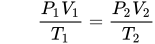
[¹Primer on Combined and Ideal Gas Laws ]\qquad {\frac {P_{1}V_{1}}{T_{1}}}={\frac {P_{2}V_{2}}{T_{2}}}.]

Betelgeuse: Schrödinger’s Star

21 Tuesday Jan 2020

Posted by Paul Kiser in Astronomy, Communication, Ethics, Exploration, Higher Education, History, Honor, Internet, Journalism, Religion, Science, Space, Technology, Universities

≈ Leave a comment

Tags

AAVSO, American Association of Variable Star Observers, astronomy, astrophysicist, Betelgeuse, dimming, fainting, light year, math, mathematics, prediction, progenitor star, Schrödinger's cat, Schrödinger's star, Star, stars, supernova

Much Ado About Something

Some astronomers are taking a dim view of the fading light of Betelgeuse. Many are trying to dampen down reports of the star’s demise while not ruling out the possibility. The reality of science is that no one knows what is happening.

What are you doing, Betelgeuse?

A Funny Thing Happened On the Way to a Supernova

Betelgeuse is the hot topic in astronomy because it has been dramatically dimming or ‘fainting’ [SEE Graph 1.0.] In a period of three months, it has dropped from being the eleventh brightest star in the night sky to the twenty-third brightest. This fainting spell is significant because when a star goes supernova it rapidly collapses prior to the event.

Astronomers Edward Guinan, Richard Wasatonic (Villanova University,) and Thomas Calderwood (AAVSO) posted a notice on December 8th of the fainting of Betelgeuse that helped raise awareness of the event. The news media became aware of it and by late December the fainting of Betelgeuse was trending in public speculation of a spectacular doom for Betelgeuse.

Graph 1.0 – Betelgeuse fainting is historic (2018 to current)

A 645-Year-Old Notice

Because of the distance between Earth and Betelgeuse, we wouldn’t know of a supernova event until approximately 645 years after it happens. Our first indication would likely be through a sudden increase in neutrinos. The visual confirmation would occur a few hours later.

If Betelgeuse has gone supernova within the past ≈645 years, then an astronomer could say that Betelgeuse has both gone supernova and has not gone supernova. The delay creates a Schrödinger’s cat scenario. The truth is unknowable.

But astronomers remind us that it may be 100,000 years of more until Betelgeuse makes a stellar spectacle of itself and then abruptly ends its role of marking Orion’s armpit. Their impreciseness of the future of the star is due to a lack of observations of the behavior of progenitor stars (stars that end their life as a supernova) in the years, months, weeks, and days just prior to a supernova.

Betelgeuse is the armpit of Orion

Why Don’t Astronomers Know?

It’s been over 400 years since a star in the Milky Way was observed after it went supernova. That event, like almost every other supernova observation, occurred after the star exploded. Rarely have astronomers been forewarned of an impending explosion and in those cases, the warning has been a matter of hours prior to the event.

To make an accurate prediction of a supernova, we must have data to create a theoretical model of behavior preceding the collapse of the star. The model must be created by using mathematical formulas based on observable data. Without the math, a prediction is just an opinion.

In science, “We don’t know,” is the motivation to discover the truth, even if the truth contradicts the desires and opinions of the majority. At the core of every legitimate scientist is an unwavering desire to offer facts and not mislead others. Astronomers can’t, and shouldn’t, attempt to predict a supernova. “We don’t know,” is the correct answer and the general public has to accept that answer.

Unfortunately, most humans don’t like not knowing. Religions like to give absolute answers to questions even if the answer is unknown or even if it is 100% wrong. A scientist and/or scholar is governed by a higher power of truth. For scientists, not knowing the answer is what makes the process discovery so satisfying. 

The End of the Faint?

In the past week observations of the fainting of Betelgeuse have leveled off. This may indicate that Betelgeuse is about to begin increasing in brightness. It may also indicate the fainting is pausing, or it may indicate that there is no pause and next week astronomers will see a continued drop in brightness. No one knows. 

Graph 2.0 – Is the dimming leveling off in mid-January? (OCT 2019 to current)

My Answer To the Question

I am not a scholar in the field of astronomy so I can state my opinion about the situation. My opinion is that at some time in the past 645 years, Betelgeuse has gone supernova…and it hasn’t.

You have to love Schrödinger.

SpaceX Booster Crisis

13 Monday Jan 2020

Posted by Paul Kiser in Business, Ethics, Exploration, Falcon Heavy, Layoff, Management Practices, NASA, Public Image, Public Relations, Reduction in Force, Space, SpaceX, Technology, The Tipping Point, United States, US Space Program

≈ Leave a comment

Tags

commercial space, Dragon Crew Capsule, Elon Musk, Falcon 9, Falcon Heavy, Gywnne Shotwell, human spaceflight, manned spacecraft, space flight, SpaceX

Missing SpaceX Boosters?

A rocket is required to achieve orbit. Without it, everything else is just talk. SpaceX is dependent on the Falcon 9 Block 5 SpaceX booster, but in 2019 their launch schedule decreased dramatically, in part, because of a lack of booster inventory. Nothing has changed for 2020 and, in fact, the situation may be worse.

The decline and fall of SpaceX’s launch schedule

SpaceX will have 13 (Space Flight Now,) 22+ (Space News,) or 33 (Wikipedia) launches in 2020 depending on what source is used. SpaceX’s President, CEO, and CIC (Cheerleader in Chief) Gwynne Shotwell claimed in September that her company will likely have two Starlink launches per month in 2020. This does not include the test launches required for human spaceflight, nor the paying customers already scheduled. 

The problem is that SpaceX doesn’t have enough boosters to come anywhere near the volume they brag about to the public.

In March of 2019, it was apparent that SpaceX was facing severe financial problems. A dramatic cut in SpaceX employees at their California rocket assembly plant in January of last year resulted in a drastic downsizing of booster production and launches for 2019.

SpaceX Booster Deficit:  It’s a Math Problem

SpaceX introduced the Block 5 Falcon 9 booster in May 2018. Six Block 5 boosters were used in ten launches in 2018 and five launches in 2019. Last year, after the layoffs, SpaceX put up seven new Block 5 boosters, four of which, (B1052, B1053, B1055, and B1057,) were specifically built for use in the Falcon Heavy configuration. The Falcon Heavy boosters have never been used on single booster launches. The three non-Falcon Heavy boosters were responsible for seven of the 13 SpaceX launches in 2019.

We’re almost through the hard math.

This means SpaceX has nine Block 5 boosters available. But they don’t.

Of the nine Block 5 boosters, 3 (B1047, B1050, and B1054) have been lost (sacrificed or destroyed.) Another booster (B1046) will be destroyed in the upcoming crew capsule abort test. One booster (B1051) hasn’t been seen since it left Vandenberg Airforce Base after its flight in June of last year. Two of the remaining boosters (B1048 and B1049) have been flown four times and one (B1056) three times.

This leaves one booster (B1059) with less than three flights use and one new booster (B1058) coming on online in 2020. SpaceX doesn’t have the inventory of boosters needed to accomplish even a moderate launch schedule this year.

SpaceX Exec:  Pay No Attention To Reality

In May of last year, the top executive of SpaceX either had no understanding of the company’s launch capabilities or publicly lied about the projected launch schedule. Shotwell said that SpaceX would have a total of 18 to 21 launches in 2019, not including the Starlink satellite launches. SpaceX had 13 total launches including two Starlink launches.

SpaceX CEO Gwynne Shotwell:  Doesn’t know how many rockets her company can launch

SpaceX had no major disasters or delays that would explain how Shotwell would overestimate the number of launches by over 150% with only seven months left in the year.

Fantasyland Scenarios

Elon Musk and SpaceX’s Shotwell have been known for their boasts of SpaceX’s future. In a conference call to the news media in 2018, Musk was quoted to say that the Block 5 Falcon 9 would be “…capable of at least 100 flights…” and they would be able to launch a Block 5 booster within 24 hours of recovery. He also said that all this would happen as early as 2019.

In July, Teslarati reported that SpaceX Vice President of Commercial Sales Jonathan Hofeller announced that by the end of 2019, they would launch a Block 5 booster for a fifth or sixth time. In the same article, the Musk fansite writer Eric Ralph calculated that SpaceX would launch an additional 12 to 19 times in the second half of 2019. 

Today, only two Block 5 boosters (B1048 and B1049) have been launched more than three times (B1046 is scheduled for its fourth launch on 18 January.) The ten-week turnaround time for the Block 5 boosters has also failed to meet Musk’s predictions of a 24-hour turnaround.

What is Possible For 2020?

In the short term, SpaceX has the booster capacity to launch six times in the first quarter if boosters B1048 and B1049 can be used a fifth time and if a new booster comes online before April. If not, then SpaceX would be hardpressed to launch four missions by the end of March.

Currently, only two missions have assigned boosters (B1046 for Dragon Inflight Abort test and B1058 for Dragon crewed test flight.) Without a booster assigned, it is unlikely that any other announced mission in January or February is feasible.

Musk has also claimed that the Block 5 booster can easily perform ten launches; however, as with his other claims, there is no reason to believe the Block 5 can survive the extreme temperatures and stress of ten launches and landings without a significant overhaul.

For the remainder of the year, SpaceX depends heavily on new boosters to keep flying as the current booster supply is almost exhausted.

Is SpaceX a Dead Program Walking?

Last year’s sudden layoff of 577 SpaceX employees indicated corporate financial trauma. That event was followed by an anemic 2019 launch schedule. Nine of those launches were for commercial customers, but one was a free launch because of a previous failed launch. Two launches were for test purposes and two were for the Starlink system that will not be revenue-producing until the satellite system is established and operational.

For 2020, the first five scheduled flights consist of two test flights and three non-revenue producing Starlink launches. SpaceX does have paying customer launches during 2020, but much of the schedule consists of Starlink or small customer satellites on RideShare launches.

In 2017, Musk confidently proclaimed that SpaceX would have 30 to 40 launches per year. That number was overstated and the company seems to be ‘filling in’ their launch schedule with straw customers that may not have the deep pockets SpaceX needs. They also seem to be offering deep discounts in order to attract customers.

The January 2019 layoff, the dramatic drop in launches in 2019, and the lack of Block 5 booster inventory would seem to indicate that SpaceX is in a desperate situation. 

Under Deconstruction: University of Nevada South Neighborhoods

09 Thursday Jan 2020

Posted by Paul Kiser in About Reno, Business, College, Economy, Education, Generational, Government, Higher Education, History, Housing, Life, Nevada, Politics, Pride, Reno, Universities, University of Nevada

≈ Leave a comment

Tags

Board of Regents, College, higher ed, higher education, housing, I-80, Interstate Highways, John Evans, neighborhood, neighborhoods, Reno, University of Nevada

A Different Type of 20/20 Plan 

The neighborhoods of the University of Nevada in Reno start 2020 with 20 structures recently demolished or moved and 20 more standing vacant, waiting for their demise. Not all of it is directly connected to expansion by the University, but houses in some of Reno’s oldest subdivisions are vanishing for university-related business.

The end is near for neighborhoods on the U of Nevada southside

For the last few years, structures adjacent to the university, primarily houses, have been torn down. The neighborhood on the west side of Virginia Street has seen significant changes and now the southern neighborhood has become a part of the makeover.

Southern Loss:  Under the shovel of progress

Southeast – University of Nevada Engineering Building

In 2018, the University began tearing down nine houses on the west side of Evans Street. These homes adjacent to the southeast edge of the campus were part of the University Heights subdivision but most of them have been owned by the University for many years. A large new building for the College of Engineering is replacing the nine homes. A tenth home remains standing at the curve of Evans on the southeastern corner of the campus.

University Heights subdivision homes replaced by Pennington Engineering Building (Home marked with the yellow line remains standing but is owned by the university.)

The College of Engineering has grown significantly in the past decade (1,595 students) but that growth has slowed to an increase of only 170 students in the past four years (Fall 2015 to Fall 2019.) University administrators have stated that the new Pennington Engineering building is too accommodate the growth.

The New Pennington Engineering Building in University Heights 

Evans Northeast Addition – Abandoned and Boarded

CCC-Reno LLC purchase of Evans Northeast Addition subdivision

In 1906, Elizabeth Evans, widow of John ‘Newt’ Evans, filed for the Evans Northeast Addition subdivision. Most of the homes were not built until the 1930s; however, many were torn down in the early 1970s because of the construction of Interstate 80 (I-80.) Only one small block remains of the subdivision north of I-80 and west of the railroad tracks. That block is bounded by Record Street to the east, Evans Street to the north and west, and 9th Street to the south.

Homes of the Evans Northeast Addition neighborhood

On 5 March 2018, Capstone Collegiate Communities (CCC-Reno LLC,) a company located in Birmingham, Alabama, purchased all of the remaining properties. According to Washoe County Assessor data, the purchase for the homes (excluding the commercial property) was 180% of the current (Jan 2020) Zillow.com estimated value. The Alabama buyer paid over $5.5 million for all nine properties.

Acquisitions by Capstone Collegiate Communities, an Alabama corporation

After purchasing the properties, Capstone attempted to have several public roads abandoned by the city to expand the property. One of the proposed options was to close Evans Avenue. This would have effectively eliminated access to the eastern side of the University for those coming from I-80 and would have eliminated the most direct access to I-80 from the neighborhoods east of the university.

Fortunately, that plan never came to a vote by the Reno City Council; however, Capstone did secure more land by convincing the City Council to abandon a small right turn lane and its adjacent island.

Although Capstone Collegiate Communities have owned the properties for almost two years, it has been reported that they do not intend to begin construction until the Summer of 2021. It is unclear when the existing structures will be demolished. 

Evans North Addition – One of Reno’s Oldest Neighborhoods

For many years, the University has expressed frustration with the look of the motels and properties of the block between the campus and I-80. They expressed a desire to expand into that block and create a gateway to the University.

The house at 843 Lake Street was built in 1932. One of 23 properties now owned by U of NV

The irony is that this neighborhood was one of the first planned neighborhoods in Reno, and at one time it was known as one of the nicest neighborhoods. Known as ‘Professor’s Row,’ many homes were demolished in the 1970s to make way for I-80. This attracted the small hotels to fill in the block along Virginia Street that became unsightly as they aged.

One of the post-Interstate hotels on Virginia Street that is now slated to be destroyed.

It is also a twist of fate that the University is now seeking to eliminate the subdivision known as the Evans North Addition. This subdivision was established in 1879, by John ‘Newt’ Evans and his brother. John Evans was also the person who helped to convince the legislature to move the University of Nevada from Elko to Reno in 1885, and who also sold the land to the University.

U of NV Parking Garage and Business Building

Through purchases and donations, the University has acquired 23 properties to build a new parking garage and Business building. Construction is planned to begin later this year.

University of Nevada acquisitions for the parking structure and Business building

College of Business has also experienced significant student enrollment since 2009 (+1501 students;) however, the growth has slowed in the past four years with only 216 more students than in the Fall of 2015. The current building was built in 1982 and will be 40 years old in 2022.

RTC Steps in for the University

Virginia Street has been the focus of discussion as the motels in that area have been the source of crime and visual unattractiveness for the city and the University. Last Fall the Regional Transportation Commission (RTC) announced that they had purchased three of the five properties along Virginia Street between the University and I-80. The intent of the purchases is to create a transit hub, primarily for the benefit of the University.

RTC has the power to use eminent domain; therefore, the other two properties will either have to negotiate a fair price or face a legal battle that they will likely lose. The motels on the east side of Virginia have been abandoned and a construction fence placed around them.

Unrelated to the RTC project, two additional structures have been demolished at 9th and Sierra Streets, including a vacant sorority house; however, there has been little, if any, public announcement of the future of these properties. 

The Death Blow

The loss of these neighborhoods was really initiated by the construction of Interstate 80 in the 1970s. Quiet historical homes nestled at the foot of the University were no match for a major interstate artery through the middle of their neighborhood. If the alignment of the Interstate had been along the same route as the existing Highway 40 it might have given the Evans’ subdivisions an opportunity to survive. We will never know.

But now the last evidence of some of Reno’s original neighborhoods will be swept away. Unfortunately, hindsight is always 20/20.

Other Pages of This Blog

  • About Paul Kiser
  • Common Core: Are You a Good Switch or a Bad Switch?
  • Familius Interruptus: Lessons of a DNA Shocker
  • Moffat County, Colorado: The Story of Two Families
  • Rules on Comments
  • Six Things The United States Must Do
  • Why We Are Here: A 65-Year Historical Perspective of the United States

Paul’s Recent Blogs

  • Dysfunctional Social Identity & Its Impact on Society
  • Road Less Traveled: How Craig, CO Was Orphaned
  • GOP Political Syndicate Seizes CO School District
  • DNA Shock +5 Years: What I Know & Lessons Learned
  • Solstices and Sunshine In North America
  • Blindsided: End of U.S. Solar Observation Capabilities?
  • Inspiration4: A Waste of Space Exploration

Paul Kiser’s Tweets

Tweets by PaulKiser

What’s Up

January 2020
S M T W T F S
 1234
567891011
12131415161718
19202122232425
262728293031  
« Dec   Feb »

Follow Blog via Email

Enter your email address to follow this blog and receive notifications of new posts by email.

Join 688 other subscribers

Create a website or blog at WordPress.com


Loading Comments...