Conservatives Casting Themselves in WWII Sitcom?

Tags

, , , , , , ,

Mitt Romney as the 'I-do-what-i'm-told' Schultz and John Boehner as the bumbling Colonel Klink

The more I listen to the public statements of the top Conservatives, the more I’m convinced that they are trying to play out the roles of the German soldiers in the late 60’s/early 70’s sitcom Hogan’s Heroes.

House Speaker John Boehner rants on as if he’s in charge of everything just like Colonel Wilhelm Klink who was the figurehead of his command.

Mitt Romney could also be cast as Colonel Klink, but he would be more appropriate for the role of Sargent Schultz who knows “nothing” and sees “nothing” even thought reality is staring him in the face.

Karl Rove even looks like General Burkhalter

In contacts, a WWII German officers cap and uniform, Rove could be General Burkhalter

Another key player in this political year sitcom is Karl Rove, who acts as General Burkhalter as he rarely gets his hands dirty with the details, but seems to have the power to make idiots more idiotic as he pushes absurd plans of conquest onto Colonel Klink and his underlings.

A typical script for their recasting:

(Colonel Klink and Sargent Schultz are in the Colonel’s office.)

Schultz: (Romney speaking with a bad German accent): Colonel, I know I’m not supposed to understand anything, but it does seem that the prisoners are not taking us seriously anymore.

Klink:  (Boehner speaking with no accent at all)  Schultz! How dare you question the authority of your superiors!

Schultz:  Yes sir! I-I-I mean NO sir…I mean I was only trying to say….

Klink:  Oh, shut up Schultz. Unfortunately, I believe you are correct. We tell the Americans…uhm, the prisoners what they are supposed to think and they go off and think whatever they want to. They seem to believe facts now rather than what we tell them.

Schultz:  I know what you mean, sir. I tell them women are unimportant and they don’t believe me. I tell them it’s the economy and they seem to know it was our policies that caused the problems. I tell them the rich are job creators and they want to know why they are not creating jobs now that they are richer than ever…

Klink:  Yes, yes, Schultz, I am perfectly aware of what the prisoners think of us.

(Enter Karl Rove as General Burkhalter speaking in a nasal bad German accent.)

Burkhalter:  KLINK! Is this all you do is stand around and talk all day! Tell me you have something better to be doing!

Klink:  No Sir! ….I mean YES, sir…I mean…Sargent Schultz, tell him what I mean….

Schultz:  Ya Voldt, Herr Commandant! What the Colonel means to say–

Burkhalter:  Oh, shut up Schultz!

Schultz:  Ya Voldt, GenER-al Burkhalter, SIR!

Burkhalter:  Klink, we have a problem with the prisoners.

Schultz:  The Colonel and I were just–

Klink:  Shut up, Schultz! …uhm, you heard the General…now, what were you saying?

Burkhalter:  I said, we have a problem with the prisoners.

Klink:  And which problem do we have with the prisoners, General?

Burkhalter:  They don’t believe us anymore!

Klink:  Exactly! We were just saying that the prisoners don’t believe us anymore! The Americans think we don’t know what the issues are and they know we caused many of the problems. They’re blaming us!

Burkhalter:  And what was your plan to take care of this, Klink?

Klink:  I…we…wanted to hear your opinion before we took any action, General Rove…I mean Burkhalter.

Burkhalter:  The solution is so easy I’m amazed you didn’t come up with it on your own.

Klink:  Well, we didn’t want to take credit for the General’s ideas…WHICH we knew you would eventually tell us. So what is the plan that we came up with before you told us?

Burkhalter:  Klink, it is simple. When they say something is our fault we blame them!

Klink:  We blame them?

Schultz:  Excuse me, General, won’t they know we were to blame?

Burkhalter:  The Americans are stupid.

Klink:  So when they say we turned a blind eye to corrupt banking practices, and sent billions of dollars overseas to fight two unnecessary wars led to the economic collapse of the nation?

Burkhalter:  We didn’t do it. It was the policies of the past three years, not the incompetence of the previous eight years.

Schultz:  The economy is getting better?

Burkhalter:  It’s their fault it’s not getting better faster.

Klink:  Our abuse of women and ignorance of their issues?

Schultz: They created the issue, we love women!

Burkhalter:  …women in their place, of course, but you’re getting the idea.

Klink:  General, you always know what’s best!

Schultz:  That is why he is the General and you are….uhm.

Klink:  Schultz….!

Burkhalter:  I must be going, by the way, I’m taking your Secretary into town to visit a sick brother. She will be back tomorrow.

Klink:  Of course, General Burkhalter. Please let her know that if there is anything we can do….

Burkhalter:  No Klink. I will have everything in hand. Goodbye! (Burkhalter leaves)

Schultz:  That is strange, Herr Commandant.

Klink:  What’s that Schultz?

Schultz:  Your secretary was just telling me she is an only child.

(Cue music.)

The Second Coming of Mitt Romney

Tags

, , , , , ,

The 'Next' Mitt Romney is Coming

Mitt Romney now has been anointed by the Republican party to be their nominee for President. The crown of thorns will be placed on him in August, but the Victor of The GOP Hunger Games has been decided. To gain this ‘honor’ Romney had to become someone who was ‘seriously conservative.’ To appease the wackos in the far right he had to remake himself into a blue jeans-wear’n, women hate’n, gun-luv’n, good ole white boy. 

Now that he has completed his mission, he is absolutely unelectable as President. The Spring 2012 version of Mitt Romney has become someone everyone can hate. To women he is the symbol of the Republican desire to dominate and control them. To the middle class, he is a rich, arrogant millionaire. To the far right he is the worst best-case scenario. Despite polling data that currently puts him close to President Obama, Romney carries so much baggage that he can’t say anything without contradicting himself.

To have a chance of winning in November, the Romney image must die and be reborn. His campaign knows this and they have been planning for the Second Coming of Mitt Romney. On March 21, senior campaign adviser Eric Fehrnstrom was questioned by CNN about the problem of being too conservative in the primaries to win the moderate vote in the general election. Fehrnstrom answered with the now infamous ‘Etch-a Scetch‘ response:

“I think you hit a reset button for the fall campaign. Everything changes,…It’s almost like an Etch A Sketch. You can kind of shake it up, and we start all over again.”

Romney’s campaign has obviously been constructing a ‘new’ Mitt Romney; however, the candidate cannot afford to lose the wacko right, so the Vice-President honor has to go to someone who will suck in those from the Church of Christians in Name Only. Rick Santorum, Michele Bachmann, and Sarah Palin are possibilities for that role. Newt Gingrich is only in the running for the position of “Most likely to be an answer on Jeopardy®” ¹

(¹In the category of Famous Hypocrites: In 2012, he ran a Presidential campaign complaining about the size of the Federal Debt, while running up a debt of almost $4.5 million himself.)

Romney to be recreated in whose image?

Many political analysts predict Romney’s running mate will be Hispanic, but that seems unlikely as Romney has family roots in Mexico that have yet to be exploited in his campaign. There is the issue of the reason he has family in Mexico, but there are many ways that the connection to Mexico could be made without highlighting the Mormon Polygamy Colonies from where his father, George Romney was born.

Part of Romney’s extreme makeover has to be a move back to a more moderate position on all issues. This can best be achieved by the technique of plausible denial of responsibility. In Romney’s case he needs to separate himself as the decision maker on all hot button issues. His answer to Planned Parenthood’s future? That will depend on who the people elect to Congress in 2012. On Immigration? That depends on who the people elect to Congress in 2012. On Obamacare? Well, you see the pattern. By shifting the decision to ‘the people’ he will absolve himself of appearing too moderate or too extremist.

The Next Mitt Romney will be vastly different from the one that was ‘seriously conservative;’ however, if anyone can pull off a Second Coming it will the Mr. Blue Jeans common man…I mean Mr. Suit millionaire…the destroyer of companies…uhm…the creator of jobs….I mean the Mormon from Massachusetts, Michigan, Mexico,…I mean the …oh who knows…? 

Romney Defending Women? Who is He Kidding?

Tags

, , , , , , ,

“the Democratic Party has done an effective job trying to mischaracterize our views”

Mitt Romney, regarding  women’s issues. April 2012

Romney keeping his hands clean from touching women's issues

According to Mitt Romney the reaction of women to the Republican view of issues important to them (women’s health choices, birth control, education, social justice, etc.) is part of an evil plot by the Democrats. Romney seems to feel that the GOP’s well-documented misogynistic views would not be an issue, if only women and the other political party would conveniently ignore them.

Among the many alleged ‘mischaracterizations’ was last month’s tirade by Rush Limbaugh who made a horrific personal attack on Sandra Fluke, a Georgetown law student, calling her a slut and a prostitute because she voiced her support to require mythological-based institutes to offer physician ordered pharmaceuticals even if it was contrary to their mythology. 

If Romney was not just another Conservative Pig-in-a-Suit he COULD have said:

Mr. Limbaugh’s characterization of Sandra Fluke was slanderous and outrageous. His attack on this honorable American was absolutely and unequivocally inappropriate for in any decent society. Mr. Limbaugh should immediately apologize to Ms. Fluke and to women in general. This type of discourse should never occur in the media or on the street as it lessens the moral character of every citizen of this great country.

Instead Romney’s reaction was:

“I wouldn’t have used those words.” 

What words would Romney used? Would he rather Limbaugh called her a whore or a bitch? Romney inferred his approval of Limbaugh’s statement in general, just a difference of verbiage.

In addition to his impotent reaction to Limbaugh’s remarks, when asked about Planned Parenthood, a program that provides a wide range of low and no cost health care for women, Romney has been quoted as saying:

“…we’re going to get rid of that!” (Romney, March 2012)

Despite his clear views against women and issues they care about, multi-millionaire, jean-clad Romney is now trying win women back. His campaign is surrounding him with women at political events where, rather than listening to them, he talks down to them. He tells women that the economy is what they care about and that a recovering economy under Obama is bad for women. Romney wants women to support him in his bid to return to the Republican policies of deregulation that destroyed our economy at the hands of Conservative business men who decided “Greed is Great” even when it put our country at the brink of disaster.

Ann Romney betraying American women with a kiss

Ann Romney, Mitt’s spouse, has been put front and center as the face of ‘the average’ woman. As a homemaker raising five boys she would seem to be a great image to counter the chauvinism of the Republican party; however, there is a disconnect between the difficulty the spouse of a multi-millionaire might have raising five boys and that of a woman of five boys whose husband has just laid off because Mitt Romney’s investors have just purchased his company and sliced it up and sold it off for the capital. Somehow the challenges Ann Romney may have had in deciding which SUV to take to the boy’s soccer game just doesn’t seem to be a fair portrayal of women.

Romney’s campaign was up in arms about one Democrat who said that Ann Romney “has not worked a day in her life.” While that remark was  poorly worded, there is no comparison between the resources Ann Romney had with millions of dollars at her disposal and the average American woman. If Romney feels that is a ‘mischaracterization’ he can kiss my Karl Rove.

Romney is Wrong

Tags

, , , , , , ,

“Liberals don’t like business.”

Mitt Romney, April 2, 2012

Mega-millionaire Mitt Romney trying to look 'common' to the little people with Senator John McCain

Mitt Romney is wrong…in so many ways,…but this week Mr. I-wear-jeans-so-I’m-just-like-you got it wrong at a political event in Wisconsin. Romney claimed to know what liberals think, and he thinks liberals don’t like business. That fodder is being served up to Conservatives who have spent years characterizing liberals as the spawn of Satan, but per normal, the truth is far from the five cent analysis offered by the Republican Presidential nominee (stick a fork in the GOP selection process, the wanna-bes are done.)

Liberals don’t trust business, but liberals do respect the importance of business in a healthy society. Not trusting business does not equate to not liking business.

Liberals are justified in their skepticism. Business is driven by profit. It is the alpha and omega of all enterprise. Business typically doesn’t believe in fair play, sympathy, or what is right for America. In fact, business has little interest in doing what is right even for its own customer. In publicly owned companies, the investor and next quarter’s profitability usually trumps the wants and expectations of the customer. Consider banks, airlines, and oil companies. Those are three major industries that have proved over and over that the individual customer is a piece of meat to be used and abused. Airlines fight even basic human rights for their passengers.

The fact is that business can’t be trusted. Business fails…. a lot, and they fail, not because government drove them to failure, but because the leaders of those companies were greedy, stupid, or both. Most companies last a few decades before they do something stupid, or fail to be smart about the future. A recent example is Kodak. For decades it was the dominant players in the camera film industry, then it had competition, and then it failed to adapt to a digital world. Where is Kodak now?

On Monday, Romney singled our the United States steel industry as an example of how government regulation has killed business. Again, Romney was wrong; however, he gave a classic example of how greed and stupidity by business executives destroyed their own companies. During the 20th century America’s steel industry failed to reinvest and upgrade their steel plants, believing that they were too big to fail. They were wrong.

There is no doubt that labor unions also played a role in escalating costs of United States steel; however, even an executive of US Steel admitted it was the shortsightedness of management that opened the door for competition to challenge and overtake the domination of the United States in steel production in the 1970’s and 80’s.

There is no doubt that private business is important to America’s economy. Yet, business needs oversight to keep them honest and to save America from the greedy and the stupid.

Mitt Romney might think that pandering to the myths of the right will make him a good President, but he would be wrong.

Will The Supreme Court Hand The Election To Obama?

Tags

, , , , , ,

This week the Supreme Court became Hand of God regarding the fate the Affordable Care Act of 2010. Conservative Justices seemed to indicate that they were heading to a decision that would at the very least gut the heart of the law and void mandated health coverage for all Americans. This legislation has been one of the few new laws that Conservatives have allowed to pass during the Obama administration and they are panting over the possibility that they may be able to thwart it before it fully takes effect.

Equal Justice?

The irony is that if the Supreme Court rules against the law, they will likely be handing the 2012 election to President Obama. The ramifications of their ruling might even end Republican domination of Congress.

Why?

Conservatives desperately need an issue to unite the Republican party and bring moderates to their side; however, the key issues that they hope will sway the majority of voters are wearing thin:

  • Illegal Immigration is going to be a hard sell in an election year where racism has become a central issue in the country. Recent state laws regarding illegal immigration have been proposed and voted into law almost exclusively by Conservative, white males. The issue is becoming more about the motivations of the white politicians and less about the non-existent threat they have tried to create.
  • Abortion and contraception has become an issue that is so toxic to Conservatives that women are rallying together to take on the Taliban-like Church stance on the issues. Even Christians are beginning to question the extremism of the issue.
  • The cry to kill government is getting old and some people are beginning to link government with jobs and economic prosperity, especially since every effort to reduce government has consistently resulted in higher unemployment and major economic recessions.
  • The flat tax concept inherently raises taxes on everyone but the rich and the more people discuss it, the more people see the stupidity of it.
  • The rich, oil companies, big banks, etc. are our saviors. Is anyone but Conservatives really buying it?
  • Gay marriage is an issue that has turned on Conservatives and bitten them right in their own family. The whole ‘save marriage’ campaign has run its course and is now looking as stupid whoever it was that came up with the idea in the first place.
  • It’s hard to justify changing Presidents when the economy is growing, and even harder to argue that considering the economic disaster of 2007-09 was caused by Conservatives, that they should be the ones to make it better. Sure oil prices are outrageously high and the economy might suffer, but since Conservatives run the oil companies and the speculation market, how is that President Obama’s fault?
  • The National Debt is certainly an issue that Conservatives would like to use, but the reality is that America’s debt is not at 100% of our Gross National Product (GDP,) which is where Franklin D. Roosevelt had to take it (actually he exceeded 100% of GDP) to get America out of the Great Depression. We recovered from that and enjoyed some of the most prosperous years in our history.

So what is left?

The Affordable Care Act. By labeling it, “Obamacare” and seeding the media with wild statements of doom if it is allowed to be fully enacted, it has become the only issue in which almost all Conservatives can come together; however, if the Supreme Court takes that issue away by gutting the law then there is no rallying point for Conservatives.

Yet, for Americans in general, the blatant use of political power by the Conservative Justices on the Supreme Court to take away affordable healthcare may serve as a banner for the opposition. Republicans already have a reputation for acting with America’s worst interest at heart (unregulated banks, unbridled greed, laws targeting Hispanics, and obstruction of legislation and federal appointments) and the death of the Affordable Care Act may breathe life into America’s growing dislike for Conservative destructive meddling. In a year when Republican Presidential candidates are not exciting anyone in large numbers, the Supreme Court could eviscerate any hope that Romney might have of winning the White House.

Conservative Pig Influenza of 2012

Tags

, , , , , , ,

Conservative Pig Influenza Outbreak Shows Its Ugly Face

I’ve been out of the loop for most of February and early March, but it seems that while I was otherwise occupied, a major illness struck America, which caused a rash of insanity to Conservatives. Prominent people representing the conservative ideology seem to be infecting each other with special type of pig flu.

I guess I should have had some clue of what was to come in January when the Susan G. Komen Race For the Cure foundation decided to carve out their heart with a spoon by cutting funding to Planned Parenthood. Komen’s CEO spun the organization’s rationale with all the sincerity of a Botox injection by saying that it wasn’t a political decision….no, it was a…a….procedural decision…yeah, yeah,  that’s the ticket.

The Komen fiasco seemed to be just an isolated incident of self-inflicted madness. Who would have known that the Conservative pig flu was just getting started.

Rick Santorum is not looking well these days.

The Republican Presidential candidates have been subject of several outbreaks of stupidity, but Rick Santorum demonstrated that something more than a minor bug was going around in Conservative circles when he expressed his desire to throw up.

Why? 

Almost a half a century ago the late President John F. Kennedy said that church and state should be separate to protect the right of religious freedom. That was the idea made Santorum want to vomit. Apparently, Santorum wants a Taliban-type government where a single, tyrannical church rules the government rather than a government that safeguards freedom for all citizens from the mythological dogma of a single church.  Apparently Conservative pig flu can be intestinal in nature.

God's Witnesses to the Conservative Inquisition

The 2012 strain of Conservative Pig Influenza obviously impairs good judgement as House Conservatives held a hearing on the issue of impregnating women. The panel of expert witnesses for the hearing consisted primarily of celibate, religious males. The hearing focused on singling out physician-prescribed pharmaceuticals that have been used for decades for a variety of female-related health issues, one of which helps women to control their personal fertility.

At issue was whether or not religious institutions could force their religious beliefs on those women (of any faith) involved in their institutions by denying availability of those pharmaceuticals to them. With all the impartiality of the Spanish Inquisition the Conservatives concluded that women and their highly educated, licensed physicians should not be allowed to make reasonable personal health choices. The Conservative Pig Influenza was now an epidemic.

Paul Kiser

Non-Conservatives held an unofficial hearing to allow testimony by those barred from speaking in the Republican Inquisition on contraceptives. This unofficial hearing was the trigger event that caused Conservative talk-show host Rush Limbaugh to fully succumb to the Conservative Pig flu and begin a two-day personal attack on Sandra Fluke, a female Georgetown law student. He called her a slut and a prostitute because she testified in support of allowing women and physicians to have access to traditional fertility-controlling pharmaceuticals from religious affiliated institutions.

Limbaugh also made the bizarre leap of logic that if the government was protecting women’s access to fertility pharmaceuticals, that he must be paying for their private health care coverage. He then demanded that since (in his mind) he was paying for fertility pharmaceuticals, he should be allowed to have a video of any sex act performed by her or anyone else who used contraceptives.    

Rush Limbaugh Wants Sex Videos

Limbaugh eventually apologized by saying he was only trying to be humorous. Conservative Presidential candidates responded to Limbaugh’s rampage accordingly. Mitt Romney said that he ‘wouldn’t have used those words’ in describing Ms. Fluke. Santorum said Limbaugh was only being entertaining and Newt Gingrich said that it was all the fault of the ‘elite media’ for making a big deal of Limbaugh’s character assassination of a private citizen voicing her First Amendment Rights. The Conservative Pig Influenza of 2012 has gone pandemic.

The CDC has made no official announcement, but it is expected that the Conservative Pig Influenza of 2012 will last through the summer and into the Fall. Fortunately, the most susceptible to the disease are white males over 40. The public can protect themselves by avoiding any contact with them.

USA PDT [Twitter: ] [Facebook] [LinkedIn] [Skype: 775.624.5679]

The Hunger Games Trilogy: 11 Things I Learned

Tags

, , ,

(NOTE:Spoiler Alert – This list may reveal story details of the entire trilogy, not just the first book.)

The Hunger Games Movie Poster

The film version of The Hunger Games will appear in theatres worldwide this week. I just finished reading the trilogy and here are eleven things I learned from the Scholastic Press books by Suzanne Collins:

  1. If your younger sister is selected for certain death, do not volunteer in her place! You’ll save countless lives and 80 chapters of angst. Let her go.
  2. Girls, if you have a choice between the Baker’s son and a really good hunter you should move. There are better options than the dregs living in your District and hopefully they won’t come with all the baggage.
  3. Katniss Everdeen needs a really good health plan.

    Katniss Everdeen - Poor little poor girl

  4. Presidents should use Victors at their own risk….especially ones with a really good aim.
  5. A marketing plan built around the concept of ‘the girl on fire’ is a bad idea, especially in fiction. Writers love irony.
  6. A society built around  government-imposed, segmented industries is a really stupid idea. Just ask U.S.S.R., East Germany, and China.
  7. Reality shows suck…but I knew that before I read this trilogy.
  8. Not everything that falls from Heaven is good.
  9. Well-ordered books may be a sign of a compulsive author. (3 books, each book with 3 sections, each section with 9 chapters…somebody has a color coded underwear drawer.)
  10. Fashion designers should avoid pissing off the Man.
  11. Books that infer minors involved in graphic violence, nudity, and prostitution can be best sellers…as long as the author keeps the main character celibate.

A version of this article first published as
The Hunger Games Trilogy: 11 Things I Learned

on Technorati.com

Paul Kiser

USA PDT [Twitter: ] [Facebook] [LinkedIn] [Skype: 775.624.5679]

Stroke of Fate: Me Versus My Brain

Tags

, , , , , ,

I consider myself to be fairly intelligent…you can stop laughing now. At least I’ve never auditioned for a reality television show and that has to be some sign of intelligence.

This 34 year-old woman had a stroke in a similar area as my stroke (see black arrow at base of brain)

However, I’ve learned that I am no match for my brain. My brain has hundreds of thousands of years of evolution on its side and it does so many things automatically that it dwarfs my petty conscious actions like eating, reading, talking, and walking. Now that my brain has downsized some of the automatic functions, like sensing temperature and pain on half of my body, I have learned that I am incapable of taking over those functions…without help.

Enter the team
While I was in the main hospital a physician visited me and introduced herself as my ‘Rehabilitation’ doctor. At that time I did not understand that she would become my advocate and director of my recovery. Over the next few weeks I would learn that I was not being discharged to another hospital as much as I was being transferred to a team of people, including my Rehabilitation physician, who would bring their extensive professional skills into my battle with my brain. 

VitaStim electrodes were used to strengthen my swallowing

As in most hospitals, the nursing staff at Renown Rehabilitation Hospital took on the role of monitoring my health and addressing the medical needs of my post-stroke body, however, the therapy staff became my coaches who devised the game plan¹ to reverse the damage caused by the stroke. Speech, occupational, and physical therapists each dedicated an hour per day to reestablishing a normal brain/body connection. 

(¹My apologies for the sports metaphor…I blame it on the stroke…because I can, not because it’s true.)

Brain damage (or dain bramage, as I prefer to call it) is as individual as a fingerprint, so treatment is not something you find in a medical cookbook of cures. My condition after my stroke was diagnosed as Wallenberg’s Syndrome, but my symptoms ranged from spot on to the symptoms of Wallenberg’s, to mild or non-existent for issues such as loss of speech. My team of therapists worked like great artists as they created a plan of action to help the brain rewire around the damage caused by the stroke.

Home at last!

Speech therapy focused on swallow control and strengthening my voice. In three weeks I progressed from not being able to swallow water to being able to eat a regular meal, including salad. I have to be aware of what I’m doing when I eat, but I am near normal in the use of throat systems that separate breathing and food intake. My voice is easily tired, but continues to become stronger each day.

My Occupational therapist concentrated on vision, especially eye control. My double vision issue is caused, at least in part, to muscle control of both eyes. I should have known that she would be the one to help me in this area as my first short episode of single vision occurred when I first met her. Many of the exercises she has taught me actually exacerbate my vertigo (dizziness), however, I have experienced less vertigo and more episodes of single vision on days when I completed the exercises she taught me.

While all my therapists were exceptional, it is my physical therapist that I admire the most. She took on the challenge of getting me mobile again and to do it she had to deal with me and my quirky brain. I have four issues when it comes to walking. First is the lack of balance. I feel a strong pull to the right and when I try to counter it my brain wants me to lean to the right.

Second, is my double vision issue that place my right eye image over and at a 20° angle to my left eye image. I might have an easier time walking if I just knew which image was the one I should use for reference.

Third, each of my eyes have a slow ‘swim’ that prevents me from focusing on a single point, therefore, covering one eye does not necessarily give me an easier visual reference. Part of this issue is related to uncontrolled eye movement and part is a lack of fine-concentration skills that may have been, in small part, pre-existing to the stroke. I noticed about a year ago that I could not meditate on a single point without losing focus every few milliseconds. Since the stroke, the eye swim is more pronounced.

Finally, my vertigo has taken the front seat in my balance issues. Dizziness hits me almost every time I move my head making walking fun to watch, but not fun to do. My physical therapist has not only utilized her own skills and talents in addressing my brain damage, but also involved other physical therapists, including one who has experience dealing with vision and vertigo issues like mine. The result is that I can walk and when my vertigo is under control my walk is almost normal…almost.

My brain still has some rewiring work before I will be a fully functioning adult that can hop in the car and drive to Starbucks, but thanks to the team at Renown Rehabilitation Hospital, I’m weeks to months away from being able to being fully independent. That makes me the winner.

(NOTE: Paul was released from Renown Rehabilitation Hospital at 1:00 PM today, Saturday, February 25th and is now continuing his recovery at home.)

Stroke of Fate: Fighting a Winning Battle

Tags

, , , , , ,

Why don’t strokes ever cause super powers?

Weapons of Rehab

A stroke has no sense of honor, nor fairness. It can destroy every aspect of human dignity and leave behind a pulp of flesh. A stroke can wipe out speech, sight, hearing, touch, smell, mobility, cognitive thinking, and the list goes on. Never have I heard of a case of a stroke doing good, like giving heightened senses, or more strength. Strokes don’t even fix missing functions, like giving a blind person their sight, or a deaf person hearing. Quite frankly strokes suck.

After my stroke I was faced with the possibility that I could be incapable of independent living for months, years, or even the rest of my life. That didn’t happen. While I still can’t drive, nor safely move without some type of aid (wheelchair, walker, cane, etc.) I can get around on my own. I can eat as long as I’m mindful of what I’m doing, and see well enough to write, although I often have to use just one eye. My prognosis is great, with the expectation that almost all of my disabled functions will repair over the next few weeks and months.

It’s not easy, but I am fighting a winning battle. I’m fortunate because my stroke did not do more damage. I am frustrated by the fact that my brain seems to lack the capacity to correct my balance and vision issues. Cognitively I know exactly what needs to be done, but my brain has the ability to overrule logic and tell my body that I’m about to fall to the right, so lean right….I said correctly, my brain thinks I’m leaning right, but then insists on shifting more to the right. This irony must be fun for my Conservative friends, but to me it only shows how screwed up we become when we lack balance.

Vertigo has become a major issue in my recovery. The sense that the room is spinning varies from almost non-existent, to a strong rotational pull every time I move my head slightly. Walking becomes a drunken stagger when my vertigo kicks in, which makes my physical therapy sessions almost useless.

Still, everyday I am a bit closer to a full recovery and there are times when I feel almost normal. I have a great team of therapists who are working with me to get better…possibly to get me out of their hair. I’ll talk about living in Rehab next.

Stroke of Fate: Time and Tide (Thank You, Basia)

Tags

, , , , , , ,

Basia's Time and Tide cover

One of my favorite albums is Basia’s Time and Tide. Basia has taken me through many emotional times and I should not be surprised that after this stroke she returned into my life. My brain and body have decided to have a partial trial separation. I know I know they are meant to be together, but now they’re not talking, so with Basia’s help I’m trying to get them back together. Fortunately, I have many people helping us.

Here and now is all it’s about, let’s use it or lose it.
Promises by Basia

Here And Now
Both my daughters live in Colorado. When they heard that I was hospitalized they began talking about coming out. I was ready to discourage it because I couldn’t see the purpose or value of them flying to Reno, Nevada.

I was wrong. I failed to comprehend  the significance of their presence. I have a good close-in support system here with my spouse (Saralinda,) son (Alexander,) and in-laws, but my daughters (Kelli and Katy) added to that support in ways I never could have imagined.

Love is contagious, it’s a part of a chain
Promises by Basia

My temporary home for restart my life

They arrived a few hours before I was transferred from Renown Medical Center to Renown Rehabilitation Hospital. They became an extra lift in the uncertainty of the transfer. Saralinda, Kelli, and Katy, joined forces in becoming an advocate for my recovery and the hospital staff recognized that I was not alone. I don’t fully understand how that impacted my care, but I do know that the staff seemed to appreciate their involvement.

I’ll be there if you need me, I am your helping hand.
New Day For You by Basia

A New Day
Tuesday was an important day in my recovery. On Monday I had a swallow study performed complete with a camera up my nose. From that test I learned that my NG tube would have to remain for the near future because my throat was not working correctly. My swallowing had improved from Saturday’s, but it looked like I was facing at least a week of looking like Mr. Snuffleupagus and the idea of being able to taste food again seemed farther and farther away.  

I still couldn’t walk without falling over, I’d lost temperature and pain sensation over half my body, my right and left eye were each giving me their independent version of the world, my head and body were in a constant state of spin, and I survived by fluid going in my arm or goo going to my stomach via my nose. There was not a lot of good news.

However, all that was blunted by the news that my daughters and one of my granddaughters would be arriving on Tuesday. In the moment it didn’t seem to be that important, but in hindsight, it made my world seem much brighter. It was Tuesday when my life seemed to come back to firm ground. On that day my stroke found out who it was dealing with, and it didn’t expect to be met head on by women of mass reconstruction. It whimpered.

It would be on Wednesday that I…and my stroke, would meet the rest of the team…the medical staff at Renown Rehabilitation Hospital. It was an another good day for me…not so much for my stroke.

We got time, oh baby, there’s no rush
Gonna be a better day for us
Time and Tide by Basia

Stroke of Fate: Day Two

Tags

, , , ,

I spent Saturday night fighting muscle spasms all over my body, possibly from a reaction to the nausea medication given to me in ER at Renown Medical Center. I was also feeling weak and disoriented. The right side of my face felt like I been punched by a massive fist, but with no pain, just numbness. I had no idea why my body was malfunctioning so badly with no obvious trauma. A stroke was the most  plausible cause, but no one really knew.

Me and my NG tube

Sunday morning brought new symptoms. I now had double vision. My right eye took the same image of my left eye, but put it above and at a 20° angle, which was higher on the right, lower on the left. In addition, both images seemed to spin and skip. I have not been falling down drunk many times in my life, but that is the only way I could describe this sensation.

I was incapable of functioning as a normal adult. I couldn’t stand, walk, eat, drink, see, read, or write.  I now relied on an IV to supply my fluids, and by late Sunday, would need a tube inserted for nourishment.

90° Flip: This is what my brain did to my vision for about four seconds if I closed my eyes, relaxed, then opened them

The answers did not come after initial MRI scan. The Radiologist found no visible sign of any type of hemorrhage in my brain. More tests were scheduled, but the diagnosis would eventually come after a second look at the MRI scans. I had a tiny stroke on my brain stem. The doctor told me that this type of stroke caused Wallenberg’s Syndrome or Lateral Medullary Syndrome As it turns out I am almost a textbook case.

While I was in the neurological unit I learned that I had lost heat and prick sensation on my right side of my face and the left side of my body. I could sense touch, but not pain, nor temperature. I also discovered that if I closed my eyes and relaxed, once I opened my eyes, the visual image would be turned at a 90° angle for about four seconds and then would spin and become horizontal. By the end of Sunday I had a good understanding of how much damage my stroke had done. It would be Monday before I would see any signs of hope of recovery.

Stroke of Fate: Day One

Tags

, , ,

All days come from one day, That much you must know
You cannot change what’s over,  But only where you go

Pilgrim by Enya

Last Saturday, February 4, was our 17th wedding anniversary. It was also the day of two six-year-old birthday parties that our son was to attend. The first birthday party was at Fun Quest in the Grand Sierra Resort in Reno, NV, USA. At about 3:15 PM I was eating the remnants of the piece of birthday cake that my son barely touched when I felt woozy (a technical medical term.) It felt almost like the way I feel before I become sick, but I wasn’t nauseated. It passed, but I told my spouse that I may need to leave. She became concerned, but the feeling was slowly fading.

Paul Kiser

About five minutes later it happened again, but this time was stronger. My spouse left me, and I assumed that she was getting Alexander and saying our goodbyes. Shortly, Virginia,  the Grandmother of the birthday boy was sitting next to me. She was a nurse and she began asking some questions. Although I wasn’t presenting the classic symptoms of a stroke, I’m guessing that my behavior indicated that something neurological was amiss. Again, the feeling subsided.

In another five minutes it came back stronger. At this point I knew this may be more that just a sudden onset of a flu. Virginia asked me to lay down and I was in no position to disagree;; however, the moment I laid down I felt the I was gong to lose the cake I had eaten, so I stood back up. I don’t know exactly what I said, but I indicated I needed to leave and headed out of the room. My spouse had gathered up Alexander and Virginia came up to me and said to lean on her. I did and the farther we went the more I became reliant on her support as my balance forced me to fall to the right.

We finally got to our car and left for the Emergency Room at Renown Medical Center, which was a few blocks away. There was no wait. My situation seemed obvious to everyone that I needed medical assessment immediately. In ER my symptoms were a loss of balance, a feeling of weakness, extremely high blood pressure, a tingling on the right side of the face, tingly right fingers, and possibly some dropping around my right eye. My spouse summoned our son’s grandparents who came and eventually took Alexander to the next party in hopes of keeping him from becoming drawn into the drama that he couldn’t fully grasp.

Meanwhile the ER staff set about to learn what was going on in order to establish a treatment. As a precaution they were going to give me an aspirin. That’s when we discovered I couldn’t swallow even a sip of water, let alone a pill. A CAT scan was done with no overt indication of a stroke.

The feeling was that it was either a small stroke, or an infection, with a stroke being more likely. I was admitted into the neurological unit and scheduled for a MRI scan on Sunday morning. At this time my vision was still normal, and my strength was good on both sides of my body, but I couldn’t stand, nor swallow. It would be Sunday before the damage was complete and I would know why.

PR & SM Nightmare: Komen Foundation Race To A Self-Inflicted Kill

Tags

, , , , ,

Founder & CEO Nancy Brinker leading a PR disaster

It is a public relations worst case scenario.

The decision-makers in an organization make a bad decision and then after it becomes public, the organization desperately seeks to ignore the obvious. Unfortunately, in a Social Media world, making a bad decision is tragic enough, but to try and deny the obvious is fatal. Such is the fate for the Susan G. Komen Race to the Cure foundation.

When a for-profit angers their customers they may see a downturn in sales, but often the customer often has some dependency on the product or service, so they may be willing to eventually forgive and forget.

Non-profit organizations are different. Non-profits depend on public goodwill and in the case of the Susan G. Komen foundation, they are heavily dependent on the active involvement of volunteers and donors of all political and religious views for their Race For the Cure® runs. While the Komen foundation’s purpose is noble, there are many organizations working on behalf of cancer victims and raising awareness of cancer issues. The Komen foundation has no lock on those people who have supported them in the past and continued goodwill is necessary for their continued survival.

A View To A Kill
The Komen foundation had been haunted by religious and conservative political groups once it was learned that grants by the foundation had gone to Planned Parenthood. These grants were specifically for women’s breast health issues, but the conservative groups kept pressure on the foundation to stop all funding of Planned Parenthood.

Karen Handel and Sarah Palin at campaign event

Enter Karen Handel, a rabid anti-choice advocate. Handel unsuccessfully ran for Governor of Georgia in 2010, on an anti-choice/defund Planned Parenthood platform. Her campaign was endorsed by Sarah Palin and Arizona Governor Jan Brewer. Handel narrowly lost in a primary run-off election. In April 2011, The Komen foundation hired Handel as Vice President in charge of public policy. The choice of Handel in this position was a clear message the Planned Parenthood funding would be in jeopardy and the first step in the PR nightmare to come.

In December 2011, the Komen Board of Directors created a procedural rule that would allow the organization to defund Planned Parenthood. The reaction within the organizations was immediate. According to an article by Jeffrey Goldberg in The Atlantic, Mollie Williams, the senior public health director quit in protest. At least two sources in Goldberg’s article indicate that the procedural rule was invented to allow the Komen foundation to cut funding to Planned Parenthood.

After the decision became public the reaction throughout Social Media was quick and massive. People began announcing their condemnation of the decision and that they would no longer support the Komen foundation and the Race For the Cure.

A Possible PR Save?
Once the scope of the reaction became obvious, the Komen foundation might have had a public relations opportunity to save the organization by voting to reverse their decision and immediately firing Karen Handel and any others responsible for putting the organization in a public image blood bath. That move would have instantly made them the target of conservative political and religious groups, but the organization had already experienced that pressure. A reversal would have helped to restore their public image and bought back some goodwill.

 The one thing they could not do was spin the decision to try and make it look palatable to the non-Conservative public.

The Nail In The Coffin
Rather than facing up to the bad decision the Komen foundation, led by CEO and Founder Nancy G. Brinker, instead began aggressively spinning the decision and denying the conservative religious and political motivations. Choosing to stand by the decision has now compounded the PR disaster assuring a slow and dishonorable death for the Komen foundation. Blogs are discussing the organization’s budget and how much money is retained for administrative costs. Certainly they might gain some short-term financial support from well-financed Conservative donors; however, they will not be able to replace the legions of volunteers who made The Race to the Cure possible in communities throughout the country.

It is apparent that the Susan G. Komen foundation leadership has little understanding of the impact of Social Media on public relations. They have acted as if they were operating in 20th Century media environment where a bluff could be held through a news cycle and the voice of the organization could drown out the facts of a situation. Now Nancy G. Brinker has spent all her credibility and has become the face of the scandal. Unfortunately, there is no turning back now. The Race For the Cure has made themselves political by making this decision, and by trying to spin the story they have made a serious wound a fatal one.

UPDATE:

At approximately 8:30 AM PST on Friday, February 3, 2012, CNN said the Komen Foundation was reversing its decision and would fund Planned Parenthood.

4 Reasons Why Foursquare May Be Bad 4 Your Business

Tags

, , ,

Consider the Consequences Before Posting These

Foursquare is supposed to be a fun Social Media tool that can help a business to identify their most loyal customers and promote patronage. By ‘checking in’ using their smartphone with a GPS function, a Foursquare user let’s the business and the user’s friends know that they are there. If a user checks in at a business more often than everyone else he/she can become the ‘Mayor.’ That sounds like a great idea, but there is a dark side that could lead to Foursquare chasing customers away from a business. Here are four reasons why you may want to discourage Foursquare from being a part of your enterprise, especially if you have significant customer traffic.

Negative Comments
Foursquare encourages users to give ‘tips’ to other Foursquare users. I often see negative comments as a tip. At one Starbucks I noticed that the tip that shows up when I check-in states, “Don’t come here if you’re in a hurry” That tip was left on May 6, 2011. Negative comments will haunt your business for months. Not a great first impression for a first time customer.

Competition Between Your Customers
Foursquare pushes your customers into a competition for the prize of being the Mayor. Not all Foursquare users are rabid about becoming Mayor; however, competing customers can be good or bad for your business. Under normal circumstances the competition can lead to more customer visits by those who are trying to rack up more check-ins; however, if becoming Mayor is important to a user, too much Foursquare competition could make a regular customer become frustrated. There will only be one Mayor and if that user has a lock on the Mayorship, then other users may decide to go to a competing business or store where they have a better opportunity to become Mayor. 

Not All Check-ins Equal
In addition to competition, there is an issue with fairness of the Mayor selection. On the face of it the Mayor should be the customer with the most check-in days, but that is not exactly the way it works. I have 49 check-ins in the last 60 days at my favorite Starbucks but the user who is the Mayor only has 45 Check-ins. Why is that user the Mayor? Apparently some of my check-ins don’t count even though I have 32 days in a row of check-ins at this Starbucks and the Mayor was out of town for a week during that time. I am consistently listed as 3 days away from being Mayor. I contacted Foursquare for an explanation and other than an auto-reply that they received my request, there has been no response.

Rewarding Customer Loyalty Not The Primary Goal
Foursquare would seem to be a great method for identifying and rewarding your most loyal customers; however, Foursquare is, in large part, a game and rewards those who are the most competitive, not the most loyal. While most employees can quickly recognize their loyal customers, they may not be able to recognize who the Foursquare Mayor is for their business. This is especially true of businesses with a high volume of customers and/or with a drive-thru window. The Mayor may be the person who simply plays the game and has little interest in supporting your business. If your business offers a special to the Mayor or attempts to recognize Foursquare users in some way, it could be insulting to loyal customers who feel they have neglected for their support of your business.

While Social Media tools like Foursquare can be useful in a business environment, it is important to consider the limitations and risks of employing them into your customer service plan.

Challenger STS-51L: What Happened – 12 Hours + 73 Seconds + 207 Seconds

Tags

, , , , , , , , , ,

Many experts have discussed what happened in the moments up to and after the breakup of the Challenger Space Shuttle on January 28, 1986. NASA thoroughly investigated the events the led to the loss of the vehicle and the seven astronauts on board. This information was released over the months (and years) following the disaster, but here is a synopsis of what has been learned and discussed.

The four basic parts of the Space Shuttle

What Didn’t Happen

Not An Explosion
The Challenger and the External Tank (ET) did not ‘explode’ in the sense of a violent, pressure wave of energy. The fireball that engulfed the Space Shuttle was triggered when the bottom of the External Tank broke away releasing all the hydrogen fuel. This fuel ignited and gave the ET a sudden acceleration or upward push, which then caused the rupture of the oxygen tank in the upper portion of the External Tank that tore off the top of the ET¹. The result of the escaping fuel from the top of the ET created an oxygen-rich environment around the vehicle. The fuel in the Orbiter for the thrusters also ignited which may have been released when the nose of the Challenger sheared off due to aerodynamic forces.

STS-51L at 59 seconds after launch – black smoke reappears

(¹There is also evidence that the nose of the starboard Solid Rocket Booster swung into the ET and contributed to the rupture at the top of the tank.)

The failure at both the bottom and top of the External Tank ultimately led to its breakup because it no longer had an aerodynamic structure to force the air around it. In the last images of the Space Shuttle before breakup, the entire vehicle is masked by a translucent white and gold curtain of smoke and burning fuel. The fireball that surrounded the Space Shuttle was a combination of all the liquid fuel being released and igniting.

STS-51L at 73 seconds – The both the bottom and top of the ET have ruptured

Similarly, the breakup of the Orbiter was not caused by explosive forces from the fireball. As the ET accelerated and broke apart Challenger began pivot, nose down, so that the upper portion of the Orbiter turned into the oncoming rush of air. Since it was not aerodynamically designed to fly into that position (the Shuttle was traveling at 1,450 mph) the nose portion, including the crew compartment sheared away from the rest of the vehicle. As the crew compartment separated from the rest of the Orbiter, air rushed in to the Payload Bay and other cavities literally blowing Challenger apart from the inside.

Joint Section of SRB and the seal is inspected after STS-51L disaster

Cold Weather and O-ring Failure Not the Entire Cause of Disaster
The joint on the starboard Solid Rocket Booster (SRB) failed and allowed extremely hot gases to be directed at the External Tank; however, the infamous O-rings (a primary and secondary for each joint) and the cold weather were probably NOT the only factors leading to the disaster.

STS-51L liftoff – Black smoke at lower right joint on SRB

Both Solid Rocket Boosters were subjected to subfreezing temperatures overnight (it was only 36°F at launch.) If temperature was the only factor, then other joint breaches should have occurred in the multiple joints of both SRBs. There was only one breach on one SRB and at one point in the 360° circumference around the joints. 

Photographic evidence shows that a breach of the joint occurred as Challenger lifted off, but it seemed to re-seal (probably with soot and debris) as the vehicle cleared the tower. However, Challenger hit the strongest wind shear conditions of any Shuttle in twenty-five missions soon after launch. Whatever was sealing the earlier breach in the O-ring probably broke free as the SRB joints flexed in the wind shear. That started the hot gases to burn an ever-increasing hole through the joint, which was aimed at the strut that attached the External Tank to the Solid Rocket Booster.

Joint design, wind shear, O-rings, weather, and possibly an unknown factor (undetected pre-launch damage or weakness at one point of the joint) all seem to create a set of extraordinary circumstances that doomed Challenger. 

What Happened

T Minus 12:00:00.000 Hours
In the twelve hours before the launch, Launch Pad 39B experienced colder temperatures than had occurred prior to any Shuttle launch. This likely caused the O-rings in the joint of the SRBs to contract slightly.

00:00:00.000 Launch
At launch, possibly due to the cold weather or other causes, the joint was not completely sealed and hot gases burned through one point on a joint on the starboard Solid Rocket Booster. As Challenger lifted off puffs of black smoke appeared near the joint area 3 times per second. 

+00:00:02.733 Joint Re-Seals
The black puffs of smoke are no longer visible. It is believed that debris from the O-rings temporarily re-sealed the joint.

+00:00:19.000 Wind Comment
Pilot Michael Smith says, “Looks like we’ve got a lot of wind here today.”

+00:00:36.990 Shuttle Responds to Wind Shear
Challenger automatically responds to heavy wind shear. This causes stress and flexing of the joints in the SRBs. The belief is that at some point the temporary seal formed soon after launch breaks free and hot gases begin to blow through the gap. The hole in the joint grows as the gases melt the structure around it.

At 59 seconds a flame is clearly escaping from the SRB above the rocket nozzle

+00:00:58.788 Heat Plume 
Cameras record an abnormal plume of flame and smoke coming from the starboard Solid Rocket Booster. The plume grows in size over the next several seconds. The plume is aimed at the strut on the External Tank which connects it to the Solid Rocket Booster.

+00:00:60.004 Pressure Drop in SRB
Computer data shows a pressure drop in the starboard Solid Rocket Booster. While Mission Control and the crew are not fully aware of this, there is no doubt that the leak in the joint is effecting the power output of the Solid Rocket Booster. Had the flame been pointed away from the Shuttle and the External Tank, the Solid Rocket Booster would have eventually caused an abort due to lack of thrust to make orbit.

+00:00:64.660 ET Burn Through
The plume between the Solid Rocket Booster and the External Tank suddenly changes shape. This indicates that the External Tank has burned through and hydrogen fuel is leaking and increasing the flame.

+00:00:66.764 Pressure Drop in ET
Pressure in the External Tank begins to drop indicating a massive leak; however, even if the astronauts had noted the drop in pressure there was no action they could have taken. In seven seconds the entire vehicle will be engulfed in flame and the External Tank and Orbiter will be breaking up.

+00:00:70.000 “Go at throttle up.”
Commander Scobee calmly responds to Mission Controls authorization to increase speed by saying, “Roger, go at throttle up.” While events around the Solid Rocket Booster and External Tank are beginning to impact the vehicles flight path, no one on the ground or in the air has any forewarning of what is about to happen.

+00:00:72.204 Wild Nozzle Movements
At this point the engines on the Solid Rocket Boosters are shifting positions to compensate for flight path variations caused by the cascading failures of the ET and SRB. These movements of the engines on the SRB and then by the Main Engines on the Orbiter become wilder over the next second. The computer is desperately attempting to keep the vehicle on the flight path.

+00:00:73.124 Beginning of the End
Challenger is traveling at almost twice the speed of sound. Seventy-three (73) seconds into the flight the lower strut on the External Tank, which has been the target of the blow torch of hot gases leaking from the SRB, gives way and the lower end of the starboard Solid Rocket Booster flies free. It begins to pivot around the upper support. At about the same time the bottom of the External Tank comes off allowing all the hydrogen to escape and ignite. This causes a rapid acceleration of the External Tank. The upward pressure on the interior of the ET then causes the a rupture at the top of the tank, which then releases the oxygen around the Shuttle. In rapid succession, the External Tank breaks up, the Solid Rocket Boosters completely separate from the vehicle, and the Shuttle is pushed into a pivot that causes the nose to shear off at the point just in front of the Shuttle bay.

STS-51L post breakup with crew cabin arching over ocean

The Next 207 Seconds
The crew compartment is violently thrown around, but the G-forces most likely are not severe enough to seriously injure the crew. Ultimately, the crew cabin continues to move up from approximately 46,000 feet to over 60,000 feet, until its forward momentum is lost and it begins to arc down to the ocean below. At one point the crew probably experience weightlessness as the cabin begins to fall. The crew compartment begins a rotation that will continue until about 100 seconds before impact when it seems to stabilize with the black tiles on the bottom of Challenger’s nose facing the shore.

There is little doubt that most, if not all, of the seven astronauts survived the breakup. Personal Egress Air Packs (PEAP) were activated by the crew and switches at the pilot’s station were changed from launch position. In both cases, the break up of the vehicle, nor the impact on the ocean could have caused these actions. It is believed that all astronauts were strapped into their seats at the time of impact, which would be expected regardless of their state of consciousness.

The oxygen supply for the crew was behind them and lost in the break up. It is likely that the crew knew they lost their oxygen supply, possibly due to a loss in cabin pressure and were seeking to reestablish oxygen flow via the PEAPs. Three of four air packs were activated, unfortunately, if cabin pressure was lost the air packs would not have offered pressurized flow and therefore the crew would have lost consciousness. How quickly that would have happened would have depended on the speed of the possible decompression of the crew compartment.

Regardless of their condition during free fall, the crew would have been killed instantly upon impact in the Atlantic Ocean at 207 seconds after the break up of Challenger. The upper left section of the compartment was likely the point of first impact. It would be over six weeks before the remains were found and recovered.

15 Days in January – Day 15

Tags

, , , , , , , , , , , , ,

(NOTE: The following is a fictionalized account of the 15 days in January 1986 leading up to the Challenger Space Shuttle disaster on the 28th of that month; however, the details of weather and NASA events are based on known historical data.)

Titusville, Florida
Tuesday, January 28, 1986
High Temp: 46° F Low Temp: 32° F

Challenger and crew clear the tower

Where do I start? Seven amazing, wonderful, smart people lost their lives today. None of us can come to terms with the reality of what happened.

The morning was cold. We opened the water valves on Launch Pad 39B overnight to keep the lines from freezing and ice was all over the pad. Still, that should have not been a problem, nor caused a disaster. We had a delay of two hours because of an equipment failure on the pad, but the fuel and crew were loaded normally and Challenger launched at 11:38 AM.

Ice on Launch Pad 39B after water release to protect pipes

There were no warnings, no alarms, no indication of a problem. At 73 seconds after liftoff a massive cloud surrounded the vehicle and we lost sight of it. Then the Solid Rocket Boosters (SRBs) emerged at the top of the cloud and continued on followed by pieces of debris. We knew that something had happened but it was over a minute before it became apparent that the Orbiter had not survived.

The impact on everyone was a wall of emotions. The feeling of loss because the seven astronauts were our family. The feeling of empathy for the astronaut’s families for their loss. The feeling of anxiety as to if there was something we did that caused this tragedy and the need to find answers as quickly as possible. The loss was made even harder as we all watched helplessly seeing the remains of STS-51L fall into the ocean. Many of us held out hope of the miracle until it became apparent there would not be one.

Much of what happened does not make sense. Any rocket-based vehicle is a flying explosion waiting to happen, but everything possible is done to keep the volatile chemicals from interacting until they reach the nozzle. The cloud was apparently the result of a sudden burn of fuel from the External Tank, which doesn’t necessarily mean it was a violent explosion. If there was an explosion, why did the Solid Rocket Boosters (SRBs) escape, seemingly untouched. Challenger has been cursed with Main Engine problems, so some wonder if one of them failed causing the External Tank (ET) to breach and the fuel to burn, but again, why didn’t the SRBs also explode? 

There has been discussion that the cold might have caused a problem with the seal around the joint of a SRB, but why would that destroy the External Tank (ET) and Orbiter, but have seemingly little or no impact on the SRBs? It is apparent that the ET is key to explaining what happened. A joint could fail and hot gas escape that is aimed directly at the ET, which could cause an explosion, but a joint is 360°around and less than 25% of a joint faces at or near the ET. Odds of a first time failure of a joint facing the ET after 25 missions are ridiculously low.

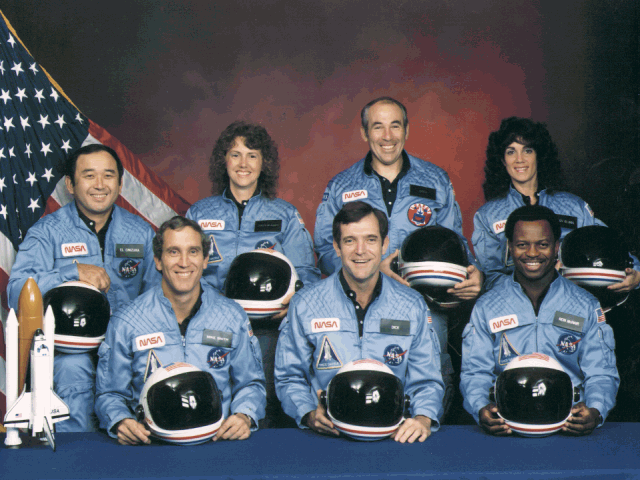
STS-51L Christa McAuliffe, Gregory Jarvis, Judy Resnik, Mission Commander Dick Scobee, Ronald McNair, Pilot Michael Smith, Ellison Onizuka in White Room on 8 JAN 1986

The biggest question on everyone’s mind is the one no one wants to discuss. What happened to the crew? The Orbiter and ET emerged from the cloud in fragments and some were large enough to be the area where the crew sat during launch. Most of us believe that they were killed instantly, but no one will rest peacefully until we know what happened to them. 

The scope and breadth of this tragedy is far beyond what I could have imagined. Somehow we all have to move forward, but we’re all trying to deal with what happened. Moving forward doesn’t seem possible, right now. The first step in moving forward will be to understand what happened.

TOMORROW: What Happened to STS-51L

15 Days in January – Day 14

Tags

, , , , , , , , , , ,

(NOTE: The following is a fictionalized account of the 15 days in January 1986 leading up to the Challenger Space Shuttle disaster on the 28th of that month; however, the details of weather and NASA events are based on known historical data.)

Titusville, Florida
Monday, January 27, 1986
High Temp: 55° F Low Temp: 36° F

Flight deck wide-angle view of STS-51L crew all dressed up and ready to go

It is frustrating when minor issues become show stoppers. Today’s first launch from Pad 39B was thwarted by a simple tool that wouldn’t come off the hatch on Challenger as we locked the crew in the Orbiter. We finally sawed it off and then drilled out a bolt to replace it. By the time we had solved the issue the winds were unacceptable for a landing if we had to abort and bring the Challenger back. We are now scheduled for launch tomorrow morning, January 28.

The weather was cold this morning. We’ve never launched in conditions this cold, but it is a lot colder than 36 ° F only 20,000 feet above Kennedy Space Center (KSC) and the Challenger will be there about 30 seconds after launch. I guess we shouldn’t be complaining down here.

STS-51L mid-deck with rest of crew strapped in

Tomorrow’s forecast is for clear skies and temperatures to be cold overnight and not as warm tomorrow during the day. The big issue on the Launch Pad for us is whether or not the temperatures will drop below freezing tonight. We have a lot of water piped in and around the pad area and if the water in the pipes freeze and break the Challenger might not go up for several days. One option being discussed is to open valves tonight and let the water flow to keep it from freezing. Trying to heat the entire pad area is not a realistic option and any open heat source is dangerous considering the fuels we have in and around the Shuttle.

If everything goes smoothly tomorrow we will finally get Challenger on its way for its 10th mission. We are now almost a week behind on this launch because of the delays of Columbia and the weather, both here and at other abort landing sites. After the launch we have to clean up the chemical residue from the Solid Rocket Boosters (SRBs) and inspect the launch pad area for damage. Repairs and  maintenance will be scheduled and addressed, which is currently underway at Launch Pad 39A after Columbia’s January 12th launch. 

By this time next year we will be more like the gate at an airport with a continuous process of preparing for launch, repairing from launch, and preparing for next launch, with three active pad crews (two here at KSC and one at Vandenberg AFB.) President John F. Kennedy gave our country a dream to reach for the stars and it is exciting to watch the dream become a reality.

15 Days in January – Day 13

Tags

, , , , , ,

(NOTE: The following is a fictionalized account of the 15 days in January 1986 leading up to the Challenger Space Shuttle disaster on the 28th of that month; however, the details of weather and NASA events are based on known historical data.)

Titusville, Florida
Sunday, January 26, 1986
High Temp: 66° F Low Temp: 48° F

Launch Rats working on the hydrogen fuel line

What’s next? One of the people on the launch pad team (we’re known as ‘Launch Rats’) likes to say, “What’s next?” He rarely stops moving. Once he’s completed one task he wants to move on. That is a great philosophy to have at NASA. We are constantly facing a new task or issue as we prepare for each launch and in order to address them all we have to keep moving.

That’s also what we have done in the American space program. It was a major achievement to get to the Moon and back, but that was only one task. We started out behind the U.S.S.R. in space technology, but we now are in the pilot’s seat in determining the future of space exploration. U.S.S.R is copying our Shuttle design so they can also have a reusable space vehicle, but they are at least a decade behind us.

Our family of Orbiters have the capacity to build a massive space station, much larger than the Soviet space station that is rumored to be launched sometime this year. Once we have a platform in space we can prepare for extended missions to the Moon or Mars without the current limitation of a single rocket’s lift capabilities. That is what’s next for America’s space program.

Tomorrow, pending good weather, we will send Challenger on its way, and before they are in orbit we have a Launch Rat that will be saying, “What’s next?”

15 Days in January – Day 12

Tags

, , , , , , , , ,

(NOTE: The following is a fictionalized account of the 15 days in January 1986 leading up to the Challenger Space Shuttle disaster on the 28th of that month; however, the details of weather and NASA events are based on known historical data.)

Titusville, Florida
Saturday, January 25, 1986
High Temp: 73° F Low Temp: 57° F

Teacher in Zero G - Christa McAuliffe trains for STS-51L

The launch of STS-51L is now scheduled for Monday. We were scheduled for a liftoff Sunday morning, but tomorrow’s weather is predicted to be as bad or worse than today’s, which was foggy until about noon. Hopefully, we can get Challenger off the ground on the 27th and then focus on Columbia’s next launch in March.

The seven astronauts going up with Challenger on Monday include our first teacher. The Teacher in Space Project was announced by President Ronald Reagan in the Fall of 1984. Last Summer Vice President George Bush announced that Sharon Christa McAuliffe was selected as the first Teacher in Space from 11,000 applicants. Christa teaches in Concord, New Hampshire and submitted her application on the last day they were being accepted.

STS-51L crew trains for emergency evacuation from launch pad

Mrs. McAuliffe, as she is known in the classroom, has always dreamed of being part of the space program and is pleased to have the chance to take her classroom skills into space. Christa talked about the opportunity she has been given, saying:

Imagine me teaching from space, all over the world, touching so many people’s lives. That’s a teacher’s dream! I have a vision of the world as a global village, a world without boundaries. Imagine a history teacher making history!

In addition to Mrs. McAuliffe will be four members of the ‘Class of 1978.’ Commander Francis R.’Dick’ Scobee, Mission Specialists Ellison ‘El’ S. Onizuka, Judith ‘Judy’ A. Resnik, and Ronald ‘Ron’ E. McNair were all selected as astronaut candidates in January of 1978. The other two crew members are Pilot Michael J. Smith and Payload Specialist Gregory Jarvis.

Commander Dick Scobee noted the opportunity of the Teacher in Space Project when he said:

“My perception is the real significance of it, and especially a teacher, is that it will get people in this country, especially the young people, expecting to fly in space. That’s the best thing that can happen to our program. The short-term gain is a publicity gain. The long term gain is getting expectations of the young people in this country to the point where they expect to fly in space, they expect to go there, they expect this country to pursue a program that allows it to be in space permanently to work and live there, to explore the planets.”

The Teacher in Space Project is just one more part in keeping America a world leader by bringing space down to Earth. On Monday we will take the next step with the beginning of mission STS-51L…assuming the weather cooperates!

15 Days in January – Day 11

Tags

, , , , , , , , , ,

(NOTE: The following is a fictionalized account of the 15 days in January 1986 leading up to the Challenger Space Shuttle disaster on the 28th of that month; however, the details of weather and NASA events are based on known historical data.)

Titusville, Florida
Friday, January 24, 1986
High Temp: 66° F Low Temp: 55° F

TDRS satellite to be launched by Challenger STS-51L

This afternoon’s launch had to be scrubbed. The weather here was cool and damp, but the real problem was the weather at one of the abort landing sites. We have an alternate abort site but they cannot handle a nighttime landing (an abort on this side of the world would be a night landing there,) so the launch was rescheduled for tomorrow morning in case we have to activate the alternate abort site. That would allow Challenger to land in daylight at the alternate site if they have to abort.

The launch was then pushed back another day because of the morning versus afternoon liftoff. The problem is that we have a set amount of work to do and it was quickly determined that we would not be ready for launch by Saturday morning. Mission Control then moved the launch to Sunday morning. 

SPARTAN 203 satellite to have its eye on Halley's Comet

Once we finally do get Challenger in orbit, the STS-51L mission has several goals. One will be to launch the TDRS-2 satellite, which is a communications relay station for analog and digital signals. These satellites are the next generation in communication technology allowing information to be transmitted around the world in seconds. Another small satellite called SPARTAN 203 is being deployed to observe Halley’s Comet, which will reach its perihelion (closest approach to the Sun) on February 9, 1986.

In addition, this mission will send our first “Teacher in Space.” More about that tomorrow. 

15 Days in January – Day 10

Tags

, , , , , , , ,

(NOTE: The following is a fictionalized account of the 15 days in January 1986 leading up to the Challenger Space Shuttle disaster on the 28th of that month; however, the details of weather and NASA events are based on known historical data.)

Titusville, Florida
Thursday, January 23, 1986
High Temp: 75° F Low Temp: 53° F

Earth looking out through Challenger cargo bay

Tomorrow we should launch Challenger on its 10th mission. Temperatures were seasonal today; however, the weather is questionable as another cold front is moving through tomorrow. We won’t know if the launch is a go or not until a few hours or less before liftoff.

Beyond weather considerations, there are thousands of things that have to be perfect before a mission is given a “go for launch.” It’s a wonder we ever get a Space Shuttle off the ground. Every individual component of the Orbiter, the External Tank (ET), and the Solid Rocket Boosters (SRBs) is rated in one of five categories of impact on the mission, vehicle, and/or crew if the part fails. The ratings are as follows:

  • Criticality 1 (C1) – Loss of vehicle or crew if the component fails
  • Criticality 2 (C2) – Loss of mission
  • Criticality 3 (C3) – Component will not have fatal impact on crew, vehicle, or mission if it alone fails
  • Criticality 1R (C 1R) – Redundant component, but loss of vehicle or crew if both primary and redundant components fail
  • Criticality 2R (C 2R) – Redundant component, but loss of mission if both primary and redundant components fail

Any component that is not rated C3 and has a known issue not only stops the countdown, but the entire program, until resolved. When trying to put seven people and tons of cargo into Earth orbit, there are a lot of components that fall into the C1, C2, C 1R, or C 2R categories. Safety can be annoying, but it save lives.

Crew of Challenger STS-7 mission working in space

That said, it is impossible for any human, regardless of how careful, intelligent or well-educated, to be able to anticipate every possible problem. Exploration of uncharted territory comes with a price and that price is the loss of human life. Over 700 people died trying to reach the North Pole and even there we have air to breathe, water, and survivable temperatures if properly dressed. In space there is no air, no water, and a human dies if directly exposed to the vacuum of space.

Space travel is risky on the best of days. Astronauts are put in a ship that is designed to be as light-weight as possible with no significant armor or shielding around them. They are attached to two highly explosive solid rocket boosters that would flatten a small city if they exploded, connected to a massive tank filled with hydrogen and oxygen that has a nasty tendency to flash burn if it comes in contact to even a small flame or spark.

In addition, the speeds and the pressures that astronauts experience are unlike any other reality most humans can imagine. There is no doubt that human life will be lost in the pursuit of space exploration. We will do everything we can to safeguard our astronauts, but at some point we will discover what we did not anticipate. At some point an accident will occur on the ground or in flight. We will investigate, learn where we failed and moved forward again.

For centuries humans sailed near the coastline because no one knew what lie out across the sea. Staying close to shore taught us how to sail, while minimizing the risk. Even then ships sank and people died. The Space Shuttle program is our way of sailing near the coastline. We send people up into low Earth orbit and learn how to ‘sail’ in space. After a few decades we will be ready to go out into open space, just as ships were ready to cross open seas.

There are some who ask why should we reach out into space. That is probably what some people asked sailors who went off to explore the new world. But those brave men sailed off into uncharted waters and everything we now enjoy in the United States of America is due to those who took the risks to leave behind the safety of ‘the known’ in order to explore the unknown.

The answer to those people who want to know ‘why’ is simply this: we don’t know why…YET. After we get there we will know why it was so important we went. That is the way it has always been when exploring the unknown. That is the way it will always be.

15 Days in January – Day 9

Tags

, , , , ,

(NOTE: The following is a fictionalized account of the 15 days in January 1986 leading up to the Challenger Space Shuttle Disaster; however, the details of weather and NASA events are based on known historical data.)

Titusville, Florida
Wednesday, January 22, 1986
High Temp: 72° F Low Temp: 46° F

Challenger main engines during STS-51F abort

It’s too bad the launch of our 25th mission was moved from today. The weather was good for most of the day. We are still go for the launch of Challenger on Friday. After Challenger we have a break until March 6th, when Columbia is scheduled to launch again.

As I’ve said, this will be Challenger’s 10th mission; however, the most problematic mission we’ve ever had in the program was her 8th mission. She was scheduled for launch on July 12, 1985 and the countdown was proceeding as planned. At 6 seconds the Orbiter’s main engines (SSMEs) began their firing sequence; however, just before the Solid Rocket Boosters (SRB) were fired the computers detected a problem with one of the engines and aborted the launch. While it is a safe procedure, any abort makes everyone’s heart beat a little faster.

Launch of STS-51F - Before one Main Engine failure

Once again the Challenger had her main engines replaced while at the launch pad, which took us two weeks. Problem solved…or at least we thought.

Challenger was then rescheduled for a liftoff on July 29th. After a technical issue delayed the launch by 97 minutes Challenger finally left pad 39A on her way to orbit. Less than six minutes into the flight one of Challenger’s main engines shutdown and another engine was reaching a potential automatic shutdown, which would have caused a serious high-risk abort issue. Quick work by Mission Control and the crew overrode the computer and kept the remaining two engines burning. Unfortunately, the Orbiter could not make its planned orbit; however, the crew was able to fulfill the mission in a lower orbit.

The launch of a Space Shuttle is never routine, but by the end of this year we will be showing the world how close space can be to those who reach for it

15 Days in January – Day 8

Tags

, , , , , , , , , , , ,

(NOTE: The following is a fictionalized account of the 15 days in January 1986 leading up to the Challenger Space Shuttle Disaster. The character’s account is fictional; however, the details of weather and Space Shuttle events are based on known historical facts.)

Titusville, Florida
Tuesday, January 21, 1986
High Temp: 64° F Low Temp: 45° F

Challenger rolls out to Launch Pad 39A

Today we are having another day of cool, but clear weather with the wind out of the north. Challenger (OV-099) is still being prepped for a Friday launch and I’m just grateful that the original launch date was pushed back because of Columbia’s flight delays. Hopefully, it will be warmer on Friday, which will make the launch more comfortable for everyone watching. 

Challenger STS-6, her maiden voyage

As I said yesterday, Challenger has given us many ‘challenges.’ The fact that OV-099 was not originally intended to fly may be part of the reason she has been sometimes reluctant to leave Earth. That said, despite her temperament, Challenger  has broken new ground for the program.

After her problematic maiden voyage the second flight was relatively trouble-free. Launched on June 18, 1983, Challenger STS-7 was the first mission with a planned landing at KSC, but that had to be waved off because of weather.

Challenger in lightning storm just prior to liftoff

Challenger’s third mission (STS-8) was supposed to be in July, but because a payload issue the launch was pushed back to August 30, 1983. After a spectacular lightning show just before launch, Challenger lifted off almost on time making history as the first nighttime launch of a Space Shuttle. This feat was complimented by the first nighttime landing when Challenger returned on September 5, 1983.

1984 was a great year for Challenger. OV-099’s fourth, fifth, and sixth missions gave us the first untethered ‘space walk,’ the first Orbiter landing at KSC, the successful recovery, repair, and redeployment of an orbiting satellite, the first time seven people were launched into space, and the first time two women were in space at the same time.

Bruce McCandless II became first human satellite on STS-41B

The seventh mission for Challenger, and her first of 1985, was unusual because it was the only mission where the Shuttle had been delivered to the launch pad and then had to be pulled back to the Vertical Assembly Building (VAB.) Concerns about the reliability of a satellite in the payload bay of Challenger forced NASA to cancel the mission.

After a two month delay Challenger’s new STS-51B mission was finally launched on April 29, 1985, with the European Space Lab – 3 in its payload bay. The mission was a success with the only issue with the flight occurring after the Solid Rocket Boosters (SRB) were recovered. The left SRB had evidence that it leaked hot gases through a joint area and two rubber o-rings that were designed to sealed the joint were damaged. One ring had 4mm of erosion and the other had 8mm of erosion.

This leakage presents two issues. The first is the potential loss of pressure if the leak is too major and the second is the danger of hot gases that might be directed toward the External Tank (ET), the Orbiter, or the other SRB, which might damage them. Fortunately, this was not an issue during this flight.

Despite the SRB hot gases leakage issue on her seventh mission, the biggest scare Challenger would give us was on her eighth mission. I’ll talk about that tomorrow. 

15 Days in January – Day 7

Tags

, , , , , ,

(NOTE: The following is a fictionalized account of the 15 days in January 1986 leading up to the Challenger Space Shuttle Disaster. The character’s account is fictional; however, the details of weather and Space Shuttle events are based on known historical facts.)

Titusville, Florida
Monday, January 20, 1986
High Temp: 66° F Low Temp: 48° F

Challenger atop the Boeing 747 on April 18, 1983

We are now four days from the launch of Challenger on the STS mission 51L. The decision was made to push back the date to Friday the 24th. I think that will be a great way to end our week. 

Challenger is our second space-qualified Orbiter. Columbia was the first. Challenger has been responsible for nine of 24 completed missions, and at times Challenger has been challenging.

Challenger rolls out to Launch Pad 39A for maiden voyage (8 DEC 1982)

While most civilians know Challenger by its name, we know it as OV-099 (technically:  Orbiter Vehicle-099;) however, that was not its original designation because initially it was not intended to fly.

Because of the lack of computer simulations, STA-099 (Structural Test Vehicle-099) was built to be a full-scale test model to determine if the design would meet stress expectations without failing. The contract to build it was awarded on July 26, 1972, but construction didn’t begin until November 21, 1975. After a year of testing was decided that it would be quicker and less expensive to refit STA-099 for space flight rather than rebuild the original air-flight test vehicle we know as Enterprise (OV-101.) The conversion of STA-099 to OV-099 began on January 28, 1979, which, in eight days, will be exactly seven years ago.

Repairing/replacing Challenger's main engines before its maiden flight

Challenger rolled out of the Palmdale assembly facility on June 30, 1982 and arrived at KSC on July 5th. Challenger was prepped for its first flight, which was scheduled for January 20, 1983, but while it sat on Launch Pad 39A testing revealed a hydrogen leak in one of the main engines. Subsequently, Challenger had to have her main engines removed for repairs while sitting on the launch pad. One of the engines had to be completely replaced.

Challenger problems did not end with the engines. A severe storm contaminated the payload while she sat on the pad. The payload had to be decontaminated. Challenger finally was successfully launched on her maiden flight on April 4, 1983, 51 months after the conversion began.

More on this ship’s history tomorrow.

15 Days in January – Day 6

Tags

, , , , , , , ,

(NOTE: The following is a fictionalized account of the 15 days in January 1986 leading up to the Challenger Space Shuttle Disaster. The character’s account is fictional; however, the details of weather and Space Shuttle events are based on known historical facts.)

Titusville, Florida
Sunday, January 19, 1986
High Temp: 73° F Low Temp: 60° F

STS-51L Challenger crew for the next launch

For most Americans Sunday should be a day of rest, but for us on the Launch Pad it is not. It’s hard to describe the workload on the Pad workers right now. This next flight will be our first off Pad 39B, which means we are breaking in a new launch pad at the same time we are trying to get the program back on schedule.

After Challenger launches we will have two launch pads operational and another one that will become operational at Vandenberg AFB in six months. We will need all three launch pads if we are going to be able to meet the needs of the ramped up space program. We are in the process of training a lot of people to staff all three launch pads but after we have a few launches under our belt it will all fall into place.

Challenger in VAB ready to be lifted

Each Orbiter goes through a series of ‘handoffs’ as it moves through the launch preparation phases. The current mission’s Orbiter, Challenger, landed at Edwards AFB on November 6, 1985, which ended its STS-61A mission. It was then prepped for riding on the back of a Boeing 747 back to Kennedy Space Center (KSC) where it arrived on November 11th. Challenger was then put in the Orbiter Processing Facility (OPF) for just over a month where it was prepped for this mission. On December 16th it was moved to the Vertical Assembly Building (VAB) where the External Tank (ET) and the two Solid Rocket Boosters (SRB’s) were mated to the Orbiter. Six days later (December 22, 1985) STS-51L rolled out to Launch Pad 39B where it is our job to prepare and maintain the ship until it launches next week.

Each ship goes through the same process. To have two launches a month, as is our goal, we will become a factory-like operation that flawlessly performs every duty, every day, 24 hours a day. We will truly be the most unique cargo operation in the world and the most vital for our country. We learn as much science and technology from every launch as the real scientists who fly our ships into space. With every new launch we are revising, updating and perfecting our skills.  Twenty years from now my children will know that their Dad was one of the people who made America the country that has the best, and possibly only, space port in the world! It makes me proud to be a part of history.