3rd From Sol

~ Learn from before. Live now. Look ahead.

3rd From Sol

Tag Archives: teachers

Nevada Education: The War On Children

22 Monday Apr 2019

Posted by Paul Kiser in About Reno, All Rights Reserved, Business, Conservatives, Economy, Education, Ethics, Government, jobs, labor, Management Practices, Nevada, Politicians, Politics, Reno, Taxes, United States

≈ Leave a comment

Tags

casinos, corporate tax, corporate taxes, Education, educational ranking, gaming, gold mining, K-12, lodging, mining, Nevada, Nevada Board of Education, Nevada gaming, Nevada mining, parenting, school adminstration, taxes, teacher salaries, teacher student ratio, teachers, Teaching, Washoe County, Washoe County School District, WCSD

Nevada Schools Closed on April 9th

April 9th was the last day of school in Nevada. Teachers, students, and staff will continue to keep the schools active until June 7th, but they are essentially working for free. This is based on a simple assumption. The assumption is that Nevada children should have the same level of funding as the average student in the United States. It doesn’t because education in Nevada is under siege and being starved of the funds it needs.

Schools in the United States spent an average of $11,762 on each student in the 2015-16 school year (the latest data available.) Nevada only spent $8,615 per pupil. [Sources:  Governing.com/U.S. Census Bureau Update 1 June 2018] Nevada funds their student’s education at 76% less than the average U.S. student. That is down from 83% in 2007.

Downward Spiral: Nevada per pupil funding as a % of the U.S. Average

At 76% of U.S. average per pupil funding, and based on a 180-day school year, Nevada’s per pupil funding runs out on April 9th, while the average U.S. student is funded to the end of the school year.

Nevada Education:  The No Money Myth

According to Education Week’s Quality Counts 2018, only Idaho ranks lower in School Finance and Nevada’ Overall education score is the worst in the United States. [Source:  Education Week 17 Jan 2018, updated 10 Oct 2018] But why doesn’t Nevada adequately fund public schools?

Nevada’s school funding, or lack thereof, is based on the assumption that Nevada is a poor State. Many believe that Nevada’s industries are overtaxed and cannot pay more in taxes than they are currently. They are not overtaxed. In fact, they’re hardly taxed at all.

Nevada is Not California, But It’s Not Nothin’

Nevada sits next to the 5th largest economy in the world, California. California casts a long shadow over almost all the other states in the United States, and it is true, Nevada’s Gross Domestic Product (GDP) is less than six percent of the Golden State.

Nevada’s GDP increased by 3.8% in 2017. In 2018, Nevada’s GDP increased by 5.7% in Q1, 4.3% in Q2, and 4.1% in Q3. (Source: U.S. Bureau of Economic Analysis Table 1)

However, Nevada’s GDP is not minor. In the United States, Nevada’s GDP is ranked 33rd (2017.) If Nevada were a country its GDP would rank 55th in the world. [Sources:  Wikipedia GDP World GDP USA] Nevada’s growth in GDP in 2017 was the second largest in the country.

What We Got Here…Is a Failure to Tax

Nevada’s problem is an almost religious belief that corporations should not pay taxes. Almost every tax in Nevada impacts the consumer, not the business. The gaming industry contributes almost nothing in taxes. They collect taxes from the winnings of the customer and collect lodging and entertainment taxes from the guest, but they pay no State corporate tax on their profits. They are essentially a tax collector for the State of Nevada, but not a taxpayer.

Nevada Mining’s Dirty Truths

Mining is one of Nevada’s major industries with a real GDP of $4.3 billion. [Source:  US ReapProject.org] Richard Perry of the Nevada Division of Minerals stated that in 2017, gold mining alone produced over $7 billion. [Source:  Nevada Business 1 Aug 2018] Since 2014, gold production has been increasing every year. [Source:  Nevada Mining Association] In 2017, Nevada accounted for 72% of all U.S. gold production. [Source:  Nevada Mining Association] Mining also offers one of the highest average wage of any industry in Nevada at just over $90,000.

It’s the other truths that make the ethics of the Nevada mining industry disturbing. Despite being a major industry, taxes paid by mining activities will only account for 1.1% of the State’s tax revenue during the 2017-19 budget. Cigarette taxes will account for almost four times the tax paid by mining. [Source:  Nevada Revenue Reference Manual 2017] 

Nevada’s Current State Revenue: Smoking is almost four times better for Nevada’s budget than mining

In 2018, Nevada ranked second in the world. For what? The mining industry ranked Nevada as having an almost a perfect score for having the most favorable policies in the world. Nevada is also ranked number one in Investment Attractiveness. [Source:  Fraser Institute 2018 Annual Mining Survey] Mining loves Nevada, in large part, because of a lax environment of taxation, labor, and regulation. Simply put, Nevada lets mining walk away with its natural resources with little benefit to its citizens.

One thing the Nevada mining industry does best is to control the message. They boast of having the highest average salary in the State. What they don’t emphasize is that mining only employees about 14,000 employees. [Source:  Wikipedia]

Mining’s high salaries are a result of, 1) employing few unskilled workers, and 2) competitive issues. They are trying to recruit highly skilled professionals to live and work in a rural, isolated environment. The high salaries are due to a workforce that is heavily mechanized and uses few unskilled labors. One report explains the employment situation in the Nevada mining industry:

Support positions represent the minority and are low-paying jobs, but this sector pays and average of about $90,000, if you’re lucky to get one of the mining or administrative positions.

Newsmax 14 Apr 2015 M.A. Smith 

 At War:  Disinformation About Public Schools

The motivation behind the war on Nevada children is greed. Also, a certain element in Nevada opposes the public education concept. This element, largely led by Nevada’s major industries, seem to believe that education is a black hole that consumes money but has no financial benefit to them.

The strategy has been to demonize public schools. For decades, a disinformation program has promoted the idea that public schools are corrupt, wasteful, and evil. Nevada’s business community, especially mining and gaming, have used their money and resources to back candidates that work to prevent adequate funding of public education. 

In addition, certain politicians have resurrected the belief that education should be centered on the concept of a deity. In 2015, Nevada Republicans passed a measure that would give parents taxpayer money to send their children to religious-operated schools. Republican Governor Brian Sandoval, whose children had attended a Catholic elementary school, signed the bill into Nevada law.

In 2016, the Nevada Supreme Court ruled the law to be unconstitutional but left the option open for Republicans to write a new bill that would allow taxpayer money to be given to parents for private religious schools. [Source:  AP 29 Sep 2016 – M. Rindels]

The Teacher Salary Deception

Those who are waging war against Nevada’s schools will point to the average teacher salary in Nevada. At $57,366, Nevada’s average teacher salary ranks as the 18th highest in the nation. [Source:  Business Insider 11 Feb 2019 – M. Perino] It is one of the few bright spots in the education story of the State…until you look closer.

With Nevada’s relatively high average teacher salary, one would expect the amount of money spent on instruction in Silver State’s schools to also be high, or at least above average. It is not.

Nevada’s per pupil spending on instruction is even worse than its overall per pupil spending. Nevada is only spending 73% per pupil than the U.S. average. So if the average Nevada teacher is paid more, why is instructional per pupil spending less?

The answer lies in Nevada’s teacher to student ratio. A single Nevada teacher instructs the same number of students as 1.6 teachers in the nation’s typical classroom. At almost 26 students per teacher, Nevada ranked first in the United States in student/teacher ratio for both 2016 and 2017. [Source:  NEA Research Table B3 Apr 2018]

Nevada pays teachers more than average because they have fewer teachers to pay. 

At War:  Infiltrate and Subvert

Stacking the Deck

Another tactic by anti-public school forces has been to infiltrate both local and state public school institutions and subvert efforts to increase public school funding to appropriate levels. The President of the Nevada State Board of Education is Elaine Wynn, co-founder and Director of Wynn Resorts, one of Nevada’s largest gaming corporations.

Seven of the eleven State Board of Education members do not have a degree in education, nor have they been employed as a public school teacher. The only active teacher on the Board is a part-time music teacher. [Source:  DOE.NV.GOV] The State Board of Education is designed to allow people with a vested interest in keeping a tight reign on funding for education.

At the school district level, the demoralizing environment of underfunded schools has caused the loss of great educators leaving the profession. This has also allowed in people who have a sadistic pleasure in experimenting on children. In the Washoe County School District (WCSD,) Nevada’s second largest, the vacuum of qualified teachers has attracted a few administrators and teachers that have seized the opportunity to push for cruelty in the schools.

Ms. Ratched is in the Classroom

The primary agenda of these dysfunctional administrators and teachers seems to the establishment a strict disciplinary state in the schools using the term, ‘rigor,’ as a code word for mental and social abuse of children. Rigor is interpreted by some teachers as an excuse to require hours of studying at home every night. When students fall behind, the teacher and the school blame the student for being mentally and/or emotionally flawed. Like Nurse Ratched in One Flew Over the Cuckoo’s Nest, a passive-aggressive teacher thrives in an environment where they’ve been approved to be tough on the students. 

Nurse Ratched also applied rigor and strict discipline to the people in her charge

Student absences are seen as opportunities by some teachers to burden the student with hours of makeup work. This work is added to the hours of homework that these same teachers send home every day. This work is due within 48 hours of receiving it. [Source:  WCSD Website] Some teachers have interpreted this policy as beginning 48 hours of being posted online, meaning students are expected to retrieve their makeup work at home while they are sick.

Some teachers have opted to use homework as an alternative to classroom instruction. In one case, a math syllabus for 7th-grade students warns students that homework will include introducing concepts not discussed in the classroom. The student is expected to research the concept at home and teach themselves how to complete the math problem. A math teacher reportedly told her students, “I’m not here to teach you, I’m here to grade you.”

I’m not here to teach you, I’m here to grade you.

Washoe County School District Teacher

During the past school year, the district also attempted to implement a program requiring students to complete improvised curriculum from home during ‘Snow Days.’ This program, known as ‘Digital Snow Days,’ had no educational justification. [See previous article] It was implemented under the banner of rigor and even though it was considered unlawful by the State Board of Education, certain district administrators vowed to pursue the program.

A typical child will often say they hate school, That’s expected, however, the fallout from an excessively cruel school environment is that students learn to hate learning.

Nevada Education:  Everyone Loses

In Nevada’s War on Children, everyone loses. Children that hate learning may do well on tests and graduate, but their motive is to do what is necessary to get away from school, not move forward with their education.

Employers that need bright, eager, well-educated employees to be competitive find Nevada high school graduates lacking. Companies like the aerospace company, Sierra Nevada Corporation, has its headquarters in Nevada where it escapes corporate and personal income taxes, but most of the company’s workforce is in Colorado. The jobs go to where the qualified people live.

Schools lose because they can’t keep great teachers who are faced with impossible work conditions. When schools recruit new teachers they are beggars offering salaries that don’t reflect the degree of education, training, licensure, personal scrutiny and professionalism required. Often they get the person willing to work for the salary, not the person they want in their school.

Parents lose because they have to confront the reality of underfunded schools, but their words fall on deaf ears when they seek remedies to the situation.

Nevada Education:  In a Tunnel Going Nowhere

There is no light on the horizon for Nevada’s schools. The current legislative session that will set the budget for the next two years will once again close without any effort to correct Nevada’s underfunding. Each year, Nevada’s per pupil funding will fall farther behind the funding for the average student in the United States. Money that belongs to Nevada’s children will end up in the bonus for a corporate executive…and the politicians will just shrug their shoulders and go home.

[NOTE:  Additional historical data was obtained from the Public Education Finances Report from the U.S. Department of Commerce, U.S. Census Bureau for 2007, 2008, 2009, 2010, 2011, 2012, 2013, 2014, 2015]

‘Rigor’ is About a School’s Public Image, Not Education

18 Tuesday Sep 2018

Posted by Paul Kiser in About Reno, Business, Conservatives, Discrimination, Education, Ethics, Generational, jobs, Nevada, parenting, Politicians, Politics, Public Image, racism, Reno, Science, Taxes, United States, Universities

≈ Leave a comment

Tags

Education, Education methods, learning, middle school, parents, pedagogy, public education, rigor, schools, teachers, Teaching, Teaching methods

Education 2020 Series – Part II:  Rigor

Rigor:  An End That Ignores the Means

Rigor is a catch phase in education. Rigor is touted by business and conservatives as preparation for college and/or the ‘working world.’ The application of rigor is often interpreted by educators as ‘making the students work hard.’ The argument is a continuation of the belief by conservatives that all the problems in the world are the fault of the individual. Schools would be great if only the students worked harder.

The irony is that the definition of rigor doesn’t match the conservative use of the word. The Merriam-Webster Dictionary uses the following words to define ‘rigor.’

“…severity, unyielding or inflexible, strictness, austerity, an act or instance severity or cruelty, a condition that makes life difficult, challenging, or uncomfortable, strict precision: exactness…”

All of these words indicate that rigor is a cruel and inflexible education system that ignores everything we have learned about best practices in teaching. 

Emphasis on Test Performance

My son is in the seventh grade in the gifted and talented education (GT or GATE) program of his school district. This his third year in the GT program and he is no stranger to a heavy homework load. Prior to joining the GT program, he attended a public charter school run by a Turkish Islamic group. In that school, he was also subject to rigor in the form of hours of homework designed to facilitate high test scores on standardized test required by the State of Nevada.

The purpose of rigor at the public charter school was two-fold. First, the public charter school administration used the high test scores as a shield to protect it from scrutiny by the school district and those test scores created an image of quality education for the school. Second, rigor was used to wash out all but the best academic performers in order to retain only college-bound students. The school has been in operation for 18 years; however, since they have had a K-12 program, the school graduates less than 25% of the students that were at the school in seventh grade. The rest of the students presumably move to other schools, which allows the charter school to brag about its 100% college-bound rates.

This week I attended my son’s “Parent Open House” His instructors pointed out their elaborate ‘agenda’ boards that covered the curriculum each day of that week. The agenda detailed in-class activities as well as assigned homework. They listed the multiple websites that are primarily established for one-way communication from instructor to student. Students are expected to constantly monitor the information provided and bear the burden of being aware of all requirements made by every instructor from every class.

Corporate Job Standards For Children?

It was a display of organization of information that any middle manager or corporate executive would envy. No student could possibly say that they didn’t know what was required of them. In the corporate world, we call these type of complicated objectives “Job Standards.”

Job Standards in the working world are used by managers to set expectations, then allow the manager to judge an employee’s performance. It sounds great, but Job Standards fail to provide mentoring for the employee, nor do they identify the shortcomings of the manager. If an employee has not been given the necessary training or resources, Job Standards create a situation to punish the employee. If the manager is partially, or completely at fault for an employee not achieving the expectations set down in the Job Standards, the employee potentially will be penalized.

Like corporate job standards, the concept of rigor in education create a system designed to produce results regardless of the objectives are realistic or not. It puts all the pressure on the victim of rigor and absolves the one who inflicts the rigor. If the student succeeds, the instructor and school can claim victory. If the student fails, it is the fault of the student.

To Mentor Students Or Throw Them In the Deep Water?

Instead of following an educational model that is based on mentoring the student, rigor is the educational model that follows the conservative concept of ‘sink or swim,’ and if the student sinks, it’s their fault. The fact that students are overwhelmed by the hours of homework and the confused by all the information coming at them from multiple instructors is acknowledged as a fact of life, not a problem. Counselors are sympathetic but cite the problem as the student’s need to adjust, not the school overreaching.

This is not to suggest that students need to be coddled, or that a challenging curriculum is wrong….let me say that again…this is not to suggest that students need to be coddled, or that a challenging curriculum is wrong;

This is not to suggest that students need to be coddled, or that a challenging curriculum is wrong…

…however, the conservative belief that education is simply a matter of demanding a heavy workload and establishing Job Standards for students is not appropriate. Twelve, thirteen, and fourteen-year-olds are not corporate employees, nor should they be subject to extended periods of excessive heavy workloads. 

The Ugly Side of Educational Rigor

It should also be noted that educational rigor benefits specific groups. Students from wealthy families have more resources for tutors, computers, etc. to help them cope with the heavy workload and digital format. Students from Caucasian or Asian families also tend to have an advantage as their cultural background has established decades of high educational expectations. This means that the students from poorer economic situations and other minorities will not have the same support and become more at-risk under the rigor model.

The failure of the rigor model is that it de-emphasizes a mentoring model and focuses on a ‘sink or swim’ model. Not only is rigor wrong for the pedagogy used in our schools, but it also is biased towards certain socioeconomic and ethnic groups. It will only be a matter of time before there is enough research to prove that schools that employ ‘rigor’ in the curriculum are discriminating against certain ethnic groups. 

Educational Landmines: Questioning the Pedagogy of Your Child’s School

17 Monday Sep 2018

Posted by Paul Kiser in About Reno, Business, College, Conservatives, Discrimination, Education, Ethics, Generational, Government, Higher Education, jobs, labor, Life, Nevada, parenting, Politicians, Politics, Public Image, racism, Religion, Reno, Science, Taxes, Universities, US History, Voting

≈ Leave a comment

Tags

administration, Conservatives, Education, Education methods, Management Practices, pedagogy, public education, Public Image, school boards, teachers, Washoe County School District, WCSD

Education 2020 – Part I:  Criticizing Pedagogy

Dangers of Discussing Pedagogy

Before any discussion of education begins, one must accept that if a parent questions the pedagogy (the methods and practice of teaching) of their child’s school that they risk being attacked, especially by other parents. My personal experience has been that other parents may become passionate about how wonderful the school is, even if there is clear documentation of problems within the school.

Sadly, parents who do criticize their child’s school often lack the knowledge and understanding of pedagogy to intelligently discuss issues and concerns. This has created a long history of parent’s crying ‘wolf’ about problems in the school. Now, all parents are assumed to be uninformed and overprotective, and their concerns and issues to be insignificant.

However, parents do have a legitimate perspective on the education of their children. It must be assumed that the parent will be biased toward their own child, but that does not completely negate the perspective. 

Who Are the Experts For Pedagogy?

Ideally, pedagogy should be influenced by people who have expertise in education. Experience and or advanced degrees in the field are factors, but should one educator’s opinions determine the pedagogy for all educators? Research is also a factor; however, simple data (graduation rates, test scores, etc.) is not research because this data is not peer-reviewed. Without peer review, critical questions are left unanswered regarding the validity of the data.

In our country’s current political climate, the idea of equal opportunity in education for all has been supplanted by education to meet the needs of corporations and religious interests. The decades-long effort of lower taxes and attacks on public schools have led conservatives to invade the school boards and districts to plant a new agenda that benefits particular groups. To support their agenda, conservatives often use single viewpoints of an expert touting his or her ‘years’ of educational experience, or advance degrees to support their political agenda.

Who Speaks For the Children?

Is there a legitimate voice in determining the pedagogy of our schools? Yes and no. Teachers and students are the core of education of our youth. Mentoring, not rigor should be the core of pedagogy in any legitimate school. Pedagogy should not be guided by what will make a student a better worker, but by what will develop the skills and ability of the student to make them a better person. Parents are biased, but parents should serve as an assistant to teachers regarding their child’s education. 

Most administrators and politicians should not have a significant role in pedagogy simply because they may have a corrupted interest in what is best for the student. Cutting costs, serving political and/or religious interests, etc. should not be part of the teacher/student interaction.

Finally, research, not data, should be at the core of pedagogy. The research should be unbiased for gender, race, and/or socioeconomic status. Graduation rates are meaningless unless there it can be documented that graduating from high school has led to personal, economic, and social success in adult life after graduation. College-bound rates are meaningless unless the student actually succeeds in college and completes a degree. Test scores and standardized tests are meaningless unless it can be proven that high test scores relate to success in adult life.

The Education 2020

It is dangerous territory to initiate a discussion on pedagogy and education in the United States of America; however, it is absolutely necessary. The future is determined by the wisdom of the present. Now is the time to discuss and correct the derailment of pedagogy in our schools.

The purpose of the Education 2020 series is to continue the discussion, identify the problems, and seek solutions.

Common Core: Are You A Good Switch Or A Bad Switch? Part III

25 Wednesday Mar 2015

Posted by Paul Kiser in Aging, College, Education, Ethics, Generational, Government, Government Regulation, Higher Education, History, Internet, parenting, Politics, Pride, Public Image, Public Relations, Science, Taxes, Technology, Universities, US History

≈ Leave a comment

Tags

Common Core, Conservatives, conspiracy, funding, math, parent protests, reading, Republicans, school districts, school funding, teachers, Teaching, writing

PART III:  An Answer to the Question:  Good? or Bad?

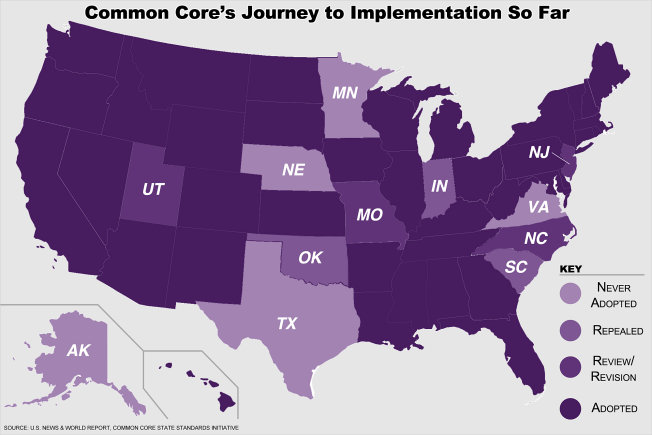
Implementation of Common Core/US News and World Report

Implementation of Common Core

THE VERDICT
In the past year significant political forces have targeted Common Core. The protests have been at near hysterical levels in many communities around the country. The complaints about Common Core are as follows:

  • Standards create a factory-like environment that attempt to put all students in one ‘box.’
  • Teachers focusing on test scores, not educational achievement
  • Parents don’t understand math methods
  • United States history under Common Core is un-American because it includes both positive and negative aspects of the history of our country
  • A belief that parents should define school curriculum, not the school, district, state, or federal government
  • A belief that President Obama is behind the implementation of Common Core and other conservative conspiracy theories

Many of the issues have been generated by conservative voices after a push by Republicans during the past election cycle to ignite anger and votes against public education. Almost all of the complaints would have occurred from any attempt to improve and refine American educational techniques, especially when those improvements involve standardization for all American schools.

If you believe that setting minimum standards in reading, writing, and math is bad, then Common Core is bad. If you believe that children in your community should graduate with similar skills to other students around the country, then Common Core is good. If you believe that a high school degree should be the end of a person’s education, then Common Core is bad. If you believe that every student should receive an education that would prepare them for college, then Common Core is good.

THE REAL PROBLEM
Despite the politicizing of Common Core, there is a real issue in implementing any change in education. Funding.

Any business that seeks to upgrade or improve their methods knows that there is a real cost to any change. Yet, even smart business people seem to forget that to improve our educational system requires a major funding commitment. It takes money to research and establish new programs. It takes money to train school districts, principals, and teachers. It takes money to create new teaching materials, and it takes money to educate parents.

What Common Core is missing is the funding needed to make it a success. Until we can accept the fact that a commitment to education requires a commitment to funding, then we will continue using 20th educational techniques in a 21st century world. America’s efforts to update our educational system will cost money and Common Core is a victim of a society that has abandon quality education because it costs too much.

THE HYSTERIA OF THE LOUDEST VOICES
Unfortunately, Common Core lost a lot of support in the past twelve months. Much of that was due to the political rhetoric during last year’s campaigns, but some teachers are also pulling back support. This is not surprising. As parents become more vocal in opposition, few teachers are willing to oppose parent sentiment even if they are wrong.

Common Core is not a perfect educational system, but it does attempt to better prepare America’s children for a higher level of achievement. Most of the real issues can be resolved with better funding. Just as a school built in the 1950’s is no longer relevant for 2015, education methods of the pre-information era are not relevant today. Our population is continuing to increase and the skills our children must have to thrive as adults are going to advance. Education is going to be expensive, but if we don’t pay now, we will pay more later.

PREVIOUSLY:  Part I:  A Primer in American Education 
                            Part II:  What is Common Core?

Common Core: Are You A Good Switch Or A Bad Switch? Part I

24 Tuesday Mar 2015

Posted by Paul Kiser in Aging, College, Education, Ethics, Generational, Government, Government Regulation, Higher Education, History, Information Technology, Internet, parenting, Politics, Pride, Public Image, Public Relations, Taxes, Universities, US History

≈ Leave a comment

Tags

classroom, college graduates, Common Core, Education methods, federal mandates, George W. Bush, graduation rates, high school graduates, job standards, K-12, NCLB, No Child Left Behind, President Barack Obama, Race to the Top, school districts, school vouchers, students, teachers, Teaching, Teaching methods, Teaching standards

School's should welcome diversity of ideas but shouldn't tolerate political agendas

School’s should welcome diversity of ideas but shouldn’t tolerate political agendas

PART I: A Primer in American Education

Who’s Afraid of Common Core?
Education in America is often the centerpiece of someone’s agenda, and the newest chapter of the how-to-fix-our-schools controversy is called Common Core. Conservatives have apparently decided that Common Core is the path to Satan. Liberals have reservations about Common Core because it smacks of a factory-like environment that assumes every student and school is the same.

The problem is that the most vocal critics of Common Core have no authority to speak on effective educational methods. Common Core is a significant paradigm shift in education, and opinions of untrained, uneducated, unhelpful ‘experts’  do nothing to move forward the debate on how best to prepare our children for Life 3.0.

The Cost of Achievement
In 1950, only one-third of the population in the United States had a high school degree or better, and only six percent had a college degree or better. In 2010, almost ninety percent of Americans had at least a high school degree, and thirty percent had at least a college degree. That increase is impressive, but what is astounding is that in the same sixty year time frame, America’s population doubled. 

To accomplish that feat cost money. A lot of money. As the bandwagon to attack government spending gained steam, education loomed large in the sights of conservatives. The real cost of the success of American educational achievement has been to become a target of the post-Reagan  agenda.  

Public school in Panama: Seeking to achieve the American dream

Public school in Panama: Seeking to achieve the American dream

A Historical Perspective
In the pre-Information age, schools were isolated in their own districts. How well the students of any given school performed was a local issue, not a state or national issue. In addition, a relatively small percentage of students sought out a college degree, and there were few school districts keeping track of college bound students.

The goal for most school districts in the 1960’s, 70’s, and 80’s was graduate as many students as possible, which sometimes opened the door to unethical practices, such as giving diplomas to students who clearly did not meet reasonable expectations (ability to read, write, etc.) to graduate.

However, by the 1990’s, the idea that all schools in the United States should be able to measure academic success through a unified set of academic standards began to take hold. As the Internet became the backbone of our society, the resulting information explosion forced us to accept that adequate math and reading skills were vital for success as an adult in a technologically advanced society. 

First Generation of Educational Standards
By the beginning of this century, plans had been put into motion to establish a set of educational standards for all schools and testing of all students to determine a school’s success or failure. Under President George W. Bush, the No Child Left Behind Act of 2001 (NCLB,) was mandated and it required States to establish standardized testing, teacher qualifications, and annual academic progress reporting. This was one of the most sweeping federal intrusions into public education. The primary focus of NCLB was to improve reading, writing, and mathematics in schools nationwide, while allowing States to establish the educational standards that would have to be met.

The catch was that rather than investing in those schools that needed help, No Child Left Behind focused on punishing schools that didn’t meet the artificial standards. Almost ever reputable educational review of NCLB  has given it a failing grade. Some of the reasons are as follows:

  • The emphasis on reading, writing, and math during a time when States were cutting funds for kindergarten through twelfth grade (K-12) created a shearing effect on other programs (language, history, music, arts, etc.) as money had to be reallocated to the studies under the NCLB Act.
  • Politicians had little understanding of education and the variables in a classroom environment and they attempted to apply factory-like operations to school systems that failed to address the real issues that impact the ability to learn.
  • NCLB assumed that teachers were mostly at fault for poor educational performance and politicians sought to intervene by imposing punishments for schools rather than actually acting in the best interest of the students.
  • The education of higher performing students was sacrificed in order to devote more resources for the poorer performing students.
  • Students with special needs were not excluded from the testing standards creating a population of students that automatically counted as failing against the school.

Educational Standards – Second Generation
Soon after taking office, the Obama administration began to move away from NCLB by introducing “Race to the Top.” This program flipped NCLB by seeking to reward States for adopting standardized programs rather than punishing them for not meeting federal standards. States competed for additional federal education funding; however, not every State rushed to play the game that offered no guarantee of financial carrot at the finish line.

The most searing problem with Obama’s Race to the Top program may have been the requirement that a teacher’s performance had to be linked to the student’s test scores. This concept of Pay For Performance suggests that teaching professionals must be threatened with a financial stick, forcing teachers to teach students to be successful on the tests by sacrificing all other educational values. It also discourages teachers from working with groups of challenging students who will not be able to produce the test results of more privileged and economically stable students.

NEXT:  Part II:  What is Common Core?
To be published Wednesday, 25 March, 0700 PDT/1400 UTC

NEXT NEXT:  Part III:  An Answer to the Question – Good? or Bad?
To be published Wednesday, 25 March, 1200 PDT/1900 UTC

Is It Time For A Two-Tiered School System?

12 Tuesday Mar 2013

Posted by Paul Kiser in Education, Ethics, Government, Management Practices, Opinion, parenting, Politics, Relationships, Respect, Taxes

≈ 2 Comments

Tags

elementary education, Parent Development, parent involvement in school, parents, Pay for Performance, schools, secondary education, teachers

Image by Paul KiserThere is a major problem in America’s educational system and that problem is obvious to anyone who spends time in the classroom. Consider this scenario:

Student X is one of the youngest in the class and started the year slightly behind (academically) her older classmates. Student X lives in a moderate, stable family environment with a modest income. The parents of Student X volunteer at the school and her Mom helps in the classroom once a week. Student X is expected to do her homework soon after coming home from school. One of the parents of Student X is available while she does her homework to answer her questions and assist her as needed, but the parent does not give her the answers. Her parents are in regular contact with her teachers and stay aware of her strengths and weakness. Student X receives constant encouragement to focus on learning.

Student Y lives in a two parent environment; however, one of the parents works 60 to 80 hours a week. Student Y is involved in a variety of non-school activities that take up several hours of after school time. One parent tends to be the mode of transportation from activity to activity, but doesn’t always wait for Student Y. Homework for Student Y is a ‘if we have time” priority, and Student Y’s parents have little contact with the school. Student Y’s parents are never sure what to expect on his report card and are often caught be surprise when there is an issue with a grade.

The absent parent in a child's education cannot be replaced by all the computers in the world.

The absent parent in a child’s education cannot be replaced by all the computers in the world.

Which student do you think will do well on a Standardized Test? Which will student has a better chance to succeed?

The fact that is often overlooked when discussing America’s public schools is the role that parents play, or fail to play in their child’s education. This is not a ‘blame’ issue, but it is a reality that must be included when politicians discuss how they want to ‘fix’ our schools. Parent investment in their child’s education is vital for her or his success in learning. Parents who, for whatever reason, fail to be committed to support and promote learning at home risk destroying the commitment their child will have in the classroom.

So the question is whether or not we need a two-tiered school system based on the parent’s commitment(†) to their child’s education. I believe that most good teachers can tell which students have committed parents, and which do not, so dividing students into two groups should be easy to accomplish.

Several studies have identified the advantages a student with involved parents has over a student who does not.(¹)(²)(³) In addition, a lack of parent involvement may require additional resources from the school to take up the slack of the parent who is not invested. If a teacher has to spend extra time to help that student who didn’t do their homework and master the needed skill, then the rest of the students pay the price because they can’t move forward until Student Y catches up. Even a child who is academically behind is less of a burden on the school when their parent is actively invested in the school.

Dividing our schools based on parental involvement makes sense…on paper, but like all quick fixes there are problems created by the fix that negate it. Identifying students with absent parents avoids the real problem, which is making parents aware that their investment in education is vital for their child’s success.

A Parent’s Place in Education
Despite the need for parental involvement, there is a limit to a parent’s engagement in their child’s education. Unless a parent also has a degree in education, the teacher is the most qualified to take the lead in the classroom. Parents should see themselves as interns in the school.

Even in fundraising, the parent’s role should be subservient to the school and its staff. Parents who decide for the school what projects and programs should be funded risk interfering with the objectives established by those who have an understanding of the larger view.

This should not cause a parent to wait to be asked to become involved. School administrators and teachers focus should be on the students, not on directing parents. This requires that parents and the school create an environment of trust and respect that is facilitated by timely and effective communication.

Professional Development for Parents?
One problem that faces parents is that most of us are not trained in the skills of helping a person learn. In addition, parents may not understand the objectives of the teacher; therefore, they may not know how they can support the in-class work when the student is working at home.

Schools are financially strapped for resources, but if politicians really want to help our educational system, maybe they should consider how schools can pay for parent development seminars (and/or webinars) that will support the objectives of the teachers and the school. By improving the at-home learning environment politicians might actually take a big step in ‘fixing’ our public schools.

We may not need a two-tiered school system, but we certainly need to accept that the failure of a student in school may indicate the failure of a parent, not the teacher or the school.

†(I was reminded this week about the difference between someone who is involved and someone who is committed. If you’re eating a bacon and egg breakfast, the chicken was involved, but the pig was committed.)

Standardized Testing is Not the Solution in American Education

09 Saturday Mar 2013

Posted by Paul Kiser in College, Education, Ethics, Government, Higher Education, Opinion, parenting, Politics, Universities

≈ 5 Comments

Tags

Nevada, Nevada Schools, No Child Left Behind, NSHE, Pay for Performance, Reno, schools, standardized tests, student performance, teachers, Washoe County School District, WCSD

Most of the political discussions about America’s failing education system do two things. First, they blame someone, usually the teachers, and second, they seek simple-minded solutions that assume all children are developmentally equal and live in the same socioeconomic environment.

If education were only about what can be scored on a test, then we don’t need teachers, we need mind programmers

No Child Left Behind was based on the belief that a standard test would be the ultimate measure of a student’s success or failure. The assumption was that if student’s scores on a standardized test failed to achieve established goals then we could all blame the teachers and administrative staff, then punish them. The concept assumed that a student’s base level abilities, and parental support was irrelevant. No Child Left Behind was an idea that applied a corporate-like measurement system, which often fails in a business environment, and forced public schools to leave education behind in pursuit of goals that reduced students to do or die numbers.

The failure of No Child Left Behind is so spectacular that after a decade the program began, over two-thirds of the States are ranked at a “D” or “F” in the quality of education by StudentsFirst.org Report Card. 

Standardized tests assume that every child is an X, but in reality they are A to Z

Standardized tests assume that every child is an X, but in reality they can be A to Z

One of the major failures of the program was the institutionalizing of testing standards that encouraged teachers to focus on teaching their students how to successfully take the tests, but not to understand the material. The program ultimately forced out many excellent teachers that rejected the absurdity of No Child Left Behind, which is ironic because the goal was to force out less effective teachers. The result has been that school after school has failed to produce the results desired leaving America with a generation of students who are even less prepared for adult life.

Nevada’s Washoe County School District (WCSD) is typical of many school districts across the United States. For the 2010-11 school year the standardized tests indicated that an average of 85% of the high school students (9th-12th grades) met or exceeded the established standards for reading, writing, and math. Those scores would indicate that 85% of the students are prepared to move on from high school.

However, of the 1,600 Washoe County School District graduates that attended Nevada state-run universities, almost half (48%) of them required remedial classes to bring them up to college entrance-level work. The standardized tests are designed to measure competency; however, even though the scores indicate the students are prepared, almost 1 out of 2 need to take classes to address educational deficiencies.

Some might say this just confirms the inadequacy of public schools; however, if that were true the standardized tests should reflect those failures and they do not. It is the inadequacy of the standardized test to measure educational performance or lack of performance.  

Standardized tests can be an effective tool in education, but they are just one tool. If we truly want to improve the educational performance of America’s students we must stop holding a knife to the throat of teachers and schools and stop using simple-minded measurements of academic performance to determine whether they live or die. A teacher can’t be held accountable for a parent that doesn’t believe in homework, therefore causing the student to be behind the rest of her/his class. It’s time we began supporting the teachers who have years of training and experience in education, rather than applying failed business models that destroy public education.

Other Pages of This Blog

  • About Paul Kiser
  • Common Core: Are You a Good Switch or a Bad Switch?
  • Familius Interruptus: Lessons of a DNA Shocker
  • Moffat County, Colorado: The Story of Two Families
  • Rules on Comments
  • Six Things The United States Must Do
  • Why We Are Here: A 65-Year Historical Perspective of the United States

Paul’s Recent Blogs

  • Dysfunctional Social Identity & Its Impact on Society
  • Road Less Traveled: How Craig, CO Was Orphaned
  • GOP Political Syndicate Seizes CO School District
  • DNA Shock +5 Years: What I Know & Lessons Learned
  • Solstices and Sunshine In North America
  • Blindsided: End of U.S. Solar Observation Capabilities?
  • Inspiration4: A Waste of Space Exploration

Paul Kiser’s Tweets

Tweets by PaulKiser

What’s Up

April 2026
S M T W T F S
 1234
567891011
12131415161718
19202122232425
2627282930  
« Jun    

Follow Blog via Email

Enter your email address to follow this blog and receive notifications of new posts by email.

Join 688 other subscribers

Create a website or blog at WordPress.com


Loading Comments...