3rd From Sol

~ Learn from before. Live now. Look ahead.

3rd From Sol

Category Archives: Science

Are We Missing an Ice Age? (PART II of III)

16 Wednesday Nov 2011

Posted by Paul Kiser in History, Science

≈ Leave a comment

Tags

aphelion, apsidal precession, axial precession, Earth's orbit, Earth's Wobble, eccentricity, Global warming, Ice Ages, invariable plane, Milankovitch Cycles, Milution Milankovic, obliquity, orbit, orbital inclination, orbital plane, perihelion, solar system, Tilt, Warm Ages

PART II – Understanding the Milankovitch Cycles, Clues to Earth’s Climate Changes 

RECAP: In Part I of this series, we looked at how scientists have determined that Earth has experienced regular cycles of cold climates followed by brief periods of warm climates during the last 400,000 years. We learned that the current cycle has been different because the warm period has persisted when past warm climates have rapidly dropped back into a cold climate. We also discussed how the Sun acts as a ‘battery charger’ for Earth’s climate.

Milutin Milanković  proposed possible mechanisms related to Earth’s tilt and orbit that could be the root cause of the regular cycle of Ice Ages. His theory, outlined in several papers from 1912 to 1920, is now referred to as the Milankovitch Cycles¹. This theory outlines four factors that change the amount of solar radiation received by the Sun, which could explain why Earth experiences dramatic changes in its climate over a 100,000 year cycle. In addition, there is a fifth factor that has been added to the Milankovitch Cycle theory, which also follows a 100,000 year cycle and may also be contributing triggering our Ice/Warm Age cycles.

FACTOR ONE
Eccentricity or Earth’s Orbit – From a Circle to Oval and Back

IMAGE 1.0 -Earth's Orbit: High Eccentricity vs. Low Eccentricity

Earth’s orbit changes from a nearly perfect circle, to an oval (technically, an ellipse) over a period of thousands of years. The cause of this elongation or eccentricity of our orbit is due to the gravity influences of Jupiter and Saturn, which are much farther away from the Earth than the Sun, but exert enough pull to periodically stretch our orbit out of its circular shape.

In an orbit that is a perfect circle the amount of energy the Earth receives is relatively constant throughout the year, assuming the Sun is generating a constant amount of energy (which it doesn’t.) However, when Earth’s orbit is an ellipse (or more eccentric) the Earth receives more energy when it is closer to the Sun than when it is farther away.

Paul Kiser

Earth’s orbit eccentricity varies from .005 (low) to .058 (high) and the cycle of low to high eccentricity is roughly 100,000 years. Our orbit had major peak eccentricities of .04 to .06 at approximately 120, 220, 320 thousand years ago. These peaks fall about 10,000 to 20,000 years before the start of the last three Warm Ages.

Currently the eccentricity of our orbit is .017 and it is falling from a minor peak of about .02. That means that Earth’s orbit is about one-third the way from our lowest eccentricity and becoming more circular. The eccentricity of Earth’s current orbit creates about a three million mile difference between its closest and farthest approach to the Sun. Earth at perihelion (closest to the Sun) is 91.4 million miles away from the Sun. At aphelion the Earth is 94.5 million miles away.

FACTOR TWO
Obliquity or the Severity of Earth’s Tilt

Currently the Earth is tilted at 23.44 degrees from the Sun’s orbital plane, but that is not constant. The Earth’s tilt or obliquity is decreasing from the high obliquity (tilt angle) of 24.4° towards the low of 22.1º. It will take Earth about 10,000 years to reach the low point in a 41,000 year cycle.

For comparison, Mars’ current obliquity is 25.19° and varies from 10° to 40° over hundreds of thousands of years. Venus’ obliquity is 177.4°, which means that the planet is so tilted that its ‘north’ is facing south. That may seem strange to have an obliquity greater than 90°; however, since Venus’ rotation is retrograde (Venus turns in the opposite direction of Earth) scientists consider its ‘up’ side to have been literally turned upside down.

IMAGE 1.1 - Tilt or Obliquity of the '8' Planets and Pluto

Higher obliquity is believed to result in the Earth absorbing more solar radiation (insolation) because the higher latitudes receive more sunshine in the summer. Earth’s current Warm Age began at about the same time as our peak obliquity, so there is evidence that this theory is valid.

FACTOR THREE
Axial Precession or Earth’s Wobble

Image 1.2 - Earth's Wobble is called Axial Precession

Currently the north pole, or axis, points towards the star called Polaris. That is temporary because the Earth wobbles. This wobble is called the Axial Precession. Over time our north axis will no longer be aimed at Polaris, but instead will leave us without a ‘North Star’ until Earth’s north axis points to Vega, Deneb, or another bright star or galaxy.

It takes about 26,000 years for the wobble to complete one full cycle and during that cycle the Earth’s wobble will cause a slow change in the seasons. This is because the axis wobble alters the direction of our tilt during every orbit of the Sun. When the Earth returns to the same relative position in its orbit, the axis will point to a slightly different place than it did the prior year. The axis will have reached that point earlier, so our seasons slowly move backward.

FACTOR FOUR
Apsidal Precession or The Hula Hoop Effect

IMAGE 1.3 - This graphic shows Apsidal Precession (Click to Activate)

One of the more interesting factors is Apsidal Precession. If you think of Earth’s orbit as a hula hoop and your waist as the Sun (no, it’s not that big,) as the hula hoop goes around, the ‘orbit’ shifts. Any particular point on the hula hoop will move from being closest to your waist and then it will shift to be the farthest away from you waist. Our seasons do the same thing as Earth’s orbit slowly shifts or precesses.

Currently, summer in the northern hemisphere occurs when the Earth is the farthest away (aphelion) and in winter we are closest to the Sun (perihelion.) In the southern hemisphere it is exactly opposite. During the summer in the southern hemisphere (Earth at perihelion) it receives 23% more solar radiation than the northern hemisphere does during its summer, which occurs at the aphelion. It takes about 21,000 years for the Apsidal Precession to cause the seasons to make a full cycle, so in about 10,000 years, the northern hemisphere will experience summer at perihelion. 

FACTOR FIVE
Orbital Inclination or Our Orbits Tilt From the Orbital Plane

IMAGE 1.4 - Earth's Orbital Plane from the Solar Systems Invariable Plane

By averaging the orbits of the eight planets scientists have created one plane that is considered the invariable plane. Jupiter is almost on this invariable plane; however, Earth and the other six planet’s orbital planes are tilted or inclined from the invariable plane.

Not only is Earth’s orbital inclination 1.57° off the invariable plane, the amount of tilt changes on a cycle that repeats every 100,000 years. Earth’s variance during that cycle can be as much as 3° off the invariable plane, which is additive to Earth’s obliquity or tilt on its axis. That means that increased orbital inclination magnifies the effect of Earth’s obliquity.

This factor was not part of Milankovic’s original theory; however, scientists have added it to the Milankovitch Cycle because it impacts the amount of insolation the Earth receives and because it follows the 100,000 year cycle.

In Part II, we have discussed five cyclical factors that change the amount of insolation the Earth receives and where Earth is in all five cycles. In Part III we look at how Earth’s climate seems to be on a hair-trigger and why we should or should not be in an Ice Age now.

PART I – Are We Missing An Ice Age?

PART III – Should We Be In An Ice Age Now?

USA PDT [Twitter: ] [Facebook] [LinkedIn] [Skype: 775.624.5679]


NOTES AND REFERENCES

¹Wikipedia – The Free Encyclopedia. (2011). Milankovitch Cycles. Retrieved November 13, 2011, from http://en.wikipedia.org/wiki/Milankovitch_cycles.

IMAGE CREDITS

IMAGE 1.0 – Image thanks to http://apollo.lsc.vsc.edu/classes/met130/notes/chapter16/mil_cycles.html

IMAGE 1.1 – Image Copyright 1999 by Calvin J. Hamilton. Found at http://www.solarviews.com/cap/misc/obliquity.htm 

IMAGE 1.2 – Image thanks to http://tomsastroblog.com/archives/8047

IMAGE 1.3 – Graphic thanks to Wikimedia Commons at http://en.wikipedia.org/wiki/File:Precessing_Kepler_orbit_280frames_e0.6_smaller.gif

Support Wikipedia

Are We Missing an Ice Age? (Part I)

14 Monday Nov 2011

Posted by Paul Kiser in History, Science

≈ 4 Comments

Tags

Earth's orbit, Global warming, Ice Age, Ice Ages, ice core data, interglacials, Milankovitch Cycles, Milution Milankovic, solar radiation, Warm Ages

There is no doubt that Earth has a fairly consistent cycle of Ice Ages followed by interglacials, or Warm Ages. Using physical geologic evidence of the last Ice Age, and by analyzing and comparing ice cores, ocean sediment cores, and other samples that preserve air and climate data within them, scientists have an understanding of Earth’s overall climate back for over 400,000 years.

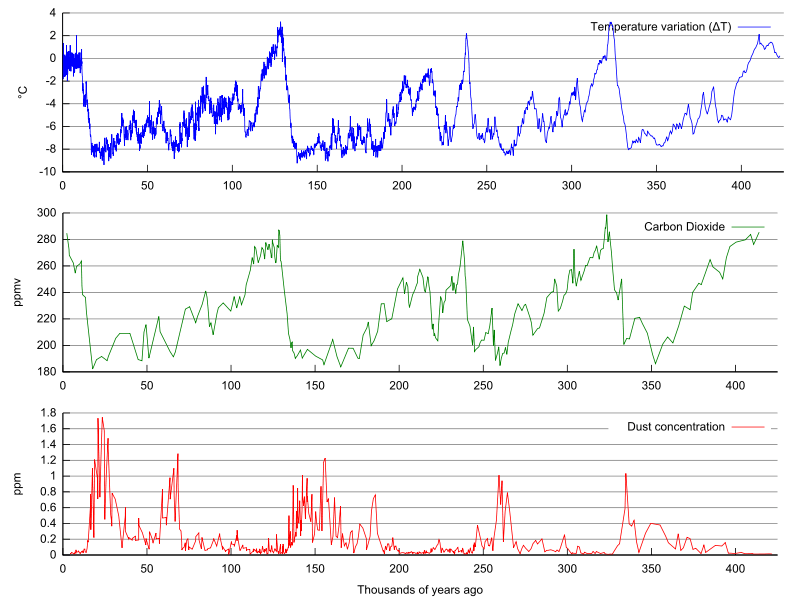
GRAPH 1.0 - Vostok Ice Core Data

There is a pattern to the data that suggests an approximate 100,000 year cycle that includes a 90,000 year cold period (Ice Age) followed by a brief 10,000 year warm period (Warm Age.) While this cycle can vary, the fact is that we have been in a Warm Age for over 10,000 years. Another unusual aspect of the current pattern is that typically the Warm Age rises to a sudden peak followed by a fairly rapid cooling period. The current Warm Age suddenly began and peaked about 11,000 years ago. The Earth has stayed relatively warm, and is in fact, continuing to get warmer.

The question is, are we missing an Ice Age?

GRAPH 1.0 is the data from the Vostok Station ice cores in the Antarctica. The top (blue line) graph indicates the trending air temperature, the middle graph (green line) indicates CO² levels trapped in the ice, and the bottom graph (red line) indicates the dust found in the ice samples. Note that present day is on the left side of all of the graphs and to the right is going farther back in time. Ice core data is not precise because of several factors; however, the data indicates the conditions within a 6,000 year margin of error.

The data indicates that there was a sudden warming starting at about 15, 140, 245, and 330 thousand years ago. The CO² has similar peaks but lags behind the temperature increases by 200 to 600 years. Dust seems to also correlate with the temperature variations, but whether low dust causes warmer temperatures, or warmer temperature cause a cleaning of atmosphere by increased rain, is unknown.

Paul Kiser

The consistency of the cycles indicates that there is some mechanism that drives the cold/warm periods which would be difficult to explain using Earth-bound causes. Volcanic periods, plate tectonics, ocean currents and other activities on Earth that might influence our climate don’t seem to have cycles that could be matched to the ice core data; however, there are exo-mechanisms (outside of Earth) that could help to explain the Ice/Warm Age cycles.

Earth as a Battery
Everyone knows that the Earth warms in the Spring and Summer and cools in the Fall and Winter. The reasons for this are due to Earth’s 23.5° tilt as we orbit around the Sun (SEE:  23.5 Degrees = Seasons on Earth.) Based on our firsthand experiences, it might be easy to believe that the Earth’s relationship to the Sun, outside of the annual march of the seasons, is relatively constant; however, it is not.

Earth’s orbit and tilt change over time and there is a significant difference in how much of the Sun’s energy (solar radiation) that Earth receives based on its relative position with the Sun. This is important because the energy our planet receives from the Sun is like a battery charger for our climate. When Earth absorbs more energy, the battery charges and we have a warmer, more active climate. When the Earth absorbs less energy, it cools and our climate reacts accordingly.

There are multiple factors that change Earth’s position in relationship to the Sun. Almost 100 years ago, Serbian geophysicist and civil engineer, Milutin Milanković noted these astronomical variations and suggested a theory of climate change based on these factors now known as the Milankovitch Cycles. In Part II of this series we will learn about the changes in Earth’s orbit and tilt that result in variation of the amount of solar radiation our planet receives. In Part III we will discuss Earth’s current status in the Milankovitch Cycle and why we may be overdue for an ice age.

PART II – Understanding the Milankovitch Cycles, Clues to Earth’s Climate Changes

PART III – Should We Be In An Ice Age Now?

USA PDT [Twitter: ] [Facebook] [LinkedIn] [Skype: 775.624.5679]

Muller: “global warming….why you should not be a skeptic”

02 Wednesday Nov 2011

Posted by Paul Kiser in Politics, Science

≈ 2 Comments

Tags

Dr. Richard Muller, erkeley Earth Surface Temperature, Global warming, Jon Stewart, Koch, Muller, Richard Muller, skeptics, The Daily Show with Jon Stewart

USA PDT [Twitter: ] [Facebook] [LinkedIn] [Skype: 775.624.5679]

Paul Kiser

On October 21, Dr. Richard Muller published an article in the Wall Street Journal (WSJ) presenting the results of a two-year exhaustive study of the world temperature records using multiple methods to verify the data. The verdict, global warming is real and the skeptics are wrong.

This was news because Dr. Muller, a physics professor at the University of California, Berkeley, has been one of the ‘legitimate scientists’ that skeptics have relied on to support their position that global warming is a myth. This startling announcement was largely ignored by the news media until Jon Stewart had a field day with the announcement on his October 26 episode of The Daily Show with Jon Stewart. Since airing, several other news media outlets have picked up the story, including MSNBC, and The Huffington Post.

Richard Muller says it's real

Part of the lack of awareness is partially due to Dr. Muller spending the first half (516 out of 1009 total words) of his Op Ed piece restating why he thinks people should be skeptical of global warming. Since most people don’t read past the first few paragraphs it was easy for the heart of his announcement to remain buried in the last half of the article where he finally states:

…But now let me explain why you should not be a skeptic, at least not any longer.

Conservatives, who are consistent skeptics of global warming, have accused scientists of almost every type of conspiracy and evil motivation in order to throw a blanket of doubt on legitimate, scientific research which have uncovered a significant change in Earth’s climate. On the Daily Show’s episode, Stewart shows clips of Texas Governor and presidential candidate, Rick Perry accusing, “a substantial number of scientists…” of “…manipulating the data…” in order to get funding for their projects. On the same show, a comical interview of Republican Strategist Noelle Nikpour has her stoically accusing scientists of making up data “…for their own finanshual (sic) gain…” and adds that “every American…would have a gut feeling…” that scientific data is wrong.

Muller’s analysis is part of the Berkeley Earth Surface Temperature study and is a review of the scientific data used to determine whether the average surface temperatures (historical and present day) are reliable. The study received $150,000 from the Charles G. Koch Charitable Foundation, associated with the Koch brothers, who made their money in the oil industry. The study also received $100,000 from both the William K. Bowes Foundation and a foundation established by Bill Gates. 

In the WSJ article Muller explains:

…When we began our study, we felt that skeptics had raised legitimate issues, and we didn’t know what we’d find. Our results turned out to be close to those published by prior groups. We think that means that those groups had truly been very careful in their work, despite their inability to convince some skeptics of that.

Will this quiet the skeptics? Probably not, but facts don’t usually get in the way of people in denial.

This article first published as
Muller: “global warming…why  you should not be a skeptic”
on Technorati.com

Why Pluto as a Planet Doesn’t Make Sense…Scientifically

12 Monday Sep 2011

Posted by Paul Kiser in Science

≈ Leave a comment

Science Monday Article:  The science behind Pluto’s demotion

Science is driven to move forward as we learn more. If we accept that old information and ideas should stand in the way of progress, then we betray all that science is to ourselves and those who will benefit in the future. The Pluto debate should have never happened, but since it has this explanation is Why Pluto as a Planet Doesn’t Make Sense…Scientifically.

Why Should We Care About Sunspots Anyway?

29 Monday Aug 2011

Posted by Paul Kiser in parenting, Science

≈ Leave a comment

Tags

Carrington Event, CME, Solar Flares, Sun, Sunspots

Why Should We Care About Sunspots Anyway?.

Parents need to be excited about science if they want their students to be excited and engaged.  This blog is dedicated to help parents get up-to-date on science through an exploration of science topics.  This article explores the significance of the dynamics of the Sun and how it impacts Earth and humans.

Happy New Year!!!

22 Wednesday Dec 2010

Posted by Paul Kiser in Random, Science

≈ Leave a comment

Tags

astronomy, northern hemisphere, southern hemisphere, Sun, winter solstice

by Paul Kiser
USA PDT  [Twitter: ] [Facebook] [LinkedIn] [Skype:kiserrotary or 775.624.5679]

Paul Kiser

For me, the New Year really begins today (December 22, 2010.) Being a science geek at heart, I tend to see the world slightly different that many and I see the day after the Winter Solstice as a rebirth. Yesterday was the shortest day of the year, so from now until June 21st the days will get longer and that is cause for celebration.

In addition, for the next two weeks the Earth is still getting closer to the Sun. This year the perihelion (Earth closest approach to the Sun) occurs at 11 AM PST on January 3rd, 2011. Sure, it’s a relatively minor difference between perihelion and aphelion (Earth’s farthest distance from the Sun), but it’s still a 3 million mile difference! In the cold and dark of winter I’ll take being even one mile closer to the Sun.

Split image of the Sun's relative size at perihelion and aphelion in 2009. Thanks to NASA, photo by Enrique Luque Cervigón

From now until January 3rd we’re getting closer to the Sun AND the days are getting longer. The fact that Christmas and New Year’s (and Hanukkah in some years) all fall in the same two week period tend to overshadow the science, but it does not diminish that, from an astronomical point of view, there is also good reason to be of good cheer.

That is, of course, for those of us in the Northern Hemisphere. For our friends south of the Equator today marks the march toward darker days that peak just before the Earth is the farthest away from the Sun. That just doesn’t seem to be as uplifting as our situation. Maybe we shouldn’t say anything to them.

Solar Halo around Sun on Dec. 21, 2010 (Winter Solstice in Reno, NV, USA

So Happy New Year to all of us in the Northern Hemisphere. Brighter, longer days are coming! For our friends in the Southern Hemisphere, uhm… man, is it hot out or what!

More Articles

Business: Public Relations, Management, and Social Media Related

  • Facebook and Twitter Doomed? …Chicken Crap
  • 5 reasons why you shouldn’t title your blog with number reasons
  • A Question of Ethics
  • HR/Security Hot Topic: Should you watch your employee’s personal Internet activities? (Facebook, MySpace, Twitter, etc.)
  • Relationship Typing: 3 factors that affect the quality and depth of friendship (Part I)
  • Starbucks Re-Imagines the business … again
  • Your Privacy Rights on the Internet: Read before you write
  • Social Media 3Q Update: Who uses Facebook, Twitter,LinkedIn, and MySpace?
  • Richmond Embassy Suites: The best at true Hospitality
  • Dear Business Person: It’s 2010, please update your brain.
  • Selling watered-down beer: The best spin campaign in advertising
  • Communication: Repetition of message does not increase awareness
  • Is it time to fire yourself?
  • Millennium Hotel: Go away, spend your money elsewhere
  • Rogue Flight Attendant shows his arrogance, Airlines dislike for the customer
  • 2Q 2010 Social Media Tools: Facebook/Twitter sail on, LinkedIn/MySpace don’t
  • War Declared on Social Media: Desperate Acts of Traditional Media
  • Pay It Middle: The Balance between Too Much and Too Little Compensation
  • Mega Executive Pay Leads to Poor Performance
  • Relationships and Thin-Slicing: Why the other person knows what you’re really thinking
  • Browser Wars: Internet Explorer losing, Google Chrome gaining ground
  • WiFi on Southwest Airlines: Is it ‘Shovel Ready’?
  • Starbucks makes a smart move: Free WiFi
  • Foul Play: FIFA shows what less regulation offers to business
  • The Shock of the McChrystal Story: The story is over before the article is published
  • Tony Hayward: The very model of a modern Major General
  • Epic Fail: PR ‘Experts’ don’t get Twitter
  • King of Anything: Social Media vs Traditional Media
  • Twitter is the Thunderstorm of World Thought
  • Signs of the Times
  • How Social Interactive Media Could Transform Higher Education
  • How to Become a Zen Master of Social Media
  • Death of All Salesmen!
  • Aristotle’s General Rules on Social Media
  • Social Media:  What is it and Why Should You Care?
  • Social Media 2020:  Keep it Personal
  • Social Media 2020:  Who Shouldn’t Be Teaching Social Media
  • Social Media 2020:  Public Relations 2001 vs Social Media Relations 2010
  • Social Media 2020: Who Moved My Public Relations?
  • Publishing Industry to End 2012
  • Who uses Facebook, Twitter, MySpace & LinkedIn?
  • Fear of Public Relations
  • Dissatisfiers: Why John Quit
  • Facebook, Twitter, LinkedIn…Oh My!
  • Does Anybody Really Understand PR?

Rotary Related

  • Leaving Rotary
  • Re-Imagining Rotary
  • Rotary@105: 7 Relationship types that affect membership retention (Part II)
  • What most non-Rotarians don’t know about Rotary
  • Rotary@105: Making Rotary Sexy
  • Rotary@105: Grieving change
  • How Rotary can..must..will plug into Social Media
  • Rotary PR: Disrespecting the Club President is a PR/Membership issue
  • Rotary Membership/Public Image Challenge
  • Rotary New Year: Retread or Renaissance?
  • Rotary@105: A young professionals networking club?
  • One Rotary Center: A home for 1.2 million members
  • Rotary@105:  What BP Could Learn from the 1914 Rotary Code of Ethics
  • Rotary Magazine Dilemma Reveals the Impact of Social Media
  • Rotary@105:  April 24th – Donald M. Carter Day
  • Rotary@105:  What kind of animal is Rotary International?
  • Rotary:  The Man in the Yellow Hat as the Ideal Club President?
  • Rotary@105:  Our 1st Rotary Club Dropout
  • Rotary Public Relations and Membership: Eight Steps to a Team Win
  • Rotary: All Public Relations is Local
  • Best Practices:  Become a Target!

Science Related

  • Negative Time: The Self-fulfilling Prophesy a Scientific Possibility?
  • Physics in 2010: The more we understand, the less we know

Personal Experience Related

  • Knowing when it’s over or beyond over
  • Dear Teresa Laraba, SVP of Southwest Airlines Customer Service
  • Things I didn’t know about being a Father to a four-year-old boy
  • Riding Reno: The Ladies of Reno
  • Up in the air down in Texas
  • I mow my lawn because…
  • Nevada I-580: An Interstate by any other name
  • Nevada’s oldest brewery opens a Reno location
  • Two Barbecues and a Wedding
  • Car Dealership Re-Imagines Customer Service

Our Country and History Related

  • Sandoval/Reid campaign money not a stimulus for Nevada
  • Nevada’s Best Kept Secret: #1 in Crime
  • The Vultures Start Circling on Election Day
  • The Quality of Mercy: Tea Party seeks its pound of flesh
  • I’m not angry, nor am I stupid … and I voted
  • Point of Confusion
  • What I’m not buying this year
  • Nevada: State of Disaster
  • Thank you, Mr. President
  • America’s Hostile Takeover of Mexico

Negative Time: The Self-fulfilling Prophecy a Scientific Possibility?

27 Monday Sep 2010

Posted by Paul Kiser in History, Lessons of Life, Passionate People, Random, Relationships, Science

≈ 3 Comments

Tags

Blogging, Blogs, Brian Greene, Double Slit Experiment, M-Theory, Mathematician, Multiple dimensions, Negative Time, one-way time, Physics, Positive Time, Quantum Physics, Science, Space, Space Time, Spacetime, String Theory, The Big Bang, The Fabric of the Universe, Thomas Young, Time, Time Travel

by Paul Kiser
USA PDT  [Twitter: ] [Facebook] [LinkedIn] [Skype:kiserrotary or 775.624.5679]

Paul Kiser

(Warning: This post contains information that may cause brain damage.)

There is a television commercial where an middle-aged couple is watching their son being inaugurated as President, which is followed by a series of scenes working backwards in time:

  • > The ‘President’ is a young boy playing with his Dad
  • > The ‘President’ being born
  • > His parents in their first house
  • > His parents at their wedding
  • > His parents on their first date
  • > And finally a scene where his Dad first sees his Mom on a train that is about to leave and he and uses his phone to buy a ticket so he can meet her.

Positive Time, No-Brainer
This backward view of a series of related events illustrates the concept of negative time, and while the new theories regarding how our micro, micro, micro world works may not yet directly propose it, there is some evidence that time may work both ways. If true, everything we understand about life would be turned upside down.

Time flows only one-way, right?

We take positive time for granted. It is so automatic in our lives that most people can’t even conceive what the opposite of positive time would be like in our universe. It is so basic to our lives that if I were to ask a lay person to define the term ‘positive time’, they might come up with a reasonable definition, but they probably would have to take a moment or two to construct their explanation. If asked for the a definition of negative time, most people would likely be stumped.

Positive time is relatively simple. In our universe time began at the Big Bang, or Big Pop, as I prefer to call it. Theoretical physicists believe that prior to the Big Pop everything in ‘the universe’ was completely ordered and homogeneous. There was no movement, or action, or decay. In essence, no ‘matter’ or substance in the universe, just energy. Time didn’t exist because you must have something changing to measure time, and there wasn’t anything to measure.

At the Big Pop, matter was created out of energy and put in motion. Matter in motion means that it has a beginning point and a direction of movement and that means it can be measured. The moment of the creation of matter was also the creation of Time. From that moment Time moved in a positive direction, meaning that one second follows the next, but in one direction only. We (in our experience of Time) cannot reverse time and go back to a past moment, nor can we figure out a way to have time run backwards. Since we can only observe Positive Time it has been easy to ignore the question, “Why does time always move in one direction?”

One depiction of how time travel might be possible

Time Travel is not Negative Time
Science fiction has toyed with the idea of time travel, but that is not quite the same as negative time. Jumping from the present to the past or future involves skipping over all those seconds between now and then. To be the opposite of positive time, negative time would have to flow backward from one moment to the next, which is how we experience positive time.

So why care about the concept of negative time when it doesn’t seem to exist? Well, maybe it does.

String Theory Shakes Up Our Idea of Space/Time and Dimensions
For most of human history we have assumed we live in a four-dimensional world (three space dimensions, plus the dimension of positive time.) It is all we can observe; therefore, it is fact. But a new view of the Quantum world of the very, very small, called String Theory, we have tangible evidence that beyond the micro, micro world of electrons, muons, and photons is a micro, micro, micro world of vibrating strings, made not of matter, but of energy. Without getting into all the background of the last 30 years of discoveries and theories, the concept of String Theory offers the best and most rational explanation of the raw materials that create the reality we see, sense, hear, and feel around us.

A simplistic view of the 'strings' in String Theory

Along with String Theory has come an acceptance by many in the field that in addition to the three dimensions we know, there must be at least seven or eight additional dimensions that we can’t observe because they are either too small to be detected, or they just are outside our realm of detection by our senses and/or equipment. It may seem odd to have a concept of something outside of our experience and before we can detect it; however, Albert Einstein is only one example of someone who came up with bizarre ideas that were not proven until years after he gave us the theory. In the case of String Theory, mathematicians have used equations to determine what is and is not possible in the micro, micro, micro world and eleven dimensions makes all the puzzle pieces fall together even though we currently lack the technical capability to observe all but three of them.

The Legacy of a 200 year-old Experiment
Note that String Theory does not propose that time works in two directions. In fact, when theoretical physicists discuss the eleven dimensions they often add, ‘and the dimension of time’ as if to reinforce that time is a singular, one-way aspect of reality. The idea that time might flow two ways is not part of the typical String Theory conversation.

The conflicting waves of the Double Slit Experiment

But there is an interesting experiment discussed in Brian Greene’s book, The Fabric of the Cosmos, which challenges our positive time flow assumptions. The experiment is known a the ‘Double Slit Experiment‘ and it was devised over 200 years ago (1801) by Thomas Young. The experiment uses two slits that light passes through to a film that would record the effect of the slits on the path of the light. If the light creates a cluster of points on the film, it is evidence of particle behavior. If the light creates a banded appearance, it is evidence of wave behavior.

The result seemed to prove that light behaved as a wave pattern and for about 150 years that was the accepted point of view, but in the past fifty years light has been proven to be a particle (known as a photon.) So what’s up with Mr. Young’s experiment?

Without delving into Quantum Theory and the Uncertainty Principle, the belief is that a photon travels every possible theoretical route before it travels the only route it is destined to travel and therefore, it shows up as a wave pattern in the classic Double Slit Experiment, but if the experiment is set up to determine the route of the photon it only detects the route that the photon actually travels and all the potential paths disappear…if you head is starting to hurt, I completely understand. The full discussion of this takes up a sizable portion of Mr. Greene’s book, but for now, I ask you to accept this so I can move on to the next concept.

According to Mr. Greene, the detector that identifies the route of the photon does not interfere with the photon reaching the recording film, but because the photon was being observed before it reached the recording film, its behavior changed at the source. In other words, somehow the light sensed the detector and rather than every possible path being recorded on the film, the only thing recorded was the singular photon.

Again, according to Mr. Greene, this was not a case that the detector changed the behavior of the light, but that the behavior of light changed at the source. There are no rational explanations for why this happens, but one possible idea is that time can flow backward, meaning that the photon’s behavior is shaped, not by positive time flow (photon emitted by source, path observed or not by detector), but by negative time (photon observed or not by detector, photon emitted by source.)

Do Final Events Determine the Events that Preceded It?
The concept of negative time is so bizarre and outside our experience that any rational mind has a hard time accepting the possibility of anything that contradicts a world ruled by positive time. But why should time be limited by what we experience? What if our Positive Time experience consists of the result of future events, not of past events?  What if the previously mentioned television commercial has correctly ordered the events? Maybe the boy who becomes President causes all the preceding events all along the timeline? What if our universe is constructed, not by one event followed by another, but by a final event that then construct all the events that led up to the final event?

By now your head may be pounding from trying to understand a concept that is absolutely alien to what we know, or you may decided to reject the idea as absurd, (which it is when taken in the context of our experience,) but if negative time is real then it means that much of what we see as coincidence is not…. and a self-fulfilling prophesy is not just an amusing idea, but a fact of life in Negative Time. It means that what we do now is guided by what we will do in the future.

The ramifications of Negative Time exceed what we can imagine and challenge our foundations of science, philosophy, religion, business, in fact, all aspects of life as we know it. It is a concept that is a long way from becoming provable in our experience of the universe, but the possibility of Time being a two-way phenomenon is exciting…even if it makes my head hurt.

More Articles
  • Thank you, Mr. President
  • Rotary@105: Making Rotary Sexy
  • Dear Business Person: It’s 2010, please update your brain.
  • Riding Reno: The Ladies of Reno
  • America’s Hostile Takeover of Mexico
  • Selling watered-down beer: The best spin campaign in advertising
  • Rotary@105: Grieving change
  • Communication: Repetition of message does not increase awareness
  • Millennium Hotel: Go away, spend your money elsewhere
  • Is it time to fire yourself?
  • Up in the air down in Texas
  • I mow my lawn because…
  • Rogue Flight Attendant shows his arrogance, Airlines dislike for the customer
  • Nevada I-580: An Interstate by any other name
  • How Rotary can..must..will plug into Social Media
  • Physics in 2010: The more we understand, the less we know
  • Nevada’s oldest brewery opens a Reno location
  • Rotary Membership/Public Image Challenge
  • 2Q 2010 Social Media Tools: Facebook/Twitter sail on, LinkedIn/MySpace don’t
  • Epic Fail: PR ‘Experts’ don’t get Twitter
  • King of Anything: Social Media vs Traditional Media
  • Rotary PR: Disrespecting the Club President is a PR/Membership issue
  • WiFi on Southwest Airlines: Is it ‘Shovel Ready’?
  • Starbucks makes a smart move: Free WiFi
  • Two Barbecues and a Wedding
  • Foul Play: FIFA shows what less regulation offers to business
  • Rotary New Year: Retread or Renaissance?
  • The Shock of the McChrystal Story: The story is over before the article is published
  • Tony Hayward: The very model of a modern Major General
  • Rotary@105: A young professionals networking club?
  • One Rotary Center: A home for 1.2 million members
  • War Declared on Social Media: Desperate Acts of Traditional Media
  • Pay It Middle: The Balance between Too Much and Too Little Compensation
  • Mega Executive Pay Leads to Poor Performance
  • Relationships and Thin-Slicing: Why the other person knows what you’re really thinking
  • Browser Wars: Internet Explorer losing, Google Chrome gaining ground
  • Rotary@105:  What BP Could Learn from the 1914 Rotary Code of Ethics
  • Twitter is the Thunderstorm of World Thought
  • Signs of the Times
  • Rotary Magazine Dilemma Reveals the Impact of Social Media
  • How Social Interactive Media Could Transform Higher Education
  • How to Become a Zen Master of Social Media
  • Car Dealership Re-Imagines Customer Service
  • Death of All Salesmen!
  • Aristotle’s General Rules on Social Media
  • Social Media:  What is it and Why Should You Care?
  • Social Media 2020:  Keep it Personal
  • Social Media 2020:  Who Shouldn’t Be Teaching Social Media
  • Social Media 2020:  Public Relations 2001 vs Social Media Relations 2010
  • Social Media 2020: Who Moved My Public Relations?
  • Publishing Industry to End 2012
  • Who uses Facebook, Twitter, MySpace & LinkedIn?
  • Fear of Public Relations
  • Dissatisfiers: Why John Quit
  • Facebook, Twitter, LinkedIn…Oh My!
  • Does Anybody Really Understand PR?
  • Rotary@105:  April 24th – Donald M. Carter Day
  • Rotary@105:  What kind of animal is Rotary International?
  • Rotary:  The Man in the Yellow Hat as the Ideal Club President?
  • Rotary@105:  Our 1st Rotary Club Dropout
  • Rotary Public Relations and Membership: Eight Steps to a Team Win
  • Rotary: All Public Relations is Local
  • Best Practices:  Become a Target!

Rotary@105: Grieving Change

07 Tuesday Sep 2010

Posted by Paul Kiser in Book Review, Branding, Business, Club Leadership, Communication, Crisis Management, Customer Relations, Customer Service, Information Technology, Internet, Lessons of Life, Management Practices, Membership Recruitment, Membership Retention, Passionate People, Print Media, Public Relations, Random, Re-Imagine!, Relationships, Rotary, Rotary@105, Science, Social Interactive Media (SIM), Social Media Relations, The Tipping Point, Traditional Media, Website

≈ 1 Comment

Tags

Acceptance, Anger, Bargaining, Blogging, Blogs, Book, Change, Club Members, Customer Loyalty, Denial, Depression, Elisabeth Kübler-Ross, Executive Management, Facebook, Grief, Grieving, Grieving Loss, History of Rotary, Internet, LinkedIn, Loss, Management Practices, Membership Recruitment, Membership Retention, New Business World, On Death and Dying, Paul Harris, Public Image, Public Relations, Publicity, Re-Imagine!, Rotarians, Rotary, Rotary Club, Rotary District 5190, Rotary International, Social Media, Tradition, Twitter, Value-added

by Paul Kiser
USA PDT  [Twitter] [Facebook] [LinkedIn] [Skype:kiserrotary or 775.624.5679]

Paul Kiser

On October 16th, our Rotary District (5190) will hold the second annual Public Relations (PR) seminar. It is a difficult topic because PR is a vital component to all aspects of Club operations, especially Membership recruitment and retention; however, for very ‘human’ reasons many members/clubs may not ready to listen to many of the key concepts because they are not ready to face the reality of the current situation.

To understand the resistance to the topic I need to refer to the 1969 book by Elisabeth Kübler-Ross, On Death and Dying and her model of the grieving process. Her book became a major work in the fields of psychology and counseling for decades and while many experts now reject the idea of ‘stages’ of grieving, her model serves to remind us that people are influenced by their emotional state and some information will not be easily accepted when change intersects with tradition.

On Death and Dying by Elisabeth Kübler-Ross

In the book, Kübler-Ross proposes that the grieving process involves five stages that help us recover from personal crisis back to a more balanced life where the incident or loss does not rule our lives and influence our decision-making. The stages are: 1) Denial, 2) Anger, 3) Bargaining, 4) Depression, and finally, 5) Acceptance.

So what is happening in Rotary that would cause a member or a club to be in crisis? Two issues come to mind.

Membership in Crisis
First, Rotary has been battling a significant membership issue for almost 15 years. For example, in 2005, Rotary Zone 23 (now re-zoned as Zone 25) had 568 clubs consisting of 33,921 members and five years later (2009) Zone 23 consisted of 33,304 members in 588 clubs.  While the number of clubs had increased by 20, total membership had decreased by over 600 people. This is only about a two percent loss over five years; however, the problem is that, 1) this has been a consistent trend for most of the last 15 years, and 2) every Rotary International President for the last nine years has pushed for increased membership as part of the key programs for his year.

The facts are simple: Rotary is bleeding membership and clubs are getting smaller (in Zone 23, an average of 3 members smaller over five years.) In seven years Rotary has brought in 1.2 million members…and lost 1.2 million members. Membership in North America, and many other western countries is on the decline. If current trends continue, over the next 15 to 20 years many community Rotary clubs will shrink until they are no longer relevant and then disband. Many small clubs are already facing this problem today and have less than five years to solve their membership crisis.

A New Business World
The second issue is external to the Rotary club. Business and communication is undergoing a rapid change and all the rules are changing. The Internet and, in particular, Social Media have challenged how business operates in a world where one person can be heard by millions, and if that person is talking about your product or service you have to be plugged in and listening or be lost in ignorance of what your customers and potential customers know about you. This new world demands personal involvement, yet many people (especially older business people) don’t want to be forced to participate in Social Media tools that put them and their company up for public scrutiny. There is a growing division between older professionals that tend to reject Social Media tools and younger professionals that tend to accept them. Guess in which category most Rotarians fit?

Action Obstructed by Grieving
Public Relations offers potential solutions to both issues. By becoming aware of the Club’s public image (how non-members perceive Rotary) the members can adapt their PR plan to maximize the value of the club projects and programs to help non-members understand the purpose and scope of Rotary. Members can also be aware of behaviors and information that reinforce negative stereotypes that non-members may have about Rotary, then avoid situations that might damage the reputation of the club. P
R can also help members understand and adapt to the Social Media tools and use them to the best advantage for the club…and their business.

The problem is that discussion of these solutions is premature when someone is grieving. It is akin to telling the man who just lost his wife that, “there are plenty of fish in the ocean.” The combination of scrambling to understand a new business environment while facing a slow bleed of Rotary club members has many Rotarians in the one of the stages of grieving.

For some it is the first stage: Denial:

Stages of Coping with Loss

“There is no membership crisis. The world is the same today as it always has been. Our club is fine, we’ve been around for decades and we will continue to be here for decades to come.”

For others it is Anger:

“This is our club! We don’t need to change, if someone wants to belong to our club they need to change to our way of doing things! Don’t tell me what to do, I’ve been around a lot longer than you! Most of our members aren’t even on Facebook!”

For some it is Bargaining:

“We need QUALITY members, not more members. What help are we going to get to make these changes? How do you know this will work? How do I know this is not just a waste of time?”

And for some it is Depression:

“….”

Of all of the stages, a club should fear depression the most. Apathy and membership are never good combinations; however, for some members who are overwhelmed by change, the depression over the issues will open the door for them to quietly leave Rotary. In some cases, a member who is entrenched in tradition may not be able to accept change and leaving Rotary is the only option, but hopefully we can be aware that grieving change is part of the process and present the message in a way that will help members to the final stage of grieving, Acceptance.

More Articles

  • Communication: Repetition of message does not increase awareness
  • Millennium Hotel: Go away, spend your money elsewhere
  • Is it time to fire yourself?
  • Up in the air down in Texas
  • I mow my lawn because…
  • Rogue Flight Attendant shows his arrogance, Airlines dislike for the customer
  • Nevada I-580: An Interstate by any other name
  • How Rotary can..must..will plug into Social Media
  • Physics in 2010: The more we understand, the less we know
  • Nevada’s oldest brewery opens a Reno location
  • Rotary Membership/Public Image Challenge
  • 2Q 2010 Social Media Tools: Facebook/Twitter sail on, LinkedIn/MySpace don’t
  • Epic Fail: PR ‘Experts’ don’t get Twitter
  • King of Anything: Social Media vs Traditional Media
  • Rotary PR: Disrespecting the Club President is a PR/Membership issue
  • WiFi on Southwest Airlines: Is it ‘Shovel Ready’?
  • Starbucks makes a smart move: Free WiFi
  • Two Barbecues and a Wedding
  • Foul Play: FIFA shows what less regulation offers to business
  • Rotary New Year: Retread or Renaissance?
  • The Shock of the McChrystal Story: The story is over before the article is published
  • Tony Hayward: The very model of a modern Major General
  • Rotary@105: A young professionals networking club?
  • One Rotary Center: A home for 1.2 million members
  • War Declared on Social Media: Desperate Acts of Traditional Media
  • Pay It Middle: The Balance between Too Much and Too Little Compensation
  • Mega Executive Pay Leads to Poor Performance
  • Relationships and Thin-Slicing: Why the other person knows what you’re really thinking
  • Browser Wars: Internet Explorer losing, Google Chrome gaining ground
  • Rotary@105:  What BP Could Learn from the 1914 Rotary Code of Ethics
  • Twitter is the Thunderstorm of World Thought
  • Signs of the Times
  • Rotary Magazine Dilemma Reveals the Impact of Social Media
  • How Social Interactive Media Could Transform Higher Education
  • How to Become a Zen Master of Social Media
  • Car Dealership Re-Imagines Customer Service
  • Death of All Salesmen!
  • Aristotle’s General Rules on Social Media
  • Social Media:  What is it and Why Should You Care?
  • Social Media 2020:  Keep it Personal
  • Social Media 2020:  Who Shouldn’t Be Teaching Social Media
  • Social Media 2020:  Public Relations 2001 vs Social Media Relations 2010
  • Social Media 2020: Who Moved My Public Relations?
  • Publishing Industry to End 2012
  • Who uses Facebook, Twitter, MySpace & LinkedIn?
  • Fear of Public Relations
  • Dissatisfiers: Why John Quit
  • Facebook, Twitter, LinkedIn…Oh My!
  • Does Anybody Really Understand PR?
  • Rotary@105:  April 24th – Donald M. Carter Day
  • Rotary@105:  What kind of animal is Rotary International?
  • Rotary:  The Man in the Yellow Hat as the Ideal Club President?
  • Rotary@105:  Our 1st Rotary Club Dropout
  • Rotary Public Relations and Membership: Eight Steps to a Team Win
  • Rotary: All Public Relations is Local
  • Best Practices:  Become a Target!

Physics in 2010: The more we understand, the less we know

27 Tuesday Jul 2010

Posted by Paul Kiser in Book Review, Higher Education, History, Lessons of Life, Passionate People, Print Media, Random, Relationships, Science

≈ 3 Comments

Tags

Blogging, Brian Greene, Fabric of the Cosmos, General Relativity, Physics, Quantum Physics, Re-Imagine!, Relativity, Special Relativity, The Elegant Universe, Theory of Relativity

by Paul Kiser
USA PDT  [Twitter: ] [Facebook] [LinkedIn] [Skype:kiserrotary or 775.624.5679]

Paul Kiser

Several years ago I decided to update my limited knowledge of physics. I took my high school physics class in the early 1970’s and it was taught by a man who probably learned physics 20 years before he taught me, using a textbook that was a least 10 years old. Needless to say, I was out-of-date before my crash course in 21st Century physics.

I read Brian Greene’s book, The Elegant Universe, and his follow-up book, The Fabric of the Cosmos. I found that even though Greene’s did an excellent job of writing for the common person, my brain would still hurt while trying to grasp the concepts of String Theory, Special Relativity, and General Relativity.

The Elegant Universe by Brian Greene

Some of the things I’ve learned:

The Speed and Time Connection
Speed and time are connected and they have an inverse relationship. The faster a person, let’s call him ‘Bob’ goes, the slower time flows in relation to an observer, let’s call her ‘Audrey’. It’s important to note that 1) Bob or Audrey won’t see the change in the passage of time unless Bob returns to Audrey and, 2) the time difference isn’t noticeable until Bob gets near light speed (670 million miles per hour.) If Bob took a quick one hour trip at 99% of the speed of light he would find that upon his return Audrey will have spent 54 days waiting for him. I would advise that you just accept this concept because it’s the explanation that will make the brain hurt.

The Speed and Mass/Energy Connection
This is where things get interesting. Mass has a relationship with speed. The faster an object moves, the more mass it has, but like the time/speed relationship, it isn’t really noticeable until you get near light speed. The important thing to note is that mass grows to infinity as the object reaches light speed, which means it would take and infinite amount of energy to make the object go faster than the speed of light, which is not possible. Thus an object can’t go faster than light speed.

Here is what I find most interesting. Everything is in motion..the Earth is revolving and orbiting the Sun, the Sun is orbiting the Milky Way Galaxy, all the galaxies are in motion, etc., therefore, everything we can see, feel, and detect (i.e., everything that has mass) is traveling at a speed. If we could figure out the absolute vector and velocity for an object and send it in an opposite vector perfectly matching its forward velocity (i.e.; decelerate it) the object would drop to zero speed. Would that mean that it would lose all its mass and that time (for the object) would pass at an infinitely fast rate?

Gravity and Space
This is where things get fuzzy. Imagine a movie screen. Now imagine the movie screen is invisible unless light hits it. Now imagine that instead of the light reflecting off of the screen surface, the light causes the material of the screen to compress and concentrate in the areas where light hits it and the material reacts the strongest to the brighter the light. A flashlight would cause some compression, but a laser pointer light would cause a higher compression. Still with me?

The universe is made of an invisible, undetectable material that reacts to energy and mass. The greater the mass the more the fabric of space concentrates (gravity) causing a deformation in space/time that influences the path of other objects of mass and can influence the path of even electromagnetic energy, like light. Gravity is a component of the fabric of space/time and yet we, as of yet, cannot determine what gravity is in a physical sense. We can see the result of gravity, but we still really don’t know gravity.

Matter, Mass, and Strings
Scientists can no longer perform experiments on the elemental matter of which everything is made. It is just too small. Atoms  are giants in the new world of physics. Protons and neutrons are made of quarks and quarks and electrons are made of vibrating strings that exist in multiple time/space dimensions. Experimental scientists have had to give way to mathematicians who are able to sort out this micro-micro world, often by mathematically proving what the strings can’t be, based on what we already know.

It is unsettling for many that we have gone beyond easy experiments and analogies to understand this bizarre new world, but the simple fact is that unless you want to become a scholarly mathematician and learn all the proofs and formulas, you have to accept the work of those who are capable of seeing reality through numbers as easily as we see the fly on the fruit. If it makes you feel any better, most of us don’t how to perform brain surgery, and yet we accept a professional neurosurgeon understands what he or she is doing when they perform brain surgery. Physics reached the level of brain surgery in the 1960’s and now they have gone way beyond it.

What’s Next?
I don’t know what we will be able to do once the secrets of String Theory are fully understood. Once we understood Relativity we realized that we could make a bomb that was more devastating than we every had imagined possible. We also learned we could create new elements out of other elements. I suspect that String Theory will open new opportunities that will again go beyond our imagination, both wonderful and terrible. For now, I just marvel at the fact that everything consists of little strings of energy, including the hands and the connected mind writing this, as well as the eyes that read it. Amazing.

More Articles

  • Rotary Membership/Public Image Challenge
  • 2Q 2010 Social Media Tools: Facebook/Twitter sail on, LinkedIn/MySpace don’t
  • Epic Fail: PR ‘Experts’ don’t get Twitter
  • King of Anything: Social Media vs Traditional Media
  • Rotary PR: Disrespecting the Club President is a PR/Membership issue
  • WiFi on Southwest Airlines: Is it ‘Shovel Ready’?
  • Starbucks makes a smart move: Free WiFi
  • Two Barbecues and a Wedding
  • Foul Play: FIFA shows what less regulation offers to business
  • Rotary New Year: Retread or Renaissance?
  • The Shock of the McChrystal Story: The story is over before the article is published
  • Tony Hayward: The very model of a modern Major General
  • Rotary@105: A young professionals networking club?
  • One Rotary Center: A home for 1.2 million members
  • War Declared on Social Media: Desperate Acts of Traditional Media
  • Pay It Middle: The Balance between Too Much and Too Little Compensation
  • Mega Executive Pay Leads to Poor Performance
  • Relationships and Thin-Slicing: Why the other person knows what you’re really thinking
  • Browser Wars: Internet Explorer losing, Google Chrome gaining ground
  • Rotary@105:  What BP Could Learn from the 1914 Rotary Code of Ethics
  • Twitter is the Thunderstorm of World Thought
  • Signs of the Times
  • Rotary Magazine Dilemma Reveals the Impact of Social Media
  • How Social Interactive Media Could Transform Higher Education
  • How to Become a Zen Master of Social Media
  • Car Dealership Re-Imagines Customer Service
  • Death of All Salesmen!
  • Aristotle’s General Rules on Social Media
  • Social Media:  What is it and Why Should You Care?
  • Social Media 2020:  Keep it Personal
  • Social Media 2020:  Who Shouldn’t Be Teaching Social Media
  • Social Media 2020:  Public Relations 2001 vs Social Media Relations 2010
  • Social Media 2020: Who Moved My Public Relations?
  • Publishing Industry to End 2012
  • Who uses Facebook, Twitter, MySpace & LinkedIn?
  • Fear of Public Relations
  • Dissatisfiers: Why John Quit
  • Facebook, Twitter, LinkedIn…Oh My!
  • Does Anybody Really Understand PR?

Pay It Middle: The Balance between Too Much and Too Little Compensation

01 Tuesday Jun 2010

Posted by Paul Kiser in 2020 Enterprise Technologies, Communication, Consulting, Customer Relations, Customer Service, Employee Retention, Human Resources, Lessons of Life, Management Practices, Public Relations, Relationships, Rotary, Science, Social Media Relations, Violence in the Workplace, Women

≈ 2 Comments

Tags

Abraham Maslow, Blogs, Compensation, Employment, HR, Management Practices, Maslow's Hierarchy of Needs, New Business World, Pay for Performance, performance reviews, Public Image, Re-Imagine!, Rotary

by Paul Kiser [Twitter: ] [Facebook] [LinkedIn] [Skype: kiserrotary or 775.624.5679]

Yesterday I wrote an article about research that shows that too much compensation actually makes performance worse.  A fellow Rotarian (thanks Skip!) sent me a link to a great video by RSA Animate that illustrates the issue and the research.  If you haven’t seen it take a look:

Dan Pink: Drive and Purpose YouTube Video

Paul Kiser - CEO 2020 Enterprise Technologies

The article is here: (Mega Executive Pay Leads to Poor Performance)

But the question is why does mega pay negatively impact performance? Here’s my theory.

The Psychology of Making Too Much Money – Barney and the Manna ATM
A man named Barney goes to withdraw $500 from his local ATM. Instead he is given $5,000. When Barney checks his balance it shows that no money was withdrawn from his account. He could go to the bank and let them know that he thinks the ATM has made a mistake but he doesn’t. Initially he is afraid that someone will discover the mistake and take the money away, but no one says anything and eventually Barney’s fear eases. Each week he goes back to the same ATM for another withdrawal and the same thing occurs. He tries other ATM’s, but he learns that it is just this one that gives him money for nothing. Soon he has built a life around getting $5,000 every week from this ATM. His fear has now subsided, but he feels a little guilty, but also a little evil.

One evening Barney is in a rush for the money and pushes a woman out-of-the-way to make his transaction. The woman is irritated but stands to the side while Barney enters in the information. When the money comes out she notices that he received $5,000 but only requested $500. She points this out to him and he denies it. She knows what she saw and she won’t be convinced. Barney offers to give her half of the money and she refuses the offer. She says she is going to tell the bank….What will Barney do to keep his lifestyle?

When examining behavior by executives and managers in the banking crisis of 2007-09, the answer to that question: “What will a man do to keep his lifestyle?” (I’m not being sexist, just accurate) is answered by the unethical business decisions that led to massive financial failures in 2008-09. Pay might purchase a person’s talents for an organization, but at a certain point, too much compensation begins to purchase the person’s ethical compass. Good decision-making is replaced by self-preservation and the future of the business is sacrificed for the financials of the current quarter.

The lesson is that too much compensation becomes a trap that will often lead to unethical decisions. Mega pay not only doesn’t improve performance, it lures executives to the dark side.

Maslow's Hierarchy of Needs

The Psychology of Making Too Little Money – Maslow’s Hierarchy of Needs
The other side of the issue is paying too little. In 1943, a researcher named Abraham Maslow published a paper titled: A Theory of Human Motivation. The work was based on examining successful people and their living situations. From his research he concluded that there is a Hierarchy of Needs that must be met in steps, with each step supporting the next level.

In Maslow’s paper he proposes that humans must meet their basic survival needs that contribute to sustaining life as the base level of life; however, security and safety needs are the next level. All levels above that (Belonging, Esteem, and finally, Self-Actualization) are dependent on the needs of the first two levels being met.

This is the key. Employers that fail to compensate their team to the point of a living wage should expect their staff to be in a constant state of crisis and that means they cannot expect these employees to be creative and innovative in dealing with the common issues that might arise with the customer. An underpaid employee will be in a constant state of personal crisis that will lead to many issues including reliability, focus, and attitude.

The question is how much is a living wage? That takes an individual examination of the job, the market, and the economy of the region. As the video suggests, you should pay enough to take money off the table as an issue.

More Articles

Business: Public Relations, Management, and Social Media Related

  • Relationship Typing: 3 factors that affect the quality and depth of friendship (Part I)
  • Starbucks Re-Imagines the business … again
  • Your Privacy Rights on the Internet: Read before you write
  • Social Media 3Q Update: Who uses Facebook, Twitter,LinkedIn, and MySpace?
  • Richmond Embassy Suites: The best at true Hospitality
  • Dear Business Person: It’s 2010, please update your brain.
  • Selling watered-down beer: The best spin campaign in advertising
  • Communication: Repetition of message does not increase awareness
  • Is it time to fire yourself?
  • Millennium Hotel: Go away, spend your money elsewhere
  • Rogue Flight Attendant shows his arrogance, Airlines dislike for the customer
  • 2Q 2010 Social Media Tools: Facebook/Twitter sail on, LinkedIn/MySpace don’t
  • War Declared on Social Media: Desperate Acts of Traditional Media
  • Pay It Middle: The Balance between Too Much and Too Little Compensation
  • Mega Executive Pay Leads to Poor Performance
  • Relationships and Thin-Slicing: Why the other person knows what you’re really thinking
  • Browser Wars: Internet Explorer losing, Google Chrome gaining ground
  • WiFi on Southwest Airlines: Is it ‘Shovel Ready’?
  • Starbucks makes a smart move: Free WiFi
  • Foul Play: FIFA shows what less regulation offers to business
  • The Shock of the McChrystal Story: The story is over before the article is published
  • Tony Hayward: The very model of a modern Major General
  • Epic Fail: PR ‘Experts’ don’t get Twitter
  • King of Anything: Social Media vs Traditional Media
  • Twitter is the Thunderstorm of World Thought
  • Signs of the Times
  • How Social Interactive Media Could Transform Higher Education
  • How to Become a Zen Master of Social Media
  • Death of All Salesmen!
  • Aristotle’s General Rules on Social Media
  • Social Media:  What is it and Why Should You Care?
  • Social Media 2020:  Keep it Personal
  • Social Media 2020:  Who Shouldn’t Be Teaching Social Media
  • Social Media 2020:  Public Relations 2001 vs Social Media Relations 2010
  • Social Media 2020: Who Moved My Public Relations?
  • Publishing Industry to End 2012
  • Who uses Facebook, Twitter, MySpace & LinkedIn?
  • Fear of Public Relations
  • Dissatisfiers: Why John Quit
  • Facebook, Twitter, LinkedIn…Oh My!
  • Does Anybody Really Understand PR?

Rotary Related

  • Rotary@105: 7 Relationship types that affect membership retention (Part II)
  • What most non-Rotarians don’t know about Rotary
  • Rotary@105: Making Rotary Sexy
  • Rotary@105: Grieving change
  • How Rotary can..must..will plug into Social Media
  • Rotary PR: Disrespecting the Club President is a PR/Membership issue
  • Rotary Membership/Public Image Challenge
  • Rotary New Year: Retread or Renaissance?
  • Rotary@105: A young professionals networking club?
  • One Rotary Center: A home for 1.2 million members
  • Rotary@105:  What BP Could Learn from the 1914 Rotary Code of Ethics
  • Rotary Magazine Dilemma Reveals the Impact of Social Media
  • Rotary@105:  April 24th – Donald M. Carter Day
  • Rotary@105:  What kind of animal is Rotary International?
  • Rotary:  The Man in the Yellow Hat as the Ideal Club President?
  • Rotary@105:  Our 1st Rotary Club Dropout
  • Rotary Public Relations and Membership: Eight Steps to a Team Win
  • Rotary: All Public Relations is Local
  • Best Practices:  Become a Target!

Science Related

  • Negative Time: The Self-fulfilling Prophesy a Scientific Possibility?
  • Physics in 2010: The more we understand, the less we know

Personal Experience Related

  • Knowing when it’s over or beyond over
  • Dear Teresa Laraba, SVP of Southwest Airlines Customer Service
  • Things I didn’t know about being a Father to a four-year-old boy
  • Riding Reno: The Ladies of Reno
  • Up in the air down in Texas
  • I mow my lawn because…
  • Nevada I-580: An Interstate by any other name
  • Nevada’s oldest brewery opens a Reno location
  • Two Barbecues and a Wedding
  • Car Dealership Re-Imagines Customer Service

Our Country and History Related

  • I’m not angry, nor am I stupid … and I voted
  • Point of Confusion
  • What I’m not buying this year
  • Nevada: State of Disaster
  • Thank you, Mr. President
  • America’s Hostile Takeover of Mexico

Mega Executive Pay Leads to Poorer Performance

31 Monday May 2010

Posted by Paul Kiser in 2020 Enterprise Technologies, Branding, Customer Relations, Human Resources, Management Practices, Public Relations, Re-Imagine!, Rotary, Science, Social Media Relations, Women

≈ 1 Comment

Tags

Blogging, Dan Pink, Employee evaluations, Employment, Executive Compensation, Executive Pay, HR, job standards, LinkedIn, Management Practices, MIT, New Business World, performance reviews, Public Image, Publicity, Re-Imagine!, Rotary, Value-added, YouTube

by Paul Kiser [Twitter: ] [Facebook] [LinkedIn] [Skype: kiserrotary or 775.624.5679]

Paul Kiser - CEO 2020 Enterprise Technologies

Mega executive pay and bonuses do not work. Mega executive pay and bonuses do not work. Mega executive pay and bonues do not work. Got it? No? Then watch this RSA Animate video by theRSAorg posted on YouTube featuring Dan Pink discussing pay and motivation:

Dan Pink: Drive and Purpose YouTube Video

In research and the real world the idea that mega pay makes for mega profit has been proven wrong over and over, yet we still have corporate directors handing out millions of dollars to single individuals…even when that person has led the company to failure. Why? Let’s go back to cognitive dissonance.

We are conditioned to believe that the more we pay, the better the quality. That is drilled into us. Value is determined by how much money we pay for a product or service. How could it possibly be different in paying an executive? So when MIT research, or Goldman Sachs, or BP, or Massey Energy, or General Motors , or Washington Mutual, or Merrill Lynch (the list goes on) demonstrate that mega pay does not equal mega performance…or even good performance, then people overlook the evidence and begin to use irrational logic to justify mega executive pay. Earlier in May, Bill Virgin wrote a piece for The News Tribune in Tacoma, WA to justify corporate exec pay where he said:

“Corporate CEOs have employees, labor unions, investors, customers and government regulators to worry about.”

One might think that CEO’s were alone on a white horse fighting off evil with a shiny silver sword according to Mr. Virgin.  The fact is that often the workers under the CEO have a much more stressful environment and in some cases lives hang in the balance, so the CEO’s typical responsibilities fail to be a good reason to pay them hundreds of times more than the workers under them.

The surprise is how little is written in support of mega pay for executives. I believe this is due to the people who make the decision (corporate directors) having no reason to adopt executive pay policies that are based in common sense and every reason to maintain the status quo, but they also have no reason to justify their reasons to anyone.  Massive pay means the appearance of importance and if you are the person handing out the massive pay you are even more important. From a corporate director’s boardroom chair the investors aren’t revolting and the customers are still buying, and Republicans are still protecting the practice, so there is no issue to discuss publicly.

But the practice has to change. Not only is it ineffective, it is immoral. Many years ago I worked in a retail store and I learned that the corporate CEO was making $4 million per year and each store was only making an average of less than $250,000 net profit per year. That meant that the work of thousands of employees in over 16 stores were dedicated to providing the salary of one person…and I can tell you, he wasn’t worth it.

If you watched the Dan Pink video you’ve learned that human motivation is based on many factors. I think the important thing to remember is that ‘satisfaction‘ is the most fleeting of all our emotions. Money is junk food in the world of motivation and performance. Too much just makes you sick.

More blogs

  • Relationships and Thin-Slicing: Why the other person knows what you’re really thinking
  • Browser Wars: Internet Explorer losing, Google Chrome gaining ground
  • Rotary@105:  What BP Could Learn from the 1914 Rotary Code of Ethics
  • Twitter is the Thunderstorm of World Thought
  • Signs of the Times
  • Rotary Magazine Dilemma Reveals the Impact of Social Media
  • How Social Interactive Media Could Transform Higher Education
  • How to Become a Zen Master of Social Media
  • Car Dealership Re-Imagines Customer Service
  • Death of All Salesmen!
  • Aristotle’s General Rules on Social Media
  • Social Media:  What is it and Why Should You Care?
  • Social Media 2020:  Keep it Personal
  • Social Media 2020:  Who Shouldn’t Be Teaching Social Media
  • Social Media 2020:  Public Relations 2001 vs Social Media Relations 2010
  • Social Media 2020: Who Moved My Public Relations?
  • Publishing Industry to End 2012
  • Who uses Facebook, Twitter, MySpace & LinkedIn?
  • Fear of Public Relations
  • Facebook, Twitter, LinkedIn…Oh My!
  • Does Anybody Really Understand PR?

Relationships and Thin Slicing: Why the Other Person Knows What You’re Really Thinking

28 Friday May 2010

Posted by Paul Kiser in 2020 Enterprise Technologies, Book Review, Branding, Communication, Customer Relations, Human Resources, Lessons of Life, Management Practices, Membership Retention, parenting, Public Relations, Relationships, Rotary, Science, Social Media Relations, The Tipping Point, Violence in the Workplace

≈ 7 Comments

Tags

Blink, Blogs, Club Members, Employee evaluations, Employee privacy, Employment, Four-Way Test, HR, job standards, John Gottman, Malcolm Gladwell, Management Practices, Membership Retention, negative relationships, New Business World, performance reviews, positive relationships, Public Image, Public Relations, Rotarians, Rotary, Rotary Club, Rotary District 5190, Rotary International, Social Media, Social Networking, The Power of Thinking Without Thinking, Thin-slicing

by Paul Kiser [Twitter: ] [Facebook] [LinkedIn] [Skype: kiserrotary or 775.624.5679]

Paul Kiser - CEO of Enterprise Technologies, inc.

You’ve been warned about ‘this person’ and now you’re being introduced to them. You smile and shake his hand and say, “nice to meet you.” Visibly, you are polite and friendly; however, inside your hoping to be able to move on because even though you’ve never met him before you are preconditioned to not like him. The introduction ends and you move on believing that went things went smoothly. He walks away knowing that you dislike him and he begins to form a negative impression of you. In less than five seconds you have cemented a negative relationship…and you didn’t even know it. What happened?

Malcolm Gladwell

In Malcolm Gladwell’s book, Blink: The Power of Thinking Without Thinking, it is called it thin-slicing and it is based on solid research. Gladwell uses many examples of how the human brain picks up seemingly unseen and unheard clues and can accurately identify what is going on in a given situation. In one example, researcher John Gottman and his team coded conversations between married couples using 14 emotional identifiers (1=contempt, 2=anger, etc.) and found that they could accurately predict whether or not the couple was heading for a divorce by the subtle clues that betrayed the inner thoughts and attitudes of each person. Most of these signals lasted a second or less, but the signal clearly indicated the inner feelings of the person and the pattern of their relationship.

Gladwell argues that in a thin-slice experience we usually do not know what we know, nor why we know it, but the evidence is conclusive, we do know it. It is often described as a ‘feeling’ and people usually cannot explain it to others, so it is usually dismissed as being oversensitive. Gladwell‘s research suggests that the feeling is real and that our unconscious mind is the source of the analysis that creates a tangible, and accurate feeling and/or assessment of the situation.

Conversations Are Never Just Casual

Based on the information in Blink one can conclude that when someone has a dislike for someone, or when people discuss someone else behind their back, the attitudes felt or expressed privately will be exposed in subtle hints the next time we meet the subject of the gossip. We are taught as children to not gossip about others, which was a valuable lesson based on what we now know; however, in the business world people often discuss work performance of subordinates with their peers or superiors. Those discussions then shape our attitudes about the subordinate, which are then revealed in our next interaction with the worker. The same can be said of any relationship, whether it be a superior/subordinate, peer/peer, Club member/member, parent/child, spouse/spouse, or any interaction between two people. Simply put, strong attitudes and opinions about another person can and will be read by that person at the next meeting.

But what is worse is once a negative relationship is formed it is almost impossible to revert it to a positive relationship. Gladwell says that if a person has contempt or other negative attitudes towards someone, even a kind or reconciliatory gesture will be misread as manipulation or motivated by a hidden agenda. That idea is reinforced by the theory of cognitive dissonance, which suggests that once we have an opinion or belief about something we will reject evidence that contradicts our opinion or belief and will even go so far as to manufacture evidence or examples to support our version of the truth.

Do We Have to Like Everyone?
Certainly we don’t have to have a positive relationship with everyone, but negative relationships tend to expend more of our energy and time. This is especially true for people in positions of leadership. Consider the time spent on emails, meetings, phone calls, and emotional stress that involve interactions with people who we have an adversarial relationship versus the support and positive reinforcement we receive through friendly relationships. It is obvious that a negative relationship that is based on our preconditioning to dislike them is not only counterproductive, but also an unnecessary waste of time and emotion.

The first step in avoiding the downward spiral of negative relationships is to recognize that our internal dislike for someone is not hidden from that person. Our actions, behaviors, and responses will be picked up and will, in turn, dictate their response to us. Gossip, whether it is causally done with friends, or professionally sanctioned as part of ‘assessment’ of subordinates is dangerous to our relationship with that person and will ultimately make our life more difficult. Most of us were taught at some point to never say anything about anyone unless you are prepared to say it to their face….it is a good rule in the home, at work, or anywhere else.

Rotary's Four-Way Test

Rotary has a Four-Way Test that is a guide to any relationship. It is meant to take Rotarians to a higher standard in business and in life. The ‘test’ is as follows:

  • First, is it the Truth?
  • Second, is it fair to all concerned?
  • Third, will it build goodwill and better friendships?
  • Fourth, will it be beneficial to all concerned?

Great words that can help us to build great relationships…even when sliced thin.

More articles

  • Browser Wars: Internet Explorer losing, Google Chrome gaining ground
  • Rotary@105:  What BP Could Learn from the 1914 Rotary Code of Ethics
  • Twitter is the Thunderstorm of World Thought
  • Signs of the Times
  • The Quality of Relationships and Social Interactive Media
  • Rotary Magazine Dilemma Reveals the Impact of Social Media
  • How Social Interactive Media Could Transform Higher Education
  • How to Become a Zen Master of Social Media
  • Car Dealership Re-Imagines Customer Service
  • Death of All Salesmen!
  • Aristotle’s General Rules on Social Media
  • Social Media:  What is it and Why Should You Care?
  • Social Media 2020:  Keep it Personal
  • Social Media 2020:  Who Shouldn’t Be Teaching Social Media
  • Social Media 2020:  Public Relations 2001 vs Social Media Relations 2010
  • Social Media 2020: Who Moved My Public Relations?
  • Publishing Industry to End 2012
  • Who uses Facebook, Twitter, MySpace & LinkedIn?
  • Fear of Public Relations
  • Facebook, Twitter, LinkedIn…Oh My!
  • Does Anybody Really Understand PR?

Rotary@105: What BP Could Learn from the 1914 Rotary Code of Ethics

25 Tuesday May 2010

Posted by Paul Kiser in 2020 Enterprise Technologies, Branding, Communication, Crisis Management, Customer Relations, Customer Service, History, Lessons of Life, Management Practices, Membership Retention, Passionate People, Public Relations, Rotary, Rotary@105, Science, Social Media Relations, US History

≈ 2 Comments

Tags

Blogs, BP, British Petroleum, Club Members, Greed, Greed is good, History of Rotary, Management Practices, Michael Douglas, New Business World, Paul Harris, Public Image, Public Relations, Publicity, Rotarians, Rotary, Rotary Club, Rotary International, Value-added, Wall Street

by Paul Kiser

One of the BP oil leaks in the Gulf of Mexico

BP…formerly known as British Petroleum, has a disaster on their hands and it is not just the disaster caused by millions of gallons of crude oil spewing out in the Gulf of Mexico. They have a public relations disaster that is re-establishing the oil industry’s reputation as the sleaziest in a business world that is not known for its ethical choices. Among their biggest mistakes has been to minimize the estimates of how much oil is leaking into open water. It is obvious that at best BP executives are completely incompetent or at worst they have intentionally deceived the public. In either case, they confirm in the public’s mind that business is all about greed and that business ethics is an oxymoron.

Greed is Good

Unfortunately, business often fails to be good custodians of our society because for profit enterprise is inherently based on a motive of greed. In the 1987 film, Wall Street, Gordon Gekko (performed by Michael Douglas), says, “Greed is good.” Gekko is merely pointing out that while greed is a selfish, dishonorable emotion, it is the fuel that drives business.

The fact that business is riddled with unethical people is not new. When Rotary was born in 1905, Chicago business people were more like Gordon Gekko than like Paul Harris, the founding father of Rotary. Business was riddled with corruption and fraudulent practices.

However, those that joined Rotary created an environment that rewarded honor in business. A Rotarian sought out his fellow Rotarians with which to do business. Each member knew that business transactions became personal when you had to sit down with the customer at the next club meeting. But Rotary didn’t formally commit to a philosophy of ethics until several years after the first club was chartered, and it wasn’t Paul Harris that led the charge.

By 1912, Paul Harris had served as President of the International Association of Rotary Clubs for two years and had spent many long hours during the past seven years nurturing the birth and growth of Rotary into a major organization. As he passed the gavel to Glenn Mead, Mr. Harris stepped away from Rotary for what would be a 10-year hiatus. Had Rotary consisted of followers, the absence of a major figure like Paul Harris would have left the organization in dismay; however Rotary consists of business leaders and President Mead stepped up to the challenge and launched a new emphasis on establishing a Code of Ethics for Rotarians to follow.

It took two years and a long train ride to the 1914 Rotary Convention in Houston, Texas to put together a formal declaration of business ethics for the organization, but both the 1914 and 1915 Rotary Conventions voted to adopt eleven articles of ethical business standards. After almost 100 years, BP as well as every business person could learn several lessons that would help them avoid disasters and Public Relations nightmares by following the 1914 Rotary Code of Ethics:

The 1914 Rotary Code of Ethics For Businessmen of All Lines

My business standards shall have in them a note of sympathy for our common humanity. My business dealings, ambitions and relations shall always cause me to take into consideration my highest duties as a member of society. In every position in business life, in every responsibility that comes before me, my chief thought shall be to fill that responsibility and discharge that duty so when I have ended each of them, I shall have lifted the level of human ideals and achievements a little higher than I found it. As a Rotarian it is my duty:

I

To consider any vocation worthy and as affording me distinct opportunity to serve society.

II

To improve myself, increase my efficiency and enlarge my service, and by doing so attest my faith in the fundamental principle of Rotary, that he/she profits most who serves the best.

III

To realize that I am a business man and ambitious to succeed; but that I am first an ethical man and wish no success that is not founded on the highest justice and morality.

IV

To hold that the exchange of my goods, my service and my ideas for profit is legitimate and ethical, provided that all parties in the exchange are benefited thereby.

V

To use my best endeavors to elevate the standards of the vocation in which I am engaged, and so to conduct my affairs that others in my vocation may find it wise, profitable and conducive to happiness to emulate my example.

VI

To conduct my business in such a manner that I may give a perfect service equal to or even better than my competitor, and when in doubt to give added service beyond the strict measure of debt or obligation.

VII

To understand that one of the greatest assets of a professional or of a business man is his friends and that any advantage gained by reason of friendship is eminently ethical and proper.

VIII

To hold that true friends demand nothing of one another and that any abuse of the confidence of friendship for profit is foreign to the spirit of Rotary, and in violation of its Code of Ethics.

IX

To consider no personal success legitimate or ethical which is secured by taking unfair advantage of certain opportunities in the social order that are absolutely denied others, nor will I take advantage of opportunities to achieve material success that others will not take because of the questionable morality involved.

X

To be not more obligated to a brother Rotarian than I am to every other man in human society; because the genius of Rotary is not in its competition, but in its cooperation; for provincialism can never have a place in an institution like Rotary, and Rotarians assert that Human Rights are not confined to Rotary Clubs, but are as deep and as broad as the race itself; and for these high purposes does Rotary exist to educate all men and all institutions.

XI

Finally, believing in the universality of the Golden Rule, all things whatsoever ye would that men should do unto you, do ye even so unto them, we contend that Society best holds together when equal opportunity is accorded all men in the natural resources of this planet.

More articles

  • Twitter is the Thunderstorm of World Thought
  • Signs of the Times
  • The Quality of Relationships and Social Interactive Media
  • Rotary Magazine Dilemma Reveals the Impact of Social Media
  • How Social Interactive Media Could Transform Higher Education
  • How to Become a Zen Master of Social Media
  • Car Dealership Re-Imagines Customer Service
  • Death of All Salesmen!
  • Aristotle’s General Rules on Social Media
  • Social Media:  What is it and Why Should You Care?
  • Social Media 2020:  Keep it Personal
  • Social Media 2020:  Who Shouldn’t Be Teaching Social Media
  • Social Media 2020:  Public Relations 2001 vs Social Media Relations 2010
  • Social Media 2020: Who Moved My Public Relations?
  • Publishing Industry to End 2012
  • Who uses Facebook, Twitter, MySpace & LinkedIn?
  • Fear of Public Relations
  • Facebook, Twitter, LinkedIn…Oh My!
  • Does Anybody Really Understand PR?

The Tipping Point Explains How Twitter Works

20 Thursday May 2010

Posted by Paul Kiser in 2020 Enterprise Technologies, Book Review, Communication, Customer Relations, Customer Service, History, Information Technology, Internet, Lessons of Life, Public Relations, Random, Re-Imagine!, Rotary, Science, Social Interactive Media (SIM), Social Media Relations, The Tipping Point

≈ 1 Comment

Tags

40404, Bloggers, Blogging, Blogs, Earth Science, Jack Dorsey, Lightening, Malcolm Gladwell, New Business World, Public Image, Public Relations, Publicity, Rotarians, Rotary, Social Media, Social Networking, The Tipping Point, Thunderstorms, Tweets, Twitter, Wikepedia

by Paul Kiser

Paul Kiser - CEO of Enterprise Technologies, inc.

People will often to say to me, “I just don’t get Twitter.” What people have to understand is that Twitter functions like a thunderstorm in the world of ideas. In the summer, air (including water vapor) heats and rises. The water vapor in the air is wrung out of the rising air (water vapor condenses to water droplets) and clouds form. For reasons not exactly understood, a discharge of electricity leaps between the positive and negative regions. FLASH! BAM! A thunderstorm is born.

Like a summer thunderstorm, 40404* provides the environment for ideas to flash across the Internet. Jack Dorsey, the Chairman and one of the creators of Twitter eludes to this ‘electricity’ when explaining how they arrived at the name:

Ideas: Lightning on the grassy plains of Twitter

“…we wanted to capture that feeling: the physical sensation that you’re buzzing your friend’s pocket. It’s like buzzing all over the world. So we did a bunch of name-storming, and we came up with the word “twitch,” because the phone kind of vibrates when it moves. But “twitch” is not a good product name because it doesn’t bring up the right imagery. So we looked in the dictionary for words around it, and we came across the word “twitter,” and it was just perfect.

(*40404 is the SMS Code for Twitter – Read more here)

I was re-reading The Tipping Point by Malcolm Gladwell and he compares mass social events/phenomenons to epidemics.  He offers three factors that are common to all mass social behaviors.

  1. The Law of the Few
  2. The Stickiness Factor
  3. The Power of Context

Note that Gladwell’s book was first published in 2000, six years before Twitter was launched, but his three factors perfectly describe the workings of Twitter. The Law of the Few suggests that a few ‘extraordinary’ people tend to trigger mass social events. In the case of Twitter, we have users who the ability to attract masses of followers that fan out information to their followers, who continue the ‘retweets’ to their followers. A few people who have a large impact and influence throughout the world.

Not every tweet or URL of a blog, becomes a ‘Viral Tweet’ but those that do have a Stickiness Factor. They hit upon an idea or thought that causes an emotional reaction among other users, which leads to the final factor of The Power of Context. A Tweet that races across the Twitter world like lightning manages to ignite something that has been brewing in a person’s mind…more specifically brewing in the minds of many people, but somehow the Tweet or blog is the perfect polarity to cause a reaction in mass.

That is why Twitter is like a thunderstorm in the world of ideas. It provides the conditions and media for ideas and thoughts to leap out of one mind and into millions…in the flash of …well, enough with the analogy.

More blogs

  • Signs of the Times
  • The Quality of Relationships and Social Interactive Media
  • Rotary Magazine Dilemma Reveals the Impact of Social Media
  • How Social Interactive Media Could Transform Higher Education
  • How to Become a Zen Master of Social Media
  • Car Dealership Re-Imagines Customer Service
  • Death of All Salesmen!
  • Aristotle’s General Rules on Social Media
  • Social Media:  What is it and Why Should You Care?
  • Social Media 2020:  Keep it Personal
  • Social Media 2020:  Who Shouldn’t Be Teaching Social Media
  • Social Media 2020:  Public Relations 2001 vs Social Media Relations 2010
  • Social Media 2020: Who Moved My Public Relations?
  • Publishing Industry to End 2012
  • Who uses Facebook, Twitter, MySpace & LinkedIn?
  • Fear of Public Relations
  • Facebook, Twitter, LinkedIn…Oh My!
  • Does Anybody Really Understand PR?

It’s Baaack: Sunspot Maximum Here It Comes

25 Thursday Mar 2010

Posted by Paul Kiser in Information Technology, Science

≈ 4 Comments

Tags

Coronal Mass Ejections, Solar Events, Solar Flares, Sunspots, The Sun

by Paul Kiser

Updated March 25, 2010

After one of the quietest periods of solar activity in known history, the Sun has roared into a new sunspot maximum cycle.  With the increase in sunspot activity is the increased risk of solar flare activity that could impact human-created systems both in orbit and on the ground.   This occurs almost exactly 150 years after the biggest known solar flares that disrupted telegraph communications and created unprecedented auroras around the world.

A Solar Minimum to Remember

A Quiet Sun - April 12, 2009

In April 2009, solar physicist Dean Pesnell stated, “We’re experiencing a very deep solar minimum,” based on the number of days without recordable sunspots in 2008 and 2009.  That statement was before a late summer episode of 51 days in a row of no sunspot activity that ended on August 31, one day short of tying the record of 52 days.  The April 1, 2009, National Aeronautics and Space Administration (NASA) news release also stated that the solar wind pressure was at a 50-year low and the Sun’s extreme ultraviolet radiation was 6% less than the last solar minimum in 1996.

On September 3rd, NASA issued a news release titled, “Are Sunspots Disappearing?”  Solar Researcher Matt Penn states in the release, “Sunspot magnetic fields are dropping by about 50 gauss per year.  If we extrapolate this trend into the future, sunspots could completely vanish around the year 2015.”   However, even Penn admits that they have little historic data to conclude that this is a permanent trend.

Solar Activity Returns

A new Solar Cycle begins - November 21, 2009

However, by late in September the Sun started showing signs of new sunspot activity. The upturn in activity this year is dramatic. In 2009, 29% of the days had a visible sunspot. So far this year 93% of the days have had sunspot activity.  The expected peak of the current activity will be in 2012-14.

No one knows if the unusually quiet Sun of 2008-09 will mean be a quieter, gentler solar maximum, or whether the Sun will bounce back with a significantly more active period, but a scientific panel for National Oceanographic and Atmospheric Administration’s (NOAA) Space Weather Prediction Center (SWPC) is betting on a quieter solar maximum than the last one in 2000-01 (see Table A) and no one believes we will have a solar cycle that will match the activity of 1859.

The Sun is Back - February 8, 2010

A 500+ Year Event
Almost 150 years ago the Sun’s activity appeared to set the sky on fire with auroras that could be seen as far south as Cuba and the Hawaiian Islands. The New Orleans Daily Picayune reported:

“Towards half past eight o’clock a singular phenomenon took place. The horizon from north to northeast became of a deep crimson hue, which expanding slowly, made the sky appear as if lighted by a Bengal fire…”

On August 28, 1859 and again on September 2, 1859, solar flares created so much electromagnetic energy on Earth that telegraph communications were temporarily disrupted.  At one point operators in the northeast were only able to communicate by detaching the power source to the telegraph lines relying on the solar flare energy captured by the wires between stations.  From 8:30 to 11:00 AM on September 2, 1859, telegraph operators between Boston, MA and Portland, ME discovered that by detaching the batteries that powered the telegraph lines they could send messages using the electromagnetic energy caused by a solar flare.  In addition to rendering most lines nearly useless the solar event created sparks from telegraph lines and telegraph equipment causing fires in multiple locations.

However, it has been determined that the magnitude of the August/September 1859 solar events are rare in human experience.  Through ice core samples going back 500 years scientists have determined that the 1859 solar flares were 6.5 times more powerful than any other flare event in known history.

Preparations for a Major Solar Flare Event

The Sun Today - March 24, 2010

In 1859 there were relatively few technological devices that would be affected by the electromagnetic energy from the Sun and had the event occurred 15 years earlier it is likely that the only note of it in history would be the unusually bright auroras.  Today the threat is much greater as power grids, pipelines, and copper phone and data lines would all act as a conduit for the energy of a major solar flare event.  Among the greatest concern is the loss of many, if not all, satellites in a major solar event.  To respond to these concerns a new field of Space Weather has emerged to monitor and respond to any potential, although unlikely, massive solar flare.

There are three satellites watching the Sun 24/7/365.   The first, called the Solar & Heliospheric Observatory or SOHO, maintains an orbit around the Sun that is directly between the Sun and Earth.  Two other satellites, the Solar TErrestrial RElations Observatory or STEREO satellites, are in the same orbit as Earth is around the Sun, but STEREO Behind trails about 45 degrees behind Earth and STEREO Ahead is 45 degrees ahead of Earth (See Figure A).

Figure A - Locations of STEREO Ahead and STEREO Behind

These three satellites give scientist a view of almost the entire surface of the sun.  Any flare threatening Earth would be identified and evaluated at least 15 hours prior to affecting the planet.  Most flares take 60 or more hours to reach Earth, but the flare of September 1-2, 1859 took an unusually rapid 17 hours from ejection from the Sun to interaction with the Earth.

To prepare for these solar related incidents private industry and government agencies have spent years creating a response plan that will minimize the effect of a major solar event on the nation’s vital systems.  Access to the Space Weather reports are also available to the general public at through both NASA and NOAA.

What’s Next?
No one disputes that the next few years should see an increase in solar activity.  Nor does anyone dispute that humans are more vulnerable to a major solar event.  However, as the Sun shakes off the quiet of the past few years it is likely we will experience a quieter solar maximum than 2000-01, and no one predicts a repeat of the solar storms of 1859 anytime soon.

Global Warming According to the Village Idiot

21 Sunday Feb 2010

Posted by Paul Kiser in Science

≈ Leave a comment

Tags

Global Energy Retention, Global warming, solar energy

I always cringe when I read or hear someone remark, “I just cleared six inches of Global Warming off my driveway.”   It sounds clever, but I when I read or hear this from someone I find myself hoping that the person is trying to make a joke about themselves, and not that the person is trying to make some political statement that they have proof that contradicts real science.  Suffice to say that even the most unsophisticated person should know that an observation at any one location is not a valid measure of global change; however, there is more to this issue.

First, the term Global ‘Warming’ is a poor description of what would better be referred to as Global Energy Retention.   What most people know about the Sun is that it is bright and hot and therefore anything to do with the sun is a light or a ‘heat’ issue.   The fact is that the Sun’s output is energy, and light and heat are merely the forms of energy that we can see and feel.   The major player in ‘Global Warming’ is infrared energy, which is a type of energy we can’t see but that we can feel as warmth.   The problem is that carbon dioxide (CO2) in the atmosphere causes some infrared energy to bounce back to the Earth and the amount of CO2 has dramatically risen in the past 100 years.    Because infrared energy is associated with ‘heat’ it would seem to make one believe that this is an issue only about higher temperatures, but it is not.

We don’t ‘feel’ visible light; however, visible light can turn into infrared energy by hitting a dark colored surface.   The ‘heat’ we feel off of asphalt is visible light energy that has been converted into infrared energy.    This is an important distinction because while we associate infrared with ‘heat’, other types of energy can be converted into infrared energy AND infrared energy can be converted into non-heat energy.   For example, the energy that is absorbed in the ocean can evaporate water that can create clouds.  Likewise, the energy absorbed by the oceans and the land can cause air to heat and begin moving causing wind.   In both situations infrared energy becomes the energy that is converted from ‘heat’ to another kind of energy.   This is why it’s so important to understand that Global Warming is not just about ‘heat’ but it is about the Earth retaining more energy.

It is likely that the reason that Global Warming was coined as the term to describe the retention of more solar energy was to help non-scientists and politicians to better understand the effect.   The problem with the term is that it creates the impression that with every new day, month, season, and year we should be observing higher temperatures than we remember from the previous year.   But because energy can be converted, the retention of more infrared energy does not necessarily mean higher temperatures as some of the excess infrared will be converted into wind and storms.

So where is all this extra energy now? It seems much of the extra energy is being transported (by the oceans and air over the oceans) to where Earth is coldest, the poles.   We are seeing a major change in the Antarctic ice shield which makes sense as the Southern Hemisphere is predominantly oceans.   We are also seeing more hurricanes and major storms (including snow storms) that indicate ‘Global Warming’ is powering up the weather dynamics across the Earth.   The point is that ‘Warming’ is a misnomer when we discuss the impact of Earth’s Energy Retention because the end product is not always ‘heat’.

However, even if there were no issue on energy retention, the idea that a person can judge global weather patterns from what the amount of snow on their driveway is pathetic.   It is akin to standing in the kitchen with the refrigerator door open and saying the house is cold.   There is no doubt that 1) we have more carbon dioxide in the atmosphere than we have had in millions of years, and a dramatic increase in the last 100 years, and 2) more carbon dioxide means more absorption of infrared energy.   The situation is real and while the long term impact of Earth’s energy retention cannot be fully understood it never will be a political or a laughing matter.

Newer posts →

Other Pages of This Blog

  • About Paul Kiser
  • Common Core: Are You a Good Switch or a Bad Switch?
  • Familius Interruptus: Lessons of a DNA Shocker
  • Moffat County, Colorado: The Story of Two Families
  • Rules on Comments
  • Six Things The United States Must Do
  • Why We Are Here: A 65-Year Historical Perspective of the United States

Paul’s Recent Blogs

  • Dysfunctional Social Identity & Its Impact on Society
  • Road Less Traveled: How Craig, CO Was Orphaned
  • GOP Political Syndicate Seizes CO School District
  • DNA Shock +5 Years: What I Know & Lessons Learned
  • Solstices and Sunshine In North America
  • Blindsided: End of U.S. Solar Observation Capabilities?
  • Inspiration4: A Waste of Space Exploration

Paul Kiser’s Tweets

Tweets by PaulKiser

What’s Up

May 2026
S M T W T F S
 12
3456789
10111213141516
17181920212223
24252627282930
31  
« Jun    

Follow Blog via Email

Enter your email address to follow this blog and receive notifications of new posts by email.

Join 688 other subscribers

Create a website or blog at WordPress.com

Loading Comments...