3rd From Sol

~ Learn from before. Live now. Look ahead.

3rd From Sol

Category Archives: NASA

Is There a Planet Nine or Not?

03 Saturday Mar 2018

Posted by Paul Kiser in Astronomy, Exploration, NASA, Science, solar, Space, Technology, US Space Program

≈ 1 Comment

Tags

ecliptic, ninth planet, orbit, Planet Nine, solar plane, solar system, Sun, trans-Neptunian objects

Is there a Planet Nine in our solar system? After Pluto got kicked out of the planet club most of us woke up to the reality that there were only eight planets. There was no reason to believe that some mysterious Planet Nine out there that met the requirements of the club. We would have seen by now, correct?
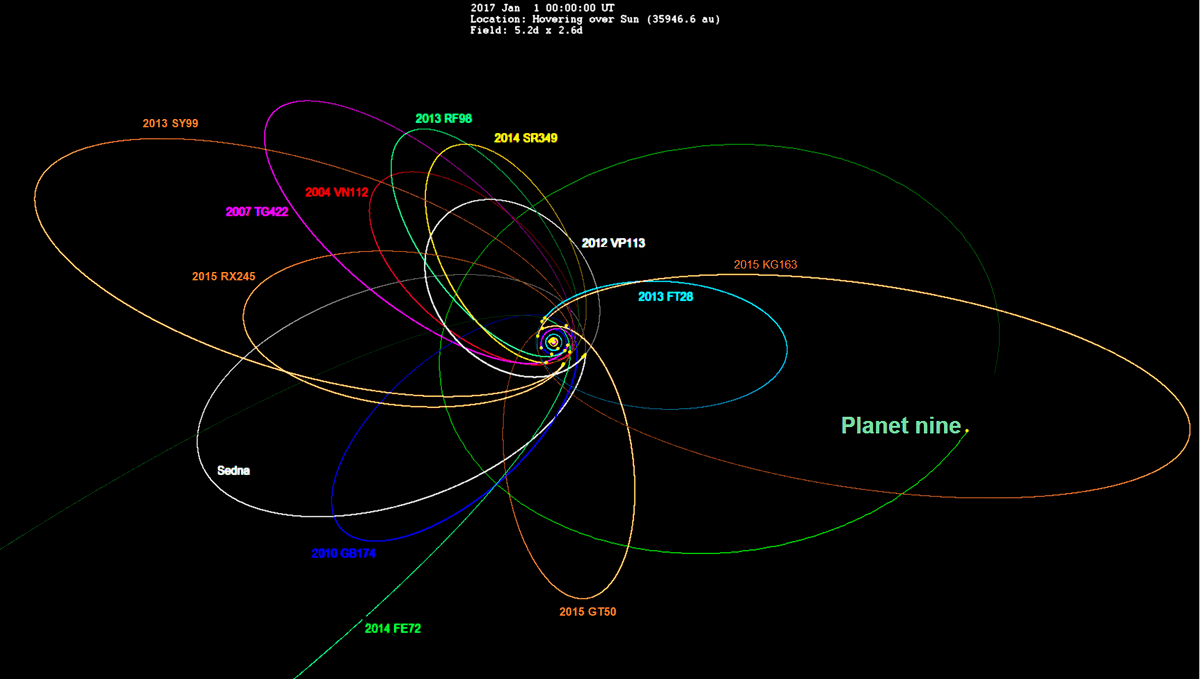
Planet Nine and other orbits looking from above the solar ecliptic

Nothing New In Planet Discovery

All the planets except Uranus and Neptune were discovered by Babylonian astronomers, although the six innermost planets were most likely noted by humans before writing was invented. Uranus was discovered in 1781, and Neptune was found in 1846. Despite all the advances in telescopes and space exploration no other ‘planet’ has been discovered in our solar system. So, why would anyone think another planet might exist?

Odd Ducks Out There

If the Sun and the planets were formed from a disk of debris, then most objects would be aligned in that disk or solar ecliptic plane, or the plane that the major planets are on as they orbit the Sun. Collisions between asteroids can send them off in unusual orbits that don’t align with the solar ecliptic.

However, there are a group of objects beyond Neptune that have unusual orbits. These objects are called trans-Neptunian objects. These are on a different plane and defy easy explanation. In addition, the Sun itself is a bit odd in its rotation. The Sun seems to rotate slightly off the ecliptic plane that all the planets follow.

Doing the Math

Two astronomers, Chad Trujillo and Scott S. Sheppard, tackled the odd orbits of the trans-Neptunian objects and discovered that some of the orbits of the objects could be explained if there were a large planet farther out in the solar system. That didn’t sit well with other astronomers so they decided to prove them wrong.

Planet Nine’s likely orbit and the orbits of trans-Neptunian objects

Konstantin Batygin and Michael E. Brown from CalTech decided to re-do the calculations of Trujillo and Shepard. They eliminated some of the objects studied because they might be influenced by Neptune’s gravity. That left six objects to study. To their surprise, they discovered that a planet ten times the size of Earth in an off-plane orbit much farther out than Neptune explained the orbits of the six objects to a 99% degree of certainty.

Is There a Ninth Planet?

Despite the mathematical support, there is no Planet Nine…yet. An analogy would be that if someone picked a date ten years in the future, say 3 March 2028, and was asked if that day would fall on a weekday. Without a calendar to look at it would be hard to say ‘yes’ or ‘no.’ It is very likely, but it is not certain until there is proof.

We currently have no proof of another planet, and spotting Planet Nine will be difficult at best. It would be a relatively small target with almost no sunlight reflecting off of it. It couldn’t be seen with today’s telescopes in either the visible or infrared spectrums. Even if we could determine where it is in its orbit, it would take a probe as many as twenty years to get into the Planet Nine neighborhood.

So the answer remains ‘no.’ There is no Planet Nine…but stay tuned.

Pigs In Space: Discrimination on the ISS

01 Thursday Mar 2018

Posted by Paul Kiser in Discrimination, Ethics, Exploration, Government, History, Honor, Management Practices, NASA, Politicians, Politics, Public Image, Public Relations, racism, Russian influence, Science, Space, Technology, United States, US History, US Space Program, Women

≈ Leave a comment

Tags

Anne  McClain, astronauts, bias, crew, discrimination, Expeditions, Female, Gender, International Space Station, ISS, Jeanette Epps, male, misogyny, NASA, racism, Russia, Serena Auñón-Chancellor, Space, United States

For the last 17 years, the International Space Station (ISS) has been the great achievement of the United States, Russia, and other nations working together to maintain a human presence in space. People around the world can look up and see the shining star of the ISS crossing the evening or predawn sky. Yet, ISS has a dark shadow that NASA and the other nations involved don’t talk about publicly. Space has a glass ceiling.

International Space Station not above discrimination

Man Cave In Space

Women have spent less than ten percent of the cumulative days on the ISS since the first crew came on board in October of 2000. In over 17 years, only 12 women have served on an expedition crew. One woman, Sunita L. Williams, served twice, and one, Peggy A. Whitson, served three times.

As of today, (1 March 2018,) women have logged only 2,527 days on the International Space Station compared to 23,493 days served by men. Most of those women have been from the United States with only two women serving from other countries. The problem of discrimination against women is bigger with Russia, as cosmonauts have spent the most time on ISS (47% Russia versus 40% USA) but only have allowed one woman to be part of the crew.

The irony is that women make up 63% of the population of Russia and yet women have had less than 7% of the days served on ISS compared to their male counterparts. The United States has also failed to utilize women as crew members, but at least in the case of the U.S., women have been 21% of the Expedition crew.

Discrimination Station

Jeanette Epps barred from ISS

The problem with the crew discrimination goes beyond gender. ISS has yet to have an African American crew member. Last year NASA announced that Dr. Jeanette Epps would be the first African American crew member before Donald Trump was sworn into office. This January NASA rescinded that decision without explanation. They replaced her with another woman, Serena Auñón-Chancellor, who was scheduled to fly in November.

Epps has been completely removed from the ISS crew rotation even though NASA claims she is still under consideration. It has been confirmed that she was not ill, nor were family issues a reason for removal. NASA has not explained whether Trump’s administration was involved in the decision, nor whether Russia has demanded that the African American woman be barred from serving as a crew member.

However, it is clear that women and minorities are shockingly underrepresented on the space station. The unexplained removal of the first African American crewmember, who also is a woman, reflects a continuation of the ongoing discriminatory behavior of the program.

Gender-Based Crew Selection

NASA has demonstrated that it has a plan for the crew assignment based on gender assignment. Jeannette Epps has a Ph.D in engineering. She was replaced by Serena Auñón-Chancellor who is a physician. Dr. Aunon-Chancellor was pulled off an ISS Expedition scheduled to begin in November 2018, and she was replaced by Anne  McClain who is a West Point graduate, Major in the Army, and a pilot with Master’s degrees in Aerospace Engineering and International Relations.

It is obvious that these three women were not shuffled around on the basis of skills, education, nor experience. Epps, and Dr. Aunon-Chancellor were selected to be an astronaut in 2009. McClain was selected in 2013, and completed her training in 2015. None of them have been in space. The only rational explanation is that NASA was replacing a woman with another woman. NASA’s 90% male to 10% female crew assignment is intentional.

Five Versus One

Another issue is the male dominated crew Expeditions. Typically only one woman is assigned to be with five men for six months on ISS. Only twice have two women served at the same time on ISS. For three months in 2010, and three and a half months in 2014-5, two women were on board at the same time. For the rest of the 200 months of occupation, ISS has either had an all-male crew, or only one woman on board.

Lack of Qualified People?

Is it possible that NASA can’t find enough qualified women or minorities? The number of people who dream to be an astronaut may have diminished since Apollo, but the dream hasn’t died.

When less than ten percent of the ISS crew time is served by women, and no African Americans have served in over 17 years of operation it’s clear there is a problem. ISS shouldn’t be the icon of white male discrimination.

SpaceX 2018 Launch Schedule Is PR Gold or PR Nightmare

28 Wednesday Feb 2018

Posted by Paul Kiser in Business, Customer Relations, Customer Service, Exploration, Falcon Heavy, Marketing, Milestone, NASA, Pride, Public Image, Public Relations, Science, Space, SpaceX, Technology, United States, US History, US Space Program

≈ 1 Comment

Tags

2018, Block 5, commercial space, fairing, Falcon 9, Falcon Heavy, launch, manned space program, manned spacecraft, NASA, space business, SpaceX, Starman, Tesla Roadster, Zuma

SpaceX is dependent on its reputation of success and reliability. There is no room in SpaceX’s 2018 launch schedule for major failures. The successful launch of the Falcon Heavy with a Tesla Roadster as the payload has repaired the long delays of the program, but in the business of space, you’re only as good as your last mission.

SpaceX’s Starman in Earth orbit

SpaceX’s reputation will be determined by the successful implementation of three critical elements of their program. Failure of any of the three elements and SpaceX could be facing a public relations (PR) nightmare; however, success will prove Elon Musk’s lofty visions for the company might be more than just talk.

SpaceX Must Do No. 1 – Consistency in Payload Delivery

The Falcon 9 program has moved out of the novice phase and into the professional phase. The question remains as to whether or not SpaceX can consistently put payloads into orbit.

Landing the booster after these launches dazzles the public, but has no impact on the effectiveness or cost efficiency of the program. Most of the boosters are the previous Block 3 or 4 versions and will not be reused. There is an issue with the booster landings. How long will paying customers accept SpaceX’s waste of resources on the ‘reusable’ PR parlor trick?

The other issue cropping up is the reliability of the fairing on the nose of the rocket. There are persistent issues with the fairing and while SpaceX absolved themselves of the loss of the super secret Zuma satellite, questions still remain as to the role of the fairing release after launch. 

SpaceX Must Do No. 2 – Prove Falcon Heavy is Reliable

The inaugural launch of the Falcon Heavy was a spectacular success for SpaceX. The PR kudos continue to pour in with every new sighting by astronomers as the alternate human, Starman, drives his Tesla out further in the solar system.

All that could be lost if the next two 2018 scheduled launches of the Falcon Heavy experience problems. Failed launches of the Heavy would erase much of the PR boost of the first launch and call back into question the wisdom of a 27-engine booster. SpaceX has to duplicate the home run first launch at least twice more before customers will feel warm and fuzzy about the Falcon Heavy.

SpaceX Must Do No. 3 – Success of the F9 Block 5 Version 

Block 5 is the final version of the Falcon 9 booster and it goes into service in 2018. It is the booster that will be rated for human spaceflight and much of SpaceX’s future as a commercial space program depends on proving it answers all the concerns of the four previous versions.

NASA is requiring seven successful booster flights of the Block 5 version of Falcon 9 before it will be rated for humans. That means SpaceX has to successfully launch the same version of the booster, without significant redesigns, seven times.

SpaceX has scheduled the maiden and second flight of the Block 5 version for April. It then has to fit five more successful flights between May and November. Once achieved, SpaceX can be approved to send astronauts up on the Block 5 booster in December of this year.

2018 A Year of Glory or Humiliation

Elon Musk has a reputation for promising more than he can deliver. He is a master of overconfidence but now results matter. He knows how to carefully craft a situation to amaze the public.

The Falcon Heavy launch was one of those moments. When they see the video of Starman orbiting Earth in a shiny red Tesla with the top down, people don’t remember that the Falcon Heavy was supposed to be ready in 2013. When they see the first stage of a rocket magically land on the pad, people don’t care that the booster was never going to be reused again.

2018 isn’t going to be a time when showmanship is going to cover up glaring issues. If there are problems meeting this year’s critical goals, people will see the man behind the curtain.

However, if SpaceX manages to achieve these milestones with minimal problems, SpaceX will be the shining star of space exploration.

Center of the Milky Way: Update

20 Tuesday Feb 2018

Posted by Paul Kiser in Astronomy, Exploration, Generational, NASA, Photography, Science, Space, US Space Program

≈ Leave a comment

Tags

Albert Einstein, astronomy, black hole, center of the galaxy, gravity, infrared, Milky Way galaxy, orbits, radio waves, S2, Sagittarius A, space dust, Star, stars, supermassive black hole

During the history of humankind, we have looked up and stared at the center of our galaxy. Most of that time we created stories about it, but now we know some of the facts. If you’re not a space geek, astronomer, or science nut, you may not know what new information has been discovered about the center of the Milky Way. A lot of information has been learned in the course of our lifetime, even if you are only 16 years old.

ESO image Milky Way

The Milky Way Galaxy…as it was 26,000 years ago

Dust in the Wind

To see the Milky Way Galaxy requires getting away from bright city lights on a clear night. It looks like a faint cloud running across the sky at an odd angle. What a person sees is light that has traveled from the center of our galaxy for about 26,000 years. Some of those stars are gone, and new stars have formed.

What you may not know is the dim light coming from the central bulge at the center would be brighter than the full Moon if it weren’t for space dust. Near the center of the Milky Way are over ten million stars. If there were no dust we would just see a dazzling glow from the central bulge.

The Story of Black Holes

Our understanding of the Milky Way has coincided with our awareness and understanding of black holes in space. The idea of a black hole was first suggested in a letter by John Michell published in November 1784. The work of Albert Einstein on general relativity led to theoretical work confirming the mathematical possibility of black holes during the first half of the 20th century.

However, the first prospective black hole wasn’t discovered until 1971. At this point, no one suspected that the centers of all galaxies were black holes. It would be 2002 before Max Planck Institute for Extraterrestrial Physics in Germany would produce evidence that a black hole was at the center of the Milky Way Galaxy.

What You Can’t See

The problems with determining a potential black hole are that, 1) as mentioned before, there is too much dust between Earth and the center of the Milky Way galaxy and, 2) a black hole doesn’t emit light. The first problem is solvable by using different wavelengths of radiation other than visible light. Gamma, infrared, and radio waves pass through space dust and allow astronomers to see their source.

The second problem in revealing a black hole is not what they are, but what they do. What black holes do best is produce the pull of gravity. Their gravitational effect is so strong that stars orbit black holes…before they are eaten by it. All astronomers had to do is find an invisible point that stars are orbiting.

Really, Really Fast Stars

It wasn’t as easy as it sounds, but they did it. What is now known as the supermassive black hole called Sagittarius A is at the center of our galaxy. A close group of stars orbit this invisible point at incredible speeds. Astronomers estimate the size of the black hole is big enough to encompass our Sun and extend almost to the orbit of Mercury.

One of the orbiting stars known as S2 comes only as close to Sagittarius A as four times the distance of Neptune is from our Sun. Despite that distance, S2 reaches speeds of 5000 km/s (11 million mph) as it swoops by Sagittarius A and heads back out in a highly elliptical orbit. S2’s orbit takes less than 16 years to make one complete orbit. S2 will make it’s next closest approach in a few months….well, it actually will have happened 26,000 years ago.

Space Exploration Isn’t Profitable, It’s Transformative

16 Friday Feb 2018

Posted by Paul Kiser in Apollo, Business, Economy, Education, Exploration, Falcon Heavy, Generational, Government, Higher Education, History, Lessons of Life, Management Practices, NASA, Passionate People, Politics, Pride, Saturn V, Space, SpaceX, Taxes, Technology, Travel, United States, Universities, US History, US Space Program

≈ Leave a comment

Tags

Age of Discovery, Apollo, Apollo missions, Columbus, economy, Golden Age of Spain, good jobs, jobs, NASA, privatization, return on investment, ROI, Soviet space program, Soviets, Space, space exploration, Spain, Technology, wages

Space exploration ROI (return on investment) sucks. Exploration doesn’t make money, it costs money. It’s not a place for private business. If the question of space exploration is, “What’s in it for me?” you’re asking the wrong question. Space exploration isn’t profitable, but it is transformative.

Apollo Saturn V

The five massive Rocketdyne F-1 engines of the Apollo Saturn V first stage booster. Twice the lift of SpaceX’s 27-engine Falcon Heavy

Exploration Creates Economic Growth

In the 15th century, when the government of Spain financed Columbus to explore a new trade route to the markets in Asia, he discovered the Caribbean. He brought back a few captured natives from the Bahamas, some gold, and a few birds. It didn’t pay for the cost of the voyage.

But what came next transformed Spain and Europe. The year of the discovery of the Americas (1492) is considered the start of the Golden Age of Spain. After Columbus first voyage to the new world, Spain continued with more voyages, and eventually the full exploitation of Central and South America. Most historians focus on the resources that were returned to Spain, but what happened at home was even more important. 

Shipbuilding entered a new phase of design and construction. Jobs at home created a new wealth for the working class. Craftsmen, as well as sailors, became vital to the needs of the Age of Discovery. That new wealth created secondary jobs, along with new businesses selling imported goods. All of this economic growth was a direct result of the exploration pushed forward by the government of Spain.

Exploration created massive economic growth for decades, but exploration didn’t give an immediate ROI for Spain.

The Model Space Program

Not all space programs are successful. The Soviet space program became mired in conflicts between good science and engineering versus political priorities. The administration was pushed into risky decisions and failure was not without punishment. In addition, new technology was considered a State secret so the development of commercial uses was not an option.

The United States approach for the space program was for the use of non-military government oversight of private contractors. The government remained accountable to the voters, which kept both the government and their contractors in a stable environment for decision making.

The result was a massive increase in highly-skilled, well-paid jobs that created a new wealth for the middle class. Space exploration supercharged the United States economy and created new technology that continued to develop for decades after the Apollo program ended. It was the model space exploration program.

A Failure of Vision

Once the United States had landed on the Moon conservatives and liberals united to kill the space program. Liberals could only see the money being spent to explore space as money that could have been used to help the poor. Conservatives could only see money not going into their pockets. As it would turn out, both viewpoints were flawed.

Money spent on for space exploration created new, high paying jobs that created a need for improved education and pumped billions of dollars into the economy that created new tax revenue that could be used for government programs to help the poor engage in the new economy.

The flood of new money into the economy helped small companies grow dramatically while increasing profits. It didn’t result in the wealthy becoming dramatically richer, but it did create prosperity that helped everyone.

Missing Greatness

Today the United States is wading in a stagnant economy. Wages aren’t growing as fast as prices are rising. The available jobs pay so poorly that they aren’t worth the cost of working them. If we are missing greatness, it is because we are killing our economy with a focus on profit for a few.

The goal of private business is never to create jobs, nor is it to create high paying jobs. Jobs are created when business has been given a mission to accomplish something. Giving tax breaks does not give business a reason to create more jobs, nor pay employees more.

However, if our country made a serious commitment to the goal of expanding space exploration, and funded it with the tax breaks we are giving billionaires, we would see our economy transformed. It is that simple.

SpaceX Falcon Heavy Defies the Odds

07 Wednesday Feb 2018

Posted by Paul Kiser in Falcon Heavy, History, NASA, Pride, Public Image, Public Relations, Science, Space, SpaceX, Technology, United States, US Space Program

≈ Leave a comment

Tags

asteroid belt, booster, Elon Musk, Falcon Heavy, landing, launch, Mars, orbit, relanding, SpaceX, Tesla, Tesla Roadster, test

I’m not a fan of SpaceX, nor of Elon Musk, but one can only observe yesterday’s Falcon Heavy launch with awe. It was brilliant. One thing that Elon Musk and I agreed on was that the chance it was not going to end in a massive fireball was slim. It is hard to convey how unlikely a successful launch was considering all the factors involved. The people working at SpaceX did at least one trillion things right to achieve the results of yesterday’s launch.

Taken from live feed of Tesla Roadster in orbit

Starman takes a test drive

SpaceX and Musk Had a Great Day

A sample of what went right:

  • Other than weather, the launch had no delays. That is unusual with a prototype rocket test.
  • An engine ignited and worked as intended. Multiply that by 27.
  • A side booster that was essentially a rocket in itself, did exactly what it suppose to do without any new issues common in a prototype test. Multiply that by 2.
  • The core booster functioned as intended and delivered the second stage and the payload, a Tesla car, into position for a boost into orbit.
  • A side booster completed a complex task of a powered relanding withing a few meters of the target zone. Multiply that by two.
  • A side booster was reused from a previous mission. Multiply that by 2.
  • The second stage booster fired its engines, times three, sending the payload into a heliocentric orbit that will extend beyond Mars, and near the Asteroid Belt.
  • A team of thousands of people performed their functions in synch allowing the payload to achieve orbit.

Hold My Beer and Watch This

The only small item that did not go as planned was the failed landing of the core booster on the Drone ship. The engineers have determined that only one of the needed three engines for landing had reignited. Until they can analyze the issue, I’m going with the explanation that the core booster was so excited about the success of the launch that it thought it would go for the biggest splash. It was successful.

Regardless, it was a minor misstep in a successful mission-impossible-type achievement.

Bye Bye Starman

Late on Tuesday the second stage of the Falcon Heavy successfully ignited for a third and final time sending ‘Starman’ (the alternate human in the spacesuit) and the Telsa Roadster into a heliocentric orbit that will take it to Mars and beyond. His orbit may last for over a million years, but the car won’t. All the exposed, non-metalic parts of the car will be no match for the radiation, heat, and cold of space. The paint job will suffer as well.

Starman’s out-for-a-drive orbit

Still, the pièce de résistance was the video of Starman in orbit above Earth. I’ll leave you with these images I captured from the live feed. Below that you can watch the video of the launch. Well done, SpaceX.

Starman 1 (2)
Starman 4 (2)
Starman 5 (2)
Starman 7 (2)

[COUNT TO 500:  496th Article in PAULx]

Zuma Mystery: It’s Classified and Invisible…Apparently

01 Thursday Feb 2018

Posted by Paul Kiser in Business, Communication, Crisis Management, Customer Relations, Ethics, Government, History, Honor, Management Practices, NASA, Pride, Public Image, Public Relations, Relationships, Science, Space, SpaceX, Technology, United States, US History, US Space Program

≈ Leave a comment

Tags

deployment, Elon Musk, failed mission, fairing, Fairings, Falcon 9, Indian Ocean, launch, launch delays, Northrop Grumman, orbital inclination, secret satellite, SpaceX, USA-280, Zuma

On 8 January 2018 the top-secret USA-280 satellite, as known as Zuma, went up, but a funny thing happened on the way to orbit. It was launched to the northeast at a vector of approximately 51° off the equator. A rough course estimate would have taken Zuma south of Great Britain, across Europe (possibly over France, Italy, and Greece,) over Saudia Arabia, and to the Indian Ocean west and/or south of India. According to one unnamed source, that is where the flight of USA-280 ended.

Zuma went down in the Indian Ocean?

Possible approximate flight path of Zuma

Elon We Have a Problem

The first hint that something was wrong is when Brian Mahlstedt, the launch narrator for SpaceX, paused for 90 seconds after announcing that the fairing (the cover around the satellite) would deploy “…any second..” and then changed the subject when he began talking again. This was also significant because he said that coverage of the launch phase of the would end AFTER the deployment of the fairings. Had the fairings deployed as scheduled it would not have crossed over into the coverage of the landing of the booster phase, which was what happened. 

The second hint was when SpaceX public relations (PR) didn’t spike the ball after the launch, praising its success.

By the next morning, sources were quietly saying that the satellite didn’t make orbit. Some seemed to suggest that the fault was with the SpaceX rocket. Some indicated the release platform of the satellite failed, keeping it connected to the upper stage as it fell back to Earth.

SpaceX came out with a qualified statement that didn’t deny the failure to achieve orbit but adamantly implied that the SpaceX rocket performed as intended. Northrop Grumman, the contractor for the super secret satellite and the release platform announced that it didn’t comment on confidential payloads. 

Disinformation Campaign

A few media sites suggested that maybe everything was fine and the satellite was safely in orbit. It was a tactic that a covert agency might employ to feed a few trusted sources with a disinformation campaign to calm the discussion of failure, and for the most part, it worked. Few follow-up reports have been made about USA-280.

The evidence, or lack of it, is telling a different story. Astronomy hobbyists, some highly skilled in finding and tracking human-made objects in orbit, have spent the past three weeks trying to find the ‘invisible’ satellite with no success. They have found a satellite lost over ten years ago, but no one has sighted the wayward Zuma satellite.

The Zuma Fairing Mystery?

The chronology of the fairing deployment is as follows: 

  • T+0:50 seconds (50 seconds after liftoff) – A SpaceX announcer begins a live and nearly continuous commentary regarding upcoming events with the Falcon 9 rocket, pausing only for those events to be confirmed by SpaceX control.
  • T+2:03 – SpaceX announcer pauses as four events related to second stage separation are about to begin.
  • T+3:06 – SpaceX announcer resumes commentary and confirms a successful second stage separation, and explains at T+3:15 that fairing separation “…should occur any second now” (ejection of protective nose shell around satellite.) He continues on to say that he will confirm the fairing separation after it occurs.
  • T+3:26 – SpaceX announcer begins a pause that lasts for one minute and thirty seconds.
  • T+4:57 – SpaceX announcer says, “Alright, so we’ll address the fairing deployment in a second once we have more information, but for now we’re going to shift our transition back to our secondary mission…”
  • T+5:17 – SpaceX announcer says, “…ah, quick sidebar here that we did get confirmation that the fairings did deploy.”

The launch of Zuma was delayed last November because of an issue with the fairing deployment. The question is whether the previous issue along with the 90-second pause in announcing the fairing deployment indicate there was an in-flight problem with the fairing.

Best Guess?

Everything is speculation. Based on what we know, this is my suggestion of the most likely scenario:

  • The fairing failed to deploy at the prescribed time, but it did deploy late. (That would fit SpaceX’s non-denial denial.)
  • The late deployment caused a decision to abort the flight so that it would come down in the Indian Ocean.
  • Had the abort been held off, the flight might have been able to continue, but point-of-no-return in the abort decision had been reached and the flight was terminated.

This would still allow SpaceX to claim its rocket performed ‘nominally’ and only fudge a little when not admitting the fairing issue. It would also suggest that there was disagreement during the ascent phase and that the incident is a sore spot for the parties involved…

…but you didn’t hear that from me.

[COUNT TO 500:  490th Article in PAULx]

The Day Business Killed The NASA Space Program

28 Sunday Jan 2018

Posted by Paul Kiser in Business, Government, History, NASA, Politicians, Politics, Public Image, Public Relations, Science, Space, Technology, US History, US Space Program

≈ 2 Comments

Tags

aerodynamic forces, astronauts, Challenger, Disaster, Ethics, International Space Station, Kennedy Space Center, launch delays, manned space program, manned spacecraft, Morton Thiokol, NASA, Solid Rocket Boosters, space exploration, space flight, Space Program, Space Shuttle, SRB, STS-51-L, Vintage Space

Thirty-two years ago today, the first in-flight deaths of NASA astronauts tragically occurred after a launch that wasn’t supposed to happen. Some have proposed that the accident was a result of NASA and their contractors being pressured for public relations reasons. The truth is that their deaths were caused by trying to make space a business venture.

Seven astronauts killed in the Challenger accident

STS-51-L crew: (front row) Michael J. Smith, Dick Scobee, Ronald McNair; (back row) Ellison Onizuka, Christa McAuliffe, Gregory Jarvis, Judith Resnik.

 Death By Impact

On 28 January 1986, seven astronauts in the Space Shuttle Challenger (STS-51-L) died as their crew compartment slammed into the Atlantic Ocean after falling 12 miles in two and a half minutes. They were not killed in the breakup of the Shuttle, nor did they become unconscious from the depressurization of the crew compartment, as suggested by NASA. Some, if not all astronauts, were aware that they were about to die and knew there was nothing they could do to avoid it.

Trail of Causes

The technical primary cause of the accident was weather-related. The Space Shuttle was not to be launched at temperatures below 4° C (39° F) and had never been launch at temperatures below 12° C (54° F.) A few hours before the launch the temperature had fallen to -8° C (18° F.)

The technical fault caused by the weather were rubber O-rings at each of the joints of the solid rocket boosters (SRB.) The O-rings needed to be warm enough to expand to seal the joint to avoid burning gases from blowing out between the sections of the solid rocket booster. The concern was that the power of the burning fuel would rupture the joint at launch and cause an uncontrolled blast of hot gases to escape causing an explosion on the launch pad.

Known Problem to NASA

After previous Space Shuttle launches some of the recovered solid rocket boosters had shown ‘blow-by’ of the O-rings. That meant that the O-rings had not completely sealed the SRB joint and could have potentially compromised the safety of the crew had the blow-by breached to the exterior of the joint.

Engineers at Morton Thiokol, the Utah contractor that designed and built the solid rocket booster, had felt that NASA was ignoring their concerns about the issues regarding the SRB joints. In an emergency teleconference meeting held the night before the launch, the engineers made it clear that the temperatures were unacceptable.

NASA decision-makers did not like the ‘no-launch’ answer and suggested that if they didn’t launch the next day, the company would be blamed for the delay. Morton Thiokol managers caved into NASA and overruled their own engineers. They gave a go for launch. Just prior to the reversal of the recommendation the general manager of Morton Thiokol said to the Vice President of Engineering, “…take off your engineering hat and put on your management hat…” It was the moment that sealed the fate of the seven Challenger astronauts.

Run NASA Like a Business

Previous space projects at NASA had been focused on spaceflight. The goal of NASA and its contractors were to safely put humans in space.

That changed after we reached the Moon. We had done the impossible and now space was less interesting and too expensive. The deflation of post-Moon public support forced NASA to find a justifiable reason to move forward. The decision was that NASA must end the exploration of space and build the ‘business’ of space. The Space Shuttle was intended to make the United States leaders in space commerce.

The Space Shuttle was built to be a reusable, frequent-launch spacecraft that would make traditional, single-use rockets too expensive and unreliable for commercial customers to use. The idea of running NASA like a business became the core value of the organization.

Delays, Delays, Delays

By January of 1986, NASA far behind its business goals. It was not launching the Shuttle frequently enough, nor was the reusability function creating the desired savings. STS-51-L was a critical point in making NASA run like a business. Delays in the launch of previous Shuttle (STS-61-C) had pushed back the STS-51-L flight twice. The launch had been pushed back four more times because of weather and equipment malfunctions.

On the Business Stage

Business is like theatre. It doesn’t matter what is going on backstage because the only thing that counts is what the audience can see. Backstage, NASA was in crisis, but if they could launch STS-51-L, they could maintain the perception that they had everything under control.

There were several public image opportunities if the launch occurred on the 28th that would be lost if it was delayed again. For Challenger and NASA, the teleconference on January 27th had only one possible business outcome. It must be launched. The engineers at Morton Thiokol didn’t know that they were up against a business mentality when they met on that night. Nor did the managers at Morton Thiokol or NASA know that they were about to kill seven astronauts. To them, it was just business-as-usual.

Events in Motion

Once the decision was made to launch events were set in motion.

  1. The cold temperatures caused the O-rings to become rigid. After the SRB’s were ignited a puff of hot gases blew through the O-rings at a point near the large external fuel tank.
  2. The joint temporarily sealed itself off from the debris of the exhaust of the burning fuel.
  3. As the Shuttle rose after launch it hit the worst wind shear ever experienced by a Shuttle and the debris sealing the O-ring broke free allowing the hot gases to burn through the joint.
  4. The flame from the joint acted as a blowtorch cutting into the external fuel tank and finally igniting the hydrogen fuel.
  5. The resulting hydrogen fuel explosion ripped the External Tank into pieces, pushing the Shuttle away.
  6. The Shuttle rolled out of its nose-forward position and was blown apart by aerodynamic forces.
  7. The crew compartment broke free of the Shuttle and continued to ascend until it lost momentum and began to fall down toward the ocean. It did not suddenly depressurize, but likely, depressurized slowly. The astronauts were jolted by the breakup, but not severely injured.
  8. At least three of the astronauts turned on personal oxygen after as the crew compartment fell. One did not, and the equipment for the other three astronauts was not found.
  9. The crew compartment fell and eventually hit the ocean, killing the seven astronauts on contact.
  10. NASA created a story that the astronauts were killed instantly, even after they knew that the events during the accident did not support the story. 

End of the NASA Manned Space Program

The Space Shuttle didn’t fly again for almost three years. It would resume flight for an additional 13 years, but it failed to meet the objectives of making space a business venture. The accident exposed the inherent issues of running a space program like a business and political pressure undermined the concept of a manned space program.

In 2011, NASA ended the United States manned space program with the last launch of the Space Shuttle. Since the last Shuttle launch, NASA has worked hard at pretending to have a manned space program by paying Russia to send U.S. astronauts to the International Space Station and producing videos of the development of the next generation of manned spacecraft. The reality is that NASA no longer can put a human in space, at won’t at any time in the near future.

Below is Vintage Space’s take on the cause of the Challenger disaster.

SpaceX Falcon Heavy-Lift Rocket: A Soviet-Style Disaster?

23 Tuesday Jan 2018

Posted by Paul Kiser in Business, Government, History, Management Practices, NASA, Public Image, Public Relations, Science, Social Interactive Media (SIM), Space, SpaceX, Technology, US History

≈ Leave a comment

Tags

Apollo, Apollo 6, booster stage, engines, Falcon Heavy, first stage, J-1 engine, J-2 engine, launch, Moon rocket, N1, NASA, pogo oscillations, rocket engines, rocket explosion, Saturn V, second stage, Soviet space program, Space, SpaceX, third stage, vibrations

SpaceX is maybe, almost, someday, hopefully going to launch the Falcon Heavy rocket that SpaceX circus master Elon Musk expects to blow up shortly after launch. His concern is legitimate as SpaceX’s 27 engine-utilization is reminiscent of the Soviet’s disastrous failure of heavy-lift rockets of the early 1970’s that used 30 engines.

I hope it makes it far enough away from the pad that it does not cause pad damage. I would consider even that a win, to be honest.

Elon Musk

Three 1st Stage Heavy Rocket Engine Configurations: top – SpaceX Falcon Heavy, lower left – Soviet N1, lower right – NASA’s Saturn V

Soviet Heavy-Lift Plan: Lots of Engines

To get to the Moon the Soviet rocket engineers decided to use thirty engines on the first stage of their N1 rocket design. Smaller engines are easier to build and operate, but more engines mean more potential for failure.

A rocket engine is an effort to contain and control a continuous stream of explosive force. The power, heat, and stress of a rocket engine is unlike almost any other human-created machine. It is a complex network of plumbing, pumps, valves, and structure that must operate perfectly in synch. If they don’t it usually ends badly.

The Soviet’s N1 rocket design avoided the need of designing massive engines, like their counterparts in the United States, however, they didn’t anticipate the complexities of all engines operating in concert. The result was four failures in four launch attempts and the cancellation of the Soviet Moon program. One failure happened at the launch pad with the power of a small nuclear bomb. 

Killer Vibrations

Even if every engine works to perfection, the vibrations caused by each engine can literally shake a rocket to pieces. NASA engineers learned early in the space program that vibrations between the engines and the aerodynamic stresses on the rocket created a ‘pogo‘ vibration running up and down the length of the rocket.

They thought they understood the issue until Apollo Six partially failed because of pogo vibration issue. During the ascent phase of the launch, vibrations damaged fuel lines on the second and third stages. The damage caused the rocket’s second stage to shut down two of the five engines prematurely, and the third stage engine failed to ignite.

Saturn V’s Five Heavy-Lift Engines

Despite the issues with pogo oscillations, NASA’s five Rocketdyne F-1 engines on the Saturn V Moon rocket resulted in 13 out of 13 successful first stage launches. The only partial failure came on Apollo 6 after the first stage had completed its boost of the second and third stages.

It is unclear why the successful Apollo program engine configuration has been rejected as an option for contemporary heavy-lift rockets. It is probable that private ventures into space operations, like SpaceX, want to save money by designing only one rocket engine for all uses.

SpaceX 2017 Great, 2018?

SpaceX is coming off a spectacular year. Of 18 launch attempts, SpaceX had 18 successful launches. SpaceX also had a perfect relanding record in 2017 for every attempt.

2018 is not starting out as well. SpaceX has only had one launch so far this year and it is rumored that the payload did not make it into orbit. No public information has been made about the success of the launch because it was a highly valued, super-secret satellite. It is so secret that the public has not even been told who the satellite was built for, or its general purpose.

SpaceX has proclaimed that its launch vehicle did everything it was designed to do, but the launch narration indicates that there might have been an issue when the fairing or cover around the satellite was supposed to deploy. The launch narrator paused for ninety seconds after he said the fairing would deploy “any second now.” When he began talking again he changed the subject. A few seconds later he finally confirmed the fairing had deployed but did not explain the delay in deployment.

SpaceX Falcon Heavy Engine Roulette

So far, the Falcon Heavy rocket is not a bright spot in the SpaceX story. Its first launch was planned for 2013, and for multiple reasons, it has been delayed for five years. It had been rescheduled for launch in late Fall of last year but was then delayed again. On 1 December Musk tweeted:

Falcon Heavy to launch next month from Apollo 11 pad at the Cape.

Elon Musk

To date (21 January 2018) the Falcon Heavy has still not had a test fire of its first stage engines. This means there are less than ten days to launch test the engines and then prepare the rocket for launch. Any issues during the test firing and the launch schedule will likely slip again into February.

If SpaceX has a successful launch it will still have to prove the reliability of the 27 engine design. The mass-numbers-of-engines design ultimately killed the Soviet program with four consecutive failures. SpaceX is reliant on business customers who have faith in their ability to deliver their payload into orbit. Continued delays and any failure will reduce confidence in the Falcon Heavy, risking it to have the fate of the Soviet N1.

(Story Update:  SpaceX had a successful test firing of the Falcon Heavy first stage booster today – 24 January 2018.)

Total Lunar Eclipse January 31…Western United States

20 Saturday Jan 2018

Posted by Paul Kiser in Astronomy, NASA, Photography, Science, solar, Space

≈ Leave a comment

Tags

blue Moon, Earth's shadow, eclipse, lunar eclipse, Moon

The last day of January will start with the second Full Moon of the month (a.k.a.:  a Blue Moon.) It will then transform into a total lunar eclipse. Asia, the Pacific, and western North America will be able to watch the Earth’s shadow move across the Moon.

However, there’s a catch. It is an early morning eclipse in western North America and it will happen just before the Moon sets in the west. Locations with mountains to the west may see the Moon set before the total lunar eclipse ends.

In some places, the rising Sun will be brightening the eastern sky as the totality ends. The Sun will be rising on Earth as the Earth’s shadow moves off of the Moon. The Earth’s Shadow is almost four Moon diameters wide, but for most U.S. cities it will pass through the southwest quadrant of the shadow. Totality will last just over an hour.

Location of Moon in Earth’s shadow at Maximum Eclipse for Reno, NV

Eclipse When?

The times for the eclipse for several western U.S. cities:

       City            TOTALITY    Begins         Maximum           Ends         Moonset

Denver, CO (MST)                  5:51 am           6:29 am            7:07 am        7:10 am

Salt Lake City, UT (MST)   5:51 am           6:29 am            7:07 am        7:41 am

Phoenix, AZ (MST)               5:51 am           6:29 am             7:07 am        7:27 am

Reno, NV (PST)                      4:51 am           5:29 am             6:07 am        7:11 am

Los Angeles, CA (PST)       4:51 am           5:29 am            6:07 am        6:54 am

San Francisco, CA (PST)  4:52 am           5:30 am           6:08 am        7:20 am

Portland, OR (PST)             4:51 am           5:29 am            6:07 am        7:37 am

Seattle, WA (PST)                 4:51 am           5:29 am            6:07 am        7:41 am


NASA’s Orion Capsule: A ‘Look Busy’ Project?

19 Friday Jan 2018

Posted by Paul Kiser in 1968, Ethics, Government, History, Honor, Management Practices, NASA, Politics, Pride, Public Image, Public Relations, Science, Space, Technology, US History

≈ Leave a comment

Tags

Airbus, Amber Gell, Amy Shira Teitel, Apollo, cosmic radiation, Curious Droid, Earth, engineer, Gemini, Kelly Smith, Lara Kearney, LEM, Lockheed Martin, lunar module, manned space program, manned spacecraft, Mars, Mercury, Moon, NASA, orbit, Orion, Paul Shillito, Space Shuttle, spacecraft, STS-135, Van Allen Belts, Vintage Space

NASA has a publicity campaign for the next generation of spacecraft. It is the Orion capsule, and it is touted as the spaceship that will take us back to the Moon and beyond. The problem is that all the talk doesn’t match reality.

8 July 2011, STS-135 – The final launch of a USA spacecraft

On 8 July 2011, I stood several miles away from Kennedy Space Center and watched the end of the United States manned spacecraft program. I stood in the warm sunshine of Florida as the last Space Shuttle (STS-135) soared into the sky. Since then NASA has put our astronauts in space by paying Russia to take them to and from the International Space Station (ISS.) 

A few months before that last Space Shuttle flight NASA announced the development of a new spacecraft called Orion. The announcement came so abruptly that it seemed that NASA was unaware it wouldn’t have a spacecraft to send humans into space until just before the end of the Space Shuttle program.

Orion – A Spacecraft of Contradictions

The Orion program, for all its hype, seems to have major flaws that NASA doesn’t seem to notice, or perhaps, hopes the public won’t notice. NASA’s description of the purpose of Orion:

For the first time in a generation, NASA is building a human spacecraft for deep-space missions that will usher in a new era of space exploration…and this new spacecraft will take us farther than we’ve gone before, including to the vicinity of the Moon and Mars…the Orion spacecraft is designed to meet the evolving needs of our nation’s deep space exploration program for decades to come. Orion deep space exploration missions…will help put NASA and America in a position to unlock the mysteries of space and to ensure this nation’s world preeminence in exploring the cosmos.

Orion a USA Spacecraft????

Lockheed Martin Corporation is designing and building the capsule of Orion. Like the Apollo capsule, Orion can only be separated from the Service Module for a short period of time.

The Service Module is the business section of Orion. It supplies all the power, fuel, oxygen, and is the primary propulsion of the spacecraft. Anyone familiar with Apollo 13 knows what happens to the capsule when the Service Module is non-functioning. The Service Module is being built by Airbus, a French corporation, for the European Space Agency.

Orion Capsule: A Human Storage Shed in Space

In Space, Size Matters

The Apollo capsule had a volume of 5.9 m³ (210 ft³.) Apollo astronauts were able to use the 6.7 m³ (235 ft³) space in the Lunar Module (LEM) during the three day trip between Earth and Moon. The total volume of the Apollo capsule and LEM was 12.6 m³ (445 ft³) for three astronauts. On the return, the Apollo astronauts were restricted to the capsule. Each astronaut had about 2 m³ in the capsule or 4 m³ in the capsule/LEM configuration.

Orion has 8.95 m3 (316 cu ft) of habitable space for four astronauts. This is slightly more cubic meters per astronaut than the Apollo capsule and much less than Apollo’s capsule/LEM configuration. The idea that Orion is capable of taking four astronauts on an eight-month journey to Mars is absurd. Orion is only for use in short-term, near-Earth missions.

NASA has briefly acknowledged the space issue in a video. Amber Gell of Lockheed Martin briefly touches on the need for an add-on crew habitat. She implies that it is an issue that NASA has yet to address. If it takes NASA twelve years to design and build a slightly bigger version of the 1960’s Apollo spacecraft, how long will it take them to build a crew quarters that four people can live in for up to three years?

NASA’s Misleading Video about Orion

NASA has been pumping out videos of engineers explaining how Orion is the next great achievement of the space agency. The videos cover a variety of subjects and some are pre-test and post-test news releases of Orion’s systems and structure. One video features Kelly Smith, a NASA Engineer, who explains how Orion is being designed to deal with the radiation from the Van Allen Belts around Earth.

The 2014 NASA video, titled, “Orion: Trial By Fire,” describes the challenges of the first test flight, including a dramatic description of the dangers of flying through the radiation of the Van Allen Belts above Earth. He explains that Orion will be designed to protect the astronauts as they fly through these dangerous regions.

The problem is that NASA already solved that problem with Apollo. They either fly around the Van Allen Belts, or through the thinner sections, as described by a video by Amy Shira Teitel of Vintage Space, and a video by Paul Shillito of Curious Droid.

There is a radiation issue in space, namely cosmic radiation, and it is a problem on long trips beyond Earth orbit; however, as Lara Kearney of NASA’s Orion Crew and Service Module’s Office explains in another NASA video, that they don’t have the answer to the cosmic radiation problem. This video contradicts the enthusiastic Smith video and raises the question:  Does NASA know what they are doing?

Orion:  The NASA Glacial-Paced Project

In May 1961, President John F. Kennedy asked Congress to fund a space program to take to the Moon and safely back. From the time of his speech in 1961 to the end of 1972, NASA launched the five of the six manned Mercury missions, designed, tested, built, and launched 10 Gemini manned missions, designed, tested, built, and launched 11 Apollo manned missions, landed men on the Moon, and overcame a disaster that delayed the manned launches for 21 months. Eleven years, three complete rocket programs, 27 manned missions, six successful Moon landings, no prior experience.

Orion, a slightly larger version of the Apollo capsule, only useful for short-term habitation in near-Earth orbit, is taking twelve years. Something is amiss.

NASA’s ‘Look Busy’ Project?

NASA definitely needs more funding, but something else is wrong. NASA’s Orion project doesn’t make any sense unless they are attempting to create the appearance that they are moving forward with a manned space program. The Orion project is, at best, an Earth to orbit elevator. It can’t meet any of the stated manned spaceflight goals of NASA. The question is, why isn’t NASA aware of these issues, and if they are aware, what is the agenda that is causing them to promote a project that is meaningless to the stated goals of deep space flight?

Newer posts →

Other Pages of This Blog

  • About Paul Kiser
  • Common Core: Are You a Good Switch or a Bad Switch?
  • Familius Interruptus: Lessons of a DNA Shocker
  • Moffat County, Colorado: The Story of Two Families
  • Rules on Comments
  • Six Things The United States Must Do
  • Why We Are Here: A 65-Year Historical Perspective of the United States

Paul’s Recent Blogs

  • Dysfunctional Social Identity & Its Impact on Society
  • Road Less Traveled: How Craig, CO Was Orphaned
  • GOP Political Syndicate Seizes CO School District
  • DNA Shock +5 Years: What I Know & Lessons Learned
  • Solstices and Sunshine In North America
  • Blindsided: End of U.S. Solar Observation Capabilities?
  • Inspiration4: A Waste of Space Exploration

Paul Kiser’s Tweets

Tweets by PaulKiser

What’s Up

March 2026
S M T W T F S
1234567
891011121314
15161718192021
22232425262728
293031  
« Jun    

Follow Blog via Email

Enter your email address to follow this blog and receive notifications of new posts by email.

Join 688 other subscribers

Create a website or blog at WordPress.com


Loading Comments...