3rd From Sol

~ Learn from before. Live now. Look ahead.

3rd From Sol

Category Archives: Consulting

Reno Nevada Mayor Schieve Declares She is Uninformed

13 Tuesday Feb 2018

Posted by Paul Kiser in About Reno, Business, Communication, Consulting, Crime, Crisis Management, Employee Retention, Ethics, Government, Honor, Human Resources, Journalism, Management Practices, Politicians, Politics, Public Image, Public Relations, Relationships, Respect, Traditional Media, Violence in the Workplace, Women

≈ Leave a comment

Tags

Andrew Clinger, Bill Dunne, City of Reno, Hillary Schieve, Hogan's Heroes, Karl Hall, lawsuit, Mayor, Mayor of Reno, MeToo, press conference, Reno Attorney, Sargent Schultz, sexual assault, sexual harassment

Reno Mayor Hillary Schieve held a press conference on Thursday, 1 February. It’s purpose was to inform the public about an accusation filed with the City of Reno in October (or November) regarding a sexual assault claim. Mayor Schieve’s three-minute-or-less press conference was an apparent attempt to reprise the role of Sergeant Schultz from the 1960’s television show, Hogan’s Heroes.

If You Can’t Dazzle Them With Brilliance…

Mayor Schieve and the staff of the City of Reno were apparently responding the previous day’s article in the Reno Gazette-Journal. It disclosed a sexual assault claim by a City of Reno contract employee against former Revitalization Manager Bill Dunne. He allegedly exposed himself in a car to the employee and attempted to force her to perform a sex act.

During her micro-press conference Mayor Schieve said:

Last night I was made aware of sexual assault allegations and I want to make sure that our residents know that we take this extremely seriously at the city of Reno…

Mayor Hillary Schieve

In the press conference, Reno city officials made a point to note that no police report was filed. It is unclear why almost no information was disclosed during the media event, other than to announce that the victim did not file a police report.

Reno officials did not explain why the Human Resources Director, nor the City Attorney failed to report the complaint to police. They were aware of the complaint in November. Nor did they explain why the man accused of a sex crime was allowed to resign without further action. Nor did they explain why the Mayor and the City Council members were not made aware of the situation immediately.

Bill Dunne resigned two weeks (10 November 2017) after the complaint of sexual harassment and assault was reported to Reno’s Human Resources Director. Dunne stated that his reason for resignation:

I feel I have done everything I was hired to do, so I am tendering my resignation to pursue other opportunities…

Bill Dunne

Dunne said nothing about being accused of sexual assault.

Victim Feared Reprisal

The victim of Dunne’s alleged behavior waited until she was about to resign before making her complaint against him because she feared of reprisals. When she gave her notice and informed to the Human Resources Director of the complaint, she indicated a desire to stay on until a replacement could be found. According to the statement, the Human Resources Director told the victim:

Today can be your last day if you’re uncomfortable. We can just turn off your email and mail you your check

Reno Attorney’s Staff: Don’t Believe the Women!

The press conference came almost three weeks after another Reno Gazette-Journal article about sexual harassment complaints against the Reno City Manager Andrew Clinger. This article discloses a motion to dismiss a lawsuit filed by two female city employees.

In that suit, they claim that Clinger sexually harassed them. Among the accusations, he is accused of touching one of the woman on her leg with sexual intent. He is also accused of sending inappropriate text messages; however, Clinger used an application to delete the messages.

After three women filed sexual harassment complaints with the Human Resources department, Reno City Attorney Karl Hall investigated the claims. Two of the three women filed the lawsuit after they felt Hall blew the investigation.

In his motion to dismiss the women’s lawsuit, Reno’s Deputy Attorney William Cooper accused the women and two others of conspiring against City Manager Clinger. The City’s conspiracy theory suggests an effort to force him out of his position.

Cooper cited an ‘independent’ review, paid for by the city, that confirmed the primary allegations as meritorious. It also determined the secondary allegations could not be verified. Cooper’s motion ignored the findings of the primary allegations. His motion to dismiss seemed to based on the findings of the secondary allegations.

Good Ole Boys Club

Perhaps not ironically, Clinger was the person who hired Dunne in 2016 after Dunne faced political pressure to leave his job as Commissioner for Planning and Development in Troy, New York.

As for the City Manager, Clinger quit his position in October 2016 and was hired a few months later by Governor Brian Sandoval as a Senior Advisor on issues relating to economic development, workforce development, and education. Clinger was given a $288,000 severance deal from the City of Reno. He is now being paid over $117,000 in his role for Governor Sandoval. 

Both of the women involved left their positions late in 2016. They stated that the work environment at the City of Reno had become too hostile to continue employment.

Four women felt they had to end their employment with the City of Reno because of a sexually toxic environment, but Mayor Hillary Schieve wants the citizens to know that she takes sexual assault seriously…after she reads about it in the news.

The Joy of No

01 Tuesday Dec 2015

Posted by Paul Kiser in Aging, Business, Club Leadership, College, Communication, Consulting, Crisis Management, Customer Relations, Customer Service, Education, Employee Retention, Ethics, Generational, Government, Higher Education, Honor, Human Resources, Lessons of Life, Management Practices, Membership Recruitment, Membership Retention, Passionate People, Politics, Pride, Public Image, Public Relations, Re-Imagine!, Relationships, Respect, Rotary, Social Interactive Media (SIM), Social Media Relations, The Tipping Point, Tom Peters, Universities

≈ Leave a comment

Tags

bosses, committees, dictators, Human Interaction, meetings, No, organizations, Social Interaction, workplace

_DSC1990No is a perfectly acceptable answer….providing,

  • The idea or suggestion lacked thought or had no basis in fact. (e.g.; Would Donald Trump be a good President?)
  • The idea or suggestion has obvious flaws. (e.g.; Should we let a gun be in a room with a bunch of 2nd grade children?)
  • Is a matter of personal opinion or seeks personal approval. (e.g.; Would you go out with me?)

But when an idea or suggestion doesn’t fall under any of these categories, the “no” answer becomes a potential weapon of personal destruction for the person saying it, and a beautiful opportunity for the person on the receiving end.

Being the youngest of four boys, my brothers and parents became accustomed to telling me ‘no.’ I was constantly asking questions and making suggestions, and the ‘yes’ answer was likely to encourage me. In those situations where I actually had a good idea, it was enough that as the youngest member of the family, a ‘no’ answer was valid.

As an adult, I never had any expectations that my ideas and suggestions would be better received, so hearing ‘no’ was an irritation, but I accepted it as part of life.

However, I as grew older I noticed that some people seemed to enjoy telling other people ‘no.’ Often these people were in leadership positions and their tactic was to dominate and/or intimidate others. In some cases people would act as a dictator within the organization, silencing the ideas and opinions of others with a type of ‘no’ answer that implied dire consequences if the person didn’t drop the subject, or the idea was treated so lightly as if the person was unintelligent for making the suggestion. For years I thought that part of being a good manager was to have the privilege and responsibility to tell others, “NO!” 

Then several years ago I joined a service club and became very involved in the organization. I served on several Boards and committees. I discovered that I could manipulate some people because I always knew their response to whatever I suggested would be, ‘no.’

It was then I realized that when someone says ‘no,’ it is a gift. The “No-ee” has done all they are required by making the suggestion or asking the question. The “No-er” has put their reputation and respectability on the line. The ‘no’ answer gives them all the responsibility, and, as a situation plays out, their failure to consider someone else’s idea or suggestion may be the fatal decision that brings them down.

I still find enjoyment of sometimes asking a perfectly legitimate question of someone I know will give me a ‘no’ answer. It is even more interesting to do this when I have more information about the issue or situation than they do and they can’t help but give me an answer that will eventually haunt them.

Still, I have learned that organizations and relationships with ‘no’ people are typically doomed. There’s a time to experience the joy of ‘no,’ and then there are times it’s best to walk away and shake the dust off your sandals.

Management Study for God

19 Wednesday Mar 2014

Posted by Paul Kiser in Business, Consulting, Customer Relations, Customer Service, Employee Retention, Ethics, Fiction, Generational, Government, History, Human Resources, Management Practices, Opinion, Politics, Public Image, Public Relations, Relationships, Religion, Sports, Tom Peters, Women

≈ Leave a comment

Tags

analysis, females, Gender, God, humans, implementation, males, management study, men, recommendations, review, Women

WORLD MANAGEMENT STUDY
EXECUTIVE SUMMARY

On March 1, 2014, Kiser and Co. was retained by God to perform a study of the world management. After a thorough review of the processes and effectiveness of the current management practices on Earth we submit the following analysis and make the following recommendations.

ANALYSIS

FINDING ONE:  Ineffective World Leadership
Our researchers found the world leadership to be largely ineffective, self-promoting, and in some cases cruel and corrupt. In most advanced civilizations we would expect to see leadership to evolve into higher quality leaders as lessons learned from poor leadership would be applied to avoid repeating past failures. In fact, we have seen the reverse is true in many situations.

Key examples are Russia and North Korea. In both cases, the eventual failures of past leaders who used military force, prisons, politically controlled media, covert police enforcement, and corrupt practices have not deterred the current leadership of these countries to return to, or continue those practices. In addition, religious-based organizations seem to be among the worst offenders in promoting policies and practices that marginalize people and encourage hate and violence.

Immediate changes in world leadership will be required if management of the planet is to move forward.

FINDING TWO:  Lack of Vision
There seems to be a lack of concern for the future of the world. Consistently we saw an attitude that can best be described as “What’s in it for me?” Companies focus on next quarter’s profit, not long-term viability. Governments tend to lack any sensitivity toward the underprivileged, tending to blame them for their problems while passing laws that benefit the privileged at the expense of those who cannot afford the basic necessities to survive and prosper.

Again, immediate changes in world leadership will be required if management of the planet is to move forward.

FINDING THREE:  Obstruction of Progress
Many in leadership positions use propaganda and destructive techniques to prevent effective management. By focusing on meaningless, but highly controversial issues, some leaders have been able to keep discussions away from relevant issues and waste time through generating anger on topics among key population groups. The result is wild, pointless discussions on issues that cannot be resolved unless everyone works together. The key element in the obstructive leadership’s tactics is to announce that any compromise is a failure. In this way they create an “all or nothing” situation that effectively stops progress.  

Again, immediate changes in world leadership will be required if management of the planet is to move forward.

FINDING FOUR:  Inequality
We were shocked to discover the issues of inequality. The gap between the “haves” and “have-nots” is vast and continues to grow. People are grouped and identified with certain expectations that determine their treatment by the world’s leadership. Slavery has become replaced with subtle tactics of discrimination that tend to become more bold over time. In many cases, the discriminatory practices have become accepted as normal.

Again, immediate changes in world leadership will be required if management of the planet is to move forward.

RECOMMENDATIONS

Despite the scope of the problem, the solution is surprisingly simple.

PROPOSAL 1:  Downsize the Male Gender
Among the four major findings, men were found to be the principal source of the problem. The current ineffective leadership group (Finding One) is overwhelmingly male dominated and they tend to be the people who demonstrate a lack of vision (Finding Two,) an inability to compromise (Finding Three,) and promote inequality (Finding Four.) Without men almost every current issue disappears without any further action.

Eliminating all males will also result in many benefits. The world population will be dramatically reduced, sexual harassment will virtually end, most, if not all, wars will end, and most pay equality issues will cease. Issue after issue becomes smaller, or disappears completely without men on the planet.

COUNTER FINDINGS
It is difficult to find negatives to this solution; however, here are some of the areas that may feel the impact of downsizing the male gender:

Reproduction — A lack of males would seem to create an issue in the propagation of the human species; however, there is believed to be enough frozen sperm available to continue reproduction on a smaller scale and the new males will be raised in a female-dominated environment, which may weed out the personality and behavior issues of the current male gender.

Male-dominated jobs — There are few jobs that truly require a male worker. Just because females have been excluded from many jobs doesn’t mean they can’t be trained to perform the work effectively.

Sports — Without males, most competitive sports will end. We cannot find a downside to this issue.

IMPLEMENTATION

It is believed that a 100% downsizing of the male gender may not be necessary for an effective change in world management. It might be more advisable to put all males on a 30-day Improvement Required Action. At the end of the 30-days those who have not demonstrated a clear reversal of  the findings of this study should be downsized. The remaining males could then be re-evaluated at 60 and 90 days to determine if the initial downsize resolved the problem or not. It is suggested that the changes required should be permanent as a condition of continued existence.

We do have recommendations about downsizing certain females; however, those may be handled on a case by case basis in a closed meeting with Human Resources.

David Ward: Mr. Reno

04 Tuesday Sep 2012

Posted by Paul Kiser in About Reno, Business, Consulting, Government, Passionate People, Politics, Pride, Public Relations, Rotary

≈ Leave a comment

Tags

David Ward, downtown, E Media Group, Nevada, panhandling, Reno, Reno City Council, The Montage, Violent Crime

David Ward

If a person represented all that is good and positive in Reno, Nevada, David Ward would be among the top candidates to be called Mr. Reno.

Native and long-term residents are unusual in Nevada where only 24% of the citizens were born here; however, Ward is one of those unusual people who has lived in the Truckee Meadows area for over 50 years. He raised a family and built a business in Reno.

David, a University of Nevada, Reno (UNR) graduate, married Shannon, his college sweetheart, 39 years ago and founded E Media Ad Group 12 years ago, where he is a trusted media consultant for several local businesses.

David at his desk at E Media Ad Group

He has consistently contributed time, money, and/or energy toward maintaining and improving the quality of life in the Truckee Meadows. Ward has served as a Nevada Commissioner for Mental Health and Developmental Disabilities, Vice Chair on the Disabilities Resource Board, a board member of W.A.R.C. (Washoe Ability Resource Center), an advocacy committee member of the Historic Reno Preservation Society, and President of Reno Central Rotary, Executive’s Association of Reno, and the Reno Ad Club.

David Ward stepping up his commitment to Reno

Campaign For The Community
Ward is now stepping up his pubic service commitment by campaigning for more effective local governmental structure as a key element in his run for Reno City Council At-Large seat. If he is successful his plan could help the area meet the needs of its citizens with less bureaucracy and at a lower cost. Primary to Ward’s plan is to lay ground work for consolidation the Truckee Meadows communities under one entity.

Consolidation
Currently the valley contains three major governments (Reno, Sparks, and Washoe County) with duplicate councils, committees, and services as well as several quasi-government entities and boards for other essential public services. The cost of multiple governments is only part of the issue as a citizen’s or business person’s interaction may vary significantly depending on which entity is involved.

Ward notes that the recent failure of the consolidation of the Reno and Washoe County fire services was due to a poor implementation plan that failed to create a fair and equitable Joint Power Agreement (JPA) for the combined fires services. He also suggested that an independent fire services board consisting of people with expertise in the field was needed to make the fire services consolidation successful.

The result of the ‘divorce’ of the Reno and Washoe Country fire services is that Washoe County residents now pay more for fewer services. Reno residents would be in a similar situation if the city had not won a two-year federal grant to supplement the cost of its fire services and there is no guarantee that the federal grant will be renewed at the end of two years.

Ward intends to meet with every key government representative to open a dialogue about consolidating all government functions under one entity that will be equitable for all citizens. He is realistic about the challenges and resistance to the idea, but consolidation has never been more necessary for the future of the area.

Trouble in the Biggest Little City: Vacant Store Fronts

Improving Reno’s Public Image
In addition to consolidation, Ward sees multiple challenges for Reno, both now and in the future. Unemployment and homelessness are high, while government and gaming revenues are declining.

Residents have complained that they don’t feel safe in the downtown area because of panhandling and other aggressive activities of homeless people. Ward recognizes that many of Reno’s panhandlers may have mental and/or financial issues that need to be addressed. He cites one casino owner who told him about a patron who panhandles downtown until he has $50, then goes to the casino to gamble. Ward suggests an “effective and compassionate” solution to the issue is needed.

The Montage Solution: Dress up the windows with quality murals

He has several ideas to improve the attractiveness and safety in the downtown area, including addressing the issue of vacant store fronts that magnify Nevada’s business and unemployment woes to visitors and citizens.

Ward suggests following the lead of The Montage upscale condo development in downtown Reno. The former casino underwent a massive renovation in 2006-08. The bottom dropped out of the Nevada real estate market just as The Montage was opening. They have faced many challenges during this economic downturn, but rather than have empty space visible to people walking by, they covered the windows of vacant ground floor space with murals. The Montage’s retains its upscale look and the street level view feels friendly, not abandoned.

Rebuilding Reno’s Tourism
Ward feels that the city must rebuild its tourism base with a more diverse marketing effort on a national and international level with less dependence on traditional gaming marketing. He is confident that Reno can continue to be a dynamic community and he is impressed by Reno’s new City Manager, Andrew Clinger, who is a Nevada resident that understands the needs of the local citizens and businesses.

Regardless of the outcome of the upcoming election, David Ward will continue to love and serve his community, which is why he can rightfully be called, Mr. Reno.

Sandoval/Reid campaign money not a stimulus for Nevada

24 Wednesday Nov 2010

Posted by Paul Kiser in About Reno, Branding, Communication, Consulting, Ethics, Government, History, Honor, Management Practices, Politics, Pride, Print Media, Public Relations, Traditional Media

≈ Leave a comment

Tags

Blogging, Blogs, Democrats, Governor, Management Practices, Nevada, New Business World, Newspapers, Politics, Public Image, Public Relations, Publicity, Republican, Republicans, Rory Reid, Sandoval

by Paul Kiser
USA PDT  [Twitter: ] [Facebook] [LinkedIn] [Skype:kiserrotary or 775.624.5679]

Paul Kiser

Article first published as
Sandoval/Reid Campaign Money Not a Stimulus for Nevada
on Technorati

We endured relentless political ads on television and radio, but Nevada didn’t hit the jackpot in campaign dollars flowing into the State from the Governor’s race. Despite the fact that almost $3.8 million dollars was spent by the Sandoval for Governor Campaign in the months leading up to the election, 80% of the money was payable to recipients outside the State. Rory Reid’s campaign also spent a significant portion of its money to out-of-state firms with MSR Media Strategies, LLC in Fairfax, Virginia netting almost $2.8 million from the Reid campaign.

Sandoval Campaign Expenses
(Spreadsheet listing all campaign expenses through October 21, 2010)

In a detailed review of Governor-Elect Sandoval’s campaign reports, 63% ($2.4 million) of campaign expenses were made payable to Strategic Media Services, inc. in Washington, D.C. for advertising. While some may argue that money spent for advertising comes back to the State in the form of purchased television and radio air time and newspaper ads, one Nevada media consultant pointed out that most media outlets in Nevada are owned by out-of-state media corporations, so political ads that ran on many local stations were payable to non-Nevada interests. The one exception is the Intermountain West Communications Company that owns several television stations including in the western United States including KSNV-Las Vegas, KRNV-Reno, and KENV-Elko. 

David Neal, President of Strategic Media Services, inc. (Sandoval’s leading campaign expenditure) and Kyle Osterhout, Partner of MSR Media Strategies, LLC (Rory Reid’s leading campaign expenditure) were not immediately available; however, two media experts with campaign related experience said that the standard fee for media agencies is 15% of the advertising purchase. In some cases a campaign may negotiate rebates from the media agency based on volume of business; however services such as the production of the ad are typically not included in the 15% fee.

The Las Vegas area did benefit from 19% (over $720,000) of the campaign funds with over $400,000 paid to political and media consultants.  Almost half a million dollars went to the three Las Vegas firms of October, Inc., Autumn Productions, and Autumn EMedia. The latter two are subsidiaries of November, Inc.

The Reno, Lake Tahoe, and Carson Valley garnered only 1 percent (less than $30,000) from the Governor-Elect’s campaign and rural Nevada received less than $10,000.

NEXT:  Where the money came from in Sandoval’s campaign

More Articles

Business: Public Relations, Management, and Social Media Related

  • A Question of Ethics
  • HR/Security Hot Topic: Should you watch your employee’s personal Internet activities? (Facebook, MySpace, Twitter, etc.)
  • Relationship Typing: 3 factors that affect the quality and depth of friendship (Part I)
  • Starbucks Re-Imagines the business … again
  • Your Privacy Rights on the Internet: Read before you write
  • Social Media 3Q Update: Who uses Facebook, Twitter,LinkedIn, and MySpace?
  • Richmond Embassy Suites: The best at true Hospitality
  • Dear Business Person: It’s 2010, please update your brain.
  • Selling watered-down beer: The best spin campaign in advertising
  • Communication: Repetition of message does not increase awareness
  • Is it time to fire yourself?
  • Millennium Hotel: Go away, spend your money elsewhere
  • Rogue Flight Attendant shows his arrogance, Airlines dislike for the customer
  • 2Q 2010 Social Media Tools: Facebook/Twitter sail on, LinkedIn/MySpace don’t
  • War Declared on Social Media: Desperate Acts of Traditional Media
  • Pay It Middle: The Balance between Too Much and Too Little Compensation
  • Mega Executive Pay Leads to Poor Performance
  • Relationships and Thin-Slicing: Why the other person knows what you’re really thinking
  • Browser Wars: Internet Explorer losing, Google Chrome gaining ground
  • WiFi on Southwest Airlines: Is it ‘Shovel Ready’?
  • Starbucks makes a smart move: Free WiFi
  • Foul Play: FIFA shows what less regulation offers to business
  • The Shock of the McChrystal Story: The story is over before the article is published
  • Tony Hayward: The very model of a modern Major General
  • Epic Fail: PR ‘Experts’ don’t get Twitter
  • King of Anything: Social Media vs Traditional Media
  • Twitter is the Thunderstorm of World Thought
  • Signs of the Times
  • How Social Interactive Media Could Transform Higher Education
  • How to Become a Zen Master of Social Media
  • Death of All Salesmen!
  • Aristotle’s General Rules on Social Media
  • Social Media:  What is it and Why Should You Care?
  • Social Media 2020:  Keep it Personal
  • Social Media 2020:  Who Shouldn’t Be Teaching Social Media
  • Social Media 2020:  Public Relations 2001 vs Social Media Relations 2010
  • Social Media 2020: Who Moved My Public Relations?
  • Publishing Industry to End 2012
  • Who uses Facebook, Twitter, MySpace & LinkedIn?
  • Fear of Public Relations
  • Dissatisfiers: Why John Quit
  • Facebook, Twitter, LinkedIn…Oh My!
  • Does Anybody Really Understand PR?

Rotary Related

  • Rotary@105: 7 Relationship types that affect membership retention (Part II)
  • What most non-Rotarians don’t know about Rotary
  • Rotary@105: Making Rotary Sexy
  • Rotary@105: Grieving change
  • How Rotary can..must..will plug into Social Media
  • Rotary PR: Disrespecting the Club President is a PR/Membership issue
  • Rotary Membership/Public Image Challenge
  • Rotary New Year: Retread or Renaissance?
  • Rotary@105: A young professionals networking club?
  • One Rotary Center: A home for 1.2 million members
  • Rotary@105:  What BP Could Learn from the 1914 Rotary Code of Ethics
  • Rotary Magazine Dilemma Reveals the Impact of Social Media
  • Rotary@105:  April 24th – Donald M. Carter Day
  • Rotary@105:  What kind of animal is Rotary International?
  • Rotary:  The Man in the Yellow Hat as the Ideal Club President?
  • Rotary@105:  Our 1st Rotary Club Dropout
  • Rotary Public Relations and Membership: Eight Steps to a Team Win
  • Rotary: All Public Relations is Local
  • Best Practices:  Become a Target!

Science Related

  • Negative Time: The Self-fulfilling Prophesy a Scientific Possibility?
  • Physics in 2010: The more we understand, the less we know

Personal Experience Related

  • Knowing when it’s over or beyond over
  • Dear Teresa Laraba, SVP of Southwest Airlines Customer Service
  • Things I didn’t know about being a Father to a four-year-old boy
  • Riding Reno: The Ladies of Reno
  • Up in the air down in Texas
  • I mow my lawn because…
  • Nevada I-580: An Interstate by any other name
  • Nevada’s oldest brewery opens a Reno location
  • Two Barbecues and a Wedding
  • Car Dealership Re-Imagines Customer Service

Our Country and History Related

  • Nevada’s Best Kept Secret: #1 in Crime
  • The Vultures Start Circling on Election Day
  • The Quality of Mercy: Tea Party seeks its pound of flesh
  • I’m not angry, nor am I stupid … and I voted
  • Point of Confusion
  • What I’m not buying this year
  • Nevada: State of Disaster
  • Thank you, Mr. President
  • America’s Hostile Takeover of Mexico

HR/Security Hot Topic: Should you watch your employee’s personal Internet activities? (Facebook, MySpace, Twitter, etc.)

28 Thursday Oct 2010

Posted by Paul Kiser in Branding, Business, Communication, Consulting, Crisis Management, Customer Service, Employee Retention, Ethics, Government Regulation, Honor, Human Resources, Information Technology, Internet, Management Practices, Pride, Privacy, Public Relations, Re-Imagine!, Recreation, Relationships, Respect, Rotary, SEO, Social Interactive Media (SIM), Social Media Relations, Violence in the Workplace, Website

≈ 1 Comment

Tags

background checks, Blogging, Blogs, case law, Employee evaluations, Employee privacy, Employer liability, Employment, Employment Law, employment verification, Executive Management, Facebook, HR, Human Resources, Internet, lawsuit, LinkedIn, Management Practices, monitoring employees, New Business World, performance reviews, Privacy, Privacy on the Internet, Public Image, Public Relations, Publicity, Rotary, security, Social Media, Social Networking

by Paul Kiser
USA PDT  [Twitter: ] [Facebook] [LinkedIn] [Skype:kiserrotary or 775.624.5679]

Paul Kiser

One of the hottest topics in the world of employment is whether or not an employer should monitor his or her Internet activities. This is a subject I’ve written about before, but it is an issue that is still emerging and has yet to have any significant case-law to provide guidance to employers.

It is well-known that a large number of employers perform a ‘Google’ search on the Internet before they hire an applicant, but now companies are feeling the need to continue to monitor an employee’s Internet activities after hire. Many experts, especially those involved in employee liability prevention support an employer’s right to monitor an employee’s Internet activities even when those activities occur off-duty and offsite. The logic is that it is prudent to aware of anything an employee might say or do that could embarrass the employer, or any indication that the employee might take an action that might involve the company and its facilities.

These are rational arguments, but I believe that monitoring an employee’s activities is opening the door to bigger liability issues. Sound odd? Here’s the scenario I see happening in three Acts.

Should the Employer be Big Brother?

Act One: A busy-body employer or manager casually checks his or her employee’s Facebook, MySpace, and/or Twitter accounts. The employer might even do a Google search on an employee from time to time. When the employer or manager finds something that they see as objectionable they confront the guilty employee and take the proper action. It becomes known throughout the company (and the employee’s family) that the employer monitors its employee’s personal Internet activity.

Act Two: An employee has been reprimanded for content they have posted on the Internet. Six months later the same employee posts information on the Internet that he  is considering suicide and describes in detail how he is going to kill himself. Two weeks later the employee carries out the suicide as described. The family is aware the employer monitors the employee’s Internet activity and sues the employer claiming that the employer should have reasonably been aware of the planned suicide and taken action.

Act Three: Companies find themselves with two polar opposite choices. Either the company does not monitor their employee’s Internet activities or the company assigns resources to constantly monitor the Internet on every employee to insure they capture any relevant data for which the company should take action.

I was trained in Human Resources under the policy that what the employee did on her or his own time was off-limits to the employer unless it had a direct impact the job performance. That policy has had to be adjusted in a world where work and off-duty time can often be hard to differentiate, and where drug testing, researching credit scores and background checks have become standard operating procedure for many companies. However, an employee’s personal Internet activities is almost impossible to track in a society that is increasing involved in hours of daily online social networking. The question is whether an employer wants to be liable for monitoring its employees 24/7/365 and being held responsible for taking the appropriate action, or whether the employer would be better served by not being sucked into liability issues that can be avoided by simply not playing the role of Big Brother ?

I know which strategy I would recommend to my clients.

More Articles

Business: Public Relations, Management, and Social Media Related

  • Relationship Typing: 3 factors that affect the quality and depth of friendship (Part I)
  • Starbucks Re-Imagines the business … again
  • Your Privacy Rights on the Internet: Read before you write
  • Social Media 3Q Update: Who uses Facebook, Twitter,LinkedIn, and MySpace?
  • Richmond Embassy Suites: The best at true Hospitality
  • Dear Business Person: It’s 2010, please update your brain.
  • Selling watered-down beer: The best spin campaign in advertising
  • Communication: Repetition of message does not increase awareness
  • Is it time to fire yourself?
  • Millennium Hotel: Go away, spend your money elsewhere
  • Rogue Flight Attendant shows his arrogance, Airlines dislike for the customer
  • 2Q 2010 Social Media Tools: Facebook/Twitter sail on, LinkedIn/MySpace don’t
  • War Declared on Social Media: Desperate Acts of Traditional Media
  • Pay It Middle: The Balance between Too Much and Too Little Compensation
  • Mega Executive Pay Leads to Poor Performance
  • Relationships and Thin-Slicing: Why the other person knows what you’re really thinking
  • Browser Wars: Internet Explorer losing, Google Chrome gaining ground
  • WiFi on Southwest Airlines: Is it ‘Shovel Ready’?
  • Starbucks makes a smart move: Free WiFi
  • Foul Play: FIFA shows what less regulation offers to business
  • The Shock of the McChrystal Story: The story is over before the article is published
  • Tony Hayward: The very model of a modern Major General
  • Epic Fail: PR ‘Experts’ don’t get Twitter
  • King of Anything: Social Media vs Traditional Media
  • Twitter is the Thunderstorm of World Thought
  • Signs of the Times
  • How Social Interactive Media Could Transform Higher Education
  • How to Become a Zen Master of Social Media
  • Death of All Salesmen!
  • Aristotle’s General Rules on Social Media
  • Social Media:  What is it and Why Should You Care?
  • Social Media 2020:  Keep it Personal
  • Social Media 2020:  Who Shouldn’t Be Teaching Social Media
  • Social Media 2020:  Public Relations 2001 vs Social Media Relations 2010
  • Social Media 2020: Who Moved My Public Relations?
  • Publishing Industry to End 2012
  • Who uses Facebook, Twitter, MySpace & LinkedIn?
  • Fear of Public Relations
  • Dissatisfiers: Why John Quit
  • Facebook, Twitter, LinkedIn…Oh My!
  • Does Anybody Really Understand PR?

Rotary Related

  • Rotary@105: 7 Relationship types that affect membership retention (Part II)
  • What most non-Rotarians don’t know about Rotary
  • Rotary@105: Making Rotary Sexy
  • Rotary@105: Grieving change
  • How Rotary can..must..will plug into Social Media
  • Rotary PR: Disrespecting the Club President is a PR/Membership issue
  • Rotary Membership/Public Image Challenge
  • Rotary New Year: Retread or Renaissance?
  • Rotary@105: A young professionals networking club?
  • One Rotary Center: A home for 1.2 million members
  • Rotary@105:  What BP Could Learn from the 1914 Rotary Code of Ethics
  • Rotary Magazine Dilemma Reveals the Impact of Social Media
  • Rotary@105:  April 24th – Donald M. Carter Day
  • Rotary@105:  What kind of animal is Rotary International?
  • Rotary:  The Man in the Yellow Hat as the Ideal Club President?
  • Rotary@105:  Our 1st Rotary Club Dropout
  • Rotary Public Relations and Membership: Eight Steps to a Team Win
  • Rotary: All Public Relations is Local
  • Best Practices:  Become a Target!

Science Related

  • Negative Time: The Self-fulfilling Prophesy a Scientific Possibility?
  • Physics in 2010: The more we understand, the less we know

Personal Experience Related

  • Knowing when it’s over or beyond over
  • Dear Teresa Laraba, SVP of Southwest Airlines Customer Service
  • Things I didn’t know about being a Father to a four-year-old boy
  • Riding Reno: The Ladies of Reno
  • Up in the air down in Texas
  • I mow my lawn because…
  • Nevada I-580: An Interstate by any other name
  • Nevada’s oldest brewery opens a Reno location
  • Two Barbecues and a Wedding
  • Car Dealership Re-Imagines Customer Service

Our Country and History Related

  • I’m not angry, nor am I stupid … and I voted
  • Point of Confusion
  • What I’m not buying this year
  • Nevada: State of Disaster
  • Thank you, Mr. President
  • America’s Hostile Takeover of Mexico

Social Media 3Q 2010 Update: Who Uses Facebook, Twitter, LinkedIn, & MySpace:

08 Friday Oct 2010

Posted by Paul Kiser in Branding, Business, Communication, Consulting, Customer Relations, Customer Service, Ethics, Information Technology, Internet, Management Practices, Passionate People, Public Relations, Re-Imagine!, Relationships, Rotary, Social Interactive Media (SIM), Social Media Relations, The Tipping Point, Tom Peters, Traditional Media

≈ 4 Comments

Tags

Age, Blogging, Blogs, Demographics, Facebook, Gender, Internet, LinkedIn, New Business World, Newspapers, Public Image, Public Relations, Publicity, Re-Imagine!, Rotary, Rotary Club, Rotary International, Social Media, Social Networking, Tom Peters, TweetDeck, Twitter, USA Today

by Paul Kiser
USA PDT  [Twitter: ] [Facebook] [LinkedIn] [Skype:kiserrotary or 775.624.5679]

Paul Kiser

The third quarter 2010 demographics of Social Media users according to Google’s Adplanner services has a few surprises. Facebook actually dropped from 550 to 540 million users in the third quarter, and Facebook users over age 54 dropped from 16% to 10% in the last six months. Based on the data from the 2nd and 3rd quarters there is a significant slowing in the growth of the major Social Media tools.

Among the numbers are the interesting age group distributions of each of the networking sites. The data gives important clues of what each site is being used for in addition to who is using it.

Facebook’s Fire Cools
No one can dispute Facebook’s impact on the world. It is BIG, and with millions of posts and interactions each day, the influence of its users is the envy of every marketing professional. Traditional media professional and other old people will be tempted to look at the 3rd quarter data and declare that the Social Media ‘fad’ is over and on the decline. That would be a statement of ignorance.

Facebook 3rdQ 2010 DAILY visits

Facebook’s growth could not continue indefinitely and its amazing growth in users from 2008 to the start of 2010 was being fueled by a viral exploration of a new media that allowed people to connect in a way they never had before. Now that exploration has calmed and I believe we are seeing the coming of age of Social Media.

The drop of 10 million users during the third quarter is only significant in that it shows a leveling off of the growth. The average time on the site is over 23 minutes, which is much longer than the other three major U.S. Social Media tools (MySpace 14:40 mins., Twitter 13:10 mins., LinkedIn 9:50 mins.) That is important as more time spent means more interaction and more influence by users and advertisers.

Facebook reaches almost 57% of the people in the United States (35% worldwide) which is a staggering statistic. If USA Today could reach 57% of Americans (without giving the newspaper away to every hotel guest) and know that the readers were spending over 23 minutes looking at their paper they would probably be the only newspaper in the United States… and mega rich. As of March 2010, USA Today has a circulation of only 1.8 million compared to Facebook’s over 65 million visitors (based on cookies.)

3rdQ Facebook Users by Age

1stQ Facebook Users by Age

One statistic that keeps bouncing around in the Social Media world is that “women over 55 is the fastest growing group of Facebook users.” That it is old data. While the over 55 group had climbed to 16% at the end of March 2010, it is now the fastest shrinking age group and Facebook users under 18 years old have been the fastest growing group during the last six months.

Finally, 57% of the Facebook users are women, which is about the same as six months ago. That seems to confirm that Facebook is about ‘social’ networking and making personal connections. Facebook continues to be the place where buying decisions are influenced through small group interactions. Business and Marketing people will find that if they try to manipulate these discussions it will eventually backfire on them. Facebook is where business should LISTEN, not talk.

Twitter 3rdQ 2010 DAILY visits

Twitter Continues to Pause
The biggest surprise in the 3rd Quarter with Twitter was that it did not break the 100 million user mark. At the end of the 2nd Quarter it was at 96 million users, which was up by 16 million from the 1st Quarter. However, Twitter only grew by 2 million and now stands at 98 million users.

Twitter’s daily visits have leveled off for the last six months, and some might see this as an ominous sign for the hyper-fast post Social Media tool; however, this is deceiving as many Twitter users, (like myself,) don’t go to the Twitter site to use the tool, but rather use an application, like TweetDeck, to interact on the site. Thus the visit count would not be recorded as a site visit.

Twitter’s lack of significant growth in the number of users may be do to a continued lack of understanding of the value of the Tweet world and a period of constant ‘Fail Whales’ in the 2nd Quarter and early 3rd Quarter. The service has seemed to address the major problems in system overloads, but lately has had a return of a few service interruptions in the past few weeks. Obviously, if Twitter continues to have problems it won’t be able to survive in an environment where reliability is oxygen to users.

As for the lack of understanding of the value of Twitter, the service will struggle to grow until people can learn that the impact of Twitter is not in the posts, but the conversations and the URL links to other blogs and webpages. Twitter is like Headline News for new ideas and concepts. Often posts reveal a new approach or cutting-edge information that won’t be in the traditional public arena for months. That is why I still see Twitter growing if they can rid themselves of service interruptions.

3rdQ 2010 Twitter users by Age

1stQ 2010 Twitter users by Age

One interesting development in the latest data is the shift in the age demographics. Twitter seems to have made a shift to younger adults. The 18-34 age group is up by 16%, while the 35-64 age group is down by 9% from six months ago. Also, teenagers (under 18) have dropped by 6% since the 1st quarter and now make up only 4% of all Twitter users. The apparent dislike for Twitter among teenagers is a clear age defining characteristic. I have had two separate teenagers say to me “You’re not on Twitter, are you!?”

Apparently Twitter gives you cooties. Who knew?

MySpace Back From the Brink?
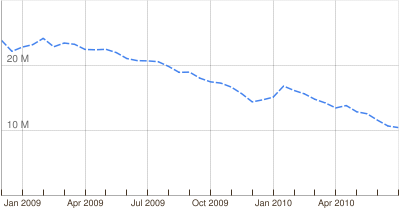
I have predicted the end of MySpace for sometime, but in the 3rd quarter it did something bizarre … it gained users. It had dropped 14 million users from the 1st to the 2nd quarter and then it gained one million users back in the 3rd quarter. MySpace now stands at 67 million users. Not earth-shaking, but certainly noteworthy. LinkedIn would sacrifice several interns to have that many users. MySpace also has more women. Female users consist of 64% of the MySpace population.

MySpace 3rdQ 2010 DAILY visits

The reason? Well, no other major Social Media tool lets you search by gender … and age … and height … and race … and body type … and sexual orientation … are you getting the picture? MySpace is a social dating site as much as anything else and lonely people make up a lot of our world’s population. So maybe MySpace has found its niche as a romance network and that will stop the freefall of the past two quarters.

3Q 2010 MySpace users by Age

3rdQ 2010 MySpace users by Age

Yes, there are more teenagers on this site than most (14%), but 63% of the users are between 18 and 44 years old. One caveat. MySpace has limited the ‘find-a-friend’ search function to give the results of people age 18 and over. That is a smart move to protect minors; however, some teenagers have simply listed themselves as an age of 18 or older to circumvent the limitation. I caught a few teenagers that list themselves as 19, but on their main page description they indicate their real age. This is likely why the number of ‘under 18’ users have dropped from 34% to 14% in six months.

LinkedIn Drifting in Niche
The 3rd quarter statistics show that despite millions of people looking work, the business person to business person website of LinkedIn is not growing. It is at 41 million,
which is actually higher than the end of 2nd quarter, but the same as the end of the 1st quarter.

LinkedIn 3rdQ DAILY visits

Like MySpace, LinkedIn has found its niche. Essentially, LinkedIn is a business-oriented website that provides a job exchange service. Most users are using the networking website as their digital résumé in order to attract job offers. In the Tom Peters ‘Re-Imagine’ business world where branding is a key element of survival, LinkedIn is Mecca for self-promotion.

Unfortunately, LinkedIn is not as successful as Facebook and Twitter in two-way interaction. Both of those Social Media tools do not have as much as of an ‘agenda’ by individual users as LinkedIn. Users of the business-oriented network seem to spend more time professing what they know and don’t spend as much time listening to others. This is the traditional media model of one-way communication, which is the style of communication that Social Media has displaced. For some, the self-promotion run amuck style of some LinkedIn users is a turn off that may hurt the site in the long run.

3Q 2010 LinkedIn user by Age

1stQ 2010 LinkedIn users by Age

It will be interesting to see how LinkedIn will fare as the business-caused Recession of 2007-09 eases and people are employed again. LinkedIn could be a key to a sudden labor shortage in 2012 as those companies with the best opportunities will be able to target and recruit candidates through LinkedIn, leaving other employers to either compete or settle for what’s left over.

Age and gender on LinkedIn reinforce the business-world orientation as more males (57%) are users and the distribution of the age groups reflects the working world. Interestingly, while LinkedIn still has more users over 54 years old (15%), this is 7% drop from the 1st quarter. That is offset by an 8% jump of the 24-34 year old users in the last six months.

4th Quarter Predictions?
I believe we are seeing a refinement of each of the big four Social Media tools. Facebook has become the social sharing network, Twitter is the thought-provoking, learning network, MySpace is the social relationship network, and LinkedIn the branding and résumé network. The demographics are settling in to reinforce the existing nature of each of the networks. Facebook, MySpace and LinkedIn will likely end 2010 about where they are now unless something viral either cause a rush of new users, or sends people running away. Twitter still has potential significant growth, but I don’t see that happening in the 4th quarter.

The volatility of the Social Media networks have made it difficult to understand what they will eventually represent in our world; however, now that there seems to be a calming of the major networks, the value and purpose is becoming clearer. That will allow the big four to lock in their market; however, it will also open the door for other networks to identify areas of opportunities and weakness. My prediction is that 2011 will be the entrenchment of the Social Media, followed by more competition by other networks seeking to improve or offer alternatives to the established services.

More Articles

Business: Public Relations, Management, and Social Media Related

  • Richmond Embassy Suites: The best at true Hospitality
  • Dear Business Person: It’s 2010, please update your brain.
  • Selling watered-down beer: The best spin campaign in advertising
  • Communication: Repetition of message does not increase awareness
  • Is it time to fire yourself?
  • Millennium Hotel: Go away, spend your money elsewhere
  • Rogue Flight Attendant shows his arrogance, Airlines dislike for the customer
  • 2Q 2010 Social Media Tools: Facebook/Twitter sail on, LinkedIn/MySpace don’t
  • War Declared on Social Media: Desperate Acts of Traditional Media
  • Pay It Middle: The Balance between Too Much and Too Little Compensation
  • Mega Executive Pay Leads to Poor Performance
  • Relationships and Thin-Slicing: Why the other person knows what you’re really thinking
  • Browser Wars: Internet Explorer losing, Google Chrome gaining ground
  • WiFi on Southwest Airlines: Is it ‘Shovel Ready’?
  • Starbucks makes a smart move: Free WiFi
  • Foul Play: FIFA shows what less regulation offers to business
  • The Shock of the McChrystal Story: The story is over before the article is published
  • Tony Hayward: The very model of a modern Major General
  • Epic Fail: PR ‘Experts’ don’t get Twitter
  • King of Anything: Social Media vs Traditional Media
  • Twitter is the Thunderstorm of World Thought
  • Signs of the Times
  • How Social Interactive Media Could Transform Higher Education
  • How to Become a Zen Master of Social Media
  • Death of All Salesmen!
  • Aristotle’s General Rules on Social Media
  • Social Media:  What is it and Why Should You Care?
  • Social Media 2020:  Keep it Personal
  • Social Media 2020:  Who Shouldn’t Be Teaching Social Media
  • Social Media 2020:  Public Relations 2001 vs Social Media Relations 2010
  • Social Media 2020: Who Moved My Public Relations?
  • Publishing Industry to End 2012
  • Who uses Facebook, Twitter, MySpace & LinkedIn?
  • Fear of Public Relations
  • Dissatisfiers: Why John Quit
  • Facebook, Twitter, LinkedIn…Oh My!
  • Does Anybody Really Understand PR?

Rotary Related

  • What most non-Rotarians don’t know about Rotary
  • Rotary@105: Making Rotary Sexy
  • Rotary@105: Grieving change
  • How Rotary can..must..will plug into Social Media
  • Rotary PR: Disrespecting the Club President is a PR/Membership issue
  • Rotary Membership/Public Image Challenge
  • Rotary New Year: Retread or Renaissance?
  • Rotary@105: A young professionals networking club?
  • One Rotary Center: A home for 1.2 million members
  • Rotary@105:  What BP Could Learn from the 1914 Rotary Code of Ethics
  • Rotary Magazine Dilemma Reveals the Impact of Social Media
  • Rotary@105:  April 24th – Donald M. Carter Day
  • Rotary@105:  What kind of animal is Rotary International?
  • Rotary:  The Man in the Yellow Hat as the Ideal Club President?
  • Rotary@105:  Our 1st Rotary Club Dropout
  • Rotary Public Relations and Membership: Eight Steps to a Team Win
  • Rotary: All Public Relations is Local
  • Best Practices:  Become a Target!

Science Related

  • Negative Time: The Self-fulfilling Prophesy a Scientific Possibility?
  • Physics in 2010: The more we understand, the less we know

Personal Experience Related

  • Things I didn’t know about being a Father to a four-year-old boy
  • Riding Reno: The Ladies of Reno
  • Up in the air down in Texas
  • I mow my lawn because…
  • Nevada I-580: An Interstate by any other name
  • Nevada’s oldest brewery opens a Reno location
  • Two Barbecues and a Wedding
  • Car Dealership Re-Imagines Customer Service

Our Country and History Related

  • Nevada: State of Disaster
  • Thank you, Mr. President
  • America’s Hostile Takeover of Mexico

Is it time to fire yourself?

27 Friday Aug 2010

Posted by Paul Kiser in Business, Communication, Consulting, Customer Relations, Customer Service, Employee Retention, Government Regulation, Higher Education, Human Resources, Lessons of Life, Management Practices, Passionate People, Public Relations, Re-Imagine!, Relationships, Rotary, Tom Peters, Universities

≈ 1 Comment

Tags

Blogging, Blogs, Employee evaluations, Employment, Executive Management, HR, Management Practices, New Business World, Public Relations, Re-Imagine!, Rotary, Tom Peters

by Paul Kiser
USA PDT  [Twitter: ] [Facebook] [LinkedIn] [Skype:kiserrotary or 775.624.5679]

Paul Kiser

One thing I have observed in government, hospitals, universities, and small business management is that all of those fields tend to be people collectors. What I mean is those particular fields have a high incidence of people who have passed their expiration date.

Why?

Government, hospitals, and universities tend to: 1) pay their employees well, 2) offer good to great benefits, 3) offer prestigious positions, and 4) have incompetent human resource professionals. A person who lands in any of these three fields may be an excellent performer for several years; however, every human being needs new challenges and after five to seven years they lose the excitement of the job. The problem is that because they have moved up to the top of the pay scale (pay scale: an example of HR incompetence) the person discovers that if they were ever to leave that job they would have to: 1) take a pay cut, 2) risk losing their excellent benefits, and 3) not find as prestigious position as what they have in their comfy current job.

Now that excellent performer is trapped like a caged animal in a job that has no challenges for them. The result is what we have in America today. Government services, hospitals, and universities that are operated by uninspired people who’s most important priority is to go home at the end of the day. And where is the human resources professional? Standing there preaching that all those systems they created that cause employee burnout are absolutely vital for retaining employees.  People collectors.

Show me an organization that prides itself on long-term employees and I’ll show you a group of people who shoved innovation and creativity into a file drawer decades before.

So why did I include small business owners in with this unhappy, unproductive group of people?

For small business owners the trap of mediocrity is different, but it has the same result.  Initially, a new business owner is excited by the challenge of creating a business from nothing. If they are successful they find the satisfaction of beating the odds, which is like a drug to a business owner. Then comes the fear of losing everything they built. That fear always, always, always leads to becoming conservative. Don’t take chances and don’t risk failure. But it doesn’t stop there.

Eventually, the intelligent business owner realized that his/her business has become stagnant. He/she then tries a series of half measures that stirs the pot but doesn’t make anything new happen. They shake up their sales team, join a peer group (they serve the same function as HR), purchase clever productivity software, or…God forbid, hire a consultant. The result is a temporary change in activity that fails to address the real problem. Fear of failure. Thus, the small business owner becomes a people collector, and they are the one collected. Stuck in a place they can’t get out of and yet, don’t want to be.

My best advice I can give to a small business owner who is stuck in this trap? Fire yourself. Put someone in charge of your company, expect that they will drive it into the ground, and go out and build a new business. At the very least you will no longer live in fear, but you will more alive than you have been in years.

More Articles

  • Up in the air down in Texas
  • I mow my lawn because…
  • Rogue Flight Attendant shows his arrogance, Airlines dislike for the customer
  • Nevada I-580: An Interstate by any other name
  • How Rotary can..must..will plug into Social Media
  • Physics in 2010: The more we understand, the less we know
  • Nevada’s oldest brewery opens a Reno location
  • Rotary Membership/Public Image Challenge
  • 2Q 2010 Social Media Tools: Facebook/Twitter sail on, LinkedIn/MySpace don’t
  • Epic Fail: PR ‘Experts’ don’t get Twitter
  • King of Anything: Social Media vs Traditional Media
  • Rotary PR: Disrespecting the Club President is a PR/Membership issue
  • WiFi on Southwest Airlines: Is it ‘Shovel Ready’?
  • Starbucks makes a smart move: Free WiFi
  • Two Barbecues and a Wedding
  • Foul Play: FIFA shows what less regulation offers to business
  • Rotary New Year: Retread or Renaissance?
  • The Shock of the McChrystal Story: The story is over before the article is published
  • Tony Hayward: The very model of a modern Major General
  • Rotary@105: A young professionals networking club?
  • One Rotary Center: A home for 1.2 million members
  • War Declared on Social Media: Desperate Acts of Traditional Media
  • Pay It Middle: The Balance between Too Much and Too Little Compensation
  • Mega Executive Pay Leads to Poor Performance
  • Relationships and Thin-Slicing: Why the other person knows what you’re really thinking
  • Browser Wars: Internet Explorer losing, Google Chrome gaining ground
  • Rotary@105:  What BP Could Learn from the 1914 Rotary Code of Ethics
  • Twitter is the Thunderstorm of World Thought
  • Signs of the Times
  • Rotary Magazine Dilemma Reveals the Impact of Social Media
  • How Social Interactive Media Could Transform Higher Education
  • How to Become a Zen Master of Social Media
  • Car Dealership Re-Imagines Customer Service
  • Death of All Salesmen!
  • Aristotle’s General Rules on Social Media
  • Social Media:  What is it and Why Should You Care?
  • Social Media 2020:  Keep it Personal
  • Social Media 2020:  Who Shouldn’t Be Teaching Social Media
  • Social Media 2020:  Public Relations 2001 vs Social Media Relations 2010
  • Social Media 2020: Who Moved My Public Relations?
  • Publishing Industry to End 2012
  • Who uses Facebook, Twitter, MySpace & LinkedIn?
  • Fear of Public Relations
  • Dissatisfiers: Why John Quit
  • Facebook, Twitter, LinkedIn…Oh My!
  • Does Anybody Really Understand PR?

2Q 2010 Social Media Tools: Facebook/Twitter sail on, LinkedIn/MySpace don’t

20 Tuesday Jul 2010

Posted by Paul Kiser in Communication, Consulting, Customer Relations, Customer Service, Information Technology, Internet, Management Practices, Passionate People, Public Relations, Re-Imagine!, Relationships, Rotary, SEO, Social Interactive Media (SIM), Social Media Relations, The Tipping Point

≈ 1 Comment

Tags

2nd Quarter Social Media Stats, Bloggers, Blogging, Blogs, Customer Loyalty, Facebook, Google Ad Planner, LinkedIn, Management Practices, MySpace, New Business World, New York Times, npr, Public Image, Public Relations, Publicity, Rotarians, Rotary, Social Media, Social Networking, The Denver Post, Twitter, users

by Paul Kiser
USA PDT  [Twitter: ] [Facebook] [LinkedIn] [Skype:kiserrotary or 775.624.5679]

Paul Kiser

Facebook Dragging Anchor?
Facebook hit 500 million users recently (Google Ad Planner puts them at 550 million as of June) and Twitter is hovering near 100 million. When you consider that Facebook doubled the number of users in about a year it seems like the growth of the giant will not stop, but something interesting has happened in the past three months. The growth in visitors (measured via cookies) has slowed; however, Facebook has gained 60 million users in the second quarter, so no one can reach a conclusion, yet.

Yes, everyone was going to quit Facebook on May 31, 2010, and that didn’t happen, but there may be a new temperamental wind blowing in the world of Social Media. It’s possible that Facebook’s bad press over privacy issues has had an impact on new users and/or it’s possible that Facebook has reached a point of saturation. Regardless, Facebook has hit a speed bump, which leads everyone to wonder if it is a temporary blip, or has the bubble burst?

Facebook Visitors 2Q 2010 (not users)

Twitter Whale of a Fail
Twitter has also seen a slight decrease in visitors over the last two months; however, Twitter gained 16 million users in the second quarter and it should easily exceed the 100 million user mark in the third quarter. Twitter may be experiencing fallout from the backlash at Facebook, but it is more likely that Twitters persistent ‘Fail Whale’ capacity issues are preventing the service from scoring big gains with new users. For several weeks in June, Twitter users experienced constant interruptions in service that were a major annoyance causing many to exacerbate the problem by Tweeting their complaints. The issues were similar to the days when AOL dial-up service lacked the capacity to handle the volume of users…and remind us of the risk an organization takes in failing to anticipate rapid growth.

Twitter Visitors 2Q 2010

From a position of potential demand by business-oriented users, Twitter is in the best position to grow into the Facebook of the business world, but it has to overcome the confusion by older users of the usefulness of the service; however, there is a ‘Tipping Point’ that once achieved could push Twitter into mega growth and a potential of becoming larger than Facebook in total users.

Twitter up-time seems to be getting better in the past two weeks, but continued reliability problems could have a significant impact on user happiness and that opens the door for another service to step up and prove that they offer more than twitchy connections.

LinkedIn Visitors 2Q 2010

LinkedIn Becalmed
The surprise in the 2nd Quarter was the loss of users for LinkedIn. Dropping from 41 million down to 38 million for the business networking website may indicate that it is in a market that is too narrow. LinkedIn encourages long discussions of business issues, and the formation of related groups, but the downside is that few care to read 257 posts of people’s opinions where the knowledgeable people are mixed in with the clueless. LinkedIn also discourages connecting to another user unless you already have a relationship with them, which means you’re talking to the same people you already know. Twitter’s advantage is a more rapid discussion that spins off to other blogs rather than an on-line list of opinions. Twitter also connects people in a way that allows the user to edit their followers, rather than depending on an existing relationship. This could be the signal of a trend and LinkedIn may come out on the short end of Darwin’s evolution theory.

MySpace Visitors 2Q 2010

MySpace: The Titanic of Social Media
MySpace is proof that failure is an option in the world of Social Media. Of course, they are a failure with 66 million followers at the end of the 2nd Quarter, but they had 80 million users at the end of the 1st Quarter. At this pace they will under 10 million users by next summer. MySpace is the Wicked Witch of the West and she is sitting under Niagara Falls …. ‘I’m meltinggggg.’

It is possible that by the end of the 3rd Quarter the field of Social Media tools could be clearly down to Facebook and Twitter. MySpace would need a massive public relations campaign and cool new tricks to stop its decline. It is the BP of the Social Media and it doesn’t have the finances to pull up before it noses into the corn field. LinkedIn is sitting on a house of cards. Being a ‘Business Networking’ service is not enough to keep it viable. If it drops under 30 million users by the end of 3rd Quarter I predict that it will be a race between LinkedIn and MySpace to be the first to dissolve in 2011. MySpace’s loss will be Facebook’s gain and LinkedIn’s loss will be Twitter’s gain. I still believe Twitter has more potential than Facebook, but they will have to overcome the misconceptions by older users of its purpose and value.

We wait for the 3rd Quarter…what will people do?

More Articles

  • Epic Fail: PR ‘Experts’ don’t get Twitter
  • King of Anything: Social Media vs Traditional Media
  • Rotary PR: Disrespecting the Club President is a PR/Membership issue
  • WiFi on Southwest Airlines: Is it ‘Shovel Ready’?
  • Starbucks makes a smart move: Free WiFi
  • Two Barbecues and a Wedding
  • Foul Play: FIFA shows what less regulation offers to business
  • Rotary New Year: Retread or Renaissance?
  • The Shock of the McChrystal Story: The story is over before the article is published
  • Tony Hayward: The very model of a modern Major General
  • Rotary@105: A young professionals networking club?
  • One Rotary Center: A home for 1.2 million members
  • War Declared on Social Media: Desperate Acts of Traditional Media
  • Pay It Middle: The Balance between Too Much and Too Little Compensation
  • Mega Executive Pay Leads to Poor Performance
  • Relationships and Thin-Slicing: Why the other person knows what you’re really thinking
  • Browser Wars: Internet Explorer losing, Google Chrome gaining ground
  • Rotary@105:  What BP Could Learn from the 1914 Rotary Code of Ethics
  • Twitter is the Thunderstorm of World Thought
  • Signs of the Times
  • Rotary Magazine Dilemma Reveals the Impact of Social Media
  • How Social Interactive Media Could Transform Higher Education
  • How to Become a Zen Master of Social Media
  • Car Dealership Re-Imagines Customer Service
  • Death of All Salesmen!
  • Aristotle’s General Rules on Social Media
  • Social Media:  What is it and Why Should You Care?
  • Social Media 2020:  Keep it Personal
  • Social Media 2020:  Who Shouldn’t Be Teaching Social Media
  • Social Media 2020:  Public Relations 2001 vs Social Media Relations 2010
  • Social Media 2020: Who Moved My Public Relations?
  • Publishing Industry to End 2012
  • Who uses Facebook, Twitter, MySpace & LinkedIn?
  • Fear of Public Relations
  • Dissatisfiers: Why John Quit
  • Facebook, Twitter, LinkedIn…Oh My!
  • Does Anybody Really Understand PR?

Pay It Middle: The Balance between Too Much and Too Little Compensation

01 Tuesday Jun 2010

Posted by Paul Kiser in 2020 Enterprise Technologies, Communication, Consulting, Customer Relations, Customer Service, Employee Retention, Human Resources, Lessons of Life, Management Practices, Public Relations, Relationships, Rotary, Science, Social Media Relations, Violence in the Workplace, Women

≈ 2 Comments

Tags

Abraham Maslow, Blogs, Compensation, Employment, HR, Management Practices, Maslow's Hierarchy of Needs, New Business World, Pay for Performance, performance reviews, Public Image, Re-Imagine!, Rotary

by Paul Kiser [Twitter: ] [Facebook] [LinkedIn] [Skype: kiserrotary or 775.624.5679]

Yesterday I wrote an article about research that shows that too much compensation actually makes performance worse.  A fellow Rotarian (thanks Skip!) sent me a link to a great video by RSA Animate that illustrates the issue and the research.  If you haven’t seen it take a look:

Dan Pink: Drive and Purpose YouTube Video

Paul Kiser - CEO 2020 Enterprise Technologies

The article is here: (Mega Executive Pay Leads to Poor Performance)

But the question is why does mega pay negatively impact performance? Here’s my theory.

The Psychology of Making Too Much Money – Barney and the Manna ATM
A man named Barney goes to withdraw $500 from his local ATM. Instead he is given $5,000. When Barney checks his balance it shows that no money was withdrawn from his account. He could go to the bank and let them know that he thinks the ATM has made a mistake but he doesn’t. Initially he is afraid that someone will discover the mistake and take the money away, but no one says anything and eventually Barney’s fear eases. Each week he goes back to the same ATM for another withdrawal and the same thing occurs. He tries other ATM’s, but he learns that it is just this one that gives him money for nothing. Soon he has built a life around getting $5,000 every week from this ATM. His fear has now subsided, but he feels a little guilty, but also a little evil.

One evening Barney is in a rush for the money and pushes a woman out-of-the-way to make his transaction. The woman is irritated but stands to the side while Barney enters in the information. When the money comes out she notices that he received $5,000 but only requested $500. She points this out to him and he denies it. She knows what she saw and she won’t be convinced. Barney offers to give her half of the money and she refuses the offer. She says she is going to tell the bank….What will Barney do to keep his lifestyle?

When examining behavior by executives and managers in the banking crisis of 2007-09, the answer to that question: “What will a man do to keep his lifestyle?” (I’m not being sexist, just accurate) is answered by the unethical business decisions that led to massive financial failures in 2008-09. Pay might purchase a person’s talents for an organization, but at a certain point, too much compensation begins to purchase the person’s ethical compass. Good decision-making is replaced by self-preservation and the future of the business is sacrificed for the financials of the current quarter.

The lesson is that too much compensation becomes a trap that will often lead to unethical decisions. Mega pay not only doesn’t improve performance, it lures executives to the dark side.

Maslow's Hierarchy of Needs

The Psychology of Making Too Little Money – Maslow’s Hierarchy of Needs
The other side of the issue is paying too little. In 1943, a researcher named Abraham Maslow published a paper titled: A Theory of Human Motivation. The work was based on examining successful people and their living situations. From his research he concluded that there is a Hierarchy of Needs that must be met in steps, with each step supporting the next level.

In Maslow’s paper he proposes that humans must meet their basic survival needs that contribute to sustaining life as the base level of life; however, security and safety needs are the next level. All levels above that (Belonging, Esteem, and finally, Self-Actualization) are dependent on the needs of the first two levels being met.

This is the key. Employers that fail to compensate their team to the point of a living wage should expect their staff to be in a constant state of crisis and that means they cannot expect these employees to be creative and innovative in dealing with the common issues that might arise with the customer. An underpaid employee will be in a constant state of personal crisis that will lead to many issues including reliability, focus, and attitude.

The question is how much is a living wage? That takes an individual examination of the job, the market, and the economy of the region. As the video suggests, you should pay enough to take money off the table as an issue.

More Articles

Business: Public Relations, Management, and Social Media Related

  • Relationship Typing: 3 factors that affect the quality and depth of friendship (Part I)
  • Starbucks Re-Imagines the business … again
  • Your Privacy Rights on the Internet: Read before you write
  • Social Media 3Q Update: Who uses Facebook, Twitter,LinkedIn, and MySpace?
  • Richmond Embassy Suites: The best at true Hospitality
  • Dear Business Person: It’s 2010, please update your brain.
  • Selling watered-down beer: The best spin campaign in advertising
  • Communication: Repetition of message does not increase awareness
  • Is it time to fire yourself?
  • Millennium Hotel: Go away, spend your money elsewhere
  • Rogue Flight Attendant shows his arrogance, Airlines dislike for the customer
  • 2Q 2010 Social Media Tools: Facebook/Twitter sail on, LinkedIn/MySpace don’t
  • War Declared on Social Media: Desperate Acts of Traditional Media
  • Pay It Middle: The Balance between Too Much and Too Little Compensation
  • Mega Executive Pay Leads to Poor Performance
  • Relationships and Thin-Slicing: Why the other person knows what you’re really thinking
  • Browser Wars: Internet Explorer losing, Google Chrome gaining ground
  • WiFi on Southwest Airlines: Is it ‘Shovel Ready’?
  • Starbucks makes a smart move: Free WiFi
  • Foul Play: FIFA shows what less regulation offers to business
  • The Shock of the McChrystal Story: The story is over before the article is published
  • Tony Hayward: The very model of a modern Major General
  • Epic Fail: PR ‘Experts’ don’t get Twitter
  • King of Anything: Social Media vs Traditional Media
  • Twitter is the Thunderstorm of World Thought
  • Signs of the Times
  • How Social Interactive Media Could Transform Higher Education
  • How to Become a Zen Master of Social Media
  • Death of All Salesmen!
  • Aristotle’s General Rules on Social Media
  • Social Media:  What is it and Why Should You Care?
  • Social Media 2020:  Keep it Personal
  • Social Media 2020:  Who Shouldn’t Be Teaching Social Media
  • Social Media 2020:  Public Relations 2001 vs Social Media Relations 2010
  • Social Media 2020: Who Moved My Public Relations?
  • Publishing Industry to End 2012
  • Who uses Facebook, Twitter, MySpace & LinkedIn?
  • Fear of Public Relations
  • Dissatisfiers: Why John Quit
  • Facebook, Twitter, LinkedIn…Oh My!
  • Does Anybody Really Understand PR?

Rotary Related

  • Rotary@105: 7 Relationship types that affect membership retention (Part II)
  • What most non-Rotarians don’t know about Rotary
  • Rotary@105: Making Rotary Sexy
  • Rotary@105: Grieving change
  • How Rotary can..must..will plug into Social Media
  • Rotary PR: Disrespecting the Club President is a PR/Membership issue
  • Rotary Membership/Public Image Challenge
  • Rotary New Year: Retread or Renaissance?
  • Rotary@105: A young professionals networking club?
  • One Rotary Center: A home for 1.2 million members
  • Rotary@105:  What BP Could Learn from the 1914 Rotary Code of Ethics
  • Rotary Magazine Dilemma Reveals the Impact of Social Media
  • Rotary@105:  April 24th – Donald M. Carter Day
  • Rotary@105:  What kind of animal is Rotary International?
  • Rotary:  The Man in the Yellow Hat as the Ideal Club President?
  • Rotary@105:  Our 1st Rotary Club Dropout
  • Rotary Public Relations and Membership: Eight Steps to a Team Win
  • Rotary: All Public Relations is Local
  • Best Practices:  Become a Target!

Science Related

  • Negative Time: The Self-fulfilling Prophesy a Scientific Possibility?
  • Physics in 2010: The more we understand, the less we know

Personal Experience Related

  • Knowing when it’s over or beyond over
  • Dear Teresa Laraba, SVP of Southwest Airlines Customer Service
  • Things I didn’t know about being a Father to a four-year-old boy
  • Riding Reno: The Ladies of Reno
  • Up in the air down in Texas
  • I mow my lawn because…
  • Nevada I-580: An Interstate by any other name
  • Nevada’s oldest brewery opens a Reno location
  • Two Barbecues and a Wedding
  • Car Dealership Re-Imagines Customer Service

Our Country and History Related

  • I’m not angry, nor am I stupid … and I voted
  • Point of Confusion
  • What I’m not buying this year
  • Nevada: State of Disaster
  • Thank you, Mr. President
  • America’s Hostile Takeover of Mexico

Social Media Book Review: The Zen of Social Media Marketing

10 Monday May 2010

Posted by Paul Kiser in 2020 Enterprise Technologies, Book Review, Branding, Consulting, Customer Relations, Customer Service, Information Technology, Management Practices, Passionate People, Public Relations, Re-Imagine!, Rotary, SEO, Social Interactive Media (SIM), Social Media Relations, Website, Women

≈ Leave a comment

Tags

2020 Enterprise Technologies, Bloggers, Blogging, Blogs, Book, Book review, Facebook, LinkedIn, Management Practices, New Business World, Public Image, Public Relations, Publicity, Re-Imagine!, Rotarians, Rotary, Rotary Club, Social Media, Social Networking, Twitter, Value-added, Website

by Paul Kiser
USA PDT  [Twitter: ] [Facebook] [LinkedIn] [Skype:kiserrotary or 775.624.5679]

  • Book Cover

    Book: The Zen of Social Media Marketing

  • Author: Shama Hyder Kabani
  • Publisher:  Benbella Books
  • Published: April 2010
  • Audience: Primary: Message professionals involved in organizational internal and external communication. Also, individuals seeking to create a personal brand. Secondary: Seekers of enlightenment regarding Social Media and Professors and Teachers in many fields (e.g.; business, arts, education, communication, etc.)
  • Rating: (Out of 5*)
    • Overall ***** (5-Must Read)
    • Content ***** (5)
    • Relevancy ***** (5)
    • Style **** (4-down to business tone)
    • Readability *** (3-read on a Kindle computer download)
    • Value***** (5)
  • Thesis:  A presentation of key aspects of Social Media and how it functions with organizational marketing.

Social Interactive Media is a very complex and variable subject.  It is unreasonable for anyone to expect one book can adequately cover this topic because the Social Media tools and their use are changing daily. It is akin to asking someone to explain Art in one book….and the request is made after the Renaissance. There is much to discuss and there is still more to come. The reality is that we are still in early childhood of Social Media, but even today it can make or break governments and businesses.

Shama Hyder Kabani

Despite the impossible task the author, Shama Hyder Kabani has not only written a great book on the subject of Social Media, she is offering a solution to the problem of keeping her book relevant by updating and revising the book on the Internet.  It is truly a book born in the Social Media era of handling difficult problems with New World solutions.

Teasers

  • Introduction – Nice comparison between Social Media and the spoon lesson in the movie ‘The Matrix”.
  • Chapter 1 – a) Learn how to A-C-T using a great B-O-D in Social Media. b) Strangers to Consumers to Clients.
  • Chapter 2 – a) What is Website 911 EMS? b) What a blog does for your website. c) Relevancy versus Content…or not
  • Chapter 3 – Use and abuse of Social Media.
  • Chapter 4 – Facebook, the coffee shop of the Internet. (I love that analogy!)
  • Chapter 5 – a) Twitter, it’s about the dialogue, not about you. b) What #ff means.
  • Chapter 6 – LinkedIn, the conference room of the Internet.
  • Chapter 7 – Video on Internet: a) About, b) How to, c) Why.
  • Chapter 8 – Social Media meets Corporate Policy.
  • Chapter 9 – Icing on the Social Media cake.

I discovered new information on Social Media through Shama’s book, but mostly this was a great read because she validated what I have learned, read, and witnessed in my exploration of Social Media. For me, it allows me to say to someone, if you don’t believe me, read the book. The Social Media Doubting Thomas’ need a hard copy book for information to be legitimate and that is what Shama Hyder Kabani provides to the world. She also confirmed for me that age does not equal wisdom in the world of Social Media. My experience has been that the older the Social Media ‘expert’ the more cynical and off-target the information. Shama knows her stuff and people of all ages should sit up and listen….or just leave.

More Articles

  • Rotary Membership/Public Image Challenge
  • 2Q 2010 Social Media Tools: Facebook/Twitter sail on, LinkedIn/MySpace don’t
  • Epic Fail: PR ‘Experts’ don’t get Twitter
  • King of Anything: Social Media vs Traditional Media
  • Rotary PR: Disrespecting the Club President is a PR/Membership issue
  • WiFi on Southwest Airlines: Is it ‘Shovel Ready’?
  • Starbucks makes a smart move: Free WiFi
  • Two Barbecues and a Wedding
  • Foul Play: FIFA shows what less regulation offers to business
  • Rotary New Year: Retread or Renaissance?
  • The Shock of the McChrystal Story: The story is over before the article is published
  • Tony Hayward: The very model of a modern Major General
  • Rotary@105: A young professionals networking club?
  • One Rotary Center: A home for 1.2 million members
  • War Declared on Social Media: Desperate Acts of Traditional Media
  • Pay It Middle: The Balance between Too Much and Too Little Compensation
  • Mega Executive Pay Leads to Poor Performance
  • Relationships and Thin-Slicing: Why the other person knows what you’re really thinking
  • Browser Wars: Internet Explorer losing, Google Chrome gaining ground
  • Rotary@105:  What BP Could Learn from the 1914 Rotary Code of Ethics
  • Twitter is the Thunderstorm of World Thought
  • Signs of the Times
  • Rotary Magazine Dilemma Reveals the Impact of Social Media
  • How Social Interactive Media Could Transform Higher Education
  • How to Become a Zen Master of Social Media
  • Car Dealership Re-Imagines Customer Service
  • Death of All Salesmen!
  • Aristotle’s General Rules on Social Media
  • Social Media:  What is it and Why Should You Care?
  • Social Media 2020:  Keep it Personal
  • Social Media 2020:  Who Shouldn’t Be Teaching Social Media
  • Social Media 2020:  Public Relations 2001 vs Social Media Relations 2010
  • Social Media 2020: Who Moved My Public Relations?
  • Publishing Industry to End 2012
  • Who uses Facebook, Twitter, MySpace & LinkedIn?
  • Fear of Public Relations
  • Dissatisfiers: Why John Quit
  • Facebook, Twitter, LinkedIn…Oh My!
  • Does Anybody Really Understand PR?

How Social Interactive Media Could Transform Higher Education

06 Thursday May 2010

Posted by Paul Kiser in College, Consulting, Customer Relations, Customer Service, Higher Education, Independent Studies, Information Technology, Management Practices, parenting, Public Relations, Re-Imagine!, Rotary, Social Interactive Media (SIM), Social Media Relations, Tom Peters, Universities

≈ 1 Comment

Tags

Blogging, Blogs, Facebook, LinkedIn, Nevada, New Business World, Re-Imagine!, Rotary, Social Media, Social Networking, Tom Peters, Twitter, Value-added

by Paul Kiser

Mom!

A Future Phone Conversation Between Mom and her Son
Mom! I just got a flash from Dr. Ramjan..HE ACCEPTED ME!!!!…Yes!…I start his program right away….for crepe’s sake Mom, it’s not like when you went to college. I don’t have to go sit in a classroom and listen to some no-name drone on about stuff nobody cares about!….No, I’m not slamming your education, but honestly Mom why did you put up with it? Going to classes, paying for parking, student fees, and being told what professors you had to learn from, etc., etc….

Paul Kiser - CEO 2020 Enterprise Technologies

Tomorrow’s College to Be Professor Based, Not University Based?
Brick and mortar universities have created elaborate rules and policies (and fees) that tell a student what classes they must complete (some required, a few elective) to obtain a degree. Many of the classes will have facts based on outdated research that must be memorized for tests. In the end the student has a degree that includes course work that had little to do with what is going in today’s working world, but was forced on him or her by a system of Higher Education that is designed for the education of a group, not of an individual.

Social Interactive Media (SIM) tools create new options for Higher Education that could overcome many of the shortcomings of the current University environment. Here are a few issues with the status quo and how Social Interactive Media offers solutions to these issues:

Less Education at a Higher Cost – Universities are slashing budgets as they are being given less money with which to operate.  This means larger classes, fewer professors, and older facilities and equipment.

SIM Solution: Eliminate the major costs of massive campuses and administrative overhead using Social Media as a student’s access to the professor. The classroom can be anywhere in the world, including in the field or in the student’s home. This is not a new idea and the use of the Internet for teaching is becoming widely accepted.

Lack of Choice – In the University environment the student has little say in what classes they will take and even less choice in the professor. The professor might be a graduate student with little or no teaching experience, or a tenured professor that has years of teaching experience, but has not performed any research in his or her field for a decade or more.

SIM Solution – Allow the student to choose the seminars and the instructors based on the information and reputation of the professors through blogs and references online. This may create a new classification of the Education Coach who advises and recommends professors and course work. Perhaps Education Coaches will be individually accredited and specialize in certain fields, or perhaps they will be accredited to help a student define a general studies (liberal arts) type program.

Inflexible Scheduling – University classes are based on the concept of group teaching, which requires all students conform their lives to the schedule determined by administrators.

SIM Solution – Individualized studies where the professor works with the student schedules programs that are mutually beneficial.

For decades there have been versions of independent study programs and in the past decade, many legitimate Internet-based colleges programs; however, the negatives of the existing University environment, exacerbated by funding shortfalls open the door to Re-Imagining higher education as a Student/Professor centered system that is relevant, rather than an administrator/bureaucratic centered system that is insensitive to the individual.

More articles

  • Tony Hayward: The very model of a modern Major General
  • Rotary@105: A young professionals networking club?
  • One Rotary Center: A home for 1.2 million members
  • War Declared on Social Media: Desperate Acts of Traditional Media
  • Pay It Middle: The Balance between Too Much and Too Little Compensation
  • Mega Executive Pay Leads to Poor Performance
  • Relationships and Thin-Slicing: Why the other person knows what you’re really thinking
  • Browser Wars: Internet Explorer losing, Google Chrome gaining ground
  • Rotary@105:  What BP Could Learn from the 1914 Rotary Code of Ethics
  • Twitter is the Thunderstorm of World Thought
  • Signs of the Times
  • Rotary Magazine Dilemma Reveals the Impact of Social Media
  • How Social Interactive Media Could Transform Higher Education
  • How to Become a Zen Master of Social Media
  • Car Dealership Re-Imagines Customer Service
  • Death of All Salesmen!
  • Aristotle’s General Rules on Social Media
  • Social Media:  What is it and Why Should You Care?
  • Social Media 2020:  Keep it Personal
  • Social Media 2020:  Who Shouldn’t Be Teaching Social Media
  • Social Media 2020:  Public Relations 2001 vs Social Media Relations 2010
  • Social Media 2020: Who Moved My Public Relations?
  • Publishing Industry to End 2012
  • Who uses Facebook, Twitter, MySpace & LinkedIn?
  • Fear of Public Relations
  • Facebook, Twitter, LinkedIn…Oh My!
  • Does Anybody Really Understand PR?

How to Become Zen Master of Social Media

04 Tuesday May 2010

Posted by Paul Kiser in Consulting, Information Technology, Lessons of Life, Passionate People, Public Relations, Rotary, Social Interactive Media (SIM), Social Media Relations

≈ 8 Comments

Tags

Bloggers, Blogging, Blogs, Facebook, LinkedIn, New Business World, parenting, Public Image, Public Relations, Publicity, Rotary, Social Media, Social Networking, Twitter

by Paul Kiser

Three States of Being: Taking In, Reflecting, and Giving Out

Today I read two articles that sparked a ‘Zen’ moment for me. It hit me that the ideal for a person who seeks to be Social Media Leader (or Master, if you prefer) is one who balances three different states of being.

Before I go into the three states of being I want to credit the two articles that led me to this enlightenment because I think they are well worth the read. The first article is by Tanveer Naseer titled, The Power of Reflection in Leadership. In the article he discusses the need for leaders to schedule reflection time in her or his day.  I am a regular reader of Mr. Naseer’s blog because he has great insight on a wide variety of topics.

(Link to The Power of Reflection in Leadership)

The second article I came across via LinkedIn and the Social Media Network titled, The Two Essential Steps to Becoming a Thought Leader by Brandon Cox. His points are simple, but the idea of becoming a Thought Leader is an important concept for anyone who wishes to be more than a do-what-your-told drone.

(Link to The Two Essential Steps to Becoming a Thought Leader)

I want to clarify that I don’t see myself as a Zen Master of Social Media, just one who wants to walk the path, but the combination of these two articles gave me a moment of clarity about what is needed for anyone who strives to be more than a user of Social Media.

Because Social Media is a new evolution in individual communication and is constantly transforming it is necessary for a leader in Social Media to research and observe. The Zen Master of Social Media must first be a Seeker of knowledge. As Naseer puts it, he or she must climb the mountain, but the mountain of Social Media has no summit. Like so many hikes I have taken in Colorado, the top of one summit only allows you to see the next summit.

A leader of Social Media must also be a Reflector of Social Media.  Learning about the function of a tool is important, but one must use the tool to truly understand the value of the it. Being a Reflector allows others to observe and learn best practices, and then to innovate new practices from the foundation laid by the ‘master’.

Finally, a leader of Social Media must be a Mentor.  Giving out the knowledge gained from being a Seeker and a Reflector is an essential function of a leader. Teaching helps others to learn, but as any Teacher can tell you, their knowledge of a subject becomes solidified as they organize their thoughts to present the information to their students.

By being equal parts of a Seeker, Reflector, and Mentor the Social Media Leader will find balance and continuous growth as they seek to reach a perfect Zen state….and then they need to shut off his or her computer and go play with their children.

A Zen of a Different Kind

A Post Script: While researching for this blog I came across a new book titled, The Zen of Social Media by Shama Kabani, published by BellaBooks.  I have downloaded it off of Amazon.com.  I may add a follow-up blog once I have read her book, but it looks interesting!

More blogs

  • Car Dealership Re-Imagines Customer Service
  • Death of All Salesmen!
  • Aristotle’s General Rules on Social Media
  • Social Media:  What is it and Why Should You Care?
  • Social Media 2020:  Keep it Personal
  • Social Media 2020:  Who Shouldn’t Be Teaching Social Media
  • Social Media 2020:  Public Relations 2001 vs Social Media Relations 2010
  • Social Media 2020: Who Moved My Public Relations?
  • Publishing Industry to End 2012
  • Who uses Facebook, Twitter, MySpace & LinkedIn?
  • Fear of Public Relations
  • Facebook, Twitter, LinkedIn…Oh My!
  • Does Anybody Really Understand PR?

Death of ALL Salesmen!

29 Thursday Apr 2010

Posted by Paul Kiser in Branding, Consulting, Information Technology, Management Practices, Passionate People, Public Relations, Re-Imagine!, Rotary, Social Interactive Media (SIM), Social Media Relations

≈ 1 Comment

Tags

Management Practices, Marketing, New Business World, Public Image, Public Relations, Sales, Salesman, Salesperson, Selling, Social Media

Dear Mr. Webster:

Please remove the following words from your dictionary:  ‘Sales‘, ‘salesman‘, ‘salesperson‘, ‘selling‘, ‘advertise‘, ‘ads‘, …oh, and while you’re at it, remove that word, ‘metrics‘.

My reasons are as follows:  While there are still gullible people who can be manipulated into buying something they don’t need, ‘selling‘ is an illegitimate word for today’s socially interactive, connected, and informed world.  It can be eliminated.

The same is true for ‘advertising‘. The idea of annoying people while they are involved in an activity like reading, watching TV, or listening to music has forced people to find alternatives to being inflicted with a sales pitch as payment for doing something they enjoy. In a social interactive world we don’t need to be assaulted.  People will discover good products and services through mass personal communication, therefore, advertising can also be eliminated.

As for the irksome term ‘metrics‘, it makes people giggle when some pompous fool uses it, so ….wait, nevermind ….keep ‘metrics’, it helps me identify our village idiots.

Thanks so much.

Sincerely,

Paul Kiser

Attention Must Be Earned!: Don’t Sell, Educate

Paul Kiser - CEO of Enterprise Technologies, inc.

Selling is a term that implies aggressiveness and manipulation.  It gives business owners the mistaken belief that if customers aren’t buying their product or service that it must be the fault of the ‘Sales’ team.

Here’s a thought: If people aren’t buying what you’re selling, maybe it’s because your products or services SUCK!

If a person doesn’t need a product or service, ‘selling’ them it will only lead to buyer’s remorse/regret and make the customer irritated at the company that manipulated them. Selling is the act of a desperate person who doesn’t believe in their product or service, but still hopes that they can find a sucker to bite. Selling something a person doesn’t need is a scam and it should be reserved for companies that have no honor or dignity.

The only time a product or service should be purchased is when it is needed by a customer and/or when it will improve the customer’s life.  Usually, a customer is not aware of all the products or services that can improve their life and that is an opportunity to educate, not sell.  Education is a service that makes the customer smarter.  It is not aggressive, nor desperate and it leads to a stronger bond between the customer and business.  Education is offered by a consultant that has his or her customer’s best interest in mind.

To educate a customer requires that the consultant know the client/customer.  The consultant should not be working for her or his company, but rather for the client. What is on the line is the brand, not of the company, but of the consultant.  A person who ‘sells’ damages his or her reputation and the person who educates becomes a valuable resource.

Educating rather than selling is a simple concept, but so few businesses seem to grasp it.  Why?  Because too many business think in the short-term – “What are our sales this month?” It’s a bad way to do business and it leads to pressure to ‘make a sale’. If revenue is down there are three possibilities.

  1. The customer has been well-taken care of and doesn’t need anything else now.
  2. The customer doesn’t realize that your company has a solution that they need.
  3. The customer knows your products/services suck.

If the situation is the first reason (a satisfied customer), then the consultant has done his or her job well!  A consultant can only take action if the situation is the second reason (needs more education.) However, if business is down because of the third reason (inferior product/service) then it is the business owner’s fault, not the consultant’s.

It is time to stop abusing customers. Start treating them with respect.  Kill your sales staff (well, not literally) and all terms that suggest manipulating the people who keep you in business.  It is a win-win for everyone.

More blogs

  • Aristotle’s General Rules on Social Media
  • Social Media:  What is it and Why Should You Care?
  • Social Media 2020:  Keep it Personal
  • Social Media 2020:  Who Shouldn’t Be Teaching Social Media
  • Social Media 2020:  Public Relations 2001 vs Social Media Relations 2010
  • Social Media 2020: Who Moved My Public Relations?
  • Publishing Industry to End 2012
  • Who uses Facebook, Twitter, MySpace & LinkedIn?
  • Fear of Public Relations
  • Facebook, Twitter, LinkedIn…Oh My!
  • Does Anybody Really Understand PR?

Other Pages of This Blog

  • About Paul Kiser
  • Common Core: Are You a Good Switch or a Bad Switch?
  • Familius Interruptus: Lessons of a DNA Shocker
  • Moffat County, Colorado: The Story of Two Families
  • Rules on Comments
  • Six Things The United States Must Do
  • Why We Are Here: A 65-Year Historical Perspective of the United States

Paul’s Recent Blogs

  • Dysfunctional Social Identity & Its Impact on Society
  • Road Less Traveled: How Craig, CO Was Orphaned
  • GOP Political Syndicate Seizes CO School District
  • DNA Shock +5 Years: What I Know & Lessons Learned
  • Solstices and Sunshine In North America
  • Blindsided: End of U.S. Solar Observation Capabilities?
  • Inspiration4: A Waste of Space Exploration

Paul Kiser’s Tweets

Tweets by PaulKiser

What’s Up

February 2026
S M T W T F S
1234567
891011121314
15161718192021
22232425262728
« Jun    

Follow Blog via Email

Enter your email address to follow this blog and receive notifications of new posts by email.

Join 688 other subscribers

Create a website or blog at WordPress.com


Loading Comments...