3rd From Sol

~ Learn from before. Live now. Look ahead.

3rd From Sol

Category Archives: Passionate People

Physics in 2010: The more we understand, the less we know

27 Tuesday Jul 2010

Posted by Paul Kiser in Book Review, Higher Education, History, Lessons of Life, Passionate People, Print Media, Random, Relationships, Science

≈ 3 Comments

Tags

Blogging, Brian Greene, Fabric of the Cosmos, General Relativity, Physics, Quantum Physics, Re-Imagine!, Relativity, Special Relativity, The Elegant Universe, Theory of Relativity

by Paul Kiser
USA PDT  [Twitter: ] [Facebook] [LinkedIn] [Skype:kiserrotary or 775.624.5679]

Paul Kiser

Several years ago I decided to update my limited knowledge of physics. I took my high school physics class in the early 1970’s and it was taught by a man who probably learned physics 20 years before he taught me, using a textbook that was a least 10 years old. Needless to say, I was out-of-date before my crash course in 21st Century physics.

I read Brian Greene’s book, The Elegant Universe, and his follow-up book, The Fabric of the Cosmos. I found that even though Greene’s did an excellent job of writing for the common person, my brain would still hurt while trying to grasp the concepts of String Theory, Special Relativity, and General Relativity.

The Elegant Universe by Brian Greene

Some of the things I’ve learned:

The Speed and Time Connection
Speed and time are connected and they have an inverse relationship. The faster a person, let’s call him ‘Bob’ goes, the slower time flows in relation to an observer, let’s call her ‘Audrey’. It’s important to note that 1) Bob or Audrey won’t see the change in the passage of time unless Bob returns to Audrey and, 2) the time difference isn’t noticeable until Bob gets near light speed (670 million miles per hour.) If Bob took a quick one hour trip at 99% of the speed of light he would find that upon his return Audrey will have spent 54 days waiting for him. I would advise that you just accept this concept because it’s the explanation that will make the brain hurt.

The Speed and Mass/Energy Connection
This is where things get interesting. Mass has a relationship with speed. The faster an object moves, the more mass it has, but like the time/speed relationship, it isn’t really noticeable until you get near light speed. The important thing to note is that mass grows to infinity as the object reaches light speed, which means it would take and infinite amount of energy to make the object go faster than the speed of light, which is not possible. Thus an object can’t go faster than light speed.

Here is what I find most interesting. Everything is in motion..the Earth is revolving and orbiting the Sun, the Sun is orbiting the Milky Way Galaxy, all the galaxies are in motion, etc., therefore, everything we can see, feel, and detect (i.e., everything that has mass) is traveling at a speed. If we could figure out the absolute vector and velocity for an object and send it in an opposite vector perfectly matching its forward velocity (i.e.; decelerate it) the object would drop to zero speed. Would that mean that it would lose all its mass and that time (for the object) would pass at an infinitely fast rate?

Gravity and Space
This is where things get fuzzy. Imagine a movie screen. Now imagine the movie screen is invisible unless light hits it. Now imagine that instead of the light reflecting off of the screen surface, the light causes the material of the screen to compress and concentrate in the areas where light hits it and the material reacts the strongest to the brighter the light. A flashlight would cause some compression, but a laser pointer light would cause a higher compression. Still with me?

The universe is made of an invisible, undetectable material that reacts to energy and mass. The greater the mass the more the fabric of space concentrates (gravity) causing a deformation in space/time that influences the path of other objects of mass and can influence the path of even electromagnetic energy, like light. Gravity is a component of the fabric of space/time and yet we, as of yet, cannot determine what gravity is in a physical sense. We can see the result of gravity, but we still really don’t know gravity.

Matter, Mass, and Strings
Scientists can no longer perform experiments on the elemental matter of which everything is made. It is just too small. Atoms  are giants in the new world of physics. Protons and neutrons are made of quarks and quarks and electrons are made of vibrating strings that exist in multiple time/space dimensions. Experimental scientists have had to give way to mathematicians who are able to sort out this micro-micro world, often by mathematically proving what the strings can’t be, based on what we already know.

It is unsettling for many that we have gone beyond easy experiments and analogies to understand this bizarre new world, but the simple fact is that unless you want to become a scholarly mathematician and learn all the proofs and formulas, you have to accept the work of those who are capable of seeing reality through numbers as easily as we see the fly on the fruit. If it makes you feel any better, most of us don’t how to perform brain surgery, and yet we accept a professional neurosurgeon understands what he or she is doing when they perform brain surgery. Physics reached the level of brain surgery in the 1960’s and now they have gone way beyond it.

What’s Next?
I don’t know what we will be able to do once the secrets of String Theory are fully understood. Once we understood Relativity we realized that we could make a bomb that was more devastating than we every had imagined possible. We also learned we could create new elements out of other elements. I suspect that String Theory will open new opportunities that will again go beyond our imagination, both wonderful and terrible. For now, I just marvel at the fact that everything consists of little strings of energy, including the hands and the connected mind writing this, as well as the eyes that read it. Amazing.

More Articles

  • Rotary Membership/Public Image Challenge
  • 2Q 2010 Social Media Tools: Facebook/Twitter sail on, LinkedIn/MySpace don’t
  • Epic Fail: PR ‘Experts’ don’t get Twitter
  • King of Anything: Social Media vs Traditional Media
  • Rotary PR: Disrespecting the Club President is a PR/Membership issue
  • WiFi on Southwest Airlines: Is it ‘Shovel Ready’?
  • Starbucks makes a smart move: Free WiFi
  • Two Barbecues and a Wedding
  • Foul Play: FIFA shows what less regulation offers to business
  • Rotary New Year: Retread or Renaissance?
  • The Shock of the McChrystal Story: The story is over before the article is published
  • Tony Hayward: The very model of a modern Major General
  • Rotary@105: A young professionals networking club?
  • One Rotary Center: A home for 1.2 million members
  • War Declared on Social Media: Desperate Acts of Traditional Media
  • Pay It Middle: The Balance between Too Much and Too Little Compensation
  • Mega Executive Pay Leads to Poor Performance
  • Relationships and Thin-Slicing: Why the other person knows what you’re really thinking
  • Browser Wars: Internet Explorer losing, Google Chrome gaining ground
  • Rotary@105:  What BP Could Learn from the 1914 Rotary Code of Ethics
  • Twitter is the Thunderstorm of World Thought
  • Signs of the Times
  • Rotary Magazine Dilemma Reveals the Impact of Social Media
  • How Social Interactive Media Could Transform Higher Education
  • How to Become a Zen Master of Social Media
  • Car Dealership Re-Imagines Customer Service
  • Death of All Salesmen!
  • Aristotle’s General Rules on Social Media
  • Social Media:  What is it and Why Should You Care?
  • Social Media 2020:  Keep it Personal
  • Social Media 2020:  Who Shouldn’t Be Teaching Social Media
  • Social Media 2020:  Public Relations 2001 vs Social Media Relations 2010
  • Social Media 2020: Who Moved My Public Relations?
  • Publishing Industry to End 2012
  • Who uses Facebook, Twitter, MySpace & LinkedIn?
  • Fear of Public Relations
  • Dissatisfiers: Why John Quit
  • Facebook, Twitter, LinkedIn…Oh My!
  • Does Anybody Really Understand PR?

Nevada’s oldest brewpub opens new Reno brewery

25 Sunday Jul 2010

Posted by Paul Kiser in About Reno, Branding, Business, Customer Relations, Information Technology, Passionate People, Public Relations, Rotary, Social Interactive Media (SIM), Social Media Relations

≈ 3 Comments

Tags

Beer, Blogging, Blogs, Brewery, Brewing, Brewpub, Craft Beer, Customer Loyalty, Employment, Food, Grain, Great Basin, Hops, Management Practices, Micorbrewery, Nevada, New Business World, Public Image, Public Relations, Publicity, Restaurant, Rotarians, Rotary, Rotary Club, Rotary District 5190, Specialty Beer, The Great Basin Brewing Company, Value-added

by Paul Kiser
USA PDT  [Twitter: ] [Facebook] [LinkedIn] [Skype:kiserrotary or 775.624.5679]

Paul Kiser

No one could legally brew beer in Nevada until the early 1990’s. That was changed, in part, by the efforts of Tom and Bonda Young and a few other brewing entrepreneurs who worked to change antiquated State laws. Once the law was changed Tom and a business partner established the first brew pub in northern Nevada, the Great Basin Brewing Company in 1993. Today, Great Basin Brewing is the oldest brewpub in Nevada and this week it will open a new top shelf brewery/restaurant in Reno.

Great Basin Brewery might have started out in Reno, except that the law that allowed brewpubs to operate in Nevada initially required the location to be in an area designated as a redevelopment zone and Sparks stepped forward to welcome the venture in the Victorian Avenue redevelopment plan. For 17 years it has been a significant part of downtown Sparks.

South side of the New Great Basin Brewing Company in Reno, NV, USA

Brewpubs are no longer restricted to redevelopment zones and last November Tom and Bonda took the leap to expand by remodeling a former Mexican chain restaurant into a showcase brewery serving some of Nevada’s most honored craft (specialty) beers. The new Reno location will significantly increase the production of the local brewpub that already is among the top 35 among over 1600 in the United States. The Sparks location can currently produce 7 barrels of beer at a time, but the new brewery will increase the combined production to 32 barrels.

Eli and Ryan working the brewing room

In addition to increased beer production, the new Reno Great Basin Brewery location will serve the same menu as its Sparks sister facility with the addition of hot baked pizza from their new brick pizza oven. The expansion of Nevada’s home-grown brewery has also created new jobs with the increased staff, along with the construction workers involved in the remodel. Tom also worked with local suppliers as demonstrated by using a local carpenter to build all the table tops in the facility.

Several members of the brewery staff have taken on significant responsibilities during the remodel and ramp up phases of the project including Jazz Aldrich, Eli Brightburg-Smith, Paul Ganzer, Dave Miller, Ryan Quinlan, and Dondo. This week has been spent taking the final step to make the new facility’s restaurant operational for the public opening on Monday (July 26).

Signs show which craft beers are currently on tap.

While watching beer brew can be as exciting as watching grass grow, it is intriguing to be able to see the large stainless steel containers that ferment grain products into a wide variety of craft beers that have landed the most awards of any Nevada brewpub. The new facility includes a silo on the southwest side of the building for the grain used by the brewery, which is a reminder that this is a real brewery with a brewpub and restaurant, and not just a restaurant that has a small brewery function to qualify as a brewpub.

I’m a big fan of the Young’s and the Great Basin Brewing Company. Tom Young has been a long-time member of the Rotary Club of Sparks and has donated many kegs of beer at cost or less for many fundraisers in the Reno/Sparks area. He and Bonda have also hosted Rotary Youth Exchange students and been active participants in club activities. It is exciting to see local business people who have given back so much to the community expand their operations and bring a quality brewery into Reno proper. If you have a chance to stop by this week I highly recommend stopping in to see the facility and have a beer..or two. Cheers!

(The Great Basin website)

More Articles

  • Rotary Membership/Public Image Challenge
  • 2Q 2010 Social Media Tools: Facebook/Twitter sail on, LinkedIn/MySpace don’t
  • Epic Fail: PR ‘Experts’ don’t get Twitter
  • King of Anything: Social Media vs Traditional Media
  • Rotary PR: Disrespecting the Club President is a PR/Membership issue
  • WiFi on Southwest Airlines: Is it ‘Shovel Ready’?
  • Starbucks makes a smart move: Free WiFi
  • Two Barbecues and a Wedding
  • Foul Play: FIFA shows what less regulation offers to business
  • Rotary New Year: Retread or Renaissance?
  • The Shock of the McChrystal Story: The story is over before the article is published
  • Tony Hayward: The very model of a modern Major General
  • Rotary@105: A young professionals networking club?
  • One Rotary Center: A home for 1.2 million members
  • War Declared on Social Media: Desperate Acts of Traditional Media
  • Pay It Middle: The Balance between Too Much and Too Little Compensation
  • Mega Executive Pay Leads to Poor Performance
  • Relationships and Thin-Slicing: Why the other person knows what you’re really thinking
  • Browser Wars: Internet Explorer losing, Google Chrome gaining ground
  • Rotary@105:  What BP Could Learn from the 1914 Rotary Code of Ethics
  • Twitter is the Thunderstorm of World Thought
  • Signs of the Times
  • Rotary Magazine Dilemma Reveals the Impact of Social Media
  • How Social Interactive Media Could Transform Higher Education
  • How to Become a Zen Master of Social Media
  • Car Dealership Re-Imagines Customer Service
  • Death of All Salesmen!
  • Aristotle’s General Rules on Social Media
  • Social Media:  What is it and Why Should You Care?
  • Social Media 2020:  Keep it Personal
  • Social Media 2020:  Who Shouldn’t Be Teaching Social Media
  • Social Media 2020:  Public Relations 2001 vs Social Media Relations 2010
  • Social Media 2020: Who Moved My Public Relations?
  • Publishing Industry to End 2012
  • Who uses Facebook, Twitter, MySpace & LinkedIn?
  • Fear of Public Relations
  • Dissatisfiers: Why John Quit
  • Facebook, Twitter, LinkedIn…Oh My!
  • Does Anybody Really Understand PR?

Rotary@105: Membership/Public Image Challenge

20 Tuesday Jul 2010

Posted by Paul Kiser in Branding, Club Leadership, Communication, Customer Relations, Customer Service, Lessons of Life, Management Practices, Membership Recruitment, Membership Retention, Passionate People, Public Relations, Relationships, Rotary, Rotary@105, The Tipping Point, Women

≈ 2 Comments

Tags

Blogging, Club Members, Customer Loyalty, exit interviews, Management Practices, Membership Recruitment, Membership Retention, New Business World, Paul Harris, Public Image, Public Relations, Publicity, Rotarians, Rotary, Rotary Club, Rotary District 5190, Rotary International, survey, Value-added

by Paul Kiser
USA PDT  [Twitter: ] [Facebook] [LinkedIn] [Skype:kiserrotary or 775.624.5679]

Paul Kiser - Rotary Public Relations Chair - District 5190

I have a challenge for every North American Rotary club that is at least ten years old:

Step 1. Look up all the new members that were inducted in the last three and a half years, excluding the new members inducted in the last six months (e.g; members inducted between January 2007 and January 2010.)
Step 2. Determine how many of those members left the club.
Step 3. Contact them (if living) and ask the following questions:

  • Why did you leave the club?
  • Why did you really leave the club?
  • In a time when more connections with business people would be more critical, why didn’t our club offer this to you?
  • What type of person would you recommend to join our club? (Age, gender, personality, etc.)
  • What irritated/disappointed you about our club?

Step 4. Hold a Board Meeting to discuss the results.

Rule One is that no one is allowed to diminish or discount the statements of the former member (e.g.; “She never was really happy with us.” or “They just wanted to network.” or “He joined for the wrong reasons.”)

Rule Two is that no one on the Board who has served over three years is allowed to participate in the discussion for the first 30 minutes.

I think you’ll find the results interesting and tell you the public image that your club projects to others. Why? Too many Rotarians are looking for members who think, believe, talk, act, and look like the existing club members. New members who don’t fit the mold are the first to leave. The question is whether the club is ready to adjust their behavior to be more inclusive of business professionals who may not fit the mold.

The reason to limit the participation of long-term Board members is because members who have become entrenched in the decision-making process of the club tend to have too much say and tend to try to preserve the status quo.

Let me know what you discover about your club’s public image.

More Articles

  • 2Q 2010 Social Media Tools: Facebook/Twitter sail on, LinkedIn/MySpace don’t
  • Epic Fail: PR ‘Experts’ don’t get Twitter
  • King of Anything: Social Media vs Traditional Media
  • Rotary PR: Disrespecting the Club President is a PR/Membership issue
  • WiFi on Southwest Airlines: Is it ‘Shovel Ready’?
  • Starbucks makes a smart move: Free WiFi
  • Two Barbecues and a Wedding
  • Foul Play: FIFA shows what less regulation offers to business
  • Rotary New Year: Retread or Renaissance?
  • The Shock of the McChrystal Story: The story is over before the article is published
  • Tony Hayward: The very model of a modern Major General
  • Rotary@105: A young professionals networking club?
  • One Rotary Center: A home for 1.2 million members
  • War Declared on Social Media: Desperate Acts of Traditional Media
  • Pay It Middle: The Balance between Too Much and Too Little Compensation
  • Mega Executive Pay Leads to Poor Performance
  • Relationships and Thin-Slicing: Why the other person knows what you’re really thinking
  • Browser Wars: Internet Explorer losing, Google Chrome gaining ground
  • Rotary@105:  What BP Could Learn from the 1914 Rotary Code of Ethics
  • Twitter is the Thunderstorm of World Thought
  • Signs of the Times
  • Rotary Magazine Dilemma Reveals the Impact of Social Media
  • How Social Interactive Media Could Transform Higher Education
  • How to Become a Zen Master of Social Media
  • Car Dealership Re-Imagines Customer Service
  • Death of All Salesmen!
  • Aristotle’s General Rules on Social Media
  • Social Media:  What is it and Why Should You Care?
  • Social Media 2020:  Keep it Personal
  • Social Media 2020:  Who Shouldn’t Be Teaching Social Media
  • Social Media 2020:  Public Relations 2001 vs Social Media Relations 2010
  • Social Media 2020: Who Moved My Public Relations?
  • Publishing Industry to End 2012
  • Who uses Facebook, Twitter, MySpace & LinkedIn?
  • Fear of Public Relations
  • Dissatisfiers: Why John Quit
  • Facebook, Twitter, LinkedIn…Oh My!
  • Does Anybody Really Understand PR?
2Q 2010 Social Media Tools: Facebook/Twitter sail on, LinkedIn/MySpace don’t

20 Tuesday Jul 2010

Posted by Paul Kiser in Communication, Consulting, Customer Relations, Customer Service, Information Technology, Internet, Management Practices, Passionate People, Public Relations, Re-Imagine!, Relationships, Rotary, SEO, Social Interactive Media (SIM), Social Media Relations, The Tipping Point

≈ 1 Comment

Tags

2nd Quarter Social Media Stats, Bloggers, Blogging, Blogs, Customer Loyalty, Facebook, Google Ad Planner, LinkedIn, Management Practices, MySpace, New Business World, New York Times, npr, Public Image, Public Relations, Publicity, Rotarians, Rotary, Social Media, Social Networking, The Denver Post, Twitter, users

by Paul Kiser
USA PDT  [Twitter: ] [Facebook] [LinkedIn] [Skype:kiserrotary or 775.624.5679]

Paul Kiser

Facebook Dragging Anchor?
Facebook hit 500 million users recently (Google Ad Planner puts them at 550 million as of June) and Twitter is hovering near 100 million. When you consider that Facebook doubled the number of users in about a year it seems like the growth of the giant will not stop, but something interesting has happened in the past three months. The growth in visitors (measured via cookies) has slowed; however, Facebook has gained 60 million users in the second quarter, so no one can reach a conclusion, yet.

Yes, everyone was going to quit Facebook on May 31, 2010, and that didn’t happen, but there may be a new temperamental wind blowing in the world of Social Media. It’s possible that Facebook’s bad press over privacy issues has had an impact on new users and/or it’s possible that Facebook has reached a point of saturation. Regardless, Facebook has hit a speed bump, which leads everyone to wonder if it is a temporary blip, or has the bubble burst?

Facebook Visitors 2Q 2010 (not users)

Twitter Whale of a Fail
Twitter has also seen a slight decrease in visitors over the last two months; however, Twitter gained 16 million users in the second quarter and it should easily exceed the 100 million user mark in the third quarter. Twitter may be experiencing fallout from the backlash at Facebook, but it is more likely that Twitters persistent ‘Fail Whale’ capacity issues are preventing the service from scoring big gains with new users. For several weeks in June, Twitter users experienced constant interruptions in service that were a major annoyance causing many to exacerbate the problem by Tweeting their complaints. The issues were similar to the days when AOL dial-up service lacked the capacity to handle the volume of users…and remind us of the risk an organization takes in failing to anticipate rapid growth.

Twitter Visitors 2Q 2010

From a position of potential demand by business-oriented users, Twitter is in the best position to grow into the Facebook of the business world, but it has to overcome the confusion by older users of the usefulness of the service; however, there is a ‘Tipping Point’ that once achieved could push Twitter into mega growth and a potential of becoming larger than Facebook in total users.

Twitter up-time seems to be getting better in the past two weeks, but continued reliability problems could have a significant impact on user happiness and that opens the door for another service to step up and prove that they offer more than twitchy connections.

LinkedIn Visitors 2Q 2010

LinkedIn Becalmed
The surprise in the 2nd Quarter was the loss of users for LinkedIn. Dropping from 41 million down to 38 million for the business networking website may indicate that it is in a market that is too narrow. LinkedIn encourages long discussions of business issues, and the formation of related groups, but the downside is that few care to read 257 posts of people’s opinions where the knowledgeable people are mixed in with the clueless. LinkedIn also discourages connecting to another user unless you already have a relationship with them, which means you’re talking to the same people you already know. Twitter’s advantage is a more rapid discussion that spins off to other blogs rather than an on-line list of opinions. Twitter also connects people in a way that allows the user to edit their followers, rather than depending on an existing relationship. This could be the signal of a trend and LinkedIn may come out on the short end of Darwin’s evolution theory.

MySpace Visitors 2Q 2010

MySpace: The Titanic of Social Media
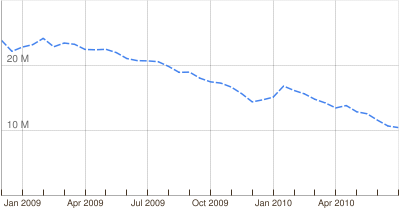
MySpace is proof that failure is an option in the world of Social Media. Of course, they are a failure with 66 million followers at the end of the 2nd Quarter, but they had 80 million users at the end of the 1st Quarter. At this pace they will under 10 million users by next summer. MySpace is the Wicked Witch of the West and she is sitting under Niagara Falls …. ‘I’m meltinggggg.’

It is possible that by the end of the 3rd Quarter the field of Social Media tools could be clearly down to Facebook and Twitter. MySpace would need a massive public relations campaign and cool new tricks to stop its decline. It is the BP of the Social Media and it doesn’t have the finances to pull up before it noses into the corn field. LinkedIn is sitting on a house of cards. Being a ‘Business Networking’ service is not enough to keep it viable. If it drops under 30 million users by the end of 3rd Quarter I predict that it will be a race between LinkedIn and MySpace to be the first to dissolve in 2011. MySpace’s loss will be Facebook’s gain and LinkedIn’s loss will be Twitter’s gain. I still believe Twitter has more potential than Facebook, but they will have to overcome the misconceptions by older users of its purpose and value.

We wait for the 3rd Quarter…what will people do?

More Articles

  • Epic Fail: PR ‘Experts’ don’t get Twitter
  • King of Anything: Social Media vs Traditional Media
  • Rotary PR: Disrespecting the Club President is a PR/Membership issue
  • WiFi on Southwest Airlines: Is it ‘Shovel Ready’?
  • Starbucks makes a smart move: Free WiFi
  • Two Barbecues and a Wedding
  • Foul Play: FIFA shows what less regulation offers to business
  • Rotary New Year: Retread or Renaissance?
  • The Shock of the McChrystal Story: The story is over before the article is published
  • Tony Hayward: The very model of a modern Major General
  • Rotary@105: A young professionals networking club?
  • One Rotary Center: A home for 1.2 million members
  • War Declared on Social Media: Desperate Acts of Traditional Media
  • Pay It Middle: The Balance between Too Much and Too Little Compensation
  • Mega Executive Pay Leads to Poor Performance
  • Relationships and Thin-Slicing: Why the other person knows what you’re really thinking
  • Browser Wars: Internet Explorer losing, Google Chrome gaining ground
  • Rotary@105:  What BP Could Learn from the 1914 Rotary Code of Ethics
  • Twitter is the Thunderstorm of World Thought
  • Signs of the Times
  • Rotary Magazine Dilemma Reveals the Impact of Social Media
  • How Social Interactive Media Could Transform Higher Education
  • How to Become a Zen Master of Social Media
  • Car Dealership Re-Imagines Customer Service
  • Death of All Salesmen!
  • Aristotle’s General Rules on Social Media
  • Social Media:  What is it and Why Should You Care?
  • Social Media 2020:  Keep it Personal
  • Social Media 2020:  Who Shouldn’t Be Teaching Social Media
  • Social Media 2020:  Public Relations 2001 vs Social Media Relations 2010
  • Social Media 2020: Who Moved My Public Relations?
  • Publishing Industry to End 2012
  • Who uses Facebook, Twitter, MySpace & LinkedIn?
  • Fear of Public Relations
  • Dissatisfiers: Why John Quit
  • Facebook, Twitter, LinkedIn…Oh My!
  • Does Anybody Really Understand PR?

Epic Fail: Media/PR ‘Experts’ don’t get Twitter

13 Tuesday Jul 2010

Posted by Paul Kiser in Branding, Communication, Customer Relations, Customer Service, Ethics, Information Technology, Internet, Lessons of Life, Management Practices, Passionate People, Print Media, Public Relations, Re-Imagine!, Relationships, Rotary, SEO, Social Interactive Media (SIM), Social Media Relations, The Tipping Point, Traditional Media

≈ 2 Comments

Tags

Blogs, Customer Loyalty, Epic Fail, Facebook, LinkedIn, Management Practices, Marketing, Media, New Business World, PR, Public Image, Public Relations, Publicity, Re-Imagine!, Rotary, Sales, sell, Selling, Social Media, Social Networking, Twitter, Value-added

by Paul Kiser
USA PDT  [Twitter: ] [Facebook] [LinkedIn] [Skype:kiserrotary or 775.624.5679]

“I just don’t see a way to monetize it” – Local PR Company Owner

Paul Kiser

Some of my best friends are Media/Public Relations (PR)/Marketing Experts…okay, maybe not my best friends, but I do have several people I consider friends who have been/are major players in the PR industry in their market and almost all of them either reject Twitter or are mystified by it. The three questions/comments I hear most from my PR friends are as follows:

  • How do you have time to do it?
  • I don’t see how to monetize Twitter.
  • I just don’t get it

The first question requires that a person accept that Twitter can be something of value to their (or their client’s) business. Unfortunately, many ‘experienced’ business people have a misconception of what Twitter is (or is not,) so they are already under the presumption of guilt on the charge the Twitter is a waste of time. They have to be convinced that it has value, thus deserving it merits their ‘time’. But for many ‘seasoned’ PR types the only way they will accept Twitter as worth their time is if it has an immediate dollar return, which leads to the second comment.

The fact is that Twitter a communication tool leads the experienced Media/PR person to fall back to the concept that it can be used for advertising/spam purposes and when Social Media users respond by unfriending/unfollowing them, they decide that Twitter is a waste of time. All their training and experience tells them that Social Media is a billboard that if they can just find the right ‘trick’ then Twitter can be used to manipulate the public to buy whatever they (or their client) is selling. That is what they know and thus it leads to the third comment, that they just don’t get it.

Twitter is a new variety of the PR Cherry

Twitter is not a spam tool. The idea that you can make revenue directly from Social Media demonstrates a lack of understanding of the environment. It would be like trying to add spam to someone’s personal email. People would not accept their personal message being overshadowed by spam for Sam’s Plumbing and it would be annoying to the receiver. Spam/advertising (all advertising is spam) is an affront to people’s intelligence and when people can turn it off they do, and that means Twitter has no value to many ‘experienced’ Media/PR people.

The failing is in the concept of trying to ‘sell’. Any reputable business does not need to ‘sell’ their product or service. I’ll say that again. Any reputable business does NOT need to sell their product or service. What they need to do is educate the public on their product or service and why it will improve their life. Educating is not selling. Selling assumes that you can manipulate people to buy whatever you’re selling. Selling is a function of greed and greed is unethical.

The Social Media environment exposes selling and rejects it, but it loves educating. Social Media is a learning environment and the PR professional that doesn’t understand that will not understand Twitter. This opens the door for those who can reject the old ideas of PR and accept a new strategy of service/product management.

Meanwhile, we should create a new Social Media tool for those who love to sell. They can all join it and try to sell to each other. Maybe we can call in ‘Spinster’?

More Articles

  • King of Anything: Social Media vs Traditional Media
  • Rotary PR: Disrespecting the Club President is a PR/Membership issue
  • WiFi on Southwest Airlines: Is it ‘Shovel Ready’?
  • Starbucks makes a smart move: Free WiFi
  • Two Barbecues and a Wedding
  • Foul Play: FIFA shows what less regulation offers to business
  • Rotary New Year: Retread or Renaissance?
  • The Shock of the McChrystal Story: The story is over before the article is published
  • Tony Hayward: The very model of a modern Major General
  • Rotary@105: A young professionals networking club?
  • One Rotary Center: A home for 1.2 million members
  • War Declared on Social Media: Desperate Acts of Traditional Media
  • Pay It Middle: The Balance between Too Much and Too Little Compensation
  • Mega Executive Pay Leads to Poor Performance
  • Relationships and Thin-Slicing: Why the other person knows what you’re really thinking
  • Browser Wars: Internet Explorer losing, Google Chrome gaining ground
  • Rotary@105:  What BP Could Learn from the 1914 Rotary Code of Ethics
  • Twitter is the Thunderstorm of World Thought
  • Signs of the Times
  • Rotary Magazine Dilemma Reveals the Impact of Social Media
  • How Social Interactive Media Could Transform Higher Education
  • How to Become a Zen Master of Social Media
  • Car Dealership Re-Imagines Customer Service
  • Death of All Salesmen!
  • Aristotle’s General Rules on Social Media
  • Social Media:  What is it and Why Should You Care?
  • Social Media 2020:  Keep it Personal
  • Social Media 2020:  Who Shouldn’t Be Teaching Social Media
  • Social Media 2020:  Public Relations 2001 vs Social Media Relations 2010
  • Social Media 2020: Who Moved My Public Relations?
  • Publishing Industry to End 2012
  • Who uses Facebook, Twitter, MySpace & LinkedIn?
  • Fear of Public Relations
  • Dissatisfiers: Why John Quit
  • Facebook, Twitter, LinkedIn…Oh My!
  • Does Anybody Really Understand PR?

King of Anything: Sara Bareilles song reflects Social Media vs Traditional Media attitudes

12 Monday Jul 2010

Posted by Paul Kiser in Branding, Communication, Customer Relations, Customer Service, Information Technology, Internet, Lessons of Life, Management Practices, Passionate People, Print Media, Public Relations, Relationships, Rotary, Social Interactive Media (SIM), Social Media Relations, Traditional Media

≈ 1 Comment

Tags

Bloggers, Blogging, Blogs, Facebook, Kaliadoscope Heart, King of Anything, LinkedIn, Music, New Business World, Newspapers, Public Image, Public Relations, Rotary, Sara Bareilles, Social Media, Social Networking, Twitter

by Paul Kiser
USA PDT  [Twitter: ] [Facebook] [LinkedIn] [Skype:kiserrotary or 775.624.5679]

Paul Kiser

It’s interesting to me how a song can make my day. Today I listened to a new song by Sara Bareilles called, ‘King of Anything‘ and it makes me smile every time I hear it. The song went on sale and the video was released late last month. I have downloaded the song (legally, on iTunes) and watched the video several times and I am enjoying both even though my song count is nearing an obsession.

(see the King of Anything video here)

Part of my attraction to the song is the music. It is an upbeat tune that sounds whimsical even though the lyrics are more serious. The chorus of the song is:

Sara Bareilles upcoming cd Kaleidoscope Heart

“Who cares if you disagree?
You are not me.
Who made you King of Anything?
So you dare tell me who to be,
who died and made you King of Anything?”

In Ms. Bareilles description of the song on Wikipedia, she says, “‘King of Anything’ is sort of a ‘f**k you’ song,” which it is, but I find a lot more in the song that relates to what Social Media has been saying to Traditional Media for over a decade.

Traditional Media (television, radio, books, magazines, etc.) have been ruled by editors and producers. They have sat on the throne of their own making deciding what we should see, hear, and read. Directors and editors have played the role of spoon-feeding the public the information they see fit and controlling the message. Usually their efforts have been an honorable attempt to provide information to the public, but more recently their have been efforts to intentionally influence the hearts and minds of the public with manipulated news through FOX news and via personalities like Rush Limbaugh.

Social Media has quietly become the force that has been giving each person the option to decide for themselves. We can talk, build groups of like-minded friends/followers, research, read first-hand reports, and explore the knowledge and experience of millions of other individuals. Social Media has challenged Traditional Media by asking, “Who made you King of anything?” The result has been a collapse of the house of cards that Traditional Media has built. Advertising and sales revenues have been dropping across the board as people now question the usefulness of media that is controlled by a few, and almost always behind the curve in information and trends.

Single released in May 2010

But back to the song. Sara Bareilles has a great line near the end where she says, “Let me hold your crown, babe.” While I fully understand the meaning (the middle finger is involved,) I’ll suggest that in Social Media we all hold the crown … and nobody needs to wear it to be heard. Traditional Media is dead. Long live the King!

(Sara Bareilles website)

More Articles

  • Rotary PR: Disrespecting the Club President is a PR/Membership issue
  • WiFi on Southwest Airlines: Is it ‘Shovel Ready’?
  • Starbucks makes a smart move: Free WiFi
  • Two Barbecues and a Wedding
  • Foul Play: FIFA shows what less regulation offers to business
  • Rotary New Year: Retread or Renaissance?
  • The Shock of the McChrystal Story: The story is over before the article is published
  • Tony Hayward: The very model of a modern Major General
  • Rotary@105: A young professionals networking club?
  • One Rotary Center: A home for 1.2 million members
  • War Declared on Social Media: Desperate Acts of Traditional Media
  • Pay It Middle: The Balance between Too Much and Too Little Compensation
  • Mega Executive Pay Leads to Poor Performance
  • Relationships and Thin-Slicing: Why the other person knows what you’re really thinking
  • Browser Wars: Internet Explorer losing, Google Chrome gaining ground
  • Rotary@105:  What BP Could Learn from the 1914 Rotary Code of Ethics
  • Twitter is the Thunderstorm of World Thought
  • Signs of the Times
  • Rotary Magazine Dilemma Reveals the Impact of Social Media
  • How Social Interactive Media Could Transform Higher Education
  • How to Become a Zen Master of Social Media
  • Car Dealership Re-Imagines Customer Service
  • Death of All Salesmen!
  • Aristotle’s General Rules on Social Media
  • Social Media:  What is it and Why Should You Care?
  • Social Media 2020:  Keep it Personal
  • Social Media 2020:  Who Shouldn’t Be Teaching Social Media
  • Social Media 2020:  Public Relations 2001 vs Social Media Relations 2010
  • Social Media 2020: Who Moved My Public Relations?
  • Publishing Industry to End 2012
  • Who uses Facebook, Twitter, MySpace & LinkedIn?
  • Fear of Public Relations
  • Dissatisfiers: Why John Quit
  • Facebook, Twitter, LinkedIn…Oh My!
  • Does Anybody Really Understand PR?

Rotary New Year: Retread or Renaissance?

25 Friday Jun 2010

Posted by Paul Kiser in 2020 Enterprise Technologies, Branding, Club Leadership, Communication, Membership Recruitment, Membership Retention, Passionate People, Public Relations, Relationships, Rotary, Rotary@105, Social Interactive Media (SIM), Social Media Relations

≈ 1 Comment

Tags

Blogging, Blogs, Club Members, denver post, History of Rotary, London Times, Los Angles Times, Membership Recruitment, Membership Retention, New York Times, npr, Public Image, Public Relations, Publicity, Rotarians, Rotary, Rotary Club, Rotary District 5190, Rotary International, Social Media

by Paul Kiser
USA PDT  [Twitter: ] [Facebook] [LinkedIn] [Skype:kiserrotary or 775.624.5679]

Paul Kiser - Public Relations Chair, Rotary District 5190

On July 1 of every year Rotary rolls out a new administration. From the club level to the 18th floor of One Rotary Center the leadership for our organization makes quietly dramatic team substitution. Each year starts with the hope of pushing Rotary to new levels of success and each year ends with a long sigh of relief.

When I first joined Rotary on July 5, 2001, I learned quickly that a new adminstration was not to take any action, including planning, until July 1, which meant that it was late August before the club leadership could get organized. This concept of not ‘stepping on the current President’s toes’ was an outdated, destructive dogma that held back the club from being prepared and in motion when the first bell rang in July. Somewhere around our Centennial in 2005 I noticed that the attitude was changing and clubs were being encouraged to get the new leadership trained and ready before July 1 and each subsequent year the quality and preparedness of clubs has improved. At least in our District, the class of 2010-11 is perhaps the best prepared for putting words and ideas into action when they stand up in front of the club on Week 1.

Theme for 2010-11

But preparing and training only set the stage, it is performance that counts. The world has changed and the role of a service organization that is not bound by religious, political, or ideological motives is more critical than ever in a world where those motives are driving a wedge between people instead of uniting them. Rotary’s constitution and history have freed our members from judging our fellow world citizens before we offer to serve, nor do we serve them with the intention of converting them to our beliefs. Rotary’s motto of Service Above Self means that we are in the unique position of unrequited care and service to others. In 2010 and beyond, the world is in desperate need of that which is the core of a Rotarian’s heart.

But we are faced with a challenge that has been dogging us for years. Despite multiple years of great Rotary International (RI) Presidents, and District Governors, one year looks much like the previous year any many of our key club functions. Our new themes and leadership fail to make any significant headway with the-way-we-have-always-done-things paradigm.

One area that demonstrates this is in Membership. An organization that is stagnant in membership growth cannot expect to meet new challenges and yet for seven years we have sat at 1.2 million members. In our District (5190) the average size of a club has been steadily shrinking. Last year I researched the last five years and found that we have dropped from an average of 53 members per club (June 2005) down to 47 members (September 2009.) As of April of 2010, that average has dropped to 46 members per club. This is not a criticism of our District because I suspect I would find the same data in all the North American Districts. It is apparent that not only is our growth stagnant, but our clubs are shrinking, which means fewer members to take on a bigger role.

2010-11 RI President Ray Klinginsmith

The question for each of us is whether this will be another year of Retread Membership or a year of rebirth, (Renaissance,) in Membership? To have a rebirth we must have a new approach and not be locked into medieval thinking. Current RI President John Kenny gave us the theme, The Future of Rotary is in Your Hands, and upcoming RI President Ray Klinginsmith challenges clubs to ‘get bigger, better, bolder’. Both invite Rotarians to not make a Retread of the 2010-11 year, but to spawn a Renaissance of our organization. So what holds us back?

(Rotary meant for young professionals? Click here for story.)

I have had many conversations with Rotarians about membership. I often hear about the barriers and challenges. But what I know is that the difference between a Retread Rotary year and a Rotary Renaissance will be determined not by a theme, or by the words of the RI President, or by great work by a District Governor. Creating a Rotary Renaissance will be determined by individual club members who decide that there are no excuses and that failure in membership growth is not an option. Robert Kennedy is credited with saying, “If not us, who? If not now, when?” Two questions every Rotarian should ask themselves in this new Rotary year.

More Articles

  • The Shock of the McChrystal Story: The story is over before the article is published
  • Tony Hayward: The very model of a modern Major General
  • Rotary@105: A young professionals networking club?
  • One Rotary Center: A home for 1.2 million members
  • War Declared on Social Media: Desperate Acts of Traditional Media
  • Pay It Middle: The Balance between Too Much and Too Little Compensation
  • Mega Executive Pay Leads to Poor Performance
  • Relationships and Thin-Slicing: Why the other person knows what you’re really thinking
  • Browser Wars: Internet Explorer losing, Google Chrome gaining ground
  • Rotary@105:  What BP Could Learn from the 1914 Rotary Code of Ethics
  • Twitter is the Thunderstorm of World Thought
  • Signs of the Times
  • Rotary Magazine Dilemma Reveals the Impact of Social Media
  • How Social Interactive Media Could Transform Higher Education
  • How to Become a Zen Master of Social Media
  • Car Dealership Re-Imagines Customer Service
  • Death of All Salesmen!
  • Aristotle’s General Rules on Social Media
  • Social Media:  What is it and Why Should You Care?
  • Social Media 2020:  Keep it Personal
  • Social Media 2020:  Who Shouldn’t Be Teaching Social Media
  • Social Media 2020:  Public Relations 2001 vs Social Media Relations 2010
  • Social Media 2020: Who Moved My Public Relations?
  • Publishing Industry to End 2012
  • Who uses Facebook, Twitter, MySpace & LinkedIn?
  • Fear of Public Relations
  • Facebook, Twitter, LinkedIn…Oh My!
  • Does Anybody Really Understand PR?

Tony Hayward: The very model of a modern Major General

23 Wednesday Jun 2010

Posted by Paul Kiser in 2020 Enterprise Technologies, Branding, Communication, Crisis Management, Customer Relations, Customer Service, Ethics, Lessons of Life, Management Practices, Passionate People, Public Relations, Rotary

≈ 1 Comment

Tags

Blogging, Blogs, BP, British, British Petroleum, CEO, Conservatives, Deep Water Drilling, Disaster, England, Executive Management, Great Britain, Gulf of Mexico, King George III, Management Practices, Mega Oil Companies, New Business World, Oil Companies, oil leak, oil spill, petrol, Public Image, Public Relations, Publicity, Republicans, Social Media, Tony Hayward

by Paul Kiser [Twitter: ] [Facebook] [LinkedIn] [Skype: kiserrotary or 775.624.5679]

Tony Hayward - Modern Major General

Enough with the BP CEO bashing! Regardless of any verbal gaffs, or ill-advised yacht racing, if Tony Hayward, the shining star of BP, is guilty of anything he is only guilty of being the perfect CEO. A corporate executives first and last duty is to his investors and when we measure up Mr. Hayward he is, in fact, the very model of a modern corporate executive. If it please the court of the business world I’ll present my case:

POINT ONE: When he took the reins of BP (that does not stand for Bloody Petrol) he immediately weeded out all those people who, and I quote, “….wanted to save the world.” Saving the world is not the goal of business, making money is, and no one can say that Mr. Hayward didn’t make money for the investors of BP. Score one for the British! They’ve become as obsessive about profit as the an American conservative!

The Public Image of Tony Hayward...but it doesn't count

POINT TWO: After the fire and rescue of the victims from the platform Mr. Hayward’s legal team leapt into action to detain the survivors until they signed a release saying that they were not injured…which, in legalese is to say they were signing a waiver of all liability, not a just that they were not physically injured, but that BP could not be sued for any mismanagement, negligence, etc. This reflects devotion that Mr. Hayward and his team have for the investor. Duty first and last!

POINT THREE: Within hours of the disaster BP’s crack crisis response team sprung into action securing all information and potential access to protect the corporation from negative portrayals by the world media. First  there was no oil leaking, then only 5,000 barrels, then, well, no comment. Carefully crafted statements were released to reassure the investors, (not the public,) that the event was a minor setback and the amount of oil would have a minimal impact on the excessive amount of water in the Gulf of Mexico. Textbook Public Relations work!

POINT FOUR: Unfortunately, BP could not hide massive oil slicks from the cameras of the media and that could scare the investors…but wait a minute…they could hide them by pouring millions of gallons of toxic dispersants on the oil at the point of origin! Yes, it would make collection the oil impossible, but that was save-the-world thinking, and this was not the time to shirk the duty to the investor with ethics. Again, Mr. Hayward shows us his stuff!

POINT FIVE: The pièce de résistance (my apologies to the British for resorting to French) was the yacht race that Tony Hayward took leave of the United States to attend. As outrage among the American public reached a fever pitch it was a stroke of genius by a perfect corporate executive to again restore order with the investors by demonstrating that this oil spill event is all much ado about nothing and normal aristocratic life is alive and well in this man’s corporation.

It is true that not since King George III have the average, non-conservative American been so incensed with a British national, but the public is passé (again my apologies for using French) in the corporate world, especially in the world of big oil companies. The public will trade ethics for petrol (I’m trying to compensate for using French by using British words) any day of the week. The public’s role is to buy their product, not tell them how to obtain it. Tony Hayward has been true-blue to the investors…I wouldn’t be surprised if his urine is blue! No one can dispute that as a model of the corporate executive, Tony is the best of the best.

I rest my case.

More Articles

  • Rotary@105: A young professionals networking club?
  • One Rotary Center: A home for 1.2 million members
  • War Declared on Social Media: Desperate Acts of Traditional Media
  • Pay It Middle: The Balance between Too Much and Too Little Compensation
  • Mega Executive Pay Leads to Poor Performance
  • Relationships and Thin-Slicing: Why the other person knows what you’re really thinking
  • Browser Wars: Internet Explorer losing, Google Chrome gaining ground
  • Rotary@105:  What BP Could Learn from the 1914 Rotary Code of Ethics
  • Twitter is the Thunderstorm of World Thought
  • Signs of the Times
  • Rotary Magazine Dilemma Reveals the Impact of Social Media
  • How Social Interactive Media Could Transform Higher Education
  • How to Become a Zen Master of Social Media
  • Car Dealership Re-Imagines Customer Service
  • Death of All Salesmen!
  • Aristotle’s General Rules on Social Media
  • Social Media:  What is it and Why Should You Care?
  • Social Media 2020:  Keep it Personal
  • Social Media 2020:  Who Shouldn’t Be Teaching Social Media
  • Social Media 2020:  Public Relations 2001 vs Social Media Relations 2010
  • Social Media 2020: Who Moved My Public Relations?
  • Publishing Industry to End 2012
  • Who uses Facebook, Twitter, MySpace & LinkedIn?
  • Fear of Public Relations
  • Facebook, Twitter, LinkedIn…Oh My!
  • Does Anybody Really Understand PR?

To Believe in the Better Me

22 Tuesday Jun 2010

Posted by Paul Kiser in Branding, Ethics, Lessons of Life, Management Practices, Passionate People, Random, Relationships, Social Media Relations, Tom Peters

≈ 1 Comment

Tags

Blogging, Blogs, Mythology, Purpose of life

by Paul Kiser [Twitter: ] [Facebook] [LinkedIn] [Skype: kiserrotary or 775.624.5679]

Paul Kiser and Family

I have a friend who was recently dealt with one of those unfair blows that we get in life. My friend is handling it well; however, even though the act was unfair, most people would still ask, “Did I fail?”

What you need to know is that this friend reminds me of a younger version of me. This person is crazy enough to view the world with a vision that sees through the masks of false conventions and questions behaviors, rules, and ideas that are silly, immoral, ignorant, or are just plain wrong. We are the type of person to tell the King that he’s wearing no clothes and then continue by telling him what he should be wearing. “Just because.” or “Because I say so!” are not good enough reasons for people like us, and that makes us a target to those who think that unquestioned obedience is a sign of strength.

(See Article on Becoming the Target)

PR Pro and fellow blogger, Jules Zunich, recently mentioned that she was a Purple Cow, which was a reference I didn’t get until she explained that author Seth Godin has written several books that promote the idea of being remarkable and indispensable; however, by standing out like a Purple Cow among the black and white cows, as Jules puts it “…certainly makes them a target for not fitting in.” Standing out doesn’t sit well with some people, especially with people who thrive on hierarchy.

(Catch Jules Zunich’s Blog by clicking on this link)

My guess is that my friend has been questioning what could have been done differently because in any negative situation there is option of not participating, thus avoiding any conflict. Drawing on my own experiences I can imagine there is a mix of anger, frustration, and self-doubt, all emotions that wear us down and can be more destructive than motivating.

The difference between my friend and myself is that over the years I have tried to stay embedded in the journey of life. Focus on what I do today and know that conflict will occur. When conflict does occur I will fight the battles I need to and walk away from the battles that have no value to me. My attitude towards life involves a mythology where I hold the hope that at the end of life there is a Better Me.

Signs of life

I don’t believe in mythological deities, but I do subscribe to the idea that in the end of life (or time) everything I’ve done (both good and bad) will be apparent to all, and likewise I will know all that was said and done (both good and bad) by others. In this mythology I hope that the Better Me can help guide me through the conflicts of life, but it will be my choices that will determine how proud or ashamed I will be in the end.

It is a mythology that has given me comfort and motivation to try to do the right thing, while not getting too hung up on those who misuse their power or authority, because I believe their actions will only reflect on them, not me….or the Better Me.

More Articles

  • Rotary@105: A young professionals networking club?
  • One Rotary Center: A home for 1.2 million members
  • War Declared on Social Media: Desperate Acts of Traditional Media
  • Pay It Middle: The Balance between Too Much and Too Little Compensation
  • Mega Executive Pay Leads to Poor Performance
  • Relationships and Thin-Slicing: Why the other person knows what you’re really thinking
  • Browser Wars: Internet Explorer losing, Google Chrome gaining ground
  • Rotary@105:  What BP Could Learn from the 1914 Rotary Code of Ethics
  • Twitter is the Thunderstorm of World Thought
  • Signs of the Times
  • Rotary Magazine Dilemma Reveals the Impact of Social Media
  • How Social Interactive Media Could Transform Higher Education
  • How to Become a Zen Master of Social Media
  • Car Dealership Re-Imagines Customer Service
  • Death of All Salesmen!
  • Aristotle’s General Rules on Social Media
  • Social Media:  What is it and Why Should You Care?
  • Social Media 2020:  Keep it Personal
  • Social Media 2020:  Who Shouldn’t Be Teaching Social Media
  • Social Media 2020:  Public Relations 2001 vs Social Media Relations 2010
  • Social Media 2020: Who Moved My Public Relations?
  • Publishing Industry to End 2012
  • Who uses Facebook, Twitter, MySpace & LinkedIn?
  • Fear of Public Relations
  • Facebook, Twitter, LinkedIn…Oh My!
  • Does Anybody Really Understand PR?

Rotary@105: A Young Professional’s Networking Club?

13 Sunday Jun 2010

Posted by Paul Kiser in Branding, Customer Relations, Membership Recruitment, Membership Retention, Passionate People, Public Relations, Rotary, Rotary@105

≈ 20 Comments

Tags

Blogs, History of Rotary, Management Practices, Membership Recruitment, Membership Retention, Nevada, New Business World, New Members, Paul Harris, Public Image, Public Relations, Publicity, Rotarians, Rotary, Rotary Club, Rotary District 5190, Rotary International, Rotary policies, Young Professionals

by Paul Kiser [Twitter: ] [Facebook] [LinkedIn] [Skype: kiserrotary or 775.624.5679]

Paul Kiser - Public Relations Chair Rotary District 5190

When Rotary was formed in 1905, Paul Harris was 36. The other three original members were 34, 40, 42. I note there ages because it is important to remember that our organization was started by young professionals, not ‘seasoned’ executives. It was a true business networking club, not a just a social club. The original concept of Rotary was to create business opportunities with other ethical business people. If it were meant to be a just another social club they wouldn’t have required the Club Statistician to track business transactions between club members. A practice that was continued until 1911.

Nor was the concept of community service in the original club’s concept. It would be 1906 before a new member would join with the intent of adding community service to the function of Rotary. While the spirit of voluntarism is a critical part of every modern club, that wasn’t why Rotary was founded.

Click here for more about the origin of community service in Rotary

Would she qualify as a Rotarian in your club?

Rotary was truly a young professionals networking club at its inception; however, today’s Rotary club is a foreign environment to most business people under 45. In discussions with several young professionals I have gained insight on why Rotary tends to repel those that it should attract. Interestingly, in discussions with Rotarians I have found we often have no clue as to how young professionals perceive Rotary, and in fact, I have found that some Rotarians have a bias against youth.

It’s Their Fault
I have heard several Rotarians comment that even when they induct a young professional, the new members often don’t stay with the club. This attrition is usually blamed on the former member’s attitude or other personal failings. Many clubs will not accept that they have any responsibility for what they could have done better to retain him or her. In one case a very prominent local Rotarian was advising clubs to ignore anyone under 40 as a potential member. His reasoning was that, “They have kids and they’re not in a place in their career to be a good Rotarian.” That was a great attitude…for keeping Rotary an old person’s organization.

Lack of Respect and Bad Public Image
Some Rotarians may think that they have no bias toward young professionals, but actions speak louder than words. I have even found myself sitting at a table with a young professional and I instantly associate them with my adult children and began talking about my twenty-something daughters, rather than discussing business topics. It is a bias and it is disrespectful to equate a young professional with our adult children. It also creates a public image that we are an old person’s social club, not a business professionals club for all ages.

I have also sat in Rotary clubs where the youngest members are joked about solely because they are young. It makes for entertainment for the older members and may seem like it’s all in good fun, but emphasizing the age difference just makes us look older and any young professional attending for the first time may have a clear impression that this is not an environment of mutual respect for them. Some members further cement a club’s public image by telling political, religious, or gender jokes that would not be acceptable in any public environment, but are tolerated in the Rotary club.

Reno New Generations Rotary Club Pre-Charter BBQ

The Solution – Segregation?
In Reno, Nevada, USA there is a new type of Rotary club that consists mostly of young professionals under 45 years old. It was modeled of the Rotary Club of La Jolla New Generations. It is not a Rotaract club, but a full-fledged Rotary club that meets in the early evening. Drinks are available and meals can be ordered, but most members do not eat. I have attended this club several times and most of what I have learned about the way we treat young professionals has been through my discussions with the members of this club. They are all stellar Rotarians who, in six months, have dived in to many community service projects. They are also business professionals, some in significant positions in their organizations. What they don’t experience in the club is treatment as adult children, or made to feel that they are too young to be serious business people.

Rotary has stood at 1.2 million members for seven years. If we are to meet the challenges of today and tomorrow we need to have a growing organization, not a stagnant one. The question is whether existing Rotary clubs are willing to tap into the millions of young professionals who seek to network with other business people. To do this clubs must address any potential age bias and become more aware of member behavior and how it might negatively impact a club’s public image. The alternative is to segregate young professionals in their own clubs and let the existing clubs eventually die out through attrition. It seems obvious that the former is the best solution, but it first will require existing members to accept individual responsibility for creating the club’s public image and that they must promote a positive impression that does not offend the best source of new members, the under-45 business professional.

We all have a responsibility to ensure the future of Rotary as a strong, viable, and relevant organization and to do that we only need to remember what we owe to Paul Harris and the other three young professionals that founded our organization…a duty to keep our clubs a place of honor and respect for all professionals..old and young.

More blogs

  • One Rotary Center: A home for 1.2 million members
  • War Declared on Social Media: Desperate Acts of Traditional Media
  • Pay It Middle: The Balance between Too Much and Too Little Compensation
  • Mega Executive Pay Leads to Poor Performance
  • Relationships and Thin-Slicing: Why the other person knows what you’re really thinking
  • Browser Wars: Internet Explorer losing, Google Chrome gaining ground
  • Rotary@105:  What BP Could Learn from the 1914 Rotary Code of Ethics
  • Twitter is the Thunderstorm of World Thought
  • Signs of the Times
  • Rotary Magazine Dilemma Reveals the Impact of Social Media
  • How Social Interactive Media Could Transform Higher Education
  • How to Become a Zen Master of Social Media
  • Car Dealership Re-Imagines Customer Service
  • Death of All Salesmen!
  • Aristotle’s General Rules on Social Media
  • Social Media:  What is it and Why Should You Care?
  • Social Media 2020:  Keep it Personal
  • Social Media 2020:  Who Shouldn’t Be Teaching Social Media
  • Social Media 2020:  Public Relations 2001 vs Social Media Relations 2010
  • Social Media 2020: Who Moved My Public Relations?
  • Publishing Industry to End 2012
  • Who uses Facebook, Twitter, MySpace & LinkedIn?
  • Fear of Public Relations
  • Facebook, Twitter, LinkedIn…Oh My!
  • Does Anybody Really Understand PR?

One Rotary Center: A Home for 1.2 Million Members

12 Saturday Jun 2010

Posted by Paul Kiser in Branding, Communication, Customer Relations, Customer Service, Employee Retention, History, Human Resources, Management Practices, Membership Retention, Passionate People, Public Relations, Rotary, Rotary@105

≈ 5 Comments

Tags

Blogs, Club Members, History of Rotary, Management Practices, Membership Retention, One Rotary Center, Paul Harris, Public Image, Public Relations, Rotarians, Rotary, Rotary Club, Rotary Coordinators, Rotary International, Value-added

by Paul Kiser [Twitter: ] [Facebook] [LinkedIn] [Skype: kiserrotary or 775.624.5679]

Paul Kiser - Public Relations Chair, Rotary District 5190

The plan was simple. On a business trip to Illinois I would go to the Rotary International (RI) headquarters in Evanston and take a few pictures to put in a future blog. Simple. No big deal. At our District Conference in May I mentioned to District Governor Elect Steve Lewis that I was going to stop by RI HQ and take some pictures. “Call them first,” DGE Steve said, “they’ll give you a tour.” Okay. That might be nice. So I called the main RI number and set up an appointment. A quick look at RI could be interesting.

One Rotary Center

A little before 10 AM on a beautiful June day I walked into the main cog of the Rotary universe: One Rotary Center. I’m instructed to go up to the 16th floor where I was greeted by Delores and another staff member at the front reception area. I told them my name and my purpose and Delores repeated, “Oh, you’re here for the TOUR!” I expected the emphasis to be on the ‘Oooh’, as if to say, ‘here’s another Rotarian here for the dog and pony tour’. But Delores sounded excited, like it was great to have a Rotarian look over the home of 1.2 million members. She called my tour guide, Amanda Runge, who promptly greeted me in the waiting area.

Amanda and her friend Paul

I learned that Amanda is not just a tour guide. She is a Program Coordinator for the 41 new Rotary Coordinators (RCs) that will serve to assist Clubs as a resource for multiple areas such as Youth Programs. RI President Elect Ray Klinginsmith created the RC post in an effort to help clubs reach a level of excellence through close-in support by knowledgeable Rotarians who have proven skills and expertise in a wide range of Rotary programs. (For more information go to this link:)

RI PE Ray Klinginsmith Discusses Rotary Coordinators

As Program Coordinator, Amanda will be the hands-on RI support out of Evanston, so I was actually interfering in her day, but you would have never known it by the attention she gave to me for almost an hour. My simple, no big deal of a tour was rapidly becoming kind of a big deal. As it turns out Amanda is a product of Rotary. Her Mother is a Rotarian and she was a participant in a five-week Rotary Exchange program to France. I knew the outgoing, friendly demeanor seemed familiar…it’s the same we see with almost every Youth Exchange student after they return to her or his host country.

Replica of the 711 office where the original Chicago club met

The Tour
After seeing ‘Room 711’, the office where most of the Rotary meetings were held for the first several months of Rotary and a look at a room of memorabilia from the office of Paul Harris, Amanda took me up to the top floor of One Rotary Center. As in most office buildings, the ‘big cog’s’ offices are around the exterior of the top floor. The difference at Rotary is that there is a type of musical chairs (or offices) in this space. Each new year the President-Elect, the President Nominee, and the President Nominee Designate change offices. The Immediate Past RI President thanked for his service as he is also moved out of his corner office. Ouch!

Eileen Eckhouse and Amanda Runge

It was on the 18th floor that we saw the RI PE Ray in his office talking on the phone. I asked Amanda if I could take a picture of him on the phone. His Executive Assistant Eileen Eckhouse and RI PE Ray’s Number One (his full-time Rotarian Aide) Duane Sterling were both just outside his office and Amanda consulted them. Duane said,”But don’t you want a picture with him? He’ll be off the phone in a minute.”

Before I know it RI PE Ray is standing beside me introducing himself…like that was necessary…and he suggests we go over in front of the Flags of Nations in the elevator lobby for the picture. There another gentleman joined us to talk to Ray (I’m pretending were on a first name basis) and Amanda introduced me to him. It was the General Secretary of Rotary International, Ed Futa.

In Rotary a President serves for one year, the General Secretary can serve for decades. The first General Secretary, Chez Perry, served for 32 years and I refer to him as the ‘Mother’ of Rotary as he did the work that helped establish and grow our organization. My instant impression of General Secretary Ed was that he performs his duties with the same passion as Chez Perry.

Click to Read more about Chesley Perry

I am now standing next to two of the three men that occupy the corner offices on the top floor of RI and Amanda says, “Why don’t you have your picture with both of them?” At this point reality sort of fades away. It was not supposed to be a big deal, but by the time I walked out of the building it started to hit me what had occurred. It was a big deal…and I have the picture!

RI Gen. Sec. Ed Futa (left), RI PE Ray Klinginsmith (right), and some guy (center)

After the photo op, the three of us sat down and…wait-a-minute, that’s my fantasy world. What actually happened was the gentlemen went on to do real work and Amanda continued the tour of the top floor and the next floor down, which is the Rotary Foundation. Finally, the tour ended and I bought a few things at the Rotary store and then left.

It was sheer luck of timing that I found myself standing between the two people who have a great responsibility as leaders of our organization, but I will always remember the day I stood on the top floor of Rotary International flanked by RI’s President Elect and General Secretary.

One Rotary Center does not have the significance of a religious ‘Mecca’, but that doesn’t diminish it’s importance to all of us. It’s well worth the visit and I would recommend it for anyone visiting the Chicago area. After all, it’s the home…for 1.2 million of us.

Thank you Amanda…and the rest of the RI staff!

More blogs

  • Rotary@105: A young professionals networking club?
  • War Declared on Social Media: Desperate Acts of Traditional Media
  • Pay It Middle: The Balance between Too Much and Too Little Compensation
  • Mega Executive Pay Leads to Poor Performance
  • Relationships and Thin-Slicing: Why the other person knows what you’re really thinking
  • Browser Wars: Internet Explorer losing, Google Chrome gaining ground
  • Rotary@105:  What BP Could Learn from the 1914 Rotary Code of Ethics
  • Twitter is the Thunderstorm of World Thought
  • Signs of the Times
  • Rotary Magazine Dilemma Reveals the Impact of Social Media
  • How Social Interactive Media Could Transform Higher Education
  • How to Become a Zen Master of Social Media
  • Car Dealership Re-Imagines Customer Service
  • Death of All Salesmen!
  • Aristotle’s General Rules on Social Media
  • Social Media:  What is it and Why Should You Care?
  • Social Media 2020:  Keep it Personal
  • Social Media 2020:  Who Shouldn’t Be Teaching Social Media
  • Social Media 2020:  Public Relations 2001 vs Social Media Relations 2010
  • Social Media 2020: Who Moved My Public Relations?
  • Publishing Industry to End 2012
  • Who uses Facebook, Twitter, MySpace & LinkedIn?
  • Fear of Public Relations
  • Facebook, Twitter, LinkedIn…Oh My!
  • Does Anybody Really Understand PR?

Rotary@105: What BP Could Learn from the 1914 Rotary Code of Ethics

25 Tuesday May 2010

Posted by Paul Kiser in 2020 Enterprise Technologies, Branding, Communication, Crisis Management, Customer Relations, Customer Service, History, Lessons of Life, Management Practices, Membership Retention, Passionate People, Public Relations, Rotary, Rotary@105, Science, Social Media Relations, US History

≈ 2 Comments

Tags

Blogs, BP, British Petroleum, Club Members, Greed, Greed is good, History of Rotary, Management Practices, Michael Douglas, New Business World, Paul Harris, Public Image, Public Relations, Publicity, Rotarians, Rotary, Rotary Club, Rotary International, Value-added, Wall Street

by Paul Kiser

One of the BP oil leaks in the Gulf of Mexico

BP…formerly known as British Petroleum, has a disaster on their hands and it is not just the disaster caused by millions of gallons of crude oil spewing out in the Gulf of Mexico. They have a public relations disaster that is re-establishing the oil industry’s reputation as the sleaziest in a business world that is not known for its ethical choices. Among their biggest mistakes has been to minimize the estimates of how much oil is leaking into open water. It is obvious that at best BP executives are completely incompetent or at worst they have intentionally deceived the public. In either case, they confirm in the public’s mind that business is all about greed and that business ethics is an oxymoron.

Greed is Good

Unfortunately, business often fails to be good custodians of our society because for profit enterprise is inherently based on a motive of greed. In the 1987 film, Wall Street, Gordon Gekko (performed by Michael Douglas), says, “Greed is good.” Gekko is merely pointing out that while greed is a selfish, dishonorable emotion, it is the fuel that drives business.

The fact that business is riddled with unethical people is not new. When Rotary was born in 1905, Chicago business people were more like Gordon Gekko than like Paul Harris, the founding father of Rotary. Business was riddled with corruption and fraudulent practices.

However, those that joined Rotary created an environment that rewarded honor in business. A Rotarian sought out his fellow Rotarians with which to do business. Each member knew that business transactions became personal when you had to sit down with the customer at the next club meeting. But Rotary didn’t formally commit to a philosophy of ethics until several years after the first club was chartered, and it wasn’t Paul Harris that led the charge.

By 1912, Paul Harris had served as President of the International Association of Rotary Clubs for two years and had spent many long hours during the past seven years nurturing the birth and growth of Rotary into a major organization. As he passed the gavel to Glenn Mead, Mr. Harris stepped away from Rotary for what would be a 10-year hiatus. Had Rotary consisted of followers, the absence of a major figure like Paul Harris would have left the organization in dismay; however Rotary consists of business leaders and President Mead stepped up to the challenge and launched a new emphasis on establishing a Code of Ethics for Rotarians to follow.

It took two years and a long train ride to the 1914 Rotary Convention in Houston, Texas to put together a formal declaration of business ethics for the organization, but both the 1914 and 1915 Rotary Conventions voted to adopt eleven articles of ethical business standards. After almost 100 years, BP as well as every business person could learn several lessons that would help them avoid disasters and Public Relations nightmares by following the 1914 Rotary Code of Ethics:

The 1914 Rotary Code of Ethics For Businessmen of All Lines

My business standards shall have in them a note of sympathy for our common humanity. My business dealings, ambitions and relations shall always cause me to take into consideration my highest duties as a member of society. In every position in business life, in every responsibility that comes before me, my chief thought shall be to fill that responsibility and discharge that duty so when I have ended each of them, I shall have lifted the level of human ideals and achievements a little higher than I found it. As a Rotarian it is my duty:

I

To consider any vocation worthy and as affording me distinct opportunity to serve society.

II

To improve myself, increase my efficiency and enlarge my service, and by doing so attest my faith in the fundamental principle of Rotary, that he/she profits most who serves the best.

III

To realize that I am a business man and ambitious to succeed; but that I am first an ethical man and wish no success that is not founded on the highest justice and morality.

IV

To hold that the exchange of my goods, my service and my ideas for profit is legitimate and ethical, provided that all parties in the exchange are benefited thereby.

V

To use my best endeavors to elevate the standards of the vocation in which I am engaged, and so to conduct my affairs that others in my vocation may find it wise, profitable and conducive to happiness to emulate my example.

VI

To conduct my business in such a manner that I may give a perfect service equal to or even better than my competitor, and when in doubt to give added service beyond the strict measure of debt or obligation.

VII

To understand that one of the greatest assets of a professional or of a business man is his friends and that any advantage gained by reason of friendship is eminently ethical and proper.

VIII

To hold that true friends demand nothing of one another and that any abuse of the confidence of friendship for profit is foreign to the spirit of Rotary, and in violation of its Code of Ethics.

IX

To consider no personal success legitimate or ethical which is secured by taking unfair advantage of certain opportunities in the social order that are absolutely denied others, nor will I take advantage of opportunities to achieve material success that others will not take because of the questionable morality involved.

X

To be not more obligated to a brother Rotarian than I am to every other man in human society; because the genius of Rotary is not in its competition, but in its cooperation; for provincialism can never have a place in an institution like Rotary, and Rotarians assert that Human Rights are not confined to Rotary Clubs, but are as deep and as broad as the race itself; and for these high purposes does Rotary exist to educate all men and all institutions.

XI

Finally, believing in the universality of the Golden Rule, all things whatsoever ye would that men should do unto you, do ye even so unto them, we contend that Society best holds together when equal opportunity is accorded all men in the natural resources of this planet.

More articles

  • Twitter is the Thunderstorm of World Thought
  • Signs of the Times
  • The Quality of Relationships and Social Interactive Media
  • Rotary Magazine Dilemma Reveals the Impact of Social Media
  • How Social Interactive Media Could Transform Higher Education
  • How to Become a Zen Master of Social Media
  • Car Dealership Re-Imagines Customer Service
  • Death of All Salesmen!
  • Aristotle’s General Rules on Social Media
  • Social Media:  What is it and Why Should You Care?
  • Social Media 2020:  Keep it Personal
  • Social Media 2020:  Who Shouldn’t Be Teaching Social Media
  • Social Media 2020:  Public Relations 2001 vs Social Media Relations 2010
  • Social Media 2020: Who Moved My Public Relations?
  • Publishing Industry to End 2012
  • Who uses Facebook, Twitter, MySpace & LinkedIn?
  • Fear of Public Relations
  • Facebook, Twitter, LinkedIn…Oh My!
  • Does Anybody Really Understand PR?

Signs of the Times

19 Wednesday May 2010

Posted by Paul Kiser in Branding, Communication, History, Lessons of Life, Membership Retention, parenting, Passionate People, Random, Rotary, Social Interactive Media (SIM), Social Media Relations

≈ 1 Comment

Tags

Ads, Billboards, Black Eyed Peas, Blogging, Blogs, Buddhists, Facebook, Imma Be, Management Practices, Membership Retention, New Business World, Nike, parenting, Public Relations, Rotarians, Rotary, San Francisco, Signs, Social Media, Social Networking

by Paul Kiser

Last weekend we took a short vacation in the Bay area (Pacifica/San Francisco, CA, USA.) During the trip I took notice of signs along the way and it struck me that they might say more about us…than to us. Here are some signs of note:

Do you want to be Smart or Stupid?

Obvious Choices
This sign on Market street in San Francisco spoke a truth that you can’t argue with…but does it need to be said? In politics and entertainment we definitely see who has balls and they do seem to gather a following, but maybe it’s time we celebrate intelligence. The great outcome of social media is that people are looking deeper than just short, catchy statements that gain a “Right on!” from those who are wowed by a deceptive turn of phrase.

In politics it seems the more outrageous the idea the more excited some people get about a candidate. I’ve watched people become incensed over very sound ideas to solve our most significant problems and those same people then praise politicians that spew out hate for everything that has made our country great. I hope that this is a phase that we outgrow soon…before the ballsy people destroy all that we stand for as Americans.

I'm not sure of the purpose of this Nike ad, but from a Social Media viewpoint it's 'write' on
The pen is mightier than the sword

Write On!
I hadn’t seen this Nike ad before. It is in the Union Square area of San Francisco and if Nike is speaking of the explosion of Social Interactive Media then I agree!

Before the Internet and Social Media tools a small group of editors controlled who could have a voice and be published. Now new and raw ideas are being openly expressed in millions of independent blogs. Some of us could use an editor, but the beauty of this New World of communication is that the reader is the editor…it is democracy in its purest form.

A great future is coming…today is still under construction

We’re Not There Yet
Some people seem easily frustrated that we never get ‘there’. We are in a world where change is constant and the road is always in a state of being improved. Satisfaction is the most temporary of all human feelings and people who do not understand this fact will always be deceived by bad politicians and religious fanatics who promise a perfect tomorrow if we only do exactly what they tell us.

Buddhists promote the idea of being and I think that is a great attitude to have to survive this world. Take advice from the musical group Black Eyed Peas. To me the title of one of their latest songs says it all: Imma Be. Yes the world is always changing but that is what makes it exciting. Take a break from time to time and then re-engage and have some fun!

Greet the day and be open for new possibilities

Arms Wide Open
Yes, I had to get my four year-old in on this blog. In Union Square he thought he could catch a bird. He actually knew that he couldn’t, but that did not dissuade him from trying.

I hope that he can maintain a sense of wonder and never let those that think it can’t be done hold him back from trying. There are people in this world whose sole function is to be a naysayer. These people infest anyplace where past success has built up an organization. They constantly destroy all new ideas and creativity in the name of ‘preserving the traditions.’ Don’t ever believe it! The only way to counter their negative attitude is to ignore them and move on.

Lots of choices, but where do we want to go?

Where to Go?
It doesn’t have to be confusing. We only need to remember that life happens. Today is tomorrow’s history and we choose which signs to follow to get there.

More blogs

  • The Quality of Relationships and Social Interactive Media
  • Rotary Magazine Dilemma Reveals the Impact of Social Media
  • How Social Interactive Media Could Transform Higher Education
  • How to Become a Zen Master of Social Media
  • Car Dealership Re-Imagines Customer Service
  • Death of All Salesmen!
  • Aristotle’s General Rules on Social Media
  • Social Media:  What is it and Why Should You Care?
  • Social Media 2020:  Keep it Personal
  • Social Media 2020:  Who Shouldn’t Be Teaching Social Media
  • Social Media 2020:  Public Relations 2001 vs Social Media Relations 2010
  • Social Media 2020: Who Moved My Public Relations?
  • Publishing Industry to End 2012
  • Who uses Facebook, Twitter, MySpace & LinkedIn?
  • Fear of Public Relations
  • Facebook, Twitter, LinkedIn…Oh My!
  • Does Anybody Really Understand PR?

Social Media Book Review: The Zen of Social Media Marketing

10 Monday May 2010

Posted by Paul Kiser in 2020 Enterprise Technologies, Book Review, Branding, Consulting, Customer Relations, Customer Service, Information Technology, Management Practices, Passionate People, Public Relations, Re-Imagine!, Rotary, SEO, Social Interactive Media (SIM), Social Media Relations, Website, Women

≈ Leave a comment

Tags

2020 Enterprise Technologies, Bloggers, Blogging, Blogs, Book, Book review, Facebook, LinkedIn, Management Practices, New Business World, Public Image, Public Relations, Publicity, Re-Imagine!, Rotarians, Rotary, Rotary Club, Social Media, Social Networking, Twitter, Value-added, Website

by Paul Kiser
USA PDT  [Twitter: ] [Facebook] [LinkedIn] [Skype:kiserrotary or 775.624.5679]

  • Book Cover

    Book: The Zen of Social Media Marketing

  • Author: Shama Hyder Kabani
  • Publisher:  Benbella Books
  • Published: April 2010
  • Audience: Primary: Message professionals involved in organizational internal and external communication. Also, individuals seeking to create a personal brand. Secondary: Seekers of enlightenment regarding Social Media and Professors and Teachers in many fields (e.g.; business, arts, education, communication, etc.)
  • Rating: (Out of 5*)
    • Overall ***** (5-Must Read)
    • Content ***** (5)
    • Relevancy ***** (5)
    • Style **** (4-down to business tone)
    • Readability *** (3-read on a Kindle computer download)
    • Value***** (5)
  • Thesis:  A presentation of key aspects of Social Media and how it functions with organizational marketing.

Social Interactive Media is a very complex and variable subject.  It is unreasonable for anyone to expect one book can adequately cover this topic because the Social Media tools and their use are changing daily. It is akin to asking someone to explain Art in one book….and the request is made after the Renaissance. There is much to discuss and there is still more to come. The reality is that we are still in early childhood of Social Media, but even today it can make or break governments and businesses.

Shama Hyder Kabani

Despite the impossible task the author, Shama Hyder Kabani has not only written a great book on the subject of Social Media, she is offering a solution to the problem of keeping her book relevant by updating and revising the book on the Internet.  It is truly a book born in the Social Media era of handling difficult problems with New World solutions.

Teasers

  • Introduction – Nice comparison between Social Media and the spoon lesson in the movie ‘The Matrix”.
  • Chapter 1 – a) Learn how to A-C-T using a great B-O-D in Social Media. b) Strangers to Consumers to Clients.
  • Chapter 2 – a) What is Website 911 EMS? b) What a blog does for your website. c) Relevancy versus Content…or not
  • Chapter 3 – Use and abuse of Social Media.
  • Chapter 4 – Facebook, the coffee shop of the Internet. (I love that analogy!)
  • Chapter 5 – a) Twitter, it’s about the dialogue, not about you. b) What #ff means.
  • Chapter 6 – LinkedIn, the conference room of the Internet.
  • Chapter 7 – Video on Internet: a) About, b) How to, c) Why.
  • Chapter 8 – Social Media meets Corporate Policy.
  • Chapter 9 – Icing on the Social Media cake.

I discovered new information on Social Media through Shama’s book, but mostly this was a great read because she validated what I have learned, read, and witnessed in my exploration of Social Media. For me, it allows me to say to someone, if you don’t believe me, read the book. The Social Media Doubting Thomas’ need a hard copy book for information to be legitimate and that is what Shama Hyder Kabani provides to the world. She also confirmed for me that age does not equal wisdom in the world of Social Media. My experience has been that the older the Social Media ‘expert’ the more cynical and off-target the information. Shama knows her stuff and people of all ages should sit up and listen….or just leave.

More Articles

  • Rotary Membership/Public Image Challenge
  • 2Q 2010 Social Media Tools: Facebook/Twitter sail on, LinkedIn/MySpace don’t
  • Epic Fail: PR ‘Experts’ don’t get Twitter
  • King of Anything: Social Media vs Traditional Media
  • Rotary PR: Disrespecting the Club President is a PR/Membership issue
  • WiFi on Southwest Airlines: Is it ‘Shovel Ready’?
  • Starbucks makes a smart move: Free WiFi
  • Two Barbecues and a Wedding
  • Foul Play: FIFA shows what less regulation offers to business
  • Rotary New Year: Retread or Renaissance?
  • The Shock of the McChrystal Story: The story is over before the article is published
  • Tony Hayward: The very model of a modern Major General
  • Rotary@105: A young professionals networking club?
  • One Rotary Center: A home for 1.2 million members
  • War Declared on Social Media: Desperate Acts of Traditional Media
  • Pay It Middle: The Balance between Too Much and Too Little Compensation
  • Mega Executive Pay Leads to Poor Performance
  • Relationships and Thin-Slicing: Why the other person knows what you’re really thinking
  • Browser Wars: Internet Explorer losing, Google Chrome gaining ground
  • Rotary@105:  What BP Could Learn from the 1914 Rotary Code of Ethics
  • Twitter is the Thunderstorm of World Thought
  • Signs of the Times
  • Rotary Magazine Dilemma Reveals the Impact of Social Media
  • How Social Interactive Media Could Transform Higher Education
  • How to Become a Zen Master of Social Media
  • Car Dealership Re-Imagines Customer Service
  • Death of All Salesmen!
  • Aristotle’s General Rules on Social Media
  • Social Media:  What is it and Why Should You Care?
  • Social Media 2020:  Keep it Personal
  • Social Media 2020:  Who Shouldn’t Be Teaching Social Media
  • Social Media 2020:  Public Relations 2001 vs Social Media Relations 2010
  • Social Media 2020: Who Moved My Public Relations?
  • Publishing Industry to End 2012
  • Who uses Facebook, Twitter, MySpace & LinkedIn?
  • Fear of Public Relations
  • Dissatisfiers: Why John Quit
  • Facebook, Twitter, LinkedIn…Oh My!
  • Does Anybody Really Understand PR?

Rotary@105: Chesley R. Perry – ‘Mother’ of Rotary

05 Wednesday May 2010

Posted by Paul Kiser in Lessons of Life, Membership Retention, Passionate People, Public Relations, Rotary, Rotary@105

≈ 1 Comment

Tags

Blogs, Club Members, History of Rotary, Management Practices, Membership Retention, Paul Harris, Public Image, Public Relations, Publicity, Rotarians, Rotary, Rotary Club, Rotary District 5190, Rotary International

by Paul Kiser

One Club and Only One Club

Most Rotarians know that Paul Harris was the Father of Rotary. He is credited with the idea for the club and today he is ‘Mr. Rotary’ to millions of Rotarians. The Chicago Rotary club was an immediate success and it achieved all that Paul Harris could have hoped for and maybe even more than he had imagined.

However, by 1909, several other business men in other cities had heard of the new Chicago Rotary club and they wanted to know more about the organization.  Paul Harris was receiving letters from all over the United States asking about creating new clubs and when the second club was chartered on November 12, 1908 (San Francisco) it created an explosion of interest and letters came pouring in to Paul’s office.

The New Face of Rotary as the Organization Transforms

The work to charter new Rotary clubs brought new challenges and tasks for the organization.  Chicago Club President ‘Red’ Ramsey asked a member, Chesley R. Perry, if he would take charge of club expansion or ‘extension’. Ches, as he was known by his friends, accepted.  It would change the course of Rotary.

Chesley R. Perry

Ches Perry was not one of the original charter members,…not even close.  He joined Rotary in late June of 1908, over three years after the organization was born.  When he was asked to take on the leadership of chartering new clubs he had been a Rotarian for just over a year, but he was the right person for the job. Ches took on his task as if Rotary was his idea. At the end of his work day he would go over to Paul Harris’ office and work long hours with Paul responding to all the letters coming in from potential club organizers. Paul and Ches became a team that laid the groundwork for what was to come.

Within months after the San Francisco club was chartered four more clubs were organized in Oakland, CA; Seattle, WA; and Los Angeles, CA. By the fifth anniversary of Rotary (February 23, 1910) 12 clubs had been chartered but each club was an independent organization that adopted the Chicago Rotary club’s Constitution. The first club had been the central focus and contact for all the new clubs, but there was not a unifying organization. Now a new dilemma surfaced.

The Chicago club had become the primary entity for a rapidly growing group of Rotary clubs, but that was not the purpose of the original club.  It was time to create an umbrella entity that would act on behalf of all existing clubs and qualify new clubs.  It was decided to hold a convention of all Rotary clubs to establish a national Rotary organization. The task of planning a three-day convention fell to largely Ches Perry.

Years later Paul would tell of the role Ches played in his role in the fledgling Rotary organization:

“…Ches did not want to be told what to do; he did it. He did more work than I in the calling of the first convention, a great deal more….”

Like so many great Rotarians, Ches didn’t hesitate to act when action was needed.

What followed was a transformation of Rotary.  The first convention was held on August 15-17, 1910 and the Rotary clubs immediately elected Ches to be the chairman of the convention. The representatives then established the National Association of Rotary Clubs of America. Paul was elected as its first President and soon after the convention the new Board of Directors asked a young 33 year-old Ches to temporarily serve as Secretary. He accepted and then served in that role until 1942 when he retired at age 65.

Ches created the Rotarian magazine (then called the National Rotarian) that every member now receives monthly. When Paul took a ten-year absence from Rotary in 1912, it was Ches that kept the organization moving forward. It may be that someone else would have stepped into the role instead of Ches and kept the main cog of the Rotary organization well oiled and in motion, but it seems that Ches was exactly the right person at exactly the right time.

As we approached the Centennial of the first Rotary Convention, let’s remember the person who cared and nurtured our organization during its most formative years: Chesley R. Perry.

Other Rotary Blog Posts

  • Rotary:  New Polio Strategy in the Works
  • Rotary:  Club Websites Not Optional
  • Rotary@105:  April 24th – Donald M. Carter Day
  • Rotary@105:  What kind of animal is Rotary International?
  • Rotary:  The Man in the Yellow Hat as the Ideal Club President?
  • Rotary@105:  Our 1st Rotary Club Dropout
  • Rotary Public Relations and Membership: Eight Steps to a Team Win
  • Rotary: All Public Relations is Local
  • Best Practices:  Become a Target!
  • Fear of Public Relations

A Century of Service by David C. Forward

(Special thanks to David C. Forward and his book, A Century of Service:  The story of Rotary International.  Book is available at www.shop.rotary.org)

How to Become Zen Master of Social Media

04 Tuesday May 2010

Posted by Paul Kiser in Consulting, Information Technology, Lessons of Life, Passionate People, Public Relations, Rotary, Social Interactive Media (SIM), Social Media Relations

≈ 8 Comments

Tags

Bloggers, Blogging, Blogs, Facebook, LinkedIn, New Business World, parenting, Public Image, Public Relations, Publicity, Rotary, Social Media, Social Networking, Twitter

by Paul Kiser

Three States of Being: Taking In, Reflecting, and Giving Out

Today I read two articles that sparked a ‘Zen’ moment for me. It hit me that the ideal for a person who seeks to be Social Media Leader (or Master, if you prefer) is one who balances three different states of being.

Before I go into the three states of being I want to credit the two articles that led me to this enlightenment because I think they are well worth the read. The first article is by Tanveer Naseer titled, The Power of Reflection in Leadership. In the article he discusses the need for leaders to schedule reflection time in her or his day.  I am a regular reader of Mr. Naseer’s blog because he has great insight on a wide variety of topics.

(Link to The Power of Reflection in Leadership)

The second article I came across via LinkedIn and the Social Media Network titled, The Two Essential Steps to Becoming a Thought Leader by Brandon Cox. His points are simple, but the idea of becoming a Thought Leader is an important concept for anyone who wishes to be more than a do-what-your-told drone.

(Link to The Two Essential Steps to Becoming a Thought Leader)

I want to clarify that I don’t see myself as a Zen Master of Social Media, just one who wants to walk the path, but the combination of these two articles gave me a moment of clarity about what is needed for anyone who strives to be more than a user of Social Media.

Because Social Media is a new evolution in individual communication and is constantly transforming it is necessary for a leader in Social Media to research and observe. The Zen Master of Social Media must first be a Seeker of knowledge. As Naseer puts it, he or she must climb the mountain, but the mountain of Social Media has no summit. Like so many hikes I have taken in Colorado, the top of one summit only allows you to see the next summit.

A leader of Social Media must also be a Reflector of Social Media.  Learning about the function of a tool is important, but one must use the tool to truly understand the value of the it. Being a Reflector allows others to observe and learn best practices, and then to innovate new practices from the foundation laid by the ‘master’.

Finally, a leader of Social Media must be a Mentor.  Giving out the knowledge gained from being a Seeker and a Reflector is an essential function of a leader. Teaching helps others to learn, but as any Teacher can tell you, their knowledge of a subject becomes solidified as they organize their thoughts to present the information to their students.

By being equal parts of a Seeker, Reflector, and Mentor the Social Media Leader will find balance and continuous growth as they seek to reach a perfect Zen state….and then they need to shut off his or her computer and go play with their children.

A Zen of a Different Kind

A Post Script: While researching for this blog I came across a new book titled, The Zen of Social Media by Shama Kabani, published by BellaBooks.  I have downloaded it off of Amazon.com.  I may add a follow-up blog once I have read her book, but it looks interesting!

More blogs

  • Car Dealership Re-Imagines Customer Service
  • Death of All Salesmen!
  • Aristotle’s General Rules on Social Media
  • Social Media:  What is it and Why Should You Care?
  • Social Media 2020:  Keep it Personal
  • Social Media 2020:  Who Shouldn’t Be Teaching Social Media
  • Social Media 2020:  Public Relations 2001 vs Social Media Relations 2010
  • Social Media 2020: Who Moved My Public Relations?
  • Publishing Industry to End 2012
  • Who uses Facebook, Twitter, MySpace & LinkedIn?
  • Fear of Public Relations
  • Facebook, Twitter, LinkedIn…Oh My!
  • Does Anybody Really Understand PR?

Car Dealership Re-Imagines Customer Service

30 Friday Apr 2010

Posted by Paul Kiser in Branding, Lessons of Life, Management Practices, Passionate People, Public Relations, Random, Re-Imagine!, Rotary, Tom Peters

≈ 3 Comments

Tags

Auto, Auto Dealerships, Camry, Car, Car Dealerships, Carson City, Carson City Toyota, Nevada, New Business World, Public Image, Public Relations, Re-Imagine!, Recall, Rotary, Starbucks, Tom Peters, Toyota, Value-added

by Paul Kiser

Car Dealerships: A Scorpion on the Fox’s Back

The world revolves around certain truths and we hold these truths to be self-evident. One absolute truth is that interactions with a car dealership will leave the customer feeling soiled, dirty…robbed. It’s bad enough to buy a car from a dealership, but then to have to go back for regular servicing is rubbing metal shavings in the wound.  Bad customer service at a car dealership is a fact, like the sun rising in the morning, or traffic lights always being red when you’re late for a critical appointment.

Paul Kiser - CEO of Enterprise Technologies, inc.

Last year we bought a car and admittedly the experience was not what I expected.  I attributed the unusually positive experience to the fact that we had our loan pre-approved through USAA and to already completing an Internet search for the car we wanted.  The dealership we finally did business with was located in Carson City, Nevada and they were willing to close the deal over the phone (and fax)…with no haggling. I gave them the results of my search through USAA and they found a car with most of the features, gave me a price that was close to what I expected and we were done. It was a freak situation.

However, regular servicing on the car would still force us to go back to the dealership, so despite our positive experience, I set my expectations appropriately low for return visits. I should note that our car is a Toyota Camry and yes, part of the service I had done this week was the accelerator assembly recall work.  I didn’t get upset about the recall. Cars are incredibly sophisticated systems and I’m amazed that we don’t have more problems.  I know other people are outraged, but honestly, if this had been a problem with GM cars we would have all said, “GM cars still suck.” But because is was Toyota, we all had higher expectations.

I am confident that our Camry is a quality product, but experience has trained me to expect the dealerships to behave like the scorpion who stings the fox.  The story is about a scorpion hitching a ride on the fox so that both of them can cross a river, but partway across the scorpion stings the fox, dooming both of them. In one version of the story, when the fox asks why the scorpion stung him he answers that it is in his nature. Likewise, bad customer service is in a car dealership’s nature.

Carson City Toyota: Do They Not Understand?  Their Supposed to be Bad!

On Monday I called to make an appointment. They asked me when I wanted to bring it in.  “Thursday,” I said, expecting a response that this week was booked, maybe next week.  Instead he responded, “What time do you want to bring it in?” This guy had to be new, because he didn’t understand how the game works in the auto service world.  He apparently didn’t know that the customer doesn’t schedule the appointment time.  The dealership always schedules the time and they always manage to find the most inconvenient time of the day to drop the car off. But I wasn’t going to tell him his job so I said, “10 AM?”  He said, “That will work fine.”  Now I knew this guy was not only new, this was probably his first day.

My plan was to go in and drop off the car and go to a Starbucks for the rest of the day.  They said it would take three to four hours, which is car dealership speak for six to eight hours. I hoped to drop it off and get out of there as quickly as possible. Most car dealerships can be scary places and the Service Waiting Area is usually a modified storage room with an old TV that is tuned to Fox News or a Soap Opera.

Carson City Toyota just prior to opening the new location.

I knew that Carson City Toyota had just moved into a new facility and I expected to be a new version of the same old thing.

My first shock was that instead of parking the car outside and turning over the keys to some overworked and poorly paid clerk at a counter, this dealership has a huge, fully enclosed car drop off area.  I pulled my car inside and the service person immediately met me, introduced himself (Greg), asked all the questions, looked over the car, and then took me to his office to enter in all the information needed to pass to the service staff.  I decided that he must be the new guy I talked to on the phone because he was entirely too attentive and efficient for a seasoned car service professional. He confirmed it would be three to four hours for all the work to be done.

I told him I was going to walk to the nearby Starbucks and he said that would be fine, or if I needed a shuttle somewhere he could have me dropped off.  He showed me how to go through the new building to get to the front but as he walked me into the heart of the dealership we came to the ‘Waiting Area’.

A Waiting Area for VIP’s…the Customer?

I looked over the room and thought, “Mother of God!”   This was not what a Waiting Area in a car dealership is supposed to be!  The waiting area was the size of two or three Starbucks. There was a floor to ceiling stone wall with a fireplace and a large flat screen TV.  In front of the wall were 12 or so sofa-type chairs with a desk-like arm on the side, all facing the fireplace/TV wall. To one side was a cafeteria-style refreshment area with a variety of coffee/tea offerings and free small pastries. I was impressed!

I walked through this beautiful tiled lounge area only to discover that I had only observed half of the waiting area.  On the other side was the mirror image with another 12 or so sofa-type chairs.  The only difference was that instead of a refreshment station along the wall they had installed a laptop computer counter with power outlets and bar stools. They even had free WiFi!

Carson City Toyota is a car dealership that obviously values their customers and treats the customer with kindness! What is wrong with them!

I was committed to my Starbucks Chai Tea, so I walked the block to the store and settled into my normal routine.  At three hours on-the-dot Greg called and said, “I’m sorry Mr. Kiser, but they do not have the car ready yet.” Yep, he’s new.  Rule No. 1 in the world of auto service is that you don’t keep the customer informed because if you do it once, the customer will expect it all the time. I told Greg that I was settled in and it was not a problem. He told me he would call me when it was ready.

A little over an hour later Greg called me again and said that the car was almost ready. I wrapped up what I was doing and walked back to the dealership. When I got there I learned that my car was being washed…at no charge. I settled the bill and a few minutes later my car was ready for me…parked as close as possible without driving it into the waiting area.

It’s been 24 hours and I’m in still in awe.  One thing I know is that the experience we had last year when we bought the car was not a fluke. Customer Service is not an accident at Carson City Toyota.

For decades Tom Peters has been preaching about things like ‘taking care of the customer’, ‘creating a new paradigm’, and rising above the customer’s expectations.  Peters wrote the book on Re-Imagining the business.  It appears to me that Carson City Toyota has read the book and is writing their own chapter.

(This blog was not paid for, nor solicited, nor approved by Carson City Toyota.)

More blogs

  • Death of All Salesmen!
  • Aristotle’s General Rules on Social Media
  • Social Media:  What is it and Why Should You Care?
  • Social Media 2020:  Keep it Personal
  • Social Media 2020:  Who Shouldn’t Be Teaching Social Media
  • Social Media 2020:  Public Relations 2001 vs Social Media Relations 2010
  • Social Media 2020: Who Moved My Public Relations?
  • Publishing Industry to End 2012
  • Who uses Facebook, Twitter, MySpace & LinkedIn?
  • Fear of Public Relations
  • Facebook, Twitter, LinkedIn…Oh My!
  • Does Anybody Really Understand PR?

Death of ALL Salesmen!

29 Thursday Apr 2010

Posted by Paul Kiser in Branding, Consulting, Information Technology, Management Practices, Passionate People, Public Relations, Re-Imagine!, Rotary, Social Interactive Media (SIM), Social Media Relations

≈ 1 Comment

Tags

Management Practices, Marketing, New Business World, Public Image, Public Relations, Sales, Salesman, Salesperson, Selling, Social Media

Dear Mr. Webster:

Please remove the following words from your dictionary:  ‘Sales‘, ‘salesman‘, ‘salesperson‘, ‘selling‘, ‘advertise‘, ‘ads‘, …oh, and while you’re at it, remove that word, ‘metrics‘.

My reasons are as follows:  While there are still gullible people who can be manipulated into buying something they don’t need, ‘selling‘ is an illegitimate word for today’s socially interactive, connected, and informed world.  It can be eliminated.

The same is true for ‘advertising‘. The idea of annoying people while they are involved in an activity like reading, watching TV, or listening to music has forced people to find alternatives to being inflicted with a sales pitch as payment for doing something they enjoy. In a social interactive world we don’t need to be assaulted.  People will discover good products and services through mass personal communication, therefore, advertising can also be eliminated.

As for the irksome term ‘metrics‘, it makes people giggle when some pompous fool uses it, so ….wait, nevermind ….keep ‘metrics’, it helps me identify our village idiots.

Thanks so much.

Sincerely,

Paul Kiser

Attention Must Be Earned!: Don’t Sell, Educate

Paul Kiser - CEO of Enterprise Technologies, inc.

Selling is a term that implies aggressiveness and manipulation.  It gives business owners the mistaken belief that if customers aren’t buying their product or service that it must be the fault of the ‘Sales’ team.

Here’s a thought: If people aren’t buying what you’re selling, maybe it’s because your products or services SUCK!

If a person doesn’t need a product or service, ‘selling’ them it will only lead to buyer’s remorse/regret and make the customer irritated at the company that manipulated them. Selling is the act of a desperate person who doesn’t believe in their product or service, but still hopes that they can find a sucker to bite. Selling something a person doesn’t need is a scam and it should be reserved for companies that have no honor or dignity.

The only time a product or service should be purchased is when it is needed by a customer and/or when it will improve the customer’s life.  Usually, a customer is not aware of all the products or services that can improve their life and that is an opportunity to educate, not sell.  Education is a service that makes the customer smarter.  It is not aggressive, nor desperate and it leads to a stronger bond between the customer and business.  Education is offered by a consultant that has his or her customer’s best interest in mind.

To educate a customer requires that the consultant know the client/customer.  The consultant should not be working for her or his company, but rather for the client. What is on the line is the brand, not of the company, but of the consultant.  A person who ‘sells’ damages his or her reputation and the person who educates becomes a valuable resource.

Educating rather than selling is a simple concept, but so few businesses seem to grasp it.  Why?  Because too many business think in the short-term – “What are our sales this month?” It’s a bad way to do business and it leads to pressure to ‘make a sale’. If revenue is down there are three possibilities.

  1. The customer has been well-taken care of and doesn’t need anything else now.
  2. The customer doesn’t realize that your company has a solution that they need.
  3. The customer knows your products/services suck.

If the situation is the first reason (a satisfied customer), then the consultant has done his or her job well!  A consultant can only take action if the situation is the second reason (needs more education.) However, if business is down because of the third reason (inferior product/service) then it is the business owner’s fault, not the consultant’s.

It is time to stop abusing customers. Start treating them with respect.  Kill your sales staff (well, not literally) and all terms that suggest manipulating the people who keep you in business.  It is a win-win for everyone.

More blogs

  • Aristotle’s General Rules on Social Media
  • Social Media:  What is it and Why Should You Care?
  • Social Media 2020:  Keep it Personal
  • Social Media 2020:  Who Shouldn’t Be Teaching Social Media
  • Social Media 2020:  Public Relations 2001 vs Social Media Relations 2010
  • Social Media 2020: Who Moved My Public Relations?
  • Publishing Industry to End 2012
  • Who uses Facebook, Twitter, MySpace & LinkedIn?
  • Fear of Public Relations
  • Facebook, Twitter, LinkedIn…Oh My!
  • Does Anybody Really Understand PR?

Aristotle’s General Rules of Social Media

27 Tuesday Apr 2010

Posted by Paul Kiser in Branding, Communication, Ethics, Information Technology, Lessons of Life, Passionate People, Public Relations, Random, Re-Imagine!, Rotary, Social Interactive Media (SIM), Social Media Relations, The Tipping Point

≈ 5 Comments

Tags

Bloggers, Blogging, Blogs, Facebook, LinkedIn, New Business World, Public Relations, Publicity, Re-Imagine!, Rotarians, Rotary, Rules of Social Media, Social Media, Social Networking, Stereotypes online, Twitter

by Paul Kiser
USA PDT  [Twitter: ] [Facebook] [LinkedIn] [Skype:kiserrotary or 775.624.5679]

We learn the rules as we gain new experiences

Most people would not walk up to a stranger on the street and say, “I’m so f*&king happy! I just got laid!”; however, there are many people who might say this, or some other inappropriate remark on Facebook, Twitter, or more likely, MySpace.  It sometimes can be easy to think that writing online is his or her online diary, but the reality is that when sharing your thoughts on Facebook or Twitter, you are sharing to the general public, and those thoughts will be recorded for all time. Unfortunately, there are no rules of etiquette, except that abusers (as defined by other Users) can be identified and the operators of the service can ‘de-member’ them.

(Blog – Social Media: What is it and why should you care?)

However, Social Media (SM) is the ultimate democracy in that it is self-correcting.  On most Social Media tools members choose who they want to ‘friend’ or ‘follow’, so if someone is offended by the posts or practices of another member they can stop including them in his or her circle of friends. That is why there is significant peer pressure to abide by the unwritten rules.

How Rules are Formed in New Media
Historically, when any new method of communicating is established the rules of the media are created by the people who use the media.  It is a system of experimentation where new concepts are tested and those that work become the unwritten rules.  A good example is Western theatre which was formalized by the Greek civilization.  The Greek playwrights established the characteristics of comedy and tragedy, but it was later observers, like Aristotle, who saw patterns in the different genres of plays and put these ‘rules’ down in writing for others to understand and follow.

Social Media has started out in the same way, with the Users creating unwritten rules and observers trying to identify and discuss those rules. The difference with the Social Media tools is that everyone has different pet peeves, which means the rules vary from User to User.  Still, by using personal experiences and listening to the experiences of others it is possible to identify general traits and rules of Social Media.

User Types
There are some stereotypes that seem to find a home in one or more of the online social networks.  Here are a few:

  • Sit-Down Comic – This person has posts about everyday life and can often find the absurdity in her or his life to present to others.  For the older crowd, think Erma Bombeck and for the younger crowd, think Paula Poundstone as examples.
  • The Informer – This person typically posts informative items on a topic and may provide links to blogs or websites that elaborate on the subject.  Often this is the person who wants to establish/brand themselves as the expert on the subject and uses SM to gather a following of believers.
  • All About Me – This person is not at the level of humor of the Sit-Down Comic but tends to have a running dialogue about his or her life.  It would be easy to identify this person with the teenage girl, but to varying degrees you can usually find people of both genders and all ages who fall into this category.  To most, this User can be annoying; however, her or his circle of friends is often compact and consists of other Users who want to hear the diary of a friend.
  • Pollyanna – This person seems driven to spread good cheer to all. Typically they quote others, but the quotes are always positive and uplifting.  However, if the posts are used a vehicle for the person to preach and pray online then the User risks being unfriended by those who are not as zealous.

Some photos should just go away

  • The Photo Op – This person loves their camera, or at least photos. Often they are one of the other stereotypes I’ve mentioned, but they like to dress their posts with pictures.  It can be great if they are a good photographer showing interesting photos…or bad if it is all pictures of them in varying states of embarrassing or incriminating poses.
  • The Observer – This is the most mysterious User. They never comment or post, they just read other User’s posts. In some ways they can be creepy if they are male, but bizarrely okay if they are female.

There are some stereotypes in SM that are often seen as bad or annoying. They typically have a high loss rate in friends/followers:

  • The Hoser – This person floods the network with posts.  Sometimes it is for a short period of time each day (an hour or so) and sometimes it’s for multiple times during the day. This is the person who wants to dominate the conversation. It may be that these users just need to be loved, but my money is that they just need therapy.
  • The Political Nazi – This person has an opinion and wants everyone know what that opinion.  It can be appropriate if all of their friends are like-minded, but if not, their connections will soon shrink to just the like-minded.
  • The Salesman – For most, the fastest unfriend/unfollow is the Salesman. People like the Social Media tools because they want to connect to real people, and not to someone trying to sell something. I’m amazed by people who just don’t get that SM is not a billboard for their use, but everyday someone tries to Amway/Mary Kay their friends or promote their service.
  • Tally Ho – This person believes that quantity of friends=success, and so they are driven by getting the most friends or followers.  They will do or try anything to get their numbers up.  They are a number Ho.
  • Prime Time Host – This person creates the impression that they are the person in charge and you are on his or her show.  They tend to be online and connected all the time, ready to make comment on anything.  They have a life….and it is spent watching you!

Typically a user of SM does not fit into one single stereotype, but is a combination of many online personalities.  Regardless of the characteristics of the User, the unwritten rules have more control over all User types.  These rules are mostly common-sense concepts.

Aristotle’s General Rules of Social Media

Chart 1 - Social Appreciation Scale

Overposting and/or  Underposting – This is when a User is too visible or not visible enough on the media. On Chart 1 is a best guess at what turns Users on, or turns them off regarding the volume of posts by other Users.  There is no good way to measure this value in the real world because most people just react when they’ve seen too many posts from one person and unfriend them. I would guess that an average of one or two posts an hour is near the ideal. Too few posts and a User becomes invisible, and posting excessively makes a User is too visible. The scale is a 1 to 10 rating with 10 being the ideal.

Be Interesting, Be Fun – It’s one thing to inform people, but if all your posts are a lecture delivered in 48 parts, then you become boring.  Crossing over different stereotypes throughout the day makes for more interesting reading.

NEVER, EVER, EVER SELL on Social Media – Be the expert, inform, but anything that smacks of advertising will be interpreted as spam.

Age Mismatches – It’s okay to follow or friend younger or older Users, but older Users need to be restrained in commenting on younger Users posts.  It will always be interpreted as creepy regardless of the intention.  Yes, you have wisdom, but younger people don’t care to have another father or mother watching over them and it’s more likely to be seen as a sexual come-on.

Be Real, but Not Too Real – It’s okay for people to know your political and religious opinions, but they should be showing like a bra strap and not like exposed underwear. Passion is great, but it is exhausting and uncomfortable for others. The same goes for emotions, unprofessional conduct (drunk photos) and mating behavior (sexy talk, photos).

It’s Forever – Jimmy Buffet has a song that refers to a tattoo as a “permanent reminder of a temporary feeling.”  That’s a good way to think about the Social Media. Anything written online is there to stay…forever.  That scares many people, but if you just remember that your online self is just an extension of who you are in a public place like a mall or church, then you can keep your comments and emotions in perspective.

Social Media is the most empowering personal tool that has been invented since the automobile. It has the potential to change a person’s life…for better or worse.  For years, the Social Media as been making or breaking the public and political figures that we all look up to, or down on. Companies and governments are being heavily influenced by the impact of SM.  It is hard to overstate what tools like Blogs, Facebook, Twitter, and LinkedIn are having on our lives, but the people who participate will have an advantage over those who don’t and those that participate need to know the rules.

More Articles

  • Epic Fail: PR ‘Experts’ don’t get Twitter
  • King of Anything: Social Media vs Traditional Media
  • Rotary PR: Disrespecting the Club President is a PR/Membership issue
  • WiFi on Southwest Airlines: Is it ‘Shovel Ready’?
  • Starbucks makes a smart move: Free WiFi
  • Two Barbecues and a Wedding
  • Foul Play: FIFA shows what less regulation offers to business
  • Rotary New Year: Retread or Renaissance?
  • The Shock of the McChrystal Story: The story is over before the article is published
  • Tony Hayward: The very model of a modern Major General
  • Rotary@105: A young professionals networking club?
  • One Rotary Center: A home for 1.2 million members
  • War Declared on Social Media: Desperate Acts of Traditional Media
  • Pay It Middle: The Balance between Too Much and Too Little Compensation
  • Mega Executive Pay Leads to Poor Performance
  • Relationships and Thin-Slicing: Why the other person knows what you’re really thinking
  • Browser Wars: Internet Explorer losing, Google Chrome gaining ground
  • Rotary@105:  What BP Could Learn from the 1914 Rotary Code of Ethics
  • Twitter is the Thunderstorm of World Thought
  • Signs of the Times
  • Rotary Magazine Dilemma Reveals the Impact of Social Media
  • How Social Interactive Media Could Transform Higher Education
  • How to Become a Zen Master of Social Media
  • Car Dealership Re-Imagines Customer Service
  • Death of All Salesmen!
  • Aristotle’s General Rules on Social Media
  • Social Media:  What is it and Why Should You Care?
  • Social Media 2020:  Keep it Personal
  • Social Media 2020:  Who Shouldn’t Be Teaching Social Media
  • Social Media 2020:  Public Relations 2001 vs Social Media Relations 2010
  • Social Media 2020: Who Moved My Public Relations?
  • Publishing Industry to End 2012
  • Who uses Facebook, Twitter, MySpace & LinkedIn?
  • Fear of Public Relations
  • Dissatisfiers: Why John Quit
  • Facebook, Twitter, LinkedIn…Oh My!
  • Does Anybody Really Understand PR?

Rotary: Club Websites Not Optional

19 Monday Apr 2010

Posted by Paul Kiser in Branding, Club Leadership, Customer Relations, Customer Service, Information Technology, Internet, Management Practices, Membership Recruitment, Membership Retention, Passionate People, Public Relations, Re-Imagine!, Rotary, Rotary@105, Social Interactive Media (SIM), Social Media Relations, The Tipping Point, Website

≈ 1 Comment

Tags

Club Members, Club Website, Facebook, GM, History of Rotary, LinkedIn, Membership Retention, New Business World, Public Image, Public Relations, Publicity, Rotarians, Rotary Club, Rotary District 5190, Rotary International, Social Media

by Paul Kiser
USA PDT  [Twitter: ] [Facebook] [LinkedIn] [Skype:kiserrotary or 775.624.5679]

Looking In From Outside: Understanding Our Public Image

Paul Kiser - Rotary District 5190 Public Relations Chair - RC of Reno Sunrise, NV

When Congress was considering giving survival loans to American car manufacturers it was interesting to see the reaction of the American public. There were calls by many to let the car manufacturers fail even if it meant forcing hundreds of thousands of Americans out of a job. This is a great study in Public Relations, or the lack of it. The American auto industry spends millions of dollars to advertise.  From a standpoint of ‘publicity’ they have one of the largest shares of advertising power of all the industries in America.

But while the auto industry may be giants in ‘publicity’, they suck at Public Relations.  How bad do you have to be at Public Relations to have your customers and potential customers wanting to see you fail?  A key component to Public Relations is understanding your ‘public image’ and that involves looking at your organization as an ‘outsider.’ The auto industry either was blissfully ignorant of their public image, or just didn’t care.  It’s an easy mistake to make, but it’s almost always a fatal error.

A Rotarian sees our organization from an inside view.  She or he typically understands and accepts the purpose of Rotary and values the organization as fulfilling a significant role in her or his life, as well as in the local and world communities.  Whether it is by design or by accident, the leadership of the Rotary Club creates an internal public relations message that is communicated both actively and passively to the membership. From that internal message the member forms an attitude and opinion of what Rotary means to them.

However, when discussing the positive and negative aspects the Club’s public image we must ignore everything that we have learned from the internal message and put ourselves in the place of the person who knows nothing about Rotary.  This is a critical step if we are to understand the strengths and weaknesses of our external public relations message.

In fact, the issue goes farther than assuming a person knows nothing about Rotary because in many cases people have heard of Rotary and they have a skewed and/or false impression of the organization. The person who is not a member of Rotary either:

  1. Doesn’t know about Rotary
  2. Knows, but doesn’t understand the purpose of Rotary
  3. Has a false and/or misleading impression of Rotary and therefore doesn’t believe that the organization to be worthwhile
  4. Knows and understands the purpose of Rotary, but doesn’t want to participate in the organization for some reason

Of these four reasons, the first three require additional information for the person to make an informed decision about participating in, and/or supporting Rotary club’s programs and projects.

Making Clubs More Accessible

The challenge is to somehow make more information available to the public about Rotary, the Rotary club, and our purpose as a service organization.  We can do this through one-on-one contact, which is a valuable tool; however, even with a one-on-one contact the person is seeing Rotary through the eyes of one Rotarian and that member may not have all the information needed for the person to make an informed decision about the purpose and value of Rotary.  Even attending a club meeting will not provide enough information for a person to understand why Rotary might be an organization that could meet her or his personal needs.

In addition to one-on-one contact, we can also purchase advertising and send out public service announcements to inform the general public of the scope and purpose of Rotary; however, people may be exposed to the message for only a few seconds, which may create more questions than answers.

The problem is that we need to make information about a Rotary Club more accessible.  This would be hard under normal circumstances, but at the same time we are looking to ramp up Public Relations to make Clubs more accessible, the world of communication and information technology is undergoing a metamorphosis.

Communication 2010:  Not Your Father’s, but, Your Children’s Internet.

By 1995, it was clear that the Internet, and websites in particular, were going to become a valuable business tool, but to find a company’s website you typically had to know the web address.  By early in the new century, Google had created a search engine that was so effective, it began to replace phone books and print advertising as tools to market and provide information about an organization.

In addition to websites, the explosion of new social networks like Facebook and Twitter have changed the landscape of Marketing and Public Relations. Traditional methods of communicating information are being replaced with an Internet media that is so rapid that even oppressive governments find it difficult to keep pace and silence their citizens.

The changes in information communication have happened so fast that a ten year-old child in 2000 has seen the birth and rise of Google; the Blackberry; text messaging; MySpace; Facebook, Twitter, and all the other Social Media.  That ten year-old child of 2000 is now a twenty year-old adult in 2010 and they have seen newspapers and magazines first falter, then collapse as the new media displaces slow and expensive with fast and inexpensive.

Accessibility is the Alpha and Omega of Public Relations in 2010

A Rotary Club exists for one and one half hours once a week.  The Club is inaccessible to most of the public the remaining 166.5 hours of the week. To become more accessible we must bypass yesterday’s traditional methods for communication and information sharing that are no longer viable options as effective Public Relations tools.  Clubs must learn to use communication methods that will allow accessibility to the public using today’s technology and we must be prepared to change our methods in order to adapt to new technologies.

While a Club website is hardly a new idea, many clubs fail to have even this basic Public Relations tool.  The Club website creates a 24/7/365 presence that allows it to be accessible to anyone in the world.  The Club website is the ultimate membership recruitment tool as it can offer a full explanation of the club, and its projects and programs.  In addition, the website can give an interested person direct access to someone who can help them take the next step to becoming a member.  An updated and dynamic Club website can no longer be considered an option for any Club that seeks to remain relevant in the community.  It is absolutely essential for successful external Public Relations.

A great example of a Rotary Club website is the Rotary Club of Reno New Generations.  It has a great look, and it has several functions that use Social Media tools.

(See their website at www.renonewgenrotary.org)

It is easy to overlook how critical Public Relations can be to a Club’s survival, but for every Club that is scratching their heads over why recruiting new members is so difficult, take a hard look at your Club website…or lack of one.

More Articles

  • Up in the air down in Texas
  • I mow my lawn because…
  • Rogue Flight Attendant shows his arrogance, Airlines dislike for the customer
  • Nevada I-580: An Interstate by any other name
  • How Rotary can..must..will plug into Social Media
  • Physics in 2010: The more we understand, the less we know
  • Nevada’s oldest brewery opens a Reno location
  • Rotary Membership/Public Image Challenge
  • 2Q 2010 Social Media Tools: Facebook/Twitter sail on, LinkedIn/MySpace don’t
  • Epic Fail: PR ‘Experts’ don’t get Twitter
  • King of Anything: Social Media vs Traditional Media
  • Rotary PR: Disrespecting the Club President is a PR/Membership issue
  • WiFi on Southwest Airlines: Is it ‘Shovel Ready’?
  • Starbucks makes a smart move: Free WiFi
  • Two Barbecues and a Wedding
  • Foul Play: FIFA shows what less regulation offers to business
  • Rotary New Year: Retread or Renaissance?
  • The Shock of the McChrystal Story: The story is over before the article is published
  • Tony Hayward: The very model of a modern Major General
  • Rotary@105: A young professionals networking club?
  • One Rotary Center: A home for 1.2 million members
  • War Declared on Social Media: Desperate Acts of Traditional Media
  • Pay It Middle: The Balance between Too Much and Too Little Compensation
  • Mega Executive Pay Leads to Poor Performance
  • Relationships and Thin-Slicing: Why the other person knows what you’re really thinking
  • Browser Wars: Internet Explorer losing, Google Chrome gaining ground
  • Rotary@105:  What BP Could Learn from the 1914 Rotary Code of Ethics
  • Twitter is the Thunderstorm of World Thought
  • Signs of the Times
  • Rotary Magazine Dilemma Reveals the Impact of Social Media
  • How Social Interactive Media Could Transform Higher Education
  • How to Become a Zen Master of Social Media
  • Car Dealership Re-Imagines Customer Service
  • Death of All Salesmen!
  • Aristotle’s General Rules on Social Media
  • Social Media:  What is it and Why Should You Care?
  • Social Media 2020:  Keep it Personal
  • Social Media 2020:  Who Shouldn’t Be Teaching Social Media
  • Social Media 2020:  Public Relations 2001 vs Social Media Relations 2010
  • Social Media 2020: Who Moved My Public Relations?
  • Publishing Industry to End 2012
  • Who uses Facebook, Twitter, MySpace & LinkedIn?
  • Fear of Public Relations
  • Dissatisfiers: Why John Quit
  • Facebook, Twitter, LinkedIn…Oh My!
  • Does Anybody Really Understand PR?
  • Rotary@105:  April 24th – Donald M. Carter Day
  • Rotary@105:  What kind of animal is Rotary International?
  • Rotary:  The Man in the Yellow Hat as the Ideal Club President?
  • Rotary@105:  Our 1st Rotary Club Dropout
  • Rotary Public Relations and Membership: Eight Steps to a Team Win
  • Rotary: All Public Relations is Local
  • Best Practices:  Become a Target!

Rotary@105: April 24th – Donald M. Carter Day

17 Saturday Apr 2010

Posted by Paul Kiser in Membership Retention, Passionate People, Public Relations, Rotary, Rotary@105

≈ 1 Comment

Tags

Club Members, History of Rotary, Paul Harris, Public Relations, Rotarians, Rotary, Rotary District 5190, Rotary International, Rotary policies

by Paul Kiser

For 364 Days a year, thousands of Rotary Clubs around the world are involved in programs and projects to help the local, regional, national, and international communities, but on one day, EVERY Rotary Club is asked to do a community service project.  This year that day will be April 24, 2010.

Throughout Rotary we know this day as Rotarians at Work Day, but I like to think of it as Donald M. Carter Day.  Who was Donald M. Carter?

If you do a Google search for him you will find a few articles that mention his name. You might find out that he was a patent attorney and that he was involved in attempting to obtain a patent on the Rotary cog icon, but that would hardly justify naming a day after him.  If fact, to most Rotarians, Donald M. Carter is no one special….unless they know the early history of Rotary.

When Rotary was formed in 1905, Rotarians in the inaugural club established two reasons as the ‘purpose’ of Rotary.  They were as follows:

  1. The promotion of the business interests of its members
  2. The promotion of good fellowship and other desiderata ordinarily incident to social clubs.

In 1905, Rotary was a networking club that promoted business within the membership. The organization was established for the sole benefit of the members.

In April of 1906, a patent attorney named Donald M. Carter was approached by Frederick Tweed, a new Rotarian, and encouraged to join.  Carter was interested and asked about the objectives of the club.  When told of the two stated purposes of Rotary and shown the newly created Club Constitution, he declined and said that a club should have a higher ideal, some ‘civic’ purpose.  Tweed then suggested that Carter join and propose the new purpose to the club.

At this moment Carter could have just said ‘no’.  He could have thanked Tweed and sent him off with a handshake.  Rotary might have remained a business networking club existing solely for the benefit of the members…but Carter didn’t say ‘no’ to Tweed, or ‘no’ to his desire for a higher ideal for the organization.

The next month Donald M. Carter became a member of Rotary and later that year he composed the third purpose of Rotary:

3.  The advancement of the best interests of Chicago and the spreading of the spirit of civic pride and loyalty among its citizens.

The third purpose was adopted in 1907 and Rotary ceased to become an inward focused group of business men.  It became a group of people who promoted service and pride in the larger community outside of business and Rotary.

So on April 24, 2010, let’s give a nod and a smile to Donald M. Carter who gave Rotary a challenge to be more than a pursuit of the personal interests of the members, and instilled the value of community service and civic pride into every member.

Thanks Donald.  I glad you were a Rotarian!

A Century of Service by David C. Forward

(Special thanks to David C. Forward and his book, A Century of Service:  The story of Rotary International.  Book is available at www.shop.rotary.org)

Other Rotary Blog Posts

  • Rotary@105:  What kind of animal is Rotary International?
  • Rotary:  The Man in the Yellow Hat as the Ideal Club President?
  • Rotary@105:  Our 1st Rotary Club Dropout
  • Rotary Public Relations and Membership: Eight Steps to a Team Win
  • Rotary: All Public Relations is Local
  • Best Practices:  Become a Target!
  • Fear of Public Relations


Social Media 2020: Public Relations 2001 vs Social Media Relations 2010

13 Tuesday Apr 2010

Posted by Paul Kiser in Human Resources, Information Technology, Management Practices, Passionate People, Public Relations, Re-Imagine!, Rotary, Social Interactive Media (SIM), Social Media Relations, Tom Peters

≈ 1 Comment

Tags

Book, Facebook, HR, LinkedIn, Management Practices, New Business World, Public Image, Publicity, Social Media, Social Networking, Tom Peters, Twitter

A lot has changed in the last nine years in regard to the world of Public Relations.  In Part One I compare the fable presented in the Late 1990’s book, Who Moved My Cheese by Spencer Johnson to the reaction towards today’s new world of Social Media.  In Part Two of this series I compare how we looked at Public Relations in 2001 versus how we look at it today.

Paul Kiser

(Read Part One of this series – Social Media 2020: Who Moved My Public Relations?)

Public Relations 2001:  The Power of Third-Party Media

In 2001, Public Relations was more distinct.  A person could easily identify the roles and responsibilities. Publicity was defined as earning the attention of third-party media of an organization through free media channels. Promotion described the use of paid third-party media advertising (newspaper, radio, TV, phone book, mail, etc.) to gain public attention.  It was easier to define Public Relations in 2001 because it consisted of three distinct roles:  1) The organization seeking publicity/promotion, 2) the third-party media, and 3) the target audience.

Of the three roles, the third-party media was considered a deity.  The goal of PR professionals (and non-professionals) was to gain favorable attention of those key people in the third-party media so that they would talk about you to their audience.  You could buy your way into the hearts and minds of the media, but the goal was to seduce the media and gain their favor.  Journalists, newspaper editors, television news directors, and other media professionals had the power to make or break the public image of company and/or influence customers purchasing habits.  The people in the media were the gatekeepers to the public.

In 2001, the Internet was not new, but it was still primarily a place of email and websites.  PR professionals were promoting websites as another tool in their arsenal to reach the public, but many organizations still had their doubts about the importance of how a website could increase their business.  A few could see beyond the existing uses of the Internet.  Some of those gifted few might have imagined a world where junk mail and the yellow pages would become obsolete, but the idea of masses of people in continuous connection to each other was hard to fathom by almost everyone, especially PR professionals.

The New Cheese: The Individual

Tom Peters - author of Re-Imagine! New Business Excellence in a Disruptive World

One person who saw something brewing in the early part of the new millennium was Tom Peters.  In his 2003 book, Re-Imagine! Business Excellence in a Disruptive Age, he devoted a chapter to Individual Branding.  He suggested a future where the skills and experience of the individual would be key to ‘New Business’.  A world where a person isn’t swallowed up as a commodity in the belly of a corporation, but rather as an independent professional that companies would compete to have on their team.

(Go to Tom Peters Re-Imagine! website)

In 2003, it seemed hard to imagine how an individual could become relevant in a business world that often captured employees and then made them sign non-disclosure, non-compete, we-own-you agreements.  The ability for someone to market themselves was severely restricted, if not, banned outright by the corporation that made no promises of job security, but demanded total loyalty.

Perhaps Peters could see that the blogging sites of 2001-03 were signaling a new age of individualism; perhaps there were trends in place that Peters could project in the future; or perhaps (and this is my theory) that Peters has the ability to travel in time; but with the development and massive growth of Social Interactive Media in the last five years, Peters accurately predicted a new world of branding of the individual that is now a reality.

The Individual Trumps False Corporate and Media Gods

The rapid growth of Facebook and Twitter are two of the significant factors that changed the world of Public Relations.  Facebook made Social Media acceptable to millions.  Social Media allowed an individual to connect with hundreds of other people without the approval or denial of a third-party media deity.  Ideas, opinions, and knowledge were now being shared and it all bypassed the traditional gatekeepers.  It is hard to say what was the critical mass flash point that pushed Social Media into the mainstream, but once Facebook exceeded 100 million users there was no doubt that the Age of the Individual had dawned.

Twitter’s contribution to the age of the individual was two-fold.  The 140 character limitation for Twitter messages created a need to link to blogs, articles, and websites to fully convey new information and ideas; therefore, the practice of embedding links into a Tweet became commonplace.  That spurred a new connectivity of an individual’s ideas and opinions to the rest of the world.  Prior to Twitter, a blog was primarily found via a Google search, but a Tweet brought more attention to the general public without relying on a deliberate search, AND, the Tweet put new information out to an audience that was already interested in the topic.

The second impact of Twitter was a continuous flow of connectivity.  As a Social Media tool it put people in touch with each other 24/7/365.  While other Social Media tools could make a similar claim, Twitter encouraged users to stay connected and placed a priority on real-time interaction.  This was a pace of communication that corporations, with layers of control and approval, were not equipped to handle.  The corporate practice of running every statement or concept by a Public Relations professional before it goes public was not possible in the world of real-time information.  Twitter was designed for communication of individuals, not corporations, which is exactly the way users wanted it.

A Different Flavor of Cheese

Nobody will deny that Public Relations is still not a viable function in today’s world, but the old concept of the worship of third-party media like newspapers has been lost.  Discussing the Internet and Social Media when a newspaper professional is in the room is like discussing a new girlfriend in front of someone who used to date her and got dumped.  Public Relations is no longer an effort to make the best possible impression with the public as it is about being genuine.  Users of Social Media can spot a fake PR effort and anything that smacks of a corporate sell job is rejected…permanently.

To survive in a world of ‘Social Media Relations,’ corporations no longer can hide behind the perfect façade of Public Relations.  A business will be judged by the sum of its individuals and that means less control and manipulation of its employees.  The successful company will unshackle its people to dazzle its customers with their expertise of the business, and their competitors will tremble in fear.  It’s a new world, but not for those who don’t adapt and adopt.

Tom Peters world of New Business is here and Public Relations can no longer hide behind the curtain in New Oz.

Other Blogs on Social Media and Public Relations

Publishing Industry to End 2012

Who uses Facebook, Twitter, MySpace & LinkedIn?

Fear of Public Relations

Facebook, Twitter, LinkedIn…Oh My!

Does Anybody Really Understand PR?

Leash Your Accountant Now!

09 Friday Apr 2010

Posted by Paul Kiser in Management Practices, Passionate People, Public Relations, Re-Imagine!

≈ 2 Comments

Tags

Accountants, Evil, Executive Management, Star Trek, Value-added

Paul Kiser - CEO of Enterprise Technologies, inc.

Accountants are evil.  They are generally nice people…outside the company walls, but that changes once they walk into an office.  Once in their natural environment an accountant becomes a ravenous predator that feeds on nickels and dimes.  Like any beast they need to be caged and carefully watched.

The problem with accountants as business managers is simple.  They hate the customer.  Customers are messy, demanding, fickle, illogical, expensive, unreliable, and in general, not conducive to an orderly stream of revenue.  For accountants the world breaks down to revenue and expenses.  Everything that is ‘business’ falls into these two categories.  For accountants business is about increasing revenue or decreasing expenses or both.  Everything else is irrelevant.

Your Typical Accountant Eating the Customer's Money

To an accountant the customer is an income stream and they want that income stream to be efficient and reliable.  Accountants get down right testy when customers defy the rules of their little world and become demanding and emotional.

By now those few accountants who might be reading this are probably fuming.  How dare I say accountants hate the customer!  Most accountants would vehemently argue that they love the customer!  That they wouldn’t have a job if it wasn’t for the customer!

But what they love is the customer’s money…the nickel and dimes.  They love to romp through a company and institute new policies, slash budgets, shut down experimental divisions, and in general kill anything that smacks of fun or excitement.  Show me a happy accountant and I’ll show you a company where the employees are considering other job offers and customers are re-thinking their loyalty.  Show me an unhappy accountant and I’ll show you a company where the leadership keeps them on a short leash and as far away from the customer as possible.

Unfortunately, most businesses go through a cycle where money becomes an issue and then somebody lets the accountants out of the cage and they start chasing all the loose nickels and dimes.  In the short-term the bottom-line might improve which reinforces the myth that the problem with the company was not giving the accountants free reign in the first place.

Then the company begins a slow death.  Customers discover that the business no longer provides value-added service

(See Previous Blog on Surprising the Customer)

and employees and managers find that the little extra money that they had to provide better service and/or address problems has been eaten up by accountants.  What follows is company stagnation.

Mr. Spock from the Original TV Series Star Trek

All this stems from a lack of control on the accountants.  Accountants should be able to tell you how much money is in the bank and where it was spent, but then they need to be muzzled.  If a company is going to succeed or fail it will be done by giving the customer what they want, when (or before) they want it.  Business is emotional.  It is driven by intangible things like satisfaction, surprise, joy.  Accountants don’t get emotion.   Like Mr. Spock on Star Trek, accountants see emotion as irrelevant because it isn’t a revenue or expense.

The moment an accountant says, “you know we could save $x.xx, if we just…” is the moment that a CEO needs to say, “Don’t you have something that needs ledgered?”

Do that and everyone else will be happy, especially your customers!

Ahem…I now apologize to my accountant friends..I still love you Dave!

More Paul Kiser Blogs

Publishing Industry to End 2012

Who Uses Facebook, Twitter, MySpace, & LinkedIn?

Rotary@105:  Our 1st Rotary Dropout

Best Practices:  Become a Target

Starbucks: A Tradition in Surprising the Customer

30 Tuesday Mar 2010

Posted by Paul Kiser in Lessons of Life, Management Practices, Passionate People, Public Relations, Re-Imagine!, Tom Peters

≈ Leave a comment

Tags

Coffee, Starbucks, Value-added

Starbucks One in Reno

The survival of any organization depends on the ability to satisfy…no, surprise the customer.  Satisfying the customer is a major challenge, but surprising the customer separates the Disney’s of the world from amusement parks.   Surprising the customer takes many forms but it all comes down to offering a value-added service or product.

Paul Kiser - CEO of 2020 Enterprise Technologies, inc.

The economic definition of value-added is the difference between the actual cost of producing a product or service and the price the customer is willing to pay. However, author/speaker/ranter extraordinaire Tom Peters uses the term value-added to describe the satisfaction a customer experiences with the product or service that exceeds their expectations.  This is a point that most organizations (for profit or not) fail to understand.

The Lesson of Starbucks
Starbucks is a good example of a company that has traditionally succeeded in giving ‘value-added’ products and service.  Many people forget that in the 1970’s and 1980’s coffee was on it’s way out.  Younger generations were choosing sweet soda drinks and mocking their parent’s addiction to coffee.

While it was Peet’s Coffee that pioneered specialty coffee in the 1960’s, it was two of Peet’s customers, Jerry Baldwin and Gordon Bowker, who started a little company called Starbucks that copied Peet’s idea of selling quality specialty coffee beans.  But Balwin and Bowker couldn’t visualize how coffee could become a new staple in a world that was done with drinking coffee.

It was Starbucks Director of Retail Operations and Marketing, Howard Schultz, that saw how coffee could establish a new market that was almost non-existent at the time.   Schultz couldn’t convince his company that a retail specialty coffee outlet (not just beans, but fresh, made-to-order coffee drinks) was realistic.

The lesson of Starbucks is that Howard Schultz could understand how a customer could love the uniqueness of providing fresh specialty coffee when no one else could.  Somehow Schultz knew that he could provide a value-added experience to his customers even before there was a market of specialty drinking customers.  Peet’s coffee didn’t get it…even the owners of Starbucks didn’t get it…but Howard got it.

So what happened?  Like in every great success story the champion quit.  Howard Schultz quit Starbucks.  He started his own specialty coffee retail outlet in 1985 using coffee beans he purchased from his former employer, and then in 1987, Schultz bought Starbucks from his former employers and the rest is…well, a lot of brewed coffee.

Customers liked Starbucks because it was different, because it was a good product, because it was convenient, because it made them feel special, but mostly because the experience of Starbucks exceeded her or his expectations.  It was a value-added product that surprised the customer…and everyone else.

Next time: What’s next for Starbucks?

Starbucks One

29 Monday Mar 2010

Posted by Paul Kiser in Human Resources, Lessons of Life, Management Practices, Passionate People, Public Relations, Re-Imagine!

≈ 2 Comments

Tags

Customer Loyalty, Friendly People, Starbucks, Taking Care of the Customer

Starbucks One - Reno, NV @ Keystone & I-80

My GPS has the locations of most Starbucks stores in my area programmed in with the name and location; however, I have one store programmed in as Starbucks One.  That would be the Starbucks at Keystone and I-80 in Reno, NV.  I refer to it as my home Starbucks.  I typically spend 15 hours or more per week at that one store.  Why?

Despite that there are two other Starbucks stores closer to my home, I come to this store for one reason…the staff.  I used to split my time between several Starbucks stores and I have come to spend more time (and money) in this one location because of the people.  It’s not to say that the staff at the other stores weren’t friendly, but this staff is friendly and genuine.  They are always courteous and respectful, but they also know me as a person.  I’m not the almighty customer…I’m just Paul.  In return I try to respect that they are on the job, so I try to avoid engaging in too much conversation if they seem busy.

It is likely that part of my attachment to this location was created when one of the staff had come during her day off as a customer and we engaged in a conversation for a half an hour or more.  After that I got to know several other members of the staff and now there are very few of the day staff that I don’t at least know by name.

I have also come to appreciate the challenges faced by everyone from the Store Manager to the newest team member.  There is a special chaos caused by customer contact that occurs on a minute basis and from multiple directions.  Walk-in, drive through, noise, people spilling drinks, the occasional homeless person, keeping the tables clean, too cold, too hot,..the list of distractions goes on and on.  It is a pressure environment and I try to not contribute to the stress.

Drive Thru at Starbucks One

For me it is a no-brainer that it is the people interaction that builds customer loyalty, but I am constantly surprised by those that either don’t understand that, OR think that it can be imposed by corporate policy…”would you like fries for an addition 39 cents?”

Every time I hear a person try to up-sell me at a fast food place I can hear the voice of some Senior Vice President who sat in around a nice wooden table, saying, ..”you know, if we can just up-sell five percent of our customers we will make $2,000 per day per store!”  It all sounds great to the guy who is more concerned about the weather for his Friday golf date than treating his employee’s with respect, but annoying the customer has a greater long-term impact on profits and everyone seems to know this except the people in the Crystal Palace known as corporate headquarters.

What brought me to Starbucks were Chai Tea, brownies, and free WiFi (I have AT&T at home so it’s free for me at Starbucks).  What keeps me coming to Starbucks One are the people.

I wanted to write a blog about Re-Imagining! Starbucks in 2014, and I will in a Part II blog, but today I realized that the Starbucks won’t be around in 2014 without the people who manage the chaos and still seem to be happy that I came in today.

Thank you (in the order we met) Katie, Laura, Vicky, Stacia, Sarah, the other Katie, Kelsey, Jenna, Marissa, Khris, and the rest of the team!

← Older posts
Newer posts →

Other Pages of This Blog

  • About Paul Kiser
  • Common Core: Are You a Good Switch or a Bad Switch?
  • Familius Interruptus: Lessons of a DNA Shocker
  • Moffat County, Colorado: The Story of Two Families
  • Rules on Comments
  • Six Things The United States Must Do
  • Why We Are Here: A 65-Year Historical Perspective of the United States

Paul’s Recent Blogs

  • Dysfunctional Social Identity & Its Impact on Society
  • Road Less Traveled: How Craig, CO Was Orphaned
  • GOP Political Syndicate Seizes CO School District
  • DNA Shock +5 Years: What I Know & Lessons Learned
  • Solstices and Sunshine In North America
  • Blindsided: End of U.S. Solar Observation Capabilities?
  • Inspiration4: A Waste of Space Exploration

Paul Kiser’s Tweets

Tweets by PaulKiser

What’s Up

June 2026
S M T W T F S
 123456
78910111213
14151617181920
21222324252627
282930  
« Jun    

Follow Blog via Email

Enter your email address to follow this blog and receive notifications of new posts by email.

Join 688 other subscribers

Create a website or blog at WordPress.com

Loading Comments...