3rd From Sol

~ Learn from before. Live now. Look ahead.

3rd From Sol

Category Archives: Communication

Communication: Repetition of message does not increase awareness

03 Friday Sep 2010

Posted by Paul Kiser in Branding, Business, Communication, Crisis Management, Customer Relations, Customer Service, Ethics, Government Regulation, Information Technology, Internet, Lessons of Life, Management Practices, Passionate People, Public Relations, Relationships, Rotary, Social Interactive Media (SIM), Social Media Relations, Traditional Media, Travel

≈ 1 Comment

Tags

air safety, Blogging, Facebook, flight attendant, Internet, LinkedIn, Management Practices, New Business World, pre-flight briefing, Public Image, Public Relations, Publicity, Rotary, Social Media, Social Networking, Southwest Airlines, SWA, Twitter

by Paul Kiser
USA PDT  [Twitter] [Facebook] [LinkedIn] [Skype:kiserrotary or 775.624.5679]

Paul Kiser

“….Welcome to Flight 2333 to Norfolk….”

August was a busy month of travel for me. On four round trips in one month I spent over 40 hours on sixteen Southwest Airline planes and heard the pre-flight safety briefing 19 times. That would theoretically make me one of the most knowledgeable passengers on flight safety. One would think that I could repeat the flight attendant patter verbatim by now. But I can’t. I travel enough that the safety briefing is merely spam to me.

“…We would like to point out a few of the safety features on this Boeing 737. To fasten your seat belt slide the metal tab in the buckle. To release the belt pull up on the tab on the top of the buckle…..”

Attention will be paid to that which is unique

I know that this briefing is intended to provide a safe traveling environment and maybe there is someone who is allowed out in public who doesn’t know how to buckle a seatbelt, but really, does mindless repetition make us safer? The answer is ‘no’. Repetition can be useful in helping the brain hardwire complex information, but when the information is perceived to be too basic most people stop listening.

The failure of the passenger pre-flight briefing to inform serves as a good lesson for business people. A lot of smart people should know this, but I still find business men and women who live by the erroneous assumption that the more they get their message out, the more successful will be their endeavor. I have one group that sends at least one email to me everyday, and sometimes more than one email. I support the purpose of this organization, but I am considering blocking their emails because they have become spam to me.  When I open their email I read a few words and I file it away.

A ‘Hoser’ is what I call people who flood a Social Media tool with posts. On Twitter, I never read Tweets from someone who has multiple posts in quick succession. Sometimes people use applications that allow the Tweets to be posted on a schedule, which I think is a mistake.  When I see the same face on five consecutive posts I consider ‘unfollowing’ them over reading what they have to say. The same is true on Facebook and LinkedIn.

More about using Social Media in Aristotle’s Rules of Social Media

To be successful Public Relations and Marketing professionals must accept that a message must be more than a pre-flight briefing. If the message is just about repetition then not only will the audience not get the information, they will be annoyed by it. This is a hard lesson for traditional media ‘experts’ because they lived through a time when the audience had to get spam to get the entertainment (commercials embedded in television shows or ads embedded in magazine/newspaper articles.) Traditional media was designed to force the audience to accept the spam, but the Social Media is oriented to the audience, not the advertiser, and this means the reader has the power of the ‘off’ switch. To be heard, and understood PR/Marketing professionals must reject the old annoying ways of the past and use style, not repetition to get the message out.

As for the airlines, the pre-flight briefing will never go away even though it is completely ineffective. The briefing has little to do with informing people and everything to do with asserting the authority of the flight attendants. By standing up and lecturing the passengers on what passengers can and can’t do, they are identifying themselves as the people in charge, which is important in the unlikely event of a crisis on the plane.

However, the problem is that when your message is largely being ignored because it lacks content, the risk is that passengers won’t listen to other announcements. That’s another important lesson for PR professionals.

More Articles

  • Millennium Hotel: Go away, spend your money elsewhere
  • Is it time to fire yourself?
  • Up in the air down in Texas
  • I mow my lawn because…
  • Rogue Flight Attendant shows his arrogance, Airlines dislike for the customer
  • Nevada I-580: An Interstate by any other name
  • How Rotary can..must..will plug into Social Media
  • Physics in 2010: The more we understand, the less we know
  • Nevada’s oldest brewery opens a Reno location
  • Rotary Membership/Public Image Challenge
  • 2Q 2010 Social Media Tools: Facebook/Twitter sail on, LinkedIn/MySpace don’t
  • Epic Fail: PR ‘Experts’ don’t get Twitter
  • King of Anything: Social Media vs Traditional Media
  • Rotary PR: Disrespecting the Club President is a PR/Membership issue
  • WiFi on Southwest Airlines: Is it ‘Shovel Ready’?
  • Starbucks makes a smart move: Free WiFi
  • Two Barbecues and a Wedding
  • Foul Play: FIFA shows what less regulation offers to business
  • Rotary New Year: Retread or Renaissance?
  • The Shock of the McChrystal Story: The story is over before the article is published
  • Tony Hayward: The very model of a modern Major General
  • Rotary@105: A young professionals networking club?
  • One Rotary Center: A home for 1.2 million members
  • War Declared on Social Media: Desperate Acts of Traditional Media
  • Pay It Middle: The Balance between Too Much and Too Little Compensation
  • Mega Executive Pay Leads to Poor Performance
  • Relationships and Thin-Slicing: Why the other person knows what you’re really thinking
  • Browser Wars: Internet Explorer losing, Google Chrome gaining ground
  • Rotary@105:  What BP Could Learn from the 1914 Rotary Code of Ethics
  • Twitter is the Thunderstorm of World Thought
  • Signs of the Times
  • Rotary Magazine Dilemma Reveals the Impact of Social Media
  • How Social Interactive Media Could Transform Higher Education
  • How to Become a Zen Master of Social Media
  • Car Dealership Re-Imagines Customer Service
  • Death of All Salesmen!
  • Aristotle’s General Rules on Social Media
  • Social Media:  What is it and Why Should You Care?
  • Social Media 2020:  Keep it Personal
  • Social Media 2020:  Who Shouldn’t Be Teaching Social Media
  • Social Media 2020:  Public Relations 2001 vs Social Media Relations 2010
  • Social Media 2020: Who Moved My Public Relations?
  • Publishing Industry to End 2012
  • Who uses Facebook, Twitter, MySpace & LinkedIn?
  • Fear of Public Relations
  • Dissatisfiers: Why John Quit
  • Facebook, Twitter, LinkedIn…Oh My!
  • Does Anybody Really Understand PR?
  • Rotary@105:  April 24th – Donald M. Carter Day
  • Rotary@105:  What kind of animal is Rotary International?
  • Rotary:  The Man in the Yellow Hat as the Ideal Club President?
  • Rotary@105:  Our 1st Rotary Club Dropout
  • Rotary Public Relations and Membership: Eight Steps to a Team Win
  • Rotary: All Public Relations is Local
  • Best Practices:  Become a Target!

Millennium Hotel: Go away, spend your money elsewhere

27 Friday Aug 2010

Posted by Paul Kiser in Branding, Business, Communication, Customer Relations, Customer Service, Information Technology, Internet, Lessons of Life, Management Practices, Passionate People, Public Relations, Re-Imagine!, Rotary, Social Interactive Media (SIM), Social Media Relations, The Tipping Point, Tom Peters, Travel

≈ 3 Comments

Tags

Blogging, Customer Loyalty, Executive Management, Free Internet, Free WiFi, hotels, Internet, Management Practices, Millennium Hotel, Minneapolis, Minnesota, New Business World, Public Image, Public Relations, Publicity, Re-Imagine!, Social Media, Social Networking, Tom Peters, Value-added, WiFi

by Paul Kiser
USA PDT  [Twitter] [Facebook] [LinkedIn] [Skype:kiserrotary or 775.624.5679]

Paul Kiser

This week I spent a couple of nights in the Millennium Hotel in downtown Minneapolis, Minnesota, USA. Now this is a good hotel and it has everything you would expect for the business traveler. The rooms are clean and reasonably updated. The staff is pleasant. It has a restaurant and a bar (although it struck me that maybe both were afterthoughts in the lobby design.) It has a pool on a fitness room (I didn’t go to hunt for them, but I’m assured that they exist.) It has a television with a selection of stations and optional pay-for-movies.

They have everything you might expect, save one item. Free WiFi/Internet. To access the Internet in the Millennium Hotel in Minneapolis you must add $10 (okay, $9.95) to the daily room rate.

Some business practices reflect old ideas.

This means one of two things. Either they decided to contract out their Internet service and they are getting some kind of kickback, or they have a bean-counter in their organization that has said to management, “Hey, we can boost our room rate by $10 if we charge for the Internet!”

It doesn’t matter why they charge for Internet service because what it says to me is simply, “We would prefer that you go elsewhere for Internet service.” In my case, I go to Starbucks where I can get online for free…and buy my tea with my extra $10…and then, rather than go back to the hotel to eat I find a place near Starbucks. Is that what they want their guests to do? Apparently.

A better place to spend $10/day

Next month I will be going back to Minneapolis and I will find my hotel on Priceline.com. That may land me back in the Millennium Hotel and once more I will go outside the hotel to connect to the world…and spend my money. I wonder if they have a clue? I seriously doubt it.

More Articles

  • Is it time to fire yourself?
  • Up in the air down in Texas
  • I mow my lawn because…
  • Rogue Flight Attendant shows his arrogance, Airlines dislike for the customer
  • Nevada I-580: An Interstate by any other name
  • How Rotary can..must..will plug into Social Media
  • Physics in 2010: The more we understand, the less we know
  • Nevada’s oldest brewery opens a Reno location
  • Rotary Membership/Public Image Challenge
  • 2Q 2010 Social Media Tools: Facebook/Twitter sail on, LinkedIn/MySpace don’t
  • Epic Fail: PR ‘Experts’ don’t get Twitter
  • King of Anything: Social Media vs Traditional Media
  • Rotary PR: Disrespecting the Club President is a PR/Membership issue
  • WiFi on Southwest Airlines: Is it ‘Shovel Ready’?
  • Starbucks makes a smart move: Free WiFi
  • Two Barbecues and a Wedding
  • Foul Play: FIFA shows what less regulation offers to business
  • Rotary New Year: Retread or Renaissance?
  • The Shock of the McChrystal Story: The story is over before the article is published
  • Tony Hayward: The very model of a modern Major General
  • Rotary@105: A young professionals networking club?
  • One Rotary Center: A home for 1.2 million members
  • War Declared on Social Media: Desperate Acts of Traditional Media
  • Pay It Middle: The Balance between Too Much and Too Little Compensation
  • Mega Executive Pay Leads to Poor Performance
  • Relationships and Thin-Slicing: Why the other person knows what you’re really thinking
  • Browser Wars: Internet Explorer losing, Google Chrome gaining ground
  • Rotary@105:  What BP Could Learn from the 1914 Rotary Code of Ethics
  • Twitter is the Thunderstorm of World Thought
  • Signs of the Times
  • Rotary Magazine Dilemma Reveals the Impact of Social Media
  • How Social Interactive Media Could Transform Higher Education
  • How to Become a Zen Master of Social Media
  • Car Dealership Re-Imagines Customer Service
  • Death of All Salesmen!
  • Aristotle’s General Rules on Social Media
  • Social Media:  What is it and Why Should You Care?
  • Social Media 2020:  Keep it Personal
  • Social Media 2020:  Who Shouldn’t Be Teaching Social Media
  • Social Media 2020:  Public Relations 2001 vs Social Media Relations 2010
  • Social Media 2020: Who Moved My Public Relations?
  • Publishing Industry to End 2012
  • Who uses Facebook, Twitter, MySpace & LinkedIn?
  • Fear of Public Relations
  • Dissatisfiers: Why John Quit
  • Facebook, Twitter, LinkedIn…Oh My!
  • Does Anybody Really Understand PR?
  • Rotary@105:  April 24th – Donald M. Carter Day
  • Rotary@105:  What kind of animal is Rotary International?
  • Rotary:  The Man in the Yellow Hat as the Ideal Club President?
  • Rotary@105:  Our 1st Rotary Club Dropout
  • Rotary Public Relations and Membership: Eight Steps to a Team Win
  • Rotary: All Public Relations is Local
  • Best Practices:  Become a Target!

Is it time to fire yourself?

27 Friday Aug 2010

Posted by Paul Kiser in Business, Communication, Consulting, Customer Relations, Customer Service, Employee Retention, Government Regulation, Higher Education, Human Resources, Lessons of Life, Management Practices, Passionate People, Public Relations, Re-Imagine!, Relationships, Rotary, Tom Peters, Universities

≈ 1 Comment

Tags

Blogging, Blogs, Employee evaluations, Employment, Executive Management, HR, Management Practices, New Business World, Public Relations, Re-Imagine!, Rotary, Tom Peters

by Paul Kiser
USA PDT  [Twitter: ] [Facebook] [LinkedIn] [Skype:kiserrotary or 775.624.5679]

Paul Kiser

One thing I have observed in government, hospitals, universities, and small business management is that all of those fields tend to be people collectors. What I mean is those particular fields have a high incidence of people who have passed their expiration date.

Why?

Government, hospitals, and universities tend to: 1) pay their employees well, 2) offer good to great benefits, 3) offer prestigious positions, and 4) have incompetent human resource professionals. A person who lands in any of these three fields may be an excellent performer for several years; however, every human being needs new challenges and after five to seven years they lose the excitement of the job. The problem is that because they have moved up to the top of the pay scale (pay scale: an example of HR incompetence) the person discovers that if they were ever to leave that job they would have to: 1) take a pay cut, 2) risk losing their excellent benefits, and 3) not find as prestigious position as what they have in their comfy current job.

Now that excellent performer is trapped like a caged animal in a job that has no challenges for them. The result is what we have in America today. Government services, hospitals, and universities that are operated by uninspired people who’s most important priority is to go home at the end of the day. And where is the human resources professional? Standing there preaching that all those systems they created that cause employee burnout are absolutely vital for retaining employees.  People collectors.

Show me an organization that prides itself on long-term employees and I’ll show you a group of people who shoved innovation and creativity into a file drawer decades before.

So why did I include small business owners in with this unhappy, unproductive group of people?

For small business owners the trap of mediocrity is different, but it has the same result.  Initially, a new business owner is excited by the challenge of creating a business from nothing. If they are successful they find the satisfaction of beating the odds, which is like a drug to a business owner. Then comes the fear of losing everything they built. That fear always, always, always leads to becoming conservative. Don’t take chances and don’t risk failure. But it doesn’t stop there.

Eventually, the intelligent business owner realized that his/her business has become stagnant. He/she then tries a series of half measures that stirs the pot but doesn’t make anything new happen. They shake up their sales team, join a peer group (they serve the same function as HR), purchase clever productivity software, or…God forbid, hire a consultant. The result is a temporary change in activity that fails to address the real problem. Fear of failure. Thus, the small business owner becomes a people collector, and they are the one collected. Stuck in a place they can’t get out of and yet, don’t want to be.

My best advice I can give to a small business owner who is stuck in this trap? Fire yourself. Put someone in charge of your company, expect that they will drive it into the ground, and go out and build a new business. At the very least you will no longer live in fear, but you will more alive than you have been in years.

More Articles

  • Up in the air down in Texas
  • I mow my lawn because…
  • Rogue Flight Attendant shows his arrogance, Airlines dislike for the customer
  • Nevada I-580: An Interstate by any other name
  • How Rotary can..must..will plug into Social Media
  • Physics in 2010: The more we understand, the less we know
  • Nevada’s oldest brewery opens a Reno location
  • Rotary Membership/Public Image Challenge
  • 2Q 2010 Social Media Tools: Facebook/Twitter sail on, LinkedIn/MySpace don’t
  • Epic Fail: PR ‘Experts’ don’t get Twitter
  • King of Anything: Social Media vs Traditional Media
  • Rotary PR: Disrespecting the Club President is a PR/Membership issue
  • WiFi on Southwest Airlines: Is it ‘Shovel Ready’?
  • Starbucks makes a smart move: Free WiFi
  • Two Barbecues and a Wedding
  • Foul Play: FIFA shows what less regulation offers to business
  • Rotary New Year: Retread or Renaissance?
  • The Shock of the McChrystal Story: The story is over before the article is published
  • Tony Hayward: The very model of a modern Major General
  • Rotary@105: A young professionals networking club?
  • One Rotary Center: A home for 1.2 million members
  • War Declared on Social Media: Desperate Acts of Traditional Media
  • Pay It Middle: The Balance between Too Much and Too Little Compensation
  • Mega Executive Pay Leads to Poor Performance
  • Relationships and Thin-Slicing: Why the other person knows what you’re really thinking
  • Browser Wars: Internet Explorer losing, Google Chrome gaining ground
  • Rotary@105:  What BP Could Learn from the 1914 Rotary Code of Ethics
  • Twitter is the Thunderstorm of World Thought
  • Signs of the Times
  • Rotary Magazine Dilemma Reveals the Impact of Social Media
  • How Social Interactive Media Could Transform Higher Education
  • How to Become a Zen Master of Social Media
  • Car Dealership Re-Imagines Customer Service
  • Death of All Salesmen!
  • Aristotle’s General Rules on Social Media
  • Social Media:  What is it and Why Should You Care?
  • Social Media 2020:  Keep it Personal
  • Social Media 2020:  Who Shouldn’t Be Teaching Social Media
  • Social Media 2020:  Public Relations 2001 vs Social Media Relations 2010
  • Social Media 2020: Who Moved My Public Relations?
  • Publishing Industry to End 2012
  • Who uses Facebook, Twitter, MySpace & LinkedIn?
  • Fear of Public Relations
  • Dissatisfiers: Why John Quit
  • Facebook, Twitter, LinkedIn…Oh My!
  • Does Anybody Really Understand PR?

I mow my lawn because…

17 Tuesday Aug 2010

Posted by Paul Kiser in Branding, Business, Club Leadership, Communication, Crisis Management, Customer Relations, Customer Service, Employee Retention, Ethics, Government Regulation, Higher Education, Lessons of Life, Management Practices, Membership Recruitment, Membership Retention, Passionate People, Public Relations, Random, Re-Imagine!, Recreation, Relationships, Rotary, The Tipping Point

≈ 1 Comment

Tags

Agent Smith, Blogging, Blogs, Club Members, Customer Loyalty, Executive Management, HR, inevitability, lawns, Management Practices, Membership Recruitment, Membership Retention, movie, mowing, mowing the lawn, Mr. Anderson, nature, Neo, New Business World, overcoming the odds, parenting, Public Image, Public Relations, Publicity, Re-Imagine!, Rotarians, Rotary, Rotary Club, Social Media, The Matrix, Value-added

by Paul Kiser
USA PDT  [Twitter: ] [Facebook] [LinkedIn] [Skype:kiserrotary or 775.624.5679]

Paul Kiser

Mowing the lawn is a futile task.

It’s like Agent Smith said to Mr. Anderson (Neo) in The Matrix as he held him as the subway train rushed toward them:

Do you hear that Mr. Anderson? That is the sound of inevitability. It is the sound of your own death.

That is what my lawn says to me everyday as it smirks and says, “Do you hear that Mr. Kiser? That is the sound of inevitability. It is the sound of nature winning.” It doesn’t stop with the grass. Everyday we face the battle against the march of  time. We live in a reality that will always have the last word…and last laugh. We cannot win….

Agent Smith: The sound of inevitability

…but I don’t see it that way.

I mow my lawn and I do it as an act of defiance. Yes, it is going to grow back, and yes, I could spend my time some other way than weekly harvesting my valueless grass, but that would be giving up.

We can have small victories. We can defy the odds and make nature work for her ‘inevitability’. Yes, the grass will grow, but look at my lawn and today… it didn’t win. The day belongs to me and my lawnmower. Take your inevitability and chew on it, Mother Nature, because today I own you.

In the past few years I have noticed that many people have given in to Agent Smith. They see only the inevitability. Everything will only lead to failure, so why try? The only problem is that everything great that humans have accomplished have been done by defying inevitability. bridges, tunnels, interstate highways, monuments, dams, water systems, sewer systems, powerlines,….the list goes on. It is in our nature to defy nature…and win….even if it is only for today.

Whether it is the start of a new school year, greeting the 833rd customer of the day, inviting the 18th prospective new member when the first 17 didn’t join, planning the fundraiser…again, walking around and talking to the employees for the third time today, or convincing someone that a new creative idea really can work, we beat the odds and make inevitability wait and that’s why we exist.

Beating inevitability

So I will continue to mow my lawn…until Alexander is old enough to do it.

More Articles

  • Rogue Flight Attendant shows his arrogance, Airlines dislike for the customer
  • Nevada I-580: An Interstate by any other name
  • How Rotary can..must..will plug into Social Media
  • Physics in 2010: The more we understand, the less we know
  • Nevada’s oldest brewery opens a Reno location
  • Rotary Membership/Public Image Challenge
  • 2Q 2010 Social Media Tools: Facebook/Twitter sail on, LinkedIn/MySpace don’t
  • Epic Fail: PR ‘Experts’ don’t get Twitter
  • King of Anything: Social Media vs Traditional Media
  • Rotary PR: Disrespecting the Club President is a PR/Membership issue
  • WiFi on Southwest Airlines: Is it ‘Shovel Ready’?
  • Starbucks makes a smart move: Free WiFi
  • Two Barbecues and a Wedding
  • Foul Play: FIFA shows what less regulation offers to business
  • Rotary New Year: Retread or Renaissance?
  • The Shock of the McChrystal Story: The story is over before the article is published
  • Tony Hayward: The very model of a modern Major General
  • Rotary@105: A young professionals networking club?
  • One Rotary Center: A home for 1.2 million members
  • War Declared on Social Media: Desperate Acts of Traditional Media
  • Pay It Middle: The Balance between Too Much and Too Little Compensation
  • Mega Executive Pay Leads to Poor Performance
  • Relationships and Thin-Slicing: Why the other person knows what you’re really thinking
  • Browser Wars: Internet Explorer losing, Google Chrome gaining ground
  • Rotary@105:  What BP Could Learn from the 1914 Rotary Code of Ethics
  • Twitter is the Thunderstorm of World Thought
  • Signs of the Times
  • Rotary Magazine Dilemma Reveals the Impact of Social Media
  • How Social Interactive Media Could Transform Higher Education
  • How to Become a Zen Master of Social Media
  • Car Dealership Re-Imagines Customer Service
  • Death of All Salesmen!
  • Aristotle’s General Rules on Social Media
  • Social Media:  What is it and Why Should You Care?
  • Social Media 2020:  Keep it Personal
  • Social Media 2020:  Who Shouldn’t Be Teaching Social Media
  • Social Media 2020:  Public Relations 2001 vs Social Media Relations 2010
  • Social Media 2020: Who Moved My Public Relations?
  • Publishing Industry to End 2012
  • Who uses Facebook, Twitter, MySpace & LinkedIn?
  • Fear of Public Relations
  • Dissatisfiers: Why John Quit
  • Facebook, Twitter, LinkedIn…Oh My!
  • Does Anybody Really Understand PR?

Rogue Flight Attendant shows his arrogance, Airlines dislike for customers

16 Monday Aug 2010

Posted by Paul Kiser in Business, Communication, Crisis Management, Customer Relations, Customer Service, Ethics, Government Regulation, Lessons of Life, Management Practices, Passionate People, Public Relations, Rotary, Travel, Violence in the Workplace

≈ 5 Comments

Tags

Air travel, airline rules, Airlines, avionics, bad behavior, Blogging, Blogs, cell phones, Customer Loyalty, drama queen, electronic devices, Employment, FAA, flight attendant, hero, HR, jetBlue, Management Practices, New Business World, petty behavior, Public Image, Public Relations, Publicity, Southwest Airlines, Steven Slater

by Paul Kiser
USA PDT  [Twitter: ] [Facebook] [LinkedIn] [Skype:kiserrotary or 775.624.5679]

Paul Kiser

Last week Steven Slater was anointed as the working person’s hero by CNN and based on Internet response it would seem that most admire this jetBlue flight attendant and his dramatic act of quitting his job over the intercom, grabbing two beers, opening the plane door, inflating the emergency escape slide, and leaping into history. His behavior was allegedly in response to a passenger that refused to listen to his order to sit down as the plane taxied to the gate, and it has somehow elevated Slater to fame and offers of mega-financial deals.

Yet, the facts indicate that he is anything but heroic, and more accurately described as an arrogant, customer-loathing, self-obsessed man who betrayed the passengers on his plane and showed how control-obsessed some flight attendants have become in putting their petty desires over customer service.

Steven Slater - It's all about him

First, the facts of the alleged incident that supposedly drove him to his tantrum are in dispute. He claims that while the plane was taxiing to the gate a passenger stood up to get his bag and that while confronting the passenger the bag came down and hit him in the head. Yet, passengers claim the injury to his head was there earlier in the flight and no one can validate his fight with a passenger. By his own admission, Slater said he has thought about doing this act for 20 years.

Also, when Slater opened the starboard door and blew the slide, the plane was at the gate with the jetway in place. If the port side external door was not open, it could have been easily opened and he could have exited without the big show that took a plane out of service….but it wouldn’t have been as dramatic.

I do not doubt that there was some incident, but it seems that the facts according to Steven Slater don’t quite match the story. If a passenger stood up and began getting his bags before the plane had made a complete stop then that passenger was certainly in the wrong, but here is the catch, flight attendants have almost unlimited authority and if there was a major issue Slater only had to report the incident and the passenger would be spending some quality time with the New York Police. The passenger has no such power over the flight attendants, so why would Steven Slater portray himself as some beaten down victim at the mercy of a passenger?

Note that Steven Slater’s drama not only disrupted and punished the passengers on his flight, but his act also affected the passengers waiting to board that plane when it left New York. The plane had to be taken out of service leaving hundreds of people stranded. Slater’s co-workers were left to clean up his mess and he is a hero? To whom? What possible positive example does this petty, childish, little boy set for anyone? That bad behavior is rewarded?

Of course there are problem passengers. I have witnessed people who are rude, offensive, and ignorant of everyone around them. I will not defend these people, but I will say that most passengers are well-behaved even when they are dealing with a ground staff or flight crew that has belittled and/or humiliated them.

What I see more often on planes is not rude passengers, but rude flight crews that revel in power over their customers. No where in the business world do employees hold more power than flight attendants have over their passengers. Bizarre rules that have no meaning are enforced beyond common sense.

My favorite rule is turning off all electronic devices. Most Southwest flight attendants use the phrase, “..anything with an on/off switch must be completely turned off.” The rationale is that electronic devices will interfere with the plane’s ‘sensitive’ avionics, which is not true. Every urban area is blanketed with cell phone towers, microwave towers, and millions of electronic devices that transmit electromagnetic signals. Below 10,000 feet are electromagnetic waves that are far more powerful than anything a passenger can carry on a plane. If there were a danger of electronic interference it is more likely to come from external signals, rather than internal signals. In addition, the FAA and the airlines have yet to re-create an avionics problem that they could trace back to a mobile phone or an passenger’s electronic device. However, every airline enforces these rules even though they are only FAA advisories, NOT requirements.

The mix of petty rules and petty flight attendants, along with airlines that see passengers as the evil that they must deal with in order to gain a better dividend for their investor has created an abusive situation in the skies and on the ground. It’s not an excuse but passengers are reacting to the way they are being treated. I don’t condone bad behavior by passengers, but I’ll be damned if some drama queen* should be glorified for being the worst customer representative in an industry that hates their customer but still wants their money.

(*I know Steven Slater is openly gay and I am not slamming gays with the ‘drama queen’ remark. In theatre, and in life, there are drama queens, both male and female, and if the shoe fits…)

More Articles

  • Nevada I-580: An Interstate by any other name
  • How Rotary can..must..will plug into Social Media
  • Physics in 2010: The more we understand, the less we know
  • Nevada’s oldest brewery opens a Reno location
  • Rotary Membership/Public Image Challenge
  • 2Q 2010 Social Media Tools: Facebook/Twitter sail on, LinkedIn/MySpace don’t
  • Epic Fail: PR ‘Experts’ don’t get Twitter
  • King of Anything: Social Media vs Traditional Media
  • Rotary PR: Disrespecting the Club President is a PR/Membership issue
  • WiFi on Southwest Airlines: Is it ‘Shovel Ready’?
  • Starbucks makes a smart move: Free WiFi
  • Two Barbecues and a Wedding
  • Foul Play: FIFA shows what less regulation offers to business
  • Rotary New Year: Retread or Renaissance?
  • The Shock of the McChrystal Story: The story is over before the article is published
  • Tony Hayward: The very model of a modern Major General
  • Rotary@105: A young professionals networking club?
  • One Rotary Center: A home for 1.2 million members
  • War Declared on Social Media: Desperate Acts of Traditional Media
  • Pay It Middle: The Balance between Too Much and Too Little Compensation
  • Mega Executive Pay Leads to Poor Performance
  • Relationships and Thin-Slicing: Why the other person knows what you’re really thinking
  • Browser Wars: Internet Explorer losing, Google Chrome gaining ground
  • Rotary@105:  What BP Could Learn from the 1914 Rotary Code of Ethics
  • Twitter is the Thunderstorm of World Thought
  • Signs of the Times
  • Rotary Magazine Dilemma Reveals the Impact of Social Media
  • How Social Interactive Media Could Transform Higher Education
  • How to Become a Zen Master of Social Media
  • Car Dealership Re-Imagines Customer Service
  • Death of All Salesmen!
  • Aristotle’s General Rules on Social Media
  • Social Media:  What is it and Why Should You Care?
  • Social Media 2020:  Keep it Personal
  • Social Media 2020:  Who Shouldn’t Be Teaching Social Media
  • Social Media 2020:  Public Relations 2001 vs Social Media Relations 2010
  • Social Media 2020: Who Moved My Public Relations?
  • Publishing Industry to End 2012
  • Who uses Facebook, Twitter, MySpace & LinkedIn?
  • Fear of Public Relations
  • Dissatisfiers: Why John Quit
  • Facebook, Twitter, LinkedIn…Oh My!
  • Does Anybody Really Understand PR?

Nevada I-580: An Interstate by any other name

13 Friday Aug 2010

Posted by Paul Kiser in About Reno, Branding, Communication, History, Lessons of Life, Passionate People, Public Relations, Random, Travel

≈ 5 Comments

Tags

395, Blogging, Blogs, Highway, I-580, I580, Interstate Highways, NDOT, Nevada, Nevada Department of Transportation, Public Image, Public Relations, Publicity, US 395

by Paul Kiser
USA PDT  [Twitter: ] [Facebook] [LinkedIn] [Skype:kiserrotary or 775.624.5679]

Paul Kiser

I’ve lived in Reno, Nevada, USA for 15 years and one thing that has confused me is the identity of main north-south freeway through northern Nevada. To most it is known simply as ‘395’ and it is the only north-south freeway between I-5 in California and I-15 in Utah. When I first moved here I sometimes mistakenly called it I-395 because it is a freeway (access only by on or off ramps); however, the ‘395’ is officially ‘US 395’. Recently I learned that the road does have a federal designation, which is Interstate 580 or I-580; however, no where on the freeway can you find signage for I-580. Why?

For decades Nevada Department of Transportation (NDOT) has been working to upgrade US 395 into a north-south freeway from Hallelujah Junction north of Reno (in California) through the communities of Reno and Carson City with the ultimate plan to continue it south of Carson City. The Federal designation for this upgrade has been Interstate 580 or I-580. According to one source, at one point in the 1980’s signage was put on the section of I-580 in Reno; however, for unknown reasons it was removed. Thus, Reno has an Interstate that is not identified as such, and is still known by an identifier associated with highways.

Signage for I-580 doesn't exist

One thing I have learned in living in Reno is that there is a strong sentiment among ‘natives’ to hang on to the past, and an even stronger dislike for the Federal government. My best guess is that there is reluctance of renaming the freeway by its correct designation for fear of upsetting the natives. I know at least a dozen people who would say something to the effect of, “I don’t care what they say, 395 is 395, and you can’t make me call it anything different!”

I actually don’t care what designation it is given, but it is an Interstate and I’m interested in how long it will take before it is referred to by its correct identifier. Rumor has it that once the link between south Reno and Washoe Valley is complete the I-580 designation will be finally given to the Interstate, but I’m not holding my breath. Nevada schools are consistently the worst in the nation, so learning new things is not a popular sport in this State.

I guess I shouldn’t be surprised by confusion over I-580. Nevada has a long history of avoiding reality. Just try using the correct pronunciation of Nevada (Ne-va-da) and you will have every native acting like they invented the Spanish language and tell you it is pronounced Ne-vad-duh.

That pretty much says it all.

More Articles

  • How Rotary can..must..will plug into Social Media
  • Physics in 2010: The more we understand, the less we know
  • Nevada’s oldest brewery opens a Reno location
  • Rotary Membership/Public Image Challenge
  • 2Q 2010 Social Media Tools: Facebook/Twitter sail on, LinkedIn/MySpace don’t
  • Epic Fail: PR ‘Experts’ don’t get Twitter
  • King of Anything: Social Media vs Traditional Media
  • Rotary PR: Disrespecting the Club President is a PR/Membership issue
  • WiFi on Southwest Airlines: Is it ‘Shovel Ready’?
  • Starbucks makes a smart move: Free WiFi
  • Two Barbecues and a Wedding
  • Foul Play: FIFA shows what less regulation offers to business
  • Rotary New Year: Retread or Renaissance?
  • The Shock of the McChrystal Story: The story is over before the article is published
  • Tony Hayward: The very model of a modern Major General
  • Rotary@105: A young professionals networking club?
  • One Rotary Center: A home for 1.2 million members
  • War Declared on Social Media: Desperate Acts of Traditional Media
  • Pay It Middle: The Balance between Too Much and Too Little Compensation
  • Mega Executive Pay Leads to Poor Performance
  • Relationships and Thin-Slicing: Why the other person knows what you’re really thinking
  • Browser Wars: Internet Explorer losing, Google Chrome gaining ground
  • Rotary@105:  What BP Could Learn from the 1914 Rotary Code of Ethics
  • Twitter is the Thunderstorm of World Thought
  • Signs of the Times
  • Rotary Magazine Dilemma Reveals the Impact of Social Media
  • How Social Interactive Media Could Transform Higher Education
  • How to Become a Zen Master of Social Media
  • Car Dealership Re-Imagines Customer Service
  • Death of All Salesmen!
  • Aristotle’s General Rules on Social Media
  • Social Media:  What is it and Why Should You Care?
  • Social Media 2020:  Keep it Personal
  • Social Media 2020:  Who Shouldn’t Be Teaching Social Media
  • Social Media 2020:  Public Relations 2001 vs Social Media Relations 2010
  • Social Media 2020: Who Moved My Public Relations?
  • Publishing Industry to End 2012
  • Who uses Facebook, Twitter, MySpace & LinkedIn?
  • Fear of Public Relations
  • Dissatisfiers: Why John Quit
  • Facebook, Twitter, LinkedIn…Oh My!
  • Does Anybody Really Understand PR?

How Rotary can…must…will plug into Social Media

28 Wednesday Jul 2010

Posted by Paul Kiser in Branding, Club Leadership, Communication, Customer Relations, Customer Service, Information Technology, Internet, Management Practices, Membership Recruitment, Membership Retention, Passionate People, Print Media, Public Relations, Re-Imagine!, Rotary, Rotary@105, Social Interactive Media (SIM), Social Media Relations, Tom Peters, Traditional Media, Website

≈ 4 Comments

Tags

Bloggers, Blogging, Blogs, Club Members, Facebook, History of Rotary, LinkedIn, Membership Recruitment, Membership Retention, New Business World, Paul Harris, Public Image, Public Relations, Publicity, Re-Imagine!, Rotarians, Rotary, Rotary Club, Rotary District 5190, Rotary International, Rotary policies, Social Media, Social Networking, Tom Peters, Twitter, Value-added

by Paul Kiser
USA PDT  [Twitter: ] [Facebook] [LinkedIn] [Skype:kiserrotary or 775.624.5679]

Social Media (sO-shul  mE-dE-ah) – 1) any Internet function that allows user comment or input, 2) interconnected Internet tools that promote participation in the sharing of ideas, concepts, and information between users or members, 3) a type of interactive communication on the Internet that bypasses the non-interactive, one-way, broadcast-type communication of traditional media (e.g.; newspaper, magazine, radio, television, books, etc.) 4) an evil plot devised by mostly young people who seek to destroy traditional media, end all privacy, and rule the world by talking to each other.

Paul Kiser

Rotary is not an organization that reacts quickly to change. The parent organization meets only once every three years to discuss and propose major policy changes and even then the meeting consists of senior representatives (Past District Governors) from each Rotary District. Rotary clubs themselves often consist of members that disproportionately represents males over 50, (of which I am one,) and that group is not normally known for its adaptation skills in changing environments. In many ways, Rotary is the poster child for rigidity, rules, and tradition.

The problem is that we don’t live in a world that rewards the slow or unadaptive. We have moved into a period of rapid change that is similar to the Crusades ‘convert or die’ philosophy and nowhere is this more obvious than in the world of Social Media. Never before have we seen a key function of our world, namely communication, advance in such a short time period. We now live in the Peter Drucker and Tom Peters world of Ready, Fire, Aim!

Consider the revolution of computers. From the introduction of personal computers from 1975 to 1985, the personal computer at home and in the office was a novelty. It was an interesting device, but limited in its usefulness. By 1985, the personal computer was starting to become a staple in business and by 1995, the computer was firmly entrenched into our everyday lives. It took approximately 20 years for computers to go from ‘a toy’ to staple of life.

Compare the computer revolution to the Social Media revolution. Just over six years ago Facebook didn’t exist. Just over four years ago Twitter didn’t exist. In the past three years the way we communicate has so drastically changed that email is considered on par with snail mail by most people under 30 years old.

Social Media Revolution

(What’s changed? See the Social Media Revolution Video)

So what does this mean for a world-wide service organization like Rotary? Change. Change like our organization has never experienced in its 105 years. But it will be good change…for most of us.

Open Discussion of Issues
The Social Media revolution is characterized by open discussion of ideas and concepts. Over the next 18 months we should expect to see more members who are passionate about Rotary writing personal blogs. These individual blogs will not be sanitized messages approved by Rotary International, but personal viewpoints (like this one) discussing current issues at the Club, District, and RI levels. Sometimes the ideas and opinions expressed will be uplifting, sometimes awkward and/or uncomfortable, and sometimes they will just be wrong. The point is that there will be discussion of Rotary…good…bad…or both, and we should expect it.

The leadership of Rotary, from Club Presidents to the RI President, can either pretend it is not happening and hope it will go away, or they can decide to participate. My vote is participation. A District Governor may serve her or his District for a year and speak once at every club, but a blog is forever and is accessible to everyone in the world. Wise input from knowledgeable leaders can help promote positive discussions, and discourage inappropriate discussions. The worst thing to do is to allow a single Rotarian to create misguided impressions of Rotary by not correcting or responding to incorrect statements.

This must be done with care, as we are all aware that in the 1980’s Rotary International (RI) took a stand against a California club that allowed women to join, thus beginning a fight that ended up in the U.S. Supreme Court where RI ended up on the wrong end of the law.

Still, we do have key principles that must be protected as was the case in 2006-07. A California club began promoting a project to buy special ammo clips for U.S. soldiers at war in Iraq and Afghanistan and was pedaling this program to other clubs. Clearly, this was a violation of Rotary’s peaceful mission to serve and of RI’s Constitution. Such violations of our principles must be addressed and corrected by the leadership of Rotary.

Rotary leadership must take care in participating, but they should not only comment, they should write their own blogs. A more open discussion of Rotary related issues will serve to make our organization stronger and will help guide the leadership to address true member issues, not just what filters up through the Chain of Command.

Better Communications – Smaller Chunks, Targeted Audience
In the 1960’s a newsletter was vital information that couldn’t be accessed anywhere else. As copy machines in the 1970’s and 80’s got better the quality of the newsletters got better. The spread of color inkjet printers (HP made a killing on color ink) of the 1990’s brought newsletters to the height of their glory and anybody and everybody put out newsletters about anything. Today, a newsletter is only slightly higher on the value scale than junk mail. The problem is that few people have time to spend 15 minutes reading it and much of the information is not of interest to the reader. In addition, the quality of the editing and design of a weekly club newsletter goes from professional grade to…well, not so much. Often the editor is a volunteer who is passionate about the club, but may or may not agree with the current priorities of the club leadership.

Enter Facebook and Twitter. Most clubs I’ve been involved in regarding incorporating Facebook or Twitter into club communications have included this statement, “But most of our club members don’t use Facebook.” If there is a defining remark about the state of a club’s recruitment situation, that is it. Over 500 million people use Facebook and Rotary clubs don’t think it is relevant because their current members don’t use it. If your membership is not using the most current methods of communication, that should tell you why people in the real world see Rotary and your club as out-of-date and out of touch.

Facebook and Twitter provide information in small readable chunks. No one has to read all 10,000 words in the newsletter to get the information they need, they just read what is of interest to them and they read it in a format that gives it to them when they are ready to read it. Those that don’t use Facebook or Twitter will find that they know less and less about what is going on in the world around them and ignorance is not a Rotary value. The club that doesn’t have an active website and Facebook Fan Page within 12 months will most likely be the club that is consistently struggling to maintain membership. It that simple.

Fortunately, I know that Rotary clubs will adapt to the new Social Media whether anyone wants it or not. They will adapt because those clubs that don’t will waste away, while those that embrace Social Media will begin to see new, younger, smarter members fill in the ranks. It’s the way change works according to Darwin.

Paul Harris began Rotary to make connections with other people. Paul Harris would have loved Social Media.

More Articles

  • Physics in 2010: The more we understand, the less we know
  • Nevada’s oldest brewery opens a Reno location
  • Rotary Membership/Public Image Challenge
  • 2Q 2010 Social Media Tools: Facebook/Twitter sail on, LinkedIn/MySpace don’t
  • Epic Fail: PR ‘Experts’ don’t get Twitter
  • King of Anything: Social Media vs Traditional Media
  • Rotary PR: Disrespecting the Club President is a PR/Membership issue
  • WiFi on Southwest Airlines: Is it ‘Shovel Ready’?
  • Starbucks makes a smart move: Free WiFi
  • Two Barbecues and a Wedding
  • Foul Play: FIFA shows what less regulation offers to business
  • Rotary New Year: Retread or Renaissance?
  • The Shock of the McChrystal Story: The story is over before the article is published
  • Tony Hayward: The very model of a modern Major General
  • Rotary@105: A young professionals networking club?
  • One Rotary Center: A home for 1.2 million members
  • War Declared on Social Media: Desperate Acts of Traditional Media
  • Pay It Middle: The Balance between Too Much and Too Little Compensation
  • Mega Executive Pay Leads to Poor Performance
  • Relationships and Thin-Slicing: Why the other person knows what you’re really thinking
  • Browser Wars: Internet Explorer losing, Google Chrome gaining ground
  • Rotary@105:  What BP Could Learn from the 1914 Rotary Code of Ethics
  • Twitter is the Thunderstorm of World Thought
  • Signs of the Times
  • Rotary Magazine Dilemma Reveals the Impact of Social Media
  • How Social Interactive Media Could Transform Higher Education
  • How to Become a Zen Master of Social Media
  • Car Dealership Re-Imagines Customer Service
  • Death of All Salesmen!
  • Aristotle’s General Rules on Social Media
  • Social Media:  What is it and Why Should You Care?
  • Social Media 2020:  Keep it Personal
  • Social Media 2020:  Who Shouldn’t Be Teaching Social Media
  • Social Media 2020:  Public Relations 2001 vs Social Media Relations 2010
  • Social Media 2020: Who Moved My Public Relations?
  • Publishing Industry to End 2012
  • Who uses Facebook, Twitter, MySpace & LinkedIn?
  • Fear of Public Relations
  • Dissatisfiers: Why John Quit
  • Facebook, Twitter, LinkedIn…Oh My!
  • Does Anybody Really Understand PR?

Rotary@105: Membership/Public Image Challenge

20 Tuesday Jul 2010

Posted by Paul Kiser in Branding, Club Leadership, Communication, Customer Relations, Customer Service, Lessons of Life, Management Practices, Membership Recruitment, Membership Retention, Passionate People, Public Relations, Relationships, Rotary, Rotary@105, The Tipping Point, Women

≈ 2 Comments

Tags

Blogging, Club Members, Customer Loyalty, exit interviews, Management Practices, Membership Recruitment, Membership Retention, New Business World, Paul Harris, Public Image, Public Relations, Publicity, Rotarians, Rotary, Rotary Club, Rotary District 5190, Rotary International, survey, Value-added

by Paul Kiser
USA PDT  [Twitter: ] [Facebook] [LinkedIn] [Skype:kiserrotary or 775.624.5679]

Paul Kiser - Rotary Public Relations Chair - District 5190

I have a challenge for every North American Rotary club that is at least ten years old:

Step 1. Look up all the new members that were inducted in the last three and a half years, excluding the new members inducted in the last six months (e.g; members inducted between January 2007 and January 2010.)
Step 2. Determine how many of those members left the club.
Step 3. Contact them (if living) and ask the following questions:

  • Why did you leave the club?
  • Why did you really leave the club?
  • In a time when more connections with business people would be more critical, why didn’t our club offer this to you?
  • What type of person would you recommend to join our club? (Age, gender, personality, etc.)
  • What irritated/disappointed you about our club?

Step 4. Hold a Board Meeting to discuss the results.

Rule One is that no one is allowed to diminish or discount the statements of the former member (e.g.; “She never was really happy with us.” or “They just wanted to network.” or “He joined for the wrong reasons.”)

Rule Two is that no one on the Board who has served over three years is allowed to participate in the discussion for the first 30 minutes.

I think you’ll find the results interesting and tell you the public image that your club projects to others. Why? Too many Rotarians are looking for members who think, believe, talk, act, and look like the existing club members. New members who don’t fit the mold are the first to leave. The question is whether the club is ready to adjust their behavior to be more inclusive of business professionals who may not fit the mold.

The reason to limit the participation of long-term Board members is because members who have become entrenched in the decision-making process of the club tend to have too much say and tend to try to preserve the status quo.

Let me know what you discover about your club’s public image.

More Articles

  • 2Q 2010 Social Media Tools: Facebook/Twitter sail on, LinkedIn/MySpace don’t
  • Epic Fail: PR ‘Experts’ don’t get Twitter
  • King of Anything: Social Media vs Traditional Media
  • Rotary PR: Disrespecting the Club President is a PR/Membership issue
  • WiFi on Southwest Airlines: Is it ‘Shovel Ready’?
  • Starbucks makes a smart move: Free WiFi
  • Two Barbecues and a Wedding
  • Foul Play: FIFA shows what less regulation offers to business
  • Rotary New Year: Retread or Renaissance?
  • The Shock of the McChrystal Story: The story is over before the article is published
  • Tony Hayward: The very model of a modern Major General
  • Rotary@105: A young professionals networking club?
  • One Rotary Center: A home for 1.2 million members
  • War Declared on Social Media: Desperate Acts of Traditional Media
  • Pay It Middle: The Balance between Too Much and Too Little Compensation
  • Mega Executive Pay Leads to Poor Performance
  • Relationships and Thin-Slicing: Why the other person knows what you’re really thinking
  • Browser Wars: Internet Explorer losing, Google Chrome gaining ground
  • Rotary@105:  What BP Could Learn from the 1914 Rotary Code of Ethics
  • Twitter is the Thunderstorm of World Thought
  • Signs of the Times
  • Rotary Magazine Dilemma Reveals the Impact of Social Media
  • How Social Interactive Media Could Transform Higher Education
  • How to Become a Zen Master of Social Media
  • Car Dealership Re-Imagines Customer Service
  • Death of All Salesmen!
  • Aristotle’s General Rules on Social Media
  • Social Media:  What is it and Why Should You Care?
  • Social Media 2020:  Keep it Personal
  • Social Media 2020:  Who Shouldn’t Be Teaching Social Media
  • Social Media 2020:  Public Relations 2001 vs Social Media Relations 2010
  • Social Media 2020: Who Moved My Public Relations?
  • Publishing Industry to End 2012
  • Who uses Facebook, Twitter, MySpace & LinkedIn?
  • Fear of Public Relations
  • Dissatisfiers: Why John Quit
  • Facebook, Twitter, LinkedIn…Oh My!
  • Does Anybody Really Understand PR?

2Q 2010 Social Media Tools: Facebook/Twitter sail on, LinkedIn/MySpace don’t

20 Tuesday Jul 2010

Posted by Paul Kiser in Communication, Consulting, Customer Relations, Customer Service, Information Technology, Internet, Management Practices, Passionate People, Public Relations, Re-Imagine!, Relationships, Rotary, SEO, Social Interactive Media (SIM), Social Media Relations, The Tipping Point

≈ 1 Comment

Tags

2nd Quarter Social Media Stats, Bloggers, Blogging, Blogs, Customer Loyalty, Facebook, Google Ad Planner, LinkedIn, Management Practices, MySpace, New Business World, New York Times, npr, Public Image, Public Relations, Publicity, Rotarians, Rotary, Social Media, Social Networking, The Denver Post, Twitter, users

by Paul Kiser
USA PDT  [Twitter: ] [Facebook] [LinkedIn] [Skype:kiserrotary or 775.624.5679]

Paul Kiser

Facebook Dragging Anchor?
Facebook hit 500 million users recently (Google Ad Planner puts them at 550 million as of June) and Twitter is hovering near 100 million. When you consider that Facebook doubled the number of users in about a year it seems like the growth of the giant will not stop, but something interesting has happened in the past three months. The growth in visitors (measured via cookies) has slowed; however, Facebook has gained 60 million users in the second quarter, so no one can reach a conclusion, yet.

Yes, everyone was going to quit Facebook on May 31, 2010, and that didn’t happen, but there may be a new temperamental wind blowing in the world of Social Media. It’s possible that Facebook’s bad press over privacy issues has had an impact on new users and/or it’s possible that Facebook has reached a point of saturation. Regardless, Facebook has hit a speed bump, which leads everyone to wonder if it is a temporary blip, or has the bubble burst?

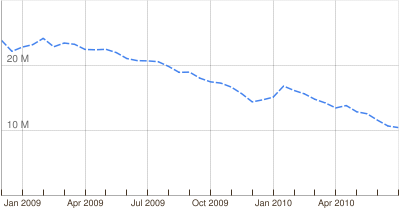
Facebook Visitors 2Q 2010 (not users)

Twitter Whale of a Fail
Twitter has also seen a slight decrease in visitors over the last two months; however, Twitter gained 16 million users in the second quarter and it should easily exceed the 100 million user mark in the third quarter. Twitter may be experiencing fallout from the backlash at Facebook, but it is more likely that Twitters persistent ‘Fail Whale’ capacity issues are preventing the service from scoring big gains with new users. For several weeks in June, Twitter users experienced constant interruptions in service that were a major annoyance causing many to exacerbate the problem by Tweeting their complaints. The issues were similar to the days when AOL dial-up service lacked the capacity to handle the volume of users…and remind us of the risk an organization takes in failing to anticipate rapid growth.

Twitter Visitors 2Q 2010

From a position of potential demand by business-oriented users, Twitter is in the best position to grow into the Facebook of the business world, but it has to overcome the confusion by older users of the usefulness of the service; however, there is a ‘Tipping Point’ that once achieved could push Twitter into mega growth and a potential of becoming larger than Facebook in total users.

Twitter up-time seems to be getting better in the past two weeks, but continued reliability problems could have a significant impact on user happiness and that opens the door for another service to step up and prove that they offer more than twitchy connections.

LinkedIn Visitors 2Q 2010

LinkedIn Becalmed
The surprise in the 2nd Quarter was the loss of users for LinkedIn. Dropping from 41 million down to 38 million for the business networking website may indicate that it is in a market that is too narrow. LinkedIn encourages long discussions of business issues, and the formation of related groups, but the downside is that few care to read 257 posts of people’s opinions where the knowledgeable people are mixed in with the clueless. LinkedIn also discourages connecting to another user unless you already have a relationship with them, which means you’re talking to the same people you already know. Twitter’s advantage is a more rapid discussion that spins off to other blogs rather than an on-line list of opinions. Twitter also connects people in a way that allows the user to edit their followers, rather than depending on an existing relationship. This could be the signal of a trend and LinkedIn may come out on the short end of Darwin’s evolution theory.

MySpace Visitors 2Q 2010

MySpace: The Titanic of Social Media
MySpace is proof that failure is an option in the world of Social Media. Of course, they are a failure with 66 million followers at the end of the 2nd Quarter, but they had 80 million users at the end of the 1st Quarter. At this pace they will under 10 million users by next summer. MySpace is the Wicked Witch of the West and she is sitting under Niagara Falls …. ‘I’m meltinggggg.’

It is possible that by the end of the 3rd Quarter the field of Social Media tools could be clearly down to Facebook and Twitter. MySpace would need a massive public relations campaign and cool new tricks to stop its decline. It is the BP of the Social Media and it doesn’t have the finances to pull up before it noses into the corn field. LinkedIn is sitting on a house of cards. Being a ‘Business Networking’ service is not enough to keep it viable. If it drops under 30 million users by the end of 3rd Quarter I predict that it will be a race between LinkedIn and MySpace to be the first to dissolve in 2011. MySpace’s loss will be Facebook’s gain and LinkedIn’s loss will be Twitter’s gain. I still believe Twitter has more potential than Facebook, but they will have to overcome the misconceptions by older users of its purpose and value.

We wait for the 3rd Quarter…what will people do?

More Articles

  • Epic Fail: PR ‘Experts’ don’t get Twitter
  • King of Anything: Social Media vs Traditional Media
  • Rotary PR: Disrespecting the Club President is a PR/Membership issue
  • WiFi on Southwest Airlines: Is it ‘Shovel Ready’?
  • Starbucks makes a smart move: Free WiFi
  • Two Barbecues and a Wedding
  • Foul Play: FIFA shows what less regulation offers to business
  • Rotary New Year: Retread or Renaissance?
  • The Shock of the McChrystal Story: The story is over before the article is published
  • Tony Hayward: The very model of a modern Major General
  • Rotary@105: A young professionals networking club?
  • One Rotary Center: A home for 1.2 million members
  • War Declared on Social Media: Desperate Acts of Traditional Media
  • Pay It Middle: The Balance between Too Much and Too Little Compensation
  • Mega Executive Pay Leads to Poor Performance
  • Relationships and Thin-Slicing: Why the other person knows what you’re really thinking
  • Browser Wars: Internet Explorer losing, Google Chrome gaining ground
  • Rotary@105:  What BP Could Learn from the 1914 Rotary Code of Ethics
  • Twitter is the Thunderstorm of World Thought
  • Signs of the Times
  • Rotary Magazine Dilemma Reveals the Impact of Social Media
  • How Social Interactive Media Could Transform Higher Education
  • How to Become a Zen Master of Social Media
  • Car Dealership Re-Imagines Customer Service
  • Death of All Salesmen!
  • Aristotle’s General Rules on Social Media
  • Social Media:  What is it and Why Should You Care?
  • Social Media 2020:  Keep it Personal
  • Social Media 2020:  Who Shouldn’t Be Teaching Social Media
  • Social Media 2020:  Public Relations 2001 vs Social Media Relations 2010
  • Social Media 2020: Who Moved My Public Relations?
  • Publishing Industry to End 2012
  • Who uses Facebook, Twitter, MySpace & LinkedIn?
  • Fear of Public Relations
  • Dissatisfiers: Why John Quit
  • Facebook, Twitter, LinkedIn…Oh My!
  • Does Anybody Really Understand PR?

Epic Fail: Media/PR ‘Experts’ don’t get Twitter

13 Tuesday Jul 2010

Posted by Paul Kiser in Branding, Communication, Customer Relations, Customer Service, Ethics, Information Technology, Internet, Lessons of Life, Management Practices, Passionate People, Print Media, Public Relations, Re-Imagine!, Relationships, Rotary, SEO, Social Interactive Media (SIM), Social Media Relations, The Tipping Point, Traditional Media

≈ 2 Comments

Tags

Blogs, Customer Loyalty, Epic Fail, Facebook, LinkedIn, Management Practices, Marketing, Media, New Business World, PR, Public Image, Public Relations, Publicity, Re-Imagine!, Rotary, Sales, sell, Selling, Social Media, Social Networking, Twitter, Value-added

by Paul Kiser
USA PDT  [Twitter: ] [Facebook] [LinkedIn] [Skype:kiserrotary or 775.624.5679]

“I just don’t see a way to monetize it” – Local PR Company Owner

Paul Kiser

Some of my best friends are Media/Public Relations (PR)/Marketing Experts…okay, maybe not my best friends, but I do have several people I consider friends who have been/are major players in the PR industry in their market and almost all of them either reject Twitter or are mystified by it. The three questions/comments I hear most from my PR friends are as follows:

  • How do you have time to do it?
  • I don’t see how to monetize Twitter.
  • I just don’t get it

The first question requires that a person accept that Twitter can be something of value to their (or their client’s) business. Unfortunately, many ‘experienced’ business people have a misconception of what Twitter is (or is not,) so they are already under the presumption of guilt on the charge the Twitter is a waste of time. They have to be convinced that it has value, thus deserving it merits their ‘time’. But for many ‘seasoned’ PR types the only way they will accept Twitter as worth their time is if it has an immediate dollar return, which leads to the second comment.

The fact is that Twitter a communication tool leads the experienced Media/PR person to fall back to the concept that it can be used for advertising/spam purposes and when Social Media users respond by unfriending/unfollowing them, they decide that Twitter is a waste of time. All their training and experience tells them that Social Media is a billboard that if they can just find the right ‘trick’ then Twitter can be used to manipulate the public to buy whatever they (or their client) is selling. That is what they know and thus it leads to the third comment, that they just don’t get it.

Twitter is a new variety of the PR Cherry

Twitter is not a spam tool. The idea that you can make revenue directly from Social Media demonstrates a lack of understanding of the environment. It would be like trying to add spam to someone’s personal email. People would not accept their personal message being overshadowed by spam for Sam’s Plumbing and it would be annoying to the receiver. Spam/advertising (all advertising is spam) is an affront to people’s intelligence and when people can turn it off they do, and that means Twitter has no value to many ‘experienced’ Media/PR people.

The failing is in the concept of trying to ‘sell’. Any reputable business does not need to ‘sell’ their product or service. I’ll say that again. Any reputable business does NOT need to sell their product or service. What they need to do is educate the public on their product or service and why it will improve their life. Educating is not selling. Selling assumes that you can manipulate people to buy whatever you’re selling. Selling is a function of greed and greed is unethical.

The Social Media environment exposes selling and rejects it, but it loves educating. Social Media is a learning environment and the PR professional that doesn’t understand that will not understand Twitter. This opens the door for those who can reject the old ideas of PR and accept a new strategy of service/product management.

Meanwhile, we should create a new Social Media tool for those who love to sell. They can all join it and try to sell to each other. Maybe we can call in ‘Spinster’?

More Articles

  • King of Anything: Social Media vs Traditional Media
  • Rotary PR: Disrespecting the Club President is a PR/Membership issue
  • WiFi on Southwest Airlines: Is it ‘Shovel Ready’?
  • Starbucks makes a smart move: Free WiFi
  • Two Barbecues and a Wedding
  • Foul Play: FIFA shows what less regulation offers to business
  • Rotary New Year: Retread or Renaissance?
  • The Shock of the McChrystal Story: The story is over before the article is published
  • Tony Hayward: The very model of a modern Major General
  • Rotary@105: A young professionals networking club?
  • One Rotary Center: A home for 1.2 million members
  • War Declared on Social Media: Desperate Acts of Traditional Media
  • Pay It Middle: The Balance between Too Much and Too Little Compensation
  • Mega Executive Pay Leads to Poor Performance
  • Relationships and Thin-Slicing: Why the other person knows what you’re really thinking
  • Browser Wars: Internet Explorer losing, Google Chrome gaining ground
  • Rotary@105:  What BP Could Learn from the 1914 Rotary Code of Ethics
  • Twitter is the Thunderstorm of World Thought
  • Signs of the Times
  • Rotary Magazine Dilemma Reveals the Impact of Social Media
  • How Social Interactive Media Could Transform Higher Education
  • How to Become a Zen Master of Social Media
  • Car Dealership Re-Imagines Customer Service
  • Death of All Salesmen!
  • Aristotle’s General Rules on Social Media
  • Social Media:  What is it and Why Should You Care?
  • Social Media 2020:  Keep it Personal
  • Social Media 2020:  Who Shouldn’t Be Teaching Social Media
  • Social Media 2020:  Public Relations 2001 vs Social Media Relations 2010
  • Social Media 2020: Who Moved My Public Relations?
  • Publishing Industry to End 2012
  • Who uses Facebook, Twitter, MySpace & LinkedIn?
  • Fear of Public Relations
  • Dissatisfiers: Why John Quit
  • Facebook, Twitter, LinkedIn…Oh My!
  • Does Anybody Really Understand PR?

King of Anything: Sara Bareilles song reflects Social Media vs Traditional Media attitudes

12 Monday Jul 2010

Posted by Paul Kiser in Branding, Communication, Customer Relations, Customer Service, Information Technology, Internet, Lessons of Life, Management Practices, Passionate People, Print Media, Public Relations, Relationships, Rotary, Social Interactive Media (SIM), Social Media Relations, Traditional Media

≈ 1 Comment

Tags

Bloggers, Blogging, Blogs, Facebook, Kaliadoscope Heart, King of Anything, LinkedIn, Music, New Business World, Newspapers, Public Image, Public Relations, Rotary, Sara Bareilles, Social Media, Social Networking, Twitter

by Paul Kiser
USA PDT  [Twitter: ] [Facebook] [LinkedIn] [Skype:kiserrotary or 775.624.5679]

Paul Kiser

It’s interesting to me how a song can make my day. Today I listened to a new song by Sara Bareilles called, ‘King of Anything‘ and it makes me smile every time I hear it. The song went on sale and the video was released late last month. I have downloaded the song (legally, on iTunes) and watched the video several times and I am enjoying both even though my song count is nearing an obsession.

(see the King of Anything video here)

Part of my attraction to the song is the music. It is an upbeat tune that sounds whimsical even though the lyrics are more serious. The chorus of the song is:

Sara Bareilles upcoming cd Kaleidoscope Heart

“Who cares if you disagree?
You are not me.
Who made you King of Anything?
So you dare tell me who to be,
who died and made you King of Anything?”

In Ms. Bareilles description of the song on Wikipedia, she says, “‘King of Anything’ is sort of a ‘f**k you’ song,” which it is, but I find a lot more in the song that relates to what Social Media has been saying to Traditional Media for over a decade.

Traditional Media (television, radio, books, magazines, etc.) have been ruled by editors and producers. They have sat on the throne of their own making deciding what we should see, hear, and read. Directors and editors have played the role of spoon-feeding the public the information they see fit and controlling the message. Usually their efforts have been an honorable attempt to provide information to the public, but more recently their have been efforts to intentionally influence the hearts and minds of the public with manipulated news through FOX news and via personalities like Rush Limbaugh.

Social Media has quietly become the force that has been giving each person the option to decide for themselves. We can talk, build groups of like-minded friends/followers, research, read first-hand reports, and explore the knowledge and experience of millions of other individuals. Social Media has challenged Traditional Media by asking, “Who made you King of anything?” The result has been a collapse of the house of cards that Traditional Media has built. Advertising and sales revenues have been dropping across the board as people now question the usefulness of media that is controlled by a few, and almost always behind the curve in information and trends.

Single released in May 2010

But back to the song. Sara Bareilles has a great line near the end where she says, “Let me hold your crown, babe.” While I fully understand the meaning (the middle finger is involved,) I’ll suggest that in Social Media we all hold the crown … and nobody needs to wear it to be heard. Traditional Media is dead. Long live the King!

(Sara Bareilles website)

More Articles

  • Rotary PR: Disrespecting the Club President is a PR/Membership issue
  • WiFi on Southwest Airlines: Is it ‘Shovel Ready’?
  • Starbucks makes a smart move: Free WiFi
  • Two Barbecues and a Wedding
  • Foul Play: FIFA shows what less regulation offers to business
  • Rotary New Year: Retread or Renaissance?
  • The Shock of the McChrystal Story: The story is over before the article is published
  • Tony Hayward: The very model of a modern Major General
  • Rotary@105: A young professionals networking club?
  • One Rotary Center: A home for 1.2 million members
  • War Declared on Social Media: Desperate Acts of Traditional Media
  • Pay It Middle: The Balance between Too Much and Too Little Compensation
  • Mega Executive Pay Leads to Poor Performance
  • Relationships and Thin-Slicing: Why the other person knows what you’re really thinking
  • Browser Wars: Internet Explorer losing, Google Chrome gaining ground
  • Rotary@105:  What BP Could Learn from the 1914 Rotary Code of Ethics
  • Twitter is the Thunderstorm of World Thought
  • Signs of the Times
  • Rotary Magazine Dilemma Reveals the Impact of Social Media
  • How Social Interactive Media Could Transform Higher Education
  • How to Become a Zen Master of Social Media
  • Car Dealership Re-Imagines Customer Service
  • Death of All Salesmen!
  • Aristotle’s General Rules on Social Media
  • Social Media:  What is it and Why Should You Care?
  • Social Media 2020:  Keep it Personal
  • Social Media 2020:  Who Shouldn’t Be Teaching Social Media
  • Social Media 2020:  Public Relations 2001 vs Social Media Relations 2010
  • Social Media 2020: Who Moved My Public Relations?
  • Publishing Industry to End 2012
  • Who uses Facebook, Twitter, MySpace & LinkedIn?
  • Fear of Public Relations
  • Dissatisfiers: Why John Quit
  • Facebook, Twitter, LinkedIn…Oh My!
  • Does Anybody Really Understand PR?

Starbucks makes a smart move: Free WiFi

09 Friday Jul 2010

Posted by Paul Kiser in About Reno, Branding, Communication, Customer Relations, Customer Service, Information Technology, Internet, Lessons of Life, Management Practices, Public Relations, Re-Imagine!, Relationships, Rotary, Social Interactive Media (SIM), Social Media Relations, The Tipping Point

≈ 11 Comments

Tags

Blogging, Blogs, Circus Circus, Coffee, convention authority, Customer Loyalty, Executive Management, Free Internet, Free WiFi, gambling, Gaming properties, Grand Sierra Resort, hotels, John Ascuaga's Nugget, Las Vegas, Management Practices, Nevada gaming, New Business World, Public Image, Public Relations, Publicity, Re-Imagine!, Reno Gaming, Rotary, Social Media, Social Networking, South Point, Starbucks, The Atlantis, The Eldorado, The Peppermill, The Silver Legacy, Value-added, WiFi

by Paul Kiser
USA PDT  [Twitter: ] [Facebook] [LinkedIn] [Skype:kiserrotary or 775.624.5679]

Customer Loyalty: Paul Kiser in Starbucks style

Today I’m dressed like a Starbucks employee to honor the wisdom of the decision-makers at the famous coffee company to team with AT&T to offer free WiFi to all. They started it on July 1st. It is a smart move…a very smart move.

Why? There is one common aspect of every successful business and it is simply to give your customers a reason to love you. That’s it! Customers who love a service or product is an absolute ‘must’ if you want to build customer loyalty and business referrals. You can spend millions of dollars in advertising and not get the return that a company gets with requited love from their customers. With free WiFi Starbucks has found a way of creating value-added service that will cause many people to love Starbucks.

If you have a ‘butts-in-the-seats’ type of business and you want customers to: 1) frequent your location, 2) spend time and money in your business and, 3) be loyal to your business then free WiFi is one of the best ways to make it happen. Here’s what will happen for Starbucks over the next 12 months.

  • Starbucks will see increased traffic of laptop users (a ‘small’ market of people who will buy almost 200 million laptops in 2010)
  • Starbucks will see more repeat business
  • Starbucks will be more visible to more people
  • Starbucks will not need to spend as much on advertising and will get more social media publicity

All butts-in-the-seats organizations would like to experience these four outcomes in their business, so why don’t more places offer free WiFi? In brief, the answer is ‘accountant-think’, which is always short-sighted. The common rationale is one of two issues. First, instead of seeing free WiFi as an inexpensive way to add value to their service the accountant-think business people try to make it a revenue source. In Reno, Nevada the major hotel/gaming properties have been known to charge as much as $500 to ‘turn on’ WiFi in their convention areas and most of the properties charge around $13/day for guests to have access to WiFi. The result is that technology conventions go elsewhere rather than be charged for a service that they can get for considerably less (or free) in another market. The Reno gaming properties have boxed themselves in with contracts or dependence on the revenue source from WiFi, so they are now in a death spiral of losing more and more business or give up a piece of their dwindling revenue.

Last year I was in Las Vegas on a business trip and stayed at the South Point property. They charged a fee for WiFi, so I went to Starbucks to get online (my home account is with AT&T, so I’ve always had free access at Starbucks.) Afterward I picked up dinner at the Outback Restaurant next door and took it back to my room. South Point didn’t get me to stay on property, nor did they even get me to eat at in-house, simply because they didn’t offer Free WiFi. Is that a smart business move on their part? Nope, just good, solid accountant-think.

The second rationale accountant-think executives is that WiFi customers don’t have a revenue impact. In August of 2009, Erica Alini wrote an article for the Wall Street Journal (NOTE: the Wall Street Journal or WSJ is a historical archive of old business trends written by accountant-think reporters) that declared, “Coffee Shops Pull the Plug on Laptop Users.” For her article Ms. Alini cites three examples in New York that discussed limiting or eliminating laptops at a cafe or coffee shop. The most common problem seemed to be too many customers … what a tragic problem … and that some laptop users were purchasing minimal product. However, Ms. Alini admits that some places were using laptop users to ‘make the place look busy.’

A deserted restaurant is cause for people to avoid the business, so having customers, even minimal revenue producing customers, can mean more paying customers. My question is how much would a coffee shop have to pay people to sit and look like customers? Free WiFi is a small price to pay. I spend $10 to $15 per day at my Home Starbucks on Keystone in Reno, NV, USA. It will not make me a shareholder, but it is money I would not spend in one place, except for the fact that I am a captured customer. I also always meet with people at a Starbucks, so I bring in additional customers. The major factor in my customer loyalty is the access to free WiFi.

Starbucks has made a very smart business move with making free WiFi a value-added service for all and the return on the service will reap big dividends in customer loyalty and increased traffic (butts in the seats.) Starbucks customers have a new reason to love Starbucks and that is key to survival in today’s world. But don’t try telling that to the accountant-think executives running other stores and restaurants. They just won’t understand it … and I’m sure that’s okay with Starbucks.

More Articles

  • Two Barbecues and a Wedding
  • Foul Play: FIFA shows what less regulation offers to business
  • Rotary New Year: Retread or Renaissance?
  • The Shock of the McChrystal Story: The story is over before the article is published
  • Tony Hayward: The very model of a modern Major General
  • Rotary@105: A young professionals networking club?
  • One Rotary Center: A home for 1.2 million members
  • War Declared on Social Media: Desperate Acts of Traditional Media
  • Pay It Middle: The Balance between Too Much and Too Little Compensation
  • Mega Executive Pay Leads to Poor Performance
  • Relationships and Thin-Slicing: Why the other person knows what you’re really thinking
  • Browser Wars: Internet Explorer losing, Google Chrome gaining ground
  • Rotary@105:  What BP Could Learn from the 1914 Rotary Code of Ethics
  • Twitter is the Thunderstorm of World Thought
  • Signs of the Times
  • Rotary Magazine Dilemma Reveals the Impact of Social Media
  • How Social Interactive Media Could Transform Higher Education
  • How to Become a Zen Master of Social Media
  • Car Dealership Re-Imagines Customer Service
  • Death of All Salesmen!
  • Aristotle’s General Rules on Social Media
  • Social Media:  What is it and Why Should You Care?
  • Social Media 2020:  Keep it Personal
  • Social Media 2020:  Who Shouldn’t Be Teaching Social Media
  • Social Media 2020:  Public Relations 2001 vs Social Media Relations 2010
  • Social Media 2020: Who Moved My Public Relations?
  • Publishing Industry to End 2012
  • Who uses Facebook, Twitter, MySpace & LinkedIn?
  • Fear of Public Relations
  • Facebook, Twitter, LinkedIn…Oh My!
  • Does Anybody Really Understand PR?

Rotary New Year: Retread or Renaissance?

25 Friday Jun 2010

Posted by Paul Kiser in 2020 Enterprise Technologies, Branding, Club Leadership, Communication, Membership Recruitment, Membership Retention, Passionate People, Public Relations, Relationships, Rotary, Rotary@105, Social Interactive Media (SIM), Social Media Relations

≈ 1 Comment

Tags

Blogging, Blogs, Club Members, denver post, History of Rotary, London Times, Los Angles Times, Membership Recruitment, Membership Retention, New York Times, npr, Public Image, Public Relations, Publicity, Rotarians, Rotary, Rotary Club, Rotary District 5190, Rotary International, Social Media

by Paul Kiser
USA PDT  [Twitter: ] [Facebook] [LinkedIn] [Skype:kiserrotary or 775.624.5679]

Paul Kiser - Public Relations Chair, Rotary District 5190

On July 1 of every year Rotary rolls out a new administration. From the club level to the 18th floor of One Rotary Center the leadership for our organization makes quietly dramatic team substitution. Each year starts with the hope of pushing Rotary to new levels of success and each year ends with a long sigh of relief.

When I first joined Rotary on July 5, 2001, I learned quickly that a new adminstration was not to take any action, including planning, until July 1, which meant that it was late August before the club leadership could get organized. This concept of not ‘stepping on the current President’s toes’ was an outdated, destructive dogma that held back the club from being prepared and in motion when the first bell rang in July. Somewhere around our Centennial in 2005 I noticed that the attitude was changing and clubs were being encouraged to get the new leadership trained and ready before July 1 and each subsequent year the quality and preparedness of clubs has improved. At least in our District, the class of 2010-11 is perhaps the best prepared for putting words and ideas into action when they stand up in front of the club on Week 1.

Theme for 2010-11

But preparing and training only set the stage, it is performance that counts. The world has changed and the role of a service organization that is not bound by religious, political, or ideological motives is more critical than ever in a world where those motives are driving a wedge between people instead of uniting them. Rotary’s constitution and history have freed our members from judging our fellow world citizens before we offer to serve, nor do we serve them with the intention of converting them to our beliefs. Rotary’s motto of Service Above Self means that we are in the unique position of unrequited care and service to others. In 2010 and beyond, the world is in desperate need of that which is the core of a Rotarian’s heart.

But we are faced with a challenge that has been dogging us for years. Despite multiple years of great Rotary International (RI) Presidents, and District Governors, one year looks much like the previous year any many of our key club functions. Our new themes and leadership fail to make any significant headway with the-way-we-have-always-done-things paradigm.

One area that demonstrates this is in Membership. An organization that is stagnant in membership growth cannot expect to meet new challenges and yet for seven years we have sat at 1.2 million members. In our District (5190) the average size of a club has been steadily shrinking. Last year I researched the last five years and found that we have dropped from an average of 53 members per club (June 2005) down to 47 members (September 2009.) As of April of 2010, that average has dropped to 46 members per club. This is not a criticism of our District because I suspect I would find the same data in all the North American Districts. It is apparent that not only is our growth stagnant, but our clubs are shrinking, which means fewer members to take on a bigger role.

2010-11 RI President Ray Klinginsmith

The question for each of us is whether this will be another year of Retread Membership or a year of rebirth, (Renaissance,) in Membership? To have a rebirth we must have a new approach and not be locked into medieval thinking. Current RI President John Kenny gave us the theme, The Future of Rotary is in Your Hands, and upcoming RI President Ray Klinginsmith challenges clubs to ‘get bigger, better, bolder’. Both invite Rotarians to not make a Retread of the 2010-11 year, but to spawn a Renaissance of our organization. So what holds us back?

(Rotary meant for young professionals? Click here for story.)

I have had many conversations with Rotarians about membership. I often hear about the barriers and challenges. But what I know is that the difference between a Retread Rotary year and a Rotary Renaissance will be determined not by a theme, or by the words of the RI President, or by great work by a District Governor. Creating a Rotary Renaissance will be determined by individual club members who decide that there are no excuses and that failure in membership growth is not an option. Robert Kennedy is credited with saying, “If not us, who? If not now, when?” Two questions every Rotarian should ask themselves in this new Rotary year.

More Articles

  • The Shock of the McChrystal Story: The story is over before the article is published
  • Tony Hayward: The very model of a modern Major General
  • Rotary@105: A young professionals networking club?
  • One Rotary Center: A home for 1.2 million members
  • War Declared on Social Media: Desperate Acts of Traditional Media
  • Pay It Middle: The Balance between Too Much and Too Little Compensation
  • Mega Executive Pay Leads to Poor Performance
  • Relationships and Thin-Slicing: Why the other person knows what you’re really thinking
  • Browser Wars: Internet Explorer losing, Google Chrome gaining ground
  • Rotary@105:  What BP Could Learn from the 1914 Rotary Code of Ethics
  • Twitter is the Thunderstorm of World Thought
  • Signs of the Times
  • Rotary Magazine Dilemma Reveals the Impact of Social Media
  • How Social Interactive Media Could Transform Higher Education
  • How to Become a Zen Master of Social Media
  • Car Dealership Re-Imagines Customer Service
  • Death of All Salesmen!
  • Aristotle’s General Rules on Social Media
  • Social Media:  What is it and Why Should You Care?
  • Social Media 2020:  Keep it Personal
  • Social Media 2020:  Who Shouldn’t Be Teaching Social Media
  • Social Media 2020:  Public Relations 2001 vs Social Media Relations 2010
  • Social Media 2020: Who Moved My Public Relations?
  • Publishing Industry to End 2012
  • Who uses Facebook, Twitter, MySpace & LinkedIn?
  • Fear of Public Relations
  • Facebook, Twitter, LinkedIn…Oh My!
  • Does Anybody Really Understand PR?

The shock of the McChrystal story: Story is over before the article is published

24 Thursday Jun 2010

Posted by Paul Kiser in 2020 Enterprise Technologies, Communication, Crisis Management, Ethics, Human Resources, Internet, Lessons of Life, Management Practices, Print Media, Public Relations, Rotary, Social Interactive Media (SIM), Traditional Media

≈ 1 Comment

Tags

Afghanistan, Army, Bloggers, Blogging, Blogs, David Pertraeus, denver post, Executive Management, Facebook, General Stanley McChrystal, latimes, Magazines, Management Practices, McChrystal, Military Command, New Business World, Newspapers, npr, nytimes, President Obama, Public Image, Public Relations, Publicity, Rolling Stones Magaizine, Rotary, scandal, Social Media, Social Networking, traditional media, Twitter, US Military, War

by Paul Kiser [Twitter: ] [Facebook] [LinkedIn] [Skype:kiserrotary or 775.624.5679]

Paul Kiser - CEO 2020 Enterprise Technologies

Today is an amazing day! It may not seem that different to some people, but they just don’t realize what today signifies in the world of social and traditional media. Still, not clear? Think about this:

General Stanley McChrystal

  • Monday, June 21 – Reports surface that President Obama is angry about an article that would be appearing in Rolling Stones magazine. The article has several remarks by General Stanley McChrystal that were derogatory in nature about several people in the Administration. It is announced that McChrystal has been ordered to appear in person at the White House for Wednesday’s staff meeting, normally done via a secure video transmission.
  • Tuesday, June 22 – Thousands of articles, blogs, and news stories on television and radio discuss the article, the General and what should be done. All this happens while the General is in transit to Washington, D.C.
  • Wednesday, June 23 – General McChrystal reports to the White House, his resignation is accepted and it is announced that General David Petraeus will assume his command.
  • Thursday, June 24 – Continued discussion around the world about the article, the General, and President Obama’s solution to the issue. A Google search of the terms ‘McChrystal runaway general Obama’ nets 464,000 hits (many refer to another situation in October 2009) and the same terms appearing in blogs nets 92,000 hits.

So why does this make today an amazing day? The article that is the cause of bringing down the US Commander of the war in Afghanistan, the President making a swift, major change in his top military administrative staff, and has been the subject of discussion around the world for days…isn’t published in print until tomorrow.

But that isn’t even the best part! The best part is that no one is amazed by this bizarre situation. We have become so accustomed to the Internet trumping print media that no one sees the significance of the reaction to a news story superseding the news story actually being published.

What does it mean?
There is no better example of what has happened in the worlds of Social and Traditional Media than the events of this week. Print media used to ‘be’ the news but now print media is only a historical account of news. It is impossible for print media to have any impact on the world because it is too slow. Yes, television and radio were leaders in promoting the story; however, it was the Internet that provided the mechanism for so many ‘civilians’ to react to the story. The story was discussed in blogs, on Facebook, and on Twitter…all in real-time, not on a news cycle.

For the business person it is simple. If you think that Social Media is a waste of time and that it has no ROI (return on investment) for your company then know that your business could be dead before you even know why. If you are not plugged in and aware then you are flying blind in a world that quietly watches you and everything you do. The Google search will give your customer access to the good, the bad, and the ugly about you.

Think about this: a very powerful and successful military man was brought down by one reporter through some inappropriate remarks. In this situation he worked for a major publication, but it could have been a blogger with a video and the impact would have been the same. Social Media is not about how much time it will take out of your day, nor is it about the return on your investment. It is about your survival.

More Articles

  • Tony Hayward: The very model of a modern Major General
  • Rotary@105: A young professionals networking club?
  • One Rotary Center: A home for 1.2 million members
  • War Declared on Social Media: Desperate Acts of Traditional Media
  • Pay It Middle: The Balance between Too Much and Too Little Compensation
  • Mega Executive Pay Leads to Poor Performance
  • Relationships and Thin-Slicing: Why the other person knows what you’re really thinking
  • Browser Wars: Internet Explorer losing, Google Chrome gaining ground
  • Rotary@105:  What BP Could Learn from the 1914 Rotary Code of Ethics
  • Twitter is the Thunderstorm of World Thought
  • Signs of the Times
  • Rotary Magazine Dilemma Reveals the Impact of Social Media
  • How Social Interactive Media Could Transform Higher Education
  • How to Become a Zen Master of Social Media
  • Car Dealership Re-Imagines Customer Service
  • Death of All Salesmen!
  • Aristotle’s General Rules on Social Media
  • Social Media:  What is it and Why Should You Care?
  • Social Media 2020:  Keep it Personal
  • Social Media 2020:  Who Shouldn’t Be Teaching Social Media
  • Social Media 2020:  Public Relations 2001 vs Social Media Relations 2010
  • Social Media 2020: Who Moved My Public Relations?
  • Publishing Industry to End 2012
  • Who uses Facebook, Twitter, MySpace & LinkedIn?
  • Fear of Public Relations
  • Facebook, Twitter, LinkedIn…Oh My!
  • Does Anybody Really Understand PR?

Tony Hayward: The very model of a modern Major General

23 Wednesday Jun 2010

Posted by Paul Kiser in 2020 Enterprise Technologies, Branding, Communication, Crisis Management, Customer Relations, Customer Service, Ethics, Lessons of Life, Management Practices, Passionate People, Public Relations, Rotary

≈ 1 Comment

Tags

Blogging, Blogs, BP, British, British Petroleum, CEO, Conservatives, Deep Water Drilling, Disaster, England, Executive Management, Great Britain, Gulf of Mexico, King George III, Management Practices, Mega Oil Companies, New Business World, Oil Companies, oil leak, oil spill, petrol, Public Image, Public Relations, Publicity, Republicans, Social Media, Tony Hayward

by Paul Kiser [Twitter: ] [Facebook] [LinkedIn] [Skype: kiserrotary or 775.624.5679]

Tony Hayward - Modern Major General

Enough with the BP CEO bashing! Regardless of any verbal gaffs, or ill-advised yacht racing, if Tony Hayward, the shining star of BP, is guilty of anything he is only guilty of being the perfect CEO. A corporate executives first and last duty is to his investors and when we measure up Mr. Hayward he is, in fact, the very model of a modern corporate executive. If it please the court of the business world I’ll present my case:

POINT ONE: When he took the reins of BP (that does not stand for Bloody Petrol) he immediately weeded out all those people who, and I quote, “….wanted to save the world.” Saving the world is not the goal of business, making money is, and no one can say that Mr. Hayward didn’t make money for the investors of BP. Score one for the British! They’ve become as obsessive about profit as the an American conservative!

The Public Image of Tony Hayward...but it doesn't count

POINT TWO: After the fire and rescue of the victims from the platform Mr. Hayward’s legal team leapt into action to detain the survivors until they signed a release saying that they were not injured…which, in legalese is to say they were signing a waiver of all liability, not a just that they were not physically injured, but that BP could not be sued for any mismanagement, negligence, etc. This reflects devotion that Mr. Hayward and his team have for the investor. Duty first and last!

POINT THREE: Within hours of the disaster BP’s crack crisis response team sprung into action securing all information and potential access to protect the corporation from negative portrayals by the world media. First  there was no oil leaking, then only 5,000 barrels, then, well, no comment. Carefully crafted statements were released to reassure the investors, (not the public,) that the event was a minor setback and the amount of oil would have a minimal impact on the excessive amount of water in the Gulf of Mexico. Textbook Public Relations work!

POINT FOUR: Unfortunately, BP could not hide massive oil slicks from the cameras of the media and that could scare the investors…but wait a minute…they could hide them by pouring millions of gallons of toxic dispersants on the oil at the point of origin! Yes, it would make collection the oil impossible, but that was save-the-world thinking, and this was not the time to shirk the duty to the investor with ethics. Again, Mr. Hayward shows us his stuff!

POINT FIVE: The pièce de résistance (my apologies to the British for resorting to French) was the yacht race that Tony Hayward took leave of the United States to attend. As outrage among the American public reached a fever pitch it was a stroke of genius by a perfect corporate executive to again restore order with the investors by demonstrating that this oil spill event is all much ado about nothing and normal aristocratic life is alive and well in this man’s corporation.

It is true that not since King George III have the average, non-conservative American been so incensed with a British national, but the public is passé (again my apologies for using French) in the corporate world, especially in the world of big oil companies. The public will trade ethics for petrol (I’m trying to compensate for using French by using British words) any day of the week. The public’s role is to buy their product, not tell them how to obtain it. Tony Hayward has been true-blue to the investors…I wouldn’t be surprised if his urine is blue! No one can dispute that as a model of the corporate executive, Tony is the best of the best.

I rest my case.

More Articles

  • Rotary@105: A young professionals networking club?
  • One Rotary Center: A home for 1.2 million members
  • War Declared on Social Media: Desperate Acts of Traditional Media
  • Pay It Middle: The Balance between Too Much and Too Little Compensation
  • Mega Executive Pay Leads to Poor Performance
  • Relationships and Thin-Slicing: Why the other person knows what you’re really thinking
  • Browser Wars: Internet Explorer losing, Google Chrome gaining ground
  • Rotary@105:  What BP Could Learn from the 1914 Rotary Code of Ethics
  • Twitter is the Thunderstorm of World Thought
  • Signs of the Times
  • Rotary Magazine Dilemma Reveals the Impact of Social Media
  • How Social Interactive Media Could Transform Higher Education
  • How to Become a Zen Master of Social Media
  • Car Dealership Re-Imagines Customer Service
  • Death of All Salesmen!
  • Aristotle’s General Rules on Social Media
  • Social Media:  What is it and Why Should You Care?
  • Social Media 2020:  Keep it Personal
  • Social Media 2020:  Who Shouldn’t Be Teaching Social Media
  • Social Media 2020:  Public Relations 2001 vs Social Media Relations 2010
  • Social Media 2020: Who Moved My Public Relations?
  • Publishing Industry to End 2012
  • Who uses Facebook, Twitter, MySpace & LinkedIn?
  • Fear of Public Relations
  • Facebook, Twitter, LinkedIn…Oh My!
  • Does Anybody Really Understand PR?

Public Relations and Ethics: Cover up or come clean

18 Friday Jun 2010

Posted by Paul Kiser in 2020 Enterprise Technologies, Branding, Communication, Crisis Management, Customer Relations, Customer Service, Ethics, Management Practices, Public Relations, Relationships, Rotary, Social Media Relations

≈ 2 Comments

Tags

Blogs, BP, Management Practices, New Business World, Public Image, Public Relations, Publicity, Rotarians, Rotary, Social Media

by Paul Kiser [Twitter: ] [Facebook] [LinkedIn] [Skype: kiserrotary or 775.624.5679]

Paul Kiser - CEO 2020 Enterprise Technologies

In an ideal world a Public Relations person would be the liaison between the organization they represent and the community. The problem with that concept is that the community doesn’t pay the salary of a Public Relations person. If someone wishes to be paid in a PR career they have to serve the interests of the organization, not the community. In the world of publicly owned corporations the interests of an organization are always about profit, not what is right or wrong. The job of the PR person is to protect the public image of the corporation….sometimes even if it sacrifices a person’s ethics to do it, and there’s the rub.

Public Relations should be exposed to full light

Public Relations is not inherently evil. The purpose of PR in any organization should be to educate the public on the organization and address any misperceptions or misunderstandings that would put the company in a negative light. Unfortunately, corporate executives don’t always stop at misunderstandings. They want the company to look good even when they have screwed up. The pressure on the PR staff to cover up or mislead the public can be oppressive, including requiring employees to sign non-disclosure agreements that extend beyond employment (even though they may not be legally enforceable.)

The difference between ethical and unethical PR tactics is not always clear. In the case of criminal situations, such as a violent employee, an organization has an obligation to withhold certain information to protect the dignity and privacy of the victims and the rights of the accused. At the same time a company has an obligation to inform the community of any potential danger, even if it may reflect negatively on the company or reveals corporate negligence.

A good example of questionable ethics is the PR strategy that BP has used during the Gulf of Mexico oil spill disaster. They have clearly sought to minimize the scope of the spill and kept information closely guarded. It will be years before we know the truth, but the use of massive amounts of toxic oil dispersants seems more of an intent to hide long, black, visible oil slicks from news media cameras than a logical strategy to mitigate the problem. This is textbook example of an unethical PR tactic of deferring the bad news from being today’s feature story on CNN in the hope that it will be a footnote in history when the truth surfaces.

Tony Hayward - BP CEO

Many people may think that Tony Hayward is the bumbling fool responsible for the PR mess at BP; however, anyone in our field knows that the PR staff will be radioactive when they apply for a position at another company. For the person in Public Relations, how the organization responds to a major PR crisis could end her or his career. This may not seem fair, but it is appropriate. People who work with unethical executives always have the option of saying no, and if needed, resigning before they sacrifice the truth or the well-being of the public or their fellow workers.

How to Draw the Line
So how can you decide when your ethics are being compromised by your organization? Here are four tests used in Rotary to determine if what you are doing is ethical or not:

Is it the truth? – Truth can be elusive, but in this context it means are you not lying and you are not attempting to be deceptive by what you are saying or not saying.

Is it fair to all concerned? – A company wants to be treated fairly by the media and public, but there is an obligation for the company to do the same.

Will it build goodwill and better friendships? – This is the best part of public relations and should be the foundation of every organization’s efforts with the community. Goodwill and an offer of friendship may be interpreted as manipulation at first, but by being consistently genuine will eventually dispel the cynicism.

Will it be beneficial to all concerned? – This is not for the short-term, but for now and into the future. There is no reason that a difficult public relations issue cannot be made into a win-win for everyone…providing the company is willing to act responsibly and look out for the public’s interest as well as that of its shareholders.

More blogs

  • Rotary@105: A young professionals networking club?
  • One Rotary Center: A home for 1.2 million members
  • War Declared on Social Media: Desperate Acts of Traditional Media
  • Pay It Middle: The Balance between Too Much and Too Little Compensation
  • Mega Executive Pay Leads to Poor Performance
  • Relationships and Thin-Slicing: Why the other person knows what you’re really thinking
  • Browser Wars: Internet Explorer losing, Google Chrome gaining ground
  • Rotary@105:  What BP Could Learn from the 1914 Rotary Code of Ethics
  • Twitter is the Thunderstorm of World Thought
  • Signs of the Times
  • Rotary Magazine Dilemma Reveals the Impact of Social Media
  • How Social Interactive Media Could Transform Higher Education
  • How to Become a Zen Master of Social Media
  • Car Dealership Re-Imagines Customer Service
  • Death of All Salesmen!
  • Aristotle’s General Rules on Social Media
  • Social Media:  What is it and Why Should You Care?
  • Social Media 2020:  Keep it Personal
  • Social Media 2020:  Who Shouldn’t Be Teaching Social Media
  • Social Media 2020:  Public Relations 2001 vs Social Media Relations 2010
  • Social Media 2020: Who Moved My Public Relations?
  • Publishing Industry to End 2012
  • Who uses Facebook, Twitter, MySpace & LinkedIn?
  • Fear of Public Relations
  • Facebook, Twitter, LinkedIn…Oh My!
  • Does Anybody Really Understand PR?

One Rotary Center: A Home for 1.2 Million Members

12 Saturday Jun 2010

Posted by Paul Kiser in Branding, Communication, Customer Relations, Customer Service, Employee Retention, History, Human Resources, Management Practices, Membership Retention, Passionate People, Public Relations, Rotary, Rotary@105

≈ 5 Comments

Tags

Blogs, Club Members, History of Rotary, Management Practices, Membership Retention, One Rotary Center, Paul Harris, Public Image, Public Relations, Rotarians, Rotary, Rotary Club, Rotary Coordinators, Rotary International, Value-added

by Paul Kiser [Twitter: ] [Facebook] [LinkedIn] [Skype: kiserrotary or 775.624.5679]

Paul Kiser - Public Relations Chair, Rotary District 5190

The plan was simple. On a business trip to Illinois I would go to the Rotary International (RI) headquarters in Evanston and take a few pictures to put in a future blog. Simple. No big deal. At our District Conference in May I mentioned to District Governor Elect Steve Lewis that I was going to stop by RI HQ and take some pictures. “Call them first,” DGE Steve said, “they’ll give you a tour.” Okay. That might be nice. So I called the main RI number and set up an appointment. A quick look at RI could be interesting.

One Rotary Center

A little before 10 AM on a beautiful June day I walked into the main cog of the Rotary universe: One Rotary Center. I’m instructed to go up to the 16th floor where I was greeted by Delores and another staff member at the front reception area. I told them my name and my purpose and Delores repeated, “Oh, you’re here for the TOUR!” I expected the emphasis to be on the ‘Oooh’, as if to say, ‘here’s another Rotarian here for the dog and pony tour’. But Delores sounded excited, like it was great to have a Rotarian look over the home of 1.2 million members. She called my tour guide, Amanda Runge, who promptly greeted me in the waiting area.

Amanda and her friend Paul

I learned that Amanda is not just a tour guide. She is a Program Coordinator for the 41 new Rotary Coordinators (RCs) that will serve to assist Clubs as a resource for multiple areas such as Youth Programs. RI President Elect Ray Klinginsmith created the RC post in an effort to help clubs reach a level of excellence through close-in support by knowledgeable Rotarians who have proven skills and expertise in a wide range of Rotary programs. (For more information go to this link:)

RI PE Ray Klinginsmith Discusses Rotary Coordinators

As Program Coordinator, Amanda will be the hands-on RI support out of Evanston, so I was actually interfering in her day, but you would have never known it by the attention she gave to me for almost an hour. My simple, no big deal of a tour was rapidly becoming kind of a big deal. As it turns out Amanda is a product of Rotary. Her Mother is a Rotarian and she was a participant in a five-week Rotary Exchange program to France. I knew the outgoing, friendly demeanor seemed familiar…it’s the same we see with almost every Youth Exchange student after they return to her or his host country.

Replica of the 711 office where the original Chicago club met

The Tour
After seeing ‘Room 711’, the office where most of the Rotary meetings were held for the first several months of Rotary and a look at a room of memorabilia from the office of Paul Harris, Amanda took me up to the top floor of One Rotary Center. As in most office buildings, the ‘big cog’s’ offices are around the exterior of the top floor. The difference at Rotary is that there is a type of musical chairs (or offices) in this space. Each new year the President-Elect, the President Nominee, and the President Nominee Designate change offices. The Immediate Past RI President thanked for his service as he is also moved out of his corner office. Ouch!

Eileen Eckhouse and Amanda Runge

It was on the 18th floor that we saw the RI PE Ray in his office talking on the phone. I asked Amanda if I could take a picture of him on the phone. His Executive Assistant Eileen Eckhouse and RI PE Ray’s Number One (his full-time Rotarian Aide) Duane Sterling were both just outside his office and Amanda consulted them. Duane said,”But don’t you want a picture with him? He’ll be off the phone in a minute.”

Before I know it RI PE Ray is standing beside me introducing himself…like that was necessary…and he suggests we go over in front of the Flags of Nations in the elevator lobby for the picture. There another gentleman joined us to talk to Ray (I’m pretending were on a first name basis) and Amanda introduced me to him. It was the General Secretary of Rotary International, Ed Futa.

In Rotary a President serves for one year, the General Secretary can serve for decades. The first General Secretary, Chez Perry, served for 32 years and I refer to him as the ‘Mother’ of Rotary as he did the work that helped establish and grow our organization. My instant impression of General Secretary Ed was that he performs his duties with the same passion as Chez Perry.

Click to Read more about Chesley Perry

I am now standing next to two of the three men that occupy the corner offices on the top floor of RI and Amanda says, “Why don’t you have your picture with both of them?” At this point reality sort of fades away. It was not supposed to be a big deal, but by the time I walked out of the building it started to hit me what had occurred. It was a big deal…and I have the picture!

RI Gen. Sec. Ed Futa (left), RI PE Ray Klinginsmith (right), and some guy (center)

After the photo op, the three of us sat down and…wait-a-minute, that’s my fantasy world. What actually happened was the gentlemen went on to do real work and Amanda continued the tour of the top floor and the next floor down, which is the Rotary Foundation. Finally, the tour ended and I bought a few things at the Rotary store and then left.

It was sheer luck of timing that I found myself standing between the two people who have a great responsibility as leaders of our organization, but I will always remember the day I stood on the top floor of Rotary International flanked by RI’s President Elect and General Secretary.

One Rotary Center does not have the significance of a religious ‘Mecca’, but that doesn’t diminish it’s importance to all of us. It’s well worth the visit and I would recommend it for anyone visiting the Chicago area. After all, it’s the home…for 1.2 million of us.

Thank you Amanda…and the rest of the RI staff!

More blogs

  • Rotary@105: A young professionals networking club?
  • War Declared on Social Media: Desperate Acts of Traditional Media
  • Pay It Middle: The Balance between Too Much and Too Little Compensation
  • Mega Executive Pay Leads to Poor Performance
  • Relationships and Thin-Slicing: Why the other person knows what you’re really thinking
  • Browser Wars: Internet Explorer losing, Google Chrome gaining ground
  • Rotary@105:  What BP Could Learn from the 1914 Rotary Code of Ethics
  • Twitter is the Thunderstorm of World Thought
  • Signs of the Times
  • Rotary Magazine Dilemma Reveals the Impact of Social Media
  • How Social Interactive Media Could Transform Higher Education
  • How to Become a Zen Master of Social Media
  • Car Dealership Re-Imagines Customer Service
  • Death of All Salesmen!
  • Aristotle’s General Rules on Social Media
  • Social Media:  What is it and Why Should You Care?
  • Social Media 2020:  Keep it Personal
  • Social Media 2020:  Who Shouldn’t Be Teaching Social Media
  • Social Media 2020:  Public Relations 2001 vs Social Media Relations 2010
  • Social Media 2020: Who Moved My Public Relations?
  • Publishing Industry to End 2012
  • Who uses Facebook, Twitter, MySpace & LinkedIn?
  • Fear of Public Relations
  • Facebook, Twitter, LinkedIn…Oh My!
  • Does Anybody Really Understand PR?

War Declared on Social Media: Desperate Acts of Traditional Media

02 Wednesday Jun 2010

Posted by Paul Kiser in 2020 Enterprise Technologies, About Reno, Branding, Communication, Customer Service, Information Technology, Internet, Management Practices, Public Relations, SEO, Social Interactive Media (SIM), Social Media Relations, Website

≈ 1 Comment

Tags

Bloggers, Blogging, Blogs, copyright infringement, Elmer, Facebook, Freedom of Speech, journalism, journalists, Las Vegas Review-Journal, Las Vegas Sun, LinkedIn, Management Practices, Nevada, New Business World, Newspapers, Public Image, Public Relations, Publicity, Reno Gazette-Journal, reporters, Rotary, Sherman Frederick, Social Media, Stephens Media Group, The Old Conservative Times, traditional media, Twitter

by Paul Kiser

Paul Kiser - CEO 2020 Enterprise Technologies

(NOTE USE AND REPRINT INFORMATION BELOW)

For the most part, the people in the traditional media (newspapers, magazines, TV, etc.)  have seen the tidal wave of Social Media coming for years. They have typically adopted an if-you-can’t-beat-them-join-them strategy. The editors of our local paper have pushed their reporters (from here forward I’ll refer to them as journalists) to use Twitter and to blog in order to keep pace with the millions of reporters online that inform the world of everything from the cute thing their toddler did this week to the world event that everyone will be talking about in tomorrow’s newspaper.

Social Media has given voice to everyone and now journalists are but one voice among many, which is a problem if your living comes from your ability to be paid to have people read your stuff. In the days before blogs and Twitter, publishers and editors had the ability to control who could be heard and who could be silenced, but Social Media took away all their power and at least one publisher is mad as hell and he’s not going to take it anymore. He has declared war! He is going to sue!

The rationale for the suit is legitimate. A certain publisher (let’s call him, Elmer) at a certain Nevada newspaper (let’s call it The Old Conservative Times) has called out the demons (let’s call them lawyers…on second thought, let’s stick with demons) and is going after any website that uses copyrighted material of the The Old Conservative Times. What’s more, Elmer wants everyone else in the traditional media to get on the bandwagon with him.

I agree that anyone who steals an article from another website without crediting or revealing their original source of information is wrong.  If possible, they should also link back to the original source. That’s the way Social Media works. We share information and let our friends, followers, readers know from where we got the information and, in turn, help publicize their work. Journalists, for the most part are professionals, and to steal their work and claim it as your own is unethical.

But that is not what this issue is really about for Elmer and the methods being used by The Old Conservative Times demonstrate that this is not an act of preserving the work of professional journalists. Elmer and his demons have decided to sue first and ask questions…never. Rather than contacting the offender and telling them to remove the copyrighted information, Elmer and his demons are going for the throat and filing suit with the intention of stealing the domain rights of the organization. That’s right, Elmer is using the nuclear option. No warning, just show up in court and turn over everything to Elmer. Freedom of Speech be damned, Elmer is here to tell us what we should think!

I should note that according to Elmer’s blogs he is a conservative. He hates President Barrack Obama and he takes any opportunity to spin a situation to cast a negative light on our President, or Democrats, or the elected government of the greatest nation in the history of the world. It seems about every third blog is pounding home the conservative dribble that proposes hate for our government, hate for our elected leaders, hate for the citizens of Mexico, ….you get the picture.

So Elmer is lashing out at Social Media, which is composed of people who want to be informed, but not by just those who hate, but those who can love, and everyone in between. Elmer wants traditional media to regain control of people’s hearts and minds and this Social Media thing is not acceptable! So Elmer and his demons are not seeking to correct the issue of copyright infringement, which could be done with a phone call or an email, they want to take away the voices of the Social Media, one domain at a time. Elmer also wants all his publishing friends to join him as he strikes a blow against freedom of speech for all and raises a flag on the land of the uninformed.

Hey Elmer, let me know how that works out for you…but don’t quote me, or I’ll sue you.

(Any use or reprint of part or all of this article is expressly ALLOWED for anyone,-except The Las Vegas Review-Journal, its staff, Stephens Media Group, or any affiliates, or any conservative-based organization that has made derogatory remarks about President Barack Obama, Senator Harry Reid, or Speaker Nancy Pelosi,-providing credit is given to Paul Kiser and, if possible, a link to this web address is included with the appearance.)

More blogs

  • Pay It Middle: The Balance between Too Much and Too Little Compensation
  • Mega Executive Pay Leads to Poor Performance
  • Relationships and Thin-Slicing: Why the other person knows what you’re really thinking
  • Browser Wars: Internet Explorer losing, Google Chrome gaining ground
  • Rotary@105:  What BP Could Learn from the 1914 Rotary Code of Ethics
  • Twitter is the Thunderstorm of World Thought
  • Signs of the Times
  • Rotary Magazine Dilemma Reveals the Impact of Social Media
  • How Social Interactive Media Could Transform Higher Education
  • How to Become a Zen Master of Social Media
  • Car Dealership Re-Imagines Customer Service
  • Death of All Salesmen!
  • Aristotle’s General Rules on Social Media
  • Social Media:  What is it and Why Should You Care?
  • Social Media 2020:  Keep it Personal
  • Social Media 2020:  Who Shouldn’t Be Teaching Social Media
  • Social Media 2020:  Public Relations 2001 vs Social Media Relations 2010
  • Social Media 2020: Who Moved My Public Relations?
  • Publishing Industry to End 2012
  • Who uses Facebook, Twitter, MySpace & LinkedIn?
  • Fear of Public Relations
  • Facebook, Twitter, LinkedIn…Oh My!
  • Does Anybody Really Understand PR?

Pay It Middle: The Balance between Too Much and Too Little Compensation

01 Tuesday Jun 2010

Posted by Paul Kiser in 2020 Enterprise Technologies, Communication, Consulting, Customer Relations, Customer Service, Employee Retention, Human Resources, Lessons of Life, Management Practices, Public Relations, Relationships, Rotary, Science, Social Media Relations, Violence in the Workplace, Women

≈ 2 Comments

Tags

Abraham Maslow, Blogs, Compensation, Employment, HR, Management Practices, Maslow's Hierarchy of Needs, New Business World, Pay for Performance, performance reviews, Public Image, Re-Imagine!, Rotary

by Paul Kiser [Twitter: ] [Facebook] [LinkedIn] [Skype: kiserrotary or 775.624.5679]

Yesterday I wrote an article about research that shows that too much compensation actually makes performance worse.  A fellow Rotarian (thanks Skip!) sent me a link to a great video by RSA Animate that illustrates the issue and the research.  If you haven’t seen it take a look:

Dan Pink: Drive and Purpose YouTube Video

Paul Kiser - CEO 2020 Enterprise Technologies

The article is here: (Mega Executive Pay Leads to Poor Performance)

But the question is why does mega pay negatively impact performance? Here’s my theory.

The Psychology of Making Too Much Money – Barney and the Manna ATM
A man named Barney goes to withdraw $500 from his local ATM. Instead he is given $5,000. When Barney checks his balance it shows that no money was withdrawn from his account. He could go to the bank and let them know that he thinks the ATM has made a mistake but he doesn’t. Initially he is afraid that someone will discover the mistake and take the money away, but no one says anything and eventually Barney’s fear eases. Each week he goes back to the same ATM for another withdrawal and the same thing occurs. He tries other ATM’s, but he learns that it is just this one that gives him money for nothing. Soon he has built a life around getting $5,000 every week from this ATM. His fear has now subsided, but he feels a little guilty, but also a little evil.

One evening Barney is in a rush for the money and pushes a woman out-of-the-way to make his transaction. The woman is irritated but stands to the side while Barney enters in the information. When the money comes out she notices that he received $5,000 but only requested $500. She points this out to him and he denies it. She knows what she saw and she won’t be convinced. Barney offers to give her half of the money and she refuses the offer. She says she is going to tell the bank….What will Barney do to keep his lifestyle?

When examining behavior by executives and managers in the banking crisis of 2007-09, the answer to that question: “What will a man do to keep his lifestyle?” (I’m not being sexist, just accurate) is answered by the unethical business decisions that led to massive financial failures in 2008-09. Pay might purchase a person’s talents for an organization, but at a certain point, too much compensation begins to purchase the person’s ethical compass. Good decision-making is replaced by self-preservation and the future of the business is sacrificed for the financials of the current quarter.

The lesson is that too much compensation becomes a trap that will often lead to unethical decisions. Mega pay not only doesn’t improve performance, it lures executives to the dark side.

Maslow's Hierarchy of Needs

The Psychology of Making Too Little Money – Maslow’s Hierarchy of Needs
The other side of the issue is paying too little. In 1943, a researcher named Abraham Maslow published a paper titled: A Theory of Human Motivation. The work was based on examining successful people and their living situations. From his research he concluded that there is a Hierarchy of Needs that must be met in steps, with each step supporting the next level.

In Maslow’s paper he proposes that humans must meet their basic survival needs that contribute to sustaining life as the base level of life; however, security and safety needs are the next level. All levels above that (Belonging, Esteem, and finally, Self-Actualization) are dependent on the needs of the first two levels being met.

This is the key. Employers that fail to compensate their team to the point of a living wage should expect their staff to be in a constant state of crisis and that means they cannot expect these employees to be creative and innovative in dealing with the common issues that might arise with the customer. An underpaid employee will be in a constant state of personal crisis that will lead to many issues including reliability, focus, and attitude.

The question is how much is a living wage? That takes an individual examination of the job, the market, and the economy of the region. As the video suggests, you should pay enough to take money off the table as an issue.

More Articles

Business: Public Relations, Management, and Social Media Related

  • Relationship Typing: 3 factors that affect the quality and depth of friendship (Part I)
  • Starbucks Re-Imagines the business … again
  • Your Privacy Rights on the Internet: Read before you write
  • Social Media 3Q Update: Who uses Facebook, Twitter,LinkedIn, and MySpace?
  • Richmond Embassy Suites: The best at true Hospitality
  • Dear Business Person: It’s 2010, please update your brain.
  • Selling watered-down beer: The best spin campaign in advertising
  • Communication: Repetition of message does not increase awareness
  • Is it time to fire yourself?
  • Millennium Hotel: Go away, spend your money elsewhere
  • Rogue Flight Attendant shows his arrogance, Airlines dislike for the customer
  • 2Q 2010 Social Media Tools: Facebook/Twitter sail on, LinkedIn/MySpace don’t
  • War Declared on Social Media: Desperate Acts of Traditional Media
  • Pay It Middle: The Balance between Too Much and Too Little Compensation
  • Mega Executive Pay Leads to Poor Performance
  • Relationships and Thin-Slicing: Why the other person knows what you’re really thinking
  • Browser Wars: Internet Explorer losing, Google Chrome gaining ground
  • WiFi on Southwest Airlines: Is it ‘Shovel Ready’?
  • Starbucks makes a smart move: Free WiFi
  • Foul Play: FIFA shows what less regulation offers to business
  • The Shock of the McChrystal Story: The story is over before the article is published
  • Tony Hayward: The very model of a modern Major General
  • Epic Fail: PR ‘Experts’ don’t get Twitter
  • King of Anything: Social Media vs Traditional Media
  • Twitter is the Thunderstorm of World Thought
  • Signs of the Times
  • How Social Interactive Media Could Transform Higher Education
  • How to Become a Zen Master of Social Media
  • Death of All Salesmen!
  • Aristotle’s General Rules on Social Media
  • Social Media:  What is it and Why Should You Care?
  • Social Media 2020:  Keep it Personal
  • Social Media 2020:  Who Shouldn’t Be Teaching Social Media
  • Social Media 2020:  Public Relations 2001 vs Social Media Relations 2010
  • Social Media 2020: Who Moved My Public Relations?
  • Publishing Industry to End 2012
  • Who uses Facebook, Twitter, MySpace & LinkedIn?
  • Fear of Public Relations
  • Dissatisfiers: Why John Quit
  • Facebook, Twitter, LinkedIn…Oh My!
  • Does Anybody Really Understand PR?

Rotary Related

  • Rotary@105: 7 Relationship types that affect membership retention (Part II)
  • What most non-Rotarians don’t know about Rotary
  • Rotary@105: Making Rotary Sexy
  • Rotary@105: Grieving change
  • How Rotary can..must..will plug into Social Media
  • Rotary PR: Disrespecting the Club President is a PR/Membership issue
  • Rotary Membership/Public Image Challenge
  • Rotary New Year: Retread or Renaissance?
  • Rotary@105: A young professionals networking club?
  • One Rotary Center: A home for 1.2 million members
  • Rotary@105:  What BP Could Learn from the 1914 Rotary Code of Ethics
  • Rotary Magazine Dilemma Reveals the Impact of Social Media
  • Rotary@105:  April 24th – Donald M. Carter Day
  • Rotary@105:  What kind of animal is Rotary International?
  • Rotary:  The Man in the Yellow Hat as the Ideal Club President?
  • Rotary@105:  Our 1st Rotary Club Dropout
  • Rotary Public Relations and Membership: Eight Steps to a Team Win
  • Rotary: All Public Relations is Local
  • Best Practices:  Become a Target!

Science Related

  • Negative Time: The Self-fulfilling Prophesy a Scientific Possibility?
  • Physics in 2010: The more we understand, the less we know

Personal Experience Related

  • Knowing when it’s over or beyond over
  • Dear Teresa Laraba, SVP of Southwest Airlines Customer Service
  • Things I didn’t know about being a Father to a four-year-old boy
  • Riding Reno: The Ladies of Reno
  • Up in the air down in Texas
  • I mow my lawn because…
  • Nevada I-580: An Interstate by any other name
  • Nevada’s oldest brewery opens a Reno location
  • Two Barbecues and a Wedding
  • Car Dealership Re-Imagines Customer Service

Our Country and History Related

  • I’m not angry, nor am I stupid … and I voted
  • Point of Confusion
  • What I’m not buying this year
  • Nevada: State of Disaster
  • Thank you, Mr. President
  • America’s Hostile Takeover of Mexico

Relationships and Thin Slicing: Why the Other Person Knows What You’re Really Thinking

28 Friday May 2010

Posted by Paul Kiser in 2020 Enterprise Technologies, Book Review, Branding, Communication, Customer Relations, Human Resources, Lessons of Life, Management Practices, Membership Retention, parenting, Public Relations, Relationships, Rotary, Science, Social Media Relations, The Tipping Point, Violence in the Workplace

≈ 7 Comments

Tags

Blink, Blogs, Club Members, Employee evaluations, Employee privacy, Employment, Four-Way Test, HR, job standards, John Gottman, Malcolm Gladwell, Management Practices, Membership Retention, negative relationships, New Business World, performance reviews, positive relationships, Public Image, Public Relations, Rotarians, Rotary, Rotary Club, Rotary District 5190, Rotary International, Social Media, Social Networking, The Power of Thinking Without Thinking, Thin-slicing

by Paul Kiser [Twitter: ] [Facebook] [LinkedIn] [Skype: kiserrotary or 775.624.5679]

Paul Kiser - CEO of Enterprise Technologies, inc.

You’ve been warned about ‘this person’ and now you’re being introduced to them. You smile and shake his hand and say, “nice to meet you.” Visibly, you are polite and friendly; however, inside your hoping to be able to move on because even though you’ve never met him before you are preconditioned to not like him. The introduction ends and you move on believing that went things went smoothly. He walks away knowing that you dislike him and he begins to form a negative impression of you. In less than five seconds you have cemented a negative relationship…and you didn’t even know it. What happened?

Malcolm Gladwell

In Malcolm Gladwell’s book, Blink: The Power of Thinking Without Thinking, it is called it thin-slicing and it is based on solid research. Gladwell uses many examples of how the human brain picks up seemingly unseen and unheard clues and can accurately identify what is going on in a given situation. In one example, researcher John Gottman and his team coded conversations between married couples using 14 emotional identifiers (1=contempt, 2=anger, etc.) and found that they could accurately predict whether or not the couple was heading for a divorce by the subtle clues that betrayed the inner thoughts and attitudes of each person. Most of these signals lasted a second or less, but the signal clearly indicated the inner feelings of the person and the pattern of their relationship.

Gladwell argues that in a thin-slice experience we usually do not know what we know, nor why we know it, but the evidence is conclusive, we do know it. It is often described as a ‘feeling’ and people usually cannot explain it to others, so it is usually dismissed as being oversensitive. Gladwell‘s research suggests that the feeling is real and that our unconscious mind is the source of the analysis that creates a tangible, and accurate feeling and/or assessment of the situation.

Conversations Are Never Just Casual

Based on the information in Blink one can conclude that when someone has a dislike for someone, or when people discuss someone else behind their back, the attitudes felt or expressed privately will be exposed in subtle hints the next time we meet the subject of the gossip. We are taught as children to not gossip about others, which was a valuable lesson based on what we now know; however, in the business world people often discuss work performance of subordinates with their peers or superiors. Those discussions then shape our attitudes about the subordinate, which are then revealed in our next interaction with the worker. The same can be said of any relationship, whether it be a superior/subordinate, peer/peer, Club member/member, parent/child, spouse/spouse, or any interaction between two people. Simply put, strong attitudes and opinions about another person can and will be read by that person at the next meeting.

But what is worse is once a negative relationship is formed it is almost impossible to revert it to a positive relationship. Gladwell says that if a person has contempt or other negative attitudes towards someone, even a kind or reconciliatory gesture will be misread as manipulation or motivated by a hidden agenda. That idea is reinforced by the theory of cognitive dissonance, which suggests that once we have an opinion or belief about something we will reject evidence that contradicts our opinion or belief and will even go so far as to manufacture evidence or examples to support our version of the truth.

Do We Have to Like Everyone?
Certainly we don’t have to have a positive relationship with everyone, but negative relationships tend to expend more of our energy and time. This is especially true for people in positions of leadership. Consider the time spent on emails, meetings, phone calls, and emotional stress that involve interactions with people who we have an adversarial relationship versus the support and positive reinforcement we receive through friendly relationships. It is obvious that a negative relationship that is based on our preconditioning to dislike them is not only counterproductive, but also an unnecessary waste of time and emotion.

The first step in avoiding the downward spiral of negative relationships is to recognize that our internal dislike for someone is not hidden from that person. Our actions, behaviors, and responses will be picked up and will, in turn, dictate their response to us. Gossip, whether it is causally done with friends, or professionally sanctioned as part of ‘assessment’ of subordinates is dangerous to our relationship with that person and will ultimately make our life more difficult. Most of us were taught at some point to never say anything about anyone unless you are prepared to say it to their face….it is a good rule in the home, at work, or anywhere else.

Rotary's Four-Way Test

Rotary has a Four-Way Test that is a guide to any relationship. It is meant to take Rotarians to a higher standard in business and in life. The ‘test’ is as follows:

  • First, is it the Truth?
  • Second, is it fair to all concerned?
  • Third, will it build goodwill and better friendships?
  • Fourth, will it be beneficial to all concerned?

Great words that can help us to build great relationships…even when sliced thin.

More articles

  • Browser Wars: Internet Explorer losing, Google Chrome gaining ground
  • Rotary@105:  What BP Could Learn from the 1914 Rotary Code of Ethics
  • Twitter is the Thunderstorm of World Thought
  • Signs of the Times
  • The Quality of Relationships and Social Interactive Media
  • Rotary Magazine Dilemma Reveals the Impact of Social Media
  • How Social Interactive Media Could Transform Higher Education
  • How to Become a Zen Master of Social Media
  • Car Dealership Re-Imagines Customer Service
  • Death of All Salesmen!
  • Aristotle’s General Rules on Social Media
  • Social Media:  What is it and Why Should You Care?
  • Social Media 2020:  Keep it Personal
  • Social Media 2020:  Who Shouldn’t Be Teaching Social Media
  • Social Media 2020:  Public Relations 2001 vs Social Media Relations 2010
  • Social Media 2020: Who Moved My Public Relations?
  • Publishing Industry to End 2012
  • Who uses Facebook, Twitter, MySpace & LinkedIn?
  • Fear of Public Relations
  • Facebook, Twitter, LinkedIn…Oh My!
  • Does Anybody Really Understand PR?

Browser Wars: Internet Explorer losing, Google Chrome gaining ground

26 Wednesday May 2010

Posted by Paul Kiser in 2020 Enterprise Technologies, Communication, Customer Relations, Customer Service, History, Information Technology, Internet, Management Practices, Public Relations, Rotary, SEO, Social Interactive Media (SIM), Social Media Relations, The Tipping Point, Website

≈ 1 Comment

Tags

Apple Inc., Blogs, Browsers, Chrome, Firefox, Google, Google Aps, Internet, Internet Explorer, iPod, iTunes, Microsoft, Mozilla, Net Applications, New Business World, Public Image, Rotary, Safari, Social Media, Social Networking, Value-added

by Paul Kiser [Twitter: ] [Facebook] [LinkedIn] [Skype: kiserrotary or 775.624.5679]

Paul Kiser - CEO of 2020 Enterprise Technologies, inc.

Browsers are simply a platform that facilitates our access to webpages on the Internet. They are a vehicle that takes a user to the places they want to go on the Internet. Using the auto analogy, Internet Explorer (IE) would be a utilitarian type of car….a white, 4-cylinder sedan with no air conditioning and an AM radio. That may sound like a biased description, but it is not meant to be derogatory. IE’s browser has served us for 15 years (version 1.0 was launched in 1995) in the capacity it was designed; to get us around on the web with no frills or flash. But many people are no longer satisfied with just getting there. They want more, and IE is losing market share as customers learn to expect more from their browser.

In May 2005, ninety percent of website hits were via Microsoft’s Internet Explorer. It was the 800-pound gorilla of the Internet, but by April 2010, IE users only made up about half of the Internet browser market and one group (w3schools.com) showed IE’s share down to almost one-third. The past two years have seen a major change in the industry with Mozilla Firefox’s browser in a commanding second place and Google’s new Chrome browser successfully gaining market share.

April 2010 Market Share (Ave. of data by Wikipedia)

According to a report by Net Applications, Firefox had 18.3% of the browser market in May 2008, which grew to over 24% (Wikipedia’s average is 28%) by last Fall; however, Firefox’s market share growth has been flat (most survey groups actually indicate market shrinkage) during the last seven months while Google’s Chrome browser (introduced in December 2008) has had a steady half percent growth in market share each month during the same period. It is clear that Google’s new offering is still not on the radar of most browser users, but it seems that it is nearing a Tipping Point that could create a major jump in market share by the end of this year.

May 2008 Browser Market - Data courtesy of Net Applications

Dissatisfiers Driving the Change
Internet Explorer has had the advantage of being the product of Microsoft and as such it was the default browser for most Internet users. Several attempts have been made to usurp IE but none were successful until Firefox managed to gain a foothold in 2004 and started a march to capture almost a quarter of the browser market by late last year. During its growth Firefox exposed the increasing dissatisfaction of IE users with Microsoft’s product.

The most common issue for users has been the slow response of IE browser. As everything else in the world has sped up, Internet Explorer has been slowing down. It can take a minute or more for the IE browser to load up pages. Also, many of the Internet Service Provider (ISP) services like Yahoo have embedded advertising (spam) in prominent places on the page and they don’t allow the user to delete or move the ads. These ISP pages have become the home page for many IE users and they associate the spam with the IE browser even though it is a function of the ISP, not Microsoft.

Google Chrome App Page

Chrome ‘s Speed  and Apps Capturing IE Users

As people become more educated about browser alternatives, IE is likely to lose more market share to newer, flashier options. Google has used Firefox’s success with a new concept of an Internet tool to advance web browsing to a new level. Users are pleasantly surprised with Chrome’s a 15-second response time versus IE’s 30 to 60 second wait. Google’s browser also offers a wide group of applications for an easy build-it-yourself home page that doesn’t include any spam. Firefox also offers apps, but it does not have the ease of drag and drop page construction of Chrome, which makes Google’s browser feel more like an Apple product in the sense that it seems more user-friendly.

That brings up the question of where is Apple in the mix? Apple has attempted to duplicate Microsoft’s model of forcing it’s Safari browser on users of Apple’s iPod/iTunes users. In over three years in the market and despite it being included in every update of iTunes, Safari (not so goody) has failed to make any headway with consumers. Google has managed to leapfrog Apple’s product, which has to be a source of irritation for the company that wants to be the primary thorn in the side of Microsoft.

The rest of 2010 will be important to the three leaders in the browser market. Google is positioned to capture a significant percentage of the Internet users and if they end the year with a market share of 14% or more it is likely that Internet Explorer and Firefox could be in a battle for survival in 2011.

More articles

  • Rotary@105:  What BP Could Learn from the 1914 Rotary Code of Ethics
  • Twitter is the Thunderstorm of World Thought
  • Signs of the Times
  • The Quality of Relationships and Social Interactive Media
  • Rotary Magazine Dilemma Reveals the Impact of Social Media
  • How Social Interactive Media Could Transform Higher Education
  • How to Become a Zen Master of Social Media
  • Car Dealership Re-Imagines Customer Service
  • Death of All Salesmen!
  • Aristotle’s General Rules on Social Media
  • Social Media:  What is it and Why Should You Care?
  • Social Media 2020:  Keep it Personal
  • Social Media 2020:  Who Shouldn’t Be Teaching Social Media
  • Social Media 2020:  Public Relations 2001 vs Social Media Relations 2010
  • Social Media 2020: Who Moved My Public Relations?
  • Publishing Industry to End 2012
  • Who uses Facebook, Twitter, MySpace & LinkedIn?
  • Fear of Public Relations
  • Facebook, Twitter, LinkedIn…Oh My!
  • Does Anybody Really Understand PR?

Rotary@105: What BP Could Learn from the 1914 Rotary Code of Ethics

25 Tuesday May 2010

Posted by Paul Kiser in 2020 Enterprise Technologies, Branding, Communication, Crisis Management, Customer Relations, Customer Service, History, Lessons of Life, Management Practices, Membership Retention, Passionate People, Public Relations, Rotary, Rotary@105, Science, Social Media Relations, US History

≈ 2 Comments

Tags

Blogs, BP, British Petroleum, Club Members, Greed, Greed is good, History of Rotary, Management Practices, Michael Douglas, New Business World, Paul Harris, Public Image, Public Relations, Publicity, Rotarians, Rotary, Rotary Club, Rotary International, Value-added, Wall Street

by Paul Kiser

One of the BP oil leaks in the Gulf of Mexico

BP…formerly known as British Petroleum, has a disaster on their hands and it is not just the disaster caused by millions of gallons of crude oil spewing out in the Gulf of Mexico. They have a public relations disaster that is re-establishing the oil industry’s reputation as the sleaziest in a business world that is not known for its ethical choices. Among their biggest mistakes has been to minimize the estimates of how much oil is leaking into open water. It is obvious that at best BP executives are completely incompetent or at worst they have intentionally deceived the public. In either case, they confirm in the public’s mind that business is all about greed and that business ethics is an oxymoron.

Greed is Good

Unfortunately, business often fails to be good custodians of our society because for profit enterprise is inherently based on a motive of greed. In the 1987 film, Wall Street, Gordon Gekko (performed by Michael Douglas), says, “Greed is good.” Gekko is merely pointing out that while greed is a selfish, dishonorable emotion, it is the fuel that drives business.

The fact that business is riddled with unethical people is not new. When Rotary was born in 1905, Chicago business people were more like Gordon Gekko than like Paul Harris, the founding father of Rotary. Business was riddled with corruption and fraudulent practices.

However, those that joined Rotary created an environment that rewarded honor in business. A Rotarian sought out his fellow Rotarians with which to do business. Each member knew that business transactions became personal when you had to sit down with the customer at the next club meeting. But Rotary didn’t formally commit to a philosophy of ethics until several years after the first club was chartered, and it wasn’t Paul Harris that led the charge.

By 1912, Paul Harris had served as President of the International Association of Rotary Clubs for two years and had spent many long hours during the past seven years nurturing the birth and growth of Rotary into a major organization. As he passed the gavel to Glenn Mead, Mr. Harris stepped away from Rotary for what would be a 10-year hiatus. Had Rotary consisted of followers, the absence of a major figure like Paul Harris would have left the organization in dismay; however Rotary consists of business leaders and President Mead stepped up to the challenge and launched a new emphasis on establishing a Code of Ethics for Rotarians to follow.

It took two years and a long train ride to the 1914 Rotary Convention in Houston, Texas to put together a formal declaration of business ethics for the organization, but both the 1914 and 1915 Rotary Conventions voted to adopt eleven articles of ethical business standards. After almost 100 years, BP as well as every business person could learn several lessons that would help them avoid disasters and Public Relations nightmares by following the 1914 Rotary Code of Ethics:

The 1914 Rotary Code of Ethics For Businessmen of All Lines

My business standards shall have in them a note of sympathy for our common humanity. My business dealings, ambitions and relations shall always cause me to take into consideration my highest duties as a member of society. In every position in business life, in every responsibility that comes before me, my chief thought shall be to fill that responsibility and discharge that duty so when I have ended each of them, I shall have lifted the level of human ideals and achievements a little higher than I found it. As a Rotarian it is my duty:

I

To consider any vocation worthy and as affording me distinct opportunity to serve society.

II

To improve myself, increase my efficiency and enlarge my service, and by doing so attest my faith in the fundamental principle of Rotary, that he/she profits most who serves the best.

III

To realize that I am a business man and ambitious to succeed; but that I am first an ethical man and wish no success that is not founded on the highest justice and morality.

IV

To hold that the exchange of my goods, my service and my ideas for profit is legitimate and ethical, provided that all parties in the exchange are benefited thereby.

V

To use my best endeavors to elevate the standards of the vocation in which I am engaged, and so to conduct my affairs that others in my vocation may find it wise, profitable and conducive to happiness to emulate my example.

VI

To conduct my business in such a manner that I may give a perfect service equal to or even better than my competitor, and when in doubt to give added service beyond the strict measure of debt or obligation.

VII

To understand that one of the greatest assets of a professional or of a business man is his friends and that any advantage gained by reason of friendship is eminently ethical and proper.

VIII

To hold that true friends demand nothing of one another and that any abuse of the confidence of friendship for profit is foreign to the spirit of Rotary, and in violation of its Code of Ethics.

IX

To consider no personal success legitimate or ethical which is secured by taking unfair advantage of certain opportunities in the social order that are absolutely denied others, nor will I take advantage of opportunities to achieve material success that others will not take because of the questionable morality involved.

X

To be not more obligated to a brother Rotarian than I am to every other man in human society; because the genius of Rotary is not in its competition, but in its cooperation; for provincialism can never have a place in an institution like Rotary, and Rotarians assert that Human Rights are not confined to Rotary Clubs, but are as deep and as broad as the race itself; and for these high purposes does Rotary exist to educate all men and all institutions.

XI

Finally, believing in the universality of the Golden Rule, all things whatsoever ye would that men should do unto you, do ye even so unto them, we contend that Society best holds together when equal opportunity is accorded all men in the natural resources of this planet.

More articles

  • Twitter is the Thunderstorm of World Thought
  • Signs of the Times
  • The Quality of Relationships and Social Interactive Media
  • Rotary Magazine Dilemma Reveals the Impact of Social Media
  • How Social Interactive Media Could Transform Higher Education
  • How to Become a Zen Master of Social Media
  • Car Dealership Re-Imagines Customer Service
  • Death of All Salesmen!
  • Aristotle’s General Rules on Social Media
  • Social Media:  What is it and Why Should You Care?
  • Social Media 2020:  Keep it Personal
  • Social Media 2020:  Who Shouldn’t Be Teaching Social Media
  • Social Media 2020:  Public Relations 2001 vs Social Media Relations 2010
  • Social Media 2020: Who Moved My Public Relations?
  • Publishing Industry to End 2012
  • Who uses Facebook, Twitter, MySpace & LinkedIn?
  • Fear of Public Relations
  • Facebook, Twitter, LinkedIn…Oh My!
  • Does Anybody Really Understand PR?

NETGEAR = BADGEAR + BAD PR = EPIC FAIL

23 Sunday May 2010

Posted by Paul Kiser in 2020 Enterprise Technologies, Branding, Communication, Customer Relations, Customer Service, Information Technology, Lessons of Life, Management Practices, Public Relations, Social Media Relations

≈ Leave a comment

Tags

ActionTec, Best Buy, Blogs, Cisco, Community TV Series, Customer Service, Defective Equipment, DNG2000, Hulu, Management Practices, Modem, NETGEAR, New Business World, Public Image, Public Relations, Publicity, Router, Social Media, Value-added

By Paul Kiser

The appropriate location for a NETGEAR DGN2000 Router Modem

Dear NETGEAR:

Bite me…

Sincerely,
Paul

One hundred and eleven days ago our 2Wire DSL Modem Router died.  It died just one day short of being five years old and it took me about a day to decide what to do about it. AT&T’s ‘store’ wasn’t going to be open until the next Monday, so I decided to go with a third-party replacement. I opted for a slightly more expensive, but faster NETGEAR Modem Router that I found at Best Buy.

I brought it home and set it up, and even though followed all the procedures, I spent most of the next two days trying to trouble shoot why some of my computers could log on and some could not. I finally called NETGEAR support and I learned that all of the computers had to have the same (lower) encryption settings of Microsoft XP operating systems to prevent the intermittent problem with each of the computers. During the call the tech requested all of my password information so he could record it.

Fast Forward 109 Days
On Saturday, May 22 our Internet service stopped working and a red ‘Internet’ light indicator appeared on the NETGEAR Modem. I called AT&T and after 15 minutes of waiting I got a real person, who then transferred me into another five minutes of void. Finally a person picked up the line and listened to my issue.  She was very nice, but she told me that it is a NETGEAR issue. Ultimately, I discovered she was correct.

The phone number is bait..if you’re willing to be a sucker

I then called the NETGEAR support number where I was given another number to call. Finally, after three phone calls and over 30 minutes of run around, I had a person at NETGEAR. After explaining the problem he asked me whether I wanted to pay $70 for six months of technical support, or $100 for one year of technical support.  I explained to him that I just bought this product three months ago and he told me that May 1st was the end of the 90-day free installation support. He explained that, “…this was a common problem..” with my equipment and that “..the technical support could fix it without taking too much of my time…”

I’m sure it was all a coincidence that my 111 day-old NETGEAR DGN2000 Modem Router failed 21 days after technical support expired. I’m also sure that I could pay the $70 ransom to have the problem fixed and that it would take the technician too long to fix a ‘common problem’, but I won’t.

The fact that the product…

  1. …has a problem that can be fixed remotely, but I can’t fix it myself without NETGEAR tech support
  2. …that the problem occurred after less than four months of use
  3. …that according to NETGEAR the problem is a common problem and easily fixable
  4. …that NETGEAR has complete access to my passwords to access the configuration of my modem
  5. …and it will only cost me another $70 to $100 to have a working device

…is enough to convince me that I’m not pouring any more money into defective NETGEAR equipment. After a Google search I discovered that at least one Amazon.com customer went through 3 new DGN2000 modems and none of them worked. There is more to this saga, but suffice to say I was disappointed by the Phone Call Center in India and their, ‘these our the only options we can offer’ excuse.  When discussing public image we can us NETGEAR as an example of an Epic Fail.

P.S.: I spent all day today (Sunday) on this problem. A second call to India resulted in much the same rhetoric, with one additional option and that is I can pay a per incident fee to have them look at my modem; however, if it is not a hardware problem they keep the fee. I’m not paying NETGEAR to prove that my equipment is defective when I already know it isn’t operational. I also cannot login to the website to check the configuration myself.

The good news is that I bought a Cisco Router and an ActionTec modem and we just watch an episode of Community with no buffering issues.  That was common with the NETGEAR equipment. The bad news is that it cost me another $120 and a full day of my time to make it happen. In materials and labor NETGEAR has cost me over $1000.

More articles

  • Twitter is the Thunderstorm of World Thought
  • Signs of the Times
  • The Quality of Relationships and Social Interactive Media
  • Rotary Magazine Dilemma Reveals the Impact of Social Media
  • How Social Interactive Media Could Transform Higher Education
  • How to Become a Zen Master of Social Media
  • Car Dealership Re-Imagines Customer Service
  • Death of All Salesmen!
  • Aristotle’s General Rules on Social Media
  • Social Media:  What is it and Why Should You Care?
  • Social Media 2020:  Keep it Personal
  • Social Media 2020:  Who Shouldn’t Be Teaching Social Media
  • Social Media 2020:  Public Relations 2001 vs Social Media Relations 2010
  • Social Media 2020: Who Moved My Public Relations?
  • Publishing Industry to End 2012
  • Who uses Facebook, Twitter, MySpace & LinkedIn?
  • Fear of Public Relations
  • Facebook, Twitter, LinkedIn…Oh My!
  • Does Anybody Really Understand PR?

The Tipping Point Explains How Twitter Works

20 Thursday May 2010

Posted by Paul Kiser in 2020 Enterprise Technologies, Book Review, Communication, Customer Relations, Customer Service, History, Information Technology, Internet, Lessons of Life, Public Relations, Random, Re-Imagine!, Rotary, Science, Social Interactive Media (SIM), Social Media Relations, The Tipping Point

≈ 1 Comment

Tags

40404, Bloggers, Blogging, Blogs, Earth Science, Jack Dorsey, Lightening, Malcolm Gladwell, New Business World, Public Image, Public Relations, Publicity, Rotarians, Rotary, Social Media, Social Networking, The Tipping Point, Thunderstorms, Tweets, Twitter, Wikepedia

by Paul Kiser

Paul Kiser - CEO of Enterprise Technologies, inc.

People will often to say to me, “I just don’t get Twitter.” What people have to understand is that Twitter functions like a thunderstorm in the world of ideas. In the summer, air (including water vapor) heats and rises. The water vapor in the air is wrung out of the rising air (water vapor condenses to water droplets) and clouds form. For reasons not exactly understood, a discharge of electricity leaps between the positive and negative regions. FLASH! BAM! A thunderstorm is born.

Like a summer thunderstorm, 40404* provides the environment for ideas to flash across the Internet. Jack Dorsey, the Chairman and one of the creators of Twitter eludes to this ‘electricity’ when explaining how they arrived at the name:

Ideas: Lightning on the grassy plains of Twitter

“…we wanted to capture that feeling: the physical sensation that you’re buzzing your friend’s pocket. It’s like buzzing all over the world. So we did a bunch of name-storming, and we came up with the word “twitch,” because the phone kind of vibrates when it moves. But “twitch” is not a good product name because it doesn’t bring up the right imagery. So we looked in the dictionary for words around it, and we came across the word “twitter,” and it was just perfect.

(*40404 is the SMS Code for Twitter – Read more here)

I was re-reading The Tipping Point by Malcolm Gladwell and he compares mass social events/phenomenons to epidemics.  He offers three factors that are common to all mass social behaviors.

  1. The Law of the Few
  2. The Stickiness Factor
  3. The Power of Context

Note that Gladwell’s book was first published in 2000, six years before Twitter was launched, but his three factors perfectly describe the workings of Twitter. The Law of the Few suggests that a few ‘extraordinary’ people tend to trigger mass social events. In the case of Twitter, we have users who the ability to attract masses of followers that fan out information to their followers, who continue the ‘retweets’ to their followers. A few people who have a large impact and influence throughout the world.

Not every tweet or URL of a blog, becomes a ‘Viral Tweet’ but those that do have a Stickiness Factor. They hit upon an idea or thought that causes an emotional reaction among other users, which leads to the final factor of The Power of Context. A Tweet that races across the Twitter world like lightning manages to ignite something that has been brewing in a person’s mind…more specifically brewing in the minds of many people, but somehow the Tweet or blog is the perfect polarity to cause a reaction in mass.

That is why Twitter is like a thunderstorm in the world of ideas. It provides the conditions and media for ideas and thoughts to leap out of one mind and into millions…in the flash of …well, enough with the analogy.

More blogs

  • Signs of the Times
  • The Quality of Relationships and Social Interactive Media
  • Rotary Magazine Dilemma Reveals the Impact of Social Media
  • How Social Interactive Media Could Transform Higher Education
  • How to Become a Zen Master of Social Media
  • Car Dealership Re-Imagines Customer Service
  • Death of All Salesmen!
  • Aristotle’s General Rules on Social Media
  • Social Media:  What is it and Why Should You Care?
  • Social Media 2020:  Keep it Personal
  • Social Media 2020:  Who Shouldn’t Be Teaching Social Media
  • Social Media 2020:  Public Relations 2001 vs Social Media Relations 2010
  • Social Media 2020: Who Moved My Public Relations?
  • Publishing Industry to End 2012
  • Who uses Facebook, Twitter, MySpace & LinkedIn?
  • Fear of Public Relations
  • Facebook, Twitter, LinkedIn…Oh My!
  • Does Anybody Really Understand PR?

Signs of the Times

19 Wednesday May 2010

Posted by Paul Kiser in Branding, Communication, History, Lessons of Life, Membership Retention, parenting, Passionate People, Random, Rotary, Social Interactive Media (SIM), Social Media Relations

≈ 1 Comment

Tags

Ads, Billboards, Black Eyed Peas, Blogging, Blogs, Buddhists, Facebook, Imma Be, Management Practices, Membership Retention, New Business World, Nike, parenting, Public Relations, Rotarians, Rotary, San Francisco, Signs, Social Media, Social Networking

by Paul Kiser

Last weekend we took a short vacation in the Bay area (Pacifica/San Francisco, CA, USA.) During the trip I took notice of signs along the way and it struck me that they might say more about us…than to us. Here are some signs of note:

Do you want to be Smart or Stupid?

Obvious Choices
This sign on Market street in San Francisco spoke a truth that you can’t argue with…but does it need to be said? In politics and entertainment we definitely see who has balls and they do seem to gather a following, but maybe it’s time we celebrate intelligence. The great outcome of social media is that people are looking deeper than just short, catchy statements that gain a “Right on!” from those who are wowed by a deceptive turn of phrase.

In politics it seems the more outrageous the idea the more excited some people get about a candidate. I’ve watched people become incensed over very sound ideas to solve our most significant problems and those same people then praise politicians that spew out hate for everything that has made our country great. I hope that this is a phase that we outgrow soon…before the ballsy people destroy all that we stand for as Americans.

I'm not sure of the purpose of this Nike ad, but from a Social Media viewpoint it's 'write' on
The pen is mightier than the sword

Write On!
I hadn’t seen this Nike ad before. It is in the Union Square area of San Francisco and if Nike is speaking of the explosion of Social Interactive Media then I agree!

Before the Internet and Social Media tools a small group of editors controlled who could have a voice and be published. Now new and raw ideas are being openly expressed in millions of independent blogs. Some of us could use an editor, but the beauty of this New World of communication is that the reader is the editor…it is democracy in its purest form.

A great future is coming…today is still under construction

We’re Not There Yet
Some people seem easily frustrated that we never get ‘there’. We are in a world where change is constant and the road is always in a state of being improved. Satisfaction is the most temporary of all human feelings and people who do not understand this fact will always be deceived by bad politicians and religious fanatics who promise a perfect tomorrow if we only do exactly what they tell us.

Buddhists promote the idea of being and I think that is a great attitude to have to survive this world. Take advice from the musical group Black Eyed Peas. To me the title of one of their latest songs says it all: Imma Be. Yes the world is always changing but that is what makes it exciting. Take a break from time to time and then re-engage and have some fun!

Greet the day and be open for new possibilities

Arms Wide Open
Yes, I had to get my four year-old in on this blog. In Union Square he thought he could catch a bird. He actually knew that he couldn’t, but that did not dissuade him from trying.

I hope that he can maintain a sense of wonder and never let those that think it can’t be done hold him back from trying. There are people in this world whose sole function is to be a naysayer. These people infest anyplace where past success has built up an organization. They constantly destroy all new ideas and creativity in the name of ‘preserving the traditions.’ Don’t ever believe it! The only way to counter their negative attitude is to ignore them and move on.

Lots of choices, but where do we want to go?

Where to Go?
It doesn’t have to be confusing. We only need to remember that life happens. Today is tomorrow’s history and we choose which signs to follow to get there.

More blogs

  • The Quality of Relationships and Social Interactive Media
  • Rotary Magazine Dilemma Reveals the Impact of Social Media
  • How Social Interactive Media Could Transform Higher Education
  • How to Become a Zen Master of Social Media
  • Car Dealership Re-Imagines Customer Service
  • Death of All Salesmen!
  • Aristotle’s General Rules on Social Media
  • Social Media:  What is it and Why Should You Care?
  • Social Media 2020:  Keep it Personal
  • Social Media 2020:  Who Shouldn’t Be Teaching Social Media
  • Social Media 2020:  Public Relations 2001 vs Social Media Relations 2010
  • Social Media 2020: Who Moved My Public Relations?
  • Publishing Industry to End 2012
  • Who uses Facebook, Twitter, MySpace & LinkedIn?
  • Fear of Public Relations
  • Facebook, Twitter, LinkedIn…Oh My!
  • Does Anybody Really Understand PR?

← Older posts
Newer posts →

Other Pages of This Blog

  • About Paul Kiser
  • Common Core: Are You a Good Switch or a Bad Switch?
  • Familius Interruptus: Lessons of a DNA Shocker
  • Moffat County, Colorado: The Story of Two Families
  • Rules on Comments
  • Six Things The United States Must Do
  • Why We Are Here: A 65-Year Historical Perspective of the United States

Paul’s Recent Blogs

  • Divorce Without Mercy Part 9 – Epilogue
  • Divorce Without Mercy Part 8 – June/July 2026
  • Divorce Without Mercy Part 7 – May 2026
  • Divorce Without Mercy Part 6 – April 2026
  • Divorce Without Mercy Part 5 – March 2026
  • Divorce Without Mercy Part 4 – February 2026
  • Divorce Without Mercy Part 3 – January 2026

Paul Kiser’s Tweets

Tweets by PaulKiser

What’s Up

September 2026
S M T W T F S
 12345
6789101112
13141516171819
20212223242526
27282930  
« Aug    

Follow Blog via Email

Enter your email address to follow this blog and receive notifications of new posts by email.

Join 685 other subscribers

Create a website or blog at WordPress.com

Loading Comments...