3rd From Sol

~ Learn from before. Live now. Look ahead.

3rd From Sol

Category Archives: parenting

Pokémon NO GO December Events

24 Saturday Dec 2016

Posted by Paul Kiser in About Reno, Business, Communication, Customer Relations, Customer Service, exercise, Generational, Health, Honor, Information Technology, Internet, parenting, Pride, Public Image, Public Relations, Recreation, Technology, Travel

≈ Leave a comment

Tags

Apps, Game, Games, Niantic, Pokémon, PokéStops, Pokemon GO, The Pokémon Company International

The Pokéstop locator screen reinforces the blandness of the game with no interesting creatures for kilometers

The Pokéstop locator screen reinforces the blandness of the game with no interesting creatures for kilometers

Pokémon GO has announced its Christmas/New Years events and players were served coal in their stockings. It’s clear the people at Niantic are out to teach their customers about having expectations, and they want to end any hope for trainers that the game will become reenergized.

The stunning game of the Summer of 2016 has been replaced by an anemic and expensive app that rapidly drains the phone battery, insults players, and rewards loyalty with false hopes. Those loyal players have kept a belief that Niantic was committed to keeping the game interesting, and that by the end of the year there would be scores of new characters in the field to seek and capture.

Instead, we discovered that the naysayers who pitied us for playing a game that they felt was a waste of time, were correct. The Pokémon GO game has become Pong. 

Niantic’s cruel trick of December 12 was doubled down with the anti-event for the end of the year. Not only did Niantic fail to add new characters in the field…AGAIN, they took away the double point bonus of the Halloween and Thanksgiving events.

I’m embarrassed by my support for Pokémon GO. I thought Niantic was a company who appreciated their customers, and were keenly aware of what had to happen to keep their loyal players and bring back their old ones, but I was completely wrong. I apologize to former players who I mislead. Niantic is not going to reenergize the game, and it is a waste of time.

A Failure of Communication

06 Tuesday Oct 2015

Posted by Paul Kiser in About Reno, Branding, Business, Communication, Crisis Management, Customer Relations, Customer Service, Education, Generational, Government, Higher Education, Information Technology, Internet, Management Practices, parenting, Print Media, Public Image, Public Relations, Social Interactive Media (SIM), Social Media Relations, Technology, Traditional Media, Universities, Website, Women

≈ Leave a comment

Tags

CAS, charter schools, Communication, Coral Academy of Science, Education, elementary, emal, Facebook, Gulen movement, Gulen Schools, high school, Iman, Instagram, K-12, middle school, Nevada, Reno, Teaching

“What we got here is a failure to communicate“
Prison Warden in Cool Hand Luke

Organizations should use extreme caution in employing anyone over forty-five for handling public image and public relations. I fall into that bracket and I’ve been studying social media since 2007, but I only know enough to understand that most ‘professionals’ of the traditional media don’t have a clue when it comes to communicating information to people in this century.

Traditional media professionals reminisce about the glory days when the game was to be on good terms with the editor of the local newspapers, have drinks with the news directors of the local television stations, and talk shop with the other local public relations (PR) directors at the bigger companies. Those were the days when a phone call could land a big story for the local news that would launch a new product or service. Top management would pat the PR guy on the back (or on the butt if the person was female) and tell him or her what a great job they did.

Those days are over.

The Internet, Facebook, customer reviews, Twitter, Yelp, and a thousand other media channels severely wounded traditional media and the old ways are never coming back. Yet, talk to an old PR person and say that nothing has really changed. It’s all about who you know. Old PR people don’t have a clue at how silly they sound.

I was at a school board meeting for a public charter school last week where a self-professed ‘expert’ in public relations announced that she was at a conference and learned that people no longer used websites to obtain information. She said that parents of school-age children only paid attention to Facebook and Instagram.

Actual "Principal's message" from current school website....written at least three years ago

Actual “Principal’s message” from current school website….written at least three years ago

It should be noted, and that the school’s website is one of the worst on the Internet, and that the school is known for its severe deficiency in communicating information to parents.

Public Communication 2015
As part of the out-of-touch generation, take my advice with a grain of sodium chloride, or whatever water retaining additive you choose, but here is what I have learned in the past eight years.

It is true that many people from different generations tend to engage in social media at varying levels; however, there is no one single media that can reach everyone regardless of their generation. Education level, social economic status, and language all play a role in where people gather information. To declare that there are one or two media sources that parents of school-age children rely on is arrogant at best, and more likely, ignorant.

Any organization’s strategy has to be to use every possible form of media delivery to reach the stakeholders. In the case of a school, information has to be delivered through student folders, phone call announcements, in-school announcements, school website, parent emails, mail, Public Service Announcements (PSA,) school’s Facebook page, etc. Information must also be repeated in order to reach people when they’re listening. A single Facebook post is like going to a street corner at 6:00 AM and yelling out information and then assuming that everyone who passes by that street corner that day will hear the message.

But just sending out the same message through all the channels is ineffective. Social media channels are best used as a ‘reminder’ or ‘alert’ forum with a link back to one source (e.g.; the school website.) Long posts on Facebook make the information less likely to be read both now and in the future. Short posts with a link to more information for those interested is the most efficient method of delivery.

The website is NOT dead. In fact, it is more vital than ever. A charter school’s website is an information source for those considering enrolling their children, a primary source for parents for detailed information, and it establishes the public image for the school. A Facebook page is vital, and if you have a brilliant administration, Twitter can be the inside source for parents who want to know the inside scoop of what is happening now, but the school website will always be the 24/7/365 place for vital information.

It will take a decade or more to weed out the old PR professionals who live in the past; however, it doesn’t take a sixteen-year-old to know when someone doesn’t understand how to communicate in this century. If the stakeholders say they are not being adequately informed, it’s obvious the organization has a problem.

Death By Incentive Program

04 Monday May 2015

Posted by Paul Kiser in Business, Customer Relations, Customer Service, Education, Employee Retention, Ethics, Honor, Human Resources, Management Practices, parenting, Public Image, Public Relations, Re-Imagine!, Relationships, Respect

≈ 2 Comments

Tags

evaluation, incentive programs, office, Pay for Performance, reward, school

_DSC0363 (2)Incentive programs are the tip of the sword in organizational suicide. They are often designed by people who believe that there is a single cause leading to a positive effect in achievement. The reality is that life isn’t that simple. Here are three examples of incentive program fails:

EXAMPLE 1 – Retaining Major Customers
ISSUE:  A business owner loses a major customer and believes that it was because his employees weren’t responsive enough to the major customer’s needs.

INCENTIVE:  The owner creates and incentive program that rewards employees for being more attentive to major customers. (Potential measures:  Major customer satisfaction surveys, increase in revenue from major customers, response time data.)

EFFECT: Some employees learn how to gain the favor of the major customer through unethical tactics:  i.e. kickbacks, access to inside information about the major customer’s competition, sacrificing minor customers in order to be more attentive to major customers, giving more product or service to the major customers and charging it to minor customers, etc.

RESULT:  The owner finds out that some unethical employees look like superstars to the major customers, while ethical employees seem to be failures. Minor customers, a primary source of new revenue, leave for competitors leaving the company with a few major customers that demand special treatment.

EXAMPLE 2 – Improving Student Performance
ISSUE:  Recognizing and reinforcing good student behavior and educational achievement.

INCENTIVE:  Teachers are given special reward tokens to give to students who display good behavior, or who perform exceptionally on class or homework assignments. Students with the most tokens are given a special reward at the end of the school year.

EFFECT:  Some teachers give out tokens liberally and gain favor with the students. Some teachers attempt to ethically administer the program, but find that they are not consistent in giving out tokens to the students for similar positive events. Some teachers do not buy into the incentive program and rarely give out tokens.

RESULT:  High performing students discover that their behavior and achievements is subject to different evaluators who create an reward system that is not objective. Students who are recognized feel superior to other students, and other high performing students become angry, frustrated, and discouraged.

EXAMPLE 3 – Improving Productivity
ISSUE:  Motivate management to improve to eliminate wasted time and resources.

INCENTIVE:  Financial bonuses for top managers who have higher output per employee and/or expenses, OR have lower cost per dollar of revenue.

EFFECT:  Managers discover that by making salaried employees work longer hours and not replacing old equipment as needed, they can look more productive. Employees may not like working with broken or outdated equipment, or be required to work longer hours, but that is not what is measured, so it is irrelevant to the manager.

RESULT:  Other indicators (high turnover, loss of customers, etc.) might indicate a failure of the manager in performing his or her duty; however, because the incentive is to improve productivity, those factors are ignored. The manager looks like a superstar and yet the division or department has severe morale issues and is a business failure._DSC0361 (2)

Why Incentive Programs Fail
Despite the popular idea that incentive programs are a good motivational tool, there are four reasons why they are not.

Organizational success is not a science, but an art

Incentive plans are based on the old idea that the ends justify the means. True organizational success is all about the ‘means’ and the success comes only after multiple factors combine. Organizational success often can’t be repeated because it was contingent on the talents of key team members who brought key talents or skills into the formula of success.

Cause and effect are rarely in a one-to-one relationship

Whatever is defined as the positive outcome, people will find multiple ways to achieve the desired goal, regardless of ethics.

People are not ethical by nature

Incentive programs encourage unethical behavior. The goal is assumed to be the highest priority and that is tacit approval to some that anything goes as long as the goal is met or exceeded.

Some organizations intend the incentive program to encourage unethical behavior

Executives cannot tell their employees to be unethical, but they can create the environment that fosters unethical behavior in pursuit of the indicators of success. This protects the company and puts all the risk on the employees.

Incentive = Manipulation

People who design incentive programs explain that the intent is to reward good behavior, and they fail to complete the sentence, “through manipulation.” Manipulation requires a lack of respect. Most people want to do the right thing and don’t need to be tricked into doing it. It is possible that unethical behavior is stimulated by incentive programs because the person feels disrespected by the use of manipulation and responds by obtaining the reward while sabotaging the program.

The Need For An Incentive Program?
Organizations that need an incentive program indicate a failure in leadership. Any business or school should know who its best performers without an artificial measurement program in place to identify them. In addition, any organization should have an ongoing effort to recognize and reward the best performers. Leadership that is effective in celebrating success will be setting the example for others without manipulation through an artificial program that disrespects people and will likely be vulnerable to unfair evaluation and unethical behavior.

Free Range Parenting: How to Say I Don’t Love You

03 Sunday May 2015

Posted by Paul Kiser in Aging, Communication, Crime, Ethics, Generational, Lessons of Life, parenting, Politics, Relationships

≈ Leave a comment

Tags

Alexander, Child Development, Danielle, Dvora, free range parents, free-range parenting, Maryland, Meitiv, Rafi

Abandoning a child does teach a lesson: Parent's don't care

Abandoning a child does teach a lesson: Parent’s don’t care

The parent always correct. That is the basis of free-range parenting. The idea that a parent should be allowed to do whatever they want, including nothing, with their children.

I grew up in rural northwestern Colorado. The idea of ‘free-range’ is common in farming communities where it refers to animals. It means the rancher allows his animals to roam on open land, usually federal land and expends minimal personal resources on the care and maintenance of his or her livestock until it’s time to round them up for sale. The expectation is that some of the animals will be lost to predators, but the money saved by not feeding and watering them is worth the risk.

In parenting, ‘free-range’ is applied to the children of the mother and father. The concept is that children of almost any age will mature faster as unsupervised survivalists than under the care and monitoring of an adult. It is as stupid as it sounds.

Rafi and Dvora Meitiv: Children with a lack of parenting

This idea gained national awareness when Rafi, a ten-year-old boy, and Dvora his six-year-old sister were picked up by law enforcement when they were reported to be unsupervised about a mile from home. They are children of Danielle and Alexander Meitiv who believe that their children should be allowed to roam free on streets and in parks in order to learn the lessons that life offers. The parents have been charged with child neglect.

The real issue with free-range parenting is not one of parenting style. Parenting style requires that you actually take the responsibility to be a parent, which free-range parents don’t. Free-range parenting can be compared to having something of infinite value entrusted to someone, for which they go to the back door and throw it as far away has possible.

The critical issue with free-range parenting is assuming that children are born with an automatic sense of right and wrong. They are not. Children learn good behavior and they learn it from the human examples around them. Left on their own, many children experiment with cruelty and seek to satisfy baser desires, especially when one child is older and/or stronger than another child.

Parents have to constantly guide children to understand the concepts of boundaries, respect, kindness, responsibility, and humility. Often children battle against parents when told that certain behaviors and/or actions are not acceptable, but as a child matures they begin to understand that parents are acting out of love in teaching proper social behavior. They understand this, often because they see other people around them who lacked proper parental supervision and who are social failures as an adult.

A free-range parent is also setting themselves up for failure. The child will soon discover that the more they stay away from the parents, the less hassle they will experience, so the detach themselves emotionally from the parent. Once a child has found the parent to be irrelevant the opportunity for the parent to offer advice and guidance is lost forever.

J. K. Rowling: The Unexpected Author

13 Monday Apr 2015

Posted by Paul Kiser in Book Review, College, Communication, Education, Ethics, Fiction, Generational, Higher Education, Honor, Information Technology, Internet, Lessons of Life, Opinion, parenting, Passionate People, Public Relations, Science Fiction, Traditional Media, Universities, Women

≈ Leave a comment

Tags

books, Harry Potter, J. K. Rowling, Jo Rowling, Joanne Rowling, library, Literaray, readership, reading

jkr-photo_new_debra-hurford-brown-j.k.-rowling

Jo Rowling A.K.A: J. K. Rowling

This week my son’s Elementary school is engaged in a venture into the world of Harry Potter. The teachers of 3rd, 4th, and 5th grades have divided the students into the four Houses of Hogwarts School of Witchcraft and Wizardry. This is an opportunity to look back on the single person who created a series of fictional children’s books that revitalized reading for millions of people of all ages.

Any story of great personal success is characterized by being the correct person, in the correct place, at the correct time. That is a requirement. The story of J. K. Rowling is more compelling for why she was the correct person.

Her birth name is Joanne Rowling and she uses “Jo” in casual environments. She has no given middle name but was asked by her publisher to disguise her name so that young boys would not know that Harry Potter was written by a woman. Since she had no middle name she used her grandmother’s name, ‘Kathleen,’ and thus became, “J. K. Rowling (her last name is pronounced, ‘rolling.’) 

Rowling accomplished the unthinkable. At a time when reading books was declining and the Internet was blossoming, the idea that one person could ignite a renaissance of book reading was considered absurd. Rowling’s first publisher told her to get a day job because writing children’s books would never provide enough income.

Like William Shakespeare, there is no significant indicator in Rowling’s pre-Potter life of her eventual rise to the top of the literary world. Still, there are earlier experiences that probably contributed to her success. Among them are the following:

  • Her parents met at King’s Cross Station in London, which became the fictional departure point for the fictional train station departure point to Hogwarts. [Potter influences]
  • As a child she was known to write out a story and read it to her sister, Dianne. [Early fiction writing]
  • Her mother, Anne, was a science technician and also taught science at the Secondary school that Rowling attended. [Priority of education]
  • She speaks English, French and studied German in Secondary school. [Broad-based education]
  • She read and is an admirer of Jessica Mitford, a British-turned-American journalist, author, and political activist. [Ethics, writing, and honor]
  • She has a Bachelor’s of Arts degree in French and the Classics from the University of Exeter. [Writing and knowledge]
  • She studied a year in Paris. [Broad-based education]
  • She taught English in Portugal [Life experience]
  • Her mother had multiple sclerosis (MS) and died while she was writing her first Harry Potter book. [Life experience]
  • Rowling suffered from depression triggered by several life events (Unemployed, her mother’s death, her divorce, etc.) [Life experience]Harry Potter Covers

The idea for Harry Potter apparently came in 1990, during a four-hour train delay to London. She began writing as soon as she reached home and among the first chapters written was the final chapter of the last book. The first book was not finished until 1995. It was submitted and rejected by twelve publishers before it was finally accepted by Bloomsbury Publishing in England the follow year. 

She went from living off of State benefits to a millionaire in five years. Since then, she has devoted a large portion of her fortune to philanthropic causes. 

Though remarkable, Rowling’s financial success is not as significant as what she did for slowing the decline of children reading for fun during the period her books were published (1996-2007.) According to a study by Common Sense Media, 9-year-olds reading for fun at least one to two per week dropped only one percent from 1984 to 2004; however, by 2012 that dropped by another four percent (76% in 2012.) For 13-year-olds the decline in reading for fun from 1984 to 2004, was six percent, but that decline nearly doubled five years after the last Harry Potter book was published (down an additional eleven percent in 2012 to 53%.) 

No one, including possibly Rowling, herself, could have expected anyone to capture a worldwide audience, as did the Harry Potter series. She brought new readers into the literary market that had no interest in reading. Her unexpected achievement is a reminder that what is possible extends beyond the impossible.  

Common Core: Are You A Good Switch Or A Bad Switch? Part III

25 Wednesday Mar 2015

Posted by Paul Kiser in Aging, College, Education, Ethics, Generational, Government, Government Regulation, Higher Education, History, Internet, parenting, Politics, Pride, Public Image, Public Relations, Science, Taxes, Technology, Universities, US History

≈ Leave a comment

Tags

Common Core, Conservatives, conspiracy, funding, math, parent protests, reading, Republicans, school districts, school funding, teachers, Teaching, writing

PART III:  An Answer to the Question:  Good? or Bad?

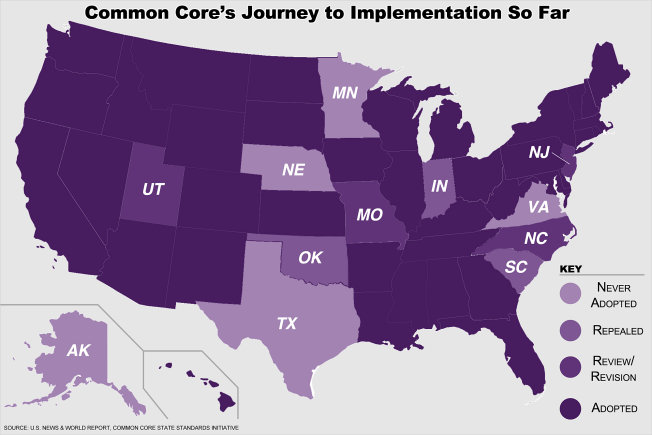
Implementation of Common Core/US News and World Report

Implementation of Common Core

THE VERDICT
In the past year significant political forces have targeted Common Core. The protests have been at near hysterical levels in many communities around the country. The complaints about Common Core are as follows:

  • Standards create a factory-like environment that attempt to put all students in one ‘box.’
  • Teachers focusing on test scores, not educational achievement
  • Parents don’t understand math methods
  • United States history under Common Core is un-American because it includes both positive and negative aspects of the history of our country
  • A belief that parents should define school curriculum, not the school, district, state, or federal government
  • A belief that President Obama is behind the implementation of Common Core and other conservative conspiracy theories

Many of the issues have been generated by conservative voices after a push by Republicans during the past election cycle to ignite anger and votes against public education. Almost all of the complaints would have occurred from any attempt to improve and refine American educational techniques, especially when those improvements involve standardization for all American schools.

If you believe that setting minimum standards in reading, writing, and math is bad, then Common Core is bad. If you believe that children in your community should graduate with similar skills to other students around the country, then Common Core is good. If you believe that a high school degree should be the end of a person’s education, then Common Core is bad. If you believe that every student should receive an education that would prepare them for college, then Common Core is good.

THE REAL PROBLEM
Despite the politicizing of Common Core, there is a real issue in implementing any change in education. Funding.

Any business that seeks to upgrade or improve their methods knows that there is a real cost to any change. Yet, even smart business people seem to forget that to improve our educational system requires a major funding commitment. It takes money to research and establish new programs. It takes money to train school districts, principals, and teachers. It takes money to create new teaching materials, and it takes money to educate parents.

What Common Core is missing is the funding needed to make it a success. Until we can accept the fact that a commitment to education requires a commitment to funding, then we will continue using 20th educational techniques in a 21st century world. America’s efforts to update our educational system will cost money and Common Core is a victim of a society that has abandon quality education because it costs too much.

THE HYSTERIA OF THE LOUDEST VOICES
Unfortunately, Common Core lost a lot of support in the past twelve months. Much of that was due to the political rhetoric during last year’s campaigns, but some teachers are also pulling back support. This is not surprising. As parents become more vocal in opposition, few teachers are willing to oppose parent sentiment even if they are wrong.

Common Core is not a perfect educational system, but it does attempt to better prepare America’s children for a higher level of achievement. Most of the real issues can be resolved with better funding. Just as a school built in the 1950’s is no longer relevant for 2015, education methods of the pre-information era are not relevant today. Our population is continuing to increase and the skills our children must have to thrive as adults are going to advance. Education is going to be expensive, but if we don’t pay now, we will pay more later.

PREVIOUSLY:  Part I:  A Primer in American Education 
                            Part II:  What is Common Core?

Common Core: Are You A Good Switch Or A Bad Switch? Part II

25 Wednesday Mar 2015

Posted by Paul Kiser in Aging, Business, College, Education, Ethics, Generational, Government, Government Regulation, Higher Education, History, parenting, Politics, Public Image, Public Relations, Taxes, Technology, Universities, US History

≈ Leave a comment

Tags

Asian learning methods, Common Core, K-12, learning, math, mathematics, New Math, No Child Left Behind, parent involvement in school, parent reactions, students

PART TWO: What is Common Core?

Cartoon in Chicago Tribune about parent reaction to Common Core

Cartoon in Chicago Tribune about parent reaction to Common Core

The Third Generation of Standardized Education
The basic premise of the George W. Bush (43rd President) administration’s No Child Left Behind (NCLB) mandate was that reading, writing, and math are fundamental to all learning. This is a sound concept; however, these basic skills cannot supplant other subjects traditionally taught in K-12 schools, nor can they be isolated from those subjects. Our society, both business and personal interactions, require an adequate understanding of a wide variety skills and knowledge that exceed the basic skills of reading, writing, and math.

Common Core is an attempt to refine the concept of NCLB by creating standards for all schools that focus on reading, writing, and math, but it also folds these skills into other subjects that impact personal success in the 21st century. Common Core emphasizes teaching methods and outcomes, but leaves it to the State, school district, and school on how to incorporate the program into the curriculum.

Why Some Parents Dislike Common Core Math
Some of the methods adopted by Common Core have angered parents and politicians. In particular, the approach to teaching math. The math issue centers on bewildered parents who don’t understand the revised math teaching methods and why equations seem to be more complicated than when they attended school. The assumption by parents is that whatever they were taught is good enough for their children; however, that is not necessarily true.

Almost every adult in this country was taught that the symbol for a number (e.g.; ‘7’) was everything we needed to know about the number that it represents. We were taught to memorize how the symbol ‘7’ multiplied by the symbol ‘9’ equals the symbol ’63.’ That teaching method does not mean that the student understands that ‘7,’ ‘9,’ and ’63’ are symbols representing a group of objects. 

This is a subtle, but important understanding in math functions. The equation ‘7 x 9 = 63,’ means that we are taking a group of seven objects, adding eight more groups of seven, and determining the total of objects. That is much more complicated than just memorizing that 7 x 9 = 63, but it helps us realize that multiplication is a shortcut to manually counting out 63 objects individual, rather than grouping them.

The weakness of memorization of relationships between symbols also creates confusion as a student moves into higher mathematical equations. In algebra, geometry, and calculus the numeral symbols become less relevant. For example, X = (X+1) and Y = (X-3) can be confusing because ‘X’ stands for EVERY number.

The Credit Card Example
A man is given ten credit cards, but he is NOT told that each credit card represents an amount of money in the bank and, that if used, the money is replenished the next day. He is told how to use each credit card. One card is to buy gas, one to use at the grocery store, etc. Today, he’s at the gas station and it so happened that two of his friends are already there. He decides to pay for his friend’s fuel, which they appreciate. They go on their way, but when he tries to pay for his fuel, the credit card is declined. He didn’t understand that the card represented a limited amount of money, he just assumed it could be used for any amount of fuel. That is similar to how math has been taught in the past. We may have known what to do with the numbers (symbols,) but we may not have fully understood that numbers are just symbols.

Good News, Bad News
Parents objections to the new math teaching methods are a good sign that our children are gaining a deeper understanding of mathematics than their parents did in school; however, parents need to be able to assist their children with homework.¹ This means parents need to be taught the new methods, but few if any schools have developed programs to teach parents because there is no funding available to accomplish the task.

Who Came Up With the Common Core Math Techniques?
Despite the belief that Common Core math techniques were invented in the past few years, the techniques were modeled off educational programs in certain Asian countries where they have been more successful at preparing students for college. In 2009, a coalition of State Governors and Educators worked together to build an educational program that would serve as a ‘best practices’ guide for American schools, which was the birth of Common Core.

NEXT:  Part III:  An Answer to the Question – Good? or Bad?
PREVIOUSLY:  Part I:  A Primer in American Education 

¹Most studies indicate that students perform better when parents are involved in their children’s education. At the very least it indicates to the child that their parents place a high value on becoming educated.

Common Core: Are You A Good Switch Or A Bad Switch? Part I

24 Tuesday Mar 2015

Posted by Paul Kiser in Aging, College, Education, Ethics, Generational, Government, Government Regulation, Higher Education, History, Information Technology, Internet, parenting, Politics, Pride, Public Image, Public Relations, Taxes, Universities, US History

≈ Leave a comment

Tags

classroom, college graduates, Common Core, Education methods, federal mandates, George W. Bush, graduation rates, high school graduates, job standards, K-12, NCLB, No Child Left Behind, President Barack Obama, Race to the Top, school districts, school vouchers, students, teachers, Teaching, Teaching methods, Teaching standards

School's should welcome diversity of ideas but shouldn't tolerate political agendas

School’s should welcome diversity of ideas but shouldn’t tolerate political agendas

PART I: A Primer in American Education

Who’s Afraid of Common Core?
Education in America is often the centerpiece of someone’s agenda, and the newest chapter of the how-to-fix-our-schools controversy is called Common Core. Conservatives have apparently decided that Common Core is the path to Satan. Liberals have reservations about Common Core because it smacks of a factory-like environment that assumes every student and school is the same.

The problem is that the most vocal critics of Common Core have no authority to speak on effective educational methods. Common Core is a significant paradigm shift in education, and opinions of untrained, uneducated, unhelpful ‘experts’  do nothing to move forward the debate on how best to prepare our children for Life 3.0.

The Cost of Achievement
In 1950, only one-third of the population in the United States had a high school degree or better, and only six percent had a college degree or better. In 2010, almost ninety percent of Americans had at least a high school degree, and thirty percent had at least a college degree. That increase is impressive, but what is astounding is that in the same sixty year time frame, America’s population doubled. 

To accomplish that feat cost money. A lot of money. As the bandwagon to attack government spending gained steam, education loomed large in the sights of conservatives. The real cost of the success of American educational achievement has been to become a target of the post-Reagan  agenda.  

Public school in Panama: Seeking to achieve the American dream

Public school in Panama: Seeking to achieve the American dream

A Historical Perspective
In the pre-Information age, schools were isolated in their own districts. How well the students of any given school performed was a local issue, not a state or national issue. In addition, a relatively small percentage of students sought out a college degree, and there were few school districts keeping track of college bound students.

The goal for most school districts in the 1960’s, 70’s, and 80’s was graduate as many students as possible, which sometimes opened the door to unethical practices, such as giving diplomas to students who clearly did not meet reasonable expectations (ability to read, write, etc.) to graduate.

However, by the 1990’s, the idea that all schools in the United States should be able to measure academic success through a unified set of academic standards began to take hold. As the Internet became the backbone of our society, the resulting information explosion forced us to accept that adequate math and reading skills were vital for success as an adult in a technologically advanced society. 

First Generation of Educational Standards
By the beginning of this century, plans had been put into motion to establish a set of educational standards for all schools and testing of all students to determine a school’s success or failure. Under President George W. Bush, the No Child Left Behind Act of 2001 (NCLB,) was mandated and it required States to establish standardized testing, teacher qualifications, and annual academic progress reporting. This was one of the most sweeping federal intrusions into public education. The primary focus of NCLB was to improve reading, writing, and mathematics in schools nationwide, while allowing States to establish the educational standards that would have to be met.

The catch was that rather than investing in those schools that needed help, No Child Left Behind focused on punishing schools that didn’t meet the artificial standards. Almost ever reputable educational review of NCLB  has given it a failing grade. Some of the reasons are as follows:

  • The emphasis on reading, writing, and math during a time when States were cutting funds for kindergarten through twelfth grade (K-12) created a shearing effect on other programs (language, history, music, arts, etc.) as money had to be reallocated to the studies under the NCLB Act.
  • Politicians had little understanding of education and the variables in a classroom environment and they attempted to apply factory-like operations to school systems that failed to address the real issues that impact the ability to learn.
  • NCLB assumed that teachers were mostly at fault for poor educational performance and politicians sought to intervene by imposing punishments for schools rather than actually acting in the best interest of the students.
  • The education of higher performing students was sacrificed in order to devote more resources for the poorer performing students.
  • Students with special needs were not excluded from the testing standards creating a population of students that automatically counted as failing against the school.

Educational Standards – Second Generation
Soon after taking office, the Obama administration began to move away from NCLB by introducing “Race to the Top.” This program flipped NCLB by seeking to reward States for adopting standardized programs rather than punishing them for not meeting federal standards. States competed for additional federal education funding; however, not every State rushed to play the game that offered no guarantee of financial carrot at the finish line.

The most searing problem with Obama’s Race to the Top program may have been the requirement that a teacher’s performance had to be linked to the student’s test scores. This concept of Pay For Performance suggests that teaching professionals must be threatened with a financial stick, forcing teachers to teach students to be successful on the tests by sacrificing all other educational values. It also discourages teachers from working with groups of challenging students who will not be able to produce the test results of more privileged and economically stable students.

NEXT:  Part II:  What is Common Core?
To be published Wednesday, 25 March, 0700 PDT/1400 UTC

NEXT NEXT:  Part III:  An Answer to the Question – Good? or Bad?
To be published Wednesday, 25 March, 1200 PDT/1900 UTC

How to Choose Your Favorite Son or Daughter

20 Saturday Dec 2014

Posted by Paul Kiser in Aging, Lessons of Life, parenting, Pride, Relationships

≈ Leave a comment

Tags

children, Colorado, daughter, Denver, Favorite child, love, Nevada, offspring, parent, Parent Development, parenting, Reno, son

And the favorite child is?

And the favorite child is?

Every family that has more than one child faces a question as to which one is the favorite child. When asked, a parent will typically say, “They’re all my favorite,” which is BS and we all know it. Every parent should be able to know which child is their favorite, even if they can’t be honest about it.

Evaluating Your Offspring

Trying to determine which is your favorite is not as easy as it sounds. Flight attendants giving the pre-flight safety briefing on Southwest Airlines sometimes encourage parents of flying with more than one child to determine which child has the best earning potential in case they have to choose one to give oxygen in the event the cabin depressurizes. This is funny the first 20 times you hear it, but that doesn’t stop  them from delivering the joke 100 hundreds of times.

However, earning potential is a poor criteria for determining a favorite child…unless you have a binding contract that gives you a kickback as a quid pro quo for favorite child status. Quite frankly, successful adults often start out as horrible offspring, so I would not use earning potential as a factor.

Ease of child-rearing is also not a reliable criteria. Often it is the badly behaved child that teaches us the most about ourselves and our skills as a parent. Bad children can also become grateful adults, although one shouldn’t bank on that either.

Children who are ‘Mama’s boy’ or ‘Daddy’s girl’ should not be considered as an indicator of favorite child status. Sweet young children can become Satan’s spawn as teenagers, leaving the parent to wonder what they did wrong…as if the parent is at fault.

Children who remain in constant contact, calling their Mom or Dad daily, may seem like candidates for the favorite child, but this stalking technique is illegal in most states, so it doesn’t seem prudent to consider it as a factor?

So how does a parent determine the favorite child?

I have two adult daughters and a nine-year-old son. My daughters have successful lives, wonderful children and selected husbands that are more intelligent than their (my daughter’s) father. My son works hard to do his best and constantly impresses me with his development out of conservative it’s-all-about-me behavior into liberal, make-the-world better behavior. It would seem I would have a difficult time choosing the favorite….

….but I don’t.

The secret to choosing your favorite child is remembering that life is made up of moments. Every moment (in person or by phone or text) with one or more of my children is a moment with my favorite child or children. Our offspring don’t often understand why ‘family gatherings’ are so important to parents because they don’t realize that it is a time when a parent is rich with favorite children.

This doesn’t mean any of our children fall out of favor just because they are not with the parent at any given moment. Children are part of a parent’s life at all times, but when we have the opportunity to interact with our children, the moment is special.

Children are our legacy and we can move on in our lives reassured that we have accomplished all we needed to when we have raised a child. Our offspring become the painting of life we create as parents.We are artists and when we spend time with our children we can admire the grace and creativity of work that we did without a manual, training or degree. We can’t take credit for everything our children become, but we can smile and be content in that role we played in their lives….even if they don’t realize it.

This holiday season, remember to enjoy your favorite child and know that you are not limited to just one. Happy Holidays!

A Glimpse of Education in Panama

22 Saturday Nov 2014

Posted by Paul Kiser in Customer Relations, Education, Information Technology, Internet, parenting, Passionate People, Technology, Travel

≈ Leave a comment

Tags

Centro Educativo, children, Coronado, Educacion, elementary school, Panama, parenting, San Jose, school

2014NN_119DSC_0129 (2)

The Principal in the classroom in Panama

Teaching children is a challenge anywhere in the world. Culture, government, and environment all affect the quality of education. Still, it seems that the foundation of any great school is the dedication of the staff to the students.

Recently I was on my second visit to a community about 90 km (60 mi.) from Panama City, Panama. While in the area I decided to research their education system by dropping in on a local school, the Centro Educativo San Jose elementary school.

It should be noted that to truly understand the education system in Panama, I should first be proficient in Spanish, and second, I should visit multiple schools, both private and public, over a period of weeks or months. A thirty minute conversation with the Principal, who does not speak English, and a teacher acting as my interpreter is only enough to give a first impression.

However, there are clues about the quality of education that are instantly obvious and transcend language barriers.

2014NN_100DSC_0118 (2)Laughing children. It is difficult to bridle the enthusiasm of children, but some schools seem to manage to stifle the joy of childhood. Centro Educativo San Jose has not made this mistake. At this elementary school the children were well-behaved, but laughing and smiling. It was obvious they understood discipline, but they were obviously happy to be at school.

Panama celebrates Thanksgiving

Panama celebrates Thanksgiving

Helpful children. When I arrived I first met an adult with several children. I wasn’t sure of her role in the school (she may have been a parent,) but when I asked if she spoke English, she said, “No.” Instantly a young girl at her side pointed at one of the teachers and indicated she spoke English, then the girl quickly ran to the teacher and brought her to me. This girl knew she could help and did so without hesitation. That tells me that the school encourages critical thinking that empowers children with the ability to respond quickly to a situation.

Professional Staff. In the tropics the temperature is near 30° C (86° F) year round and the humidity wraps around you like a wet towel. There is no air conditioning at this school and any breeze is welcome in the classroom. Despite these environmental conditions, the staff at the school looked and acted professional.

What I learned during my visit surprised me. The students have access to computers and they have a ‘Technology Room” filled with computers. I couldn’t tell if the computers were connected to the Internet; however, I did not expect an 80 year-old public school to have dozens of desktop computers with flat screen monitors.

This school is funded by government support, which limits the per/student resources; however, most schools in Panama are private where parents pay $1,500 to $3000 per year for tuition.

Many schools in Panama operate double sessions with one group of students attending in the morning and another attending in the afternoon. At this school the morning session is 7 AM to 12 Noon, and the second session is 12 Noon to 5 PM.2014NN_120DSC_0130 (2)

While most private schools are open twelve months a year, public schools are in session March through December, and have ‘summer’ break in January and February.

I asked about homework and parent involvement and heard what I expected. Once the students leave the school they are not expected to do homework and parents are not typically involved in assisting the staff in school. In an environment of low pay and long working hours, parents likely have no time to be involved in their children’s education.

I was told the biggest challenge is teaching English to the students. The impact of being bilingual is significant in a working adult’s life in Panama, and anywhere else. Yet, It is hard to explain that to a child in rural Panama whose only encounter with another language is in the school.

I’m grateful to have the opportunity to visit the school, and hope to do it again the next time I’m in Panama. I apologize to the Principal and the teacher who interpreted for me. I failed to write their names down before I left. Both graciously gave me valuable time out of their schedule and I appreciate it.

It was a pleasure meeting dedicated professionals who are changing lives every day by caring about the future of the students in their school.

Espanol Version (Using Google Translate)

Enseñar a los niños es un desafío en cualquier parte del mundo. Cultura, gobierno, medio ambiente y afectan la calidad de la educación. Aún así, parece que el fundamento de cualquier gran escuela es la dedicación del personal de los estudiantes.

Hace poco estuve en mi segunda visita a una comunidad a unos 90 km (60 mi.) De la Ciudad de Panamá, Panamá. Mientras que en la zona me decidí a investigar su sistema educativo por meterme en una escuela local, la escuela primaria Centro Educativo San José.

Cabe señalar que para comprender verdaderamente el sistema de educación en Panamá, que primero debería ser competentes en español, y en segundo lugar, que debe visitar varias escuelas, tanto públicas como privadas, en un periodo de semanas o meses. Una conversación treinta minutos con el director, que no habla Inglés, y un profesor que actúa como mi intérprete sólo es suficiente para dar una primera impresión.

Sin embargo, hay pistas sobre la calidad de la educación que son inmediatamente obvias y trascienden las barreras del idioma.

Niños de risa. Es difícil de frenar el entusiasmo de los niños, pero algunas escuelas parecen manejar a silenciar la alegría de la infancia. Centro Educativo San José no ha cometido este error. En esta escuela primaria los niños estaban bien atendidos, pero riendo y sonriendo. Era obvio que entendían la disciplina, pero eran obviamente feliz de estar en la escuela.

Niños útiles. Cuando llegué por primera vez a un adulto con varios hijos. Yo no estaba seguro de su papel en la escuela (que puede haber sido uno de los padres), pero cuando le pregunté si hablaba Inglés, dijo, “No.” Al instante una chica joven a su lado señaló a uno de los profesores y indica que hablaba Inglés, entonces la chica corrió rápidamente a la maestra y la trajo a mí. Esta chica sabía que podía ayudar y lo hizo sin dudarlo. Eso me dice que la escuela promueve el pensamiento crítico que permite a los niños con la capacidad para responder rápidamente a una situación.

Personal Profesional. En los trópicos la temperatura es de cerca de 30 ° C (86 ° F) durante todo el año y los abrigos de humedad a su alrededor como una toalla húmeda. No hay aire acondicionado en esta escuela y cualquier brisa es bienvenida en el salón de clases. A pesar de estas condiciones ambientales, el personal de la escuela parecía y actuaba profesional.

Lo que aprendí durante mi visita me sorprendió. Los estudiantes tienen acceso a computadoras y tienen un ‘Room Tecnología “lleno de computadoras. No podría decir si los equipos estaban conectados a Internet; Sin embargo, no esperaba un 80 años de edad de escuelas públicas para tener docenas de computadoras de escritorio con monitores de pantalla plana.

Esta escuela está financiado por el apoyo del gobierno, lo que limita los recursos per / estudiante; Sin embargo, la mayoría de las escuelas en Panamá son privadas donde los padres pagan $ 1.500 a $ 3000 por mes para la matrícula.

Muchas escuelas en Panamá operan sesiones dobles con un grupo de estudiantes que asisten por la mañana y otra que asisten por la tarde. En esta escuela la sesión de la mañana a 7 de la mañana a 12 del mediodía, y la segunda sesión es de 12 del mediodía a 17:00.

Aunque la mayoría de las escuelas privadas están abiertas los doce meses del año, las escuelas públicas están en sesión de marzo a diciembre, y tienen descanso “verano” en enero y febrero.

Le pregunté acerca de la tarea y la participación de los padres y escuché lo que me esperaba. Una vez que los estudiantes salen de la escuela a la que no se espera que hagan los deberes y los padres no suelen participar en la asistencia al personal de la escuela. En un entorno de bajos salarios y largas horas de trabajo, los padres probablemente no tienen tiempo para participar en la educación de sus hijos.

Me dijeron que el mayor desafío es la enseñanza de Inglés a los estudiantes. El impacto de ser bilingüe es importante en la vida de un adulto que trabaja en Panamá, y en cualquier otro lugar. Es difícil de explicar que a un niño que sólo el encuentro con otro idioma es en la escuela.

Fue un placer conocer a los profesionales que están cambiando vidas todos los días por el cuidado por el futuro de los estudiantes en su escuela dedicada.

Reno’s NBC Affiliate Runs Anti-Union Press Release As News

09 Wednesday Apr 2014

Posted by Paul Kiser in About Reno, Branding, Business, Communication, Customer Relations, Customer Service, Education, Ethics, Government, Management Practices, Opinion, parenting, Politics, Pride, Public Image, Public Relations, Taxes, Traditional Media

≈ Leave a comment

Tags

KRNV, labor unions, MyNews4, Nevada Policy Research Institute, NPRI, On Your Side, SBGI, schools, Shelby Sheehan, Sinclair Broadcast Group, teacher's unions, Washoe County School District, WCSD

Taking another step away from journalism, KRNV co-anchor Shelby Sheehan presented a press release from the conservative Nevada Policy Research Institute (NPRI) as news during the April 7th 6 PM broadcast. In what has been an almost nightly anti-government feeding frenzy, the NBC affiliated station, managed by Fox News operator, Sinclair Broadcast Group (SBGI,) announced that according to NPRI, 168 educators left the Washoe County teacher’s union.

Image by Paul Kiser from KRV newscast

Conservative NPRI spokesperson, Shelby Sheehan

Sheehan introduced the story by admitting that NPRI has a statewide campaign against the teacher’s union and they are:

“...letting teachers know when and how they can leave (the union,) so many are doing just that…”

The KRNV veteran anchor briefly mentions that the two percent loss in membership occurred in the Summer of 2013, and then wraps up the NPRI media release by suggesting that more teachers want to leave, but can’t because:

“…once they (the teachers) do (join the union) they only have a short period of time to get out of their membership, which they say (NPRI) prevents more teachers from leaving.”

Sheehan’s sole source for the story was NPRI, which is an anti-government think tank that, among other conservative agendas, is anti- public school and pushes for school vouchers and charter schools. They represent the polar position against unionized teachers. 

Other than her paraphrasing the information given to her by NPRI, Sheehan reported no information or statements from a teacher, the union, nor an independent source. She apparently didn’t even question NPRI’s information, nor why they were just now releasing data that was almost a year old.

NEXT:  Sinclair’s Survey of Shame (To be released 9 April 2014 at 6:30 AM PDT)

University of Nevada Student Housing Gamble a Lose-Lose Scenario

10 Monday Mar 2014

Posted by Paul Kiser in About Reno, Business, College, Communication, Education, Ethics, Government, Higher Education, Management Practices, parenting, Politics, Public Image, Public Relations, Respect, Taxes, Universities

≈ Leave a comment

Tags

Balfour, California universities, construction, dormitories, dorms, housing prices, New student housing, President Marc Johnson, Ranking, realty, Sterling, student beds, Top 500 International Universities, University of Nevada, UNR

University of Nevada betting on more live-in students

University of Nevada betting on more live-in students

The University of Nevada in Reno (UNR) is about to flood the local housing market with almost 1500 new student beds. The growth comes at a time when higher education expenses have been skyrocketing and the assumption is that there is an untapped source of new students who have the resources to pay even more to attend and live near UNR.

UNR Published Enrollment Data and Projections - Nov 2013

UNR Published Enrollment Data and Projections – Nov 2012

In October, University President Marc Johnson predicted that the school would grow Fall enrollment from the current 18,000 students to 22,000 by 2021 with an annual growth of 400 students per year. President Johnson’s prediction closely matches the average growth in student enrollment over the past fourteen years; however, this growth assumes every new student will be seeking on campus, or near campus housing, which is implausible.

Ironically, eleven months prior to the President’s remarks, the university published past and projected student enrollment growth that contradicted his version of UNR enrollment growth. The projected growth averages less than 300 students per year, falling over 1,000 students short of President Johnson’s 2021 prediction. The November 2012 data remains on the UNR website.

Expecting significant growth in student enrollment is betting against the odds according to a July article in the New York Times (July 25, 2013)

“College enrollment fell 2 percent in 2012-13, the first significant decline since the 1990s, but nearly all of that drop hit for-profit and community colleges; now, signs point to 2013-14 being the year when traditional four-year, nonprofit colleges begin a contraction that will last for several years.“

900 bed Sterling student apartments will open this Fall

900 bed Sterling student apartments will open this Fall

Outcome of Sudden Increase in Student Beds
One of two scenarios are possible as the university waits for new enrollment. The first scenario involves new beds remaining empty as students balk at the increased rental fees for the new properties. This will result in a loss in revenue for the university and the leasing companies of the new housing units.

The second scenario would be that students in rental houses and apartments, move into the newer facilities, which would devalue the current leasing rates in the local economy as the vacancy rate rises. The reaction by some investment properties owners might be foreclosure as owners walk away from money-losing properties.

UNR Losing Reputation as Quality School
President Johnson may be relying on picking up students from California due to large increases in tuition costs increases in recent years; however, the belief that the quality of education at UNR is of equal value to California schools assumes that students and parents are uninformed. 

View of UNR's dormitory row to be joined by new 400 bed unit in 2015

View of UNR’s dormitory row to be joined by new 400 bed unit in 2015

In 2003, UNR, Georgetown, Utah State, and San Diego State University ranked in the top 300 of Shanghai Ranking Top 500 Academic Ranking of World Universities. UNR’s ranking dropped almost every year, and dropped off the top 500 list for the last two years in a row. The other three universities also dropped; however, Georgetown and San Diego State ranked only slightly lower during the past two years than in 2003, and Utah State dropped out of the top 500 in 2011, but has been in the top 500 for 2012 and 2013. In 2013, California had eleven universities in the top 500, with eight in the top 50.

A silver lining to the Silver State's UNR?

A silver lining to the Silver State’s UNR?

Silver Lining?
While the need for this surge of student housing is questionable at best, will result in student beds at higher prices than currently available, and may trigger a local foreclosure crisis, there may be a positive outcome for the university neighborhoods.

If students leave the rental houses, causing a crash in rental prices, and if owners of investment properties walk away from their rental units, the area housing prices will drop. That will open the door for the redevelopment of the sixty-year-old neighborhood with updated houses that would attract families back to the area.

There is much at stake over the next five years for students, homeowners, investment property owners, and the community in general as UNR takes a big risk on short odds.

The Seduction of Anger

03 Monday Mar 2014

Posted by Paul Kiser in Aging, Business, Communication, Crime, Crisis Management, Customer Relations, Ethics, Generational, Health, Human Resources, Lessons of Life, Management Practices, Opinion, parenting, Politics, Public Image, Public Relations, Relationships, Respect, Violence in the Workplace, Women

≈ 2 Comments

Tags

Anger, anger addict, anger management, angry, rage, Violence

Anger sucks you in, then eats you up

Anger sucks you in, then eats you up

I have noticed something about people (including myself) and anger. For most of us, anger is seductive. Despite popular belief, it feels really good to get angry. There is pleasure in it. Yelling and screaming, ranting, and losing control is self-satisfying. We let go of the constraints of good behavior as we explore the limits of bad behavior.

Often, our anger follows a logical thread, but anger doesn’t need logic to fan the flames. When we’re angry we choose facts based on how well they support the reasoning we want, not what is reasonable. We also look to find old issues that our compromising or humiliating to the person we are arguing with, in order to verbally attack their vulnerabilities.

In the heat of our anger we feel powerful because we see ourselves as righteous and pure in our cause for perceived injustices. Anger gives us license to ignore anyone else’s viewpoint because they don’t agree with you, therefore, they must be wrong.

How To Respond To Anger
Ignoring someone’s anger is not a solution. Ignoring an angry person enables him or her through a belief that the behavior is appropriate. Direct confrontation with the person is also inappropriate as it is likely he or she is not rationale, nor are they interested in a logical discussion.

If it is appropriate, a person expressing overt anger can be removed from the situation providing they can be paired with a calm, non-threatening person while they de-escalate. If that is not appropriate and the person seems capable of harming themselves or others, another tactic is to become their ally. Agreeing with them and helping them to make a plan of addressing the issues causing the anger may defuse them long enough to disengage from the anger.

This tactic cannot be sarcastic, nor condescending in any way. It may also require lying to the person; however, if physical harm is a possibility, lying is a small price to pay to avoid someone becoming hurt. Once you have lied to a person who is angry, you may have damaged the relationship beyond recovery, so it should not be done unless all other options have been exhausted.

Once out of the situation, the person should be directed to counseling. It may be helpful to see an angry person as an addict who turns to rage for their high, and just like an addict, the person needs expert help to disconnect from the need for a fix.

Exposing a Bully is Not Bullying

02 Sunday Mar 2014

Posted by Paul Kiser in Aging, Branding, Business, Communication, Crisis Management, Customer Relations, Customer Service, Education, Employee Retention, Ethics, Generational, Honor, Human Resources, Internet, Lessons of Life, Management Practices, Opinion, parenting, Pride, Public Image, Public Relations, Relationships, Respect, Social Interactive Media (SIM), Social Media Relations, Women

≈ 5 Comments

Tags

bully, bullying, Dr. Peggy Drexler, Kelly Blazek

During this past week much has been written (including myself) about the case of a person in a position of power, Kelly Blazek, the gatekeeper of a Cleveland, Ohio jobs listing for marketing positions, writing a nasty email to a job seeker. Blazek’s language in the email was unyielding in her attempt to embarrass and humiliate the job seeker. Blazek was using her power to bully someone who was in an inferior position.   

Therefore, I was shocked when I read an ‘Opinion‘ on CNN.com by Dr. Peggy Drexler, who wrote that by publicizing the email and seeking attention to the bullying, the job seeker:

“….acted with malice, and caused the older woman significant damage…”

The specific language suggests that Dr. Drexler is encouraging Blazek, the person who was the bully, to sue the victim on the grounds of malice, libel, and/or age discrimination. One might question as to whether Dr. Drexler’s motives were that of an ambulance chaser, seeking to be employed by Blazek as an ‘expert’ witness in a civil suit.

Dr. Drexler’s opinion piece did describe the nature of Blazek’s email; however, she softened Blazek’s misdeeds by saying:

“Blazek’s words were, of course, undeniably, and likely unnecessarily, harsh”

In her opinion piece, Dr. Drexler masterfully works around the most blatant language in Blazek’s email and, in at least one place, segmented the quoted language so that the most vicious remark doesn’t look like it was the climax of the rest of the paragraph. She also uses Blazek’s “Communicator of the Year” recognition as a reference of her skills, rather than the irony that is obvious after reading a complete version of Blazek’s blistering email. The most damning paragraph from Blazek’s email is missing from Dr. Drexler’s opinion:

“I suggest you join the other Job Bank in town. Oh wait — there isn’t one.”

Dr. Drexler admits that Blazek’s behavior was wrong:

“No question, Blazek lashed out first, with unprofessional behavior that can only be described as bullying.”

However, Dr. Drexler seems to enable Blazek’s behavior by accusing the job seeker:

“But Mekota responding in kind makes her no less a bully.”

In Dr. Drexler’s world, when bullied, sit back and take. Don’t fight back and don’t call out the bully. Other professionals have a different take on how to respond to a bully. In responding to adult bullying, Mental Health Support (from the United Kingdom) suggests the following :

“…if you find yourself the victim of bullying, a bully’s bad behaviour is entirely his or her responsibility, not yours,…”

The website goes on to say:

“Once you have identified a bully and know what to expect from him or her, you must choose not to be a victim, if you want the bullying to stop. Expose the bullying for what it is. Take a stand, and don’t back down…”

“…The important point here is to expose the bully and call him or her to account. Confrontation and exposure, with evidence to support a victim’s accusations, are what the bully tries hardest to avoid. Once exposure happens, the bullying is likely to stop.”

There was an injustice done to Ms. Blazek, but that was from Dr. Drexler in attempting to sanctify Blazek’s behavior by accusing the job seeker of an equal act. Dr. Drexler’s portrait of Blazek as the older woman, victimized by the young, evil job seeker, causing her to lose her career and disappear from social media is absurd. The job seeker did not write the email, nor did she make the decision to shut down Blazek’s websites and social media accounts. Blazek was in the wrong and the damage to her career rests solely in her hands.

Armed Teacher Games

13 Thursday Feb 2014

Posted by Paul Kiser in Crime, Crisis Management, Education, Ethics, Government Regulation, Health, Higher Education, Lessons of Life, Opinion, parenting, Politics, Universities, Violence in the Workplace

≈ 2 Comments

Tags

2nd Amendment, active shooter, Active shooter scenarios, Arming Teachers, elementary school, gun laws, gun rights, K-12, law enforcement, National Rifle Association, NRA, school, school violence, War Games

SHALL WE PLAY A GAME?

ARMED TEACHER SCENARIOS

STUDENT DISCOVERY
First grader finds hiding place of gun when teacher isn’t looking and pretends to shoot friend not realizing he’s released the safety. Kills the student. WINNER:  NONE

STUDENT WITH INTENT
Student learns where teacher keeps gun. One day student is despondent and decides to commit suicide and take others with him. Kills teacher, kills two students, kills self. WINNER:  NONE

DESPONDENT TEACHER
Teacher despondent after a series of life-changing events. Takes out gun and shoots self in front of classroom. Teacher dead. WINNER:  NONE

LOUD NOISE
Teacher responds to loud noise in hallway. See a person with a gun and shoots them. Other person is another teacher with a gun also investigating the loud noise. Teacher dead. WINNER:  NONE

STUDENT WITH GUN
Teacher sees a student with a gun. Accesses gun and yells at student to drop weapon, student turns, teacher shoots the student. Student was taking prop fake gun for school play back to office to be secured. Student dead. WINNER:  NONE

ACTIVE SHOOTER CONFRONTATION
Teacher hears popping in hallway. Accesses gun and opens door. Active shooter with assault weapon shoots teacher, enters open classroom door, shoots students who have no time to hide or escape. Teacher dead, 25 students dead. WINNER:  NONE.

OK CORRAL SHOOTOUT
Teacher hears popping noise in hallway. Accesses gun as shooter enters classroom. Gun battle ensues resulting in Teacher, shooter, and several students killed. WINNER:  NONE.

ACCIDENTAL DISCHARGE
Teacher hears popping noise in hallway. Accesses gun. Begins to quietly evacuate students to safety, but accidentally discharges gun and shoots one of the students. WINNER:  NONE

ACCIDENTAL POLICE SHOOTING
Teacher hears popping noise in hallway. Evacuates students to safe area and returns classroom. Accesses gun. Identifies shooter. Kills shooter. Police enter, see a person with gun and orders the person to drop their gun. Person turns, police shoot and kill teacher. WINNER:  NONE.

STRANGE GAME. IT SEEMS THE ONLY WAY TO WIN IS NOT TO PLAY.

Hey Stupid, Privacy is Dead and Your Face is the Reason

31 Tuesday Dec 2013

Posted by Paul Kiser in Communication, Crime, Crisis Management, Customer Relations, Ethics, Generational, Government, Honor, Information Technology, Internet, Lessons of Life, parenting, Photography, Public Relations, Relationships, Respect, Social Interactive Media (SIM), Social Media Relations, Technology

≈ Leave a comment

Tags

Anthony Weiner, Biometrics, face, Facebook, facial recognition software, Facial recognition system, Ohio, on line, Privacy, Twitter

Facial recognition software is the final nail in Internet privacy

Facial recognition software is the final nail in Internet privacy

Go ahead, just try to protect your privacy. Give up Facebook. Scoff at Twitter. Swear you’re going to never sign on the computer again. It is all useless.

Stick a fork in privacy on the Internet. There no such thing as privacy on the Internet, nor is there privacy off the Internet.

A girl decides to check up on her boyfriend. She happens to be an attorney in Ohio and has access to the State’s facial recognition software. She uses it to snoop on her boyfriend and other people her friends were dating. This was in 2008. Five years ago and she was using (well, misusing) facial recognition software that was meant for finding criminals.

It doesn’t matter whether you take the picture or post it. It doesn’t even matter if you knew you were in the picture. New Years Eve? Good luck in keeping your face out of every picture that people around you take. If your face shows up in a posted picture, it can be found and matched. 

Not only law enforcement is using facial recognition software. Casinos are using it. Some suggest that Disney is using it in their parks. Retailers are using it. Your significant other can buy it and download it today. If you want to see how deep the rabbit hole goes, watch this TED Talk on facial recognition software.

Anthony Weiner: Too bad it wasn't his face that got him in trouble

Anthony Weiner: Too bad it wasn’t his face that got him in trouble

There is no such thing as privacy. One more time. There is no such thing as privacy.

THE ANSWER
Behave. That’s it. Or at least know that if you don’t behave everyone will find out and it will be at the worst possible moment for you. People learn how to behave when they go out in public. The Internet is public. There is no difference.

Five Rules For Taking Images of Your Children

01 Monday Jul 2013

Posted by Paul Kiser in About Reno, Lessons of Life, Opinion, parenting, Photography, Random, Recreation, Technology

≈ 2 Comments

Tags

camera, children, D60, digital, Family, how to, Image, Nikon, photo, pictures, portrait

Alexander and JasmineI’m an image horse. From my first film-hungry Nikon FM in the 1970’s to the inexpensive, but utilitarian digital Nikon D60, I’ve recorded life through my camera lens. I’m not a professional, but I’ve logged years with landscape, micro, macro, stellar, animal, model, and most other forms of photography.

The one type of photography I dislike most is the type that parents love to do, take semi-posed pictures of people. Every time I hear a parent say, “Smile! Smile! Come on, SMILE!,” I cringe. I don’t know who started the “Smile” prompting, but it is the worst thing anyone can ask of the subject of an image to do. It is saying to the child (or adult), “We want you to fake an emotion so we can show you faking an emotion to other people.”

Humans don’t fake emotions well. In fact, we are horrible at faking emotions. Children are the worst. A fake smile is marked by a tight facial expression around the mouth, bared teeth, and cringed eyes. Unfortunately, the people who take these horrible images are often rewarded by comments like, “Oh, he looks so handsome,” or “They look like they’re having such a great time!” Of course people are going to compliment your picture-taking ability, they want it to end!

This doesn’t mean people need to take sad or “how-long-do-I-have-to-stand-here?” pictures. There are a few simple rules that will avoid taking fake pictures of people you love.

Image Composition is YOUR Job, Not Their’s
Instead of going for the posed shot, which everyone hates to be involved in, position yourself so that you can take a REAL image of what is happening. From talking to playing children (and adults) in action are much more interesting than a posed shot. You want a recorded image of people engaged in life, not the camera, so you must do the work required of any good photographer, not them.

Does Fake Happy Really Tell The Story?
Sometimes children can be intensely focused on a task, or interacting with others. WHY would you want to stop this intensity and fake a smile for the image? Take the picture that tells the story instead of the fake happy picture that makes them look stupid.

If You Demand Happy, Make It Real
Okay, happy children can be a great image, but if you must have that type of image, make them laugh naturally. Ask questions like, “who’s the stupidest person with a camera?” When they laugh and point at you, take the picture. I guarantee that image will be better than the one where you said, “Smile!”

Be Unseen and Patient
It’s almost always better to hang around for a while before you take the picture. Look for the best composition, the best angle, and become part of the background. They may notice you, but children attention spans are marvelously short and they have a Jedi-like power to ignore a parent, so use that to your advantage.

It’s Digital, Take Lots of Images, Select Few
People sometimes think that every image should be perfect. I’ll admit, in the days of film cameras, when I got my photos back from the developer I used to feel guilty about all the failed images; however, today they are just digital bytes and bad pictures can be deleted. Take ten images and consider yourself a great photographer if there is one good one in the bunch.

Here’s one thing to consider the next time you see someone point a camera at another human:  if they say ‘Smile!’ it’s going to be a bad image.

Is It Time For A Two-Tiered School System?

12 Tuesday Mar 2013

Posted by Paul Kiser in Education, Ethics, Government, Management Practices, Opinion, parenting, Politics, Relationships, Respect, Taxes

≈ 2 Comments

Tags

elementary education, Parent Development, parent involvement in school, parents, Pay for Performance, schools, secondary education, teachers

Image by Paul KiserThere is a major problem in America’s educational system and that problem is obvious to anyone who spends time in the classroom. Consider this scenario:

Student X is one of the youngest in the class and started the year slightly behind (academically) her older classmates. Student X lives in a moderate, stable family environment with a modest income. The parents of Student X volunteer at the school and her Mom helps in the classroom once a week. Student X is expected to do her homework soon after coming home from school. One of the parents of Student X is available while she does her homework to answer her questions and assist her as needed, but the parent does not give her the answers. Her parents are in regular contact with her teachers and stay aware of her strengths and weakness. Student X receives constant encouragement to focus on learning.

Student Y lives in a two parent environment; however, one of the parents works 60 to 80 hours a week. Student Y is involved in a variety of non-school activities that take up several hours of after school time. One parent tends to be the mode of transportation from activity to activity, but doesn’t always wait for Student Y. Homework for Student Y is a ‘if we have time” priority, and Student Y’s parents have little contact with the school. Student Y’s parents are never sure what to expect on his report card and are often caught be surprise when there is an issue with a grade.

The absent parent in a child's education cannot be replaced by all the computers in the world.

The absent parent in a child’s education cannot be replaced by all the computers in the world.

Which student do you think will do well on a Standardized Test? Which will student has a better chance to succeed?

The fact that is often overlooked when discussing America’s public schools is the role that parents play, or fail to play in their child’s education. This is not a ‘blame’ issue, but it is a reality that must be included when politicians discuss how they want to ‘fix’ our schools. Parent investment in their child’s education is vital for her or his success in learning. Parents who, for whatever reason, fail to be committed to support and promote learning at home risk destroying the commitment their child will have in the classroom.

So the question is whether or not we need a two-tiered school system based on the parent’s commitment(†) to their child’s education. I believe that most good teachers can tell which students have committed parents, and which do not, so dividing students into two groups should be easy to accomplish.

Several studies have identified the advantages a student with involved parents has over a student who does not.(¹)(²)(³) In addition, a lack of parent involvement may require additional resources from the school to take up the slack of the parent who is not invested. If a teacher has to spend extra time to help that student who didn’t do their homework and master the needed skill, then the rest of the students pay the price because they can’t move forward until Student Y catches up. Even a child who is academically behind is less of a burden on the school when their parent is actively invested in the school.

Dividing our schools based on parental involvement makes sense…on paper, but like all quick fixes there are problems created by the fix that negate it. Identifying students with absent parents avoids the real problem, which is making parents aware that their investment in education is vital for their child’s success.

A Parent’s Place in Education
Despite the need for parental involvement, there is a limit to a parent’s engagement in their child’s education. Unless a parent also has a degree in education, the teacher is the most qualified to take the lead in the classroom. Parents should see themselves as interns in the school.

Even in fundraising, the parent’s role should be subservient to the school and its staff. Parents who decide for the school what projects and programs should be funded risk interfering with the objectives established by those who have an understanding of the larger view.

This should not cause a parent to wait to be asked to become involved. School administrators and teachers focus should be on the students, not on directing parents. This requires that parents and the school create an environment of trust and respect that is facilitated by timely and effective communication.

Professional Development for Parents?
One problem that faces parents is that most of us are not trained in the skills of helping a person learn. In addition, parents may not understand the objectives of the teacher; therefore, they may not know how they can support the in-class work when the student is working at home.

Schools are financially strapped for resources, but if politicians really want to help our educational system, maybe they should consider how schools can pay for parent development seminars (and/or webinars) that will support the objectives of the teachers and the school. By improving the at-home learning environment politicians might actually take a big step in ‘fixing’ our public schools.

We may not need a two-tiered school system, but we certainly need to accept that the failure of a student in school may indicate the failure of a parent, not the teacher or the school.

†(I was reminded this week about the difference between someone who is involved and someone who is committed. If you’re eating a bacon and egg breakfast, the chicken was involved, but the pig was committed.)

Standardized Testing is Not the Solution in American Education

09 Saturday Mar 2013

Posted by Paul Kiser in College, Education, Ethics, Government, Higher Education, Opinion, parenting, Politics, Universities

≈ 5 Comments

Tags

Nevada, Nevada Schools, No Child Left Behind, NSHE, Pay for Performance, Reno, schools, standardized tests, student performance, teachers, Washoe County School District, WCSD

Most of the political discussions about America’s failing education system do two things. First, they blame someone, usually the teachers, and second, they seek simple-minded solutions that assume all children are developmentally equal and live in the same socioeconomic environment.

If education were only about what can be scored on a test, then we don’t need teachers, we need mind programmers

No Child Left Behind was based on the belief that a standard test would be the ultimate measure of a student’s success or failure. The assumption was that if student’s scores on a standardized test failed to achieve established goals then we could all blame the teachers and administrative staff, then punish them. The concept assumed that a student’s base level abilities, and parental support was irrelevant. No Child Left Behind was an idea that applied a corporate-like measurement system, which often fails in a business environment, and forced public schools to leave education behind in pursuit of goals that reduced students to do or die numbers.

The failure of No Child Left Behind is so spectacular that after a decade the program began, over two-thirds of the States are ranked at a “D” or “F” in the quality of education by StudentsFirst.org Report Card. 

Standardized tests assume that every child is an X, but in reality they are A to Z

Standardized tests assume that every child is an X, but in reality they can be A to Z

One of the major failures of the program was the institutionalizing of testing standards that encouraged teachers to focus on teaching their students how to successfully take the tests, but not to understand the material. The program ultimately forced out many excellent teachers that rejected the absurdity of No Child Left Behind, which is ironic because the goal was to force out less effective teachers. The result has been that school after school has failed to produce the results desired leaving America with a generation of students who are even less prepared for adult life.

Nevada’s Washoe County School District (WCSD) is typical of many school districts across the United States. For the 2010-11 school year the standardized tests indicated that an average of 85% of the high school students (9th-12th grades) met or exceeded the established standards for reading, writing, and math. Those scores would indicate that 85% of the students are prepared to move on from high school.

However, of the 1,600 Washoe County School District graduates that attended Nevada state-run universities, almost half (48%) of them required remedial classes to bring them up to college entrance-level work. The standardized tests are designed to measure competency; however, even though the scores indicate the students are prepared, almost 1 out of 2 need to take classes to address educational deficiencies.

Some might say this just confirms the inadequacy of public schools; however, if that were true the standardized tests should reflect those failures and they do not. It is the inadequacy of the standardized test to measure educational performance or lack of performance.  

Standardized tests can be an effective tool in education, but they are just one tool. If we truly want to improve the educational performance of America’s students we must stop holding a knife to the throat of teachers and schools and stop using simple-minded measurements of academic performance to determine whether they live or die. A teacher can’t be held accountable for a parent that doesn’t believe in homework, therefore causing the student to be behind the rest of her/his class. It’s time we began supporting the teachers who have years of training and experience in education, rather than applying failed business models that destroy public education.

Romney Defending Women? Who is He Kidding?

14 Saturday Apr 2012

Posted by Paul Kiser in Ethics, Government Regulation, parenting, Politics, Religion, Respect, Women

≈ Leave a comment

Tags

Ann Romney, Conservatives, GOP, Mitt Romney, Planned Parenthood, Republicans, Romney, Rush Limbaugh

“the Democratic Party has done an effective job trying to mischaracterize our views”

Mitt Romney, regarding  women’s issues. April 2012

Romney keeping his hands clean from touching women's issues

According to Mitt Romney the reaction of women to the Republican view of issues important to them (women’s health choices, birth control, education, social justice, etc.) is part of an evil plot by the Democrats. Romney seems to feel that the GOP’s well-documented misogynistic views would not be an issue, if only women and the other political party would conveniently ignore them.

Among the many alleged ‘mischaracterizations’ was last month’s tirade by Rush Limbaugh who made a horrific personal attack on Sandra Fluke, a Georgetown law student, calling her a slut and a prostitute because she voiced her support to require mythological-based institutes to offer physician ordered pharmaceuticals even if it was contrary to their mythology. 

If Romney was not just another Conservative Pig-in-a-Suit he COULD have said:

Mr. Limbaugh’s characterization of Sandra Fluke was slanderous and outrageous. His attack on this honorable American was absolutely and unequivocally inappropriate for in any decent society. Mr. Limbaugh should immediately apologize to Ms. Fluke and to women in general. This type of discourse should never occur in the media or on the street as it lessens the moral character of every citizen of this great country.

Instead Romney’s reaction was:

“I wouldn’t have used those words.” 

What words would Romney used? Would he rather Limbaugh called her a whore or a bitch? Romney inferred his approval of Limbaugh’s statement in general, just a difference of verbiage.

In addition to his impotent reaction to Limbaugh’s remarks, when asked about Planned Parenthood, a program that provides a wide range of low and no cost health care for women, Romney has been quoted as saying:

“…we’re going to get rid of that!” (Romney, March 2012)

Despite his clear views against women and issues they care about, multi-millionaire, jean-clad Romney is now trying win women back. His campaign is surrounding him with women at political events where, rather than listening to them, he talks down to them. He tells women that the economy is what they care about and that a recovering economy under Obama is bad for women. Romney wants women to support him in his bid to return to the Republican policies of deregulation that destroyed our economy at the hands of Conservative business men who decided “Greed is Great” even when it put our country at the brink of disaster.

Ann Romney betraying American women with a kiss

Ann Romney, Mitt’s spouse, has been put front and center as the face of ‘the average’ woman. As a homemaker raising five boys she would seem to be a great image to counter the chauvinism of the Republican party; however, there is a disconnect between the difficulty the spouse of a multi-millionaire might have raising five boys and that of a woman of five boys whose husband has just laid off because Mitt Romney’s investors have just purchased his company and sliced it up and sold it off for the capital. Somehow the challenges Ann Romney may have had in deciding which SUV to take to the boy’s soccer game just doesn’t seem to be a fair portrayal of women.

Romney’s campaign was up in arms about one Democrat who said that Ann Romney “has not worked a day in her life.” While that remark was  poorly worded, there is no comparison between the resources Ann Romney had with millions of dollars at her disposal and the average American woman. If Romney feels that is a ‘mischaracterization’ he can kiss my Karl Rove.

Stroke of Fate: Time and Tide (Thank You, Basia)

13 Monday Feb 2012

Posted by Paul Kiser in Aging, Generational, Health, Lessons of Life, parenting, Random, Relationships, Women

≈ 4 Comments

Tags

Basia, Rehabilitation, Renown, Renown Medical Center, stroke, Time and Tide, Wallenberg's Stroke, Wallenberg's Syndrome

Basia's Time and Tide cover

One of my favorite albums is Basia’s Time and Tide. Basia has taken me through many emotional times and I should not be surprised that after this stroke she returned into my life. My brain and body have decided to have a partial trial separation. I know I know they are meant to be together, but now they’re not talking, so with Basia’s help I’m trying to get them back together. Fortunately, I have many people helping us.

Here and now is all it’s about, let’s use it or lose it.
Promises by Basia

Here And Now
Both my daughters live in Colorado. When they heard that I was hospitalized they began talking about coming out. I was ready to discourage it because I couldn’t see the purpose or value of them flying to Reno, Nevada.

I was wrong. I failed to comprehend  the significance of their presence. I have a good close-in support system here with my spouse (Saralinda,) son (Alexander,) and in-laws, but my daughters (Kelli and Katy) added to that support in ways I never could have imagined.

Love is contagious, it’s a part of a chain
Promises by Basia

My temporary home for restart my life

They arrived a few hours before I was transferred from Renown Medical Center to Renown Rehabilitation Hospital. They became an extra lift in the uncertainty of the transfer. Saralinda, Kelli, and Katy, joined forces in becoming an advocate for my recovery and the hospital staff recognized that I was not alone. I don’t fully understand how that impacted my care, but I do know that the staff seemed to appreciate their involvement.

I’ll be there if you need me, I am your helping hand.
New Day For You by Basia

A New Day
Tuesday was an important day in my recovery. On Monday I had a swallow study performed complete with a camera up my nose. From that test I learned that my NG tube would have to remain for the near future because my throat was not working correctly. My swallowing had improved from Saturday’s, but it looked like I was facing at least a week of looking like Mr. Snuffleupagus and the idea of being able to taste food again seemed farther and farther away.  

I still couldn’t walk without falling over, I’d lost temperature and pain sensation over half my body, my right and left eye were each giving me their independent version of the world, my head and body were in a constant state of spin, and I survived by fluid going in my arm or goo going to my stomach via my nose. There was not a lot of good news.

However, all that was blunted by the news that my daughters and one of my granddaughters would be arriving on Tuesday. In the moment it didn’t seem to be that important, but in hindsight, it made my world seem much brighter. It was Tuesday when my life seemed to come back to firm ground. On that day my stroke found out who it was dealing with, and it didn’t expect to be met head on by women of mass reconstruction. It whimpered.

It would be on Wednesday that I…and my stroke, would meet the rest of the team…the medical staff at Renown Rehabilitation Hospital. It was an another good day for me…not so much for my stroke.

We got time, oh baby, there’s no rush
Gonna be a better day for us
Time and Tide by Basia

Stroke of Fate: Day One

11 Saturday Feb 2012

Posted by Paul Kiser in Aging, Health, parenting, Random

≈ Leave a comment

Tags

Renown, Renown Medical Center, stroke, Wallenberg's Stroke

All days come from one day, That much you must know
You cannot change what’s over,  But only where you go

Pilgrim by Enya

Last Saturday, February 4, was our 17th wedding anniversary. It was also the day of two six-year-old birthday parties that our son was to attend. The first birthday party was at Fun Quest in the Grand Sierra Resort in Reno, NV, USA. At about 3:15 PM I was eating the remnants of the piece of birthday cake that my son barely touched when I felt woozy (a technical medical term.) It felt almost like the way I feel before I become sick, but I wasn’t nauseated. It passed, but I told my spouse that I may need to leave. She became concerned, but the feeling was slowly fading.

Paul Kiser

About five minutes later it happened again, but this time was stronger. My spouse left me, and I assumed that she was getting Alexander and saying our goodbyes. Shortly, Virginia,  the Grandmother of the birthday boy was sitting next to me. She was a nurse and she began asking some questions. Although I wasn’t presenting the classic symptoms of a stroke, I’m guessing that my behavior indicated that something neurological was amiss. Again, the feeling subsided.

In another five minutes it came back stronger. At this point I knew this may be more that just a sudden onset of a flu. Virginia asked me to lay down and I was in no position to disagree;; however, the moment I laid down I felt the I was gong to lose the cake I had eaten, so I stood back up. I don’t know exactly what I said, but I indicated I needed to leave and headed out of the room. My spouse had gathered up Alexander and Virginia came up to me and said to lean on her. I did and the farther we went the more I became reliant on her support as my balance forced me to fall to the right.

We finally got to our car and left for the Emergency Room at Renown Medical Center, which was a few blocks away. There was no wait. My situation seemed obvious to everyone that I needed medical assessment immediately. In ER my symptoms were a loss of balance, a feeling of weakness, extremely high blood pressure, a tingling on the right side of the face, tingly right fingers, and possibly some dropping around my right eye. My spouse summoned our son’s grandparents who came and eventually took Alexander to the next party in hopes of keeping him from becoming drawn into the drama that he couldn’t fully grasp.

Meanwhile the ER staff set about to learn what was going on in order to establish a treatment. As a precaution they were going to give me an aspirin. That’s when we discovered I couldn’t swallow even a sip of water, let alone a pill. A CAT scan was done with no overt indication of a stroke.

The feeling was that it was either a small stroke, or an infection, with a stroke being more likely. I was admitted into the neurological unit and scheduled for a MRI scan on Sunday morning. At this time my vision was still normal, and my strength was good on both sides of my body, but I couldn’t stand, nor swallow. It would be Sunday before the damage was complete and I would know why.

PBS Station To Cut After-School Programming To Attract Donors

28 Wednesday Dec 2011

Posted by Paul Kiser in About Reno, Communication, Customer Relations, Customer Service, Education, Ethics, Generational, Management Practices, parenting, Public Relations

≈ Leave a comment

Tags

Child Development, children, children's programming, Idaho PTV, KNPB, Kurt Mische, Nevada, PBS, PBS Kids, PBS Kids Go, Reno

Paul Kiser

Reno, Nevada PBS affiliate, KNPB is cutting almost a third of its dedicated children’s programming and all of its dedicated after-school shows that target school-aged children. Effective next week all PBS Kids shows on KNPB will end at 12:30 PM, cutting 2.5 hours from its current 9 hours of children’s programming. The programming cuts will put KNPB third from the bottom of 30 western United States PBS stations in total hours of daily children’s programs  and the only PBS affiliate without after-school programming.

Kurt Mische, President and CEO of KNPB, denied that the station is cutting ‘all’ programming for school-aged children, and noted that programs like NOVA, Nature, American Experience, and Great Performances “are of great benefit…and interest…to school age children.” Those programs along with the Antique Roadshow will now air once a week at 5:00 PM after PBS News Hour and The Charlie Rose Show, which will fill the after-school time slots at 3:00 PM and 4:00 PM.   

Mische indicated that the programming changes are being initiated to attract donors and money, which school-age children are not providing to the non-profit organization.  He explained,  

“Making our changes will allow us to serve a larger audience of viewers…and donors…who not only watch but help to financially support our important service.”

Another PBS affiliate recognizes the issue, but has different philosophy regarding programming for school-age children. Ron Pisaneschi, the Director of Content for the PBS affiliate in Boise, Idaho (Idaho PTV) said that there is more programming competition for the attention of school-age children because of commercial children’s television on the cable channels, but added, “even though the audience is small, we want to serve them.” 

Hours of Daily Children's Programming of 30 Western US PBS Stations

Programs cut from KNPB’s schedule are The Electric Company for 6-10 year-olds, Cyberchase for 8-11 year-olds, Super Why! for 3-6 year-olds, WordWorld for pre-schoolers, and a second daily airing of Arthur for 4-8 year-olds. KNPB already had cut Fetch! for 6-10 year-olds earlier this year. The only two PBS stations with fewer hours of children programs are Rohnert Park and San Mateo, California. Both are in the San Francisco area market where PBS affiliate KQED has 19.5 hours of children’s programming in addition to a 24-hour PBS Kids channel. San Mateo PBS affiliate KCSM has only one hour of daily children’s programming; however, KCSM is currently up for sale and accepting bids until February 14, 2012.

Ironically, Mische’s attitude about the value of children’s programming to KNPB and to the State of Nevada was more supportive last year when he stated,

KNPB is proud to be a leader in education. At a time when education in Nevada garners its share of negative publicity, KNPB is taking action to impact education and life-long learning. We broadcast 52 hours per week of award winning, high quality, and trusted children’s programs that delight and teach youngsters.

KNPB 2010 Annual Report

The children’s shows, including all after-school shows will be cut effective January 2, 2012.

A version of this article first published as
PBS Station To Cut After-School Programming To Attract Donors

on Technorati.com

USA PDT [Twitter: ] [Facebook] [LinkedIn] [Skype: 775.624.5679]

Graph: Hours of Children’s Programming on 30 Western US PBS Affiliates

28 Wednesday Dec 2011

Posted by Paul Kiser in About Reno, Communication, Customer Relations, Customer Service, Education, Ethics, Generational, Management Practices, parenting, Public Relations

≈ Leave a comment

Tags

children, children's programming, KNPB, Nevada, PBS, PBS Kids, Reno

How many hours of dedicated children’s programming are on PBS stations in the western United States?  This graph shows that after KNPB cuts 2.5 hours of children’s programming on January 2nd, it will be tied for third among 30 western US PBS affiliates for the least amount of children’s programs (programming survey based on changes to be made in January 2012.) KNPB will also be the only station among those surveyed without after-school programming.

Click on graph for larger image

Writing My Obituary

19 Monday Dec 2011

Posted by Paul Kiser in History, Lessons of Life, parenting, Random

≈ Leave a comment

Tags

Obituary, Paul Kiser

NOTE: Today is my 54th birthday.  This is not a significant birthday; however, I have decided that this is a good time to tempt fate and write my obituary. I should note that I have no death wish and I hope I live for at least a few decades more, but without further ado, my obituary:

Attitude, attitude, attitude

Paul was born on December 19, 1957, in the evening at a small hospital in Craig, Colorado. His birth interrupted a card game being played by his mother some of her friends. He was the fourth son by his mother, Frances, and father, Vernon, both of whom have passed. His surviving siblings are Ken, Mike, and Roy who still do not understand how someone with Paul’s political belief’s and attitudes could have been born to two nice conservative parents.

Paul Kiser, on the phone, mouth open, per usual

Paul grew up in Craig and spent summers as a young child with his family camping at various work sites where his father was a heavy equipment operator for a local business known as Henderson Construction Company. These summers at Hahn’s Peak in northwestern Colorado and Bridger’s Peak in southwestern Wyoming gave Paul an appreciation for spending time outdoors. He also loved the times that his father would let him ‘walk the Cat’ from one work site to another, or use the Backhoe to dig really deep holes.

Paul and his brother Roy spent many summer afternoons at Hahn’s Peak digging and chipping quartz crystals out of boulders near the family’s summer camp, and built miles of toy-sized roads and canals around the stream that ran by the Airstream Trailer that was the summer home to the Kiser clan.

The bike, the car, 1968

Throughout his childhood Paul participated in the annual rituals of deer and elk seasons that involved large hunting camps, long, cold stretches of sitting on a rock overlooking a valley, and gutting, dragging, and hanging animals on a nearby tree. Eventually the animals were butchered into packages of white, waxed butcher paper that would be labeled with the type of animal and year killed, then placed in one of two freezers.

Paul was taught that while guns in the field were appropriate if used correctly, loaded guns in populated places were never acceptable and later in life found gun proponents concept of gun ownership with the hope of having a legal opportunity to kill another human among the most anti-Christian of conservative thought.

Paul was not a great athlete in his youth; however, he was a better than average cross-country runner in high school, but not by much. He did excel at Frisbee playing late in High School; however, he found that being a cool Frisbee player does not impress small town girls, ….nor should it.

Prom 1976

Paul left Craig after graduation in 1976, and attended the University of Northern Colorado for three years. He was a Student Advisor (SA) in Wiebking Residence Hall for his second and third years to help pay for his college. After changing majors more than his hair style, he left Greeley to live in Colorado Springs for a year where he met his first wife while he worked in Penrose Hospital’s Staffing Office.

Paul moved to Denver shortly before his marriage to work for a temporary medical staffing agency. It was there that he would live the next fifteen years. During that time he worked for two different hospitals in Human Resources. It was also during this time that his two daughters, Kelli and Katy were born. Paul and his first wife divorced after eight years of marriage.

After being laid off in the late 1980’s Paul was given a severance package that included outplacement counseling and testing. Paul was told that he scored in the 90th percentile for logical thinking and independence, but in the 10th percentile in ability to conform. He was advised to seek a career in the arts.

New Year's Eve 2001

Paul worked several jobs in retail and management until he met his second wife, Saralinda. who had a theater degree.  Paul and Saralinda moved to Reno, Nevada in 1995 where he finished his first degree in Business Administration and began his Bachelor of Fine Arts degree in Theatre. It was during this time that he and Saralinda started a theater company that taught theatre and produced plays and musicals for both children and adult actors.

Kennedy Space Center 2006

Paul joined Rotary in July of 2001 and was an active member until 2010. After closing the theatre in 2003, Paul worked for the University of Nevada and then an IT company in Sparks. In 2005, Alexander, Paul’s third child, and first with Saralinda was born. Both of Paul’s daughters married and Alexander is uncle to three nieces and one nephew. Paul once noted that life is enriched by your children and they are also the only legacy that counts in the end.

Late in his life Paul began writing extensively, as well as traveling for business, which he enjoyed. One of his favorite trips was taken in July 2010 when he went to observe the final launch of the Space Shuttle in Florida.

Kelli, Kelli, Husbands Ellery and Austin, and Grandchildren

Paul aspired to be George Bernard Shaw’s ‘Unreasonable Man’ and his articles often reflect a rejection of the status quo and sought to challenge the paradigms created in the past in favor of adapting to the realities of the present. This almost always caused significant irritation and conflict with those who were comfortable with current methods and ideas.

Paul favored the concept of multiple universes as proposed by string and M-theories, believing that of all possible realities, that he lived one of, if not the best, reality.

Paul Kiser, dead at 54…or not.

Paul Kiser

USA PDT [Twitter: ] [Facebook] [LinkedIn] [Skype: 775.624.5679]

← Older posts
Newer posts →

Other Pages of This Blog

  • About Paul Kiser
  • Common Core: Are You a Good Switch or a Bad Switch?
  • Familius Interruptus: Lessons of a DNA Shocker
  • Moffat County, Colorado: The Story of Two Families
  • Rules on Comments
  • Six Things The United States Must Do
  • Why We Are Here: A 65-Year Historical Perspective of the United States

Paul’s Recent Blogs

  • Dysfunctional Social Identity & Its Impact on Society
  • Road Less Traveled: How Craig, CO Was Orphaned
  • GOP Political Syndicate Seizes CO School District
  • DNA Shock +5 Years: What I Know & Lessons Learned
  • Solstices and Sunshine In North America
  • Blindsided: End of U.S. Solar Observation Capabilities?
  • Inspiration4: A Waste of Space Exploration

Paul Kiser’s Tweets

Tweets by PaulKiser

What’s Up

May 2026
S M T W T F S
 12
3456789
10111213141516
17181920212223
24252627282930
31  
« Jun    

Follow Blog via Email

Enter your email address to follow this blog and receive notifications of new posts by email.

Join 688 other subscribers

Create a website or blog at WordPress.com

Loading Comments...