3rd From Sol

~ Learn from before. Live now. Look ahead.

3rd From Sol

Category Archives: Technology

Lady Gaga’s ARTPOP Release a Full Frontal Lesson in Pop Music Y2K+13

20 Wednesday Nov 2013

Posted by Paul Kiser in Public Relations, Social Media Relations, Technology, Women

≈ Leave a comment

Tags

Applause, ARTPOP, Donatella, Lady Gaga, Music, pop music, popular music

Lady Gaga is the artist that some love to hate, still it’s hard not to be in awe of Lady Gaga’s success. If you want a textbook case of how to create anticipation over an artist’s work, then study Lady Gaga’s newest musical release, ARTPOP. Sans costumes and masks, Lady G demonstrates why she is the reigning queen of popular music even without the flash.

ARTPOP by Lady Gaga

Lady Gaga’s newest ‘album’ ARTPOP 

Delivery of Product
It’s important to have a historical perspective of the journey of an artist’s music from the recording studio to the listener’s ear. When ARTPOP was released last week, millions accessed the ‘album’ without buying a vinyl disc, recorded magnetic tape, cd, nor any tangible media. This is old news, but much of the music industry still fails to accept that the world has changed. Today, music goes from recording studio to the listener in the time it Sarah Palin to say something stupid, yet the music industry is still trying to figure out how to keep old revenue streams (e.g.; CD sales) going despite the new reality.

Quality of Work
While there are rare examples of a great album coming together in a matter of months, most quality music takes time, focus, and dedication. Lady Gaga started work on ARTPOP in 2011 and spent much of 2012 and some of 2013 molding it into a final product. It is said that William Shakespeare did not waste a word in crafting a play. Each line is intended to have meaning and purpose. Such are the songs of ARTPOP.

Art work from ARTPOP

Art work from ARTPOP

How many songs in the ARTPOP collection will be in the Top 10 on the charts is unknown; however, it is clear that each song is crafted for its poetry, musicality, and/or statement on life, sex, and fame. The songs are blatant expressions from the Lady Gaga point of view. This is not music for pre-teens. It is heavily laced with sexuality and statements of passion. She also takes a slaps the fashion industry with Donatella and Fashion! 

ARTPOP is the exclamation point in the pop music industry. Lady Gage uses all aspects of technology and media in conceiving, nurturing, and delivering her artistic creations to the listener. She reaches out to her public, but is not a slave to them. She gives the audience what it wants, and then gives them more. I believe she is sincere singing, “I live for the applause.” (Applause) and just as sincere when she sings, “U can’t have my heart and u won’t use my mind’ (Do What U Want featuring R Kelly.)

ARTPOP is pop music Y2K+13 and Lady Gaga is writing the book on how it’s done.

(NOTE:  This review was not solicited nor was any form of compensation offered in exchange for the views expressed.)

Camera Locations Needed For NASA All Sky Fireball Network

15 Friday Nov 2013

Posted by Paul Kiser in Education, Photography, Science, Space, Technology

≈ Leave a comment

Tags

All Sky Fireball Network, Fireballs, Marshall Space Flight Center, MEO, Meteors, NASA

Did you see a meteor fireball last night? Do you know how far away or near it was to you? Do you know how fast it was going? What direction it came from or if pieces of it might have hit the ground? NASA is trying to answer those questions by maintaining a constant watch on our skies.

Recently NASA started the All Sky Fireball Network, which is a series of cameras that look up for major meteor fireballs in the sky. They use a minimum of two cameras placed 50 to 90 miles apart to allow both cameras to record the fireball. That allows NASA to determine the direction and speed of the meteor.

Current camera locations for NASA's Fireball network

Current camera locations for NASA’s Fireball network

The network is operated by NASA’s Meteoroid Environment Office (MEO) in Huntsville, Alabama, and they are looking for additional locations for the bi-camera system. The sites must meet the following requirements:

Camera
Need an outdoor location that is/has:

  •  Secure
  • A mostly unobstructed view of the sky, horizon to horizon
  • Relatively free of light pollution – no bright lights near the camera. For example:
  • No sports field or stadium lights nearby
  • No towers with blinking lights visible
  • No parking lot lights that would shine into the camera
  • Stable; we cannot mount a camera on a moving roof or other platform that would change the camera’s position from night to night.
  • Distant from kilowatt radio transmitters or other sources of radio noise

Camera-control Computer
Need an indoor location that is/has:

  • Secure
  • Climate controlled (ideally)
  • Power
  • Fast, reliable Internet connection (minimum upload speed of 100 KB/s) with the ability to assign a static IP address
  • The ability to open port 22 for internet communication in/out (only necessary if a firewall is in place)
  • Located within 125 feet of the camera
  • The means to run cables from the camera to the computer
  • A window or some other means (e.g. short cable run to the outdoors) by which the GPS unit can get a lock. The cable on the GPS receiver is 22 feet long, so the window would need to be located within 22 feet of the computer. Similarly, a cable run to the outdoors shouldn’t be more than 22 feet long.

If your organization is interested in making a proposal, contact Danielle Moser at MEO at the Marshall Space Flight Center or contact me for her email.

How Did Earth Get A Moon?

08 Monday Jul 2013

Posted by Paul Kiser in Science, Space, Technology

≈ Leave a comment

Tags

Apollo, Earth, formation, missions, Moon, NASA, origin, Satellite, space exploration

Earth's Only Child

Earth’s Only Child

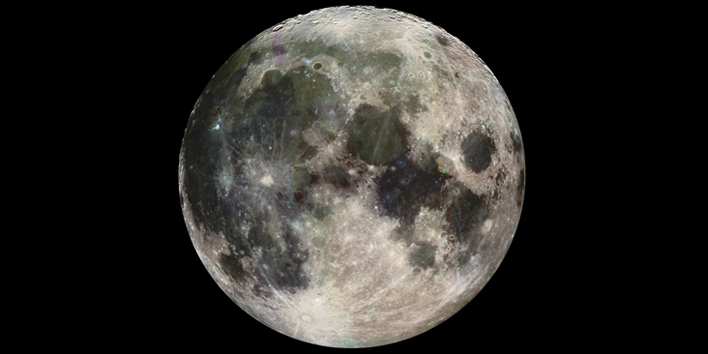
How Earth was blessed with a Moon was anybody’s guess 50 years ago. In our solar system it’s a relatively big moon. At slightly over 1,000 miles (1,700 km) in diameter it’s about half the size of planet Mars and there are only four moons (Ganymede, Titan, Callisto, and Io) that are bigger than Earth’s Moon.

Pre-Apollo Mission Theories
So how did Earth end up with a natural satellite that rivals the biggest moons of  the massive planets Jupiter and Saturn? And why just one?

Moons of our Solar System

Moons of our Solar System

Prior to the Apollo missions to the Moon, there were three main theories of the origin of the Moon. First, was the adopted daughter theory. It proposed that our Moon wandered into Earth’s gravitational pull and was captured. Second, was the mother/daughter theory that suggested the Moon was spun off from the Earth when it was still a molten blob of spinning material. The final theory was the sister theory where both bodies that formed side by side.

Apollo 17 Astronaut - Our last mission to the Moon, 40 years ago

Apollo 17 Astronaut – Our last mission to the Moon, 40 years ago

Hard Evidence: The Destroyer of Theories
When the Apollo missions came back to Earth with Moon rocks the three existing theories took a big hit. Had the Moon rocks matched the composition of Earth rocks then scientists could dismiss the adopted daughter theory because a wandering Moon wouldn’t likely have rocks similar to Earth’s. If the composition of the Moon rocks were different then they could dismiss the other two theories. What no one saw coming was the idea that the Moon rocks would match the composition of our Earth rocks, except for a lack of iron. The rocks were the same, but different.

None of the theories really met the evidence in hand, but now the geologists had a vital clue. When Earth first formed all the elements were mixed throughout the molten mass that would become our planet. As time passed most of the iron sank deeper into the mass to become Earth’s core. The evidence suggested that the Moon must have formed from Earth’s material after the iron sank into the core.

The New Theory: Impact Earth
It was clear the material for the Moon had to come from Earth, but the transfer of material had to occur after the most of the iron was not mixed in with the shallow layers of molten Earth. Enter the Impact Theory.

Scientists proposed that the Earth must have been hit with a large object (about the size of Mars) that pushed out shallow molten material into a near Earth orbit to create our Moon. The theory assumes the object was absorbed into Earth’s mass and didn’t significantly change the composition of the Earth or the Moon. Those are big assumptions.

The Little Bang Theory
Recently scientists are suggesting a new theory for the formation of the Moon that proposes a natural nuclear explosion blew off part of Earth’s shallow material after most of the iron sank into the core. The idea of natural nuclear reactions are not new. Radioactive material will always start a chain reaction upon reaching its critical mass and we have evidence that Earth has had multiple natural nuclear explosions in the past. It simply requires enough radioactive material to consolidate in close proximity to start a chain reaction. If it is radioactive and it reaches critical mass, BANG! A nuclear explosion.

So is this it? Do we now know how the Moon was formed? Not Exactly. Scientific knowledge is like the work of a detective. Learn something new and you can rule out certain possibilities, but it takes decades, sometimes centuries, to understand enough of what ‘couldn’t have happened’ in order to understand what did happen. It is likely we won’t have many more answers coming until we have scientists working on the Moon again. It’s hard to gather the evidence when you aren’t at the scene of the crime.

Five Rules For Taking Images of Your Children

01 Monday Jul 2013

Posted by Paul Kiser in About Reno, Lessons of Life, Opinion, parenting, Photography, Random, Recreation, Technology

≈ 2 Comments

Tags

camera, children, D60, digital, Family, how to, Image, Nikon, photo, pictures, portrait

Alexander and JasmineI’m an image horse. From my first film-hungry Nikon FM in the 1970’s to the inexpensive, but utilitarian digital Nikon D60, I’ve recorded life through my camera lens. I’m not a professional, but I’ve logged years with landscape, micro, macro, stellar, animal, model, and most other forms of photography.

The one type of photography I dislike most is the type that parents love to do, take semi-posed pictures of people. Every time I hear a parent say, “Smile! Smile! Come on, SMILE!,” I cringe. I don’t know who started the “Smile” prompting, but it is the worst thing anyone can ask of the subject of an image to do. It is saying to the child (or adult), “We want you to fake an emotion so we can show you faking an emotion to other people.”

Humans don’t fake emotions well. In fact, we are horrible at faking emotions. Children are the worst. A fake smile is marked by a tight facial expression around the mouth, bared teeth, and cringed eyes. Unfortunately, the people who take these horrible images are often rewarded by comments like, “Oh, he looks so handsome,” or “They look like they’re having such a great time!” Of course people are going to compliment your picture-taking ability, they want it to end!

This doesn’t mean people need to take sad or “how-long-do-I-have-to-stand-here?” pictures. There are a few simple rules that will avoid taking fake pictures of people you love.

Image Composition is YOUR Job, Not Their’s
Instead of going for the posed shot, which everyone hates to be involved in, position yourself so that you can take a REAL image of what is happening. From talking to playing children (and adults) in action are much more interesting than a posed shot. You want a recorded image of people engaged in life, not the camera, so you must do the work required of any good photographer, not them.

Does Fake Happy Really Tell The Story?
Sometimes children can be intensely focused on a task, or interacting with others. WHY would you want to stop this intensity and fake a smile for the image? Take the picture that tells the story instead of the fake happy picture that makes them look stupid.

If You Demand Happy, Make It Real
Okay, happy children can be a great image, but if you must have that type of image, make them laugh naturally. Ask questions like, “who’s the stupidest person with a camera?” When they laugh and point at you, take the picture. I guarantee that image will be better than the one where you said, “Smile!”

Be Unseen and Patient
It’s almost always better to hang around for a while before you take the picture. Look for the best composition, the best angle, and become part of the background. They may notice you, but children attention spans are marvelously short and they have a Jedi-like power to ignore a parent, so use that to your advantage.

It’s Digital, Take Lots of Images, Select Few
People sometimes think that every image should be perfect. I’ll admit, in the days of film cameras, when I got my photos back from the developer I used to feel guilty about all the failed images; however, today they are just digital bytes and bad pictures can be deleted. Take ten images and consider yourself a great photographer if there is one good one in the bunch.

Here’s one thing to consider the next time you see someone point a camera at another human:  if they say ‘Smile!’ it’s going to be a bad image.

GPS for the Homeless

01 Monday Apr 2013

Posted by Paul Kiser in April Fools Day, Fiction, Passionate People, Respect, Technology

≈ 1 Comment

Tags

Global Positioning System, GPS, homeless, Nancy Brinker, poor, Race for the Cure, Susan G. Komen

Dallas, Texas – April 1, 2013

Nancy Brinker Cure for homelessness: GPS

Nancy Brinker Cure for homelessness: A GPS device

Nancy Brinker, former Susan G. Komen Race for the Cure CEO, has a new cause. She is the driving force behind a new non-profit called, GPS 4 Homeless. The project is collecting old Global Positioning System (GPS) devices and giving them to the homeless.

In a news conference held this morning Brinker explained:

“The homeless are just people who are lost and need direction. That is exactly what a GPS device does and if homeless people could afford a GPS device they would no longer be lost! I don’t know why nobody has thought of this before!”

A spokesperson for GPS 4 Homeless added:

“When one of our people upgrade to a newer model they put the old one in a drawer. Now it can be put to good use for those people.”

When asked what they meant by ‘our people,’ the spokesperson responded, “You know, us.” Asked if they meant wealthy white people, the spokesperson replied, “Who else would I be talking about?”

Brinker added:

“This is one cause that has no political division. Everybody wants to help the homeless and that’s what we’re doing.”

GPS 4 Homeless is currently only in Texas, but their plan is to expand into Oklahoma, Arkansas, and Mississippi by 2014.

Raging Employee: A Case Study For Today’s Business

26 Tuesday Feb 2013

Posted by Paul Kiser in Business, Communication, Crime, Crisis Management, Customer Relations, Employee Retention, Ethics, Government, Human Resources, Information Technology, Internet, Management Practices, Opinion, Politics, Public Relations, Respect, Social Interactive Media (SIM), Social Media Relations, Technology, Violence in the Workplace, Women

≈ Leave a comment

Tags

denver post, Frank Sain, Franklin Sain, gun, gun magazine, gun violence, NRA, Public Image, rifles, Softec Solutions

Frank Sain's Mug Shot

Frank Sain’s Mug Shot

Last Tuesday (February 19,) police detectives visited Frank Sain at his office at SofTec Solutions in Englewood, Colorado. Sain was hired as the Chief Operating Officer for the technology company in the Fall of 2011.

As reported by the Denver Post, they questioned him about six emails he sent between February 13 and 15, in addition to voicemails left to Colorado State Representative Rhonda Fields. Representative Fields has proposed legislation to limit gun magazine capacities in Colorado. The emails and voicemails were said to be sexually and racially offensive and indicated he was enraged by the proposed legislation.

“Hopefully somebody Gifords both of your asses with a gun….”

per The Denver Post – In an email from Frank Sain to Representative Rhonda Fields

Two days after the police interviewed him (February 21) an unsigned letter was received by Representative Fields that threatened harm to both her and her daughter.

The next day Frank Sain was arrested and this past Monday the arrest was reported in the Denver Post. According to the Denver Post, Sain admits to the emails.

The situation is an important case study for business because it is the type of crisis that every business must be prepared for in today’s social media, politically charged world.

Company Public Image Issues

Frank Sain's headshot before he was erased from the company's website

Frank Sain’s headshot before he was erased from the company’s website

The obvious issue is public relations. A rank-and-file employee who acts out in a public forum out can damage a company’s reputation, but to have a manager, and in this case, a company executive, who acts out creates an impression that the organization might have been involved, or at least, enabled the behavior of the person.

In addition, an organization’s website typically boasts about its executives and when one of them misbehaves it makes the company look incompetent. It is important for a company to not prejudge an accused employee; however, when the basic allegations are admitted to by the employee the organization must take quick action to divorce itself from the actions of the employee. In this situation, with the allegations reportedly admitted to by the employee, SofTec Solutions quickly responded by removing Frank Sain from their website within 24 hours of the Denver Post story.

One issue is whether or not the organization should speak out publicly regarding the employee. Many companies might choose to not create any more public exposure regarding the situation, but I feel that would be the wrong choice. Both the public and customers/clients of the company will have a negative impression of the company that will be left in everyone’s mind if not addressed. It is important that the company make it clear that the acts and opinions of their executive were not enabled, endorsed, nor condoned by the organization and some type of heartfelt statement should be made with apologies to the appropriate people.¹

SofTec Management Team webpages - Monday versus Tuesday

SofTec Management Team webpages – Monday versus Tuesday

Human Resources Issues
Separating an employee is never easy. Separating an employee who has demonstrated rage and flaunts his gun ownership is even harder.

An organization cannot have an executive who makes derogatory sexual and racial statements and threatens to do violent harm to others. Of special concern is that in this situation the person seemed to escalate in his bad behavior after being questioned by law enforcement, signaling the potential of underlying, uncontrolled rage.

If the person can be reasoned with, it would be best to sit down with the employee and discuss the situation. Allowing the person to resign might be appropriate; however, in some cases an organization may have a duty to inform other potential employers of the circumstances of the separation. Making the employee someone else’s problem is not a smart move, especially if the company failed to warn the new employer of potential violent behavior.

The best practice in this situation might be to put the employee on paid leave for a period of time and require he seek counseling to address his behavior issues. There should be an understanding that separation with some type of severance package would occur upon compliance with the counseling requirement.

The organization should discuss the situation with legal counsel that is experienced in employee law as local, state and/or federal laws may dictate what an organization can, must, and can’t do in these types of circumstances. Engaging an expert in crisis management and/or violent employee situations should be part of separation planning.

In House Investigation
Under these types of circumstances an organization should conduct a thorough investigation of the employee’s co-workers, clients, etc. The purpose is to identify the scope of the issue. Did he confide in people who should have informed the company? Are there others who are sympathetic to him and might have behavior issues of their own? Does the company foster extreme political anger and if so, how should it be addressed? Did he act out among customers/clients and, if so, what is the impression they have of the company? Did he have an abusive email style with employees and/or customers.

There are many questions that must be answered if an organization hopes to move out of the crisis. Burying the incident may make everyone feel better, but it may turn out that the problem was just the tip of the proverbial iceberg. Training, counseling and other remedial efforts for all employees may be required to heal the damage caused by the executive who put the company into the crisis.

¹(UPDATE: Just before publishing this article, the Denver Post announced that SofTec Solutions had suspended Frank Sain and issued a strongly worded statement condemning his behavior.)

Public Relations Techniques That Kill Organizations

06 Wednesday Feb 2013

Posted by Paul Kiser in Branding, Business, Communication, Crisis Management, Customer Relations, Customer Service, Ethics, Generational, Information Technology, Internet, Management Practices, Public Relations, Respect, Social Interactive Media (SIM), Social Media Relations, Technology, Traditional Media

≈ 2 Comments

Tags

anti-listening, Conservatives, Managing the message, Nancy Brinker, Planned Parenthood, PR, Race for the Cure, sim, sm, Susan G. Komen

In Part I, “Why ‘Managing the Message’ Doesn’t,” we discussed the dangers of trying to ‘manage the message’ in a Social Media world. Part II looks at the techniques used by organizations to manage the message and why they fail.

Organizations that adopt a manage the message policy for Public Relations (PR) assume that they are the controllers and manipulators of the public image of their organization, which demotes the public to the role of a mindless zombie. If that doesn’t sound stupid enough, let’s look at the methods that organizations use to manage the message.¹

[¹ I realize that I’ve used the words Manage the Message five times in the first two paragraphs; however, “insulting PR techniques” isn’t quite specific enough as there are so many of them. 😉 ]

Corporate PR:  We manage the message by not listening

Corporate PR: We manage the message by not listening

Anti-listening Techniques
The subtle use of anti-listening techniques is one strategy used by organizations who seek to manage the message. The concept is simple: an organization can’t be held accountable for issues that don’t exist. By not listening an organization can effectively deny existence of an issue because they can claim ignorance, therefore can deny accountability.

One example is the use of formalized procedures for communication from the stakeholders, including the public. An organization might ignore or restrict communication on their Facebook page, requiring complaints and comments to be made through a process that is more complex or requires greater risk to complainer.

EXAMPLE:  From the Facebook page for a Parent/Teacher group of an Elementary School after parents discussed concerns about major changes in the school calendar:

“Please remember that this page is used for the PTC to share PTC sponsored fundraising events and activities. If anyone has comments/complaints about the school they need to be addressed with the administration.”

(From the School’s Marketing Director)

The strategy of denying open discussion of issues allows an organization to divide and conquer people who may object or have a strong reaction to negative events or significant changes. By restricting public comment on their website or Social Media formats such as Facebook, an organization can prevent all but the most committed people from voicing their opinion or concern. For those that do comment, the organization can hide dissent and concerns behind a veil that only they have access to, so the true scope of the issue is hidden from public.

The problem with this technique is that issues or concerns do not go away by ignoring or hiding them. Whether expressed or not the reaction exists and it impacts the public image of the organization. A divide and conquer strategy increases the reaction once people discover that others share their concerns. In the Social Media world, the truth will eventually come out through a disgruntled customer, employee, or other source.  Once the full scope of the deception is exposed the organization will lose all credibility and once the organization loses credibility the public image is also lost.

In January of 2012, the Susan G. Komen Foundation was receiving massive condemnation for a politically charged decision to defund Planned Parenthood. Rather than accepting that the public voice was valid, CEO Nancy Brinker attempted to double down on their position by claiming a bogus conservative-initiated Congressional investigation was reason to deny the grant requests by Planned Parenthood. Her efforts to paint an obvious conservative-motivated action as justified left her and the organization looking like right-wing wackos who had no clue that the organization depended on the perceived goodwill of the public.

By the time they tried to back peddle and fix the problem it was too late. Race For the Cure events in 2012 lost as much as one-third of the participation from the previous year and many donors question the use of their money by the Foundation. The irony is that Nancy Brinker had founded the organization thirty years earlier in her sister’s memory and now the Susan G. Komen name is not so much a symbol of fighting breast cancer as it is a reminder of conservative attempts to use backdoor methods to inflict their religious beliefs on everyone else.

MONDAY: The Dark Side of PR: Distraction and Deception Or ‘Armstronging’ the Public. When ethics are not a consideration, an organization is headed into a downward spiral that will almost always end with a public image that can be fatal. 

Why ‘Managing the Message’ Doesn’t

05 Tuesday Feb 2013

Posted by Paul Kiser in Business, Communication, Crisis Management, Customer Relations, Customer Service, Employee Retention, Ethics, Information Technology, Internet, Management Practices, Opinion, Public Relations, Respect, Social Interactive Media (SIM), Social Media Relations, Technology, Traditional Media

≈ 2 Comments

Tags

BP, Cool Hand Luke, Managing the message, Mitt Romney, PR, Public Image, Race for the Cure, Susan G. Komen, Tony Hayward

“What we got here….is a failure…..to communicate” Captain, the Prison Warden in Cool Hand Luke

Captain (Strother Martin) in 1967 film, Cool Hand Luke knew how to manage the message

Captain (Strother Martin) in 1967 film, Cool Hand Luke knew how to manage the message

If you are a business professor teaching students the importance of  ‘managing the message,’ or a Public Relations (PR) firm telling your client how to ‘manage the message,’ would you please stop. No, I mean stop right now. In fact, contact everyone you have taught or advised and tell them you were wrong then refund their money.

CEO Tony Hayward got his 'life back,' but BP is still in PR clean up mode in the United States

CEO Tony Hayward got his ‘life back,’ but BP is still in PR clean up mode in the United States

‘Managing the message’ cost Mitt Romney the Presidential election. It severely damaged Netflix in 2011. It cost a BP CEO his job. It took the Susan G. Komen Foundation from being a major player in non-profit foundations to one that has to hide its name in shame. 

Why?

First, ‘managing the message’ doesn’t work. Second, it’s a cowardly way to approach public relations. Third, it’s stupid advice. Fourth, it will end up causing major problems up to and including the end of an organization.

‘Managing the message’ assumes a person has control over the message. That would be a stupid assumption in a world driven by Social Media. John F. Kennedy’s words should be amended:

You can fool all of the people some of the time….until Social Media picks it up and then you’re screwed.

PR is no longer about creating an image. That was true back in the day individuals had no voice and people were subjected to mass advertising in every thing they watched, heard, and read. That was yesterday. Today an organization’s image is created by everyone who comes into contact with the organization. Customers, especially angry ones have as much of a voice in an organization’s public image as the Vice President of Marketing. Today PR is about listening and being honest and real in everything you say and do. That is something that can’t be faked or managed.

Reaction Avoidance
Managing the message is mostly about reaction avoidance. The idea is that if an organization handles it correctly, any negative situation will be minimized. The technique acts like a dam that has a short-term benefit, but a long-term disaster. When a PR crisis occurs the first instinct is to pretend there is no major problem. That is the start of a PR death spiral that only leads to bigger and bigger denials until the organization appears to be run by fools. By then executives turn and blame the PR staff for not ‘managing the message’ better.

TOMORROW: Public Relations Techniques That Kill Organizations. The two common techniques that characterize an organization who is trying to manage the message and why they fail.

MONDAY: The Dark Side of PR: Distraction and Deception Or ‘Armstronging’ the Public. When ethics are not a consideration, an organization is headed into a downward spiral that will almost always end with a public image that can be fatal. 

Why You Hate Facebook and Can’t Stand Twitter

04 Monday Feb 2013

Posted by Paul Kiser in Aging, Business, Ethics, Generational, Information Technology, Internet, Lessons of Life, Pride, Public Relations, Relationships, Social Interactive Media (SIM), Social Media Relations, Technology

≈ Leave a comment

Tags

Facebook, personality, Privacy, Privacy on the Internet, Twitter, work behavior

Social Media Violates the Dual Work/Home Personality

You hate Facebook and can’t stand Twitter. You are mystified as to why anyone would want to share their personal information on the Internet and you probably make fun of people who do. The surprise is that it’s not because you’re male or because you’re over 40. But you are.

The reason Social Media is such an annoyance to you is because it goes against everything you were taught as you grew up. Social Media exposes your private persona and violates the boundary between your professional and personal identities.

Self Identity Devoured By The Corporation
Industrialization in the 19th and 20th centuries changed reshaped the life of the American male. As employment opportunities switched from being primarily farmers and small business owners to employees of the factories and corporations, workers found that their on-the-job behavior had to conform to company expectations. Job advancement within the company structure depended on a bosses perception of the perceived professionalism of the employee and not who they were in real life. That transformed the American worker into an actor who performed by the company script while he was under the watchful eye of his employer.

This division of a person’s life between home and work created a dual personality in men. At home a man was relaxed, caring, and spontaneous, or ‘unprofessional.’ At work a man was controlled, self-conscious, and unemotional, or ‘professional.’ As corporations became bigger, the division between the home and work personas became deeper to the point that a man might not be recognizable to his co-workers if their paths crossed outside of the work day.

Enter Social Media
Social Media tools like Facebook and Twitter have no work/home boundaries. The idea that a man should have a two personas is laughable in a Google searchable world that exposes the smallest of lies. That cold and tough business man doesn’t look so tough or cold when he posts pictures of his family activities on Facebook and that strips a man of his power base. The fake professionalism at work that empowers him can’t compete with the real person revealed on-line. The more a man’s power is dependent on his ‘professional’ persona, the more likely he is to abhor Social Media.

However, men who are angry about the lack of privacy in Social Media are trying to wage a hopeless battle to protect the nurtured idea that they must maintain two separate personas. The problem is that humans were never meant to divide their lives. Who we are at home is who we should be at work and vice versa.

It is understandable why you hate Facebook and can’t stand Twitter. They expose your greatest vulnerability…the real you. Perhaps someday that won’t seem like a vulnerability to you. And perhaps someday you’ll understand that the real you is not your weakness, but your strength.

Perhaps.

What America Must Do: Step 6 – Reinvent Higher Education

14 Wednesday Nov 2012

Posted by Paul Kiser in College, Communication, Education, Generational, Government, Higher Education, History, Information Technology, Internet, Opinion, Politics, Public Relations, Taxes, Technology, The Tipping Point, Traditional Media, Universities, US History

≈ Leave a comment

Tags

college degree, faculty, professors, state run, students, tuition and fees, universities

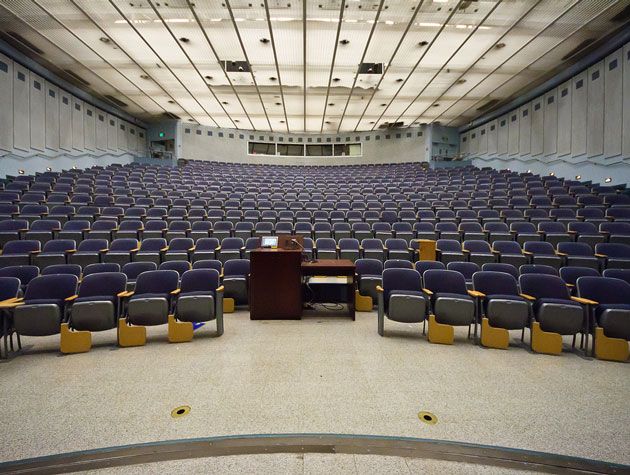
Sans Students: Is this what university classrooms will look like in 2020?

Higher Education is an unmovable object with an unstoppable force heading straight for it and universities are at ground zero. Classrooms as we know them may be doomed and the question is whether our country will lead the world in adapting to a new model, or whether we will be the last ones to accept reality.

The Value of the College Degree
The unmovable object in Higher Education is importance of the college degree in American commerce. Business lives or dies on information. The person who can access, filter, analyze, organize, and explain information tends to be valuable in a company.

High schools are tasked to help students graduate with basic competencies, but they are dealing with children who are still maturing into adulthood and that process needs to be complete before they are morphed into business men and women.

Those who believe high schools should be vocational schools are assuming that all children will become a construction laborer or office drone, so why bother with college prep? The concept of education as a training ground for corporate zombies is too simple-minded to apply in a country that encourages all citizens to reach their maximum potential.

College is where young adults are given the tools to become valued business leaders. College classes require a student to learn how to access and report information, which is central in business competitiveness. The business that can out think its competition always wins, which may be why many top businesses are more concerned about the degree, not the major. A college degree is more than a piece of paper, it is a badge of achievement that says this person is ready for the business world.

The Relentless Rise in the Cost of College
The unstoppable force is the rising cost of a college education. With cuts in federal and state budgets a greater share of the burden is being heaped on those who are least able to avoid it. In Mitt Romney’s failed bid to be President he suggested that students should borrow from their parents to pay for college. That was one telling sign that Romney is out of touch with the real world the rest of us live in.

March 2012 protest in Sacramento over tuition hikes

In 1991 the annual average cost for a university education was at $7,602 or over $30,000 for four years of college. In 2001, that annual cost had risen to $12,922 or over $50,000 in four years. In 2011, the annual cost had risen to $22,092, which meant it cost over $88,000 for the average college four-year degree. That is the equivalent of buying a new car every year a student attends college. If the trend continues it will cost a student an average of over $41,000/year for college by 2021, which means a four-year college degree in 2021 may cost over $167,000.

Students and their parents are already outraged by the rising costs, but it is universities who control the expenses, and therefore control the costs.

Based on current trends, the average annual cost for college may exceed $40,000 by 2021

Students want to be competitive for careers that will lead them to higher paying jobs, but they have no means to afford college and the list of parents who CAN pay over $22,000 a year for four years are on a first name basis with Mitt Romney.

The Other Unmovable Object – Faculty
Teachers at the college level have traditionally been considered the most important asset to a university and for centuries they were treated with dignity and respect by administrators, but financial pressures have made them a target for saving money. While students face escalating tuition and fees, university faculty are also a target of the unstoppable force. Professors have been constantly asked to accept budget cuts and teach more students for the same, or lower pay. 

Some universities have replaced expensive tenured professors with temporary faculty employed by contract on a semester by semester basis. Temporary faculty make a fraction of a full, tenured professor. Not surprisingly, a teacher that may not be offered a contract the next semester tends to be more accepting of increased class sizes, or other cost-cutting measures.

What may be surprising is that a college teacher is likely not receiving a significant portion of the tuition paid by the students in his or her classes. A temporary professor may bring in $100,000 or more in revenue each year for the university, but a temporary professor is often paid less than $4,000 per class with no benefits. Low pay and increased pressure to do more for no additional money makes the teaching environment unpleasant for the student and professor.

A Revolution Caused by the Internet
Ironically, the Internet was originally intended to allow one university to have quick access to the knowledge database at other universities and research laboratories. As it expanded and became commercially available in the late 1980’s and early 1990’s the public began to have access to a vast storage of on and off-campus knowledge without a student ID. Within a decade homes across the world were linked into a mass of dynamic information via business and personal websites, blogs, chat rooms, and other social media sites.

Suddenly anyone could access information and share ideas and they didn’t have to pay tuition to have easy access to it. Certainly some of the information was in error, but often people found information that outpaced the knowledge produced in books. Universities no longer held the monopoly on information.

Government Must Change
State governments and Higher Education face these problems:

  1. A college degree is still a valuable achievement and desired by the public and business.
  2. Tuition and fees are too high and the public can no longer afford them.
  3. Professors have been devalued in a system where more and more of the revenue is channeled away from the them.
  4. University administrators and government legislators have created a paradigm for Higher Education that is unsustainable.

Social media has changed the expectations of the public. People expect to be able to have ready access to anyone to whom they are paying for a service.

Controlling advanced knowledge within ivy covered walls is no longer possible in a world where anyone can do a Google search and know as much or more about the most current knowledge on any topic. However, just doing a Google search does not teach a person how to filter, analyze, organize, and report that information.

State-run universities have a unique opportunity to reinvent Higher Education. The challenge is that they are the most unlikely to do it. Administrators have Accreditation organizations that are established to dictate what Higher Education is and will be today and tomorrow based on the best practices of yesterday. That doesn’t work in a world where today is already history that was recorded by over 340 million tweets a day (March 2012 data.)

When the unstoppable force hits the unmovable objects (value of a degree and the need for faculty) few things about Higher Education will remain unchanged. Now is the time for State-run universities to dodge the upcoming annihilation and take the lead in reinventing Higher Education. They can start considering the following guidelines:

  • Tuition must stabilize and regress. Fees should be eliminated. Universities can assume that there will be no money available to siphon off for student activities, the football program, or any other money-absorbing entity. 
  • Support materials (textbooks, etc.) will be digital only and the cost will be pennies on the dollar of what students have been paying. Goodbye, McGraw-Hill. Hello, Faculty Publishing.
  • Classrooms will be more like Boardrooms with fewer students where the Professor is the CEO of knowledge and students must bring their best or beg for a second chance with someone else. Much of the lecture and information gathering will be done via webcasts and/or outside of class time. ‘Class’ will be where the work outside the classroom is brought in for discussion and idea sharing.
  • Class schedules will not follow a semester system and will be on a schedule that is more like a project team.
  • Faculty will lead students while at the same time work toward advancing knowledge on the subject matter.
  • The most important person to the student will be the educational coordinator (i.e. Counselor or Adviser in the old paradigm) who will create an individualized degree that is based on achieving a level of mastery information handling, not a number of credit hours.

The framework in which this happens must be within a government structure. Private enterprise has proven that when they try to create a system of higher learning they fail. It solves nothing to make Higher Education a profit-based program that is a poor imitation of the old, outdated model. If government can successfully create a new model it will make the United States of America the leader of advanced knowledge. If not, we can expect to be exporters of our future.

Links to:

What America Must Do:  Step 1 – Silence the Wackos in Politics
What America Must Do:  Step 2 – An Extreme Makeover of Government at All Levels
What America Must Do:  Step 3 – Restore Government Revenue and Fair Taxation
What America Must Do:  Step 4 – Balanced Budget By 2015, Debt under 50% of GDP by 2020
What America Must Do:  Step 5 – Restart a Federally Run Space Program

What America Must Do: Step 5 – Restart a Federally Run Space Program

05 Monday Nov 2012

Posted by Paul Kiser in College, Crisis Management, Ethics, Government, Health, Higher Education, History, Information Technology, Opinion, Passionate People, Politics, Pride, Re-Imagine!, Religion, Science, Space, Taxes, Technology, Universities, US History

≈ Leave a comment

Tags

NASA, power, Prosperity, self sustaining, sewer, Space, Space Program, Space X, technologies, water

USSR scared America into the space race and it led to our prosperity

Fifty years ago America was scared. The USSR had sent a man into space and he had orbited the Earth. The Soviet Union was also threatening to plant their ballistic missile weaponry in Cuba. The United States entry into the space race was out of a fear that if we didn’t respond quickly, it might be too late.

This dire situation caused a crisis-type response that defined who we are as a people. Ignoring profit or ROI (return on investment) we established our space program and became proficient at churning out new technologies. Almost overnight we had a new breed of people who literally became rocket scientists.

And then it happened. We discovered that space technology had terrestrial applications. That wasn’t the justification for it, but our space program suddenly pushed the United States of America into the role as the go-to nation for space technology applied to terrestrial application. For decades Americans and the world reaped the benefits of the new materials, equipment and knowledge that came from our effort to go beyond the safety and protection of Earth’s womb.

Young people became excited about the space program and suddenly universities had applicants knocking down their doors to become a scientist, mathematician, or engineer that would go on to shape tomorrow’s world. Space ignited learning and research at colleges that shook up their dusty libraries and ivy covered walls. Philosophy, religion, arts, economics, and literature were blindsided in the 1960’s and 70’s by new questions that challenged our old beliefs and standards.

In 2008, USA space competitiveness was dominant, but today it wanes

Meanwhile, in Russia, scientists were put under extreme pressure to be successful on an accelerated space program. Behaving more like a mega-corporation that pushed for immediate results, Russia’s government forced scientists to try to take major risks in a dangerous environment where failure meant loss of life. When the scientist did have a new breakthrough they became state secrets and the larger population did not benefit. For the Soviets, the space race showcased the failure of running a government like a business.

Fifty years later America can look around at our computers, cell phones, medical devices and almost everything we touch, consume, or use and know that the space program had a direct or indirect impact on its development.

Yet, today America is stagnant. We are desperately trying to be competitive in a global market that spends most of its time figuring out how to make things cheaper, but not better. We say we want young people to pursue careers as engineers and scientists, but there is no burning reason for a high school graduate to pursue those careers. Instead we have university Psychology programs that are filled to overflowing with students who are more inspired to collect a salary by listening to other people’s problems than in designing the transportation and living habitats for a colony on Mars.

The United States is desperate for water in the South and West, but everyday we waste it

For decades the western United States has been battling with a growing population and a dwindling fresh water supply. We also face aging community water and sewer systems that are in need of major updating and repairs. We face global climate change because the we have been filling the air with energy absorbing carbon from burning coal, gasoline and natural gas.

The concept of transporting power, water, and waste is based on 19th and 20th century engineering. Power has to be generated hundreds of miles away and then delivered to homes via power lines that can fail in a major storm. Expensive and overburdened water treatment plants transport fresh, clean water through miles of pipeline and is only used once and then it becomes waste. Purified water that would be the envy of many people in Africa and the Middle East is mindlessly sprayed on our lawns and used to flush our toilets. 

In space water has to be recycled, air must be purified, and power must be generated efficiently on a micro scale. That means focusing on self-sustaining habitats built that will face extreme conditions. On Earth, these technologies will pave the way to a shift from macro water, sewer and power systems (power plants and water and sewage treatment facilities) to cost-effective micro systems that free families from relying on expensive, polluting, and wasteful systems that are unsustainable. Everything we need to solve America’s terrestrial problems can be found by solving the  problems of extended human living in space. In addition, a renewed public space program will inspire High School graduates to pursue careers in engineering and science.

Space X Falcon 9 Engine Array – Redefining space technology

America needs to be pushed into using new technologies that break down the paradigms of the past. In the 1960’s we were pushed by the Soviets and the result was prosperity.  Today we need to push ourselves, not out of fear, but out of pride and courage. I have nothing against Space X or any other private or commercial space program, but prosperity doesn’t happen out of the pursuit of profit. Prosperity happens when everyone sacrifices from the board room to the break room for the good of the United States.  

Space X has made new breakthroughs in the bureaucracies and waste built up over five decades by NASA and its private contractors and they should be the model of a new public space program, but investors and ROI are not the reason America needs to take back the leadership in space exploration.

If the last 50 years have taught us anything it is that raising ships to the stars, we will raise all ships on Earth. It’s time to reclaim our space program.

Links to:

What America Must Do:  Step 1 – Silence the Wackos in Politics
What America Must Do:  Step 2 – An Extreme Makeover of Government at All Levels
What America Must Do:  Step 3 – Restore Government Revenue and Fair Taxation
What America Must Do:  Step 4 – Balanced Budget By 2015, Debt under 50% of GDP by 2020
What America Must Do:  Step 6 – Reinvent Higher Education

What America Must Do: Step 2 – An Extreme Makeover of Government at All Levels

02 Friday Nov 2012

Posted by Paul Kiser in Business, Communication, Customer Service, Ethics, Government, Government Regulation, Higher Education, Honor, Human Resources, Management Practices, Opinion, Politics, Public Relations, Re-Imagine!, Respect, Taxes, Technology, Universities

≈ Leave a comment

Tags

Extreme government makeover, government workers, job descriptions, Organizational Charts, policies and procedures

Over a period of years any organization tends to end up with outdated job descriptions, ineffective departments, and outmoded missions. Five percent of the people cause 95% of all policies and procedures to be written. As common sense is replaced by policies written to address the five percent, an organization fails to serve the 95%.

Sometimes organizational charts are meant to confuse, but governments should be clear and concise

Administrative assistants in most organizations tend to accumulate more and more power over time as they learn the tricks to cutting through the bureaucracy and working around the budget. Learning how to play the ‘game’ is the first step in becoming a corrupt organization.

Because business is established on a motive of basic greed, most businesses fall victim to corruption within a few decades and then fail. Governments established with the blessing of the citizens and motivated by creating a fair playing field for all tend to avoid massive corruption, but fall victim to small-scale corruption as individuals give in to their base human nature. Unlike business, good governments tend last for centuries; however, that doesn’t mean they don’t need to be restructured.

Government workers are the heart of America’s employment

In the United States, governments (federal, state, and local) have performed honorably, but it is time to do an extreme makeover. This means taking all policies and procedures, organizational charts, and job descriptions to the shredder. New ones will have to be written, but they must not be written just to address the five percent causing problems.

This may require the elimination of Human Resource (HR) departments. HR departments tend to be builders of bureaucratic systems and they are often locked into paradigms which dictate that nothing can exist outside of a written policy or job description.

This Extreme Makeover of government should not be done to ‘reduce’ government. The motive should be to create a government structure that answers the needs of ALL the citizens and maintains a fair and ethical environment for business. The idea that we can eliminate or privatize government is an unrealistic, unethical, and expensive mistake. A federal, state, or local government is absolutely necessary to protect all the rights of its citizens. 

Links to:

What America Must Do:  Step 1 – Silence the Wackos in Politics
What America Must Do:  Step 3 – Restore Government Revenue and Fair Taxation
What America Must Do:  Step 4 – Balanced Budget By 2015, Debt under 50% of GDP by 2020
What America Must Do:  Step 5 – Restart a Federally Run Space Program
What America Must Do:  Step 6 – Reinvent Higher Education

Nevada’s Death By Stupidity: The Business Friendly Myth

11 Monday Jun 2012

Posted by Paul Kiser in About Reno, Business, Crime, Ethics, Government, Government Regulation, Higher Education, Politics, Public Relations, Taxes, Technology, Travel

≈ Leave a comment

Tags

business friendliness, business friendly, Conservatives, Nevada, smaller government, spending

A shuttered grocery store sits in the shadow of one of Reno’s largest Casino’s

Nevada is the poster child of what not to do to save an economy. Politicians who promote failed policies continue to be elected in the State that leads the nation in being the worst at everything (unemployment, foreclosures, violent crime, education, etc.)  Voters have been little more than Pavlov’s dogs in Nevada politics and are roped in by the claim that all Nevada’s problems can be solved by lower taxes and smaller government, which allegedly will make the Silver State more ‘business friendly.’ 

Once Reno’s 2nd largest Mall, Park Lane Mall is now just a sign in front of a vast empty space.

The problem is that Nevada is one of the most business friendly States in the nation and yet Nevada’s economic and social ills continue to spiral downward. Nevada has no income tax, no corporate or capital gains tax, and is one of the easiest States in which to establish a business. Yet, politicians win elections through promises of more jobs by making Nevada what already is: business friendly.   

Nevada leads the nation in unemployment at 11.7% (April 2012). Ranked 50th out of fifty States in 2011 and 2010, and 49th in 2009, jobs¹, or the lack of them, is certainly a major issue for Nevada; however, Conservatives rank Nevada in the top three States as being the most ‘business friendly.’ The data used for this ranking is based primarily on low taxes and low business fees. So if Nevada is business friendly, why is the unemployment the highest in the nation?

Stores that relocate leave vacant commercial space, sometimes for years

(¹Unemployment for Nevada 2011 – 13.5%, 2010 – 14.9%, 2009 – 11.6%, 2008 – 7.0%. Note that in 2006, Nevada’s unemployment was only 4.2%.)

CNBC also has a business friendly ranking, but low taxes and business fees are only part of the factors considered. CNBC’s 2011 ranking placed Nevada as 45th in Business Friendliness. Among the major factors in the State’s poor ranking were Education (50th,) Economy (50th,) Quality of Life (44th,) and Technology and Innovation (37th.)

Nevada’s fate will be determined by the voter and if CNBC’s rankings are more indicative of business friendliness then Nevada voters must elect politicians willing to invest more money in quality of life issues and infrastructure. Revenue will have to be found to address the real issues or else the Silver State will continue its death spiral.

Next:  Poor Quality Jobs and Education Killing Nevada

Massive Use of Hydroxic Acid In Animal and Crop Production

16 Wednesday May 2012

Posted by Paul Kiser in Business, Communication, Ethics, Government, Government Regulation, Health, Public Relations, Science, Technology

≈ 5 Comments

Tags

cattle, crops, dihydrogen monoxide, FDA, food production, food safety, hydroxic acid, water

Potatoes sprayed with Hydroxic Acid

Animals and crops in American food production are given massive doses of hydroxic acid. Hydroxic acid is a colorless and tasteless liquid that is used in animal production externally as a sanitation agent, but it’s also ingested in major quantities by animals that end up on your dinner plate. It is a naturally occurring compound that usually does not harm humans unless exposed to the lungs, but it tends to absorb other toxic and non-toxic compounds easily making it potential dangerous to humans.

Hydroxic Acid application system for cattle

Cows are exposed to hydroxic acid externally to fight off disease inducing bacteria and viruses; however, cattle have evolved to be completely dependent on internal use of hydroxic acid for normal bodily functions. All fish and shellfish are immersed in hydroxic acid before they are processed and the compound is typically used in the cleaning and preparing process.

Hydroxic Acid has become so significant to food production that the University of Nebraska is hosting the fourth annual World Conference beginning on May 30th to discuss the use of it for food production. Among the topics to be discussed are the future of hydroxic acid in food production and creative application of the compound in various food production environments.

Paul Kiser – author and consumer of hydroxic acid

The Food and Drug Administration (FDA) has specific guidelines on the use and quality of hydroxic acid; however, there seems to be no effort to curtail its use in food production other than to avoid the waste of the compound. It is apparent that hydroxic acid will continue to be a part of America’s food chain whether we understand it or not. 

For further information regarding hydroxic acid click on link.

Nevada Newspaper Goes Behind the Wall…to Die

11 Friday May 2012

Posted by Paul Kiser in About Reno, Business, Communication, Customer Service, Employee Retention, Ethics, Generational, History, Human Resources, Information Technology, Internet, Print Media, Public Relations, Social Media Relations, Technology, Traditional Media, US History

≈ 2 Comments

Tags

Newspapers, online, Reno Gazette-Journal, RGJ, Subscription fees

RGJ’s main bunker…entrance in Reno

The Reno Gazette-Journal (RGJ) recently decided to lock themselves behind a wall and it will cost you at least $12/month to see what they have hidden. Does anyone else see the problem with this business model?

Allow me to reconstruct the history of news media in America to understand why this is a death sentence to the RGJ.

In the 1800’s newspapers owned the information world

1700-1900
In the 1700’s, newspapers became the source of community news. These newspapers often portrayed a political view, but were THE source of information in a society where travel was limited and information scarce. Writers and editors often became key figures in the social and political structure as the gatekeepers of what would be printed.

Radio was faster, but newspapers were corporeal

1900’s
The invention of radio and television gave new options to the public on how they accessed news. The radio offered broadcast news that reached more people faster; however, newspapers remained the source of news because it existed in corporeal form. News transmitted on radio waves disappeared if a person wasn’t in front of the radio during the broadcast. Newspapers; however, almost always gave more a more in-depth account of the events.

Television came shortly after radio and added the exciting features of seeing the reporter and moving images of events; however, newspapers continued to be the best source of significant events.

CNN was to newspapers what Wal-Mart was to Mom & Pop stores

1980
CNN was the first real threat to newspapers. It offered news 24/7/365 and it often relayed events in progress. People no longer had to wait for a newspaper’s version that would come the next day. The newspaper still had the corporeal advantage because CNN would eventually move on to the other news while newspapers could be read anytime. Newspapers also still gave more in-depth reporting on local news issues.

1995
It wasn’t until the creation of the Internet that newspapers faced a challenge that would threaten their existence. The public use of the Internet stripped newspapers of almost every advantage they held. News was not only reported, it was discussed and people reacted in real-time. With the development of the Google search engine topics could be accessed and researched at any time anywhere there was Internet access. The news was no longer filtered and limited to what an editor thought people should know, but rather raw information reached individuals who made their own decisions on what was significant to them.

Reporters who spent years in college and thousands of dollars in tuition and books now found themselves competing against bloggers who had no editors to please. Reporters might get the story and accurately report it to their community but in a real-time world their information was just following up to what people already knew. Newspapers have adapted by presenting an online version of the information that will be in the next day’s paper and that has helped writers compete and be read; however, investors want profit and that is the heart of the dilemma.

The Reno Gazette-Journal has decided that they will create demand and increase revenue by limiting access. That is a rational position to take if you have a product that has significant value and demand, but newspapers and their value appeals to a diminishing demographic. Older white males are dying off at an incredibly rapid pace and newspapers have little demand or value to younger, non-white, non-male demographics. How does RGJ expect to gain new readers by charging for access who have free access to local online news through three Reno television news station’s webpages?

There is another problem with RGJ’s decision that may impact the quality of writing. A writer for RGJ has to accept that their audience will be extremely limited. Blogs will exist for decades and are be searchable to anyone in the world. An RGJ reporters work is locked away behind a wall forever. Who wants to dedicate their life to writing and have it unread? Over time writers will have to decide how much damage RGJ is doing to their career by locking their work behind a pay wall. Once the good writers are gone, what value will the Reno Gazette-Journal have to anyone, paying or otherwise?

4 Reasons Why Foursquare May Be Bad 4 Your Business

31 Tuesday Jan 2012

Posted by Paul Kiser in Branding, Business, Customer Relations, Information Technology, Internet, Management Practices, Public Relations, Social Interactive Media (SIM), Social Media Relations, Technology

≈ Leave a comment

Tags

Check-in, Customer Loyalty, Foursquare, Mayor

Consider the Consequences Before Posting These

Foursquare is supposed to be a fun Social Media tool that can help a business to identify their most loyal customers and promote patronage. By ‘checking in’ using their smartphone with a GPS function, a Foursquare user let’s the business and the user’s friends know that they are there. If a user checks in at a business more often than everyone else he/she can become the ‘Mayor.’ That sounds like a great idea, but there is a dark side that could lead to Foursquare chasing customers away from a business. Here are four reasons why you may want to discourage Foursquare from being a part of your enterprise, especially if you have significant customer traffic.

Negative Comments
Foursquare encourages users to give ‘tips’ to other Foursquare users. I often see negative comments as a tip. At one Starbucks I noticed that the tip that shows up when I check-in states, “Don’t come here if you’re in a hurry” That tip was left on May 6, 2011. Negative comments will haunt your business for months. Not a great first impression for a first time customer.

Competition Between Your Customers
Foursquare pushes your customers into a competition for the prize of being the Mayor. Not all Foursquare users are rabid about becoming Mayor; however, competing customers can be good or bad for your business. Under normal circumstances the competition can lead to more customer visits by those who are trying to rack up more check-ins; however, if becoming Mayor is important to a user, too much Foursquare competition could make a regular customer become frustrated. There will only be one Mayor and if that user has a lock on the Mayorship, then other users may decide to go to a competing business or store where they have a better opportunity to become Mayor. 

Not All Check-ins Equal
In addition to competition, there is an issue with fairness of the Mayor selection. On the face of it the Mayor should be the customer with the most check-in days, but that is not exactly the way it works. I have 49 check-ins in the last 60 days at my favorite Starbucks but the user who is the Mayor only has 45 Check-ins. Why is that user the Mayor? Apparently some of my check-ins don’t count even though I have 32 days in a row of check-ins at this Starbucks and the Mayor was out of town for a week during that time. I am consistently listed as 3 days away from being Mayor. I contacted Foursquare for an explanation and other than an auto-reply that they received my request, there has been no response.

Rewarding Customer Loyalty Not The Primary Goal
Foursquare would seem to be a great method for identifying and rewarding your most loyal customers; however, Foursquare is, in large part, a game and rewards those who are the most competitive, not the most loyal. While most employees can quickly recognize their loyal customers, they may not be able to recognize who the Foursquare Mayor is for their business. This is especially true of businesses with a high volume of customers and/or with a drive-thru window. The Mayor may be the person who simply plays the game and has little interest in supporting your business. If your business offers a special to the Mayor or attempts to recognize Foursquare users in some way, it could be insulting to loyal customers who feel they have neglected for their support of your business.

While Social Media tools like Foursquare can be useful in a business environment, it is important to consider the limitations and risks of employing them into your customer service plan.

15 Days in January – Day 15

28 Saturday Jan 2012

Posted by Paul Kiser in Fiction, Government, History, Science, Space, Technology, US History

≈ Leave a comment

Tags

1986, Challenger, Disaster, ET, External Tank, January 28, Kennedy Space Center, KSC, NASA, Orbiter, Solid Rocket Boosters, Space Shuttle, SRB, STS-51L

(NOTE: The following is a fictionalized account of the 15 days in January 1986 leading up to the Challenger Space Shuttle disaster on the 28th of that month; however, the details of weather and NASA events are based on known historical data.)

Titusville, Florida
Tuesday, January 28, 1986
High Temp: 46° F Low Temp: 32° F

Challenger and crew clear the tower

Where do I start? Seven amazing, wonderful, smart people lost their lives today. None of us can come to terms with the reality of what happened.

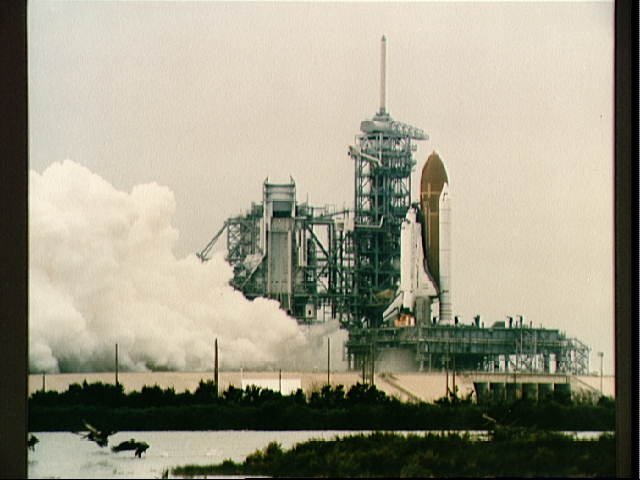
The morning was cold. We opened the water valves on Launch Pad 39B overnight to keep the lines from freezing and ice was all over the pad. Still, that should have not been a problem, nor caused a disaster. We had a delay of two hours because of an equipment failure on the pad, but the fuel and crew were loaded normally and Challenger launched at 11:38 AM.

Ice on Launch Pad 39B after water release to protect pipes

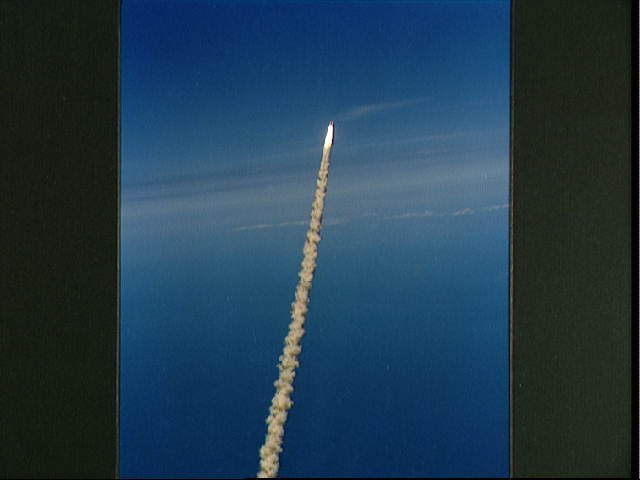
There were no warnings, no alarms, no indication of a problem. At 73 seconds after liftoff a massive cloud surrounded the vehicle and we lost sight of it. Then the Solid Rocket Boosters (SRBs) emerged at the top of the cloud and continued on followed by pieces of debris. We knew that something had happened but it was over a minute before it became apparent that the Orbiter had not survived.

The impact on everyone was a wall of emotions. The feeling of loss because the seven astronauts were our family. The feeling of empathy for the astronaut’s families for their loss. The feeling of anxiety as to if there was something we did that caused this tragedy and the need to find answers as quickly as possible. The loss was made even harder as we all watched helplessly seeing the remains of STS-51L fall into the ocean. Many of us held out hope of the miracle until it became apparent there would not be one.

Much of what happened does not make sense. Any rocket-based vehicle is a flying explosion waiting to happen, but everything possible is done to keep the volatile chemicals from interacting until they reach the nozzle. The cloud was apparently the result of a sudden burn of fuel from the External Tank, which doesn’t necessarily mean it was a violent explosion. If there was an explosion, why did the Solid Rocket Boosters (SRBs) escape, seemingly untouched. Challenger has been cursed with Main Engine problems, so some wonder if one of them failed causing the External Tank (ET) to breach and the fuel to burn, but again, why didn’t the SRBs also explode? 

There has been discussion that the cold might have caused a problem with the seal around the joint of a SRB, but why would that destroy the External Tank (ET) and Orbiter, but have seemingly little or no impact on the SRBs? It is apparent that the ET is key to explaining what happened. A joint could fail and hot gas escape that is aimed directly at the ET, which could cause an explosion, but a joint is 360°around and less than 25% of a joint faces at or near the ET. Odds of a first time failure of a joint facing the ET after 25 missions are ridiculously low.

STS-51L Christa McAuliffe, Gregory Jarvis, Judy Resnik, Mission Commander Dick Scobee, Ronald McNair, Pilot Michael Smith, Ellison Onizuka in White Room on 8 JAN 1986

The biggest question on everyone’s mind is the one no one wants to discuss. What happened to the crew? The Orbiter and ET emerged from the cloud in fragments and some were large enough to be the area where the crew sat during launch. Most of us believe that they were killed instantly, but no one will rest peacefully until we know what happened to them. 

The scope and breadth of this tragedy is far beyond what I could have imagined. Somehow we all have to move forward, but we’re all trying to deal with what happened. Moving forward doesn’t seem possible, right now. The first step in moving forward will be to understand what happened.

TOMORROW: What Happened to STS-51L

15 Days in January – Day 14

27 Friday Jan 2012

Posted by Paul Kiser in Fiction, Government, History, Science, Space, Technology, US History

≈ Leave a comment

Tags

1986, Challenger, Disaster, freezing temperatures, launch delays, Launch Pad, NASA, Pad 39A, Pad 39B, Space Shuttle, STS-51L, Weather

(NOTE: The following is a fictionalized account of the 15 days in January 1986 leading up to the Challenger Space Shuttle disaster on the 28th of that month; however, the details of weather and NASA events are based on known historical data.)

Titusville, Florida
Monday, January 27, 1986
High Temp: 55° F Low Temp: 36° F

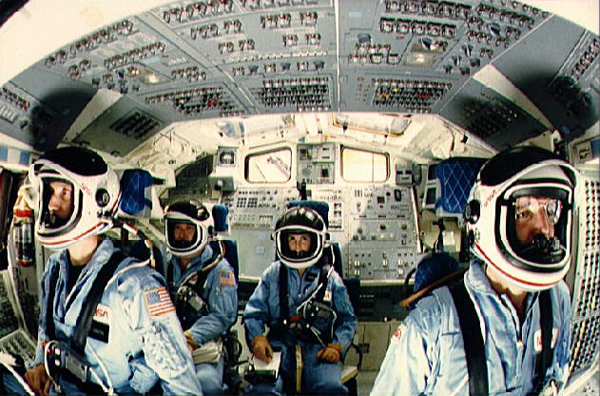
Flight deck wide-angle view of STS-51L crew all dressed up and ready to go

It is frustrating when minor issues become show stoppers. Today’s first launch from Pad 39B was thwarted by a simple tool that wouldn’t come off the hatch on Challenger as we locked the crew in the Orbiter. We finally sawed it off and then drilled out a bolt to replace it. By the time we had solved the issue the winds were unacceptable for a landing if we had to abort and bring the Challenger back. We are now scheduled for launch tomorrow morning, January 28.

The weather was cold this morning. We’ve never launched in conditions this cold, but it is a lot colder than 36 ° F only 20,000 feet above Kennedy Space Center (KSC) and the Challenger will be there about 30 seconds after launch. I guess we shouldn’t be complaining down here.

STS-51L mid-deck with rest of crew strapped in

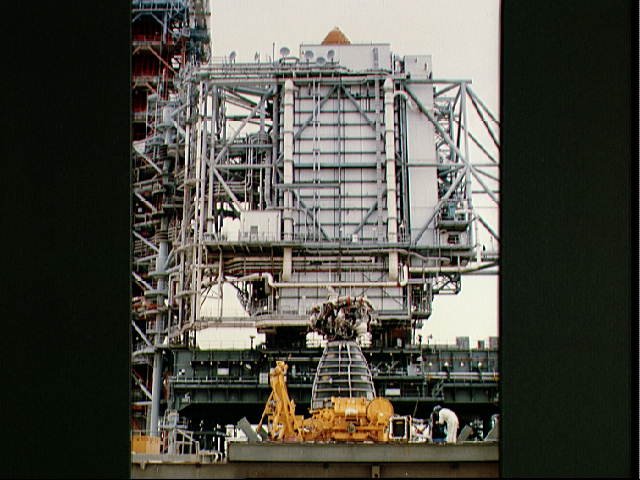
Tomorrow’s forecast is for clear skies and temperatures to be cold overnight and not as warm tomorrow during the day. The big issue on the Launch Pad for us is whether or not the temperatures will drop below freezing tonight. We have a lot of water piped in and around the pad area and if the water in the pipes freeze and break the Challenger might not go up for several days. One option being discussed is to open valves tonight and let the water flow to keep it from freezing. Trying to heat the entire pad area is not a realistic option and any open heat source is dangerous considering the fuels we have in and around the Shuttle.

If everything goes smoothly tomorrow we will finally get Challenger on its way for its 10th mission. We are now almost a week behind on this launch because of the delays of Columbia and the weather, both here and at other abort landing sites. After the launch we have to clean up the chemical residue from the Solid Rocket Boosters (SRBs) and inspect the launch pad area for damage. Repairs and  maintenance will be scheduled and addressed, which is currently underway at Launch Pad 39A after Columbia’s January 12th launch. 

By this time next year we will be more like the gate at an airport with a continuous process of preparing for launch, repairing from launch, and preparing for next launch, with three active pad crews (two here at KSC and one at Vandenberg AFB.) President John F. Kennedy gave our country a dream to reach for the stars and it is exciting to watch the dream become a reality.

15 Days in January – Day 13

26 Thursday Jan 2012

Posted by Paul Kiser in Fiction, Government, History, Science, Space, Technology, US History

≈ Leave a comment

Tags

Challenger, Launch Rats, NASA, Space Station, STS-51L, Teacher in Space, USSR

(NOTE: The following is a fictionalized account of the 15 days in January 1986 leading up to the Challenger Space Shuttle disaster on the 28th of that month; however, the details of weather and NASA events are based on known historical data.)

Titusville, Florida
Sunday, January 26, 1986
High Temp: 66° F Low Temp: 48° F

Launch Rats working on the hydrogen fuel line

What’s next? One of the people on the launch pad team (we’re known as ‘Launch Rats’) likes to say, “What’s next?” He rarely stops moving. Once he’s completed one task he wants to move on. That is a great philosophy to have at NASA. We are constantly facing a new task or issue as we prepare for each launch and in order to address them all we have to keep moving.

That’s also what we have done in the American space program. It was a major achievement to get to the Moon and back, but that was only one task. We started out behind the U.S.S.R. in space technology, but we now are in the pilot’s seat in determining the future of space exploration. U.S.S.R is copying our Shuttle design so they can also have a reusable space vehicle, but they are at least a decade behind us.

Our family of Orbiters have the capacity to build a massive space station, much larger than the Soviet space station that is rumored to be launched sometime this year. Once we have a platform in space we can prepare for extended missions to the Moon or Mars without the current limitation of a single rocket’s lift capabilities. That is what’s next for America’s space program.

Tomorrow, pending good weather, we will send Challenger on its way, and before they are in orbit we have a Launch Rat that will be saying, “What’s next?”

15 Days in January – Day 12

25 Wednesday Jan 2012

Posted by Paul Kiser in Education, Fiction, Government, History, Public Relations, Science, Space, Technology, US History

≈ 1 Comment

Tags

1986, Challenger, Christa McAuliffe, Dick Scobee, Kennedy Space Center, KSC, NASA, Space Shuttle, STS-51L, Teacher in Space

(NOTE: The following is a fictionalized account of the 15 days in January 1986 leading up to the Challenger Space Shuttle disaster on the 28th of that month; however, the details of weather and NASA events are based on known historical data.)

Titusville, Florida
Saturday, January 25, 1986
High Temp: 73° F Low Temp: 57° F

Teacher in Zero G - Christa McAuliffe trains for STS-51L

The launch of STS-51L is now scheduled for Monday. We were scheduled for a liftoff Sunday morning, but tomorrow’s weather is predicted to be as bad or worse than today’s, which was foggy until about noon. Hopefully, we can get Challenger off the ground on the 27th and then focus on Columbia’s next launch in March.

The seven astronauts going up with Challenger on Monday include our first teacher. The Teacher in Space Project was announced by President Ronald Reagan in the Fall of 1984. Last Summer Vice President George Bush announced that Sharon Christa McAuliffe was selected as the first Teacher in Space from 11,000 applicants. Christa teaches in Concord, New Hampshire and submitted her application on the last day they were being accepted.

STS-51L crew trains for emergency evacuation from launch pad

Mrs. McAuliffe, as she is known in the classroom, has always dreamed of being part of the space program and is pleased to have the chance to take her classroom skills into space. Christa talked about the opportunity she has been given, saying:

Imagine me teaching from space, all over the world, touching so many people’s lives. That’s a teacher’s dream! I have a vision of the world as a global village, a world without boundaries. Imagine a history teacher making history!

In addition to Mrs. McAuliffe will be four members of the ‘Class of 1978.’ Commander Francis R.’Dick’ Scobee, Mission Specialists Ellison ‘El’ S. Onizuka, Judith ‘Judy’ A. Resnik, and Ronald ‘Ron’ E. McNair were all selected as astronaut candidates in January of 1978. The other two crew members are Pilot Michael J. Smith and Payload Specialist Gregory Jarvis.

Commander Dick Scobee noted the opportunity of the Teacher in Space Project when he said:

“My perception is the real significance of it, and especially a teacher, is that it will get people in this country, especially the young people, expecting to fly in space. That’s the best thing that can happen to our program. The short-term gain is a publicity gain. The long term gain is getting expectations of the young people in this country to the point where they expect to fly in space, they expect to go there, they expect this country to pursue a program that allows it to be in space permanently to work and live there, to explore the planets.”

The Teacher in Space Project is just one more part in keeping America a world leader by bringing space down to Earth. On Monday we will take the next step with the beginning of mission STS-51L…assuming the weather cooperates!

15 Days in January – Day 11

24 Tuesday Jan 2012

Posted by Paul Kiser in Communication, Education, Fiction, Government, History, Information Technology, Science, Space, Technology, US History

≈ Leave a comment

Tags

Challenger, Halley's Comet, Kennedy Space Center, KSC, NASA, Satellite, Space Shuttle, SPARTAN 203, STS-51L, TDRS, Teacher in Space

(NOTE: The following is a fictionalized account of the 15 days in January 1986 leading up to the Challenger Space Shuttle disaster on the 28th of that month; however, the details of weather and NASA events are based on known historical data.)

Titusville, Florida
Friday, January 24, 1986
High Temp: 66° F Low Temp: 55° F

TDRS satellite to be launched by Challenger STS-51L

This afternoon’s launch had to be scrubbed. The weather here was cool and damp, but the real problem was the weather at one of the abort landing sites. We have an alternate abort site but they cannot handle a nighttime landing (an abort on this side of the world would be a night landing there,) so the launch was rescheduled for tomorrow morning in case we have to activate the alternate abort site. That would allow Challenger to land in daylight at the alternate site if they have to abort.

The launch was then pushed back another day because of the morning versus afternoon liftoff. The problem is that we have a set amount of work to do and it was quickly determined that we would not be ready for launch by Saturday morning. Mission Control then moved the launch to Sunday morning. 

SPARTAN 203 satellite to have its eye on Halley's Comet

Once we finally do get Challenger in orbit, the STS-51L mission has several goals. One will be to launch the TDRS-2 satellite, which is a communications relay station for analog and digital signals. These satellites are the next generation in communication technology allowing information to be transmitted around the world in seconds. Another small satellite called SPARTAN 203 is being deployed to observe Halley’s Comet, which will reach its perihelion (closest approach to the Sun) on February 9, 1986.

In addition, this mission will send our first “Teacher in Space.” More about that tomorrow. 

15 Days in January – Day 10

23 Monday Jan 2012

Posted by Paul Kiser in Fiction, Government, History, Science, Space, Technology, US History

≈ Leave a comment

Tags

C1, C2, C3, Challenger, Criticality, KSC, NASA, space flight, STS-51L

(NOTE: The following is a fictionalized account of the 15 days in January 1986 leading up to the Challenger Space Shuttle disaster on the 28th of that month; however, the details of weather and NASA events are based on known historical data.)

Titusville, Florida
Thursday, January 23, 1986
High Temp: 75° F Low Temp: 53° F

Earth looking out through Challenger cargo bay

Tomorrow we should launch Challenger on its 10th mission. Temperatures were seasonal today; however, the weather is questionable as another cold front is moving through tomorrow. We won’t know if the launch is a go or not until a few hours or less before liftoff.

Beyond weather considerations, there are thousands of things that have to be perfect before a mission is given a “go for launch.” It’s a wonder we ever get a Space Shuttle off the ground. Every individual component of the Orbiter, the External Tank (ET), and the Solid Rocket Boosters (SRBs) is rated in one of five categories of impact on the mission, vehicle, and/or crew if the part fails. The ratings are as follows:

  • Criticality 1 (C1) – Loss of vehicle or crew if the component fails
  • Criticality 2 (C2) – Loss of mission
  • Criticality 3 (C3) – Component will not have fatal impact on crew, vehicle, or mission if it alone fails
  • Criticality 1R (C 1R) – Redundant component, but loss of vehicle or crew if both primary and redundant components fail
  • Criticality 2R (C 2R) – Redundant component, but loss of mission if both primary and redundant components fail

Any component that is not rated C3 and has a known issue not only stops the countdown, but the entire program, until resolved. When trying to put seven people and tons of cargo into Earth orbit, there are a lot of components that fall into the C1, C2, C 1R, or C 2R categories. Safety can be annoying, but it save lives.

Crew of Challenger STS-7 mission working in space

That said, it is impossible for any human, regardless of how careful, intelligent or well-educated, to be able to anticipate every possible problem. Exploration of uncharted territory comes with a price and that price is the loss of human life. Over 700 people died trying to reach the North Pole and even there we have air to breathe, water, and survivable temperatures if properly dressed. In space there is no air, no water, and a human dies if directly exposed to the vacuum of space.

Space travel is risky on the best of days. Astronauts are put in a ship that is designed to be as light-weight as possible with no significant armor or shielding around them. They are attached to two highly explosive solid rocket boosters that would flatten a small city if they exploded, connected to a massive tank filled with hydrogen and oxygen that has a nasty tendency to flash burn if it comes in contact to even a small flame or spark.

In addition, the speeds and the pressures that astronauts experience are unlike any other reality most humans can imagine. There is no doubt that human life will be lost in the pursuit of space exploration. We will do everything we can to safeguard our astronauts, but at some point we will discover what we did not anticipate. At some point an accident will occur on the ground or in flight. We will investigate, learn where we failed and moved forward again.

For centuries humans sailed near the coastline because no one knew what lie out across the sea. Staying close to shore taught us how to sail, while minimizing the risk. Even then ships sank and people died. The Space Shuttle program is our way of sailing near the coastline. We send people up into low Earth orbit and learn how to ‘sail’ in space. After a few decades we will be ready to go out into open space, just as ships were ready to cross open seas.
There are some who ask why should we reach out into space. That is probably what some people asked sailors who went off to explore the new world. But those brave men sailed off into uncharted waters and everything we now enjoy in the United States of America is due to those who took the risks to leave behind the safety of ‘the known’ in order to explore the unknown.

The answer to those people who want to know ‘why’ is simply this: we don’t know why…YET. After we get there we will know why it was so important we went. That is the way it has always been when exploring the unknown. That is the way it will always be.

15 Days in January – Day 9

22 Sunday Jan 2012

Posted by Paul Kiser in Fiction, Government, History, Science, Space, Technology, US History

≈ Leave a comment

Tags

abort, Challenger, NASA, Space Shuttle, SSME, STS-51F

(NOTE: The following is a fictionalized account of the 15 days in January 1986 leading up to the Challenger Space Shuttle Disaster; however, the details of weather and NASA events are based on known historical data.)

Titusville, Florida
Wednesday, January 22, 1986
High Temp: 72° F Low Temp: 46° F

Challenger main engines during STS-51F abort

It’s too bad the launch of our 25th mission was moved from today. The weather was good for most of the day. We are still go for the launch of Challenger on Friday. After Challenger we have a break until March 6th, when Columbia is scheduled to launch again.

As I’ve said, this will be Challenger’s 10th mission; however, the most problematic mission we’ve ever had in the program was her 8th mission. She was scheduled for launch on July 12, 1985 and the countdown was proceeding as planned. At 6 seconds the Orbiter’s main engines (SSMEs) began their firing sequence; however, just before the Solid Rocket Boosters (SRB) were fired the computers detected a problem with one of the engines and aborted the launch. While it is a safe procedure, any abort makes everyone’s heart beat a little faster.

Launch of STS-51F - Before one Main Engine failure

Once again the Challenger had her main engines replaced while at the launch pad, which took us two weeks. Problem solved…or at least we thought.

Challenger was then rescheduled for a liftoff on July 29th. After a technical issue delayed the launch by 97 minutes Challenger finally left pad 39A on her way to orbit. Less than six minutes into the flight one of Challenger’s main engines shutdown and another engine was reaching a potential automatic shutdown, which would have caused a serious high-risk abort issue. Quick work by Mission Control and the crew overrode the computer and kept the remaining two engines burning. Unfortunately, the Orbiter could not make its planned orbit; however, the crew was able to fulfill the mission in a lower orbit.

The launch of a Space Shuttle is never routine, but by the end of this year we will be showing the world how close space can be to those who reach for it

15 Days in January – Day 8

21 Saturday Jan 2012

Posted by Paul Kiser in Fiction, Government, History, Science, Space, Technology, US History

≈ Leave a comment

Tags

Challenger, hot gases, joint leakage, NASA, O-rings, Solid Rocket Boosters, SRB, STS-51-L, STS-51B, STS-51L, STS-6, STS-7, STS-8

(NOTE: The following is a fictionalized account of the 15 days in January 1986 leading up to the Challenger Space Shuttle Disaster. The character’s account is fictional; however, the details of weather and Space Shuttle events are based on known historical facts.)

Titusville, Florida
Tuesday, January 21, 1986
High Temp: 64° F Low Temp: 45° F

Challenger rolls out to Launch Pad 39A

Today we are having another day of cool, but clear weather with the wind out of the north. Challenger (OV-099) is still being prepped for a Friday launch and I’m just grateful that the original launch date was pushed back because of Columbia’s flight delays. Hopefully, it will be warmer on Friday, which will make the launch more comfortable for everyone watching. 

Challenger STS-6, her maiden voyage

As I said yesterday, Challenger has given us many ‘challenges.’ The fact that OV-099 was not originally intended to fly may be part of the reason she has been sometimes reluctant to leave Earth. That said, despite her temperament, Challenger  has broken new ground for the program.

After her problematic maiden voyage the second flight was relatively trouble-free. Launched on June 18, 1983, Challenger STS-7 was the first mission with a planned landing at KSC, but that had to be waved off because of weather.

Challenger in lightning storm just prior to liftoff

Challenger’s third mission (STS-8) was supposed to be in July, but because a payload issue the launch was pushed back to August 30, 1983. After a spectacular lightning show just before launch, Challenger lifted off almost on time making history as the first nighttime launch of a Space Shuttle. This feat was complimented by the first nighttime landing when Challenger returned on September 5, 1983.

1984 was a great year for Challenger. OV-099’s fourth, fifth, and sixth missions gave us the first untethered ‘space walk,’ the first Orbiter landing at KSC, the successful recovery, repair, and redeployment of an orbiting satellite, the first time seven people were launched into space, and the first time two women were in space at the same time.

Bruce McCandless II became first human satellite on STS-41B

The seventh mission for Challenger, and her first of 1985, was unusual because it was the only mission where the Shuttle had been delivered to the launch pad and then had to be pulled back to the Vertical Assembly Building (VAB.) Concerns about the reliability of a satellite in the payload bay of Challenger forced NASA to cancel the mission.

After a two month delay Challenger’s new STS-51B mission was finally launched on April 29, 1985, with the European Space Lab – 3 in its payload bay. The mission was a success with the only issue with the flight occurring after the Solid Rocket Boosters (SRB) were recovered. The left SRB had evidence that it leaked hot gases through a joint area and two rubber o-rings that were designed to sealed the joint were damaged. One ring had 4mm of erosion and the other had 8mm of erosion.

This leakage presents two issues. The first is the potential loss of pressure if the leak is too major and the second is the danger of hot gases that might be directed toward the External Tank (ET), the Orbiter, or the other SRB, which might damage them. Fortunately, this was not an issue during this flight.

Despite the SRB hot gases leakage issue on her seventh mission, the biggest scare Challenger would give us was on her eighth mission. I’ll talk about that tomorrow. 

15 Days in January – Day 7

20 Friday Jan 2012

Posted by Paul Kiser in Fiction, Government, History, Science, Space, Technology, US History

≈ Leave a comment

Tags

Challenger, NASA, Orbiter, OV-099, Space Shuttle, STA-099, STS-51L

(NOTE: The following is a fictionalized account of the 15 days in January 1986 leading up to the Challenger Space Shuttle Disaster. The character’s account is fictional; however, the details of weather and Space Shuttle events are based on known historical facts.)

Titusville, Florida
Monday, January 20, 1986
High Temp: 66° F Low Temp: 48° F

Challenger atop the Boeing 747 on April 18, 1983

We are now four days from the launch of Challenger on the STS mission 51L. The decision was made to push back the date to Friday the 24th. I think that will be a great way to end our week. 

Challenger is our second space-qualified Orbiter. Columbia was the first. Challenger has been responsible for nine of 24 completed missions, and at times Challenger has been challenging.

Challenger rolls out to Launch Pad 39A for maiden voyage (8 DEC 1982)

While most civilians know Challenger by its name, we know it as OV-099 (technically:  Orbiter Vehicle-099;) however, that was not its original designation because initially it was not intended to fly.

Because of the lack of computer simulations, STA-099 (Structural Test Vehicle-099) was built to be a full-scale test model to determine if the design would meet stress expectations without failing. The contract to build it was awarded on July 26, 1972, but construction didn’t begin until November 21, 1975. After a year of testing was decided that it would be quicker and less expensive to refit STA-099 for space flight rather than rebuild the original air-flight test vehicle we know as Enterprise (OV-101.) The conversion of STA-099 to OV-099 began on January 28, 1979, which, in eight days, will be exactly seven years ago.

Repairing/replacing Challenger's main engines before its maiden flight

Challenger rolled out of the Palmdale assembly facility on June 30, 1982 and arrived at KSC on July 5th. Challenger was prepped for its first flight, which was scheduled for January 20, 1983, but while it sat on Launch Pad 39A testing revealed a hydrogen leak in one of the main engines. Subsequently, Challenger had to have her main engines removed for repairs while sitting on the launch pad. One of the engines had to be completely replaced.

Challenger problems did not end with the engines. A severe storm contaminated the payload while she sat on the pad. The payload had to be decontaminated. Challenger finally was successfully launched on her maiden flight on April 4, 1983, 51 months after the conversion began.

More on this ship’s history tomorrow.

← Older posts
Newer posts →

Other Pages of This Blog

  • About Paul Kiser
  • Common Core: Are You a Good Switch or a Bad Switch?
  • Familius Interruptus: Lessons of a DNA Shocker
  • Moffat County, Colorado: The Story of Two Families
  • Rules on Comments
  • Six Things The United States Must Do
  • Why We Are Here: A 65-Year Historical Perspective of the United States

Paul’s Recent Blogs

  • Dysfunctional Social Identity & Its Impact on Society
  • Road Less Traveled: How Craig, CO Was Orphaned
  • GOP Political Syndicate Seizes CO School District
  • DNA Shock +5 Years: What I Know & Lessons Learned
  • Solstices and Sunshine In North America
  • Blindsided: End of U.S. Solar Observation Capabilities?
  • Inspiration4: A Waste of Space Exploration

Paul Kiser’s Tweets

Tweets by PaulKiser

What’s Up

July 2026
S M T W T F S
 1234
567891011
12131415161718
19202122232425
262728293031  
« Jun    

Follow Blog via Email

Enter your email address to follow this blog and receive notifications of new posts by email.

Join 686 other subscribers

Create a website or blog at WordPress.com

Loading Comments...