3rd From Sol

~ Learn from before. Live now. Look ahead.

3rd From Sol

Category Archives: Universities

Confronting Truth: The Difference Between Science and Religion

27 Monday Nov 2017

Posted by Paul Kiser in Education, Ethics, History, Passionate People, Religion, Respect, Science, Space, Technology, Universities

≈ Leave a comment

Tags

astronomy, belief, Catholic, Catholic Church, center of the universe, Christian, Earth, Faith, Galileo, Galileo Galilei, geocentric, heliocentric, Islam, religious doctrine, scientific method, scientific process, Sun

There is a primary difference between science and religion. Religion discourages the confrontation of the ‘truth’ as it is presented by the leaders of the church. When I say discourage, I mean up to and including the murder of those who challenge the church’s version of the truth.

Science, not only accepts a challenge to the current truth, it is the fundamental architecture of all scientific endeavors to challenge the truth. Scientists accept that our current knowledge is incomplete, and that research, observation, and experimentation will replace the current truth of the universe around us.

A good example of this is our understanding of Earth and its relationship to other bodies in space. The religious doctrine stated that Earth was the center of the universe. Religious sources have claimed that holy text have told them the Earth is the center of the universe, and that was a truth which could not be challenged.

However, the concept of an Earth-centered (geocentric) universe had been challenged in the third century BCE by Greek astronomer and mathematician, Aristarchus of Samos, who theorized a Sun-centered (heliocentric) universe. Unfortunately, his idea lacked supportive evidence and was largely ignored.

Galileo was a victim of the Church, not of science

Over 1,700 years later, others began using observations that indicated that the geocentric model didn’t work as well as the heliocentric model. In January of 1610, Galileo Galilei used a telescope to discover three of Jupiter’s four largest moons, and observed that they orbited Jupiter. He then theorized that the Earth may also orbit the Sun, rather than the Sun orbiting the Earth.

This challenged the belief that dated back to Aristotle that all objects orbited the Earth, a concept that was adopted by both Islam and Christian churches. Galileo’s findings contradicted a fundamental truth of the church. For that crime, Galileo was subject to a Roman Inquisition, and ultimately, arrested and imprisoned.

While it is true that Galileo’s theories were not readily accepted, even by other astronomers of his time, he began a process of challenging truth, and using observation to determine truth. For this, Galileo is known as the father of the scientific method.

Some might think that their religion has outgrown this absolute interpretation of doctrine, and accepts scientific proof. To some degree, most Christian churches, when faced with overwhelming proof will either reluctantly accept the science, or become mute on the subject.

However, in the case of Galileo, the Catholic Church has attempted to use revisionism to explain its position on the geocentric/heliocentric debate. In 2004, the Catholic Church published a revised history of its role in the matter of Galileo. In a blog article on Catholic.com, the Church implies:

  1. that it was his fellow scientists, not the Church that disputed Galileo’s findings,
  2. that it was Galileo’s fault for promoting his theories that challenged Church doctrine,
  3. that Galileo failed to prove his position,
  4. that Galileo’s findings were not 100% correct, and 
  5. that Galileo did not suffer any real consequence for his research and findings.

All five of these points are twisted interpretations of what we know to be fact.

  • Galileo was persecuted by the Church, not his fellow scientists. Arrested by the Church, not this fellow scientists, and sentenced by the Church, not his fellow scientists. Yes, his findings were not widely accepted by other astronomers, but as Galileo was the first to observe Jupiter’s moons and their orbits, he would have been alone in promoting the observations.
  • Galileo had his observations, and while there would need to be more observations and the development of better technology to confirm his observations and conclusions, he had every right to promote the concept, even if it disputed the truth of the Church.
  • Galileo observed and hypothesized, but he wasn’t 100% correct. The Catholic Church suggests that because he wasn’t 100% correct that they were right in persecuting him for his theories. They were not, and the idea that the church was waiting for better evidence is a lie.
  • Galileo faced an Inquisition, and was sentenced. Whether he was tortured is not relevant to the Church’s role in trying to silence those who challenge the teachings of their doctrine.

Science seeks truth, but scientists know that all truth is subject to the gathering of more data, which may disprove the known truth and replace it with a new concept. The church believes that all truth comes from God, and it is not subject to revision, even if the truth of the Church is wrong.

Job Killing: The Republican Prime Directive

25 Thursday May 2017

Posted by Paul Kiser in About Reno, Branding, Business, Education, Employee Retention, Ethics, Generational, Government, Government Regulation, History, Human Resources, Management Practices, Politics, Public Image, Public Relations, racism, Taxes, Technology, Universities, US History, Women

≈ Leave a comment

Tags

BLS, Bureau of Labor Standards, Employment, GOP, government jobs, high paying jobs, job creation, jobs, Manufacturing jobs, Republican, Republicans, Trump's finances, Unemployment

There may be no political party in the history of the world that has killed more jobs, or enacted legislation to kill jobs, than the Republicans of the United States of America. They attempt to deny their legacy and claim that it is government that is killing jobs, while also claiming that illegal immigrants are taking high paying jobs from our citizens. Those are damn lies.

Trump’s SS forces raid homes to allegedly save high paying jobs for U.S. citizens

Business and Republicans are one in the same. Republicans always do what business wants, and in the past thirty years there have been few, if any, examples where a majority of Republicans have voted for legislation that was contrary to business wishes. When manufacturing jobs leave the United States, a Republican businessperson is behind it and it is done with the blessing of Republican politicians.

Manufacturing jobs in the U.S. 1939 to present. Growth occurs under Democratic leadership and shrinks under Republican leadership. (Source:  Bureau of Labor Standards)

Trump’s feigned anger at businesses sending jobs overseas is almost comical if it weren’t so pitiful. In 1995, the sixty-year reign of Democratic majority control of Congress ended. in that sixty year history Democrats controlled either the House of Representatives and the Senate for all but four of those years. Republicans controlled the House of Representatives for six additional years during the Reagan administration. Since 1995, Republicans have controlled the Senate, House, or Presidency for all but two years under a banner to thwart all Democratic legislation.

Four years after the Republicans seized control of Congress and passed major business-friendly legislation, the number of manufacturing jobs in the United States began a plunge that would take it down to levels not seen in fifty years.

Job killing our country’s key employer is a primary goal of the Republican party. Federal, state, county, and local governments have been under attack since the Reagan administration. Republicans have consistently sought to strangle funding for public schools as our population has grown, eliminate jobs of the people paid to protect workers and consumers from unethical businesses, prevent funding for workers providing veteran services, and attack critical jobs that provide services for the typical citizen.

The goal of every business person is to make money, not create jobs. That is why Republicans seek to eliminate costs by killing jobs, rather than spend money to create jobs. To a business person, jobs are an expense, and are the obstacle to making money. What Republicans don’t understand is that jobs move the money through the economy, and eliminating high paying government jobs takes money out of the economy. This is why our economy is barely moving forward.

Trump supporters can’t understand the complexities of a national economy, which is why they are the problem in perpetuating Republican domination of our government. Trump is trying to push our economy into a disaster that we may never recover from unless he is stopped.

Six Facts About Manufacturing Jobs

22 Monday May 2017

Posted by Paul Kiser in About Reno, Aging, Business, College, Customer Relations, Customer Service, Education, Employee Retention, Ethics, Generational, Government, Government Regulation, Higher Education, History, Management Practices, Politics, Public Image, Public Relations, Taxes, Universities, US History

≈ Leave a comment

Tags

Donald Trump, Employment, jobs, Manufacturing jobs, Sierra Nevada Corp., Trump, Trump supporters, unskilled workers

Manufacturing jobs do not just appear or disappear, and the government is not the bad guy.

It is sad to hear Trump supporters to be interviewed about anything, but when they start talking about the lack of manufacturing jobs is when they really start looking like adults in diapers. They act like the government is supposed to force private manufacturers to build a factory and make something so that Joe Blow, with a high school degree, in Small Town USA can drive two miles to the local factory and earn $150,000.

Here are the facts:
 
1. Manufacturing jobs go overseas because consumers in the USA want to pay less for goods, and labor is cheaper in many places outside the United States, which makes the cost of manufacturing less, which makes the price of the product less. 
 
2. USA, state, and local taxes have almost no impact on good manufacturing jobs. For example, the Sierra Nevada Corporation (a private version of early 1960’s NASA…before we had a successful launch) has its headquarters in Nevada, but all of their non-executive jobs are in Colorado. Colorado has higher taxes than Nevada, but Colorado also has a better, more skilled, higher educated workforce. Nevada is the headquarters only so the executives don’t have to pay taxes, but the jobs are in Colorado. If the issue was about taxes, the jobs would be in Nevada, not Colorado.
 

Job fairy or much ado about nothing?

3. There is no manufacturing jobs fairy. Manufacturing jobs REQUIRE someone who wants to buy the product. The NEED for a manufacturing job is determined by the consumer. You don’t build a factory, then hang out a sign saying you’re open for business. Manufacturing jobs are “secondary jobs” meaning that before a manufacturing job is created, a product that people want to buy must exist. 

 
4. Most unskilled manufacturing jobs don’t pay well regardless of where the factory is located. CONSERVATION OF COMPENSATION: If anyone can do the work, the jobs go to the people who are willing to be paid the least amount of money. Whether the job is in the United States, or elsewhere, pay is driven by the supply of workers who can do the job.
 
5. Small towns rarely attract high paying manufacturing jobs. While some factories have moved to rural locations to reduce labor costs, it is rare, and factories still need enough potential workers to avoid a labor shortage, which would increase labor costs.
6.  Good business REQUIRES government regulation. Government regulations protect the employee and the consumer. Many countries don’t have rules of against abuse of workers and don’t require manufacturers to abide ethical business practices, and result is always unethical business practices. Remember the Samsung Galaxy Note 7?

1968: The Year of Fear and Hate

04 Thursday May 2017

Posted by Paul Kiser in Aging, Communication, Crime, Crisis Management, Education, Ethics, Generational, Government, Government Regulation, Health, Higher Education, History, Honor, Politics, Pride, Public Image, Public Relations, racism, Respect, Taxes, Traditional Media, Universities, US History, Women

≈ Leave a comment

Tags

1968, Alabama, Civil Rights, Democrat, Democrats, Elections, George Wallace, Governor, Hubert Humphrey, Protests, Richard Nixon, Riots, Robert Kennedy, Vietnam, Vietnam War

October 1968. Richard Nixon, Hubert Humphrey, and George Wallace, and were desperately trying to win the Presidential election. Former Vice President Nixon had moderate conservatives and war-hawks backing him. Vice President Humphrey had Democratic core voters and intelligent liberals backing him, and Alabama Governor George Wallace was the darling of racists and right wing extremists.

1968 Democratic Convention (The LIFE Picture Collection/Getty Images)

1968:  A Year of Chaos
In 1967, most had assumed President Lyndon Johnson would run, and likely win reelection. Those in his administration’s military leadership offered an optimistic view of the Vietnam War, with one of his recent close advisors publicly saying that the enemy was losing their will to fight.

Despite the rosy picture, over 70,000 U.S. soldiers had been killed or wounded during the war, and 1,000 more were being killed each month. Opposition to the war was tearing the Democratic party apart, and it overshadowed almost all other political issues.

In late January 1968, North Vietnam launched the Tet Offensive. Ultimately, the invading armies were beaten back, but the offensive shocked the United States. Those confident of Johnson’s ability to bring a successful end to the war waned in their support, and in March, the New Hampshire primary gave Johnson an uncomfortably narrow win over Eugene McCarthy, who was considered a relatively minor candidate that focused on an anti-war campaign.

Sen. Robert F. Kennedy (AP Photo/Dick Strobel)

Soon after the primary, Robert Kennedy entered the race, and Johnson ended his campaign. (Although Johnson probably dropped out because he doubted he could beat Kennedy, it is noteworthy that President Johnson’s decision to drop out was heavily influenced by his health concerns. Specifically, that he would likely not live through another term.) Without Johnson in the race, there was no single, obvious choice for President.

The year became more chaotic after Johnson dropped out. Martin Luther King, Jr. was assassinated on April 4. Robert Kennedy was assassinated on June 6. Anti-war and civil rights protests and riots, along with mounting U.S. casualties in Vietnam dominated the news everyday.

Baltimore, Maryland, 1968 (Photo by Afro-American Newspapers/Gado/Getty Images)

By October, voters were reacting to the the presidential election as the prescription moment in the United States. The next President would either cure or kill our country, depending on the point of view. People who sought a calm return to normalcy were split between Nixon and Humphrey.

However, there were people who sought a disruptive choice for President, in the hopes that he would revive the Confederacy’s goal of remaking the United States into a white dominated government that would undo decades of work to create equal rights for all citizens. Their choice was George Wallace.

While many may believe that Wallace was a bigger threat to Nixon’s campaign, the reality was that the Governor from Alabama was luring as much as half of the support of the unions that normally support the Democratic ticket. Uneducated, Caucasian, blue-collar workers were taken in by Wallace’s hardline racist positions.

The civil rights riots generated fear among white voters, many of whom, felt they were not racist, but were of the opinion that life for the African-American would be fine if they would just settle down and accept their lot in life.

In the end, Nixon won with less than half the vote, and was in a statistical tie with Humphrey, but he had a significant electoral college margin. Wallace won over almost ten million voters, and certainly had an impact on the outcome.

Both Nixon and President Johnson used last-minute tactics to sway voters in the final weeks. President Johnson publicly suggested that a Vietnam peace deal was imminent, and Nixon’s campaign used back channels to interfere with those peace efforts, coupled with a spy in the White House that kept the Nixon campaign informed of Johnson’s diplomatic efforts.

NEXT:  A hard look at the Wallace voter

We Don’t Need More Service Jobs

14 Tuesday Mar 2017

Posted by Paul Kiser in Aging, Business, College, Education, Ethics, Generational, Government, Government Regulation, Higher Education, History, Management Practices, Politics, Pride, Public Image, Public Relations, Respect, Science, Space, Taxes, Technology, Travel, Universities, US History

≈ Leave a comment

Tags

economy, government programs, government spending, high paying jobs, job creation, job growth, livable wages, Moon landing, NASA, presidential terms, Presidents, private business, service jobs, Space Program, technical jobs

Putting people on the Moon meant jobs on Earth

During President Lyndon Johnson’s second term (1965-1969,) the space program was booming. At almost four percent job growth, his administration exceeded any other presidential term since World War II, including President Jimmy Carter’s impressive 3.2% growth. These were high paying, skilled jobs that created a demand for workers that enticed many young people to choose engineering and scientific careers.

PRESIDENT PARTY TERM YR JOB GROWTH
Herbert Hoover R 1929–1933 -5.41%
Franklin Roosevelt D 1933–1937 4.97%
Franklin Roosevelt D 1937–1941 2.53%
Franklin Roosevelt D 1941–1945 5.00%
Roosevelt/Truman D 1945–1949 1.61%
Harry Truman D 1949–1953 2.93%
Dwight Eisenhower R 1953–1957 1.34%
Dwight Eisenhower R 1957–1961 0.87%
Kennedy/Johnson D 1961–1965 2.64%
Lyndon Johnson D 1965–1969 3.90%
Richard Nixon R 1969–1973 2.23%
Nixon/Ford R 1973–1977 1.68%
Jimmy Carter D 1977–1981 3.21%
Ronald Reagan R 1981–1985 1.47%
Ronald Reagan R 1985–1989 2.80%
George H. W. Bush R 1989–1993 0.45%
Bill Clinton D 1993–1997 2.85%
Bill Clinton D 1997–2001 2.33%
George W. Bush R 2001–2005 0.02%
George W. Bush R 2005–2009 0.24%
Barack Obama D 2009–2013 0.23%
Barack Obama D 2013–2017 1.85%

CHART 1.0 – Job growth during Presidential Terms (1929-2017) Growth over 2.5% is in green. (DATA credit: Wikipedia)

Service jobs were a byproduct of the main engine driving the boom in the rapid expansion of the space program. Service jobs did not offer the wages or the excitement of the space program, but they did provide employment for those who lacked motivation to qualify and/or seek out better paying, higher skilled jobs.

And then we landed on the Moon.

After we had achieved the primary objective, people who didn’t understand what a large government project means to employment, began questioning the space program. Over time the naysayers effectively killed the program, leaving private business to reinvent what NASA had accomplished in the 1960’s (landing on the Moon) and the 1980’s (a reusable rocket system.)

Today, we are trying to sustain and expand a service industry that lacks the main component of job growth, namely, a major public project that creates high paying and highly skilled jobs. Since NASA wound down its Space Shuttle program, job growth has flat-lined.

Private business does not exist to create jobs. It exists to put money in the pockets of the executives and owners of the business. Creating jobs cuts into profit. Paying higher wages cuts into profit. Private business is never going to create significant job growth, nor improve wages and benefits for the worker.

If we want job growth and livable wages, it is the government that will do it, not private business.

A Return to the United States of America

15 Friday Jul 2016

Posted by Paul Kiser in Aging, Communication, Crime, Education, Ethics, Generational, Government, Higher Education, History, Honor, Politics, Pride, Public Image, Respect, Taxes, Universities, US History, Violence in the Workplace

≈ Leave a comment

Tags

Customer Loyalty, Democrats, Nevada, United States of America, victim, victimization

_DSC4367 (2)We have to stop pretending we’re victims. There are problems in the world. There are problems in our country. But there are always problems and problems don’t make us victims.

A victim needs to be rescued. A victim is looking for a hero to save them. We don’t need to be rescued, nor do we need to be saved.

In the United States of America, we have attempted to educate all of our citizens because people who can solve their own problems do a better job of it, and education gives a person the ability to solve their own problems.

Too many people in this country are looking for a political figure that is going to save them. They are like moths to the flame. They are drawn in by the politician that dazzles them and they surrender their intelligence in order to believe that they can be rescued.

We forget that we are not witnesses to the acts of violence that we see on television or online. We are shocked and repulsed, but the real victims are those who were there, and the families and friends who knew someone who was there.

Our impulse to be a victim, makes us feel helpless to do anything, but we are not helpless. Just being a citizen of this country makes us part of the solution. By selecting intelligent politicians, by paying taxes, by being watchful, we help to defeat acts of violence.

Some delude themselves that a gun in their hands empowers them to respond to a violent event. With little or no training, they believe they can improvise a defense in an urban environment, and stop a mentally ill person who has likely been planning their attack for weeks or months. They cannot.

Only trained law enforcement can adequately respond to a violent situation, and private citizens carrying guns in an urban environment can only make a bad situation worse.

However, we don’t have to be the victim. There is violence, and there is corruption, in this country, but we are not on a path to chaos as long as we remember for over two hundred years, we have a consistent record of defeating threats to our country.

Many of those threats did not come from outside our borders, but inside them. The worst of those threats occurred when a group of our own citizens decided to reject the results of a legitimate elections. and betray our country and our Constitution. They failed because we didn’t respond as victims, but as proud and loyal citizens.

After all we’ve been through, we are still here. Working, raising families, enjoying life more than most of the rest of the world. We are not the victims. We are the solution. We are the United States of America.


Sanders Supporter’s Big Blunder

31 Tuesday May 2016

Posted by Paul Kiser in Aging, College, Ethics, Generational, Government, Government Regulation, Higher Education, History, Politics, Pride, Taxes, Universities, US History, Women

≈ Leave a comment

Tags

2016, Bernie Sanders, Congress, Conservatives, Donald Trump, Election 2016, House of Representatives, Presidential candidates, Presidential election, Senate, Senator Bernie Sanders, supporters

Bernie Sanders supportersThe biggest mistake of Sander’s supporters is the ignoring the opportunity they have in front of them.

Sanders has lost the nomination, and the attempt to destroy the Democratic Party is not going to change that fact. Beyond whining, the main message I hear from Sander’s supporters is that it is time for changing the status quo.

Liberal and progressive people are unified in investing our money in people, not corporations. They are unified in maintaining strong government regulations that level the playing field in every commercial endeavor, including the banking and finance industry. Most Clinton supporters would completely agree that current government established by conservatives, for conservatives, and against the citizens of the United States, must be fixed.

The problem is that neither Hillary Clinton, nor Bernie Sanders can get anything done if both the House of Representatives and the Senate are run by conservative.

This is the big blunder of Sander’s supporters. Hillary Clinton will be ruled and regulated by Congress. If Sander’s supporters really want to see change, they need to stop wasting time on a lost cause, and start identifying the politicians that will focus on fixing our country, not shutting it down.

If Congress voted for a law to force banks to be smaller, and added new regulations, Clinton would have to accept it. To go to war with her own party would end her Presidency. If Clinton feels that Congress is too liberal, she will have to either get on board, or be humiliated.

Sanders supporters don’t understand this, because if they did, they would be one hundred percent focused on Congressional races, and not drooling at the idea of destroying the Democratic National Convention. There is nothing that will happen in Philadelphia this July, because it is meaningless. National political conventions are all show, and no substance.

The alpha and omega of positive changes in our country will be in the hands of Congress. If the dust settles in November and the Republicans still have control of either the House or the Senate, nothing, absolutely nothing will change.

Ironically, the real catalyst for change is in the hands of the Sanders supporters, but they have no idea of what to do with what the power they have in changing Congress.

Trump Supporters: The Brown Stain On USA’s Underwear

21 Monday Mar 2016

Posted by Paul Kiser in Aging, College, Education, Ethics, Generational, Government, Higher Education, History, Honor, Politics, Religion, Taxes, Universities, US History, Women

≈ Leave a comment

Tags

Conservatives, Donald Trump, lies, New York Times, Politico, Republican, Republicans

There are two things that are true about this Presidential election year. First, Donald Trump is a pathological liar, and second, that his supporters represent the worst examples of citizens of United States of America.

The Product of Conservative's Lunacy

Lies of a Political Whore

rulings-tom-falseDonald Trump says:  the man who rushed the stage at him in Dayton, Ohio, “had chatter about ISIS, or with ISIS” in his social media posts.

Donald Trump says:  “GDP was zero essentially for the last two quarters.”

Donald Trump says:  Under the Iran nuclear deal, “we give them $150 billion, we get nothing.”

Donald Trump says:  Common Core is “education through Washington D.C.”

Donald Trump says:  The wives of the 9/11 hijackers “knew exactly what was happening” and went back to Saudi Arabia two days before the attacks to watch their husbands on television flying the planes.

Donald Trump says:  Mahatma Gandhi once said, “First they ignore you, then they laugh at you, then they fight you, then you win.”

Donald Trump says:  “the New York Times can write a story that they know is false” yet “they can’t basically be sued.”

Donald Trump says:  “We (Trump University) have an ‘A’ from the Better Business Bureau.”  

Donald Trump says:  “If it weren’t for me … (illegal immigration) wouldn’t even be a big subject.”  

Donald Trump says:  On the Iraq war, “I said it loud and clear, ‘You’ll destabilize the Middle East.’ “

rulings-tom-pantsonfireVoldemort’s Big Lies

Donald Trump says:  “I don’t know anything about David Duke.”

Donald Trump says:  Ted Cruz “said I was in favor in Libya. I never discussed that subject.”

Donald Trump says:  that in the Philippines more than a century ago, Gen. John Pershing “took 50 bullets, and he dipped them in pigs’ blood,” and shot 49 Muslim rebels. “The 50th person, he said, ‘You go back to your people, and you tell them what happened.’ And for 25 years, there wasn’t a problem.”

Donald Trump says:  “Don’t believe those phony numbers when you hear 4.9 and 5 percent unemployment. The number’s probably 28, 29, as high as 35. In fact, I even heard recently 42 percent.”

Trump Speaks the Lies of the Uneducated, Old, White

Since 2007, the only Presidential candidate that has a worse record than Donald Trump of lying, is Dr. Ben Carson, and Trump has twice as many “Pants on Fire” lies as even Carson. Donald Trump has built his campaign on incitement of the older, less educated, white people who see themselves as victims based on lies and misconceptions they created. Trump is loved by his supporters for ‘speaking the truth’ and ‘saying what no one else will say,’ which is to say, he is gaining their love by saying what they want to hear. Trump validates their view of the world, even though everyone else knows he’s lying. 

Political lying

The demographics of Trump supporters are the people the type of people who blame everyone else for their lot in life. Only 19% have a college degree. More than 80% are over age 45. Only 15% of Hispanics said they support Trump, and only 9% of African-Americans favored Trump.

Trump supporters are the opposite end of the model citizen, and based on multiple incidents and media interviews with them, they are violent and susceptible to the type of incitement that Trump offers in his rallies. They are misfits who don’t believe in anything that doesn’t match their dysfunctional view of the world.

Every time Trump lies to gain their support, they interpret it as a confirmation of all that they want to believe to be true. They believe they are the chosen ones by birth and through Trump, they will take their rightful place as the superior race, and the rest of us shall fall to our knees and worship them.


The Joy of No

01 Tuesday Dec 2015

Posted by Paul Kiser in Aging, Business, Club Leadership, College, Communication, Consulting, Crisis Management, Customer Relations, Customer Service, Education, Employee Retention, Ethics, Generational, Government, Higher Education, Honor, Human Resources, Lessons of Life, Management Practices, Membership Recruitment, Membership Retention, Passionate People, Politics, Pride, Public Image, Public Relations, Re-Imagine!, Relationships, Respect, Rotary, Social Interactive Media (SIM), Social Media Relations, The Tipping Point, Tom Peters, Universities

≈ Leave a comment

Tags

bosses, committees, dictators, Human Interaction, meetings, No, organizations, Social Interaction, workplace

_DSC1990No is a perfectly acceptable answer….providing,

  • The idea or suggestion lacked thought or had no basis in fact. (e.g.; Would Donald Trump be a good President?)
  • The idea or suggestion has obvious flaws. (e.g.; Should we let a gun be in a room with a bunch of 2nd grade children?)
  • Is a matter of personal opinion or seeks personal approval. (e.g.; Would you go out with me?)

But when an idea or suggestion doesn’t fall under any of these categories, the “no” answer becomes a potential weapon of personal destruction for the person saying it, and a beautiful opportunity for the person on the receiving end.

Being the youngest of four boys, my brothers and parents became accustomed to telling me ‘no.’ I was constantly asking questions and making suggestions, and the ‘yes’ answer was likely to encourage me. In those situations where I actually had a good idea, it was enough that as the youngest member of the family, a ‘no’ answer was valid.

As an adult, I never had any expectations that my ideas and suggestions would be better received, so hearing ‘no’ was an irritation, but I accepted it as part of life.

However, I as grew older I noticed that some people seemed to enjoy telling other people ‘no.’ Often these people were in leadership positions and their tactic was to dominate and/or intimidate others. In some cases people would act as a dictator within the organization, silencing the ideas and opinions of others with a type of ‘no’ answer that implied dire consequences if the person didn’t drop the subject, or the idea was treated so lightly as if the person was unintelligent for making the suggestion. For years I thought that part of being a good manager was to have the privilege and responsibility to tell others, “NO!” 

Then several years ago I joined a service club and became very involved in the organization. I served on several Boards and committees. I discovered that I could manipulate some people because I always knew their response to whatever I suggested would be, ‘no.’

It was then I realized that when someone says ‘no,’ it is a gift. The “No-ee” has done all they are required by making the suggestion or asking the question. The “No-er” has put their reputation and respectability on the line. The ‘no’ answer gives them all the responsibility, and, as a situation plays out, their failure to consider someone else’s idea or suggestion may be the fatal decision that brings them down.

I still find enjoyment of sometimes asking a perfectly legitimate question of someone I know will give me a ‘no’ answer. It is even more interesting to do this when I have more information about the issue or situation than they do and they can’t help but give me an answer that will eventually haunt them.

Still, I have learned that organizations and relationships with ‘no’ people are typically doomed. There’s a time to experience the joy of ‘no,’ and then there are times it’s best to walk away and shake the dust off your sandals.

A Failure of Communication

06 Tuesday Oct 2015

Posted by Paul Kiser in About Reno, Branding, Business, Communication, Crisis Management, Customer Relations, Customer Service, Education, Generational, Government, Higher Education, Information Technology, Internet, Management Practices, parenting, Print Media, Public Image, Public Relations, Social Interactive Media (SIM), Social Media Relations, Technology, Traditional Media, Universities, Website, Women

≈ Leave a comment

Tags

CAS, charter schools, Communication, Coral Academy of Science, Education, elementary, emal, Facebook, Gulen movement, Gulen Schools, high school, Iman, Instagram, K-12, middle school, Nevada, Reno, Teaching

“What we got here is a failure to communicate“
Prison Warden in Cool Hand Luke

Organizations should use extreme caution in employing anyone over forty-five for handling public image and public relations. I fall into that bracket and I’ve been studying social media since 2007, but I only know enough to understand that most ‘professionals’ of the traditional media don’t have a clue when it comes to communicating information to people in this century.

Traditional media professionals reminisce about the glory days when the game was to be on good terms with the editor of the local newspapers, have drinks with the news directors of the local television stations, and talk shop with the other local public relations (PR) directors at the bigger companies. Those were the days when a phone call could land a big story for the local news that would launch a new product or service. Top management would pat the PR guy on the back (or on the butt if the person was female) and tell him or her what a great job they did.

Those days are over.

The Internet, Facebook, customer reviews, Twitter, Yelp, and a thousand other media channels severely wounded traditional media and the old ways are never coming back. Yet, talk to an old PR person and say that nothing has really changed. It’s all about who you know. Old PR people don’t have a clue at how silly they sound.

I was at a school board meeting for a public charter school last week where a self-professed ‘expert’ in public relations announced that she was at a conference and learned that people no longer used websites to obtain information. She said that parents of school-age children only paid attention to Facebook and Instagram.

Actual "Principal's message" from current school website....written at least three years ago

Actual “Principal’s message” from current school website….written at least three years ago

It should be noted, and that the school’s website is one of the worst on the Internet, and that the school is known for its severe deficiency in communicating information to parents.

Public Communication 2015
As part of the out-of-touch generation, take my advice with a grain of sodium chloride, or whatever water retaining additive you choose, but here is what I have learned in the past eight years.

It is true that many people from different generations tend to engage in social media at varying levels; however, there is no one single media that can reach everyone regardless of their generation. Education level, social economic status, and language all play a role in where people gather information. To declare that there are one or two media sources that parents of school-age children rely on is arrogant at best, and more likely, ignorant.

Any organization’s strategy has to be to use every possible form of media delivery to reach the stakeholders. In the case of a school, information has to be delivered through student folders, phone call announcements, in-school announcements, school website, parent emails, mail, Public Service Announcements (PSA,) school’s Facebook page, etc. Information must also be repeated in order to reach people when they’re listening. A single Facebook post is like going to a street corner at 6:00 AM and yelling out information and then assuming that everyone who passes by that street corner that day will hear the message.

But just sending out the same message through all the channels is ineffective. Social media channels are best used as a ‘reminder’ or ‘alert’ forum with a link back to one source (e.g.; the school website.) Long posts on Facebook make the information less likely to be read both now and in the future. Short posts with a link to more information for those interested is the most efficient method of delivery.

The website is NOT dead. In fact, it is more vital than ever. A charter school’s website is an information source for those considering enrolling their children, a primary source for parents for detailed information, and it establishes the public image for the school. A Facebook page is vital, and if you have a brilliant administration, Twitter can be the inside source for parents who want to know the inside scoop of what is happening now, but the school website will always be the 24/7/365 place for vital information.

It will take a decade or more to weed out the old PR professionals who live in the past; however, it doesn’t take a sixteen-year-old to know when someone doesn’t understand how to communicate in this century. If the stakeholders say they are not being adequately informed, it’s obvious the organization has a problem.

Rebirth of the Liberal

25 Friday Sep 2015

Posted by Paul Kiser in Education, Ethics, Government, Government Regulation, Green, Health, Higher Education, History, Honor, Passionate People, Politics, Pride, Religion, Respect, Space, Taxes, Technology, Universities, US History

≈ Leave a comment

Tags

anti-American, Bernie Sanders, conservatism, Conservatives, Elizabeth Warren, Liberal, liberalism, liberals, Pledge of Allegiance, President Barack Obama

Liberals, Inc.

Liberals, Inc.

The values and traditions of liberalism in the United States of America is experiencing a Renaissance. This is a not a time for a cautious return to a government by and for the people.  It is a time to boldly stand up for intelligence in political office.

The disastrous policies of George W. Bush, coupled with decades of conservative efforts to put our country in retreat have met with consistent failure. Those failures have forced conservatives to put up artificial issues that appeal to a distinctly anti-American segment of the population, but that has only driven them into a corner.

Conservative politicians strain to win applause from the stupid and the ignorant, but the United States needs and deserves smart, not stupid. Liberals must now step up and engage our citizens and remind them that politics in our country is not to be entertainment for small minds. We have to expose the absurdity of 2015  “conservative values:”

When everyone has guns in public, innocent people die. Gun ownership without rules is anarchy. Laws protect people from those who are too stupid to know better. It’s not about taking guns away; it’s about protecting the innocent from the stupid.

Our government is a blessing, not a curse, and we pay for the privilege of living in this great country by paying our taxes and doing so without complaint.

Unregulated business is the playground of the unethical and immoral. Business is motivated by greed and destruction of competitors. Without government, ethical businesses can’t survive.

If a group of people on an island were running out of fresh water, the liberal mind would determine how to obtain more water, and the conservative mind would begin planning on who they can kill.

The confederate flag is the symbol of racists and traitors who tried to steal part of America away from then attempted to overthrow our country. The confederate flag is a heritage of losers and has no place among a nation of winners.

Government is not a place for religion, nor a country where a majority religion is to dictate the beliefs and morals for all citizens. America is a country that offers freedom FROM religion, not slavery to a religion.

War is the opium for the 2015 conservative. When in doubt the conservative wants to wage war, but war never results in a quick and easy peace. War devastates all involved and it is rarely the leaders who started the war who pay the heaviest price.

The time to coddle the wealthy is past. Money is not the measure of a human, nor does it give special privilege to a person in a country where all citizens are created equal.

For 35 years conservatives have been shouting down common sense and intelligence with false accusations, deceptions, and biased fear mongering. It’s time that loyal Americans regained their voice.

To be liberal is to be an American that loves our country and our government. We believe that all humans are created equal. We believe that our country becomes stronger, not weaker through diplomacy and respect for other countries. We believe that education is the foundation to a better life and schools should be more than a cheap training ground for dead-end service jobs. We believe that when government spends money it provides jobs and needed infrastructure that helps grow our economy.

The call of liberalism is not for everyone, nor is it restricted to one party. Our country’s founders were liberals who broke away from conservatives who wanted to stay loyal to the English King. Republicans were liberal when Abraham Lincoln stood up against domestic enemies that sought to defile our Constitution. Franklin D. Roosevelt was liberal when he made our citizens believe in the greatness of our country. Dwight D. Eisenhower was liberal when he made the Interstate Highway System a reality. John F. Kennedy was a liberal when he said we could go to the Moon and back.

Elementary school children can grasp the values of conservatives. The egocentric concept that everyone else exists to serve their needs is a common attitude of children and conservatives.

However, it takes significant maturity and intelligence to understand liberal values. It requires the person to see themselves as part of a greater society. A liberal knows that respect, cooperation, humility, and honor cannot be compromised for a free society to function. Our original 1942 Pledge of Allegiance reinforced these values:

I pledge allegiance to the flag of the UNITED States of America, and to the REPUBLIC for which it stands, ONE NATION, INDIVISIBLE,  with liberty and justice FOR ALL.

We are a republic, not an oligarchy. We are one nation that shall not be divided. We shall have liberty and justice for all, not just for those with the most money, nor the most guns. 

We are a nation founded by liberals, built by those who believed in “Yes We Can.” Liberal ideals have been a part of every great achievement in our country. Conversely, conservative leadership has maligned and crippled this nation. It’s time we took our country back.

J. K. Rowling: The Unexpected Author

13 Monday Apr 2015

Posted by Paul Kiser in Book Review, College, Communication, Education, Ethics, Fiction, Generational, Higher Education, Honor, Information Technology, Internet, Lessons of Life, Opinion, parenting, Passionate People, Public Relations, Science Fiction, Traditional Media, Universities, Women

≈ Leave a comment

Tags

books, Harry Potter, J. K. Rowling, Jo Rowling, Joanne Rowling, library, Literaray, readership, reading

jkr-photo_new_debra-hurford-brown-j.k.-rowling

Jo Rowling A.K.A: J. K. Rowling

This week my son’s Elementary school is engaged in a venture into the world of Harry Potter. The teachers of 3rd, 4th, and 5th grades have divided the students into the four Houses of Hogwarts School of Witchcraft and Wizardry. This is an opportunity to look back on the single person who created a series of fictional children’s books that revitalized reading for millions of people of all ages.

Any story of great personal success is characterized by being the correct person, in the correct place, at the correct time. That is a requirement. The story of J. K. Rowling is more compelling for why she was the correct person.

Her birth name is Joanne Rowling and she uses “Jo” in casual environments. She has no given middle name but was asked by her publisher to disguise her name so that young boys would not know that Harry Potter was written by a woman. Since she had no middle name she used her grandmother’s name, ‘Kathleen,’ and thus became, “J. K. Rowling (her last name is pronounced, ‘rolling.’) 

Rowling accomplished the unthinkable. At a time when reading books was declining and the Internet was blossoming, the idea that one person could ignite a renaissance of book reading was considered absurd. Rowling’s first publisher told her to get a day job because writing children’s books would never provide enough income.

Like William Shakespeare, there is no significant indicator in Rowling’s pre-Potter life of her eventual rise to the top of the literary world. Still, there are earlier experiences that probably contributed to her success. Among them are the following:

  • Her parents met at King’s Cross Station in London, which became the fictional departure point for the fictional train station departure point to Hogwarts. [Potter influences]
  • As a child she was known to write out a story and read it to her sister, Dianne. [Early fiction writing]
  • Her mother, Anne, was a science technician and also taught science at the Secondary school that Rowling attended. [Priority of education]
  • She speaks English, French and studied German in Secondary school. [Broad-based education]
  • She read and is an admirer of Jessica Mitford, a British-turned-American journalist, author, and political activist. [Ethics, writing, and honor]
  • She has a Bachelor’s of Arts degree in French and the Classics from the University of Exeter. [Writing and knowledge]
  • She studied a year in Paris. [Broad-based education]
  • She taught English in Portugal [Life experience]
  • Her mother had multiple sclerosis (MS) and died while she was writing her first Harry Potter book. [Life experience]
  • Rowling suffered from depression triggered by several life events (Unemployed, her mother’s death, her divorce, etc.) [Life experience]Harry Potter Covers

The idea for Harry Potter apparently came in 1990, during a four-hour train delay to London. She began writing as soon as she reached home and among the first chapters written was the final chapter of the last book. The first book was not finished until 1995. It was submitted and rejected by twelve publishers before it was finally accepted by Bloomsbury Publishing in England the follow year. 

She went from living off of State benefits to a millionaire in five years. Since then, she has devoted a large portion of her fortune to philanthropic causes. 

Though remarkable, Rowling’s financial success is not as significant as what she did for slowing the decline of children reading for fun during the period her books were published (1996-2007.) According to a study by Common Sense Media, 9-year-olds reading for fun at least one to two per week dropped only one percent from 1984 to 2004; however, by 2012 that dropped by another four percent (76% in 2012.) For 13-year-olds the decline in reading for fun from 1984 to 2004, was six percent, but that decline nearly doubled five years after the last Harry Potter book was published (down an additional eleven percent in 2012 to 53%.) 

No one, including possibly Rowling, herself, could have expected anyone to capture a worldwide audience, as did the Harry Potter series. She brought new readers into the literary market that had no interest in reading. Her unexpected achievement is a reminder that what is possible extends beyond the impossible.  

Common Core: Are You A Good Switch Or A Bad Switch? Part III

25 Wednesday Mar 2015

Posted by Paul Kiser in Aging, College, Education, Ethics, Generational, Government, Government Regulation, Higher Education, History, Internet, parenting, Politics, Pride, Public Image, Public Relations, Science, Taxes, Technology, Universities, US History

≈ Leave a comment

Tags

Common Core, Conservatives, conspiracy, funding, math, parent protests, reading, Republicans, school districts, school funding, teachers, Teaching, writing

PART III:  An Answer to the Question:  Good? or Bad?

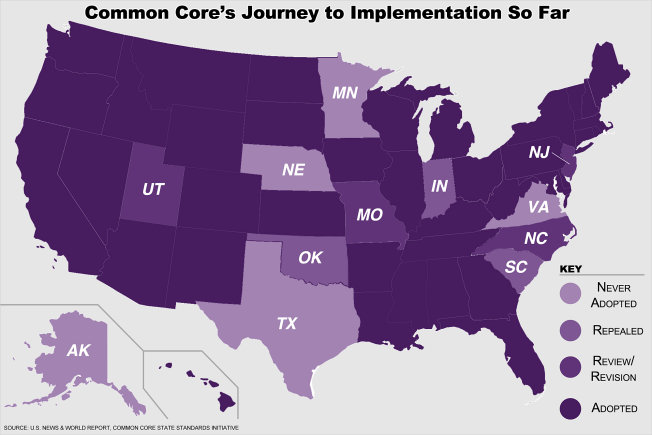
Implementation of Common Core/US News and World Report

Implementation of Common Core

THE VERDICT
In the past year significant political forces have targeted Common Core. The protests have been at near hysterical levels in many communities around the country. The complaints about Common Core are as follows:

  • Standards create a factory-like environment that attempt to put all students in one ‘box.’
  • Teachers focusing on test scores, not educational achievement
  • Parents don’t understand math methods
  • United States history under Common Core is un-American because it includes both positive and negative aspects of the history of our country
  • A belief that parents should define school curriculum, not the school, district, state, or federal government
  • A belief that President Obama is behind the implementation of Common Core and other conservative conspiracy theories

Many of the issues have been generated by conservative voices after a push by Republicans during the past election cycle to ignite anger and votes against public education. Almost all of the complaints would have occurred from any attempt to improve and refine American educational techniques, especially when those improvements involve standardization for all American schools.

If you believe that setting minimum standards in reading, writing, and math is bad, then Common Core is bad. If you believe that children in your community should graduate with similar skills to other students around the country, then Common Core is good. If you believe that a high school degree should be the end of a person’s education, then Common Core is bad. If you believe that every student should receive an education that would prepare them for college, then Common Core is good.

THE REAL PROBLEM
Despite the politicizing of Common Core, there is a real issue in implementing any change in education. Funding.

Any business that seeks to upgrade or improve their methods knows that there is a real cost to any change. Yet, even smart business people seem to forget that to improve our educational system requires a major funding commitment. It takes money to research and establish new programs. It takes money to train school districts, principals, and teachers. It takes money to create new teaching materials, and it takes money to educate parents.

What Common Core is missing is the funding needed to make it a success. Until we can accept the fact that a commitment to education requires a commitment to funding, then we will continue using 20th educational techniques in a 21st century world. America’s efforts to update our educational system will cost money and Common Core is a victim of a society that has abandon quality education because it costs too much.

THE HYSTERIA OF THE LOUDEST VOICES
Unfortunately, Common Core lost a lot of support in the past twelve months. Much of that was due to the political rhetoric during last year’s campaigns, but some teachers are also pulling back support. This is not surprising. As parents become more vocal in opposition, few teachers are willing to oppose parent sentiment even if they are wrong.

Common Core is not a perfect educational system, but it does attempt to better prepare America’s children for a higher level of achievement. Most of the real issues can be resolved with better funding. Just as a school built in the 1950’s is no longer relevant for 2015, education methods of the pre-information era are not relevant today. Our population is continuing to increase and the skills our children must have to thrive as adults are going to advance. Education is going to be expensive, but if we don’t pay now, we will pay more later.

PREVIOUSLY:  Part I:  A Primer in American Education 
                            Part II:  What is Common Core?

Common Core: Are You A Good Switch Or A Bad Switch? Part II

25 Wednesday Mar 2015

Posted by Paul Kiser in Aging, Business, College, Education, Ethics, Generational, Government, Government Regulation, Higher Education, History, parenting, Politics, Public Image, Public Relations, Taxes, Technology, Universities, US History

≈ Leave a comment

Tags

Asian learning methods, Common Core, K-12, learning, math, mathematics, New Math, No Child Left Behind, parent involvement in school, parent reactions, students

PART TWO: What is Common Core?

Cartoon in Chicago Tribune about parent reaction to Common Core

Cartoon in Chicago Tribune about parent reaction to Common Core

The Third Generation of Standardized Education
The basic premise of the George W. Bush (43rd President) administration’s No Child Left Behind (NCLB) mandate was that reading, writing, and math are fundamental to all learning. This is a sound concept; however, these basic skills cannot supplant other subjects traditionally taught in K-12 schools, nor can they be isolated from those subjects. Our society, both business and personal interactions, require an adequate understanding of a wide variety skills and knowledge that exceed the basic skills of reading, writing, and math.

Common Core is an attempt to refine the concept of NCLB by creating standards for all schools that focus on reading, writing, and math, but it also folds these skills into other subjects that impact personal success in the 21st century. Common Core emphasizes teaching methods and outcomes, but leaves it to the State, school district, and school on how to incorporate the program into the curriculum.

Why Some Parents Dislike Common Core Math
Some of the methods adopted by Common Core have angered parents and politicians. In particular, the approach to teaching math. The math issue centers on bewildered parents who don’t understand the revised math teaching methods and why equations seem to be more complicated than when they attended school. The assumption by parents is that whatever they were taught is good enough for their children; however, that is not necessarily true.

Almost every adult in this country was taught that the symbol for a number (e.g.; ‘7’) was everything we needed to know about the number that it represents. We were taught to memorize how the symbol ‘7’ multiplied by the symbol ‘9’ equals the symbol ’63.’ That teaching method does not mean that the student understands that ‘7,’ ‘9,’ and ’63’ are symbols representing a group of objects. 

This is a subtle, but important understanding in math functions. The equation ‘7 x 9 = 63,’ means that we are taking a group of seven objects, adding eight more groups of seven, and determining the total of objects. That is much more complicated than just memorizing that 7 x 9 = 63, but it helps us realize that multiplication is a shortcut to manually counting out 63 objects individual, rather than grouping them.

The weakness of memorization of relationships between symbols also creates confusion as a student moves into higher mathematical equations. In algebra, geometry, and calculus the numeral symbols become less relevant. For example, X = (X+1) and Y = (X-3) can be confusing because ‘X’ stands for EVERY number.

The Credit Card Example
A man is given ten credit cards, but he is NOT told that each credit card represents an amount of money in the bank and, that if used, the money is replenished the next day. He is told how to use each credit card. One card is to buy gas, one to use at the grocery store, etc. Today, he’s at the gas station and it so happened that two of his friends are already there. He decides to pay for his friend’s fuel, which they appreciate. They go on their way, but when he tries to pay for his fuel, the credit card is declined. He didn’t understand that the card represented a limited amount of money, he just assumed it could be used for any amount of fuel. That is similar to how math has been taught in the past. We may have known what to do with the numbers (symbols,) but we may not have fully understood that numbers are just symbols.

Good News, Bad News
Parents objections to the new math teaching methods are a good sign that our children are gaining a deeper understanding of mathematics than their parents did in school; however, parents need to be able to assist their children with homework.¹ This means parents need to be taught the new methods, but few if any schools have developed programs to teach parents because there is no funding available to accomplish the task.

Who Came Up With the Common Core Math Techniques?
Despite the belief that Common Core math techniques were invented in the past few years, the techniques were modeled off educational programs in certain Asian countries where they have been more successful at preparing students for college. In 2009, a coalition of State Governors and Educators worked together to build an educational program that would serve as a ‘best practices’ guide for American schools, which was the birth of Common Core.

NEXT:  Part III:  An Answer to the Question – Good? or Bad?
PREVIOUSLY:  Part I:  A Primer in American Education 

¹Most studies indicate that students perform better when parents are involved in their children’s education. At the very least it indicates to the child that their parents place a high value on becoming educated.

Common Core: Are You A Good Switch Or A Bad Switch? Part I

24 Tuesday Mar 2015

Posted by Paul Kiser in Aging, College, Education, Ethics, Generational, Government, Government Regulation, Higher Education, History, Information Technology, Internet, parenting, Politics, Pride, Public Image, Public Relations, Taxes, Universities, US History

≈ Leave a comment

Tags

classroom, college graduates, Common Core, Education methods, federal mandates, George W. Bush, graduation rates, high school graduates, job standards, K-12, NCLB, No Child Left Behind, President Barack Obama, Race to the Top, school districts, school vouchers, students, teachers, Teaching, Teaching methods, Teaching standards

School's should welcome diversity of ideas but shouldn't tolerate political agendas

School’s should welcome diversity of ideas but shouldn’t tolerate political agendas

PART I: A Primer in American Education

Who’s Afraid of Common Core?
Education in America is often the centerpiece of someone’s agenda, and the newest chapter of the how-to-fix-our-schools controversy is called Common Core. Conservatives have apparently decided that Common Core is the path to Satan. Liberals have reservations about Common Core because it smacks of a factory-like environment that assumes every student and school is the same.

The problem is that the most vocal critics of Common Core have no authority to speak on effective educational methods. Common Core is a significant paradigm shift in education, and opinions of untrained, uneducated, unhelpful ‘experts’  do nothing to move forward the debate on how best to prepare our children for Life 3.0.

The Cost of Achievement
In 1950, only one-third of the population in the United States had a high school degree or better, and only six percent had a college degree or better. In 2010, almost ninety percent of Americans had at least a high school degree, and thirty percent had at least a college degree. That increase is impressive, but what is astounding is that in the same sixty year time frame, America’s population doubled. 

To accomplish that feat cost money. A lot of money. As the bandwagon to attack government spending gained steam, education loomed large in the sights of conservatives. The real cost of the success of American educational achievement has been to become a target of the post-Reagan  agenda.  

Public school in Panama: Seeking to achieve the American dream

Public school in Panama: Seeking to achieve the American dream

A Historical Perspective
In the pre-Information age, schools were isolated in their own districts. How well the students of any given school performed was a local issue, not a state or national issue. In addition, a relatively small percentage of students sought out a college degree, and there were few school districts keeping track of college bound students.

The goal for most school districts in the 1960’s, 70’s, and 80’s was graduate as many students as possible, which sometimes opened the door to unethical practices, such as giving diplomas to students who clearly did not meet reasonable expectations (ability to read, write, etc.) to graduate.

However, by the 1990’s, the idea that all schools in the United States should be able to measure academic success through a unified set of academic standards began to take hold. As the Internet became the backbone of our society, the resulting information explosion forced us to accept that adequate math and reading skills were vital for success as an adult in a technologically advanced society. 

First Generation of Educational Standards
By the beginning of this century, plans had been put into motion to establish a set of educational standards for all schools and testing of all students to determine a school’s success or failure. Under President George W. Bush, the No Child Left Behind Act of 2001 (NCLB,) was mandated and it required States to establish standardized testing, teacher qualifications, and annual academic progress reporting. This was one of the most sweeping federal intrusions into public education. The primary focus of NCLB was to improve reading, writing, and mathematics in schools nationwide, while allowing States to establish the educational standards that would have to be met.

The catch was that rather than investing in those schools that needed help, No Child Left Behind focused on punishing schools that didn’t meet the artificial standards. Almost ever reputable educational review of NCLB  has given it a failing grade. Some of the reasons are as follows:

  • The emphasis on reading, writing, and math during a time when States were cutting funds for kindergarten through twelfth grade (K-12) created a shearing effect on other programs (language, history, music, arts, etc.) as money had to be reallocated to the studies under the NCLB Act.
  • Politicians had little understanding of education and the variables in a classroom environment and they attempted to apply factory-like operations to school systems that failed to address the real issues that impact the ability to learn.
  • NCLB assumed that teachers were mostly at fault for poor educational performance and politicians sought to intervene by imposing punishments for schools rather than actually acting in the best interest of the students.
  • The education of higher performing students was sacrificed in order to devote more resources for the poorer performing students.
  • Students with special needs were not excluded from the testing standards creating a population of students that automatically counted as failing against the school.

Educational Standards – Second Generation
Soon after taking office, the Obama administration began to move away from NCLB by introducing “Race to the Top.” This program flipped NCLB by seeking to reward States for adopting standardized programs rather than punishing them for not meeting federal standards. States competed for additional federal education funding; however, not every State rushed to play the game that offered no guarantee of financial carrot at the finish line.

The most searing problem with Obama’s Race to the Top program may have been the requirement that a teacher’s performance had to be linked to the student’s test scores. This concept of Pay For Performance suggests that teaching professionals must be threatened with a financial stick, forcing teachers to teach students to be successful on the tests by sacrificing all other educational values. It also discourages teachers from working with groups of challenging students who will not be able to produce the test results of more privileged and economically stable students.

NEXT:  Part II:  What is Common Core?
To be published Wednesday, 25 March, 0700 PDT/1400 UTC

NEXT NEXT:  Part III:  An Answer to the Question – Good? or Bad?
To be published Wednesday, 25 March, 1200 PDT/1900 UTC

Epilogue : The 2010’s

20 Friday Mar 2015

Posted by Paul Kiser in Aging, Business, College, Communication, Education, Ethics, Generational, Government, Government Regulation, Health, Higher Education, History, Honor, Information Technology, Internet, Politics, Pride, Public Image, Public Relations, Religion, Respect, Science, Social Interactive Media (SIM), Social Media Relations, Space, Taxes, Technology, Traditional Media, Universities, US History

≈ Leave a comment

Tags

Caucasian, college graduates, Conservatives, Equality, GDP, high school graduates, poor, racism, racists, Reagan agenda, Republicans, Ronald Reagan, The 1%, un-wealthy, wealthy, White politicians

The 2010’s – End of Civility

Image credit: J. Scott Applewhite/AP.

White Conservatives: “Go F**k Yourselves America”

  • Population:  308.7 million
  • Gross Domestic Product (GDP) per capita:  $47,805
  • Median Annual Income:  $47,793 
  • Life Expectancy:  78.7
  • Average Age at Marriage:   Men 28.2, Women 26.1
  • % of pop. w/high school degree or higher:  87.0%
  • % of pop. w/college degree or higher:  30.0% 

REAGAN:  The Killer of America’s Prosperity
From 1950 to 2010 the population of the United States of America doubled (+104.0%.) The Gross Domestic Product (GDP) tripled (+218.1%.) The median annual income is eleven times more than 1950 (+1028%.) Life expectancy has increased by over 15% (15.4%.) Men AND women are marrying an average of over five years older in 2010 than they did in 1950 (men +23.7%, women +28.6%.) The percentage of people with at least a high school degree is now almost 90% versus 34% in 1950 (+153.6%.) Today, 30% of our citizens have at least a college degree versus 6% in 1950 (+383.9%.)

Something went right for America in the last 60 years. But that is changing.

Prior to the Great Depression, Republicans controlled the House and Senate for the majority of the previous 70 years. After the Great Depression both the House and Senate was under Democratic control until 1980. In 1980, America began folowing the conservatives agenda (Reagan 1980-1988, Bush 41 1989-1992, Republican control of Congress 1994-2008) of dismantling the government at all levels, start more wars, give more money to the wealthy, and give less help for the un-wealthy. Since 1979, the wealthiest 1% after-tax income has increased by 200%.

U.S._Income_-_Changes_by_Income_Group_1979-2011

The 1% are 200% wealthier since conservatives took control of the government

Since 1980, annual increases in U.S. Gross Domestic Product (GDP) has stalled and fallen.

GDP Growth by Year

ANNUAL GDP GROWTH: Post World War II, U.S. annual GDP began a steady growth until shortly after Ronald Reagan became President.

GROWTH SACRIFICED FOR GREED
Post-war prosperity was spurred by significant federal government projects and programs. Conservatives derailed that by blaming government for economic issues that were caused by corporate and business greed.

Despite the obvious failure of the Reagan agenda, conservatives have taken a position of complete denial and fantastical thinking. They no longer believe they have any obligation to acknowledge or respect the rest of America. Conservatives are behaving as a child would behave when they are not getting their way, even though their request is completely inappropriate. Rather than accepting that President Obama was elected twice by a majority of Americans, Republicans have blocked all efforts to move forward on measures proven to generate American prosperity because it would make those that have more, give more.

Reagan conservatives have failed and they are backed in a corner of failure. They will not accept reason, nor facts. Civility would force them to accept their failure, so they must be uncivil. They are willing to destroy America, rather than acknowledge failure.

WHY ARE WE HERE?
America has experience massive change in the past 65 years. Most of that change has been good, but the one aspect of the American concept, the idea that we are all created equal, is the one issue in our country that has cast a shadow over us for centuries. White males believe that they are superior to all others and as our demographics have changed Caucasians have worked to obstruct equality rather than accept it.

Segregation was not considered racist until it became obvious it was motivated by whites who were racist. Dismantling government programs that benefit the poor and those in need may not be considered racist, until we realize that these ideas have been pushed forward almost exclusively by white politicians. Telling America that the rich are too burdened to pay a fair share of their taxes is not considered racist until you examine the loop of rich white people giving money to white politicians to pass laws that will reduce taxes on the wealthiest who are almost all white.

America is a country that has yet to commit to everyone being equal. In the 1950’s, white people took their money and ran away to the suburbs. In the 1960’s, the federal government finally stepped in and paid attention to the unequal treatment of African-Americans. In the 1970’s, we became distracted by unethical leaders, war, oil shortages, and inflation. In the 1980’s, we were conned into the idea that our government was to blame for all our problems in the 1970’s, while the Reagan spent money that America didn’t have to spend. In the 1990’s, the conservatives regained control of Congress and began dismantling the federal government and ending ethical business oversight. In the 2000’s, Republicans led America down a path of war and destruction that almost wiped out our economic system.

Why we are here is because we have become weak. We have listened to fools and we know they are fools. They are willing to tear America apart for greed and their own racist ideals. To a racist, compromise is unthinkable, and that is why conservatives will never work towards a unified nation.

THE SERIES:  The 1950’s    The 1960’s    The 1970’s    The 1980’s    The 1990’s    The 2000’s    

This is Why (2015 vs the 2000’s)

19 Thursday Mar 2015

Posted by Paul Kiser in Aging, Business, College, Communication, Crisis Management, Education, Ethics, Generational, Government, Government Regulation, Health, Higher Education, History, Honor, Information Technology, Internet, Politics, Pride, Print Media, Privacy, Public Image, Public Relations, Religion, Respect, Science, Social Interactive Media (SIM), Social Media Relations, Space, Taxes, Technology, Traditional Media, Universities, US History

≈ 1 Comment

Tags

2004 Tsunami, 9/11, Afghani, Amazon.com, Anthrax, Assault weapons ban, Conservatives, Election 2000, Facebook, Florida vote counting, George W. Bush, Global Financial Disaster, Global warming, Hurricane Katrina, Iraq, Mars, NASA, Opportunity, Pope John Paul II, President, President Barack Obama, Republicans, Rovers, Saddam Hussein, Smartphone, Space Shuttle Columbia, Spirit, Supreme Court, Texting, Twenty-ohs, Twitter, Virginia Tech Massacre, Wikipedia, YouTube

The 2000’s – The Defeat of America

Decade of Fear: Y2K, 9/11, WMD's, Katrina, Banking Collapse, Unemployment, Global Warming, Putin, ISIS

Decade of Fear: Y2K, 9/11, WMD’s, Katrina, Banking Collapse, Unemployment, Global Warming

  • Population:  281.4 million
  • Gross Domestic Product (GDP) per capita:  $44,492
  • Median Annual Income:  $40,703
  • Life Expectancy:  76.8
  •  Average Age at Marriage:   Men 26.1, Women 23.9
  • % of pop. w/high school degree or higher:  80.4%
  • % of pop. w/college degree or higher:  24.4% 

TWENTY OH’s
If the 1990’s were a seismic event of technological and social change, the twenty-oh’s is when the tsunami of change hit. Had nothing else happened but the advancement of the Internet, the changes by that alone would have drastically remade the world as we knew it; however, the twenty-oh’s were not content in merely redefining society and the way we communicate, the first decade of the new millennium was going to do an extreme makeover of all our expectations in life. Here are twenty things that made us say Oh!

  1. Y2K, the disaster that never came (Jan. 2000)
  2. Elections of 2000
    1. Florida election fiasco (Nov./Dec. 2000)
    2. Supreme Court appoints George W. Bush as President (Dec. 2000)
  3. Attacks of September 11, 2001
  4. Anthrax letters
  5. Wars of Just Because
    1. Afghanistan (2001-2014)
    2. Iraq (2003-2011)
  6. Rise of Smaller and Smarter Technology (Entire Decade)
    1. Smartphone
    2. Texting
  7. Space Shuttle Columbia destroyed on reentry (Feb. 2003)
  8. Mars Rovers bounce to successful landings and missions
    1. Spirit (June 2003)
    2. Opportunity (July 2003)
  9. Saddam Hussein captured (Dec. 2003)
  10. Assault weapon ban expires (Sept. 2004)
  11. Online Wonders
    1. Amazon.com
    2. Facebook
    3. Twitter
    4. Google
    5. YouTube
    6. Wikipedia
  12. Indian Ocean Earthquake/Tsunami (Dec. 2004)
  13. Pope John Paul dies (Apr. 2005)
  14. Global Warming
  15. Hurricane Katrina (Aug. 2005)
  16. Virginia Tech Massacre (Apr. 2007)
  17. Global Economic Disaster (2007-08)
    1.  Financial giants collapse
    2.  Housing market collapses
    3. Auto industry collapses
    4. Massive unemployment
  18. Price of gas soars, and falls….as a function of conservative politics
  19. Barack Obama elected as President (Nov. 2008)
  20. Nuclear weapons
    1. Iraq
    2. North Korea

The Twenty-oh’s began with the most bizarre Presidential election in American history, followed by the most shocking attack on American soil since Pearl Harbor, followed by two United States initiated wars that would be fought simultaneously, followed by the loss of the Space Shuttle and its crew on reentry to Earth, followed by an earthquake/tsunami that would kill almost a quarter of a million people in 14 countries in one day, followed by a massacre at Virginia Tech, followed by a near meltdown of our global financial system, followed by an African-American being elected as President.

THE GREAT CONSERVATIVE FAILURE
Despite all that happened, it was politics that defined the 2000’s. Keeping with the two-faced Reagan policy of “America Can’t” and money must be taken from the poor and given to the rich, President George Bush took the cost of running two wars off the books so that he could look like he was cutting government spending when he was, in fact, putting the government deeper in debt and running massive deficits.

Behind the scenes, a decade of conservative-driven deregulation in the financial industry created a bad debt bomb that exploded in 2007-08. Almost overnight, America’s economy was devastated by greed and a lack of common sense. People who saw the disaster coming took the attitude that everyone else was unethical, so why should I be the only good person? When the curtain fell on Wall Street, Republicans, who created the environment for the disaster, quietly stepped away and whistling as if they were unaware there was a problem.

Bush 43, was completely out of his league in dealing with the problem. To repair the damage to our economy would require taking actions that was would essentially prove that the Reagan doctrine was the cause of the disaster, and President Bush was not willing to take the necessary actions. Fortunately, Barack Obama had just been elected and, with Bush impotent in action, the 44th President stepped up and began to manage the crisis and establishing a plan of recovery.

The Republican caused disaster did not cause conservatives to humbly acknowledge their failure, but rather pushed them to further deny the facts. As the economy began recovering, conservatives began blaming Democrats for not making the recovery happen faster. As conservative predictions of Democratic policy failure began to be proven wrong, conservatives began raising absurd and meaningless issues to redirect people’s attention (e.g.; Obama was not an American, Obama was a Muslim, Obama had a secret plan to take everyone’s guns away, etc.) 

Because the Reagan doctrine was based on white, 1950’s suburban thinking, the hate for President Obama came naturally to the white, male voter. Instead of a political correction for the failed Reagan agenda, conservatives became even more rabid and illogical. By the end of the decade America was heading for defeat at the hands of conservatives who had taken away American prosperity and were unwilling to accept any idea that didn’t match their failed version of the world.

NEXT:  Epilogue

THE SERIES:  The 1950’s    The 1960’s    The 1970’s    The 1980’s    The 1990’s

This is Why (2015 vs the 1990’s)

18 Wednesday Mar 2015

Posted by Paul Kiser in Aging, College, Communication, Crisis Management, Education, Ethics, Generational, Government, Government Regulation, Health, Higher Education, Honor, Information Technology, Internet, Politics, Religion, Respect, Science, Space, Taxes, Traditional Media, Universities, US History

≈ Leave a comment

Tags

1990's, Americans with disabilities act, Bill Clinton, Congress, Contract With America, George H. W. Bush, healthcare reform, Immigration, immigration laws, Manuel Noriega, NAFTA, World Wide Web

The 1990’s – A World Turned Upside Down

An Explosion of Change

  • Population:  248.7 million
  • Gross Domestic Product (GDP) per capita:  $35,145
  • Median Annual Income:  $28,149
  • Life Expectancy:  75.4
  •  Average Age at Marriage:   Men 26.1, Women 23.9
  • % of pop. w/high school degree or higher:  77.6%
  • % of pop. w/college degree or higher:  21.3% 

POLITICS:  The Clean Up Man
George H. W. Bush was sworn in as President on January 20, 1989, as the 41st President of the United States. Having served as Vice President under Ronald Reagan, he was loyal and didn’t interfere with President Reagan’s destructive agenda. As President he then was left to clean up the messes created by Reagan and deal with new problems. Despite all that he had to deal with, President Bush managed to restore some of what Reagan had destroyed. This angered extreme conservatives who then refused to support him in his second term election.

Bush dealt with 1) an inflated deficit left by Reagan, 2) a revenue shortfall that required higher taxes, 3) restoring democracy in Panama and capturing Panamanian leader Manuel Noriega, and, 4) liberated Kuwait and drove Saddam Hussein’s Iraqi army back in a humiliating defeat. In addition, President Bush pushed through Americans with Disabilities Act of 1990, the North American Free Trade Agreement, and the Immigration Act of 1990, that opened the borders for a 40% increase in legal immigrants. He maintained a conservative stance on most issues; however, President Bush did not hesitate to act against Wacko conservatives. When the National Rifle Association (NRA) sent out material slandering Federal Agents as “Thugs,” he ended his lifetime membership to the organization.

POLITICS:  Clinton’s Capitulation
From a political standpoint, the Presidency of Bill Clinton was a study in contrasts. His election was considered a victory for Democrats and liberals, yet he constantly compromised his positions to pacify aggressive conservatives. Almost all efforts for additional programs to help Americans in need, including healthcare reform, failed to move forward during the Clinton administration. Conservatives, who were disappointed at Bush 41’s rollback of Reagan’s efforts to dismantle the federal government, were determined to win Congress and reignite the agenda that favored white and wealthy Americans.

In 1994, conservative Republican Newt Gingrich was elected on the basis of his Contract With America. This document (co-authored with Republican Representative Dick Armey) outlined several reasonable goals to bring more accountability to Congress and the government, but was laced with several goals that followed Ronald Reagan’s vision to cut funding and eliminate the government’s role of overseeing fairness in business. President Clinton was faced with vetoing all legislation, or caving in to conservatives. In his 1996 State of the Union address Clinton delighted conservatives when he announced that “the era of big government is over.” 

As a result of Clinton’s capitulation, many laws were passed in his second term that continued Reagan’s destruction of good government. The financial disaster in 2007-08 can be directly traced to legislation passed and/or repealed in the 1990’s during the Clinton administration. Congress removed federal government eyes off of key areas of financial interactions. The laws and rules that had set standards on key banking and investor interactions were eviscerated allowing a ‘no questions asked’ environment. The natural evolution of this environment was for greed to take priority over common sense, which is exactly what happened.

THE SEISMIC EVENT IN PERSONAL COMMUNICATION
Outside of the political landscape, the rest of America was becoming comfortable with the concept of owning ‘personal’ computers, and the new World Wide Web offered to interconnect computers creating a digital network of communication. It’s hard to overstate the impact of the marriage of computers and the Internet. It turned everything we knew upside down. Consider the following:

  • While personal computers increased the efficiency of certain tasks, it was the computer hooked into the Internet that made world-wide instant communication and sharing of information commonplace.
  • Television, radio, and newspapers shaped the public perception of world events until the Internet gave access to massive numbers of people who often had more timely information than traditional news media sources.
  • Younger generations adapted quickly to the possible uses of the Internet while older generations scoffed at its impact. As young generations rode the tide of the Internet, Older generations were left aground, looking foolish and ignorant.
  • Unethical governments and corporations would discover too late that their version of events would be exposed as lies and distortions by citizens who had access to the truth and shared it through the Internet. It literally brought down some governments.

The tsunami of change caused by the Internet wouldn’t hit the world until the next decade, but the earthquake of the Internet was felt in the 1990’s.

NEXT:  The 2000’s

THE SERIES:  The 1950’s    The 1960’s    The 1970’s    The 1980’s    Epilogue

This is Why (2015 vs the 1980’s)

15 Sunday Mar 2015

Posted by Paul Kiser in Aging, Business, College, Communication, Crisis Management, Education, Ethics, Generational, Government, Government Regulation, Health, Higher Education, History, Honor, Politics, Pride, Public Image, Respect, Space, Taxes, Technology, Traditional Media, Universities, US History

≈ Leave a comment

Tags

1980, 1980's, Afghanistan, American Hostage Crisis, civil war, Cold War, Communism, FBI informant, George Bush, Grenada, Iran, Iran-Contra, Lebanon, Libya, Middle East, patriotism, Ronald Reagan, Russia, Soviets, USSR

The 1980’s – Political Con Game

President Ronald Reagan:  Actor, Cowboy, FBI Informant

President Ronald Reagan: Actor, Cowboy, FBI Informant

  • Population:  226.5 million
  • Gross Domestic Product (GDP) per capita:  $28,957
  • Median Annual Income:  $16,354
  • Life Expectancy:  73.7
  •  Average Age at Marriage:   Men 24.7, Women 22.0
  • % of pop. w/high school degree or higher:  66.5%
  • % of pop. w/college degree or higher:  16.2% 

THE COWBOY PRESIDENT
The Republican leadership had been tainted by President Nixon’s Watergate scandal. In order to move back into power they needed a fresh face, and Ronald Reagan, an experienced actor, became that face. Reagan mostly had played nice guys and cowboys in the movies which formed the basis of his political persona. He was twice elected as Governor of California but twice (1968 and 1976) failed to gain the Republican party nomination in his quest to be President.

Ronald Reagan, who, in 1976, had fallen just short of winning the Republican nomination from incumbent President Gerald Ford, had finally won the party’s nomination and found himself as the beneficiary of the perfect storm of political crisis in 1979, that sunk President Jimmy Carter. As if to emphasize his luck, the American hostages in Iran were released on January 20, 1981, the same day that Ronald Reagan was sworn into office as President.

THE ERA OF WE CAN’T
President Reagan believed that government was to blame for America’s woes. Despite the role of the American corporation in damaging the our public image in the Middle East and their greed in price gouging that spurred inflation, Reagan proposed that it was the government that was at issue, not American business. He sold the idea to the public that America Can’t, meaning that government can’t and shouldn’t help its citizens to a better life. Reagan convinced the public that the wealthy are to be worshiped and the poor are guilty of laziness, so the government shouldn’t interfere with the natural order.

In his first year as President he pushed through tax cuts for those in the upper tax brackets (70% down to 50%) and in the lowest tax bracket (14% down to 11%,) buying him goodwill with all citizens; however, in 1986 he pushed through additional tax reform that cut the upper tax bracket down to 28% and increased the lower tax bracket to 15%, making the lowest wage earners pay more in taxes than they did when he took office. The irony of his tax increase on the lowest tax bracket was that his “Supply Side Economics” depended on people having more money to spend, which they didn’t by the end of his second term.

FALSE PATRIOTISM
Like many conservatives, Reagan’s patriotism was limited to only those who were of the same mindset. He was staunchly against communism and during the late 1940’s, he and his wife served as FBI informants, ratting out anyone in Hollywood they thought to be sympathetic to communists. This hate for communism manifested during his presidency in massive funding of weapon systems that forced the Soviet Union into military spending that they could not afford while they were also in an active war in Afghanistan.

Reagan, like most post-Vietnam war conservatives learned that showy patriotism for the American soldier as a warrior was vital in keeping the younger generation at bay when they were sacrificed to protect American business interests around the world. Reagan involved America in the invasion of Grenada (1983,) Lebanon Civil War (1983, ) and the bombing of Libya (1986.)

Reagan’s administration also defied Congress by secretly selling weapons to Iran, the country that held Americans hostage for over a year, and gave the money to an anti-communist group in Nicaragua. Later investigations could not prove Reagan’s direct involvement in the scandal; however, the reasoning behind the incident matched Reagan’s staunch anti-communist sentiments.

REAGAN’S TOPPLING OF THE CARDBOARD SOVIET UNION
President Reagan biggest con with the American people was his two-faced position on spending. He wailed loudly about the government spending too much and took money out of the hands that needed it the most, but in reality he was the Big Spender when it came to the military. He tripled the deficit during his eight years as President leaving his successor, George Bush, to try to find ways to pay for Reagan’s uncontrolled military spending.

Fortunately, for President Reagan, America was able to survive his addiction for spending, which was not true for the Soviet Union’s effort to keep pace with the United States. After spending too much on the Soviet space program, (that failed to advance technology for the common Russian citizen,) Soviet involvement in a 10-year war in Afghanistan, (that sent the mighty Russian army home without any significant achievement,) and building up the military might to match Reagan’s excessive spending, the Union of Soviet Socialist Republic went bankrupt.

The internal economic meltdown in Russia had a chain reaction with all of the Soviet aligned countries. Desperate East Germans sought to flee the economic disaster in their country and rejoin their cousins in West Germany. This eventually forced the East German government to either kill millions of their citizens, or open the borders completely. The fall of the Berlin Wall within a year after Reagan left office was quickly credited to him by conservatives who lauded his prowess in defeating a cardboard empire. The fact that it was self-inflicted wounds that caused the collapse of USSR and the other communist countries was ignored by those who wanted to glorify a cardboard President.

A LEGACY OF DEFEAT
As Reagan passed the conservative baton to George Bush at the end of the decade, America was fading as the world’s economic and technological leader. Government had been the catalyst in bringing America out of the Great Depression, beating the odds in World War II, improving our roads, building dams and power lines, and in countless other projects that no private business would dare attempt. The money spent by our government went directly into the hands of the private contractor, who then used it to pay employees and buy services and equipment from other private businesses.

But President Ronald Reagan ended that by using the government as the scapegoat for the misdeeds of the corporation. Without any proof the public accepted his premise that government was the problem and then he began to dismantle government and give the money to the wealthy.  It was a master deception by the actor/cowboy who pulled off one of the greatest political cons since Hitler.

NEXT:  The 1990’s

THE SERIES:  The 1950’s    The 1960’s    The 1970’s     The 2000’s    Epilogue

This is Why (2015 vs the 1970’s)

15 Sunday Mar 2015

Posted by Paul Kiser in Aging, Business, Crisis Management, Education, Ethics, Generational, Government, Health, Higher Education, History, Honor, Politics, Pride, Public Image, Taxes, Traditional Media, Universities, US History

≈ Leave a comment

Tags

1973 oil embargo, Afghanistan, American Hostage Crisis, Arab, Conservatives, Democrat, Egypt, fuel, GOP, Iran, Israel, Middle East, Munich Massacre, Munich Olympic Games, OAPEC, oil, oil prices, oil shortages, OPEC, petroleum, President Gerald Ford, President Jimmy Carter, President Richard Nixon, Republican, Russia, Soviets, Syria, USSR, Watergate, Yom Kipper War

The 1970’s – American Implosion

The Decade of Oil Domination

  • Population:  203.2 million
  • Gross Domestic Product (GDP) per capita:  $23,381
  • Median Annual Income:  $7,559
  • Life Expectancy:  70.8
  •  Average Age at Marriage:   Men 23.2, Women 20.6
  • % of pop. w/high school degree or higher:  52.3%
  • % of pop. w/college degree or higher:  10.7% 

ENEMIES DOMESTIC AND FOREIGN
America was rocked by the internal conflicts during the 1960’s, and the 1970’s did little to sooth the hearts and minds of the citizens. Inflation slowed slightly in 1970, only to be followed by recession. Then the White House was rocked in 1972, by an ever-growing scandal called ‘Watergate’ after the place where Republican operatives attempted to break into Democratic headquarters. Over the next year it would be revealed that the Republican party, including President Richard Nixon played dirty politics during the President’s re-election campaign and then used power tactics to cover up their misdeeds.

In the Fall of 1972, the world was shaken by a group of Palestinians that took Israeli athletes hostage in Germany’s Summer Olympic Games. The Palestinians were given logistical assistance by German Neo-Nazis which helped them penetrate the athlete’s living area and capture eleven of the Israel delegation (two of the eleven were killed during the invasion of the Israeli rooms.) As the world watched, the Germans eventually attempted a botched night rescue as the hostages were moved to an airport. The German snipers were untrained and had no night vision equipment. Every aspect of the German rescue plan was flawed and the Palestinians eventually made a decision to kill all hostages during a stalemate in the fighting.

In October of 1973, Israel responded to a surprise attack by Egypt and Syria (the Yom Kipper War) with a counter attack. The United States and Russia quickly began resupplying their allies (US/Israel and USSR/Syria-Egypt) with arms and materials. In response the Organization of Arab Petroleum Exporting Countries (OAPEC, later OPEC) began a six month oil embargo that created massive fuel shortages in the United States. This caused the price of oil to rise from $3/barrel to $12/barrel and sparked a new round of inflation.

OUTCOME: American Politics
By the late 1974, the Watergate scandal had ended in resignations by the Vice President and President. Gerald Ford, who had just replaced the Vice President, became the President and limped his administration through the end of Nixon’s term. By the 1976 elections people were done with the Republican party and Jimmy Carter was thrust into the job of restoring faith in government.

OUTCOME:  Oil, Greed, and the Middle East
The OPEC oil embargo and the Munich Massacre sent a message that America should be focusing on the Middle East, but the Watergate scandal had caused an information overload, so many Americans still saw Russia as the main foreign threat. However, because the Middle East had massive oil reserves it became the most strategic region in the world for oil consuming countries. This caused the governments of Russia and the United States to attempt to secure the region for each country’s own self-interest.

The questionable tactics of unscrupulous American oil companies opened new wounds in the Arab world.  Our public image had been defined by U.S. business and political interference in internal matters of many Arab countries. Americans were caught off guard by the festering hate for America in the Middle East.

OUTCOME:  Economic Instability
The roller coaster of inflation, recession, inflation left Americans with a sense of fear about the economy. The typical American was caught by surprise in 1973 when the oil embargo practically put the United States on its knees. The pride America had after beating the odds in World War II and putting a man on the Moon were all erased by one unethical President and our country’s economic vulnerabilities.

THE NEW HOPE EXTINGUISHED
Jimmy Carter’s election in 1976, brought a new hope to America. That produced a new fear for Republicans. Nothing could hurt conservatives more than to have a Democratic President restore America’s self-confidence. President Carter focused on peace and humanitarian initiatives that conservatives said made America look weak. Fortunately for conservatives, the Middle East would be what they needed to derail the Democrats and return to power.

In 1979, Russia invaded Afghanistan and students in Iran overran the American Embassy and took hostages. At the same time a mythical oil crisis (world oil supply dropped by only 4%) drove oil prices up to $39.50 per barrel in one year. The events dominated the news and overshadowed Carter’s re-election campaign. Republicans successfully used political ads to paint Democrats as out of touch during the worst political crisis of Carter’s administration. The events of 1979 could not have been more perfect for the resurgence of the disgraced conservatives.

NEXT:  The 1980’s

THE SERIES:  The 1950’s    The 1960’s    The 1990’s    2000’s    Epilogue

This is Why (2015 vs the 1960’s)

15 Sunday Mar 2015

Posted by Paul Kiser in Aging, Business, College, Communication, Crisis Management, Education, Ethics, Generational, Government, Health, Higher Education, History, Lessons of Life, Politics, Public Image, Public Relations, Religion, Respect, Space, Taxes, Technology, Traditional Media, Universities, US History

≈ Leave a comment

Tags

African American, Blacks, Civil Rights, Cold War, Communism, Inner City, JFK, John F. Kennedy, Richard M. Nixon, Riots, Russia, Selma, Soviet Union, space race, Suburban Life, Suburbs, USA, USSR, Vietnam, WIN

Note:  This series premise is that we tend to see today’s world based upon what we experienced in the past. Different generations have different experiences, which can lead to different perceptions of what is happening in today’s world.

In this article we look at the 1960’s. 

The 1960’s – The Three Americas

The Decade of the Roar

  • Population:  180.0 million
  • Gross Domestic Product (GDP) per capita:  $16,986
  • Median Annual Income:  $5,600
  • Life Expectancy:  69.7
  • Average Age at Marriage:   Men 22.8, Women 20.3
  • % of pop. w/high school degree or higher:  41.1%
  • % of pop. w/college degree or higher:  7.7% 

AMERICA AS THE TECH AND COMMERCE GORILLA
The space race continued technological advancement for both the Soviet Union and the United States; however, USSR kept even the most simple advancements secret from everyone, including their own citizens. The space-related advancements for the United States were often generated by private contractors. The advancements that were not ‘Top Secret’ could be applied in open commerce and available to the private citizen. USSR didn’t lose the  Space Race when an American stepped on the Moon, they lost it when millions of Americans were able to buy consumer goods that incorporated technology generated by sending a human to the Moon.

This thrust America into the center of technological advancement in commerce. In addition to space technology, new super highways, power grids, and phone lines increased commerce. The capitalist system of “build only what we know will sell” was replaced with a new space age economy of “solve problems that no one ever thought of before.”

The downside of a growing economy is that when people have more money to spend, then greed steps up to take their money. It’s one thing for a business to raise their prices to cover additional costs, or to pay for improvements to their products or services, but when prices increased for the sake of greed, then worker wages must increase to help them pay for a higher cost of living. That was the root cause for the upward spiral of inflation in the 1960’s. 

AMERICA AS THE WORLD’s POLICE
Communist aggression and American pride clashed as China and Russia sought to halt the threat of bottom up government (self determinism) to their model of top down (power to the few.)  The space race was fueled by Russian moves to claim the ultimate higher ground. Russia, China, and the United States began winning over developing countries in a blatant attempt to win control of strategic regions around the world. Military might became a primary resource in diplomacy. Those who stood to make money through weapon development and sales were strong proponents of meeting aggression with aggression. Governments found that the concept of small wars as a means to prevent larger wars were more palatable to the public.

With the onset of smaller wars came the utilization of forcing young men into fighting wars, while those who made the decisions to fight went home to their families every night. The gap between those who sacrifice and those who benefit from war became crystal clear. Civil unrest across the nation against the Vietnam war created a split that was widely visible through national television news. America was no longer in a post-war honeymoon.

AMERICA FACING ITS OWN FAILINGS
The Civil War purchased an end to institutionalized slavery, but it didn’t end white domination of African-Americans. Societal tools to humiliate and dominate black people created a divided America based on skin color.

Determined to no longer be oppressed, African-Americans began to challenge white society. This caught many white Americans living in communities outside of the South by surprise. Meanwhile in the South, some white groups committed heinous crimes in an effort to derail any African-American challenge to the dual-class society that protected white supremacy. 

Few people fully understood how the United States of America could become so divided in the two decades following the World War II. Small town people sought simplistic solutions to issues for which they had very little understanding. The complexities leading to the chaos of the 1960’s were two much for a ‘Mayberry RFD’ mind.

With the boom in suburban living, the segregation of the races led to a flash point in many major cities. Whites choose to run away from inner city issues to live a sanitized life that sucked taxpayer money out of the neighborhoods that needed it the most. From the comfort of their new recliner in their new subdivision, white people embraced small-town thinking. Nuke Russia, nuke Vietnam, nuke Cuba, war protesters were just drugged out hippies, Blacks were responsible for their own failings, etc. were typical of positions of the 1960’s Caucasian.

NEXT:  The 1970’s

THE SERIES:  The 1950’s    The 1980’s    The 1990’s    The 2000’s    Epilogue

Republicans Violated Sedition Act of 1918

10 Tuesday Mar 2015

Posted by Paul Kiser in Ethics, Government, Higher Education, Politics, Public Image, Respect, Universities

≈ Leave a comment

Tags

Benjamin Netanyahu, Congress, Conservatives, Fraternity, Frats, GOP, Homeland Security, Iran, John Boehner, nuclear weapons, OU, Republican, Republicans, SAE, Sedition Act of 1918, Ted Cruz

There comes a point where it is clear that the line has been overstepped. Unfortunately, the realization comes after the offender(s) have not only crossed the line, but they have gone way beyond it.

Such is the case with the Republicans in Congress.  

Congress was established to be a deliberating body of government. Issues are to be brought before the members, researched, debated, and a unified outcome reached. That doesn’t mean it is a consensus, just that every voice is heard. If it were not to be this way then our forefathers would have just had the losing party of each election stay home while the winning party runs rampant without listening to opposing voices.

However, Republicans in Congress have decided to act as if they represent the only voice in America, and as if they are in charge of the world, while placing Americans in peril. Of note:

  • Republicans have obstructed funding for Homeland Security and threatened to make the employees work without pay.
  • Republicans have invited Benjamin Netanyahu, the most hated person in the Arab world, to speak before all of Congress in order to provoke a new war in the Middle East.
  • Republicans have threatened the leaders of Iran with hostile acts if they agree to a nuclear arms deal with….the United States of America.

The last act can only be interpreted as an act of sedition, because for Republicans, not Congress, to make threats to a foreign country in order to derail diplomatic relations of the State Department and the President is not allowed. It violated the Sedition Act of 1918.

“…the use of “disloyal, profane, scurrilous, or abusive language” about the United States government, its flag, or its armed forces or that caused others to view the American government or its institutions with contempt.”  (Sedition Act of 1918)

The Act was repealed in 1920; however, the fact that the Republicans who signed the open letter to Iran’s leaders could have been charged with sedition demonstrates how far over the line that they have gone. They have the behavior of OU Frat boys happily singing songs of hate and firm in the belief that they are the Master Race.

Smoke Adds To Global Warming

18 Thursday Sep 2014

Posted by Paul Kiser in About Reno, Ethics, Green, Health, Politics, Science, solar, Universities

≈ Leave a comment

Tags

atmosphere, children, environment, Ethics, Global warming, infrared, King fire, Nevada, Reno, Rim fire, smoke, solar, Sun

Morning smoke haze over Reno, Nevada caused by California King fire

September morning smoke haze over Reno, Nevada caused by California King fire

Seventy-eight percent of the Earth’s atmosphere is nitrogen, and twenty-one percent is oxygen. Both of these gases do not absorb infrared radiation. The heat from the Sun passes through nitrogen and oxygen. When scientists refer to global warming they are not talking about the two gases that make up 99% of our atmosphere.

Global warming is what happens in one percent of the atmosphere. Carbon, water vapor, and other trace gases/particles absorb infrared radiation from the Sun, and from solar infrared radiation that.is reflected off the Earth’s surface. One percent of our air holds the balance between continuity of our climate and rapid variances.

Some are proud of their role in causing devastating environmental change.

Some are proud of their role in causing devastating environmental change.

This summer one of my friends, Dr. Narayan Adhikari, completed his doctoral theses. He studied the rate of infrared absorption in the atmosphere by using instruments that regularly measured the air over various locations in northern Nevada. His research included two significant events that impacted the air quality in the Reno, Nevada area. One event was a dust storm in June of last year and the other was smoke from the Rim fire in California in August of 2013.

Both of these events gave him the opportunity to measure the impact of infrared absorption when the atmosphere has a dramatic increase in amount of aerosol particulates. The results of his studies indicate a significant increase in heating of the atmosphere by infrared absorption during such events. 

This debunks the idea that clouds, smoke, and other ‘sun-blocking’ events might help cool the atmosphere. Smoke from fires, such as the King fire currently burning in California will trap more heat and cause increased global warming.

The Grade Negotiation Season

21 Wednesday May 2014

Posted by Paul Kiser in About Reno, College, Communication, Education, Ethics, Generational, Higher Education, Internet, Opinion, Pride, Public Image, Public Relations, Respect, Universities

≈ Leave a comment

Tags

college credit, Email, financial aid, grade point average, Grades, negotiation, professors, semester, student loans

Spring brings forth the failures as well as the flowers

Spring brings forth the failures as well as the flowers

Most people don’t realize that we are in a new season. It happens twice a year at the end of a semester when college professors are bombarded with emails from their students trying to beg, borrow, or steal a few points for a higher grade. It should be noted that the majority of these emails are not coming the students who attended class, turned in assignments on time, and studied for the tests. No, these are the students that missed class, turned in assignments late, and had a party to go to rather than study.

The emails are typically as follows:

Hi,

Could u look @my grade. I need 2 have a c n u’re clas or i lose my finansal aide. i was sure i had a c n u’re class.

Rach

The student often assumes that the professor knows in which class the student was enrolled, and writes as if she or he is texting a friend. The student probably knows that they didn’t deserve a “C” in the class; however, they hope that the professor will feel sorry for them and bump them up. Usually, nothing changes, but the student can say to her or his parents that they were sure they had a “C” in the class and that they even complained to the professor, but he or she wouldn’t change it.

For the professor, these emails take pointless hours of time to review the scores, confirm the grade, and respond. It turns the end of the semester into a circus where all the clowns come out of the woodwork after being absent most of the semester.

There is nothing wrong with a student questioning their grade; however, if a student is at the borderline of losing her or his financial aid, and/or falling below the required grade average for enrollment, the problem is not about one grade, but the overall performance in all classes.

Sadly, professors are not allowed to offer an appropriate response such as:

Rachel Smith
Student
ENG 203 – Writing For Business

Dear Rachel:

Thank you for your email. Your grade is based on your participation in my class and reflects the work you performed. The “D’ you received is not only correct, it is generous. I’m pleased to see that a student like yourself will no longer be offered financial aid, so that a better quality of student can now be a recipient.

I wish you well on your future in the world of menial labor for which you may or may not be qualified.

Sincerely,

Edward Terrell
Professor
University of  Higher Education


It’s Time To Drop the “C” From NCAA

25 Tuesday Mar 2014

Posted by Paul Kiser in About Reno, College, Education, Ethics, Government, Higher Education, Opinion, Pride, Public Image, Public Relations, Recreation, Sports, Taxes, Universities

≈ Leave a comment

Tags

basketball, Football, National Collegiate Athletic Association, NcAA, University of Nevada, UNR

Image by Paul Kiser

College football uses its stadium about 8 days a year. It stands as a monument to Higher Education’s waste of resources

Athletes making more appearances in court than in class. Millions of dollars spent to recruit athletes, only to have them jump to a professional league before they graduate. Athletes that have paid staff minders to make sure they go to class, do their homework, and study. Money donated by alumni to only benefit major athletic programs. When will universities admit that big sports is not compatible with higher education?

Money for nothing. Donors giving to big sport programs

Money for nothing. Donors giving to big sport programs

The excuses are wearing thin. The NCAA tries to sell the idea during every televised college football or basketball game that the athletes on the field or court will become great scientists, doctors, and lawyers. Of course, the success stories are of athletes of every other sport.

Maybe a donor that will only give to athletics is not the person to associate with higher education?

Maybe a donor that will only give to athletics is not the person to associate with higher education?

The marriage between sports and colleges is a joke and it’s time for a divorce. The National Athletic Association (NCAA) should become the National Athletic Association (NAA.) We know college basketball and football athlete’s first, second, and third priorities are in pursuit of a big professional contract. To deny this is just an excuse to make us feel better when they sit in the back of the college classroom playing on their phones.

Make the professional leagues pay for bringing along young athletes and let higher education focus on education.

← Older posts
Newer posts →

Other Pages of This Blog

  • About Paul Kiser
  • Common Core: Are You a Good Switch or a Bad Switch?
  • Familius Interruptus: Lessons of a DNA Shocker
  • Moffat County, Colorado: The Story of Two Families
  • Rules on Comments
  • Six Things The United States Must Do
  • Why We Are Here: A 65-Year Historical Perspective of the United States

Paul’s Recent Blogs

  • Dysfunctional Social Identity & Its Impact on Society
  • Road Less Traveled: How Craig, CO Was Orphaned
  • GOP Political Syndicate Seizes CO School District
  • DNA Shock +5 Years: What I Know & Lessons Learned
  • Solstices and Sunshine In North America
  • Blindsided: End of U.S. Solar Observation Capabilities?
  • Inspiration4: A Waste of Space Exploration

Paul Kiser’s Tweets

Tweets by PaulKiser

What’s Up

May 2026
S M T W T F S
 12
3456789
10111213141516
17181920212223
24252627282930
31  
« Jun    

Follow Blog via Email

Enter your email address to follow this blog and receive notifications of new posts by email.

Join 688 other subscribers

Create a website or blog at WordPress.com

Loading Comments...