3rd From Sol

~ Learn from before. Live now. Look ahead.

3rd From Sol

Category Archives: Internet

Pokémon GO Partners With Starbucks

08 Thursday Dec 2016

Posted by Paul Kiser in Branding, Business, Communication, Customer Relations, Customer Service, exercise, Green, Information Technology, Internet, Public Image, Public Relations, Relationships, Social Interactive Media (SIM), Social Media Relations, Technology, The Tipping Point

≈ Leave a comment

Tags

Apps, Games, Gyms, phone apps, Pokémon, PokéStops, Pokemon GO, smartphones, Starbucks

It's official!

It’s official!

It’s no longer rumor. Pokémon GO is now a partner with Starbucks, and it is the perfect match.

At shortly after noon today (8 December 2016,) Mountain Standard Time, Niantic (the developer/partner of the Pokémon GO app for The Pokémon Company International aka: TPCi) turned on over 7,500 new PokéStops and Pokémon Gyms at Starbucks locations around the United States. Starbucks also began serving Pokémon GO frappuccinos to complete the partnership.

During its July launch, Pokémon GO placed PokéStops and Gym in retail centers and malls, creating a windfall of potential customers; however, businesses were not active partners with Pokémon (TCPi.) This week’s launch of business partnerships with Starbucks and Sprint (launched yesterday) signals a new era in cross-pollination of business interests with increased customer traffic created by the Pokémon GO game.

Rumors suggest that Pokémon GO is not finished in December surprises. The most anticipated update is the addition of the second generation of Pokémon GO characters. Trainers (players) are running out of new characters to capture, so a holiday event that includes expansion of the character field would be vital to keeping trainer interest.

Stay tuned!

Successful Exercise Incentive Program Disguised As Smartphone Game

03 Saturday Dec 2016

Posted by Paul Kiser in About Reno, Aging, Business, exercise, Generational, Green, Health, Information Technology, Internet, Public Image, Public Relations, Sports

≈ Leave a comment

Tags

Apps, exercise, exercise programs, Games, Niantic, Pokémon, Pokemon GO, smartphones, The Pokémon Company International, TPCi, walking

Exercise is evil. Almost anything we do to exercise is tedious, which is why many of us don’t do it. Newsweek® tells us that seven out of ten people in the United States are overweight. Several sources have suggested that we should walk about 10,000 steps a day, or 8 kilometers (about five miles) but most of us don’t.

However, all that changed in July of this year.

On 6 July, a new game application (App) was launched for use on smartphones. The App creates a real world Google-based map of the player’s location and uses incentives to encourage players, (also known as the trainers,) to walk. Incentives include fictional characters that must be collected. Some characters are common, some are less common, and some are exceedingly rare. Each character that is collected, or captured scores points for the trainer.

Users of new exercising app

Users of new exercising app

In addition to ‘hunting’ for characters, trainers can walk around public areas such as parks, campuses, and commercial shopping areas (like downtown areas and malls) to find locations, or stops, to free supplies used to capture, cure, and hatch more characters.

The hatching process also encourages walking. Trainers who collect character eggs at a stop must walk either two, five, or ten kilometers (1.2 mi., ≈3 mi., or ≈6 mi.) to hatch the egg. The greater the distance to hatch an egg, the rarer the character.

The game limits the speed of the trainer to a walking pace. Even the cruising speed of a bicycle is too fast for obtaining mileage (kilometerage?) credit towards an egg hatch, and most game functions shut down at anything approaching the speeds of motorized travel.

After it’s launch, the game became the most successful launch of any App in history with over 10 million people downloading the App in the first week. It was so successful that some were threatened by the amount of people exercising in public areas. 

Most people know the exercise App by the name Pokémon GO. Millions of people use it every day and many of them don’t realize that it is encouraging them to exercise.

Copyright 2016 – Paul Kiser

Five Fixes For Our Primary/Caucus Fiasco

04 Thursday Feb 2016

Posted by Paul Kiser in Government, Information Technology, Internet, Politics, Taxes, US History

≈ 1 Comment

Tags

Caucus, Caucuses, Conservatives, Democrat, Democrats, GOP, Iowa, New Hampshire, Primaries, Primary, Republican, Republicans

Voting FAIL

Voting FAIL

For decades we have been given this advice about our system for electing Presidents:  “If it’s broken, don’t try to fix it.”

People get nervous about elections and major changes are automatically assumed to create new problems…and it’s true. Any change will create new issues; however, the question is whether or not the new issues are really significant, or whether they are just the Elmer’s in the room who try to find a problem even if it is absurd.

First, we have to accept that our current political system works for some people. People with money and power really, really like the current system because it is easy to manipulate. In addition, people who have more pull in the political system than they should have really, really like it because the current system gives a handful of Iowans and New Hampshirites much more of a punch to our political system than they should have under an all voices are equal” system.

But the United States of America is spiraling out of control because our system of electing our leaders has become a type of reality TV show where entertainment is rewarded and common sense is punished. So how do we fix it?

ONE:  Corporations Are NOT People
It is hard to fathom how absurd the justification was for the Supreme Court to rule in favor of Citizens United. Free speech is our greatest foundation of democracy. Each person has a right to voice his or her opinion. What the Supreme Court did was to dilute our voice and say that not only do individuals have free speech rights, but some privileged individuals can amplify their voice to have a greater access to free speech than the common individual. It’s a perversion of the First Amendment and everyone knows it.

The ruling has to be reversed if our political system is to be restored.

TWO:  Tax Big Donors
The mega-contributor to political campaigns is now the tail wagging the political dog. Our country’s dignity has been slowly eroded by the wholesale purchasing of politicians by wealthy individuals and organizations. Yes, that means unions and corporations.

Contributions that exceed $500 in a two-year period given directly or indirectly to a campaign or cause should be taxed at 100%. Give a million dollars  to a campaign, pay an additional $999,500 to the government entity the candidate or cause will serve or impact.

THREE:  Government Established Primaries
The idea that political parties can establish any method of choosing a candidate is ridiculous. It plays into the hands of the buffoon who suddenly  decides that the method was unfair and then we are off to the courts. Every State should have a Primary, not a Caucus and it should be done under the same rules in every State.

FOUR:  Fifty Primaries in Fifty Days
By lottery pull the names of each State. The first State pulled holds their primary on February 1st. The second State pulled has their primary on February 2nd, etc. Candidates can begin campaigning in a State three weeks before the primary for that State.

FIVE:  Use both Internet and In-Person Voting
Voting is going to be done by the Internet. It’s coming. Why not start with the primaries? Keep the in-person option available, but allow people to vote on a secure website.

Each registered voter is given a unique code for each election. They register for the election website and set up a password. On the election date they sign in, enter their unique code, and vote.

Earthbound Astronauts

03 Tuesday Nov 2015

Posted by Paul Kiser in Communication, Government, Internet, Science, Space, Technology, Travel

≈ Leave a comment

Tags

ESA, International Space Station, ISS, NASA, NASA ISS Live Experiment, Tracking Map

Everyday I have the pleasure of joining the International Space Station (ISS) orbiting 250 miles (400 km) above Earth. This is possible because NASA has high-definition (HD) cameras that stream live video of Earth from the International Space Station. The public may connect to this video stream from the comfort of their home with a DSL or higher Internet service. This makes it possible for millions of people to have the view of Earth from space without having to experience liftoff, special toilets, re-entry, and landing.

Streaming image below is a live video feed from the International Space Station.

Broadcast live streaming video on Ustream

Courtesy of NASA TV
Click on the ‘Play’ button to begin live streaming from ISS. (If screen is all black, ISS is on night side of Earth)

This “experiment” began in April 2014, and is meant to test the equipment needed for continuous video streaming from a space environment. It is one ISS experiment that makes us part of the ISS crew and allows us to enjoy their view of Earth almost anytime we desire.

You can watch this video feed:

  1. Above on this page.
  2. On NASA TV (click on the text to go there now.)
  3. Through an application (app) on your phone or tablet.

Some things to note:

  • Each orbit takes approximately 90 minutes and about 30 minutes of each orbit is on the night side of Earth, therefore the screen may be all black.
  • ISS loses streaming signal several times during each orbit when it is out of range of equipped Earth-based communication centers.
  • Cameras and/or angles can change.

If you want to know where ISS is over Earth go to the following link:  ISS Tracking Map

Screen shot images from the ISS HD cameras:

View from ISS as it flies over the Bering Strait area

View from ISS as it flies over the Bering Strait area

Looking southeast as ISS flies over the Northern Pacific

Looking southeast as ISS flies over the Northern Pacific

Looking straight down at the Pacific Ocean

Looking straight down at the Pacific Ocean

View to the northwest as ISS slides into night over Chile

View to the northwest as ISS slides into night over Chile (two Soyuz spacecraft docked)

Why Blog? Why Not? Six Reasons

07 Wednesday Oct 2015

Posted by Paul Kiser in About Reno, Branding, Communication, Generational, Health, Information Technology, Internet, Lessons of Life, Passionate People, Photography, Public Image, Public Relations, Social Interactive Media (SIM), Social Media Relations, Technology

≈ 1 Comment

Tags

art, Blog, Blogging, expression, self awareness, thoughts, writer, writing

Why Blog?

Because it’s there.

Blogging is the sand castle of writing, but waves don't wash it away

Blogging is the sand castle of writing, but waves don’t wash it away

  1. Blogging is not a path to fame or fortune. If you think people are going to hang on your every blog post, you will likely be disappointed. If you think your blog is going to change the world, you will likely be disappointed. If you think people are going to pay you to write, you will likely be disappointed.
  2. Blogging is the opportunity to write. Like dance, or acting, or painting, blogging is a creative art. The more you write, the better your skills. The more skilled, the more satisfying.
  3. Blogging is expression. It is a public diary that exposes who you are and what you think. If you try to be someone you’re not, you likely will be embarrassed.
  4. Blogging is long term. If your measure of success is the number of readers who read yesterday’s blog, you probably shouldn’t blog. The Internet is a library and Google is the librarian. Five years from now someone may search for information and discover your blog is exactly what they needed. That is success. Remember, your blog is one among billions, but time is without measure.
  5. Blogging is about legacy. Your children’s children will have the opportunity to get to know you through your blog. It will expose them to your mind and your passions. Somewhere down the ancestry line will be a grandchild or great-grandchild who thinks exactly like you, and they will treasure the opportunity to get to know themselves through your writing.
  6. Blogging is about finding yourself. Writing down our internal discussions can be revealing. We may not fully understand our values and who we are until it comes back to us in our own words.

Most people cannot fathom why anyone would blog, but if you blog, you are not ‘most people.’ That alone should reassure you of the value of blogging.

A Failure of Communication

06 Tuesday Oct 2015

Posted by Paul Kiser in About Reno, Branding, Business, Communication, Crisis Management, Customer Relations, Customer Service, Education, Generational, Government, Higher Education, Information Technology, Internet, Management Practices, parenting, Print Media, Public Image, Public Relations, Social Interactive Media (SIM), Social Media Relations, Technology, Traditional Media, Universities, Website, Women

≈ Leave a comment

Tags

CAS, charter schools, Communication, Coral Academy of Science, Education, elementary, emal, Facebook, Gulen movement, Gulen Schools, high school, Iman, Instagram, K-12, middle school, Nevada, Reno, Teaching

“What we got here is a failure to communicate“
Prison Warden in Cool Hand Luke

Organizations should use extreme caution in employing anyone over forty-five for handling public image and public relations. I fall into that bracket and I’ve been studying social media since 2007, but I only know enough to understand that most ‘professionals’ of the traditional media don’t have a clue when it comes to communicating information to people in this century.

Traditional media professionals reminisce about the glory days when the game was to be on good terms with the editor of the local newspapers, have drinks with the news directors of the local television stations, and talk shop with the other local public relations (PR) directors at the bigger companies. Those were the days when a phone call could land a big story for the local news that would launch a new product or service. Top management would pat the PR guy on the back (or on the butt if the person was female) and tell him or her what a great job they did.

Those days are over.

The Internet, Facebook, customer reviews, Twitter, Yelp, and a thousand other media channels severely wounded traditional media and the old ways are never coming back. Yet, talk to an old PR person and say that nothing has really changed. It’s all about who you know. Old PR people don’t have a clue at how silly they sound.

I was at a school board meeting for a public charter school last week where a self-professed ‘expert’ in public relations announced that she was at a conference and learned that people no longer used websites to obtain information. She said that parents of school-age children only paid attention to Facebook and Instagram.

Actual "Principal's message" from current school website....written at least three years ago

Actual “Principal’s message” from current school website….written at least three years ago

It should be noted, and that the school’s website is one of the worst on the Internet, and that the school is known for its severe deficiency in communicating information to parents.

Public Communication 2015
As part of the out-of-touch generation, take my advice with a grain of sodium chloride, or whatever water retaining additive you choose, but here is what I have learned in the past eight years.

It is true that many people from different generations tend to engage in social media at varying levels; however, there is no one single media that can reach everyone regardless of their generation. Education level, social economic status, and language all play a role in where people gather information. To declare that there are one or two media sources that parents of school-age children rely on is arrogant at best, and more likely, ignorant.

Any organization’s strategy has to be to use every possible form of media delivery to reach the stakeholders. In the case of a school, information has to be delivered through student folders, phone call announcements, in-school announcements, school website, parent emails, mail, Public Service Announcements (PSA,) school’s Facebook page, etc. Information must also be repeated in order to reach people when they’re listening. A single Facebook post is like going to a street corner at 6:00 AM and yelling out information and then assuming that everyone who passes by that street corner that day will hear the message.

But just sending out the same message through all the channels is ineffective. Social media channels are best used as a ‘reminder’ or ‘alert’ forum with a link back to one source (e.g.; the school website.) Long posts on Facebook make the information less likely to be read both now and in the future. Short posts with a link to more information for those interested is the most efficient method of delivery.

The website is NOT dead. In fact, it is more vital than ever. A charter school’s website is an information source for those considering enrolling their children, a primary source for parents for detailed information, and it establishes the public image for the school. A Facebook page is vital, and if you have a brilliant administration, Twitter can be the inside source for parents who want to know the inside scoop of what is happening now, but the school website will always be the 24/7/365 place for vital information.

It will take a decade or more to weed out the old PR professionals who live in the past; however, it doesn’t take a sixteen-year-old to know when someone doesn’t understand how to communicate in this century. If the stakeholders say they are not being adequately informed, it’s obvious the organization has a problem.

Bashing “Respect For Others” By Calling It “Politically Correctness”

01 Wednesday Jul 2015

Posted by Paul Kiser in Aging, Communication, Education, Ethics, Generational, Government, History, Honor, Information Technology, Internet, Politics, Pride, Public Image, Public Relations, Relationships, Religion, Respect, US History

≈ 2 Comments

Tags

African American, America, American, Confederate Flag, Donald Trump, Facebook, GOP, Hispanic, Mexican, political correct, respect for others, Twitter

2014 May (17)I grew up in a small town. Mrs. Wick was the cranky old lady that lived next door. Mr. Valdez lived down the street and was a law enforcement officer.

It would have been easy to make fun of Mrs. Wick, but my mother would not allow us to do that, and in fact, we were taught to offer to help her whenever she needed it.

It would have been easy to disrespect Mr. Valdez in our small, almost-all-white town because he was Hispanic, but I would have never thought to do that, and his son was one of my best friends in elementary school.

Basic respect for the people in our town was how I was raised. It wasn’t being ‘politically correct,’ because it was part of being a decent person. Sure there were times when people failed to be decent, but the rodeo was only in town once a year and city people who pretend to be cowboys are idiots.

Today, our neighborhood is much larger. A Facebook post reaches around the world. Our community is no longer bound by city limits, county or state lines, nor national boundaries. What we say and do is part of a recorded history that will exist for hundreds, or possibly thousands of years.

It is not easy to be respectful of other people, but it is required. There should never be a question of whether or not to fly a confederate flag. It is always wrong to wave a symbol of traitors and racists in the face of our brothers and sisters around the world.

It is never appropriate to malign a group of honorable people who often risk their lives to have a better life in the United States by characterizing them as drug dealers and rapists. We have a responsibility to speak and act with respect to others. It is not a matter of being ‘political correct,’ it is a matter of personal honor and decency. That value has been the foundation of the strength of our country. It is why, when America faces a real threat, we drop everything and respond as one.

It is why Hitler failed, and Putin hates us. The test of a true American is the ability to respect others who are different in race, gender, religion, who they love, and where they are from.

Science Versus Stupidity

31 Sunday May 2015

Posted by Paul Kiser in Ethics, Generational, Government, Government Regulation, Green, Health, Honor, Internet, Politics, Religion, Science, Social Interactive Media (SIM), solar, Technology

≈ Leave a comment

Tags

belief, Bible, church, Conservatives, evolution, fact, Global warming, GOP, logic, Mythology, Republican, Republicans, scientific process, stupid, Stupidity, Tea Party

climatecartoon2

Earth: Victim of Stupidity

“Science doesn’t have all the answers.”

It’s hard to know where to start when someone makes a statement like the one above. ‘Science’ isn’t an entity, so it can’t possess anything, but beyond the poor grammar is the issue of motivation and failed logic.

When a person makes this statement their motivation is often in defense of religion. The idea seems to be that if science doesn’t have all the answers, then religious and mythological beliefs are valid. Using this logic one could say that because nitrogen doesn’t make up all of the Earth’s atmosphere, (air is 78% nitrogen,) then the air we breathe is all fairy dust.

No intelligent person would say that science has all the answers. We are just scratching the surface of understanding the mechanisms by which our universe operates. Even after science has shown us how one system works, scientists may discover that there are other factors that affect that system. We are on a path of discovery and we have a long way to travel.

However, there are no shortcuts. Just because science hasn’t fully explained everything doesn’t give anyone license to invent an explanation that is based on opinion or agenda. This includes explanations that were created over a thousand years ago by people who didn’t even understand that urination and defecation are the end process of digestion.

All science begins with asking a question. Why? How? What? In the process of answering those questions, the scientific process rules some things out. By narrowing down what isn’t a cause or a factor the scientist begins to clarify the important causes or factors. Religion ignores this process and immediately jumps to an answer that lacks any support other than, “Because I say so!”

I have no problem with anyone’s mythological beliefs…until the believer wants the rest of society to abide by those beliefs. Public policies, laws, education and regulations that exist or are governed by someone’s mythological beliefs is pure stupidity, even if a majority believe in the mythology.

Those that don’t ‘believe’ in evolution, global warming, vaccinations, or any other scientifically based fact are stupid. I’m not calling anyone names, I’m saying they lack intelligence and logical thinking. They are incapable of making good decisions. They are, by definition, stupid.

Believe in God? Fine. But, giving credibility to religious beliefs over scientific fact defines one as being stupid. Making religious beliefs part of societal laws is mass stupidity.

Goodbye to HelloFresh

30 Thursday Apr 2015

Posted by Paul Kiser in Business, Customer Relations, Customer Service, Green, Health, Information Technology, Internet, Management Practices, Public Image, Public Relations, Recreation, Technology

≈ Leave a comment

Tags

cooking, eating, Food, food service, HelloFresh, home meal delivery, internet food, meal, meal choice, meat, vegetarian

Instructions for preparing HelloFresh meals

Instructions for preparing HelloFresh meals

We were not in the market for a home delivery meal service, but when I received a coupon for three meals for less than $30 from HelloFresh we took the plunge. 

HelloFresh is a subscription dinner service. For the normal price of $69/week we could have a UPS truck stop at our house every Tuesday (or any other day) with the ingredients and recipes for three meals. The box had three large ice blocks with the meat under them and the other ingredients on the top. The meals were enclosed in a large plastic bag in case the ice began to melt and leak.  

The meals were for two people, (you can get boxes with meals for four) and the quality of the ingredients were good with one exception, an avocado that was overripe. 

The issues with the service are as follows: 

Extremely limited menu – HelloFresh has two menus to select from, a meat menu and a vegetarian menu. You cannot mix the meals from the two different menus. On the meat menu, they offer three meals of their choosing, or we could have selected from two alternatives; however, we found the alternatives to be less palatable than the three primary choices. 

Odd menu choices – The lack of quality cuts of red meat on their menu is obvious. The red meat offerings during the two weeks were flank steak and a meal with hamburger mixed in with the stuffed pepper meal. The six meals were:

  • Pan-seared chicken & pea pilaf
  • Citrus skillet shrimp
  • Wasabi-glazed (flank) steak 
  • Goat cheese-stuffed chicken roulades
  • Indian stuffed peppers (with hamburger)
  • Oven-roasted salmon

Alternatives for week one were:

  • Fregola Sarda & Sweet Italian Sausage
  • Pea & Asparagus Gnocchi

Alternatives for week two were:

  • Mustard pork chops
  • Burst tomato & squash fusilli

The menu targets the person with eclectic taste and/or someone who loves the challenge of cooking new foods. If you are a person who can only find four or five acceptable choices on a typical 50 item restaurant menu, HelloFresh is not for you.

Heavy on frying – olive oil and the skillet are prominent aspects of preparing a HelloFresh meal.

Increased prep and clean up time – the HelloFresh website proudly states, “Cooking Made Easy.” This was not our experience. If you are an experienced chef you might be able to meet the prep times listed, but we found that it typically took about an hour to prep a HelloFresh meal. Clean up took at least two to three times longer than clean up for our own home cooked meals.

Confusing recipes – HelloFresh breaks down the recipe in steps; however, each step is written in paragraph form with multiple sub-tasks in each paragraph. It requires re-reading the same paragraph multiple times to make sure you don’t miss a step.

Cost – At almost $70 for three meals, HelloFresh is an expensive meal service. I estimate that the ingredients for each meal cost around $10, so we paid about $40 for shipping, meal planning, and ingredient procurement while still being responsible for the cooking and clean up.

Excessive delay between order and delivery – All orders for the next week must be in by Wednesday midnight of the previous week regardless of what day it is delivered. That means the food for the meals is probably ordered/finalized on Thursday. That would make the process for HelloFresh much easier, but it sacrifices convenience for the customer and means the ingredients delivered late in the week are likely as old as the ingredients delivered at the beginning of the week.

Of all the issues I have with HelloFresh, it is the lack of choice. The limitations set by HelloFresh indicate a minimal budget and a lack of commitment to the concept of home delivered meals. That suggests an organization that lacks the financial and human resources to meet the expectations of the customer.

I have tried to understand what market HelloFresh is attempting to capture; however, with the menu limitations, cost, and eccentric meal choices, it is mystifying who would pay for a glorified shopping service that places customer choice and convenience as secondary to their own.

J. K. Rowling: The Unexpected Author

13 Monday Apr 2015

Posted by Paul Kiser in Book Review, College, Communication, Education, Ethics, Fiction, Generational, Higher Education, Honor, Information Technology, Internet, Lessons of Life, Opinion, parenting, Passionate People, Public Relations, Science Fiction, Traditional Media, Universities, Women

≈ Leave a comment

Tags

books, Harry Potter, J. K. Rowling, Jo Rowling, Joanne Rowling, library, Literaray, readership, reading

jkr-photo_new_debra-hurford-brown-j.k.-rowling

Jo Rowling A.K.A: J. K. Rowling

This week my son’s Elementary school is engaged in a venture into the world of Harry Potter. The teachers of 3rd, 4th, and 5th grades have divided the students into the four Houses of Hogwarts School of Witchcraft and Wizardry. This is an opportunity to look back on the single person who created a series of fictional children’s books that revitalized reading for millions of people of all ages.

Any story of great personal success is characterized by being the correct person, in the correct place, at the correct time. That is a requirement. The story of J. K. Rowling is more compelling for why she was the correct person.

Her birth name is Joanne Rowling and she uses “Jo” in casual environments. She has no given middle name but was asked by her publisher to disguise her name so that young boys would not know that Harry Potter was written by a woman. Since she had no middle name she used her grandmother’s name, ‘Kathleen,’ and thus became, “J. K. Rowling (her last name is pronounced, ‘rolling.’) 

Rowling accomplished the unthinkable. At a time when reading books was declining and the Internet was blossoming, the idea that one person could ignite a renaissance of book reading was considered absurd. Rowling’s first publisher told her to get a day job because writing children’s books would never provide enough income.

Like William Shakespeare, there is no significant indicator in Rowling’s pre-Potter life of her eventual rise to the top of the literary world. Still, there are earlier experiences that probably contributed to her success. Among them are the following:

  • Her parents met at King’s Cross Station in London, which became the fictional departure point for the fictional train station departure point to Hogwarts. [Potter influences]
  • As a child she was known to write out a story and read it to her sister, Dianne. [Early fiction writing]
  • Her mother, Anne, was a science technician and also taught science at the Secondary school that Rowling attended. [Priority of education]
  • She speaks English, French and studied German in Secondary school. [Broad-based education]
  • She read and is an admirer of Jessica Mitford, a British-turned-American journalist, author, and political activist. [Ethics, writing, and honor]
  • She has a Bachelor’s of Arts degree in French and the Classics from the University of Exeter. [Writing and knowledge]
  • She studied a year in Paris. [Broad-based education]
  • She taught English in Portugal [Life experience]
  • Her mother had multiple sclerosis (MS) and died while she was writing her first Harry Potter book. [Life experience]
  • Rowling suffered from depression triggered by several life events (Unemployed, her mother’s death, her divorce, etc.) [Life experience]Harry Potter Covers

The idea for Harry Potter apparently came in 1990, during a four-hour train delay to London. She began writing as soon as she reached home and among the first chapters written was the final chapter of the last book. The first book was not finished until 1995. It was submitted and rejected by twelve publishers before it was finally accepted by Bloomsbury Publishing in England the follow year. 

She went from living off of State benefits to a millionaire in five years. Since then, she has devoted a large portion of her fortune to philanthropic causes. 

Though remarkable, Rowling’s financial success is not as significant as what she did for slowing the decline of children reading for fun during the period her books were published (1996-2007.) According to a study by Common Sense Media, 9-year-olds reading for fun at least one to two per week dropped only one percent from 1984 to 2004; however, by 2012 that dropped by another four percent (76% in 2012.) For 13-year-olds the decline in reading for fun from 1984 to 2004, was six percent, but that decline nearly doubled five years after the last Harry Potter book was published (down an additional eleven percent in 2012 to 53%.) 

No one, including possibly Rowling, herself, could have expected anyone to capture a worldwide audience, as did the Harry Potter series. She brought new readers into the literary market that had no interest in reading. Her unexpected achievement is a reminder that what is possible extends beyond the impossible.  

Common Core: Are You A Good Switch Or A Bad Switch? Part III

25 Wednesday Mar 2015

Posted by Paul Kiser in Aging, College, Education, Ethics, Generational, Government, Government Regulation, Higher Education, History, Internet, parenting, Politics, Pride, Public Image, Public Relations, Science, Taxes, Technology, Universities, US History

≈ Leave a comment

Tags

Common Core, Conservatives, conspiracy, funding, math, parent protests, reading, Republicans, school districts, school funding, teachers, Teaching, writing

PART III:  An Answer to the Question:  Good? or Bad?

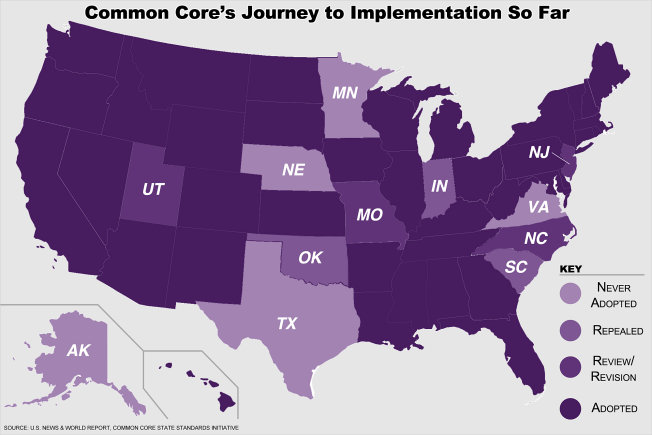
Implementation of Common Core/US News and World Report

Implementation of Common Core

THE VERDICT
In the past year significant political forces have targeted Common Core. The protests have been at near hysterical levels in many communities around the country. The complaints about Common Core are as follows:

  • Standards create a factory-like environment that attempt to put all students in one ‘box.’
  • Teachers focusing on test scores, not educational achievement
  • Parents don’t understand math methods
  • United States history under Common Core is un-American because it includes both positive and negative aspects of the history of our country
  • A belief that parents should define school curriculum, not the school, district, state, or federal government
  • A belief that President Obama is behind the implementation of Common Core and other conservative conspiracy theories

Many of the issues have been generated by conservative voices after a push by Republicans during the past election cycle to ignite anger and votes against public education. Almost all of the complaints would have occurred from any attempt to improve and refine American educational techniques, especially when those improvements involve standardization for all American schools.

If you believe that setting minimum standards in reading, writing, and math is bad, then Common Core is bad. If you believe that children in your community should graduate with similar skills to other students around the country, then Common Core is good. If you believe that a high school degree should be the end of a person’s education, then Common Core is bad. If you believe that every student should receive an education that would prepare them for college, then Common Core is good.

THE REAL PROBLEM
Despite the politicizing of Common Core, there is a real issue in implementing any change in education. Funding.

Any business that seeks to upgrade or improve their methods knows that there is a real cost to any change. Yet, even smart business people seem to forget that to improve our educational system requires a major funding commitment. It takes money to research and establish new programs. It takes money to train school districts, principals, and teachers. It takes money to create new teaching materials, and it takes money to educate parents.

What Common Core is missing is the funding needed to make it a success. Until we can accept the fact that a commitment to education requires a commitment to funding, then we will continue using 20th educational techniques in a 21st century world. America’s efforts to update our educational system will cost money and Common Core is a victim of a society that has abandon quality education because it costs too much.

THE HYSTERIA OF THE LOUDEST VOICES
Unfortunately, Common Core lost a lot of support in the past twelve months. Much of that was due to the political rhetoric during last year’s campaigns, but some teachers are also pulling back support. This is not surprising. As parents become more vocal in opposition, few teachers are willing to oppose parent sentiment even if they are wrong.

Common Core is not a perfect educational system, but it does attempt to better prepare America’s children for a higher level of achievement. Most of the real issues can be resolved with better funding. Just as a school built in the 1950’s is no longer relevant for 2015, education methods of the pre-information era are not relevant today. Our population is continuing to increase and the skills our children must have to thrive as adults are going to advance. Education is going to be expensive, but if we don’t pay now, we will pay more later.

PREVIOUSLY:  Part I:  A Primer in American Education 
                            Part II:  What is Common Core?

Common Core: Are You A Good Switch Or A Bad Switch? Part I

24 Tuesday Mar 2015

Posted by Paul Kiser in Aging, College, Education, Ethics, Generational, Government, Government Regulation, Higher Education, History, Information Technology, Internet, parenting, Politics, Pride, Public Image, Public Relations, Taxes, Universities, US History

≈ Leave a comment

Tags

classroom, college graduates, Common Core, Education methods, federal mandates, George W. Bush, graduation rates, high school graduates, job standards, K-12, NCLB, No Child Left Behind, President Barack Obama, Race to the Top, school districts, school vouchers, students, teachers, Teaching, Teaching methods, Teaching standards

School's should welcome diversity of ideas but shouldn't tolerate political agendas

School’s should welcome diversity of ideas but shouldn’t tolerate political agendas

PART I: A Primer in American Education

Who’s Afraid of Common Core?
Education in America is often the centerpiece of someone’s agenda, and the newest chapter of the how-to-fix-our-schools controversy is called Common Core. Conservatives have apparently decided that Common Core is the path to Satan. Liberals have reservations about Common Core because it smacks of a factory-like environment that assumes every student and school is the same.

The problem is that the most vocal critics of Common Core have no authority to speak on effective educational methods. Common Core is a significant paradigm shift in education, and opinions of untrained, uneducated, unhelpful ‘experts’  do nothing to move forward the debate on how best to prepare our children for Life 3.0.

The Cost of Achievement
In 1950, only one-third of the population in the United States had a high school degree or better, and only six percent had a college degree or better. In 2010, almost ninety percent of Americans had at least a high school degree, and thirty percent had at least a college degree. That increase is impressive, but what is astounding is that in the same sixty year time frame, America’s population doubled. 

To accomplish that feat cost money. A lot of money. As the bandwagon to attack government spending gained steam, education loomed large in the sights of conservatives. The real cost of the success of American educational achievement has been to become a target of the post-Reagan  agenda.  

Public school in Panama: Seeking to achieve the American dream

Public school in Panama: Seeking to achieve the American dream

A Historical Perspective
In the pre-Information age, schools were isolated in their own districts. How well the students of any given school performed was a local issue, not a state or national issue. In addition, a relatively small percentage of students sought out a college degree, and there were few school districts keeping track of college bound students.

The goal for most school districts in the 1960’s, 70’s, and 80’s was graduate as many students as possible, which sometimes opened the door to unethical practices, such as giving diplomas to students who clearly did not meet reasonable expectations (ability to read, write, etc.) to graduate.

However, by the 1990’s, the idea that all schools in the United States should be able to measure academic success through a unified set of academic standards began to take hold. As the Internet became the backbone of our society, the resulting information explosion forced us to accept that adequate math and reading skills were vital for success as an adult in a technologically advanced society. 

First Generation of Educational Standards
By the beginning of this century, plans had been put into motion to establish a set of educational standards for all schools and testing of all students to determine a school’s success or failure. Under President George W. Bush, the No Child Left Behind Act of 2001 (NCLB,) was mandated and it required States to establish standardized testing, teacher qualifications, and annual academic progress reporting. This was one of the most sweeping federal intrusions into public education. The primary focus of NCLB was to improve reading, writing, and mathematics in schools nationwide, while allowing States to establish the educational standards that would have to be met.

The catch was that rather than investing in those schools that needed help, No Child Left Behind focused on punishing schools that didn’t meet the artificial standards. Almost ever reputable educational review of NCLB  has given it a failing grade. Some of the reasons are as follows:

  • The emphasis on reading, writing, and math during a time when States were cutting funds for kindergarten through twelfth grade (K-12) created a shearing effect on other programs (language, history, music, arts, etc.) as money had to be reallocated to the studies under the NCLB Act.
  • Politicians had little understanding of education and the variables in a classroom environment and they attempted to apply factory-like operations to school systems that failed to address the real issues that impact the ability to learn.
  • NCLB assumed that teachers were mostly at fault for poor educational performance and politicians sought to intervene by imposing punishments for schools rather than actually acting in the best interest of the students.
  • The education of higher performing students was sacrificed in order to devote more resources for the poorer performing students.
  • Students with special needs were not excluded from the testing standards creating a population of students that automatically counted as failing against the school.

Educational Standards – Second Generation
Soon after taking office, the Obama administration began to move away from NCLB by introducing “Race to the Top.” This program flipped NCLB by seeking to reward States for adopting standardized programs rather than punishing them for not meeting federal standards. States competed for additional federal education funding; however, not every State rushed to play the game that offered no guarantee of financial carrot at the finish line.

The most searing problem with Obama’s Race to the Top program may have been the requirement that a teacher’s performance had to be linked to the student’s test scores. This concept of Pay For Performance suggests that teaching professionals must be threatened with a financial stick, forcing teachers to teach students to be successful on the tests by sacrificing all other educational values. It also discourages teachers from working with groups of challenging students who will not be able to produce the test results of more privileged and economically stable students.

NEXT:  Part II:  What is Common Core?
To be published Wednesday, 25 March, 0700 PDT/1400 UTC

NEXT NEXT:  Part III:  An Answer to the Question – Good? or Bad?
To be published Wednesday, 25 March, 1200 PDT/1900 UTC

Epilogue : The 2010’s

20 Friday Mar 2015

Posted by Paul Kiser in Aging, Business, College, Communication, Education, Ethics, Generational, Government, Government Regulation, Health, Higher Education, History, Honor, Information Technology, Internet, Politics, Pride, Public Image, Public Relations, Religion, Respect, Science, Social Interactive Media (SIM), Social Media Relations, Space, Taxes, Technology, Traditional Media, Universities, US History

≈ Leave a comment

Tags

Caucasian, college graduates, Conservatives, Equality, GDP, high school graduates, poor, racism, racists, Reagan agenda, Republicans, Ronald Reagan, The 1%, un-wealthy, wealthy, White politicians

The 2010’s – End of Civility

Image credit: J. Scott Applewhite/AP.

White Conservatives: “Go F**k Yourselves America”

  • Population:  308.7 million
  • Gross Domestic Product (GDP) per capita:  $47,805
  • Median Annual Income:  $47,793 
  • Life Expectancy:  78.7
  • Average Age at Marriage:   Men 28.2, Women 26.1
  • % of pop. w/high school degree or higher:  87.0%
  • % of pop. w/college degree or higher:  30.0% 

REAGAN:  The Killer of America’s Prosperity
From 1950 to 2010 the population of the United States of America doubled (+104.0%.) The Gross Domestic Product (GDP) tripled (+218.1%.) The median annual income is eleven times more than 1950 (+1028%.) Life expectancy has increased by over 15% (15.4%.) Men AND women are marrying an average of over five years older in 2010 than they did in 1950 (men +23.7%, women +28.6%.) The percentage of people with at least a high school degree is now almost 90% versus 34% in 1950 (+153.6%.) Today, 30% of our citizens have at least a college degree versus 6% in 1950 (+383.9%.)

Something went right for America in the last 60 years. But that is changing.

Prior to the Great Depression, Republicans controlled the House and Senate for the majority of the previous 70 years. After the Great Depression both the House and Senate was under Democratic control until 1980. In 1980, America began folowing the conservatives agenda (Reagan 1980-1988, Bush 41 1989-1992, Republican control of Congress 1994-2008) of dismantling the government at all levels, start more wars, give more money to the wealthy, and give less help for the un-wealthy. Since 1979, the wealthiest 1% after-tax income has increased by 200%.

U.S._Income_-_Changes_by_Income_Group_1979-2011

The 1% are 200% wealthier since conservatives took control of the government

Since 1980, annual increases in U.S. Gross Domestic Product (GDP) has stalled and fallen.

GDP Growth by Year

ANNUAL GDP GROWTH: Post World War II, U.S. annual GDP began a steady growth until shortly after Ronald Reagan became President.

GROWTH SACRIFICED FOR GREED
Post-war prosperity was spurred by significant federal government projects and programs. Conservatives derailed that by blaming government for economic issues that were caused by corporate and business greed.

Despite the obvious failure of the Reagan agenda, conservatives have taken a position of complete denial and fantastical thinking. They no longer believe they have any obligation to acknowledge or respect the rest of America. Conservatives are behaving as a child would behave when they are not getting their way, even though their request is completely inappropriate. Rather than accepting that President Obama was elected twice by a majority of Americans, Republicans have blocked all efforts to move forward on measures proven to generate American prosperity because it would make those that have more, give more.

Reagan conservatives have failed and they are backed in a corner of failure. They will not accept reason, nor facts. Civility would force them to accept their failure, so they must be uncivil. They are willing to destroy America, rather than acknowledge failure.

WHY ARE WE HERE?
America has experience massive change in the past 65 years. Most of that change has been good, but the one aspect of the American concept, the idea that we are all created equal, is the one issue in our country that has cast a shadow over us for centuries. White males believe that they are superior to all others and as our demographics have changed Caucasians have worked to obstruct equality rather than accept it.

Segregation was not considered racist until it became obvious it was motivated by whites who were racist. Dismantling government programs that benefit the poor and those in need may not be considered racist, until we realize that these ideas have been pushed forward almost exclusively by white politicians. Telling America that the rich are too burdened to pay a fair share of their taxes is not considered racist until you examine the loop of rich white people giving money to white politicians to pass laws that will reduce taxes on the wealthiest who are almost all white.

America is a country that has yet to commit to everyone being equal. In the 1950’s, white people took their money and ran away to the suburbs. In the 1960’s, the federal government finally stepped in and paid attention to the unequal treatment of African-Americans. In the 1970’s, we became distracted by unethical leaders, war, oil shortages, and inflation. In the 1980’s, we were conned into the idea that our government was to blame for all our problems in the 1970’s, while the Reagan spent money that America didn’t have to spend. In the 1990’s, the conservatives regained control of Congress and began dismantling the federal government and ending ethical business oversight. In the 2000’s, Republicans led America down a path of war and destruction that almost wiped out our economic system.

Why we are here is because we have become weak. We have listened to fools and we know they are fools. They are willing to tear America apart for greed and their own racist ideals. To a racist, compromise is unthinkable, and that is why conservatives will never work towards a unified nation.

THE SERIES:  The 1950’s    The 1960’s    The 1970’s    The 1980’s    The 1990’s    The 2000’s    

This is Why (2015 vs the 2000’s)

19 Thursday Mar 2015

Posted by Paul Kiser in Aging, Business, College, Communication, Crisis Management, Education, Ethics, Generational, Government, Government Regulation, Health, Higher Education, History, Honor, Information Technology, Internet, Politics, Pride, Print Media, Privacy, Public Image, Public Relations, Religion, Respect, Science, Social Interactive Media (SIM), Social Media Relations, Space, Taxes, Technology, Traditional Media, Universities, US History

≈ 1 Comment

Tags

2004 Tsunami, 9/11, Afghani, Amazon.com, Anthrax, Assault weapons ban, Conservatives, Election 2000, Facebook, Florida vote counting, George W. Bush, Global Financial Disaster, Global warming, Hurricane Katrina, Iraq, Mars, NASA, Opportunity, Pope John Paul II, President, President Barack Obama, Republicans, Rovers, Saddam Hussein, Smartphone, Space Shuttle Columbia, Spirit, Supreme Court, Texting, Twenty-ohs, Twitter, Virginia Tech Massacre, Wikipedia, YouTube

The 2000’s – The Defeat of America

Decade of Fear: Y2K, 9/11, WMD's, Katrina, Banking Collapse, Unemployment, Global Warming, Putin, ISIS

Decade of Fear: Y2K, 9/11, WMD’s, Katrina, Banking Collapse, Unemployment, Global Warming

  • Population:  281.4 million
  • Gross Domestic Product (GDP) per capita:  $44,492
  • Median Annual Income:  $40,703
  • Life Expectancy:  76.8
  •  Average Age at Marriage:   Men 26.1, Women 23.9
  • % of pop. w/high school degree or higher:  80.4%
  • % of pop. w/college degree or higher:  24.4% 

TWENTY OH’s
If the 1990’s were a seismic event of technological and social change, the twenty-oh’s is when the tsunami of change hit. Had nothing else happened but the advancement of the Internet, the changes by that alone would have drastically remade the world as we knew it; however, the twenty-oh’s were not content in merely redefining society and the way we communicate, the first decade of the new millennium was going to do an extreme makeover of all our expectations in life. Here are twenty things that made us say Oh!

  1. Y2K, the disaster that never came (Jan. 2000)
  2. Elections of 2000
    1. Florida election fiasco (Nov./Dec. 2000)
    2. Supreme Court appoints George W. Bush as President (Dec. 2000)
  3. Attacks of September 11, 2001
  4. Anthrax letters
  5. Wars of Just Because
    1. Afghanistan (2001-2014)
    2. Iraq (2003-2011)
  6. Rise of Smaller and Smarter Technology (Entire Decade)
    1. Smartphone
    2. Texting
  7. Space Shuttle Columbia destroyed on reentry (Feb. 2003)
  8. Mars Rovers bounce to successful landings and missions
    1. Spirit (June 2003)
    2. Opportunity (July 2003)
  9. Saddam Hussein captured (Dec. 2003)
  10. Assault weapon ban expires (Sept. 2004)
  11. Online Wonders
    1. Amazon.com
    2. Facebook
    3. Twitter
    4. Google
    5. YouTube
    6. Wikipedia
  12. Indian Ocean Earthquake/Tsunami (Dec. 2004)
  13. Pope John Paul dies (Apr. 2005)
  14. Global Warming
  15. Hurricane Katrina (Aug. 2005)
  16. Virginia Tech Massacre (Apr. 2007)
  17. Global Economic Disaster (2007-08)
    1.  Financial giants collapse
    2.  Housing market collapses
    3. Auto industry collapses
    4. Massive unemployment
  18. Price of gas soars, and falls….as a function of conservative politics
  19. Barack Obama elected as President (Nov. 2008)
  20. Nuclear weapons
    1. Iraq
    2. North Korea

The Twenty-oh’s began with the most bizarre Presidential election in American history, followed by the most shocking attack on American soil since Pearl Harbor, followed by two United States initiated wars that would be fought simultaneously, followed by the loss of the Space Shuttle and its crew on reentry to Earth, followed by an earthquake/tsunami that would kill almost a quarter of a million people in 14 countries in one day, followed by a massacre at Virginia Tech, followed by a near meltdown of our global financial system, followed by an African-American being elected as President.

THE GREAT CONSERVATIVE FAILURE
Despite all that happened, it was politics that defined the 2000’s. Keeping with the two-faced Reagan policy of “America Can’t” and money must be taken from the poor and given to the rich, President George Bush took the cost of running two wars off the books so that he could look like he was cutting government spending when he was, in fact, putting the government deeper in debt and running massive deficits.

Behind the scenes, a decade of conservative-driven deregulation in the financial industry created a bad debt bomb that exploded in 2007-08. Almost overnight, America’s economy was devastated by greed and a lack of common sense. People who saw the disaster coming took the attitude that everyone else was unethical, so why should I be the only good person? When the curtain fell on Wall Street, Republicans, who created the environment for the disaster, quietly stepped away and whistling as if they were unaware there was a problem.

Bush 43, was completely out of his league in dealing with the problem. To repair the damage to our economy would require taking actions that was would essentially prove that the Reagan doctrine was the cause of the disaster, and President Bush was not willing to take the necessary actions. Fortunately, Barack Obama had just been elected and, with Bush impotent in action, the 44th President stepped up and began to manage the crisis and establishing a plan of recovery.

The Republican caused disaster did not cause conservatives to humbly acknowledge their failure, but rather pushed them to further deny the facts. As the economy began recovering, conservatives began blaming Democrats for not making the recovery happen faster. As conservative predictions of Democratic policy failure began to be proven wrong, conservatives began raising absurd and meaningless issues to redirect people’s attention (e.g.; Obama was not an American, Obama was a Muslim, Obama had a secret plan to take everyone’s guns away, etc.) 

Because the Reagan doctrine was based on white, 1950’s suburban thinking, the hate for President Obama came naturally to the white, male voter. Instead of a political correction for the failed Reagan agenda, conservatives became even more rabid and illogical. By the end of the decade America was heading for defeat at the hands of conservatives who had taken away American prosperity and were unwilling to accept any idea that didn’t match their failed version of the world.

NEXT:  Epilogue

THE SERIES:  The 1950’s    The 1960’s    The 1970’s    The 1980’s    The 1990’s

This is Why (2015 vs the 1990’s)

18 Wednesday Mar 2015

Posted by Paul Kiser in Aging, College, Communication, Crisis Management, Education, Ethics, Generational, Government, Government Regulation, Health, Higher Education, Honor, Information Technology, Internet, Politics, Religion, Respect, Science, Space, Taxes, Traditional Media, Universities, US History

≈ Leave a comment

Tags

1990's, Americans with disabilities act, Bill Clinton, Congress, Contract With America, George H. W. Bush, healthcare reform, Immigration, immigration laws, Manuel Noriega, NAFTA, World Wide Web

The 1990’s – A World Turned Upside Down

An Explosion of Change

  • Population:  248.7 million
  • Gross Domestic Product (GDP) per capita:  $35,145
  • Median Annual Income:  $28,149
  • Life Expectancy:  75.4
  •  Average Age at Marriage:   Men 26.1, Women 23.9
  • % of pop. w/high school degree or higher:  77.6%
  • % of pop. w/college degree or higher:  21.3% 

POLITICS:  The Clean Up Man
George H. W. Bush was sworn in as President on January 20, 1989, as the 41st President of the United States. Having served as Vice President under Ronald Reagan, he was loyal and didn’t interfere with President Reagan’s destructive agenda. As President he then was left to clean up the messes created by Reagan and deal with new problems. Despite all that he had to deal with, President Bush managed to restore some of what Reagan had destroyed. This angered extreme conservatives who then refused to support him in his second term election.

Bush dealt with 1) an inflated deficit left by Reagan, 2) a revenue shortfall that required higher taxes, 3) restoring democracy in Panama and capturing Panamanian leader Manuel Noriega, and, 4) liberated Kuwait and drove Saddam Hussein’s Iraqi army back in a humiliating defeat. In addition, President Bush pushed through Americans with Disabilities Act of 1990, the North American Free Trade Agreement, and the Immigration Act of 1990, that opened the borders for a 40% increase in legal immigrants. He maintained a conservative stance on most issues; however, President Bush did not hesitate to act against Wacko conservatives. When the National Rifle Association (NRA) sent out material slandering Federal Agents as “Thugs,” he ended his lifetime membership to the organization.

POLITICS:  Clinton’s Capitulation
From a political standpoint, the Presidency of Bill Clinton was a study in contrasts. His election was considered a victory for Democrats and liberals, yet he constantly compromised his positions to pacify aggressive conservatives. Almost all efforts for additional programs to help Americans in need, including healthcare reform, failed to move forward during the Clinton administration. Conservatives, who were disappointed at Bush 41’s rollback of Reagan’s efforts to dismantle the federal government, were determined to win Congress and reignite the agenda that favored white and wealthy Americans.

In 1994, conservative Republican Newt Gingrich was elected on the basis of his Contract With America. This document (co-authored with Republican Representative Dick Armey) outlined several reasonable goals to bring more accountability to Congress and the government, but was laced with several goals that followed Ronald Reagan’s vision to cut funding and eliminate the government’s role of overseeing fairness in business. President Clinton was faced with vetoing all legislation, or caving in to conservatives. In his 1996 State of the Union address Clinton delighted conservatives when he announced that “the era of big government is over.” 

As a result of Clinton’s capitulation, many laws were passed in his second term that continued Reagan’s destruction of good government. The financial disaster in 2007-08 can be directly traced to legislation passed and/or repealed in the 1990’s during the Clinton administration. Congress removed federal government eyes off of key areas of financial interactions. The laws and rules that had set standards on key banking and investor interactions were eviscerated allowing a ‘no questions asked’ environment. The natural evolution of this environment was for greed to take priority over common sense, which is exactly what happened.

THE SEISMIC EVENT IN PERSONAL COMMUNICATION
Outside of the political landscape, the rest of America was becoming comfortable with the concept of owning ‘personal’ computers, and the new World Wide Web offered to interconnect computers creating a digital network of communication. It’s hard to overstate the impact of the marriage of computers and the Internet. It turned everything we knew upside down. Consider the following:

  • While personal computers increased the efficiency of certain tasks, it was the computer hooked into the Internet that made world-wide instant communication and sharing of information commonplace.
  • Television, radio, and newspapers shaped the public perception of world events until the Internet gave access to massive numbers of people who often had more timely information than traditional news media sources.
  • Younger generations adapted quickly to the possible uses of the Internet while older generations scoffed at its impact. As young generations rode the tide of the Internet, Older generations were left aground, looking foolish and ignorant.
  • Unethical governments and corporations would discover too late that their version of events would be exposed as lies and distortions by citizens who had access to the truth and shared it through the Internet. It literally brought down some governments.

The tsunami of change caused by the Internet wouldn’t hit the world until the next decade, but the earthquake of the Internet was felt in the 1990’s.

NEXT:  The 2000’s

THE SERIES:  The 1950’s    The 1960’s    The 1970’s    The 1980’s    Epilogue

Is Taylor Swift Planting Pity Stories?

31 Saturday Jan 2015

Posted by Paul Kiser in Branding, Honor, Internet, Public Image, Public Relations, Social Media Relations, Women

≈ Leave a comment

Tags

#katyperry, #superbowl, #taylorswift, HollywoodLife.com, katy perry, Music, pity, pop, Super Bowl, Taylor Swift

Taylor Swift:  Queen of Pity

Taylor Swift: Queen of Pity

Taylor Swift has always been a pity hound. Her ‘woe-is-me’ songs¹ about her failed relationships and enemies have one common denominator, namely, Taylor Swift.

But in the past few months stories about Katy Perry planning to “Diss” Taylor Swift at high-profile events, including tomorrow’s Super Bowl, have been surfacing. Hollywood Life ran almost identical headlines:

Katy Perry & Rihanna Plotting To Diss Taylor Swift At MTV EMAs (Hollywood Life, September 24, 2014)

Katy Perry Planning To Diss Taylor Swift During Super Bowl Performance (Hollywood Life, January 3, 2015)

Multiple media outlets picked up both stories, but all pointed back to Hollywood Life’s story without further evidence of fact. In addition, the actual source of the accusation is never revealed by Hollywood Life, so one can only speculate as to who has the most to gain by planting a ‘woe-is-me’ story.

Based on Swift’s history of pity pimping, it would seem more likely that she is planting stories about Katy Perry, than the Queen of Pop actually conspiring to use her Super Bowl honor to acknowledge the lesser wannabe pop star.

¹Songs and who the song is allegedly about (source):

  • Forever & Always – Joe Jonas
  • Better Than Revenge – Camilla Belle
  • We Are Never Ever Getting Back Together Again – Jake Gyllenhaal
  • Dear John – John Mayer
  • Out of the Woods – Harry Styles
  • Bad Blood – Katy Perry

A Glimpse of Education in Panama

22 Saturday Nov 2014

Posted by Paul Kiser in Customer Relations, Education, Information Technology, Internet, parenting, Passionate People, Technology, Travel

≈ Leave a comment

Tags

Centro Educativo, children, Coronado, Educacion, elementary school, Panama, parenting, San Jose, school

2014NN_119DSC_0129 (2)

The Principal in the classroom in Panama

Teaching children is a challenge anywhere in the world. Culture, government, and environment all affect the quality of education. Still, it seems that the foundation of any great school is the dedication of the staff to the students.

Recently I was on my second visit to a community about 90 km (60 mi.) from Panama City, Panama. While in the area I decided to research their education system by dropping in on a local school, the Centro Educativo San Jose elementary school.

It should be noted that to truly understand the education system in Panama, I should first be proficient in Spanish, and second, I should visit multiple schools, both private and public, over a period of weeks or months. A thirty minute conversation with the Principal, who does not speak English, and a teacher acting as my interpreter is only enough to give a first impression.

However, there are clues about the quality of education that are instantly obvious and transcend language barriers.

2014NN_100DSC_0118 (2)Laughing children. It is difficult to bridle the enthusiasm of children, but some schools seem to manage to stifle the joy of childhood. Centro Educativo San Jose has not made this mistake. At this elementary school the children were well-behaved, but laughing and smiling. It was obvious they understood discipline, but they were obviously happy to be at school.

Panama celebrates Thanksgiving

Panama celebrates Thanksgiving

Helpful children. When I arrived I first met an adult with several children. I wasn’t sure of her role in the school (she may have been a parent,) but when I asked if she spoke English, she said, “No.” Instantly a young girl at her side pointed at one of the teachers and indicated she spoke English, then the girl quickly ran to the teacher and brought her to me. This girl knew she could help and did so without hesitation. That tells me that the school encourages critical thinking that empowers children with the ability to respond quickly to a situation.

Professional Staff. In the tropics the temperature is near 30° C (86° F) year round and the humidity wraps around you like a wet towel. There is no air conditioning at this school and any breeze is welcome in the classroom. Despite these environmental conditions, the staff at the school looked and acted professional.

What I learned during my visit surprised me. The students have access to computers and they have a ‘Technology Room” filled with computers. I couldn’t tell if the computers were connected to the Internet; however, I did not expect an 80 year-old public school to have dozens of desktop computers with flat screen monitors.

This school is funded by government support, which limits the per/student resources; however, most schools in Panama are private where parents pay $1,500 to $3000 per year for tuition.

Many schools in Panama operate double sessions with one group of students attending in the morning and another attending in the afternoon. At this school the morning session is 7 AM to 12 Noon, and the second session is 12 Noon to 5 PM.2014NN_120DSC_0130 (2)

While most private schools are open twelve months a year, public schools are in session March through December, and have ‘summer’ break in January and February.

I asked about homework and parent involvement and heard what I expected. Once the students leave the school they are not expected to do homework and parents are not typically involved in assisting the staff in school. In an environment of low pay and long working hours, parents likely have no time to be involved in their children’s education.

I was told the biggest challenge is teaching English to the students. The impact of being bilingual is significant in a working adult’s life in Panama, and anywhere else. Yet, It is hard to explain that to a child in rural Panama whose only encounter with another language is in the school.

I’m grateful to have the opportunity to visit the school, and hope to do it again the next time I’m in Panama. I apologize to the Principal and the teacher who interpreted for me. I failed to write their names down before I left. Both graciously gave me valuable time out of their schedule and I appreciate it.

It was a pleasure meeting dedicated professionals who are changing lives every day by caring about the future of the students in their school.

Espanol Version (Using Google Translate)

Enseñar a los niños es un desafío en cualquier parte del mundo. Cultura, gobierno, medio ambiente y afectan la calidad de la educación. Aún así, parece que el fundamento de cualquier gran escuela es la dedicación del personal de los estudiantes.

Hace poco estuve en mi segunda visita a una comunidad a unos 90 km (60 mi.) De la Ciudad de Panamá, Panamá. Mientras que en la zona me decidí a investigar su sistema educativo por meterme en una escuela local, la escuela primaria Centro Educativo San José.

Cabe señalar que para comprender verdaderamente el sistema de educación en Panamá, que primero debería ser competentes en español, y en segundo lugar, que debe visitar varias escuelas, tanto públicas como privadas, en un periodo de semanas o meses. Una conversación treinta minutos con el director, que no habla Inglés, y un profesor que actúa como mi intérprete sólo es suficiente para dar una primera impresión.

Sin embargo, hay pistas sobre la calidad de la educación que son inmediatamente obvias y trascienden las barreras del idioma.

Niños de risa. Es difícil de frenar el entusiasmo de los niños, pero algunas escuelas parecen manejar a silenciar la alegría de la infancia. Centro Educativo San José no ha cometido este error. En esta escuela primaria los niños estaban bien atendidos, pero riendo y sonriendo. Era obvio que entendían la disciplina, pero eran obviamente feliz de estar en la escuela.

Niños útiles. Cuando llegué por primera vez a un adulto con varios hijos. Yo no estaba seguro de su papel en la escuela (que puede haber sido uno de los padres), pero cuando le pregunté si hablaba Inglés, dijo, “No.” Al instante una chica joven a su lado señaló a uno de los profesores y indica que hablaba Inglés, entonces la chica corrió rápidamente a la maestra y la trajo a mí. Esta chica sabía que podía ayudar y lo hizo sin dudarlo. Eso me dice que la escuela promueve el pensamiento crítico que permite a los niños con la capacidad para responder rápidamente a una situación.

Personal Profesional. En los trópicos la temperatura es de cerca de 30 ° C (86 ° F) durante todo el año y los abrigos de humedad a su alrededor como una toalla húmeda. No hay aire acondicionado en esta escuela y cualquier brisa es bienvenida en el salón de clases. A pesar de estas condiciones ambientales, el personal de la escuela parecía y actuaba profesional.

Lo que aprendí durante mi visita me sorprendió. Los estudiantes tienen acceso a computadoras y tienen un ‘Room Tecnología “lleno de computadoras. No podría decir si los equipos estaban conectados a Internet; Sin embargo, no esperaba un 80 años de edad de escuelas públicas para tener docenas de computadoras de escritorio con monitores de pantalla plana.

Esta escuela está financiado por el apoyo del gobierno, lo que limita los recursos per / estudiante; Sin embargo, la mayoría de las escuelas en Panamá son privadas donde los padres pagan $ 1.500 a $ 3000 por mes para la matrícula.

Muchas escuelas en Panamá operan sesiones dobles con un grupo de estudiantes que asisten por la mañana y otra que asisten por la tarde. En esta escuela la sesión de la mañana a 7 de la mañana a 12 del mediodía, y la segunda sesión es de 12 del mediodía a 17:00.

Aunque la mayoría de las escuelas privadas están abiertas los doce meses del año, las escuelas públicas están en sesión de marzo a diciembre, y tienen descanso “verano” en enero y febrero.

Le pregunté acerca de la tarea y la participación de los padres y escuché lo que me esperaba. Una vez que los estudiantes salen de la escuela a la que no se espera que hagan los deberes y los padres no suelen participar en la asistencia al personal de la escuela. En un entorno de bajos salarios y largas horas de trabajo, los padres probablemente no tienen tiempo para participar en la educación de sus hijos.

Me dijeron que el mayor desafío es la enseñanza de Inglés a los estudiantes. El impacto de ser bilingüe es importante en la vida de un adulto que trabaja en Panamá, y en cualquier otro lugar. Es difícil de explicar que a un niño que sólo el encuentro con otro idioma es en la escuela.

Fue un placer conocer a los profesionales que están cambiando vidas todos los días por el cuidado por el futuro de los estudiantes en su escuela dedicada.

The Grade Negotiation Season

21 Wednesday May 2014

Posted by Paul Kiser in About Reno, College, Communication, Education, Ethics, Generational, Higher Education, Internet, Opinion, Pride, Public Image, Public Relations, Respect, Universities

≈ Leave a comment

Tags

college credit, Email, financial aid, grade point average, Grades, negotiation, professors, semester, student loans

Spring brings forth the failures as well as the flowers

Spring brings forth the failures as well as the flowers

Most people don’t realize that we are in a new season. It happens twice a year at the end of a semester when college professors are bombarded with emails from their students trying to beg, borrow, or steal a few points for a higher grade. It should be noted that the majority of these emails are not coming the students who attended class, turned in assignments on time, and studied for the tests. No, these are the students that missed class, turned in assignments late, and had a party to go to rather than study.

The emails are typically as follows:

Hi,

Could u look @my grade. I need 2 have a c n u’re clas or i lose my finansal aide. i was sure i had a c n u’re class.

Rach

The student often assumes that the professor knows in which class the student was enrolled, and writes as if she or he is texting a friend. The student probably knows that they didn’t deserve a “C” in the class; however, they hope that the professor will feel sorry for them and bump them up. Usually, nothing changes, but the student can say to her or his parents that they were sure they had a “C” in the class and that they even complained to the professor, but he or she wouldn’t change it.

For the professor, these emails take pointless hours of time to review the scores, confirm the grade, and respond. It turns the end of the semester into a circus where all the clowns come out of the woodwork after being absent most of the semester.

There is nothing wrong with a student questioning their grade; however, if a student is at the borderline of losing her or his financial aid, and/or falling below the required grade average for enrollment, the problem is not about one grade, but the overall performance in all classes.

Sadly, professors are not allowed to offer an appropriate response such as:

Rachel Smith
Student
ENG 203 – Writing For Business

Dear Rachel:

Thank you for your email. Your grade is based on your participation in my class and reflects the work you performed. The “D’ you received is not only correct, it is generous. I’m pleased to see that a student like yourself will no longer be offered financial aid, so that a better quality of student can now be a recipient.

I wish you well on your future in the world of menial labor for which you may or may not be qualified.

Sincerely,

Edward Terrell
Professor
University of  Higher Education


Exposing a Bully is Not Bullying

02 Sunday Mar 2014

Posted by Paul Kiser in Aging, Branding, Business, Communication, Crisis Management, Customer Relations, Customer Service, Education, Employee Retention, Ethics, Generational, Honor, Human Resources, Internet, Lessons of Life, Management Practices, Opinion, parenting, Pride, Public Image, Public Relations, Relationships, Respect, Social Interactive Media (SIM), Social Media Relations, Women

≈ 5 Comments

Tags

bully, bullying, Dr. Peggy Drexler, Kelly Blazek

During this past week much has been written (including myself) about the case of a person in a position of power, Kelly Blazek, the gatekeeper of a Cleveland, Ohio jobs listing for marketing positions, writing a nasty email to a job seeker. Blazek’s language in the email was unyielding in her attempt to embarrass and humiliate the job seeker. Blazek was using her power to bully someone who was in an inferior position.   

Therefore, I was shocked when I read an ‘Opinion‘ on CNN.com by Dr. Peggy Drexler, who wrote that by publicizing the email and seeking attention to the bullying, the job seeker:

“….acted with malice, and caused the older woman significant damage…”

The specific language suggests that Dr. Drexler is encouraging Blazek, the person who was the bully, to sue the victim on the grounds of malice, libel, and/or age discrimination. One might question as to whether Dr. Drexler’s motives were that of an ambulance chaser, seeking to be employed by Blazek as an ‘expert’ witness in a civil suit.

Dr. Drexler’s opinion piece did describe the nature of Blazek’s email; however, she softened Blazek’s misdeeds by saying:

“Blazek’s words were, of course, undeniably, and likely unnecessarily, harsh”

In her opinion piece, Dr. Drexler masterfully works around the most blatant language in Blazek’s email and, in at least one place, segmented the quoted language so that the most vicious remark doesn’t look like it was the climax of the rest of the paragraph. She also uses Blazek’s “Communicator of the Year” recognition as a reference of her skills, rather than the irony that is obvious after reading a complete version of Blazek’s blistering email. The most damning paragraph from Blazek’s email is missing from Dr. Drexler’s opinion:

“I suggest you join the other Job Bank in town. Oh wait — there isn’t one.”

Dr. Drexler admits that Blazek’s behavior was wrong:

“No question, Blazek lashed out first, with unprofessional behavior that can only be described as bullying.”

However, Dr. Drexler seems to enable Blazek’s behavior by accusing the job seeker:

“But Mekota responding in kind makes her no less a bully.”

In Dr. Drexler’s world, when bullied, sit back and take. Don’t fight back and don’t call out the bully. Other professionals have a different take on how to respond to a bully. In responding to adult bullying, Mental Health Support (from the United Kingdom) suggests the following :

“…if you find yourself the victim of bullying, a bully’s bad behaviour is entirely his or her responsibility, not yours,…”

The website goes on to say:

“Once you have identified a bully and know what to expect from him or her, you must choose not to be a victim, if you want the bullying to stop. Expose the bullying for what it is. Take a stand, and don’t back down…”

“…The important point here is to expose the bully and call him or her to account. Confrontation and exposure, with evidence to support a victim’s accusations, are what the bully tries hardest to avoid. Once exposure happens, the bullying is likely to stop.”

There was an injustice done to Ms. Blazek, but that was from Dr. Drexler in attempting to sanctify Blazek’s behavior by accusing the job seeker of an equal act. Dr. Drexler’s portrait of Blazek as the older woman, victimized by the young, evil job seeker, causing her to lose her career and disappear from social media is absurd. The job seeker did not write the email, nor did she make the decision to shut down Blazek’s websites and social media accounts. Blazek was in the wrong and the damage to her career rests solely in her hands.

The Blazek Syndrome

01 Saturday Mar 2014

Posted by Paul Kiser in Branding, Business, Communication, Crisis Management, Customer Relations, Customer Service, Education, Ethics, Generational, Honor, Human Resources, Internet, Lessons of Life, Management Practices, Opinion, Public Image, Public Relations, Respect, Social Media Relations, Women

≈ 3 Comments

Tags

Blazek Syndrome, Cleveland, head hunter, humility, job search, Kelly Blazek, LinkedIn, Marketing, Ohio, Twitter, Wordpress

Kelly Blazek - Armed with a keyboard and dangerous

Kelly Blazek – Armed with a keyboard and dangerous

You may not recognize the name Kelly Blazek, but she is the poster child for public image disaster. When people wonder how bad personal embarrassment can be, we now have Blazek as our code word for really, really bad. 

Kelly Blazek is probably a decent human being, but what she will be remembered for is her moments of ‘Ms. Hyde’ behavior. She founded a job bank listing for marketing and public relations positions in the Cleveland, Ohio area. She had a WordPress blog and Twitter, LinkedIn accounts. Head hunter Blazek was also recognized as “Communicator of the Year.” by a local business group.

Within a matter of days she went from a leader in her field to a ghost. There is no blog site, no Twitter account, nor any trace of her other than a growing number of postmortems in blogs and news articles of her epic nasty responses to people who reached out to her.

The Blazek Syndrome
Her story is a step-by-step, what-not-to-do in business.

STEP ONE:  Don’t let frustrations with the job spill over into your communications and interactions.

Among the most notorious of her responses, Blazek reacted to a college graduate seeking to connect with her as part of her job search. Her manner that can best be described as vile. Among the barrage of hateful statements were the following:

“I love the sense of entitlement in your generation. And therefore I enjoy Denying (sic) your invite…. (to connect on LinkedIn.)”

“I suggest you join the other Job Bank in town. Oh wait — there isn’t one.”

“You’re welcome for your humility lesson for the year.”

Everyone has a bad day, but any business person should know that what you write is what will save you or hang you. There is no excuse Blazek could offer for her verbal abuse of this job seeker.

STEP TWO:  Making a mistake, even as massive as this one, does not mean it’s the final chapter. Life is not over and running and hiding will not help.

Blazek has compounded the crisis by trying to disappear. When sharks smell blood of a wounded fish they go into a frenzy. By disengaging from social media, people may lose interest, but what will remain is the public shame. The best time to do damage repair is while people are still paying attention

STEP THREE:  Apologize over and over.

Instead of deleting social media accounts, use them. In a public image crisis people need to hear every possible sincere apology, but do NOT attempt to offer excuses. 

STEP FOUR:  Listen to what is being said and respond with humility.

Remember BP’s  Tony Hayward remark, “I want my life back.” The public image crisis is over when people say its over, not when the disgraced person wants it to be over. Read what other people are saying and respond in a kind and humble way to as many people as you can. Make the story about the lesson learned. 

Early 2014 PR Fails: Target and Christie

13 Monday Jan 2014

Posted by Paul Kiser in Branding, Business, Communication, Crisis Management, Customer Relations, Customer Service, Ethics, Government, Honor, Information Technology, Internet, Management Practices, Politics, Public Image, Public Relations, Respect, Social Media Relations

≈ Leave a comment

Tags

bridgegate, George Washington Bridge, Governor Chris Christie, GW bridge scandal, New Jersey, Nixon, retail, store, Target

Self-inflicted Wounds?

Self-inflicted Wounds?

Only 13 days in 2014 and Target and New Jersey Governor Chris Christie share the spotlight for worst public image of the new year.

Target credit information theft just keeps getting worse. We learned last week that data was stolen for 70 million Target customers, not 40 million as belatedly reported earlier this month. Target is averaging over one sales-killing announcement a week so far this year and each new announcement makes the crisis worse. There are people who say Target will survive, but if someone were going to attempt to kill a leading corporate retail organization, this would be the way to do it.

It’s not like Target has no competition. Making customers worry of whether their credit data is safe when they shop is not a unique experience desired by any retail store.  Add the but-wait-it-gets-worse element and sales are bound to sink.

Target will likely continue to minimize the crisis, which will only increase the distrust of the brand. The PR strategy they are following is going to dig them into a deeper grave.

Not to be outdone, Governor Chris Christie is dropping his own PR boob bombs. After claiming that a traffic tie up at the George Washington Bridge was part of a legitimate traffic study, he then was forced to confront emails that clearly indicated his top aides were involved in Nixon-era tactics aimed at some type of petty revenge act.

Governor Christie's apology missed the mark

Governor Christie’s apology missed the mark

The issue is not whether or not Governor Christie knew that his senior staff were behaving like chimpanzees throwing their poop at people in the zoo, the issue is Christie is either 1) incompetent for surrounding himself with idiots, and/or, 2) incompetent for not knowing what was going on, or, 3) aware of everything and is lying about it. 

The big PR factors in both crises are the lack of humility and accepting responsibility. Instead of minimizing the crisis, Target should have been ahead of the crisis. Not only should they be providing the most accurate and honest information, they should have been apologizing to their customers, assisting them, and offering to make things right for any customer who is affected by the loss of their credit data. This is an issue of long-term survivability, not revenue projections for the current quarter.

As for Governor Christie, that ship has sailed. He had a chance to accept responsibility and resign. His, the-buck-stops-here-but-I’m-blaming-everyone-else strategy only proved that he has dignity of Lance Armstrong. He could have admitted his mistakes, stepped back, and then worked to rebuild his reputation, but he instead he revealed how low he can go.

Public image is everything, and it does not suffer fools gladly.

Hey Stupid, Privacy is Dead and Your Face is the Reason

31 Tuesday Dec 2013

Posted by Paul Kiser in Communication, Crime, Crisis Management, Customer Relations, Ethics, Generational, Government, Honor, Information Technology, Internet, Lessons of Life, parenting, Photography, Public Relations, Relationships, Respect, Social Interactive Media (SIM), Social Media Relations, Technology

≈ Leave a comment

Tags

Anthony Weiner, Biometrics, face, Facebook, facial recognition software, Facial recognition system, Ohio, on line, Privacy, Twitter

Facial recognition software is the final nail in Internet privacy

Facial recognition software is the final nail in Internet privacy

Go ahead, just try to protect your privacy. Give up Facebook. Scoff at Twitter. Swear you’re going to never sign on the computer again. It is all useless.

Stick a fork in privacy on the Internet. There no such thing as privacy on the Internet, nor is there privacy off the Internet.

A girl decides to check up on her boyfriend. She happens to be an attorney in Ohio and has access to the State’s facial recognition software. She uses it to snoop on her boyfriend and other people her friends were dating. This was in 2008. Five years ago and she was using (well, misusing) facial recognition software that was meant for finding criminals.

It doesn’t matter whether you take the picture or post it. It doesn’t even matter if you knew you were in the picture. New Years Eve? Good luck in keeping your face out of every picture that people around you take. If your face shows up in a posted picture, it can be found and matched. 

Not only law enforcement is using facial recognition software. Casinos are using it. Some suggest that Disney is using it in their parks. Retailers are using it. Your significant other can buy it and download it today. If you want to see how deep the rabbit hole goes, watch this TED Talk on facial recognition software.

Anthony Weiner: Too bad it wasn't his face that got him in trouble

Anthony Weiner: Too bad it wasn’t his face that got him in trouble

There is no such thing as privacy. One more time. There is no such thing as privacy.

THE ANSWER
Behave. That’s it. Or at least know that if you don’t behave everyone will find out and it will be at the worst possible moment for you. People learn how to behave when they go out in public. The Internet is public. There is no difference.

10 Things To Decline From An Employer

09 Monday Dec 2013

Posted by Paul Kiser in Business, Communication, Customer Relations, Customer Service, Employee Retention, Ethics, Health, Honor, Human Resources, Information Technology, Internet, Management Practices, Pride, Privacy, Public Relations, Re-Imagine!, Relationships, Respect, Social Interactive Media (SIM), Social Media Relations, Technology, Tom Peters

≈ Leave a comment

Tags

Affordable Care Act, benefits, company car, company cell phone, company email, Email, employment agreement, employment contract, free speech, Heath Benefits, Intellectual property, NDA, Non-compete, Pay for Performance, retirement benefits

No longer can anyone expect to build a lifelong career with one organization, nor is that considered healthy for the individual or the company. A person is now his or her own commodity. He or she must expect to build their own skills and reputation as an individual on the open market rather than as corporate employee number 8675309.

In this Brave New Working World a person should be prepared to say ‘no’ to antiquated elements of 20th Century employment, not only because they are inappropriate, but because they indicate that employer is unaware of their failure to be competitive in the 21st Century. Benefits and perks that were meant to tie a person to one organization no longer make sense in a world where ‘permanent employee’ has been replaced by ‘contract labor.’

Here are ten employment offers and requests that should be declined from an employer and cause you to re-evaluate your working relationship with a company:

No. 10 – Retirement Benefits
It should be obvious that any company offering retirement benefits either does not understand today’s working world or is trying to offer something that they know you will never receive. Better to have the money now and invest than pretend you’ll still be with the company when you retire.

The Company Email is always the company's to give or take away

The company giveth and taketh away access to your email

No. 9 – The Company Email Account
You many have to use the company email when corresponding with others in the company, but always ask yourself, “If the company decided to lay me off today and they ended my access to my email account, what information would I lose?” What about that email from the senior executive that ordered you to overcharge your customer? Every email sent to your company email account should be forwarded to a private account and blind copy any company emails you send to your private account. This protects you and the company from the unethical corporate manager.

No. 8 – The Company Car
When I was growing up my uncle worked for an oil tool business and he had a company car. I thought that was the coolest perk in the world. While it is a rare perk in today’s world, it should be declined in most situations. The problem with the full-time company car is that it becomes a liability if a better employment opportunity arises. Suddenly you’re faced with buying a new car in order to accept a better job.

The company cell phone comes with chains attached

The company cell phone comes with chains attached

No. 7 – The Company Cell Phone
Many people fail to realize what a company cell phone represents. It is a chain that ties the employee to the employer 24/7/365. A boss may hesitate to call a private cell phone, but have no problem calling the phone they are paying for at 3 AM. Many jobs require an employee to be accessible, but you are better off with your own phone than be indentured by a company cell phone.

No. 6 – Giving Your Employer Your Social Media Passwords
There are questions as to whether it is legal for an employer to demand an employee’s passwords to his or her Facebook, Twitter, and other Social Media passwords. The bottom line is that you do not want to work for a company that wants this level of control on your life. It will only go downhill from there.

No 5 – Restricting Free Speech (The NDA)
In an exercise with students in a graduate program, I purchased the fictional company they worked for and I was interviewing them to determine who to keep and who to let go. As part of this exercise I gave each of them an outrageous NDA contract (see Kco NDA) to sign. In almost every case, the Master’s program students signed it, most without question.

A company’s has a right to protect its reputation, but employers should be under the burden to gain the loyalty, trust, and respect of their employees so that they would not dream of talking smack about their workplace. If an employee is ready to bad mouth the source of their income then either the employer hired the wrong person, or the employer has failed to treat their employee as an important asset. In either case, it is the employer, not the employee who shoulders the burden of the failure.

No. 4 – Intellectual Property
If you have been consigned to produce something tangible for someone, then you have agreed to surrender it once it has been created and delivered; however, many companies are claiming ownership of any work done by an employee as their own intellectual property. Nothing could be more disrespectful to a human than to treat them as a machine that is only useful as a tree from which they pick and enjoy the fruit. A business that values their team would never have to be concerned about the issue of intellectual property because each team member’s work would be a source of pride and celebration. The important element in any organization is the person who creates the work, not the work itself.

Before you sign away your right to maintain ownership of your work you should ask if you want your give away your legacy of achievement to those who didn’t do the work?

The Affordable Care Act is emancipation for the worker

The Affordable Care Act is emancipation for the worker

No. 3 – Health Benefits
America has millions of people who continue to work for an employer primarily because they need or want the health insurance offered by the company. As an employer do you want people to only be working for you because of the health benefit perk?

The biggest impact that the Affordable Care Act will have on America is to free people to work for people they want to work for, not those who have the critical health care benefit he or she needs.

No. 2 – Pay For Performance
When someone attempts to quantify a job or project they sacrifice common sense for greed. The need to meet the measured goals forces an employee to ignore important aspects of work that can’t be measured or quantified. Pay For Performance assumes the Ends always justifies the Means, which is rarely true in the business world, despite what greedy executives and investors think. Almost always customer satisfaction is at risk under Pay For Performance standards because a customers true satisfaction cannot be measured by questionnaires, surveys, nor sales. In every case the wise employee will figure out how to exploit the system and defeat the true purpose of the evaluation tool.

Pay For Performance systems are lose-lose scenarios for everyone and a company that relies on them does not understand how to truly motivate and reward its team; therefore, you should avoid the trap they are setting for you, your customers, and themselves.

No. 1 – The NCA
The non-compete agreement or NCA is the one indicator that proves only fools work for the employer, and there are plenty of fools out there. You shouldn’t be one of them. 

An NCA basically eviscerates your career by not allowing you to continue working if you leave the current company. In today’s world that can be a death sentence. Your skills and experience are laid to waste by an NCA and you should never agree to it, nor should you consider working for someone who asks you to sign one.

Nevada Middle School Shooting Made Worse By Absent and Inept Public Relations Management

04 Wednesday Dec 2013

Posted by Paul Kiser in About Reno, Communication, Crime, Crisis Management, Ethics, Government, Information Technology, Internet, Management Practices, Opinion, Print Media, Public Relations, Social Interactive Media (SIM), Social Media Relations, Traditional Media, Violence in the Workplace

≈ Leave a comment

Tags

crisis, Crisis Management, guns, Nevada, Reno, School shooting, Sparks, Sparks Middle School, Washoe County School District, WCSD

On October 21st a 12 year-old Nevada boy brought a gun to his school, killed a teacher, shot two other students, then killed himself. The shooting left families devastated in a continuing saga of gun-related school incidents. Sadly, the crisis was intensified and prolonged by the failure of the local authorities to use standard and best practices in managing public relations. At times it seemed that there was a vacuum in media management. At other times it seemed that government officials from China had been employed to handle community relations.

Sparks Middle School - A tragedy made worse

Sparks Middle School – A tragedy made worse

In any crisis situation there is panic followed by confusion, rumors, and fear. The first goal is to resolve the immediate crisis. In most situations this will involve turning over control of the facilities and situation to law enforcement and other first responders.

However, the second goal of an organization in a crisis is to reduce the confusion, rumors, and fears. This process must start as quickly as possible, and sometimes it must be done before the crisis is under control by first responders.

In the Nevada incident, parents throughout the Reno community¹ were aware of an active shooter on a local school campus within minutes of the 7:15 AM shooting incident. There were 20 to 30 eyewitnesses when the teenager shot a teacher, who then reportedly went into the school and killed himself . It was all over within a few minutes. 

(¹The shooting occurred in Sparks, Nevada, a suburb of Reno.)

In the first hours following the shooting some rumors persisted that police were looking for the suspect; however, it is likely that law enforcement on the scene knew within ten to fifteen minutes that shooter was dead. With the suspect dead, the priorities of the first responders were to render assistance to the wounded, secure the students and school, secure the crime scene, and gather information.

Children became the official source of the shooting

Children became the official information source of the shooting

At least eight different sources were quoted in the first few hours after the shooting. This would indicate that the Washoe County School District and the various law enforcement agencies responding did not select a skilled spokesperson to manage the post-shooting situation. At 7:42 AM, less than 30 minutes after the shooting, the Reno Gazette Journal reported the following:

  • A shooting had occurred at Sparks Middle School
  • A police spokesperson had confirmed that the shooter was ‘neutralized’
  • Police were looking for the suspect
  • The school was on lockdown
  • The students had been evacuated

It shouldn’t be a surprise that the information coming from the crime scene in the first hour of the incident will be in conflict; however, the role of the primary spokesperson is to rapidly identify rumors and incorrect facts and address them. Two hours after the shooting a press conference was held. This was the opportunity for local authorities to reduce anxiety, confusion, and fear by detailing critical information. By answering as many of the basic questions (who, what, where, when, why, how) as possible the public could be reassured that despite the tragedy, authorities knew what happened and had the situation under control. After the press conference the Reno Gazette Journal reported:

“Authorities released few details about a shooting at about 7:15 a.m. at Sparks Middle School during a 9:15 a.m. press conference.”

If the families of the dead and wounded had not been notified then it would not have been appropriate to release the names; however, authorities wouldn’t even confirm whether teachers or students had been shot. Students began reporting what happened to the media and with no cooperation from local authorities, the families were contacted. That is the symptom of absent or inept media management.

Forcing Children To Be Spokespeople
Within minutes after the shooting word spread, not just within the local community, but around the world. Instantly parents, grandparents, relatives, and friends of school-age children began asking questions. What school? Was anyone killed? How many were shot? Who was killed or injured? Was it over? Why did it happen? Is my child/grandchild safe?

By withholding the details the local authorities did not withhold the story they just lost management of it. Without an official source for information the witnesses, in this case, mostly children, became the official spokesperson. To make the blunders of the first day worse, suburban police and city officials refused to release the name of the shooter for three days, citing that his name did not appear on any ‘report.’ 

The Public’s Right To Know Not the Correct Issue
Local media was incensed by the stonewalling of the authorities to release the name; however, this was more than an issue of the public’s Right to Know. The stated reason by authorities to withhold the shooter’s name was to protect the family, the failure to release this information put more focus on the shooter’s family to confirm or deny the rumors that were rampant within the community.

A skilled spokesperson would have understood this and worked to ensure that the information was appropriately released while also urging the media to respect the family’s need to grieve. 

Who Owns Information?
In the 20th century mass communication came with a catch. Access to information could be controlled. The public knew what the government, public relations staff, editors, and news directors wanted us to know. That changed with the Internet and Social Media. Information is fluid and it will flow through any conduit it can find. Information desired by the public will find the quickest path and anyone who believes they can stop the flow of it is only diverting it through another source. A spokesperson can and should be the quickest path for facts and information because it will reduce the fear, confusion and rumors.

The mishandling of the crisis in Nevada should serve as a lesson as to why a skilled, experienced crisis manager and spokesperson should be a part of every organization. No tragedy should be made worse by inept local authorities.

Chinese Men Givien iPads to Control Birthrate

01 Monday Apr 2013

Posted by Paul Kiser in April Fools Day, Fiction, Generational, Government, Government Regulation, Health, Information Technology, Internet, Politics, Recreation, Relationships, Social Media Relations, Women

≈ 1 Comment

Tags

Apple, birthrate, China, iPad, men, sex, sexual relationships

April 1, 2013 – Beijing, China

iPad in China: Better than sex?

iPad in China: Better than sex?

It was revealed today that the Chinese government struck a deal with Apple to purchase significant quantities of iPads as part of a program to control the birthrate. Unofficial Chinese sources say that they have found that a male with an iPad spends 48% less time engaged in relationship-related activity including coitus.

“The iPad is the ultimate lover as it offers constant attention and requires very little in return,” according to one government source. China expects to reduce the birthrate by 25% or more through the alternative-stimulus program. 

Apple had no public comment on the use of iPads to inhibit sexual intercourse; however, privately a reliable source did say that since iPad was launched in April 2010, the city of Cupertino, California, where Apple is headquartered, has seen no growth in population.

No one offered a direct cause for why the iPad might have an affect in inhibiting sexual activity, but one woman we asked said, “Are you just stupid, or what?”

Apple says it doesn’t expect any shortages of iPads despite the massive purchase; however, they don’t know when any more iPad will be delivered to the United States.

← Older posts
Newer posts →

Other Pages of This Blog

  • About Paul Kiser
  • Common Core: Are You a Good Switch or a Bad Switch?
  • Familius Interruptus: Lessons of a DNA Shocker
  • Moffat County, Colorado: The Story of Two Families
  • Rules on Comments
  • Six Things The United States Must Do
  • Why We Are Here: A 65-Year Historical Perspective of the United States

Paul’s Recent Blogs

  • Dysfunctional Social Identity & Its Impact on Society
  • Road Less Traveled: How Craig, CO Was Orphaned
  • GOP Political Syndicate Seizes CO School District
  • DNA Shock +5 Years: What I Know & Lessons Learned
  • Solstices and Sunshine In North America
  • Blindsided: End of U.S. Solar Observation Capabilities?
  • Inspiration4: A Waste of Space Exploration

Paul Kiser’s Tweets

Tweets by PaulKiser

What’s Up

May 2026
S M T W T F S
 12
3456789
10111213141516
17181920212223
24252627282930
31  
« Jun    

Follow Blog via Email

Enter your email address to follow this blog and receive notifications of new posts by email.

Join 688 other subscribers

Create a website or blog at WordPress.com


Loading Comments...