3rd From Sol

~ Learn from before. Live now. Look ahead.

3rd From Sol

Category Archives: Technology

The Sad Life of a Russian Troll (Печальная жизнь русского тролля)

26 Monday Mar 2018

Posted by Paul Kiser in All Rights Reserved, Branding, Business, Communication, Donald Trump, Economy, Employee Retention, Ethics, Government, Honor, Information Technology, Internet, jobs, labor, Language, Life, Politicians, Politics, Public Image, Random, Respect, Russian influence, Social Interactive Media (SIM), Technology, Travel, United States, US History, Vladimir Putin, Voting, Website, Writing

≈ 1 Comment

Tags

fake identities, fake news, GOP, Russia, Russian, Russian Troll Farms, Soviets, Troll Farms, Trumpsters, USSR, Vladimir Putin, Web Brigade

It is a statement of life in Russia when one of the best jobs to be had is employment to write fake news stories, deceive people, and attempt to create chaos in other countries. Russian Troll Farms, or Web Brigades, as they refer to themselves, tell us more about Russian life, than about Western gullibility. What follows is my own fake story of an interview with a Russian Troll.

Troll – a mythical creature in folklore living in caves or hills or under bridges as either a giant or a dwarf, typically having a very ugly appearance.

Russia Condos

Living Large in Russia: Condos in St. Petersburg

Interview With A Russian Troll

[NOTE: Some language may be inappropriate for young readers.]

Interviewer:  What’s your job? (Кем вы работаете?)

Russian Troll:  I learned to speak English so I could be paid to agitate and influence people in the United States to vote for politicians like we have in Russia. (Я научился говорить по-английски, чтобы мне могли заплатить за то, чтобы агитировать и влиять на людей в Соединенных Штатах, чтобы голосовать за таких политиков, как у нас в России.)

Interviewer:  How does that help Russia? (Как это помогает России?)

Russian Troll:  It doesn’t, but it makes the Americans suffer like we have to suffer in this shithole country. (Это не так, но это заставляет американцев страдать, как мы должны страдать в этой стране.)

Interviewer:  Why do you do it? (Почему ты это делаешь?)

Russian Troll:  I live in Russia. How else can I pay the bills? (Я живу в России. Как еще я могу оплатить счета?)

Interviewer:  The economy of the United States drives the economy of the rest of the world. If you’re successful, aren’t you afraid of a worldwide economic disaster? (Экономика Соединенных Штатов стимулирует экономику остального мира. Если вы добились успеха, разве вы не боитесь мировой экономической катастрофы?)

[Language warning]

Russian Troll:  Don’t tell me about disaster until you’ve seen the crappy place where I live in the middle of winter. Fuck the Americans. Fuck the rest of the world. They all celebrated when Americans landed on the Moon. They all celebrated when the Berlin Wall fell. Fuck them! (Не говори мне о бедствии, пока не увидишь дерьмовое место, где я живу в середине зимы. Ебать американцев. Трахайте весь остальной мир. Все они отмечали, когда американцы высадились на Луну. Все они праздновали, когда упала Берлинская стена. Трахайте их!)

Interviewer:  What about your children? How will your work help them? (Как насчет ваших детей? Как ваша работа поможет им?)

Russian Troll:  Who cares? Did anyone care about me when I was a child? For the last twenty years no one cares, so why should I care? (Какая разница? Кто-нибудь заботился обо мне, когда я был ребенком? За последние двадцать лет никто не заботится, так зачем мне это волновать?)

Interviewer:  You mean the last twenty years when Vladimir Putin has led your country? (Вы имеете в виду последние двадцать лет, когда Владимир Путин привел вашу страну?)

Russian Troll:  Exactly!…No, wait. YOU TRICK ME! (Quickly looks around) No, Putin has been good. I mean Putin has been great. Great! Putin is a great leader! (Точно! .. Нет, подожди. ВЫ ТРЕТЬЕ МЕНЯ! Нет, Путин был хорош. Я имею в виду, что Путин был замечательным. Большой! Путин – великий лидер!)

Interviewer:  What does a Russian troll do after they leave the Farm? (Что делает русский тролль после ухода из фермы?)

Russian Troll:  First of all, we are not a Troll Farm. We are a Web Brigade! We fight a war against the Free Countries of the World! We will bring them to their knees! Second, when I finish here I will be rich! I will never have to work again! I will move to America and be a…how you say,…big?, BIG, yes?, I will be a big man! You will know me by my shiny red sports car! (Прежде всего, мы не Ферма Троллей. Мы – веб-бригада! Мы ведем войну против Свободных стран мира! Мы поставим их на колени! Во-вторых, когда я закончу здесь, я буду богат! Мне больше никогда не придется работать! Я перееду в Америку и буду … как вы говорите, … большой?, БОЛЬШОЙ, да ?, Я буду большим человеком! Ты узнаешь меня своим блестящим красным спортивным автомобилем!)

Saturn V’s F-1 Engine: The Monster That Made USSR Cry

24 Saturday Mar 2018

Posted by Paul Kiser in 1968, About Reno, Aging, All Rights Reserved, Exploration, Generational, Government, History, Honor, NASA, Nevada, Politics, Pride, Relationships, Reno, Saturn V, Science, Space, Technology, United States, US History, US Space Program

≈ Leave a comment

Tags

booster, F-1 engine, Moon, Moon landings, Moon rocket, N1, NASA, NK-15 engine, Rocketdyne F-1 engine, Saturn V, Soviet Union, Soviets, space race, USSR

When Vladimir Putin was a young man he was witness to his country’s space program being eclipsed by the United States. There are many reasons that the United States won the space race with the USSR, but Rocketdyne’s Saturn V F-1 engine was the element that the Soviet space program couldn’t replicate. It was a rocket engine that has no practical use for piddling around in Earth orbit. The F-1 is the top shelf engine of space exploration.

Apollo Saturn V

The massive F-1 engines of the Apollo Saturn V first stage booster.

Who Are Those Guys?

If there was a moment when the Soviet engineers said in wonder, “Who are those guys?,” it was when they saw the first massive Saturn V blast off using only five engines. They were working on a heavy-lift rocket that used 30 rocket engines in the booster phase. The idea that a Moon rocket could be designed using only five engines was laughable.

The USSR attempted four launches with their version of the Saturn V rocket called the N1 rocket. All four attempts failed. The Saturn V rocket had 13 successful launches in 13 attempts. One rocket (unmanned Apollo 6) had vibration issues and failed to make the desired orbit, but the launch was successful. NASA and its contractors crushed the Soviet Moon rocket in performance and reliability.

Comparing Watermelons To Sour Grapes

The Soviet N1 Moon rocket used the NK-15 engines on the first, or booster stage. Compared to the Apollo Saturn V F-1 engines, the USSR effort was similar to strapping a bunch of bottle rockets together to lift a person off the ground.

Each of the 30 NK-15 engines could lift about 1,500 kilonewtons or kN (1 kilonewton equals 224.81 pounds of force) compared to a single F-1 engine thrust of 7,000 kN. The total thrust of the first stage of the Soviet N1 Moon rocket was 45,400 kN, which was significantly greater than the Saturn V’s booster thrust of 35,100 kN and the N1 Moon rocket was 215,000 kg (480,000 lbs.) lighter.

USSR N1 Moon Rocket

The USSR 30 NK-15 engine design

However, the N1 required four stages compared to the Saturn V’s three-stage rocket, and the N1 booster stage could only burn for 125 seconds, while’s United States booster stage burned for 168 seconds. The big difference was the size of payload that the Saturn V could deliver to the Moon. USSR’s N1 could only put a 23,500 kg payload (51,800 lbs.) out of Earth orbit to the Moon, while the Saturn V could send a 48,600 kg (107,100 lbs.) payload.

The Rocketdyne F-1 engine was responsible for powering everything needed for a Moon landing and safe return off the surface of the Earth and it did it better than any other rocket engine in the history of space exploration.

100 Consecutive Days of Writing

22 Thursday Mar 2018

Posted by Paul Kiser in Aging, Branding, Communication, Generational, habits, Health, Internet, Journalism, Language, Lessons of Life, Life, Mental Health, Nevada, Reno, review, Social Interactive Media (SIM), Technology, Website, Wordpress, Writing

≈ Leave a comment

Tags

100 days, Blogging, journalism, language, Publishing, words, writer, writing

On 13 December 2017, I published an article titled, “Send Our Trash Into Space.” That began a streak of 100 consecutive days of posting an article. I had no grand plan to start publishing daily, but after a week it became addictive. I decided to go for two weeks, then a month. Now it’s been over three months, and I’ve discovered something about writing every day. It’s about me.

Personal View Writing is Historical, Not Instant Analysis

Writing on a frequent basis is not great for the reader. There is a saturation point at which I passed a long time ago. To keep someone’s attention over the long-term usually requires a mystery, sensationalism, a serial-type plot, or some other device to capture a reader’s mind. I write in an episodic style that is observational. My readership numbers ebb and flow depending on the topic, but I’m not writing to attract an audience.

Our world has become obsessed with instant analysis, interview the person on the street, report the story before we have the facts, and/or assess the pulse of our society based on what is trending on social media. That is not necessarily bad, but it is not news. That is ‘entertainment.’ Its focus is attracting a bigger audience.

News organizations have always fought for market share, but in the days of Watergate and before, journalistic integrity was the foundation and audience size was secondary. Now all the media organizations are investor-owned and viewer/listener/reader body count is the center of the news world. When the goal of ‘news’ media is based on the size of the audience, the focus turns to the most outrageous, most shocking, most disgusting stories.

We have made the news into a for-profit business, and that means its primary focus is to entertain, not report. What is needed is an alternate view that is not about trying to entertain to attract an audience. The perspective of the individual writer, devoid of concerns of the accountants, is the last remnant of what was called journalism.

Witness To a Calamity

I am convinced we are in a time of crisis. We are the frogs in the pot that the heat has been slowly turned up to a boil. Many are in a state of denial, but no one can deny that our society is in upheaval with a severe conflict in process.

I am not the one who can judge the effectiveness of my writing but I hope that by offering my perspective, not for entertainment or market share, that it will give the sense of the time of this crisis. Our country has made horrible mistakes that the future needs to understand.

I’m sure people in the future will wonder at how we allowed these Republicans and this President to rise to power. In part, my political writing is to give my viewpoint in how and why that happened. Writing is a recording of history and the United States in 2018 is a time of dire history.

My Method

Not all my writing is about politics. I also try to interject subjects that interest and/or amaze me. I’m not sure I can claim to have a method in my writing. Most of the time I create a working title for the topic a few days in advance. Usually, that is all I have to start with when I start writing. I don’t plan out, nor outline my articles. If I have multiple points to make in an story I will sometimes write draft headings to remind me.

Typically, I do some research on the issue, but sometimes that doesn’t occur until a reach the point in the article that I’m trying to say something that should be backed up with a fact or source. I link to my sources rather than footnote the source. If I’m writing a reaction piece to an event or act I will link the article or include a quote.

I’m not held to any standard of truth, but my own. There have been times I have started writing about a topic and changed my opinion about the issue during my research. As a liberal, I know I have an opinion, but I it also means that I have to support my opinion. That doesn’t make my opinion correct, but it is absolutely required in a decent society.

The Score

In 2016 I wrote 40 articles using 22,085 words (an average of 552 words per article.) In 2017 I wrote 53 articles using 23,954 words (an average of 452 words per article.) So far in 2018 I’ve written 82 articles (including this one) using 47,337 words (an average of 577 words per article.)

I don’t know if I will keep going on the streak. I have other writing projects that I would like to finish and I find that writing at this pace is difficult to maintain. Regardless, this has been very rewarding for me. I hope it has been of some benefit to you.

Looking Back

Here are the articles I’ve published during the last 100 days (and more):

DECEMBER 2017

DATE TITLE WORDS
13-Dec-17 Send Our Trash Into Space 271
14-Dec-17 The End of the United States of America 225
15-Dec-17 School Vouchers Are About Religion and Racism, Not Choice 625
16-Dec-17 Journalists Using Uneducated, Uninformed Opinion As Fact 237
17-Dec-17 Government Regulation Makes USA Business Great 412
18-Dec-17 Redacted Review of Star Wars: The Last Jedi 477

[NOTE:  Articles from 19 December 2017 to 28 February 2018 are not currently linked. This is being corrected.]

19-Dec-17 What Happens In Sixty Years 304
20-Dec-17 Senator Dean Heller is Still a Stockbroker 298
21-Dec-17 A New Year’s Earthquake? 386
22-Dec-17 Review of Star Wars: The Last Jedi 217
22-Dec-17 Failure to Diagnose: Right Hemisphere Strokes 482
23-Dec-17 SpaceX and Mars: The Illogical Strategy 453
24-Dec-17 GOP War on the Spirit of Christmas 326
25-Dec-17 Can Venus Be Made Habitable? 475
26-Dec-17 Illogical: Commercial Real Estate Price Boom in an Internet Economy 183
27-Dec-17 Religion Controls Equality For Women 398
28-Dec-17 Dear Republican: Your Party Left Without You 345
29-Dec-17 1929 is Coming 216
30-Dec-17 Are You Not Breathing When You Sleep? 670
31-Dec-17 Understanding Global Warming and Cold Weather 530

JANUARY 2018

DATE TITLE WORDS
1-Jan-18 Why a Bigger Government is Being Fiscally Responsible 507
2-Jan-18 Need a New Plan for Gaining Political Support 285
3-Jan-18 Nevada’s Pot Business About to be Smoked 401
4-Jan-18 Telsa Powerwall Has Product-Killing Questions Unanswered 1000
5-Jan-18 Trump Corrupt Public Relations: Using Business PR as the Model 393
6-Jan-18 12 Days in 1968 956
7-Jan-18 1968 Mystery: Four Subs Lost In Four Months 626
8-Jan-18 To Sleep, Perchance To Dream 327
9-Jan-18 Panamá versus Oklahoma: Transportation 457
10-Jan-18 Zuma Fail: Why Space Is No Place For Private Business 509
11-Jan-18 Rapid HR Hiring Process Required In Professional Environment 477
12-Jan-18 ICE Solidifies Itself As Trump’s SS Police 555
13-Jan-18 About This, About Writing 412
14-Jan-18 Panamá’s Caribbean Afterthought 805
15-Jan-18 Why You Won’t See A Tax Cut 338
16-Jan-18 Why Trumpsters Don’t Understand Anti-Trump Reactions 377
17-Jan-18 Should the Nuremberg Code Be Applied to Internet Data Collection? 1212
18-Jan-18 Government Shutdown An Opportunity 416
19-Jan-18 NASA’s Orion Capsule: A ‘Look Busy’ Project? 1067
20-Jan-18 Total Lunar Eclipse January 31…Western United States 243
21-Jan-18 Popes That Damned Women, Choice, and Humanity 708
22-Jan-18 An Indictment Against NPR Journalism Standards 745
23-Jan-18 SpaceX Falcon Heavy-Lift Rocket: A Soviet-Style Disaster? 865
24-Jan-18 Why the Stock Market is Like a Strip Club 316
25-Jan-18 Trump and GOP Causing Emotional Numbness? 455
26-Jan-18 Employee Relations: The You’re-Not-Getting-a-Raise-Letter 342
27-Jan-18 Why We Elect the Wrong People?: #1 Business Wants Dumb Politicians 428
28-Jan-18 The Day Business Killed The NASA Space Program 1246
29-Jan-18 The State of the Union of the United States of America 1069
30-Jan-18 Why We Elect the Wrong People?: #2 We Don’t Understand the Purpose of a Republic 592
31-Jan-18 2018 Blue Moon Lunar Eclipse 499

FEBRUARY 2018

DATE TITLE WORDS
1-Feb-18 Zuma Mystery: It’s Classified and Invisible…Apparently 777
2-Feb-18 Should You Become a Parent? 789
3-Feb-18 The Plantar Wart and HPV 385
4-Feb-18 Housing Prices Edge Closer to Catastrophe 419
5-Feb-18 Stock Market Symptom of Great Depression, Not Cause 629
6-Feb-18 GOP Memo is Last Straw 343
7-Feb-18 SpaceX Falcon Heavy Defies the Odds 484
8-Feb-18 66 Years Ago: A Princess in Africa Becomes Queen 392
9-Feb-18 North Korea Bizzare Olympics Stunt 382
10-Feb-18 Snowpack is No Longer a Viable Water Supply 583
11-Feb-18 500th WordPress PAULx Post: Milestone of Words 553
12-Feb-18 Forget Stock Market & Bitcoin, Invest in Mendadent Toothpaste 329
13-Feb-18 Reno Nevada Mayor Schieve Declares She is Uninformed 804
14-Feb-18 To Love Your Child, Be Honest With Them 652
15-Feb-18 Corp USA: “The Stock Market Requires We Underpay You” 312
16-Feb-18 Space Exploration Isn’t Profitable, It’s Transformative 707
17-Feb-18 McDonald’s Shake Machines Legendary Unreliability 551
18-Feb-18 Mass Shooters Not Criminals Before They Picked Up A Gun 341
19-Feb-18 Are These People the Next Mass Shooter? 353
20-Feb-18 Center of the Milky Way: Update 608
21-Feb-18 Second Amendment: A Well Regulated Militia 501
22-Feb-18 Victims of Major Mass Shootings Since Sandy Hook Elementary 709
23-Feb-18 David Brooks is Wrong Again on Guns 473
24-Feb-18 Five ‘Facts’ About the Equinox? 529
25-Feb-18 Trumpster ‘Hillary’ Excuse Proves Russian Influence 1701
26-Feb-18 Hiding Journalists Behind the Paywall 527
27-Feb-18 My Imaginary Interview with Marketplace’s Kai Ryssdal 499
28-Feb-18 SpaceX 2018 Launch Schedule Is PR Gold or PR Nightmare 681

MARCH 2018

DATE TITLE WORDS
1-Mar-18 Pigs In Space: Discrimination on the ISS 744
2-Mar-18 Trump’s Family: Keepers of the Big Liar 335
3-Mar-18 Is There a Planet Nine or Not? 553
4-Mar-18 Urban Coyotes 609
5-Mar-18 Could David Brooks Be Correct About Being Wrong? 664
5-Mar-18 Breaking News: Trump Loses Control of Hotel in Panama 321
6-Mar-18 Pence’s White Greed National Space Council 710
7-Mar-18 Trump’s Trade Deficit Talk Proves Lack of Knowledge 522
8-Mar-18 Leadership Madness: Time To Check Trump’s Urine Color 373
9-Mar-18 Three Myths That Gun Extremist Believe 350
10-Mar-18 Magnetic Pole Reversal: Will It Turn Our World Upside Down? 620
11-Mar-18 Time To Stop Changing Time? Why We Need Daylight Saving Time All Year 425
12-Mar-18 Are We Ready For Gender Neutral Language? 355
13-Mar-18 Why Are Conservatives Anti-Society? 558
14-Mar-18 NRA is Not a Gun Safety Organization 719
15-Mar-18 The Ides of March is Really About the Moon 381
16-Mar-18 Three Steps For Solving the Assault-Type Weapons Problem 375
17-Mar-18 Saint Patrick Wasn’t Irish and Other Facts? 461
18-Mar-18 Roots of ‘Easter’ Myth Adapted For New Testament 946
19-Mar-18 Why Are There 360 Degrees in a Circle? 376
20-Mar-18 First Day of Spring is Fake News 506
21-Mar-18 Ten Reasons There is Life on Earth 965
22-Mar-18 100 Consecutive Days of Writing 828
23-Mar-18 GOP Disease: Say It, Then Apologize 477
24-Mar-18 Saturn V’s F-1 Engine: The Monster That Made USSR Cry 445
25-Mar-18 Trump’s Tariffs Are For Putin 775
26-Mar-18 The Sad Life of a Russian Troll (Печальная жизнь русского тролля) 697
27-Mar-18 Journalism Ethics: Interviewing the Reporter As a News Source 507
28-Mar-18 Falling Sky: China’s Tiangong 1 Space Station Last Hours 355
29-Mar-18 Novice Directors Make Theatre Painful 536
30-Mar-18 Trump’s Soviet-Style Government 409
31-Mar-18 Our Roving Intelligent Life On Mars 427

APRIL 2018

DATE TITLE WORDS
1-Apr-18 April Fool’s Day is Donald Trump Day 368
2-Apr-18 Tax Breaks Don’t Work When Everyone is Giving Them 502
3-Apr-18 Should Federal Dollars Go To States With Low Taxes? 451
4-Apr-18 The Dichotomy of Small Towns: Good People, Small Minds 608
5-Apr-18 My First and Final (gulp) Imaginary Interview With Terry Gross 833

Time To Stop Changing Time? Why We Need Daylight Saving Time All Year

11 Sunday Mar 2018

Posted by Paul Kiser in About Reno, Aging, All Rights Reserved, Astronomy, Daylight Saving Time, Economy, Generational, Government, habits, Health, History, Lessons of Life, Mental Health, Recreation, Reno, Science, solar, Space, Technology, Travel, United States, US History

≈ Leave a comment

Tags

clock, Daylight Saving Time, DST, Standard Time, time change, Year Round

Many people dislike the two days of the year we go to or revert from Daylight Saving Time (DST.) It requires changing the clocks and adjusting to the new rhythm of our activity related to the rise and set of the Sun. It is annoying and, as a species, annoyance is a prompt for finding a solution. Perhaps it is time to stop changing time.

A Problem of Degrees

We should recognize that the length of day is only an issue for those living between 30° and 70° latitude. The length of day within 30° of the equator doesn’t radically change from summer to winter. Above 70° latitude, the Sun sets for weeks or months during the winter and there are not many people living that close to the poles.

For those living between 30° and 70° latitude, there is an undeniable problem. Reno, Nevada, USA is at 39° north latitude. At the summer solstice, the day is almost 15 hours long and sunrise is at 5:30 am under Daylight Saving Time. If we did not have DST, the sun would rise at 4:30 am.

A Diurnal Vespertine-Adapted Species

In an agrarian economy, working in the field is easier during daylight hours. In that situation, time is relative to a solar schedule; however, in an interactive urban economy, working in shops and offices is more suitable for a common clock schedule.

After artificial electric light became the standard, and after the population moved into cities, we became a diurnal, vespertine-adapted species. Most of our country’s population works during the daylight hours and participates in non-work activities in the evenings. Today, most people are not active before six in the morning, but they remain active until 10 pm or later.

Sunrise before 6 am disturbs the typical sleep patterns of humans, and light later into the evening is more suitable for evening activities. Daylight Saving Time creates a favorable environment for a later sunrise and more sun in the evening. 

Daylight Saving Time Year Round

Standard Time was traditionally based on the position of the Sun at High Noon. That approximately divided the daylight into Morning and Afternoon. We no longer use High Noon as the foundation of Standard Time; however, it is an artifact of a primarily agrarian economy. Daylight Saving Time was used to adapt the clock to human behavior as we moved from the farms to more urban living.

Time is a human invention. It should serve the needs of humans. It would seem it is time to stop punishing humans with Standard Time and remain on Daylight Savings Time for the entire year.

Magnetic Pole Reversal: Will It Turn Our World Upside Down?

10 Saturday Mar 2018

Posted by Paul Kiser in Astronomy, Education, Exploration, Generational, History, NASA, Science, solar, Space, Technology, US Space Program

≈ Leave a comment

Tags

cosmic radiation, cosmic rays, Curious Droid, Earth, flip, Liquid core, magnetic pole reversal, magnetic poles, North Pole reversal, solar radiation, South Pole reversal, sunspot cycle, sunspot maximum, sunspot minimum, swap

The magnetic north and south poles are up to something. It looks like Earth’s magnetic poles are about to swap. It usually happens every 300,000 years or so but it’s been 780,000 years since it last happened. What does it mean for humans? Is this the end of human civilization?

Earth magnetic normal magnetic field (left) and during a swap (right)

Pole Reversal:  Another Y2K?

To answer this question let’s go back to 1984. That is the year that Jerome and Marilyn Murray published a book called Computers in Crisis, changed to The Year 2000 Computing Crisis in 1996. They laid out a problem of computer code that handled dates using only the last two digits of the year. The crisis was that at the moment the year 2000 began, they said all the computer networks around the world would crash. This was known as the Y2K problem.

The Y2K problem was a significant issue; however, because computer codes are constantly being changed, updated, and replaced, it probably would have been resolved without the hyper-scare stories in the media. Computer codes were changed and Y2K came and passed without incident.

That Y2K problem is a good comparison to the North/South magnetic pole reversal issue. There is a problem, but it is a problem that will unfold over hundreds to thousands of years. Most will not notice the effect in the next decade, but there is a significant change coming as soon as the next solar minimum.

Your Magnetic Field is Temporarily Out of Order

The problem is not about the reversal of the magnetic poles. The problem is about the process of the reversal. The magnetic field around Earth deflects cosmic and solar radiation from reaching Earth’s surface. Without this field (or shield) life, as we know it on Earth, would not be possible.

As the poles begin the process of swapping the magnetic field it becomes less organized. This results in the magnetic north and south pole fading and that causes cosmic radiation to come closer to Earth’s surface.

In addition, the magnetic field becomes weaker during solar sunspot minimums. This is when the Sun has few, if any, sunspots and generates less solar flares. This lull in solar activity approximately every eleven years is matched with a similar lull in the strength of Earth’s magnetic field.

Captain! Our Shields Are Down!

Scientists have discovered that the magnetic field is weakening much faster now than in the past. They believe the process of pole reversal, which is overdue by about 400,000 years, has now begun. We are also in the beginning stages of the solar minimum, which will result in an anemic magnetic field for the next two to three years.

Projections of the radiation dosage for this upcoming solar minimum were about 20% above the last solar minimum; however, actual rates are closer to 30% so far.  This is not a major concern, but it does mean that satellites may encounter more radiation that could damage or disable them. It also means that an astronaut only can spend about 700 days in space now than the 1,000 days they could spend in the 1990’s.

Oh Where, Oh Where Will Our North Pole Go?

The poles are on the move thanks to a liquid layer of iron in Earth’s Core.  Earth is already experiencing a strange phenomenon of magnetic weakening across the South Atlantic stretching from Africa to South America. Since we have not experienced this change before, no one can be absolutely sure what odd side effects may occur during the process; however, the only significant concern is increased radiation in Earth’s atmosphere and in orbit.

It’s important to remember that in geologic time frames we are the equivalent of lightning. As problems develop we’re pretty good at responding.

Trump’s Trade Deficit Talk Proves Lack of Knowledge

07 Wednesday Mar 2018

Posted by Paul Kiser in All Rights Reserved, Business, Donald Trump, Economy, Education, Ethics, Generational, Government, Government Regulation, History, jobs, labor, Management Practices, Nevada, Politicians, Politics, Public Image, racism, Relationships, Russian influence, selling, Stock Market, Taxes, Technology, Trade deficit, United States, US History

≈ Leave a comment

Tags

APM, Art of The Deal, Donald Trump, Kai Ryssdal, Marketplace, npr, protectionism, protectionist, tariffs, taxes, Trade Deficit, trade war

Trade deficits are bad. Everyone knows a trade deficit is bad. So when a person goes to a store and buys a product they have a trade deficit with that store. That’s bad, correct? They have the product that has value but they don’t have the money. The person has less money and the store has more. That is a trade deficit. So why don’t we build, mine, and/or grow everything so we don’t have a trade deficit?

Tariffs and Trade Wars Kill an Economy

Kai Ryssdal of American Public Media’s (APM) Marketplace had Ryan Kailath explain this on Tuesday using a sandwich shop. The point he made with his report was that we don’t ‘lose’ money in a trade deficit. It’s a point that Mr. “Art of the Deal” Donald Trump should understand, but his words and actions indicate he that he doesn’t understand the basics of international trade.

Trade Deficit:  It’s Not Just About Jobs

Many people focus on jobs when discussing the trade deficit. When other countries make stuff that we buy they create jobs for people in their country. It’s easy to argue that when they have the jobs, we don’t. That’s not necessarily true, nor relevant.

We are the 362.874 kg gorilla in the room when it comes to buying goods. We don’t need menial jobs that pay low wages in this country. We have spent a lot of money to educate people so they don’t have to work menial jobs for low wages. We need jobs that challenge workers and the pay living wages.

Buying inexpensive materials and goods from other countries we put those types of jobs there and have the products to use and raw materials for final manufacturing at a lower cost than if we did the work in this country. We save money and resell those products at a profit, but lower cost.

We create jobs in the secondary outcome of trading with other countries. That system may create a trade deficit, but that is a good thing. Trade deficits mean that a country is saving money because let’s face it, why would a company pay for a product that they could build here for less cost?

Managing a Trade Deficit

Protectionists believe that the United States is the center of the universe. They want to create a trade war with other countries because they believe our country doesn’t need them. It is driven by a racist point of view. Protectionists believe that our economy would be perfect if we didn’t interact with any other country. It is a childish mentality that is fatal in an adult world.

A trade war using taxes and tariffs to prevent trade doesn’t create jobs in the United States. A trade war makes businesses import products at a higher cost and makes other countries angry. A trade war is akin to telling your local grocer that you are going to charge them to allow you to buy food.

Trump is about to ignite a fuse that will blow our country up. The “Art of the Deal” guy isn’t artistic, and he’s giving our country a bad deal.

Pence’s White Greed National Space Council

06 Tuesday Mar 2018

Posted by Paul Kiser in Aging, Business, Discrimination, Ethics, Exploration, Generational, Government, NASA, Politicians, Politics, Public Image, racism, Science, Space, SpaceX, Taxes, Technology, United States, US History, US Space Program, Women

≈ 1 Comment

Tags

bigotry, Board certified, Buzz Aldrin, Conservatives, Donald Trump, Eileen Collins, FAA, Mike Pence, NASA, National Space Council, racism, science teacher, SpaceX

Mike Pence, who is Donald Trump’s Number 1, but acts like he’s a Number 2, has recreated the National Space Council in his own image. The purpose of the group of is to channel taxpayers money out of government space program projects and give to the wealthy corporations. He seems blissfully unaware that the 29 member Council has the scientific qualifications, and diversity of race and political ideology of Republican fundraiser in Mississippi.

Pence’s Space Council of Non-Diversity

Mike Pence:  The No Science Guy

Pence, who has less charisma and intelligence than former VP Dan Quayle, has put together a Council of primarily investor-owned corporations. No current NASA staff is included, and the former NASA employees on the Council have been retired from the agency an average of over 19 years.

In order to make sure the Council does not get caught up in any science issues, Pence has added five people who were selected because of their politically conservative resume, but devoid of any scientific qualifications.

However, there is one science teacher on the Council. No one seems to know who she is or what her qualifications are, but she is a “Board Certified Science Teacher.” 

The National Space Kangaroo Council 

The qualifications and interests of the National Space Council members are as follows:

Current NASA Staff (0)

None included

Current FAA Staff (0)

None included

Former NASA Staff (7)

Buzz Aldrin, (Retired from NASA 46 years ago)

Walked on the Moon in 1969, retired from NASA 1971, retired from Air Force 1972, a proponent of space exploration, punched faked-Moon-landing-conspiracist Bart Sibrel in the face (Sibrel had it coming.)

Eileen Collins, (Retired from NASA 12 years ago in May)

Flew Space Shuttle four times, speaker at 2016 Republican National Convention

Homer Hickam, (Retired from NASA 20 years ago)

Former NASA engineer and author

Pam Melroy, (Retired from NASA 9 years ago)

Space Shuttle astronaut, former Lockheed Martin staff, former FAA staff, former DARPA staff.

Harrison ‘Jack’ Schmitt, (Retired from NASA 42 years ago)

Apollo 17 Astronaut and former conservative U.S. Senator. Believes climate change is natural, not human-caused

David Wolf, (Retired from NASA 5 years ago)

Space Shuttle astronaut and physician

Pete Worden, (Retired from NASA 2 years ago)

Former Air Force General and NASA Ames Center Director

Minor Space Background (1)

G.P. Bud Peterson, Served as a visiting research scientist for NASA during summers of 1981 and 1982. Chairperson of the National Science Council and President of the Georgia Institute of Technology

Private Corporations Seeking Taxpayer Money (15)

  • Tory Bruno, Formerly with Lockheed Martin. President and CEO of United Launch Alliance
  • Wes Bush, CEO of Northrop Grumman
  • Mary Lynne Dittmar, Former Boeing employee and NASA advisor, currently President, and CEO of the private space industry advocacy group Coalition for Deep Space Exploration
  • Former Admiral Jim Ellis, Board of Directors Lockheed Martin, Retired 4-star Admiral, former head of STRATCOM, and member of the Space Foundation Board of Directors
  • Tim Ellis, CEO of Relativity Space, a corporation seeking to build rockets with 3D printers and using no labor or astronauts
  • Marillyn Hewson, CEO of Lockheed Martin Corporation
  • Les Lyles, Only African American on Council, Director for multiple corporations, retired Air Force in 2003 after a long history of working in various military defense missile capacities.
  • Dennis Muilenburg, CEO of the Boeing Company
  • Fatih Ozmen, CEO of the Sierra Nevada Corporation (SNC) with headquarters in Nevada which doesn’t have income or corporate taxes; however, the operations are in Colorado.
  • Gwynne Shotwell, President and COO of SpaceX (Space Exploration Technologies Corporation)
  • Bob Smith, CEO of Blue Origin
  • Eric Stallmer, President of the Commercial Spaceflight Federation
  • David Thompson, Founder and CEO of Orbital ATK
  • Mandy Vaughn, President of VOX Launch Company
  • Stu Witt, Founder of Mojave Air and Spaceport, former Navy pilot, former Chairman of the Commercial Spaceflight Federation

Conservatives Appointed For Their Political Ideology (No space industry qualifications) (5 + 2 Former NASA)

  • Dean Cheng, Political conservative working for the Heritage Foundation, a politically conservative organization
  • Eileen Collins, (See former NASA staff)
  • Steve Crisafulli, Former conservative politician, Speaker of the Florida House of Representatives
  • Newt Gingrich,  conservative politician and former Speaker of the House
  • Governor Kay Ivey, Conservative Governor of Alabama
  • Fred Klipsch, Conservative promoting the defunding of public schools, Founder and Chairman of Hoosiers for Quality Education
  • Harrison ‘Jack’ Schmitt, (See former NASA staff)

Unknown (1)

  • Pamela Vaughan, Science Teacher

Maybe we didn’t win the space race after all.

Is There a Planet Nine or Not?

03 Saturday Mar 2018

Posted by Paul Kiser in Astronomy, Exploration, NASA, Science, solar, Space, Technology, US Space Program

≈ 1 Comment

Tags

ecliptic, ninth planet, orbit, Planet Nine, solar plane, solar system, Sun, trans-Neptunian objects

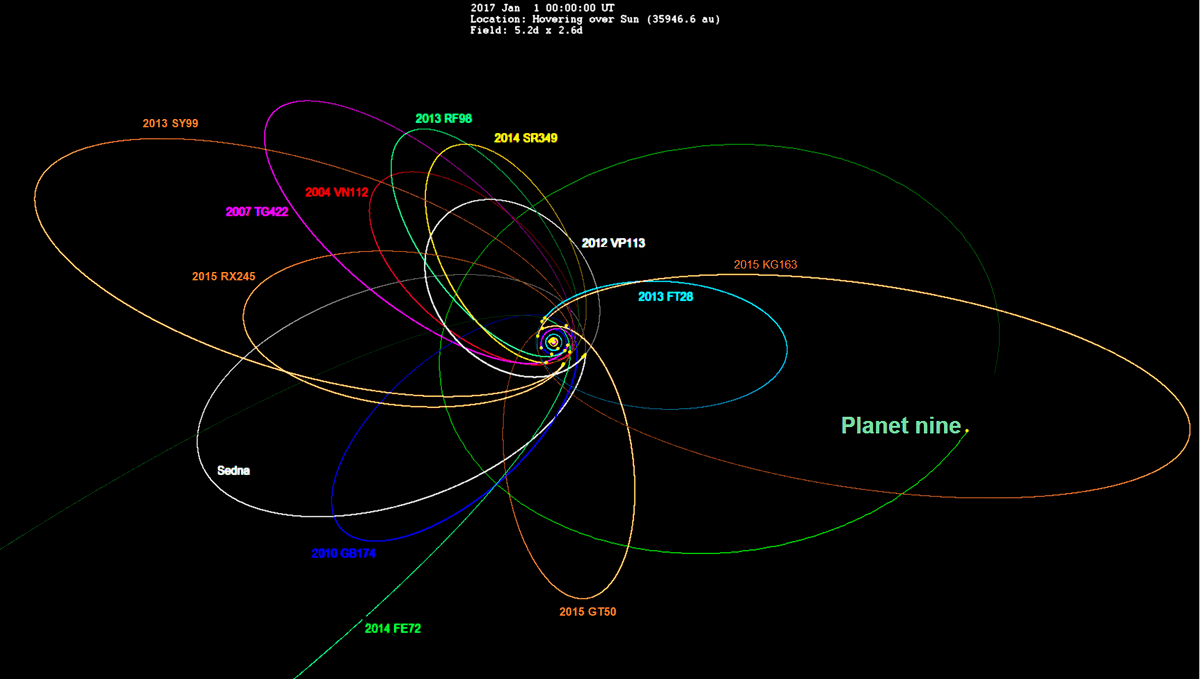
Is there a Planet Nine in our solar system? After Pluto got kicked out of the planet club most of us woke up to the reality that there were only eight planets. There was no reason to believe that some mysterious Planet Nine out there that met the requirements of the club. We would have seen by now, correct?

Planet Nine and other orbits looking from above the solar ecliptic

Nothing New In Planet Discovery

All the planets except Uranus and Neptune were discovered by Babylonian astronomers, although the six innermost planets were most likely noted by humans before writing was invented. Uranus was discovered in 1781, and Neptune was found in 1846. Despite all the advances in telescopes and space exploration no other ‘planet’ has been discovered in our solar system. So, why would anyone think another planet might exist?

Odd Ducks Out There

If the Sun and the planets were formed from a disk of debris, then most objects would be aligned in that disk or solar ecliptic plane, or the plane that the major planets are on as they orbit the Sun. Collisions between asteroids can send them off in unusual orbits that don’t align with the solar ecliptic.

However, there are a group of objects beyond Neptune that have unusual orbits. These objects are called trans-Neptunian objects. These are on a different plane and defy easy explanation. In addition, the Sun itself is a bit odd in its rotation. The Sun seems to rotate slightly off the ecliptic plane that all the planets follow.

Doing the Math

Two astronomers, Chad Trujillo and Scott S. Sheppard, tackled the odd orbits of the trans-Neptunian objects and discovered that some of the orbits of the objects could be explained if there were a large planet farther out in the solar system. That didn’t sit well with other astronomers so they decided to prove them wrong.

Planet Nine’s likely orbit and the orbits of trans-Neptunian objects

Konstantin Batygin and Michael E. Brown from CalTech decided to re-do the calculations of Trujillo and Shepard. They eliminated some of the objects studied because they might be influenced by Neptune’s gravity. That left six objects to study. To their surprise, they discovered that a planet ten times the size of Earth in an off-plane orbit much farther out than Neptune explained the orbits of the six objects to a 99% degree of certainty.

Is There a Ninth Planet?

Despite the mathematical support, there is no Planet Nine…yet. An analogy would be that if someone picked a date ten years in the future, say 3 March 2028, and was asked if that day would fall on a weekday. Without a calendar to look at it would be hard to say ‘yes’ or ‘no.’ It is very likely, but it is not certain until there is proof.

We currently have no proof of another planet, and spotting Planet Nine will be difficult at best. It would be a relatively small target with almost no sunlight reflecting off of it. It couldn’t be seen with today’s telescopes in either the visible or infrared spectrums. Even if we could determine where it is in its orbit, it would take a probe as many as twenty years to get into the Planet Nine neighborhood.

So the answer remains ‘no.’ There is no Planet Nine…but stay tuned.

Pigs In Space: Discrimination on the ISS

01 Thursday Mar 2018

Posted by Paul Kiser in Discrimination, Ethics, Exploration, Government, History, Honor, Management Practices, NASA, Politicians, Politics, Public Image, Public Relations, racism, Russian influence, Science, Space, Technology, United States, US History, US Space Program, Women

≈ Leave a comment

Tags

Anne  McClain, astronauts, bias, crew, discrimination, Expeditions, Female, Gender, International Space Station, ISS, Jeanette Epps, male, misogyny, NASA, racism, Russia, Serena Auñón-Chancellor, Space, United States

For the last 17 years, the International Space Station (ISS) has been the great achievement of the United States, Russia, and other nations working together to maintain a human presence in space. People around the world can look up and see the shining star of the ISS crossing the evening or predawn sky. Yet, ISS has a dark shadow that NASA and the other nations involved don’t talk about publicly. Space has a glass ceiling.

International Space Station not above discrimination

Man Cave In Space

Women have spent less than ten percent of the cumulative days on the ISS since the first crew came on board in October of 2000. In over 17 years, only 12 women have served on an expedition crew. One woman, Sunita L. Williams, served twice, and one, Peggy A. Whitson, served three times.

As of today, (1 March 2018,) women have logged only 2,527 days on the International Space Station compared to 23,493 days served by men. Most of those women have been from the United States with only two women serving from other countries. The problem of discrimination against women is bigger with Russia, as cosmonauts have spent the most time on ISS (47% Russia versus 40% USA) but only have allowed one woman to be part of the crew.

The irony is that women make up 63% of the population of Russia and yet women have had less than 7% of the days served on ISS compared to their male counterparts. The United States has also failed to utilize women as crew members, but at least in the case of the U.S., women have been 21% of the Expedition crew.

Discrimination Station

Jeanette Epps barred from ISS

The problem with the crew discrimination goes beyond gender. ISS has yet to have an African American crew member. Last year NASA announced that Dr. Jeanette Epps would be the first African American crew member before Donald Trump was sworn into office. This January NASA rescinded that decision without explanation. They replaced her with another woman, Serena Auñón-Chancellor, who was scheduled to fly in November.

Epps has been completely removed from the ISS crew rotation even though NASA claims she is still under consideration. It has been confirmed that she was not ill, nor were family issues a reason for removal. NASA has not explained whether Trump’s administration was involved in the decision, nor whether Russia has demanded that the African American woman be barred from serving as a crew member.

However, it is clear that women and minorities are shockingly underrepresented on the space station. The unexplained removal of the first African American crewmember, who also is a woman, reflects a continuation of the ongoing discriminatory behavior of the program.

Gender-Based Crew Selection

NASA has demonstrated that it has a plan for the crew assignment based on gender assignment. Jeannette Epps has a Ph.D in engineering. She was replaced by Serena Auñón-Chancellor who is a physician. Dr. Aunon-Chancellor was pulled off an ISS Expedition scheduled to begin in November 2018, and she was replaced by Anne  McClain who is a West Point graduate, Major in the Army, and a pilot with Master’s degrees in Aerospace Engineering and International Relations.

It is obvious that these three women were not shuffled around on the basis of skills, education, nor experience. Epps, and Dr. Aunon-Chancellor were selected to be an astronaut in 2009. McClain was selected in 2013, and completed her training in 2015. None of them have been in space. The only rational explanation is that NASA was replacing a woman with another woman. NASA’s 90% male to 10% female crew assignment is intentional.

Five Versus One

Another issue is the male dominated crew Expeditions. Typically only one woman is assigned to be with five men for six months on ISS. Only twice have two women served at the same time on ISS. For three months in 2010, and three and a half months in 2014-5, two women were on board at the same time. For the rest of the 200 months of occupation, ISS has either had an all-male crew, or only one woman on board.

Lack of Qualified People?

Is it possible that NASA can’t find enough qualified women or minorities? The number of people who dream to be an astronaut may have diminished since Apollo, but the dream hasn’t died.

When less than ten percent of the ISS crew time is served by women, and no African Americans have served in over 17 years of operation it’s clear there is a problem. ISS shouldn’t be the icon of white male discrimination.

SpaceX 2018 Launch Schedule Is PR Gold or PR Nightmare

28 Wednesday Feb 2018

Posted by Paul Kiser in Business, Customer Relations, Customer Service, Exploration, Falcon Heavy, Marketing, Milestone, NASA, Pride, Public Image, Public Relations, Science, Space, SpaceX, Technology, United States, US History, US Space Program

≈ 1 Comment

Tags

2018, Block 5, commercial space, fairing, Falcon 9, Falcon Heavy, launch, manned space program, manned spacecraft, NASA, space business, SpaceX, Starman, Tesla Roadster, Zuma

SpaceX is dependent on its reputation of success and reliability. There is no room in SpaceX’s 2018 launch schedule for major failures. The successful launch of the Falcon Heavy with a Tesla Roadster as the payload has repaired the long delays of the program, but in the business of space, you’re only as good as your last mission.

SpaceX’s Starman in Earth orbit

SpaceX’s reputation will be determined by the successful implementation of three critical elements of their program. Failure of any of the three elements and SpaceX could be facing a public relations (PR) nightmare; however, success will prove Elon Musk’s lofty visions for the company might be more than just talk.

SpaceX Must Do No. 1 – Consistency in Payload Delivery

The Falcon 9 program has moved out of the novice phase and into the professional phase. The question remains as to whether or not SpaceX can consistently put payloads into orbit.

Landing the booster after these launches dazzles the public, but has no impact on the effectiveness or cost efficiency of the program. Most of the boosters are the previous Block 3 or 4 versions and will not be reused. There is an issue with the booster landings. How long will paying customers accept SpaceX’s waste of resources on the ‘reusable’ PR parlor trick?

The other issue cropping up is the reliability of the fairing on the nose of the rocket. There are persistent issues with the fairing and while SpaceX absolved themselves of the loss of the super secret Zuma satellite, questions still remain as to the role of the fairing release after launch. 

SpaceX Must Do No. 2 – Prove Falcon Heavy is Reliable

The inaugural launch of the Falcon Heavy was a spectacular success for SpaceX. The PR kudos continue to pour in with every new sighting by astronomers as the alternate human, Starman, drives his Tesla out further in the solar system.

All that could be lost if the next two 2018 scheduled launches of the Falcon Heavy experience problems. Failed launches of the Heavy would erase much of the PR boost of the first launch and call back into question the wisdom of a 27-engine booster. SpaceX has to duplicate the home run first launch at least twice more before customers will feel warm and fuzzy about the Falcon Heavy.

SpaceX Must Do No. 3 – Success of the F9 Block 5 Version 

Block 5 is the final version of the Falcon 9 booster and it goes into service in 2018. It is the booster that will be rated for human spaceflight and much of SpaceX’s future as a commercial space program depends on proving it answers all the concerns of the four previous versions.

NASA is requiring seven successful booster flights of the Block 5 version of Falcon 9 before it will be rated for humans. That means SpaceX has to successfully launch the same version of the booster, without significant redesigns, seven times.

SpaceX has scheduled the maiden and second flight of the Block 5 version for April. It then has to fit five more successful flights between May and November. Once achieved, SpaceX can be approved to send astronauts up on the Block 5 booster in December of this year.

2018 A Year of Glory or Humiliation

Elon Musk has a reputation for promising more than he can deliver. He is a master of overconfidence but now results matter. He knows how to carefully craft a situation to amaze the public.

The Falcon Heavy launch was one of those moments. When they see the video of Starman orbiting Earth in a shiny red Tesla with the top down, people don’t remember that the Falcon Heavy was supposed to be ready in 2013. When they see the first stage of a rocket magically land on the pad, people don’t care that the booster was never going to be reused again.

2018 isn’t going to be a time when showmanship is going to cover up glaring issues. If there are problems meeting this year’s critical goals, people will see the man behind the curtain.

However, if SpaceX manages to achieve these milestones with minimal problems, SpaceX will be the shining star of space exploration.

My Imaginary Interview with Marketplace’s Kai Ryssdal

27 Tuesday Feb 2018

Posted by Paul Kiser in Business, Economy, Entertainment, Ethics, Journalism, Marketing, Passionate People, Politicians, Politics, Public Image, Public Relations, Stock Market, Taxes, Technology, Traditional Media, Writing

≈ Leave a comment

Tags

business news, entertainment, imaginary interview, Kai Ryssdal, Marketplace, National Public Radio, npr

Me:  He’s a man who is all business when it comes to business. Kai Ryssdal is the voice of Marketplace, and for the unenlightened, it is a half-hour business news radio show produced and distributed by American Public Media on public radio stations five days a week all over this country. He has been in his current role for 13 years. A graduate of Emery University, then eight years in the Navy, a Navy pilot, worked in the Pentagon, MA from Georgetown, U.S. Foreign Service in Canada and China, even a stint with California Public Radio…tell me, sir, you are a Renaissance Man are you not?

Radio host Kai Ryssdal

Kai Ryssdal: Host of Marketplace

Kai:  I’ve done some things, but I’m not sure what the test is for qualifying as a Renaissance Man.

Me:  Fair enough. Since you’ve been in the big chair at Marketplace the show has won some awards. Edward R. Murrow Prize, an Emmy, awards from radio news directors, and some 12 million listeners. What defines the success of your show?

Kai:  What defines the success of the show?

Me:  When people say Marketplace is a great show because….

Kai:  What we do, or at least is our goal, is to make the issue understandable. If we can’t get someone in her or his car listening to our show to have an a-ha moment on the topic we are discussing, we’ve missed the mark.

Me:  You’ve said the term ‘Marketplacey’ in other interviews. You’ve described it, I believe, as a type of rhythm, a style that is unique that defines the show. Why does it work?

Kai:  I’m not sure I can answer that question. I can tell you that I think it is a style that expresses a serious, but relaxed treatment of the subject matter. It’s not too formal, nor too casual. We try to keep out the political agenda and focus on what is the structure of the problem.

Me:  Might some say you trim down the problem too much? Interviews on Marketplace tend to be short and include the view of only one person, correct?

Kai:  We try to do a mix of viewpoints, but we don’t try to do the point/counterpoint interviews. We try to break issues down into small components and cover them in several segments.

Me:  Is it investigative reporting?

Kai:  Not in the sense that we are digging up a secret and exposing it to the world. Our mission is more to educate and illuminate, not uncover.

Me:  But doesn’t that mean you control the process?

Kai:  I’m not sure I understand your point.

Me:  Do you decide what people learn about an issue? Do you shape the issue for the listener?

Kai:  Not with a nefarious intent, but we do clear away the clutter of the issue so a person with little or no experience in the subject can understand the details of the problem.

Me:  Okay, we’ll have to leave this here. Kai, thank you for your time.

Kai:  Thank you.

Hiding Journalists Behind the Paywall

26 Monday Feb 2018

Posted by Paul Kiser in Branding, Business, Communication, Customer Relations, Ethics, History, Honor, Information Technology, Journalism, Management Practices, Print Media, Public Image, Public Relations, Respect, Social Interactive Media (SIM), Social Media Relations, Stock Market, Technology, Traditional Media, United States, US History, Website, Writing

≈ 1 Comment

Tags

entertainment, investors, journalism, journalism standards, journalists, New York Times, newpapers, News media, news organizations, packaging news, paywall, paywalls, The Wall Street Journal, Washington Post

Several news organizations have blocked their website content behind paywalls. The New York Times, Wall Street Journal, and The Washington Post are noteworthy examples. Paywalls are an attempt to force the reader to pay a subscription to access the news articles of the day. The question is what kind of a journalist wants her or his work held captive from the public?

Paywall News Organizations: The Road to Irrelevance

Out of Sight, Out of Mind, and Irrelevant

The thinking of these organizations is that the value of the content behind the paywall will create a desire for the reader to open a wallet and pay them money. The problem with that theory is that information is not ‘owned’ by a news organization, it is only packaged. News is what happens in the world and is reported in the raw on Twitter, Facebook, and all the other free sources on the Internet.

What investor-owned news media attempts to do is make the reader pay for their packaging of the news, not the product itself, and in an age of the Internet, someone else can offer the same product in a different package for free. 

For the writer or journalist that creates the packaging of the news, it means that the public can’t see her or his work…ever. If people can’t see your work, you become irrelevant. The best writer in the world risks becoming invisible when all his or her creative efforts are on a pay-to-read basis.

Even those who are willing to pay for the subscription can’t share an article with others when it is behind a paywall. The benefit of readers discussing a journalist’s work is limited to the subset of those who pay-to-read and in a ‘Share’ world, that is a critical shortfall.

Paying Journalists For Their Work Myth

The organizations that inflict a paywall on the reader and the journalists defend the decision by saying:

Someone has to pay for quality journalism!

But that is a lie. The truth is closer to the statement:

Our investors have to suck as much money out of the work of the journalists!

Note the list of news organizations and, according to Forbes magazine, who owns (as of June 2016) the controlling stake in them.

Behind Hard Paywall (all articles pay-to-read)

  • Wall Street Journal – Billionaires Rupert Murdoch and Lachian Murdoch
  • The Washington Post – Billionaire Jeff Bezos

Behind Soft Paywall (limited free views)

  • New York Times – Billionaire Carlos Slim Helu
  • Wired – Billionaire Donald Newhouse
  • The New Yorker– Billionaire Donald Newhouse

No Paywall

  • Bloomberg Businessweek – Billionaire Michael Bloomberg

The people who control these news organizations don’t need to find new ways to pay journalists. They are just using journalists for greed.

News As Entertainment

Journalism is a philanthropic duty. It is not created to generate profit for investors, it is created to provide information to citizens. The transition from journalism to entertainment is strictly about greed.

Few great journalists become wealthy, but great journalists become the keystone to a great society. The fall of our country can be traced, at least in part, to the fall of journalism. If journalism is about making money then journalists are just prostitutes of news.

McDonald’s Shake Machines Legendary Unreliability

17 Saturday Feb 2018

Posted by Paul Kiser in About Reno, Branding, Business, Customer Relations, Customer Service, Employee Retention, Lessons of Life, Management Practices, Marketing, Pride, Public Image, Public Relations, review, selling, Technology

≈ Leave a comment

Tags

employees, fast food, food machines, ice cream, McDonald's, milkshakes, Nevada, Reno, Restaurant, service, shakes, Shamrock Shakes, supervisors, worker

It may be just me, but something seems to be amiss with McDonald’s shake and ice cream machines. My experience tells me it’s a 50-50 chance the machine will not be working when I order a shake. Guess what? It’s not just me.

The six McDonald’s I visited in Reno, NV, USA

Apparently, the reliability, or lack thereof, of McDonald’s shake machines and ice cream machines are legendary in the fast food world. It’s so bad that last year McDonald’s corporate folks announced they were replacing the ice cream machine in every store.

Shaky Reputation For McD’s Milkshakes

An online search found multiple responses to questions about McDonald’s shake machines. On Reddit, one person asked:

McDonald’s employees: why is the milkshake machine always out of order?

Response from an alleged McDonald’s employee was:

This machine is incredibly hard to keep up and running if you have no idea what you are doing. It turns off automatically around 11 pm. It turns back on in the morning about 4 am. …Once a month it will turn off for it to be cleaned… someone must completely take it apart to clean it. If it is put back together improperly or not clean enough it will shut off after about an hour and you must clean it again. 

Former McDonalds Shift Manager

On Quora the responses to a similar question were:

Even for machines that produce products like the McFlurry, the cleaning and maintenance required is such that it is easily among the most hated tasks to be performed… a milkshake or McFlurry is a product that is usually made by the cashier. … Each McFlurry represents an added task… any request for that item represents added work for the employee with no benefit to accomplishing any of their main tasks faster… there is little downside to simply not providing this service when at all possible. 

Former McDonald’s Employee

1. Laziness…
2. The cleaning process…
3. …complicated piece of machinery…

Current McDonald’s Employee

McDonald's Shaking Up It's Shake Machine?

The New Shake Machine? At least this one was working.

McD’s in Reno, Nevada

I made nine visits to six McDonald’s restaurants in the Reno, Nevada area this week. All occurred in the afternoon to early evening. I had four instances where the shake machine was out of order; however, in one instance they said it would be ready in a few minutes, and we (my son was with me) scored our first Shamrock Shake of the season at that location.

The three other times that the shake machine was out of order all occurred at one restaurant on three consecutive days. Five other McDonald’s had working shake machines. 

Will It Be Hunting Season For the Shamrock Shake?

With the famous Shamrock Shake season coming up, will it be hunting season for those who are seeking the elusive green treat? Probably not. If the one problem location is removed from my unscientific survey, the shake machines at most of the McDonald’s restaurants could be considered reliable during peak hours.

It also seems that based on the comments of past employees, the reliability of the shake machine might be more a question of the quality of the employees and their management. I will certainly be cautious of McDonald’s locations that seem to have shake machine issues because it is likely that their problems are not isolated bad machine maintenance.

Space Exploration Isn’t Profitable, It’s Transformative

16 Friday Feb 2018

Posted by Paul Kiser in Apollo, Business, Economy, Education, Exploration, Falcon Heavy, Generational, Government, Higher Education, History, Lessons of Life, Management Practices, NASA, Passionate People, Politics, Pride, Saturn V, Space, SpaceX, Taxes, Technology, Travel, United States, Universities, US History, US Space Program

≈ Leave a comment

Tags

Age of Discovery, Apollo, Apollo missions, Columbus, economy, Golden Age of Spain, good jobs, jobs, NASA, privatization, return on investment, ROI, Soviet space program, Soviets, Space, space exploration, Spain, Technology, wages

Space exploration ROI (return on investment) sucks. Exploration doesn’t make money, it costs money. It’s not a place for private business. If the question of space exploration is, “What’s in it for me?” you’re asking the wrong question. Space exploration isn’t profitable, but it is transformative.

Apollo Saturn V

The five massive Rocketdyne F-1 engines of the Apollo Saturn V first stage booster. Twice the lift of SpaceX’s 27-engine Falcon Heavy

Exploration Creates Economic Growth

In the 15th century, when the government of Spain financed Columbus to explore a new trade route to the markets in Asia, he discovered the Caribbean. He brought back a few captured natives from the Bahamas, some gold, and a few birds. It didn’t pay for the cost of the voyage.

But what came next transformed Spain and Europe. The year of the discovery of the Americas (1492) is considered the start of the Golden Age of Spain. After Columbus first voyage to the new world, Spain continued with more voyages, and eventually the full exploitation of Central and South America. Most historians focus on the resources that were returned to Spain, but what happened at home was even more important. 

Shipbuilding entered a new phase of design and construction. Jobs at home created a new wealth for the working class. Craftsmen, as well as sailors, became vital to the needs of the Age of Discovery. That new wealth created secondary jobs, along with new businesses selling imported goods. All of this economic growth was a direct result of the exploration pushed forward by the government of Spain.

Exploration created massive economic growth for decades, but exploration didn’t give an immediate ROI for Spain.

The Model Space Program

Not all space programs are successful. The Soviet space program became mired in conflicts between good science and engineering versus political priorities. The administration was pushed into risky decisions and failure was not without punishment. In addition, new technology was considered a State secret so the development of commercial uses was not an option.

The United States approach for the space program was for the use of non-military government oversight of private contractors. The government remained accountable to the voters, which kept both the government and their contractors in a stable environment for decision making.

The result was a massive increase in highly-skilled, well-paid jobs that created a new wealth for the middle class. Space exploration supercharged the United States economy and created new technology that continued to develop for decades after the Apollo program ended. It was the model space exploration program.

A Failure of Vision

Once the United States had landed on the Moon conservatives and liberals united to kill the space program. Liberals could only see the money being spent to explore space as money that could have been used to help the poor. Conservatives could only see money not going into their pockets. As it would turn out, both viewpoints were flawed.

Money spent on for space exploration created new, high paying jobs that created a need for improved education and pumped billions of dollars into the economy that created new tax revenue that could be used for government programs to help the poor engage in the new economy.

The flood of new money into the economy helped small companies grow dramatically while increasing profits. It didn’t result in the wealthy becoming dramatically richer, but it did create prosperity that helped everyone.

Missing Greatness

Today the United States is wading in a stagnant economy. Wages aren’t growing as fast as prices are rising. The available jobs pay so poorly that they aren’t worth the cost of working them. If we are missing greatness, it is because we are killing our economy with a focus on profit for a few.

The goal of private business is never to create jobs, nor is it to create high paying jobs. Jobs are created when business has been given a mission to accomplish something. Giving tax breaks does not give business a reason to create more jobs, nor pay employees more.

However, if our country made a serious commitment to the goal of expanding space exploration, and funded it with the tax breaks we are giving billionaires, we would see our economy transformed. It is that simple.

Snowpack is No Longer a Viable Water Supply

10 Saturday Feb 2018

Posted by Paul Kiser in About Reno, College, Crisis Management, Education, Generational, Global warming, Government, Higher Education, History, Passionate People, Science, solar, Technology, United States, Universities, US History, Water

≈ Leave a comment

Tags

aquifers, Dr. James E. Church, drought, Global warming, lakes, snow surveys, snowfall, snowpack, snowpack surveys, University of Nevada, UoNV, water level, water management, wet

The Sierra Nevada mountains. In the winter, cold, moist air off the Pacific Ocean is pushed up over them. The air loses the ability to hold the water vapor as it rises up and snow precipitates out. The snow piles up and waits for Spring and as the Summer approaches the warm air melts the snowpack and water flows. That is the source of the water supply for California and western Nevada. Sometimes.

When water flows in the Sierra, life is good

Snowpack: The Alpha and Omega of Western Water Management

Sometimes the snow doesn’t fall. The creeks and rivers dwindle. The water level in the lakes and reservoirs drop and a drought begins. It is a cycle that has repeated many times in the western United States, but not when so many people have been dependent on the annual water flow.

CA Drought Wet Year History

Not Good: CA drought versus wet years

In this part of the country, it is all about the snowpack. If the Sierra Nevada mountains have a good snowpack, there is water. If not, well… This is the model of water management in California and western Nevada and in the last few decades have proven that it is not a good one. Drought is not an exception in the West, but the rule. As the population grows, the Sierra Nevada snowpack becomes the enemy.

Global Warming:  Raining on the Snowpack Parade

There is growing problem with the reliance on the snowpack. Global warming. The impact of the Earth’s atmosphere retaining more of the Sun’s energy may be that snowfall may become rare, or non-existent in temperate climates.

March 2010 Snowpack
March 2010 Snowpack
March 2015 Snowpack
March 2015 Snowpack

Beyond the issue of drought is the issue of rain versus snow. The West has reservoirs and lakes, but that storage is not enough if the precipitation falls as rain, not snow. Rain also is not as efficient as snow in replenishing the deep aquifers that have been used to supplement the surface water.

Up the Creek With No Water

Drought is the new normal in regions in the West dependent on snowpack. The current response has been to push for water restrictions. This is not a flawed approach as the water users have become accustomed to the mindless waste of fresh water; however, reducing the use of water is not going to solve the problem.

Global warming is causing the precipitation to fall as rain, not snow. If water management in California and Nevada can’t learn to transition off the snowpack model it won’t matter how much water is saved. You can’t reduce the use of water when there is no water to save.

SIDE NOTE:  Creator of the Snowpack Survey

On the University of Nevada (UoNV) campus in Reno, Nevada there is a building named the ‘Church Fine Arts Building.’ Some even make the mistake of calling it the Church ‘of’ Fine Arts, which might be appropriate for some who dedicates his or her life to the Arts.

Dr. Church in Sierra Nevada range

Dr. James E. Church on a snowpack survey

However, the building is named after the UoNV professor, Dr. James E. Church, who died in 1959. He taught Latin, German, and Fine Arts at the university from 1892 to 1939. He was not employed as a scientist at the UoNV; however, Dr. Church invented the snowpack survey that is still used today to determine the water content of the snowpack in the Sierra Nevada range. 

It is said that he and his wife’s ashes are in the cornerstone of the Church Fine Arts Building.

Dr. James E. Church

[COUNT TO 500:  499th Article in PAULx]

SpaceX Falcon Heavy Defies the Odds

07 Wednesday Feb 2018

Posted by Paul Kiser in Falcon Heavy, History, NASA, Pride, Public Image, Public Relations, Science, Space, SpaceX, Technology, United States, US Space Program

≈ Leave a comment

Tags

asteroid belt, booster, Elon Musk, Falcon Heavy, landing, launch, Mars, orbit, relanding, SpaceX, Tesla, Tesla Roadster, test

I’m not a fan of SpaceX, nor of Elon Musk, but one can only observe yesterday’s Falcon Heavy launch with awe. It was brilliant. One thing that Elon Musk and I agreed on was that the chance it was not going to end in a massive fireball was slim. It is hard to convey how unlikely a successful launch was considering all the factors involved. The people working at SpaceX did at least one trillion things right to achieve the results of yesterday’s launch.

Taken from live feed of Tesla Roadster in orbit

Starman takes a test drive

SpaceX and Musk Had a Great Day

A sample of what went right:

  • Other than weather, the launch had no delays. That is unusual with a prototype rocket test.
  • An engine ignited and worked as intended. Multiply that by 27.
  • A side booster that was essentially a rocket in itself, did exactly what it suppose to do without any new issues common in a prototype test. Multiply that by 2.
  • The core booster functioned as intended and delivered the second stage and the payload, a Tesla car, into position for a boost into orbit.
  • A side booster completed a complex task of a powered relanding withing a few meters of the target zone. Multiply that by two.
  • A side booster was reused from a previous mission. Multiply that by 2.
  • The second stage booster fired its engines, times three, sending the payload into a heliocentric orbit that will extend beyond Mars, and near the Asteroid Belt.
  • A team of thousands of people performed their functions in synch allowing the payload to achieve orbit.

Hold My Beer and Watch This

The only small item that did not go as planned was the failed landing of the core booster on the Drone ship. The engineers have determined that only one of the needed three engines for landing had reignited. Until they can analyze the issue, I’m going with the explanation that the core booster was so excited about the success of the launch that it thought it would go for the biggest splash. It was successful.

Regardless, it was a minor misstep in a successful mission-impossible-type achievement.

Bye Bye Starman

Late on Tuesday the second stage of the Falcon Heavy successfully ignited for a third and final time sending ‘Starman’ (the alternate human in the spacesuit) and the Telsa Roadster into a heliocentric orbit that will take it to Mars and beyond. His orbit may last for over a million years, but the car won’t. All the exposed, non-metalic parts of the car will be no match for the radiation, heat, and cold of space. The paint job will suffer as well.

Starman’s out-for-a-drive orbit

Still, the pièce de résistance was the video of Starman in orbit above Earth. I’ll leave you with these images I captured from the live feed. Below that you can watch the video of the launch. Well done, SpaceX.

Starman 1 (2)
Starman 4 (2)
Starman 5 (2)
Starman 7 (2)

[COUNT TO 500:  496th Article in PAULx]

Zuma Mystery: It’s Classified and Invisible…Apparently

01 Thursday Feb 2018

Posted by Paul Kiser in Business, Communication, Crisis Management, Customer Relations, Ethics, Government, History, Honor, Management Practices, NASA, Pride, Public Image, Public Relations, Relationships, Science, Space, SpaceX, Technology, United States, US History, US Space Program

≈ Leave a comment

Tags

deployment, Elon Musk, failed mission, fairing, Fairings, Falcon 9, Indian Ocean, launch, launch delays, Northrop Grumman, orbital inclination, secret satellite, SpaceX, USA-280, Zuma

On 8 January 2018 the top-secret USA-280 satellite, as known as Zuma, went up, but a funny thing happened on the way to orbit. It was launched to the northeast at a vector of approximately 51° off the equator. A rough course estimate would have taken Zuma south of Great Britain, across Europe (possibly over France, Italy, and Greece,) over Saudia Arabia, and to the Indian Ocean west and/or south of India. According to one unnamed source, that is where the flight of USA-280 ended.

Zuma went down in the Indian Ocean?

Possible approximate flight path of Zuma

Elon We Have a Problem

The first hint that something was wrong is when Brian Mahlstedt, the launch narrator for SpaceX, paused for 90 seconds after announcing that the fairing (the cover around the satellite) would deploy “…any second..” and then changed the subject when he began talking again. This was also significant because he said that coverage of the launch phase of the would end AFTER the deployment of the fairings. Had the fairings deployed as scheduled it would not have crossed over into the coverage of the landing of the booster phase, which was what happened. 

The second hint was when SpaceX public relations (PR) didn’t spike the ball after the launch, praising its success.

By the next morning, sources were quietly saying that the satellite didn’t make orbit. Some seemed to suggest that the fault was with the SpaceX rocket. Some indicated the release platform of the satellite failed, keeping it connected to the upper stage as it fell back to Earth.

SpaceX came out with a qualified statement that didn’t deny the failure to achieve orbit but adamantly implied that the SpaceX rocket performed as intended. Northrop Grumman, the contractor for the super secret satellite and the release platform announced that it didn’t comment on confidential payloads. 

Disinformation Campaign

A few media sites suggested that maybe everything was fine and the satellite was safely in orbit. It was a tactic that a covert agency might employ to feed a few trusted sources with a disinformation campaign to calm the discussion of failure, and for the most part, it worked. Few follow-up reports have been made about USA-280.

The evidence, or lack of it, is telling a different story. Astronomy hobbyists, some highly skilled in finding and tracking human-made objects in orbit, have spent the past three weeks trying to find the ‘invisible’ satellite with no success. They have found a satellite lost over ten years ago, but no one has sighted the wayward Zuma satellite.

The Zuma Fairing Mystery?

The chronology of the fairing deployment is as follows: 

  • T+0:50 seconds (50 seconds after liftoff) – A SpaceX announcer begins a live and nearly continuous commentary regarding upcoming events with the Falcon 9 rocket, pausing only for those events to be confirmed by SpaceX control.
  • T+2:03 – SpaceX announcer pauses as four events related to second stage separation are about to begin.
  • T+3:06 – SpaceX announcer resumes commentary and confirms a successful second stage separation, and explains at T+3:15 that fairing separation “…should occur any second now” (ejection of protective nose shell around satellite.) He continues on to say that he will confirm the fairing separation after it occurs.
  • T+3:26 – SpaceX announcer begins a pause that lasts for one minute and thirty seconds.
  • T+4:57 – SpaceX announcer says, “Alright, so we’ll address the fairing deployment in a second once we have more information, but for now we’re going to shift our transition back to our secondary mission…”
  • T+5:17 – SpaceX announcer says, “…ah, quick sidebar here that we did get confirmation that the fairings did deploy.”

The launch of Zuma was delayed last November because of an issue with the fairing deployment. The question is whether the previous issue along with the 90-second pause in announcing the fairing deployment indicate there was an in-flight problem with the fairing.

Best Guess?

Everything is speculation. Based on what we know, this is my suggestion of the most likely scenario:

  • The fairing failed to deploy at the prescribed time, but it did deploy late. (That would fit SpaceX’s non-denial denial.)
  • The late deployment caused a decision to abort the flight so that it would come down in the Indian Ocean.
  • Had the abort been held off, the flight might have been able to continue, but point-of-no-return in the abort decision had been reached and the flight was terminated.

This would still allow SpaceX to claim its rocket performed ‘nominally’ and only fudge a little when not admitting the fairing issue. It would also suggest that there was disagreement during the ascent phase and that the incident is a sore spot for the parties involved…

…but you didn’t hear that from me.

[COUNT TO 500:  490th Article in PAULx]

The State of the Union of the United States of America

29 Monday Jan 2018

Posted by Paul Kiser in Aging, Business, Crime, Customer Relations, Customer Service, Economy, Education, Ethics, Generational, Government, Government Regulation, Green, Health, Higher Education, History, Honor, Management Practices, Panama, Politicians, Politics, Pride, Public Image, Public Relations, racism, Relationships, Religion, Respect, Science, Space, Taxes, Technology, United States, Universities, US History, US Space Program, Women

≈ Leave a comment

Tags

Congress, Donald Trump, economy, Education, GOP, ICE, Illegal Immigrants, immigrants, Immigration, Paul Kiser, President, public education, Republican, Republican Party, Republicans, roads, Space Program, State of the Union, Tax Cut and Jobs Act, tax cut for wealthy, tax cuts, taxes, United States, United States of America

Mr. Speaker, Mr. Vice President, Members of Congress, the good citizens of the UNITED STATES of America:

We are a country of greatness, that has allowed itself to be taken over by the ungrateful. For centuries we have been the place that the world looks to as a model of what they hope to have for themselves and their families, and yet, in one year that model has become the example of what not to do.

The World Economy

We are the marketplace of the world. Companies in Africa, South America, Asia, Europe, and Austrailia want to capture the market of the United States of America. Our citizens support the world economy, and they know that when the United States falters, the world falters.

And yet, the Republican party would have you believe that if our companies are required to pay their portion of support for the United States of America, they will move their jobs away. It is a twisted logic that accepts companies will move away from their customers, but that is what the Republican party would have you believe in order to fatten the wallets of those who don’t need more money.

It is true that companies in the United States of America have been allowed to hide their money in other countries to avoid supporting the people of the United States of America. The solution to this is not to lower taxes, but to refuse to allow a company to have access to our market if they won’t pay their taxes. The Republican model rewards companies that break the laws of the United States of America by legalizing nonpayment of taxes.

The Power of Government

The Republican party has convinced people that government is inherently evil and that the citizens of this country shouldn’t have to financially support it. They have lied to our citizens by claiming that taxes are wrong, government is evil, and business is holy.

And yet, when we closely examine the ‘waste’ of government we find that typically it is a private business that is stealing from the government, not government waste. Business is based on greed. Government, our government, the government established by our forefathers, the government that financed the railroads, the government that built the water systems, the sewer systems, the dams, the roads and highways, the bridges, government that helped our world neighbors win World War I and World War II, the government that established fire protection, law enforcement, national parks, national monuments, and the government that took us to the Moon and back, THAT government is not evil. THAT government is responsible for all the great achievements in the United States of America.

We are not strong because business made us strong. The history of corporations in the United States of America is one of abuse of workers, deception of neighbors and customers, of mismanagement, fraud, and greed. It has been consistent in our country that when the government keeps a close eye on business, business has succeeded. Government, our government, the government of the United States of America makes for good business, and when government is not there, business brings down our country and our economy, just as the banks did in 2007.

The United States

In this speech, I have not used the word, “Americans.” I don’t use that term to refer to the citizens of the United States of America. Brazilians are Americans. Peruvians are Americans. Panamanians are Americans, Canadians are Americans. And our friends south of our border in Mexico are Americans. All the people of North, Central, and South America are Americans.

WE are the UNITED STATES of America. We celebrate and demand the UNION of our country, not the divisions. What we have is unique. What we have is special. Those that use only the last word in our country’s name fail to understand the importance of the first two words.

As the United States, we are pledged to a government by the people, and for the people, ALL THE PEOPLE, of the United States of America. No one is superior. The wealthy are fortunate, not better. The poor are unfortunate and we have their backs.

Immigrants are our guests until they become citizens, and we will be judged on how we treat them. We don’t need walls, we need paths. Every immigrant should be recognized and assisted as they join our great nation. Anything short of heroic support of the visitors to our nation is beneath the character of the citizens of our country.

Education For All

A miracle has happened in the United States of America. Between 1950 and 2010, our country’s population doubled. In 1950, only 34% of the adults in our nation had a high school degree. Only 6% had a college degree. By 2010, Almost 90% of the adults in our country had a high school degree and 30% of our adult citizens had a college degree. 

Our schools, our PUBLIC schools not only kept pace with the growing population, they expanded the gift of education to almost everyone willing to do the hard work of becoming better citizens.

We cannot stop now. Education is the foundation that this country stands upon. Education creates new job possibilities. Not just for the student, but for the employer. When a good employer realizes that her employees have a greater potential than his or her current job requires, they find ways to expand the challenges, and that means the company can stay competitive, and even outpace other companies in countries that don’t have the power of an employee educated in the United States of America.

It is Time

We have been deceived. The Republicans have tried to tear our country down and then claim they are building it up. Our country doesn’t need to be rescued by people who seek only to line the pockets of a few at the sacrifice of everyone else. The stock market is a measure of greed, not of wealth. Our economy is driven by millions with good jobs that pay them enough to have money to spend, not by a few investors making millions off everyone else.

Taxes are the lifeblood of our great country, and when the wealthy don’t pay their fair share, everyone suffers. It’s time we stopped the lies and deception. It’s time we remember who we are and what we stand for…We are the United States of America, and those that don’t support shouldn’t be leading our country.

The Day Business Killed The NASA Space Program

28 Sunday Jan 2018

Posted by Paul Kiser in Business, Government, History, NASA, Politicians, Politics, Public Image, Public Relations, Science, Space, Technology, US History, US Space Program

≈ 2 Comments

Tags

aerodynamic forces, astronauts, Challenger, Disaster, Ethics, International Space Station, Kennedy Space Center, launch delays, manned space program, manned spacecraft, Morton Thiokol, NASA, Solid Rocket Boosters, space exploration, space flight, Space Program, Space Shuttle, SRB, STS-51-L, Vintage Space

Thirty-two years ago today, the first in-flight deaths of NASA astronauts tragically occurred after a launch that wasn’t supposed to happen. Some have proposed that the accident was a result of NASA and their contractors being pressured for public relations reasons. The truth is that their deaths were caused by trying to make space a business venture.

Seven astronauts killed in the Challenger accident

STS-51-L crew: (front row) Michael J. Smith, Dick Scobee, Ronald McNair; (back row) Ellison Onizuka, Christa McAuliffe, Gregory Jarvis, Judith Resnik.

 Death By Impact

On 28 January 1986, seven astronauts in the Space Shuttle Challenger (STS-51-L) died as their crew compartment slammed into the Atlantic Ocean after falling 12 miles in two and a half minutes. They were not killed in the breakup of the Shuttle, nor did they become unconscious from the depressurization of the crew compartment, as suggested by NASA. Some, if not all astronauts, were aware that they were about to die and knew there was nothing they could do to avoid it.

Trail of Causes

The technical primary cause of the accident was weather-related. The Space Shuttle was not to be launched at temperatures below 4° C (39° F) and had never been launch at temperatures below 12° C (54° F.) A few hours before the launch the temperature had fallen to -8° C (18° F.)

The technical fault caused by the weather were rubber O-rings at each of the joints of the solid rocket boosters (SRB.) The O-rings needed to be warm enough to expand to seal the joint to avoid burning gases from blowing out between the sections of the solid rocket booster. The concern was that the power of the burning fuel would rupture the joint at launch and cause an uncontrolled blast of hot gases to escape causing an explosion on the launch pad.

Known Problem to NASA

After previous Space Shuttle launches some of the recovered solid rocket boosters had shown ‘blow-by’ of the O-rings. That meant that the O-rings had not completely sealed the SRB joint and could have potentially compromised the safety of the crew had the blow-by breached to the exterior of the joint.

Engineers at Morton Thiokol, the Utah contractor that designed and built the solid rocket booster, had felt that NASA was ignoring their concerns about the issues regarding the SRB joints. In an emergency teleconference meeting held the night before the launch, the engineers made it clear that the temperatures were unacceptable.

NASA decision-makers did not like the ‘no-launch’ answer and suggested that if they didn’t launch the next day, the company would be blamed for the delay. Morton Thiokol managers caved into NASA and overruled their own engineers. They gave a go for launch. Just prior to the reversal of the recommendation the general manager of Morton Thiokol said to the Vice President of Engineering, “…take off your engineering hat and put on your management hat…” It was the moment that sealed the fate of the seven Challenger astronauts.

Run NASA Like a Business

Previous space projects at NASA had been focused on spaceflight. The goal of NASA and its contractors were to safely put humans in space.

That changed after we reached the Moon. We had done the impossible and now space was less interesting and too expensive. The deflation of post-Moon public support forced NASA to find a justifiable reason to move forward. The decision was that NASA must end the exploration of space and build the ‘business’ of space. The Space Shuttle was intended to make the United States leaders in space commerce.

The Space Shuttle was built to be a reusable, frequent-launch spacecraft that would make traditional, single-use rockets too expensive and unreliable for commercial customers to use. The idea of running NASA like a business became the core value of the organization.

Delays, Delays, Delays

By January of 1986, NASA far behind its business goals. It was not launching the Shuttle frequently enough, nor was the reusability function creating the desired savings. STS-51-L was a critical point in making NASA run like a business. Delays in the launch of previous Shuttle (STS-61-C) had pushed back the STS-51-L flight twice. The launch had been pushed back four more times because of weather and equipment malfunctions.

On the Business Stage

Business is like theatre. It doesn’t matter what is going on backstage because the only thing that counts is what the audience can see. Backstage, NASA was in crisis, but if they could launch STS-51-L, they could maintain the perception that they had everything under control.

There were several public image opportunities if the launch occurred on the 28th that would be lost if it was delayed again. For Challenger and NASA, the teleconference on January 27th had only one possible business outcome. It must be launched. The engineers at Morton Thiokol didn’t know that they were up against a business mentality when they met on that night. Nor did the managers at Morton Thiokol or NASA know that they were about to kill seven astronauts. To them, it was just business-as-usual.

Events in Motion

Once the decision was made to launch events were set in motion.

  1. The cold temperatures caused the O-rings to become rigid. After the SRB’s were ignited a puff of hot gases blew through the O-rings at a point near the large external fuel tank.
  2. The joint temporarily sealed itself off from the debris of the exhaust of the burning fuel.
  3. As the Shuttle rose after launch it hit the worst wind shear ever experienced by a Shuttle and the debris sealing the O-ring broke free allowing the hot gases to burn through the joint.
  4. The flame from the joint acted as a blowtorch cutting into the external fuel tank and finally igniting the hydrogen fuel.
  5. The resulting hydrogen fuel explosion ripped the External Tank into pieces, pushing the Shuttle away.
  6. The Shuttle rolled out of its nose-forward position and was blown apart by aerodynamic forces.
  7. The crew compartment broke free of the Shuttle and continued to ascend until it lost momentum and began to fall down toward the ocean. It did not suddenly depressurize, but likely, depressurized slowly. The astronauts were jolted by the breakup, but not severely injured.
  8. At least three of the astronauts turned on personal oxygen after as the crew compartment fell. One did not, and the equipment for the other three astronauts was not found.
  9. The crew compartment fell and eventually hit the ocean, killing the seven astronauts on contact.
  10. NASA created a story that the astronauts were killed instantly, even after they knew that the events during the accident did not support the story. 

End of the NASA Manned Space Program

The Space Shuttle didn’t fly again for almost three years. It would resume flight for an additional 13 years, but it failed to meet the objectives of making space a business venture. The accident exposed the inherent issues of running a space program like a business and political pressure undermined the concept of a manned space program.

In 2011, NASA ended the United States manned space program with the last launch of the Space Shuttle. Since the last Shuttle launch, NASA has worked hard at pretending to have a manned space program by paying Russia to send U.S. astronauts to the International Space Station and producing videos of the development of the next generation of manned spacecraft. The reality is that NASA no longer can put a human in space, at won’t at any time in the near future.

Below is Vintage Space’s take on the cause of the Challenger disaster.

SpaceX Falcon Heavy-Lift Rocket: A Soviet-Style Disaster?

23 Tuesday Jan 2018

Posted by Paul Kiser in Business, Government, History, Management Practices, NASA, Public Image, Public Relations, Science, Social Interactive Media (SIM), Space, SpaceX, Technology, US History

≈ Leave a comment

Tags

Apollo, Apollo 6, booster stage, engines, Falcon Heavy, first stage, J-1 engine, J-2 engine, launch, Moon rocket, N1, NASA, pogo oscillations, rocket engines, rocket explosion, Saturn V, second stage, Soviet space program, Space, SpaceX, third stage, vibrations

SpaceX is maybe, almost, someday, hopefully going to launch the Falcon Heavy rocket that SpaceX circus master Elon Musk expects to blow up shortly after launch. His concern is legitimate as SpaceX’s 27 engine-utilization is reminiscent of the Soviet’s disastrous failure of heavy-lift rockets of the early 1970’s that used 30 engines.

I hope it makes it far enough away from the pad that it does not cause pad damage. I would consider even that a win, to be honest.

Elon Musk

Three 1st Stage Heavy Rocket Engine Configurations: top – SpaceX Falcon Heavy, lower left – Soviet N1, lower right – NASA’s Saturn V

Soviet Heavy-Lift Plan: Lots of Engines

To get to the Moon the Soviet rocket engineers decided to use thirty engines on the first stage of their N1 rocket design. Smaller engines are easier to build and operate, but more engines mean more potential for failure.

A rocket engine is an effort to contain and control a continuous stream of explosive force. The power, heat, and stress of a rocket engine is unlike almost any other human-created machine. It is a complex network of plumbing, pumps, valves, and structure that must operate perfectly in synch. If they don’t it usually ends badly.

The Soviet’s N1 rocket design avoided the need of designing massive engines, like their counterparts in the United States, however, they didn’t anticipate the complexities of all engines operating in concert. The result was four failures in four launch attempts and the cancellation of the Soviet Moon program. One failure happened at the launch pad with the power of a small nuclear bomb. 

Killer Vibrations

Even if every engine works to perfection, the vibrations caused by each engine can literally shake a rocket to pieces. NASA engineers learned early in the space program that vibrations between the engines and the aerodynamic stresses on the rocket created a ‘pogo‘ vibration running up and down the length of the rocket.

They thought they understood the issue until Apollo Six partially failed because of pogo vibration issue. During the ascent phase of the launch, vibrations damaged fuel lines on the second and third stages. The damage caused the rocket’s second stage to shut down two of the five engines prematurely, and the third stage engine failed to ignite.

Saturn V’s Five Heavy-Lift Engines

Despite the issues with pogo oscillations, NASA’s five Rocketdyne F-1 engines on the Saturn V Moon rocket resulted in 13 out of 13 successful first stage launches. The only partial failure came on Apollo 6 after the first stage had completed its boost of the second and third stages.

It is unclear why the successful Apollo program engine configuration has been rejected as an option for contemporary heavy-lift rockets. It is probable that private ventures into space operations, like SpaceX, want to save money by designing only one rocket engine for all uses.

SpaceX 2017 Great, 2018?

SpaceX is coming off a spectacular year. Of 18 launch attempts, SpaceX had 18 successful launches. SpaceX also had a perfect relanding record in 2017 for every attempt.

2018 is not starting out as well. SpaceX has only had one launch so far this year and it is rumored that the payload did not make it into orbit. No public information has been made about the success of the launch because it was a highly valued, super-secret satellite. It is so secret that the public has not even been told who the satellite was built for, or its general purpose.

SpaceX has proclaimed that its launch vehicle did everything it was designed to do, but the launch narration indicates that there might have been an issue when the fairing or cover around the satellite was supposed to deploy. The launch narrator paused for ninety seconds after he said the fairing would deploy “any second now.” When he began talking again he changed the subject. A few seconds later he finally confirmed the fairing had deployed but did not explain the delay in deployment.

SpaceX Falcon Heavy Engine Roulette

So far, the Falcon Heavy rocket is not a bright spot in the SpaceX story. Its first launch was planned for 2013, and for multiple reasons, it has been delayed for five years. It had been rescheduled for launch in late Fall of last year but was then delayed again. On 1 December Musk tweeted:

Falcon Heavy to launch next month from Apollo 11 pad at the Cape.

Elon Musk

To date (21 January 2018) the Falcon Heavy has still not had a test fire of its first stage engines. This means there are less than ten days to launch test the engines and then prepare the rocket for launch. Any issues during the test firing and the launch schedule will likely slip again into February.

If SpaceX has a successful launch it will still have to prove the reliability of the 27 engine design. The mass-numbers-of-engines design ultimately killed the Soviet program with four consecutive failures. SpaceX is reliant on business customers who have faith in their ability to deliver their payload into orbit. Continued delays and any failure will reduce confidence in the Falcon Heavy, risking it to have the fate of the Soviet N1.

(Story Update:  SpaceX had a successful test firing of the Falcon Heavy first stage booster today – 24 January 2018.)

Popes That Damned Women, Choice, and Humanity

21 Sunday Jan 2018

Posted by Paul Kiser in 1968, Aging, Ethics, Generational, History, Politics, Privacy, Public Image, Public Relations, Relationships, Religion, Respect, Technology, US History, Women

≈ Leave a comment

Tags

Anglican Communion, birth control, Catholic, Catholic Church, church, contraceptives, Lambeth Conference, Pope, Pope John XXIII, Pope Paul VI, Pope Pius XI, population control, pregnancy, religion, Second Vatican Council, Vatican II, Women, women's choice, Women's Rights

Pope Pius XI in 1930 and Pope Paul VI in 1968 had opportunities to extract the Catholic Church from the debate on birth control options for women. Both Popes had religious councils that suggested women using contraception should be allowed under some circumstances. Both Popes rejected those opinions and strictly forbade women having medical options in preventing pregnancy. 

Giovanni Battista Enrico Antonio Maria Montini, ordained 1920

Pope Paul VI as a new Catholic priest

By Brescia Photo – Instituto Paolo VI, Public Domain, Link

1930 – The Church Takes A Stand

In 1930, the Anglican Communion (the alliance of Churches associated with the Church of England) held their seventh conference known as the Lambeth Conference. This Conference, held once each decade, brought together representatives of the Anglican Churches around the world to discuss religious issues.

At the 7th Lambeth Conference the representatives, by a 193 to 67 (47 abstentions,) passed Resolution 15 that would allow certain methods of contraception provided it was, “…done in the light of the same Christian principles.”

The Catholic Church was not affected by this Resolution; however, Pope Pius XI felt he had to respond to the Conference’s Resolution with his own proclamation on New Year’s Eve the same year. For the first time in Church history, the Pope insisted that the only justifiable reason for sexual relations was for procreation. He said that anytime, “…the act is deliberately frustrated in its natural power to generate life is an offense against the law of God and of nature..” 

Pope Pius XI reaction to the Lambeth Conference was obviously his belief of the moral superiority of the Catholic Church, but 38 years later Pope Paul VI was not attempting to respond to actions of other churches. Instead, he was squelching his own committee that had been called to review the teachings of the Church.

Birth Control Guided Away From Vatican II

The Second Vatican Council (Vatican II) was convened in October 1962 and ended in December 1966. It was established to assess the role of the Church in modern life. The decisions of the Council resulted in many changes to the Church doctrine, but women’s use of contraceptives was not one of the issues discussed. 

Some in the Church wanted to bring the issue of contraception methods into the discussions during Vatican II, but instead, Pope John XXIII established a commission in 1963, that reported directly to him. The task of the commission was to study questions of birth control and population. Pope John XXIII died later that year and Pope Paul VI continued the commission to its completion in 1966.

The commission, by a 64 to 5 vote determined that the use of medical contraceptives was an extension of the method of monitoring a woman’s fertility cycle and was not inherently evil. Information about the report was leaked to the media prior to publication and Catholics around the world began to believe the Church was about to liberalize the teachings regarding the use of birth control.

A Handful of Men Kill Women’s Choice

Despite the findings of the study, a minority report by four priests vehemently opposed the decision. They stated that if the Church’s position was reversed, it would mean the declarations of Pope Pius XI and other church leaders of the past would be seen as false teachings.

Pope Paul VI chose to follow the minority report and rejected the commission’s findings. He reaffirmed the Church’s position that women should not be able to prevent a pregnancy with contraceptives.

Why Did Pope Paul VI Reject the Findings?

The four most likely factors contributing to Pope Paul VI’s rejection are as follows:

  1. The Catholic Church has been consistent in discouraging the idea that worshipers have a personal relationship with God. The Church has preferred that personal choices should be made using the Church to guide them.
  2. A historical perspective in the Church that women are subservient to men and not worthy of positions of religious leadership; therefore, a woman’s choice to want to avoid pregnancy is irrelevant.
  3. Pregnancy is an act of God, not of humans.
  4. Pope Paul VI was not a woman, never married, and rumored to be gay.

It is unlikely that any Pope will ever reconsider the issue of birth control. Note that when Pope Paul VI made his declaration in 1968, the population of the world was 3.5 billion people. The world population is now 7.6 billion. 

NASA’s Orion Capsule: A ‘Look Busy’ Project?

19 Friday Jan 2018

Posted by Paul Kiser in 1968, Ethics, Government, History, Honor, Management Practices, NASA, Politics, Pride, Public Image, Public Relations, Science, Space, Technology, US History

≈ Leave a comment

Tags

Airbus, Amber Gell, Amy Shira Teitel, Apollo, cosmic radiation, Curious Droid, Earth, engineer, Gemini, Kelly Smith, Lara Kearney, LEM, Lockheed Martin, lunar module, manned space program, manned spacecraft, Mars, Mercury, Moon, NASA, orbit, Orion, Paul Shillito, Space Shuttle, spacecraft, STS-135, Van Allen Belts, Vintage Space

NASA has a publicity campaign for the next generation of spacecraft. It is the Orion capsule, and it is touted as the spaceship that will take us back to the Moon and beyond. The problem is that all the talk doesn’t match reality.

8 July 2011, STS-135 – The final launch of a USA spacecraft

On 8 July 2011, I stood several miles away from Kennedy Space Center and watched the end of the United States manned spacecraft program. I stood in the warm sunshine of Florida as the last Space Shuttle (STS-135) soared into the sky. Since then NASA has put our astronauts in space by paying Russia to take them to and from the International Space Station (ISS.) 

A few months before that last Space Shuttle flight NASA announced the development of a new spacecraft called Orion. The announcement came so abruptly that it seemed that NASA was unaware it wouldn’t have a spacecraft to send humans into space until just before the end of the Space Shuttle program.

Orion – A Spacecraft of Contradictions

The Orion program, for all its hype, seems to have major flaws that NASA doesn’t seem to notice, or perhaps, hopes the public won’t notice. NASA’s description of the purpose of Orion:

For the first time in a generation, NASA is building a human spacecraft for deep-space missions that will usher in a new era of space exploration…and this new spacecraft will take us farther than we’ve gone before, including to the vicinity of the Moon and Mars…the Orion spacecraft is designed to meet the evolving needs of our nation’s deep space exploration program for decades to come. Orion deep space exploration missions…will help put NASA and America in a position to unlock the mysteries of space and to ensure this nation’s world preeminence in exploring the cosmos.

Orion a USA Spacecraft????

Lockheed Martin Corporation is designing and building the capsule of Orion. Like the Apollo capsule, Orion can only be separated from the Service Module for a short period of time.

The Service Module is the business section of Orion. It supplies all the power, fuel, oxygen, and is the primary propulsion of the spacecraft. Anyone familiar with Apollo 13 knows what happens to the capsule when the Service Module is non-functioning. The Service Module is being built by Airbus, a French corporation, for the European Space Agency.

Orion Capsule: A Human Storage Shed in Space

In Space, Size Matters

The Apollo capsule had a volume of 5.9 m³ (210 ft³.) Apollo astronauts were able to use the 6.7 m³ (235 ft³) space in the Lunar Module (LEM) during the three day trip between Earth and Moon. The total volume of the Apollo capsule and LEM was 12.6 m³ (445 ft³) for three astronauts. On the return, the Apollo astronauts were restricted to the capsule. Each astronaut had about 2 m³ in the capsule or 4 m³ in the capsule/LEM configuration.

Orion has 8.95 m3 (316 cu ft) of habitable space for four astronauts. This is slightly more cubic meters per astronaut than the Apollo capsule and much less than Apollo’s capsule/LEM configuration. The idea that Orion is capable of taking four astronauts on an eight-month journey to Mars is absurd. Orion is only for use in short-term, near-Earth missions.

NASA has briefly acknowledged the space issue in a video. Amber Gell of Lockheed Martin briefly touches on the need for an add-on crew habitat. She implies that it is an issue that NASA has yet to address. If it takes NASA twelve years to design and build a slightly bigger version of the 1960’s Apollo spacecraft, how long will it take them to build a crew quarters that four people can live in for up to three years?

NASA’s Misleading Video about Orion

NASA has been pumping out videos of engineers explaining how Orion is the next great achievement of the space agency. The videos cover a variety of subjects and some are pre-test and post-test news releases of Orion’s systems and structure. One video features Kelly Smith, a NASA Engineer, who explains how Orion is being designed to deal with the radiation from the Van Allen Belts around Earth.

The 2014 NASA video, titled, “Orion: Trial By Fire,” describes the challenges of the first test flight, including a dramatic description of the dangers of flying through the radiation of the Van Allen Belts above Earth. He explains that Orion will be designed to protect the astronauts as they fly through these dangerous regions.

The problem is that NASA already solved that problem with Apollo. They either fly around the Van Allen Belts, or through the thinner sections, as described by a video by Amy Shira Teitel of Vintage Space, and a video by Paul Shillito of Curious Droid.

There is a radiation issue in space, namely cosmic radiation, and it is a problem on long trips beyond Earth orbit; however, as Lara Kearney of NASA’s Orion Crew and Service Module’s Office explains in another NASA video, that they don’t have the answer to the cosmic radiation problem. This video contradicts the enthusiastic Smith video and raises the question:  Does NASA know what they are doing?

Orion:  The NASA Glacial-Paced Project

In May 1961, President John F. Kennedy asked Congress to fund a space program to take to the Moon and safely back. From the time of his speech in 1961 to the end of 1972, NASA launched the five of the six manned Mercury missions, designed, tested, built, and launched 10 Gemini manned missions, designed, tested, built, and launched 11 Apollo manned missions, landed men on the Moon, and overcame a disaster that delayed the manned launches for 21 months. Eleven years, three complete rocket programs, 27 manned missions, six successful Moon landings, no prior experience.

Orion, a slightly larger version of the Apollo capsule, only useful for short-term habitation in near-Earth orbit, is taking twelve years. Something is amiss.

NASA’s ‘Look Busy’ Project?

NASA definitely needs more funding, but something else is wrong. NASA’s Orion project doesn’t make any sense unless they are attempting to create the appearance that they are moving forward with a manned space program. The Orion project is, at best, an Earth to orbit elevator. It can’t meet any of the stated manned spaceflight goals of NASA. The question is, why isn’t NASA aware of these issues, and if they are aware, what is the agenda that is causing them to promote a project that is meaningless to the stated goals of deep space flight?

Should the Nuremberg Code Be Applied to Internet Data Collection?

17 Wednesday Jan 2018

Posted by Paul Kiser in Aging, Business, College, Crime, Customer Relations, Customer Service, Education, Ethics, Generational, Government, Government Regulation, Health, Higher Education, History, Honor, Information Technology, Internet, Management Practices, Privacy, Public Image, Public Relations, Relationships, Respect, Science, Social Interactive Media (SIM), Technology, Universities, US History

≈ Leave a comment

Tags

Belmont Report, crimes against humanity, Data collection, Human experimentation, Informed Consent, medial research, Nazi, Nazi Germany, Nazis, Nuremberg, Nuremberg Code, Nuremberg Ethics, Nuremberg Trials, Privacy, World War II

From the war crimes trials of World War II came a set of rules of human research

Privacy and dignity of the customer or user is not a big concern to business in the post-Internet world. Before a person can use software or a smartphone application (app) they are typically required to consent to an extensive agreement that only a lawyer could understand. Businesses may skip a signed agreement and collect personal information on the customer or user regardless of whether the person knows or consents to the data collection.

This type of collection of data on personal activity is often bought and sold for profit. It raises the question of why the business world is exempt from research restrictions that are applied to all other research involving humans. The possession of personal data also presents the opportunity for abuse of less ethical companies and by political and criminal organizations.

Post-WWII Guidelines For Human Experimentation

Prior to World War II, Germany established a set of standards required in human research. When Hitler came to power he wiped these standards away and Nazi researchers were allowed to experiment as they saw fit.

After World War II trials were held in Nuremberg (or Nürnberg,) Germany to bring justice for the crimes against humanity by Nazi war criminals. Among the crimes were medical experiments performed on prisoners without their knowledge or consent. Many people were harmed and some died as a result of these experiments.

The judges of the trials, moved to action by the testimony, created a set of rules called the Nuremberg Code, to define appropriate research from harmful research. This Code is not law; however, it can be used to determine a legal standard when a researcher violates any of the ten rules of the code. Human research in most civilized nations is governed by the Nuremberg Code.

However, the Nuremberg Code has always been applied to medical and scientific research, not to business situations. In 1947, the idea that business would be invading the privacy of their customers and collecting data on human interactions wasn’t a reality that anyone could envision. 

The Codes Governing Human Research

In 1972 a 40-year study of African American men in Alabama, known as the Tuskegee Syphilis Experiment, was uncovered. The study was performed by the U.S. Health service and they did not follow the Nuremberg Code. They did not inform the participants that they were part of a syphilis experiment, nor did they tell the patients they were infected with syphilis, and after an effective treatment for syphilis was discovered, they continued to leave the men untreated.

After this incident, a conference was held to establish guidelines for all federal research. That conference created the Belmont Report that established three guidelines:

  1. Respect for persons: protecting the autonomy of all people and treating them with courtesy and respect and allowing for informed consent. Researchers must be truthful and conduct no deception;
  2. Beneficence: The philosophy of “Do no harm” while maximizing benefits for the research project and minimizing risks to the research subjects; and
  3. Justice: ensuring reasonable, non-exploitative, and well-considered procedures are administered fairly — the fair distribution of costs and benefits to potential research participants — and equally.

If a college professor is studying the interaction among college students they cannot collect data on their students without their knowledge, nor can they try different stimulus on their students without their knowledge. All research, even social research, requires oversight by a research committee. Strict guidelines restrict all the aspects of the data collection, and how it is used. This applies to all federal research and all organizations receiving federal subsidies.

Once again, the rules for human research established by the Belmont Report occurred before the Internet was being used by businesses to collect data on consumers.

Business Data Collection 2018 

It is common in business, and especially on the Internet, for companies to collect data about their customers or users. The problem is that some of the data has nothing to do with the company or application being used. The organization collects this data to sell to other companies for any use they see fit.

There is a start-up company near Seattle that created a phone app for people to buy and sell personal items. All a person has to do is take a picture of the item they want to sell, post it on the app, set a price, and wait for other users to contact them. It’s a garage sale on a smartphone.

The company received millions of dollars in venture capital, not because the app was expected to make money. The app is free and there is no fee collected on any user transaction. The investors were interested in the data that the app would collect to be sold to other companies.

This is the gold mine of the business world. Save money in advertising by only reaching the people who might need, want, or qualify for the product or service.

Violations of the Nuremberg Code in Business

Under the Nuremberg Code, every business would be required to clearly inform the customer of the data collected, what the data would be used for, and obtain her or his voluntary consent prior to collecting data. The use of the data would have to aim for positive results for society, not just for the financial benefit of the company. The business would also have to prove that it couldn’t be collected in another method.

Data collected would have to be proportion to the humanitarian benefits. It would have to be done by people that understand and are qualified to do the research.

Clearly, the restrictions of the Nuremberg Code are not being followed by most businesses collecting data on their customers. This collection and selling of personal data is so insidious that most people will never know what data is being collected, nor how it is being used to manipulate them. 

At this point, there is no oversight of the data being collected. It is an issue that lurks in the background of the business-as-usual environment. It is a practice, like the Tuskeegee Syphilis Experiment, will likely be misused, if it hasn’t been already.

*_*_*_*_*_*_*_*_*_*_*_*_*_*_*_*_*_*_*_*_*_*_*_*_*_*_*_*_*_*_*_*_*_*_*_*_*_*_*_*_*_*

The Nuremberg Code

  1. Required is the voluntary, well-informed, understanding consent of the human subject in a full legal capacity.
  2. The experiment should aim at positive results for society that cannot be procured in some other way.
  3. It should be based on previous knowledge (e.g., an expectation derived from animal experiments) that justifies the experiment.
  4. The experiment should be set up in a way that avoids unnecessary physical and mental suffering and injuries.
  5. It should not be conducted when there is any reason to believe that it implies a risk of death or disabling injury.
  6. The risks of the experiment should be in proportion to (that is, not exceed) the expected humanitarian benefits.
  7. Preparations and facilities must be provided that adequately protect the subjects against the experiment’s risks.
  8. The staff who conduct or take part in the experiment must be fully trained and scientifically qualified.
  9. The human subjects must be free to immediately quit the experiment at any point when they feel physically or mentally unable to go on.
  10. Likewise, the medical staff must stop the experiment at any point when they observe that continuation would be dangerous.

Panamá’s Caribbean Afterthought

14 Sunday Jan 2018

Posted by Paul Kiser in Business, Ethics, Government, History, Lessons of Life, Panama, Photography, racism, Recreation, Respect, Technology, Travel

≈ Leave a comment

Tags

Agua Clara locks, beach, Caribbean, Colón, Fort San Lorenzo, Mira Flores locks, Panama, Panamá Canal, pirates, Spanish, Travel, vacation, visitor's center

The Spanish cannons of Fort San Lorenzo on Panamá’s Caribbean coast lie out in the open, unprotected

The Carribean coast of Panamá has played a significant role in world economic development; however, today it is an afterthought for most of the world. It is isolated and relatively undeveloped. All that may be about to change.

Panamá’s Carribean  History 

Panamá has been the center of Transocean trade routes for centuries. Before there was a canal across Panamá connecting the Pacific and the Atlantic, there was a railroad. Before there was a railroad, there was a mule trail. Crossing the fifty kilometers of Panamá has been a much better alternative than the thousands of kilometers around South America by ship.

columbus-journeys-to-the-americas

It wasn’t until Christopher Columbus’ 4th and final expedition that he landed in what would be Panamá

Christopher Columbus reached Panamá on 16 October 1502, and he was told of a path to another ocean, but it was not until 1513 when Vasco Núñez de Balboa crossed Panamá by land that a link to the Pacific (then known as the South, or Sur, Ocean) was confirmed.

After it was learned that Panamá was a narrow isthmus of land between two oceans, the country became the center of ocean trade routes between the Atlantic and the Pacific. Naturally, this activity led to the development of Panamá City on the Pacific side of the trade route. What is interesting is that on the there is not a sister major city on the Caribbean coast.

The Streets of Colón. At 78,000 (2010) it is the largest community on the Caribbean coast of Panama

The Caribbean Afterthought

The Caribbean coast of Panamá is a victim of its history. Pirates pillaged the area to steal the wealth that Spain and France were stealing from Latin American countries. Now the forts that protected the coast lie in ruins with cannon barrels scattered among the neglected sites.  

Banana plantations imported thousands of African slaves until the banana market was flooded and plantations shut down, leaving a population of people who had no power or authority, to exist in the vacuum of a society. Crime is higher, especially in Colón, and the economy of the Carribean lacks a consistent source of jobs and income. 

The Caribbean side of Panamá missed the wealth and attention that would be expected at the end of a critical trade route. The only significant town on Panamá’s Caribbean coast is Colón, at the northern end of the Panamá Canal, and it is not held in high regard to those who have seen it or know it.

Until recently, access to Panamá’s Caribbean coast was difficult, and there was no real tourist attraction. It has been the ghost of Panamá’s past that no one thought about, or cared; however, that may soon change.

The Coming Caribbean Extreme Makeover?

No one can accurately predict the next real estate boom, but there are indications that Panamá’s north coast is about to explode in new activity. There are five reasons:

Access

The completion of the Colón Expressway, driving to the Caribbean coast is relatively easy. What was an eight or nine hour drive from Panamá City is now slightly over an hour, making it the same travel time as the Pacific beaches west of Panamá City.

New Tourist Attraction

Prior to the 2017 completion of the new canal locks, the only public viewing area of the Panamá Canal was near the Pacific side, near Panama City. This Visitor Center sits adjacent to the century old Mira Flores locks.

The control tower of the new Agua Clara locks of the Panamá Canal

However, with the new locks, a second Visitor’s Center was built adjacent to the new Agua Clara locks on the Caribbean side. Because many people want to see the new locks, and because the old Visitor Center doesn’t view the new, bigger, Pacific-side locks, the new Caribbean Visitor’s Center will draw in more tourists to the Panamá’s north coast.

The New Caribbean Bridge

A new, third bridge crossing the Panamá Canal is being built at the mouth of the north end. Once completed. it will give easy access to the west side of the canal on the Caribbean coast. This area is largely undeveloped.

Towers for the new bridge over the Panamá Canal the Caribbean side

Great Beach Settings

The Pacific coast has cloudy water and more populated beaches. The Caribbean coast is the classic has clear, blue water and remote beaches.

Quiet, out-of-the-way places make Panamá’s north coast very attractive

Undeveloped

A developer operates on a desire to find undervalued property that can turn a profit. It would seem that the Caribbean coast is ripe with undervalued property. A developer that has connections with the correct people in Panamá’s government could reap big profits over the next two decades from inexpensive land on Panamá’s north coast.

About This, About Writing

13 Saturday Jan 2018

Posted by Paul Kiser in About Reno, April Fools Day, Branding, Business, Club Leadership, College, Communication, Crime, Education, Employee Retention, Ethics, genealogy, Generational, Government, Government Regulation, Health, Higher Education, History, Honor, Human Resources, Information Technology, Internet, Lessons of Life, Management Practices, Membership Recruitment, Membership Retention, Opinion, Panama, Photography, Politics, Public Image, Public Relations, racism, Relationships, Religion, Rotary, Science, Science Fiction, Social Interactive Media (SIM), Social Media Relations, Space, Taxes, Technology, Tom Peters, Travel, Universities, US History, Writing

≈ Leave a comment

Tags

Blogging, Paul Kiser, Paul Kiser's Blog, PAULx talks, rebranding, Wordpress, writing

In the Beginning

Eight years ago I started writing this blog. I had assumed that writing a blog would put me in front of a broad audience anxiously awaiting my next post.

It didn’t….but I kept writing. I wrote about business, human behavior, human resources, management, social media, my personal life, Rotary, public relations, history, time, blogging, travel, Nevada, global warming, spaceflight, politics, my stroke, April Fool’s Day, religion, science fiction, science, photography, media, more history, Panama, gay marriage, the future, great people, not-so-great people, education, Moffat County, patriotism, more politics, and fantasy.

There were a few bright moments when I touched upon a topic that caught some attention, but for the most part, my writing has simply been an expression of my opinions and ideas. I’ve discovered, writing is more important than being read.

Writing, For Me

A blog is like writing a diary or a book. It is meant to a personal statement. Someday, my children or my children’s children may read it and know more about me. I find comfort in that thought. 

My articles became less frequent in the last few years, but recently I have experienced a rebirth of writing. I suspect that my sleep apnea may be one of the issues causing the decline in writing. My brain was starved of oxygen and sleep every night for many years. Now that I am being treated for it, my cognitive functions seem to be reengaging.

Writing a blog has improved my communication skills, and has helped me organize my thoughts. This, this thing I’m doing, is an unfinished novel about the world from one perspective. I’m not a great writer, but I’m better than I was eight years ago.

For the last month, I have been publishing a new article every day. I don’t know that I will keep up that pace, but it is forcing my brain to think, and that is the goal.

Rebranding My Writing

I have decided to rename my blog. First, the term ‘blog’ has developed a negative meaning to many people, so I needed to drop the term. Second, my last name is not as relevant as it was a year ago, before I discovered that biologically, I am not a ‘Kiser.’ 

I tried several title ideas but finally settled on PAULx talks. It is the 2.0 version of Paul Kiser’s Blog. I don’t have a destination in mind for my writing. I never have, but I’ll see where this takes me.

← Older posts
Newer posts →

Other Pages of This Blog

  • About Paul Kiser
  • Common Core: Are You a Good Switch or a Bad Switch?
  • Familius Interruptus: Lessons of a DNA Shocker
  • Moffat County, Colorado: The Story of Two Families
  • Rules on Comments
  • Six Things The United States Must Do
  • Why We Are Here: A 65-Year Historical Perspective of the United States

Paul’s Recent Blogs

  • Dysfunctional Social Identity & Its Impact on Society
  • Road Less Traveled: How Craig, CO Was Orphaned
  • GOP Political Syndicate Seizes CO School District
  • DNA Shock +5 Years: What I Know & Lessons Learned
  • Solstices and Sunshine In North America
  • Blindsided: End of U.S. Solar Observation Capabilities?
  • Inspiration4: A Waste of Space Exploration

Paul Kiser’s Tweets

Tweets by PaulKiser

What’s Up

February 2026
S M T W T F S
1234567
891011121314
15161718192021
22232425262728
« Jun    

Follow Blog via Email

Enter your email address to follow this blog and receive notifications of new posts by email.

Join 688 other subscribers

Create a website or blog at WordPress.com


Loading Comments...